restraint SUZUKI ALTO 2014 Owners Manual
[x] Cancel search | Manufacturer: SUZUKI, Model Year: 2014, Model line: ALTO, Model: SUZUKI ALTO 2014Pages: 139, PDF Size: 2.22 MB
Page 24 of 139
2576G-74E
BEFORE DRIVING
3-12
Never use the same seat belt onmore than one occupant and never
attach a seat belt over an infant or
child being held on an occupant’s
lap. Such seat belt use could cause
serious injury in the event of an
accident.
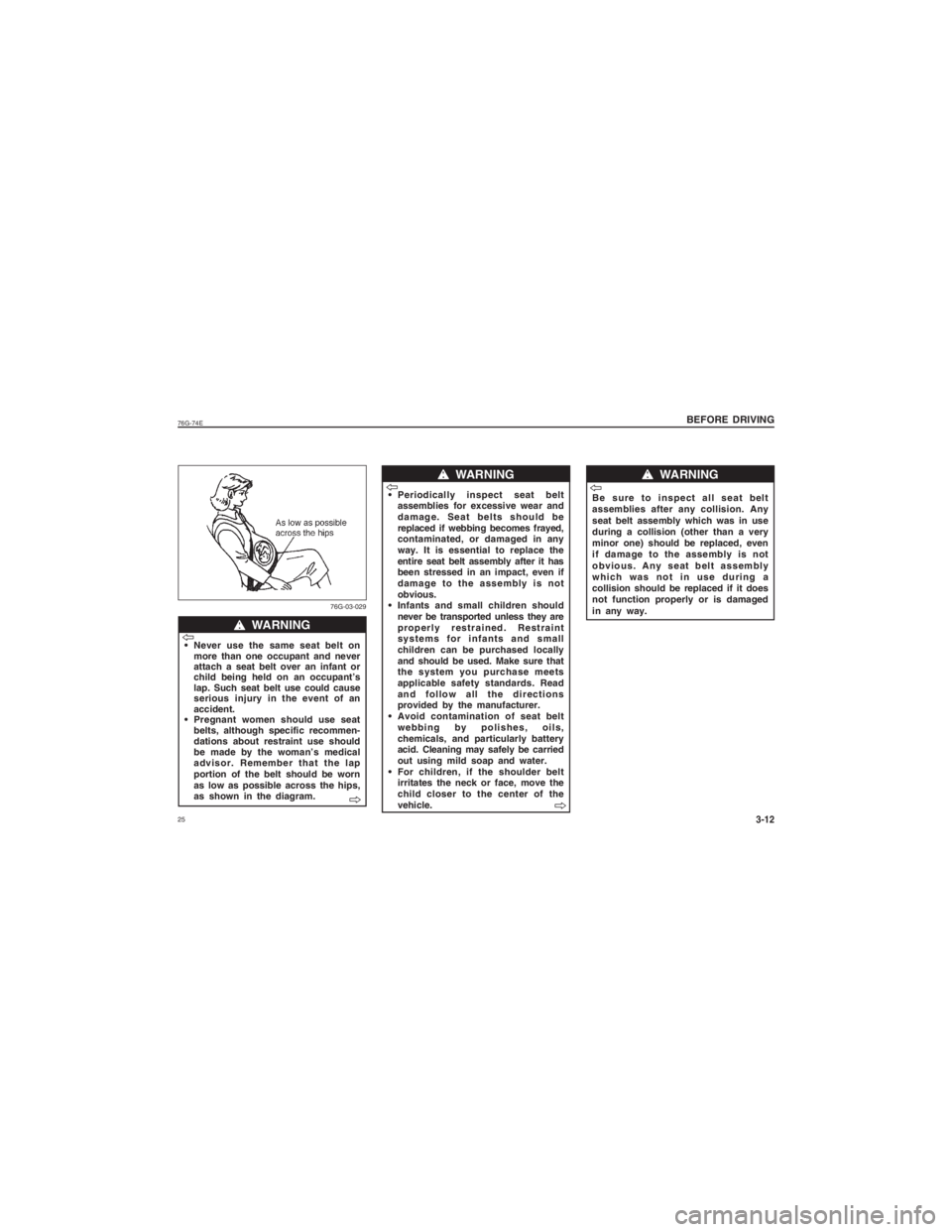
Pregnant women should use seat belts, although specific recommen-
dations about restraint use should
be made by the woman’s medical
advisor. Remember that the lap
portion of the belt should be worn
as low as possible across the hips,
as shown in the diagram.
ww ww
w WARNING
VV
VV
V
VV
VV
V
76G-03-029
Periodically inspect seat belt
assemblies for excessive wear and
damage. Seat belts should be
replaced if webbing becomes frayed,
contaminated, or damaged in any
way. It is essential to replace the
entire seat belt assembly after it has
been stressed in an impact, even if
damage to the assembly is not
obvious.
Infants and small children should never be transported unless they are
properly restrained. Restraint
systems for infants and small
children can be purchased locally
and should be used. Make sure that
the system you purchase meets
applicable safety standards. Read
and follow all the directions
provided by the manufacturer.
Avoid contamination of seat belt webbing by polishes, oils,
chemicals, and particularly battery
acid. Cleaning may safely be carried
out using mild soap and water.
For children, if the shoulder belt irritates the neck or face, move the
child closer to the center of the
vehicle.
ww ww
w WARNING
VV
VV
V
VV
VV
V
Be sure to inspect all seat belt
assemblies after any collision. Any
seat belt assembly which was in use
during a collision (other than a very
minor one) should be replaced, even
if damage to the assembly is not
obvious. Any seat belt assembly
which was not in use during a
collision should be replaced if it does
not function properly or is damaged
in any way.
ww ww
w WARNING
VV
VV
V
Page 69 of 139
70
76G-74E
EXHAUST GAS WARNING
with the engine running, make sure
the air intake lever is set to “FRESH
AIR” and the fan is at high speed.
Avoid operating the vehicle with the rearend door open. If it is necessary
to operate the vehicle with the
rearend door open, make sure all
the windows are closed and the fan
is at high speed with the air intake
lever set to "FRESH AIR".
To allow proper operation of your vehicle’s ventilation system, keep
the air inlet grille in front of the
windscreen clear of snow, leaves, or
other obstructions at all times.
Keep the exhaust tailpipe area clear of snow and other material to help
reduce the buildup of exhaust gases
under the vehicle. This is
particularly important when parked
in blizzard conditions.
Have the exhaust system inspected
periodically for damage and leaks.
Any damage or leaks should be
repaired immediately.
DAILY INSPECTION CHECKLIST
ww ww
w WARNING
7-1
ww
ww
w WARNING
Before driving:
1)
Make sure that windows, mirrors, lights,
and reflectors are clean and unobstructed.
2) Check the tyres.
3) Look for fluid and oil leaks.NOTE:
It is normal for water to drip from the air
conditioning system after use.4) Adjust the seat/head restraint.
5) Check the brake pedal and the parking brake lever.
6) Adjust the mirrors.
7) Make sure that you and passengers have properly fastened your seat belts.
8) Make sure that all warning lights come on as the key is turned to the “ON” or
“START” position.
9) Check all gauges.
10) Make sure that the brake fluid level warning light is off when the parking
brake is released with the engine
running.
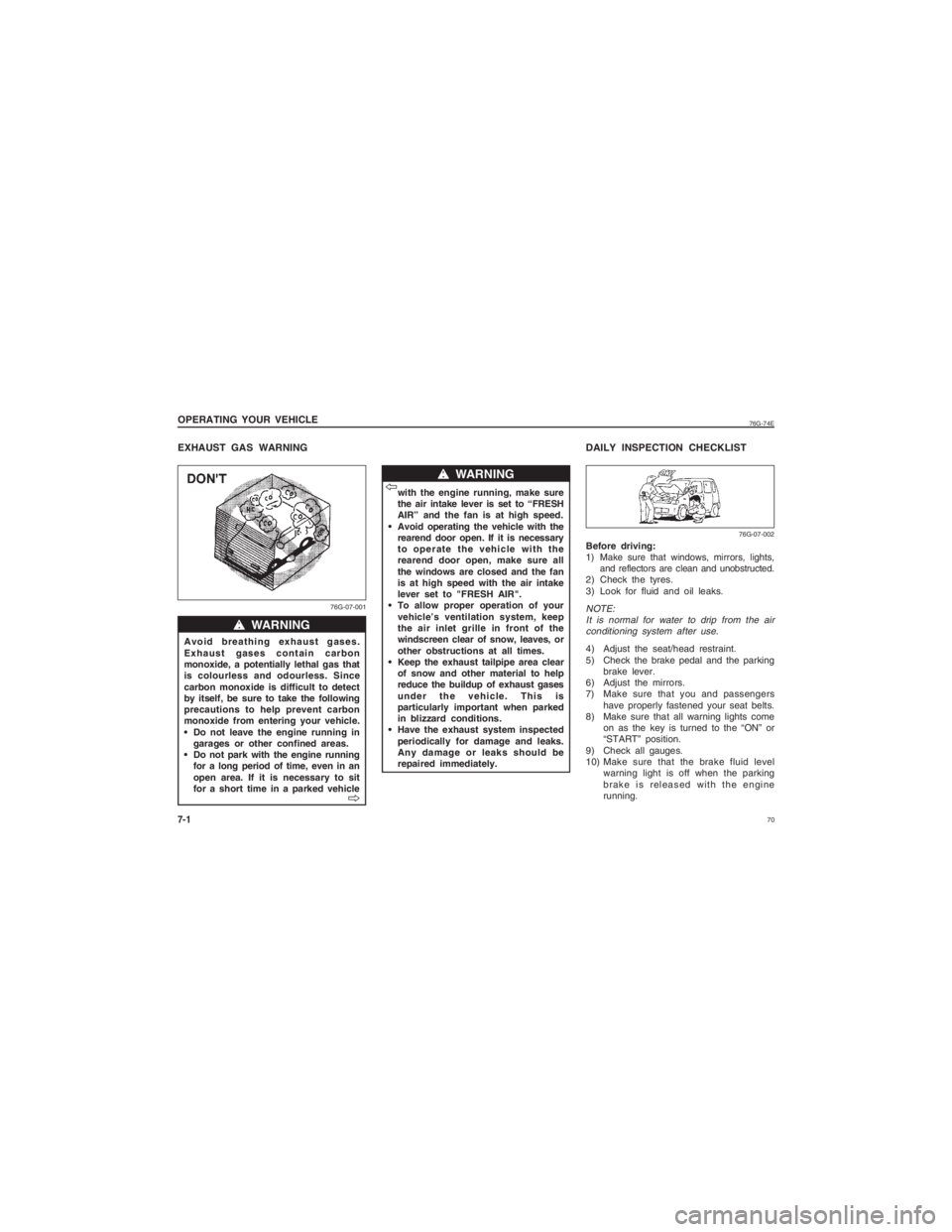
OPERATING YOUR VEHICLEAvoid breathing exhaust gases.
Exhaust gases contain carbon
monoxide, a potentially lethal gas that
is colourless and odourless. Since
carbon monoxide is difficult to detect
by itself, be sure to take the following
precautions to help prevent carbon
monoxide from entering your vehicle.
Do not leave the engine running ingarages or other confined areas.
Do not park with the engine running for a long period of time, even in an
open area. If it is necessary to sit
for a short time in a parked vehicle
VV VV
V
VV
VV
V
76G-07-001 76G-07-002
Page 73 of 139
74
76G-74E
7-5OPERATING YOUR VEHICLERUNNING-IN
The future performance and reliability
of the engine depends on the care
and restraint exercised during its early
life. It is especially important to
observe the following precautions
during the initial 1000 km of vehicle
operation.
After starting, do not race theengine. Warm it up gradually.
Avoid prolonged vehicle operation at a constant speed. Moving parts will
bed in better if you vary your speed.
Do not exceed 100 km/h.
Start off from a stop slowly. Avoid full throttle starts.
If possible, avoid hard braking, especially during the first 300 km
of driving.
Do not drive slowly with the transmission in a high gear.
Drive the vehicle at moderate engine speeds.
CAUTION
Even without reserve power in the
brake system, you can still stop the
vehicle by pressing the brake pedal
harder than normally required.
However, the stopping distance may
be longer.
On loose surface where the wheels
can easily loose traction (such as
gravel, etc.), the stopping distance
required for your vehicle may be
greater than for a comparable vehicle
with a conventional brake system.
Allow for extra stopping distance
when driving on loose surfaces.
ww ww
w WARNINGww
ww
w WARNING
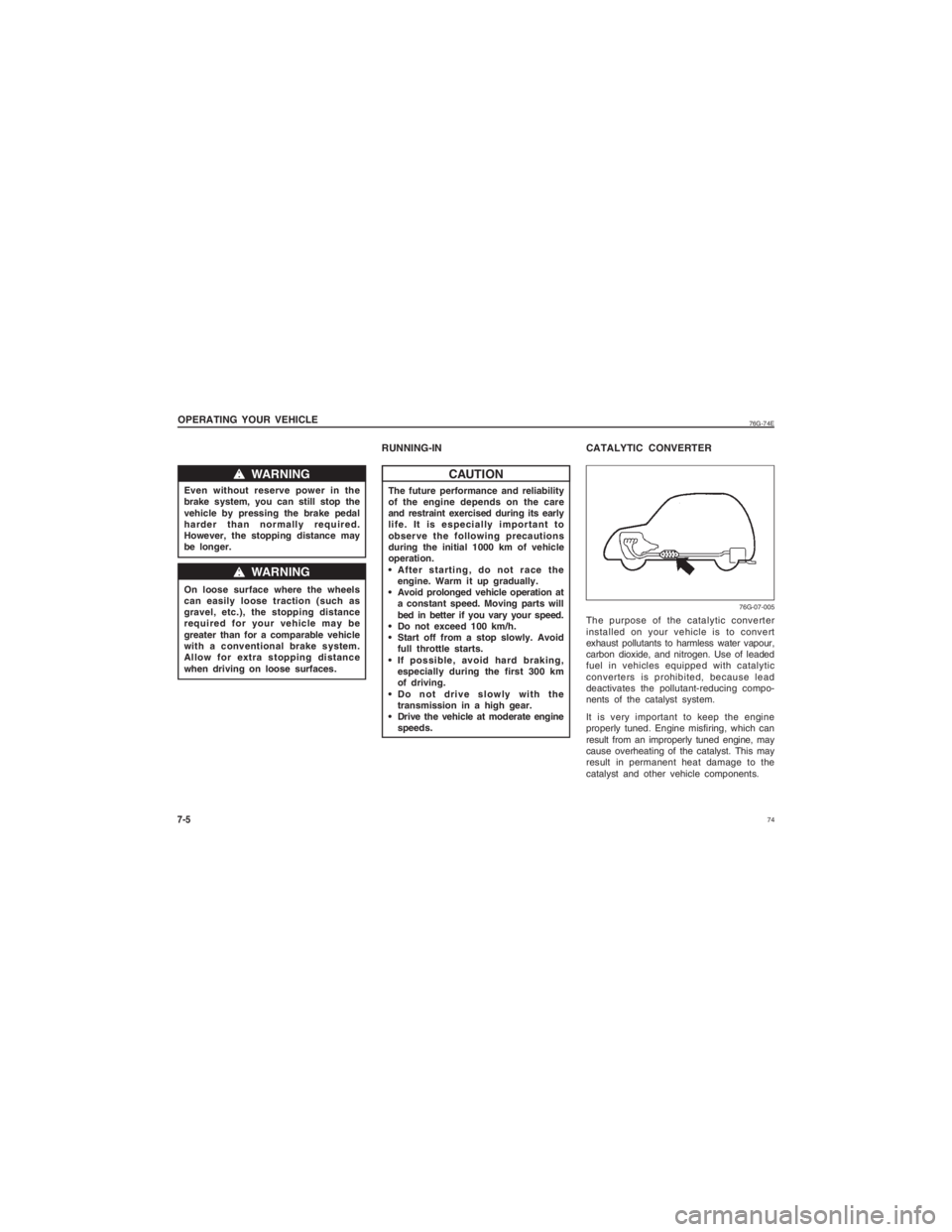
CATALYTIC CONVERTERThe purpose of the catalytic converter
installed on your vehicle is to convert
exhaust pollutants to harmless water vapour,
carbon dioxide, and nitrogen. Use of leaded
fuel in vehicles equipped with catalytic
converters is prohibited, because lead
deactivates the pollutant-reducing compo-
nents of the catalyst system.
It is very important to keep the engine
properly tuned. Engine misfiring, which can
result from an improperly tuned engine, may
cause overheating of the catalyst. This may
result in permanent heat damage to the
catalyst and other vehicle components.
76G-07-005