change SUZUKI ALTO 2020 User Guide
[x] Cancel search | Manufacturer: SUZUKI, Model Year: 2020, Model line: ALTO, Model: SUZUKI ALTO 2020Pages: 139, PDF Size: 2.22 MB
Page 66 of 139
6776G-74E
6-10
OTHER CONTROLS AND EQUIPMENT
High mount stop lamp is provided with your
vehicle and is fitted on back door. The stop
lamp will glow as when the brake pedal will
be depressed.
To change the bulb of the stop lamp,
remove the clips at both sides of the cover,
by pressing the inner pin inside so that the
clip gets loose and remove the bulb on
turning it anticlockwise.
There is one bulb in high mount stop lamp.
Page 71 of 139
72
76G-74E
7-3OPERATING YOUR VEHICLE
ww ww
w WARNINGCAUTION
Starting off
To start off, depress and maintain pressure
upon the clutch pedal and change into 1st
gear. After releasing the parking brake, GEAR MAXIMUM SPEED
First 37 km/h
Second 66 km/h
Third 98 km/h
Fourth Top Speed
Fifth
Top SpeedUSING THE TRANSMISSIONMANUAL TRANSMISSION
76G-07-00376G-07-003A
To help avoid clutch damage, do not
use the clutch pedal as a footrest while
driving or use the clutch to keep the
vehicle stationary on a hill. Depress the
clutch fully when changing gear.
When changing gears or starting off,
do not race the engine. Racing the
engine can shorten engine life and
prevent smooth operation.
Reduce your speed and change down to
a lower gear before going down a long
or steep hill. A lower gear will allow the
engine to provide braking. Avoid riding
the brakes or they may overheat, result-
ing in brake failure.
When driving on slippery roads, be sure to slow down before changing down.
Excessive and or sudden changes in
engine speed may cause loss of traction,
which could cause you to lose control.
Make sure that the vehicle is completely
stationary before you change into re-
verse.
gradually release the clutch. When you hear
a change in the engine’s sound (speed),
gently apply pressure to the accelerator to
keep the engine sound (speed) constant whilst
continuing to gradually release the clutch.
Gear changing
All forward gears are synchronized, which
provides for quiet, easy changing. Always
depress the clutch pedal fully before changing
gears. The following table shows the
maximum allowable speed for each gear.
ALTO
ALTO K10
GEAR MAXIMUM SPEED
First 43 km/h
Second 80 km/h
Third 119 km/h
Fourth Top Speed
Fifth Top Speed
ALTO
ALTO K10
Page 77 of 139
78
76G-74E
Wear Your Seat Belts at All Times.The driver and passengers should
be properly restrained at all times,
using the seatbelts provided. Refer
to the “SEATBELTS” section for
instructions on proper use of the
seat belts.
Never drive while under the
influence of alcohol or other drugs.
Alcohol and drugs can seriously
impair your ability to drive safely,
greatly increasing the risk of injury
to yourself and others. You should
also avoid driving when you are
tired, sick, irritated, or under stress.
HIGH-SPEED DRIVING
When driving down a hill, the engine should be used for braking by shifting to
next lower gear.
Try not to hold the brake pedal down
too long or too often while going
down a steep or long hill. This could
cause the brakes to overheat,
resulting in reduced braking efficiency.
Failure to take this precaution could
result in loss of vehicle control.
When descending a down hill, NEVER
turn the ignition key to the “OFF”
position. Emission control system
damage may result.DRIVING ON SLIPPERY ROADSUnder wet road conditions you should drive
at a lower speed than on dry roads due to
possible slippage of tyres during braking.
When driving on icy, snowcovered, or
muddy roads, reduce your speed and avoid
sudden acceleration, abrupt braking, or
sharp steering movements.
When driving at a high-speed, pay attention
to the following:
Stopping distance progressively increases
with vehicle speed. Apply the brakes far
enough ahead of the stopping point to
allow for the extra stopping distance.
On rainy days, “Aquaplaning” can occur. “Aquaplaning” is the loss of direct
contact between the road surface and
the vehicle’s tyres due to a water film
forming between them. Steering or
braking the vehicle while “Aquaplaning”
can be very difficult, and loss of control
can occur. Keep speed down when the
road surface is wet.
At high speeds, the vehicle may be affected by side winds. Therefore, reduce
speed and be prepared for unexpected
buffeting, which can occur at the exits
of tunnels, when passing by a cut of a
hill, or when being overtaken by large
vehicles, etc.
DRIVING ON HILLS When climbing steep hills, the vehiclemay begin to slow down and show a
lack of power. If this happens, you
should change to a lower gear so that
the engine will again be operating in its
normal power range. Change rapidly to
prevent the vehicle from losing
momentum.
ww ww
w WARNING
ww
ww
w WARNINGCAUTION
8-1DRIVING TIPS AND SAFE DRIVING
76G-08-001
Page 78 of 139
7976G-74ESnow Chains
If you must use snow chains to increase tyre
traction, observe the following precautions:
Use cable type chains.
Choose a safe place away from traffic to install the chains.
When installing the chains carefully follow the manufacturer’s instructions.
Install the chains on the front tyres.
With the chains on, drive only at slow and moderate speeds.
If the chain hits the vehicle body while
driving, stop at a safe place and
retighten it as soon as possible.
If snow and/or ice on the road disappear, remove the chains as soon
as possible.
If Your Vehicle Gets Stuck If your vehicle gets stuck in snow, mud,
or sand, follow the directions below:
1) Change back and forth between a forward range (or first gear for manual
transmission) and reverse. This will
create a rocking motion which may give
you enough momentum to free the
vehicle. Press gently on the accelerator
to keep wheel spin to a minimum.
Remove your foot from the accelerator
while changing gear.
Do not race the engine. Excessive wheel
spin will cause the tyres to dig deeper,
making it more difficult to free the
vehicle. 2) If your vehicle remains stuck after a few
minutes of rocking, get another vehicle
to pull you out.
Do not allow anyone to stand near the
vehicle when you are rocking it, and
do not spin the wheels faster than an
indicated 40 km/h on the speedometer.
Personal injury and/or vehicle damage
may result from spinning the wheels
too fast.
Do not continue rocking the vehicle
for more than a few minutes.
Prolonged rocking can cause engine
overheating or transmission damage. Make sure your tyres are in good
condition and always maintain the
specified tyre pressure. Refer to
“TYRES” in the “INSPECTION AND
MAINTENANCE” section for details.
Do not use tyres other than those specified by MARUTI SUZUKI. Never
use different sizes or types of tyres
on the front and rear wheels. For
information regarding the specified
tyres, refer to the “SPECI-
FICATIONS” section.
Never use oversized tyres or special
shock absorbers and springs to
raise (jack up) your vehicle. This will
change the handling characteristics.
After driving through water, test the
brakes while driving at a slow speed
to see if they have maintained their
normal effectiveness. If the brakes
are less effective than normal, dry
them by repeatedly applying the
brakes while driving slowly until the
brakes have regained their normal
effectiveness.
ww ww
w WARNINGCAUTION
8-2
ww
ww
w WARNING
DRIVING TIPS AND SAFE DRIVING
DRIVING ON WET ROADS
When driving on wet roads, avoid driving through large amount of
standing water on the road. Large
amount of water entering the engine
compartment may cause damage to
the engine and or electrical
components.
If stuck in deep water, do not start till water level drops.
Water is incompressible substance, water inside engine is harmful to the
engine.
CAUTION
Page 84 of 139
8576G-74E
INSPECTION AND MAINTENANCE
9-2
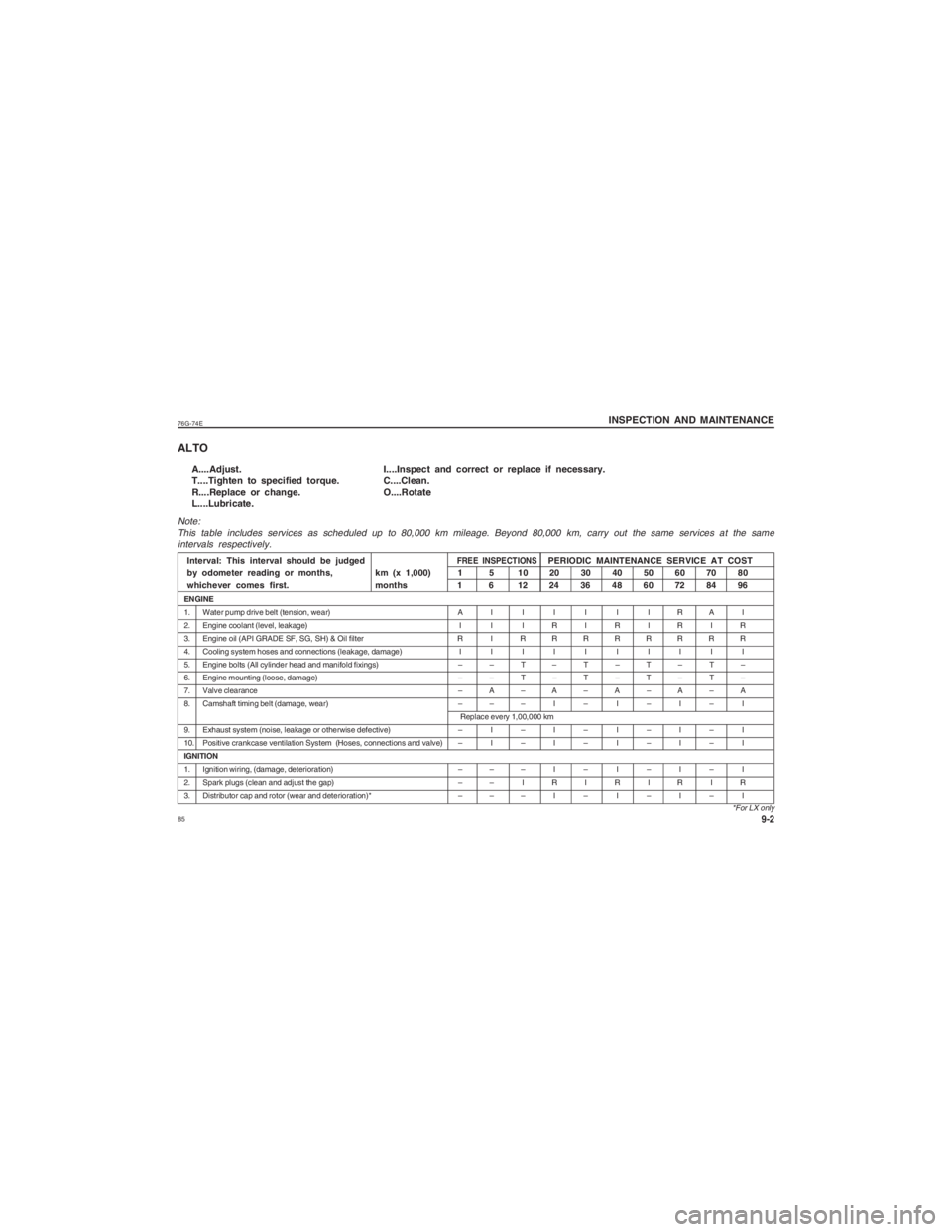
A....Adjust. I....Inspect and correct or replace if necessary.
T....Tighten to specified torque. C....Clean.
R....Replace or change. O....Rotate
L....Lubricate.
Note:
This table includes services as scheduled up to 80,000 km mileage. Beyon\
d 80,000 km, carry out the same services at the sameintervals respectively.Interval: This interval should be judged
FREE INSPECTIONS
PERIODIC MAINTENANCE SERVICE AT COST
by odometer reading or months, km (x 1,000) 1 5 10 20 30 40 50 60 70 80
whichever comes first. months 1 6 12 24 36 48 60 72 84 96
ENGINE
1. Water pump drive belt (tension, wear) A I I I I I I R A I
2. Engine coolant (level, leakage) I I I R I R I R I R
3. Engine oil (API GRADE SF, SG, SH) & Oil filter R I R R R R R R R R
4. Cooling system hoses and connections (leakage, damage) I I I I I I I I I I
5. Engine bolts (All cylinder head and manifold fixings) – – T – T – T – T –
6. Engine mounting (loose, damage) – – T – T – T – T –
7. Valve clearance – A – A – A – A – A
8. Camshaft timing belt (damage, wear) – – – I – I – I – I
Replace every 1,00,000 km
9. Exhaust system (noise, leakage or otherwise defective) – I – I – I – I – I
10. Positive crankcase ventilation System (Hoses, connections and valve) – I – I – I – I – I
IGNITION
1. Ignition wiring, (damage, deterioration) – – – I – I – I – I
2. Spark plugs (clean and adjust the gap) – – I R I R I R I R
3. Distributor cap and rotor (wear and deterioration)* – – – I – I – I – I
*For LX only
ALTO
Page 87 of 139
88
76G-74E
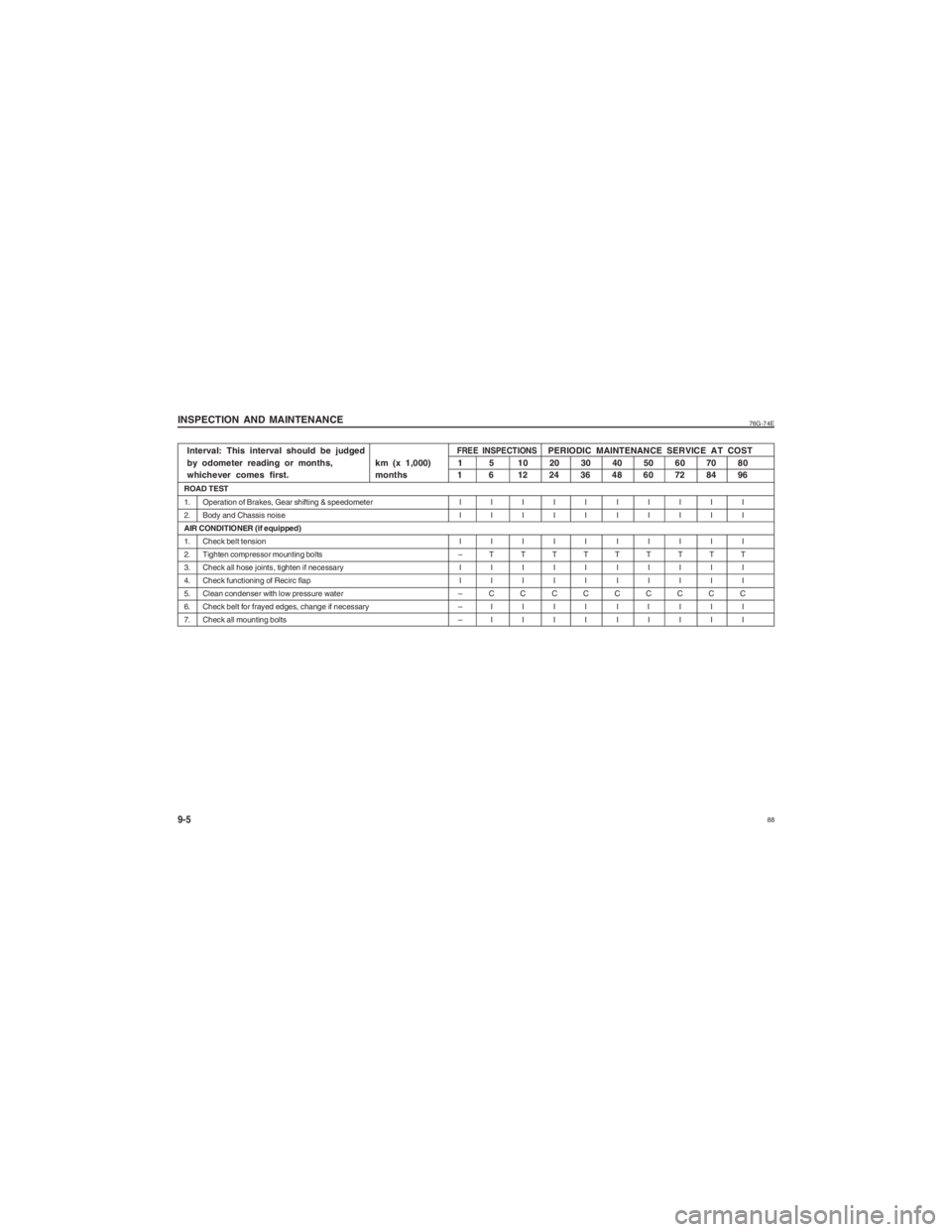
INSPECTION AND MAINTENANCE9-5Interval: This interval should be judged
FREE INSPECTIONS
PERIODIC MAINTENANCE SERVICE AT COST
by odometer reading or months, km (x 1,000) 1 5 10 20 30 40 50 60 70 80
whichever comes first. months 1 6 12 24 36 48 60 72 84 96
ROAD TEST
1. Operation of Brakes, Gear shifting & speedometer I I I I I I I I I I
2. Body and Chassis noise I I I I I I I I I I
AIR CONDITIONER (if equipped)
1. Check belt tension I I I I I I I I I I
2. Tighten compressor mounting bolts – T T T T T T T T T
3. Check all hose joints, tighten if necessary I I I I I I I I I I
4. Check functioning of Recirc flap I I I I I I I I I I
5. Clean condenser with low pressure water – C C C C C C C C C
6. Check belt for frayed edges, change if necessary – I I I I I I I I I
7. Check all mounting bolts – I I I I I I I I I
Page 88 of 139
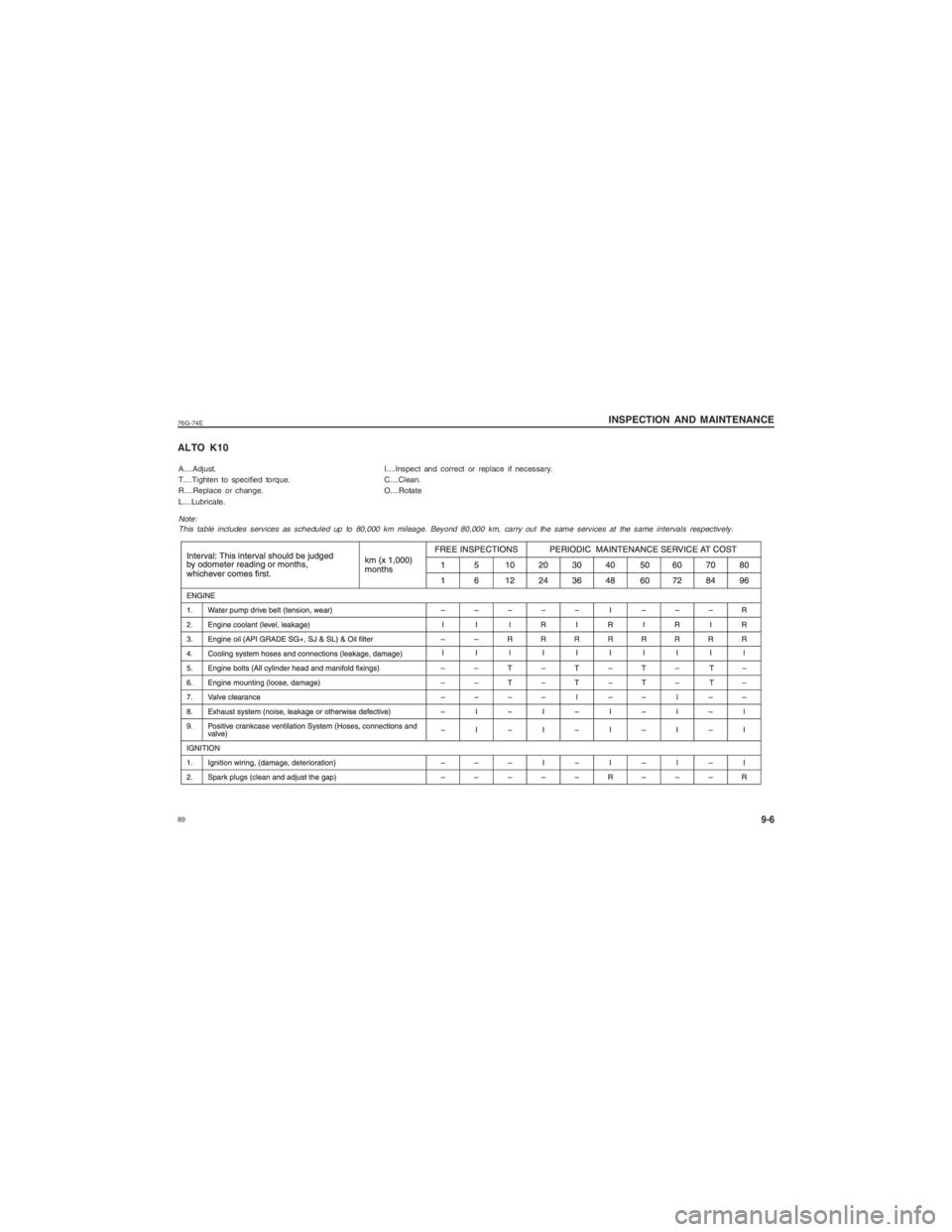
8976G-74EA....Adjust. I....Inspect and correct or replace if necessary.
T....Tighten to specified torque. C....Clean.
R....Replace or change. O....Rotate
L....Lubricate.Note: This table includes services as scheduled up to 80,000 km mileage. Beyon\
d 80,000 km, carry out the same services at the same in tervals respectively.
INSPECTION AND MAINTENANCE
9-6
ALTO K10
Page 96 of 139
9776G-74E
INSPECTION AND MAINTENANCE
9-14
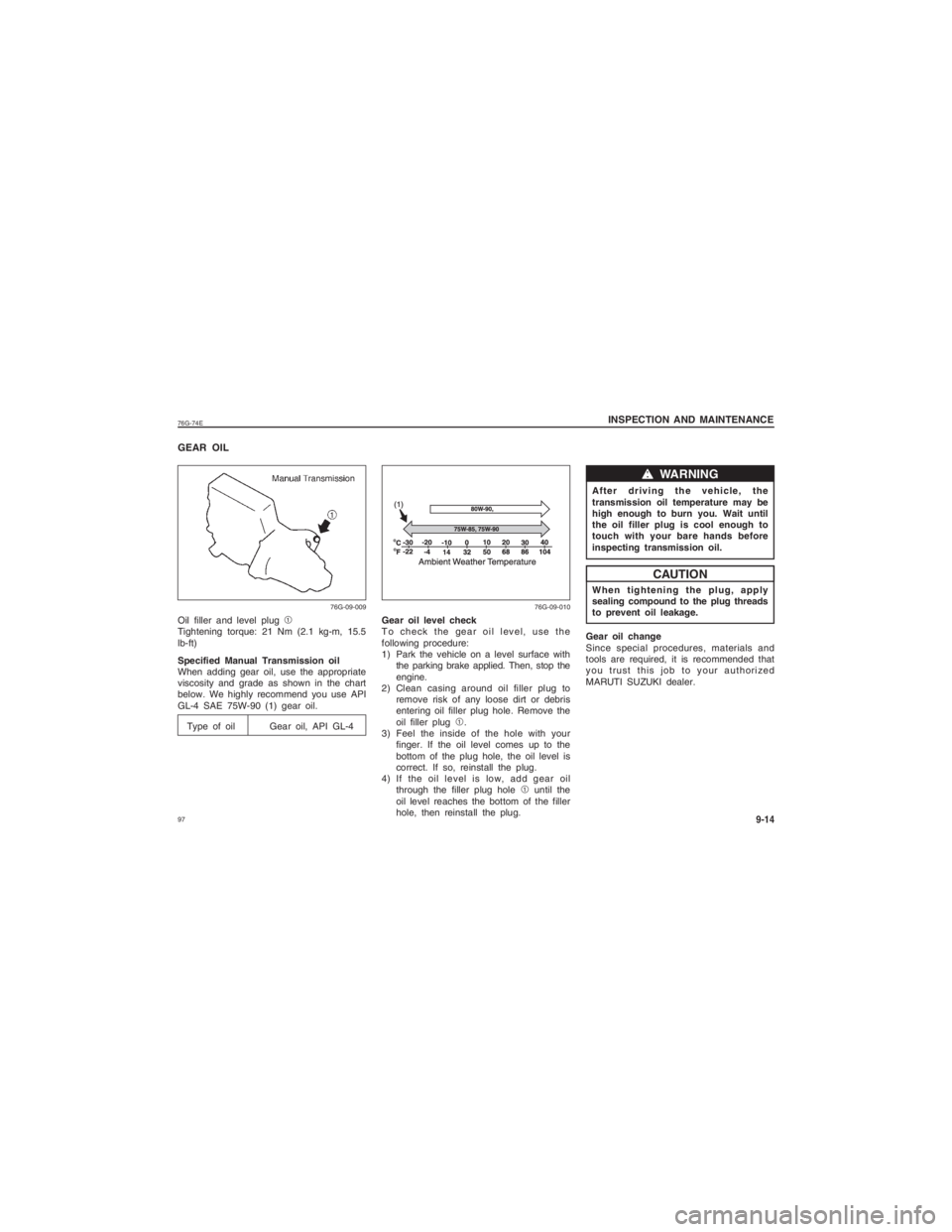
GEAR OILOil filler and level plug 1
Tightening torque: 21 Nm (2.1 kg-m, 15.5
lb-ft)
Specified Manual Transmission oil
When adding gear oil, use the appropriate
viscosity and grade as shown in the chart
below. We highly recommend you use API
GL-4 SAE 75W-90 (1) gear oil.
Type of oil Gear oil, API GL-4
Gear oil level check
To check the gear oil level, use the
following procedure:
1) Park the vehicle on a level surface with the parking brake applied. Then, stop the
engine.
2) Clean casing around oil filler plug to remove risk of any loose dirt or debris
entering oil filler plug hole. Remove the
oil filler plug 1.
3) Feel the inside of the hole with your finger. If the oil level comes up to the
bottom of the plug hole, the oil level is
correct. If so, reinstall the plug.
4) If the oil level is low, add gear oil
through the filler plug hole 1 until the
oil level reaches the bottom of the filler
hole, then reinstall the plug. After driving the vehicle, the
transmission oil temperature may be
high enough to burn you. Wait until
the oil filler plug is cool enough to
touch with your bare hands before
inspecting transmission oil.
When tightening the plug, apply
sealing compound to the plug threads
to prevent oil leakage.
Gear oil change
Since special procedures, materials and
tools are required, it is recommended that
you trust this job to your authorized
MARUTI SUZUKI dealer.
ww ww
w WARNINGCAUTION
76G-09-009 76G-09-010
Page 107 of 139
108
76G-74E
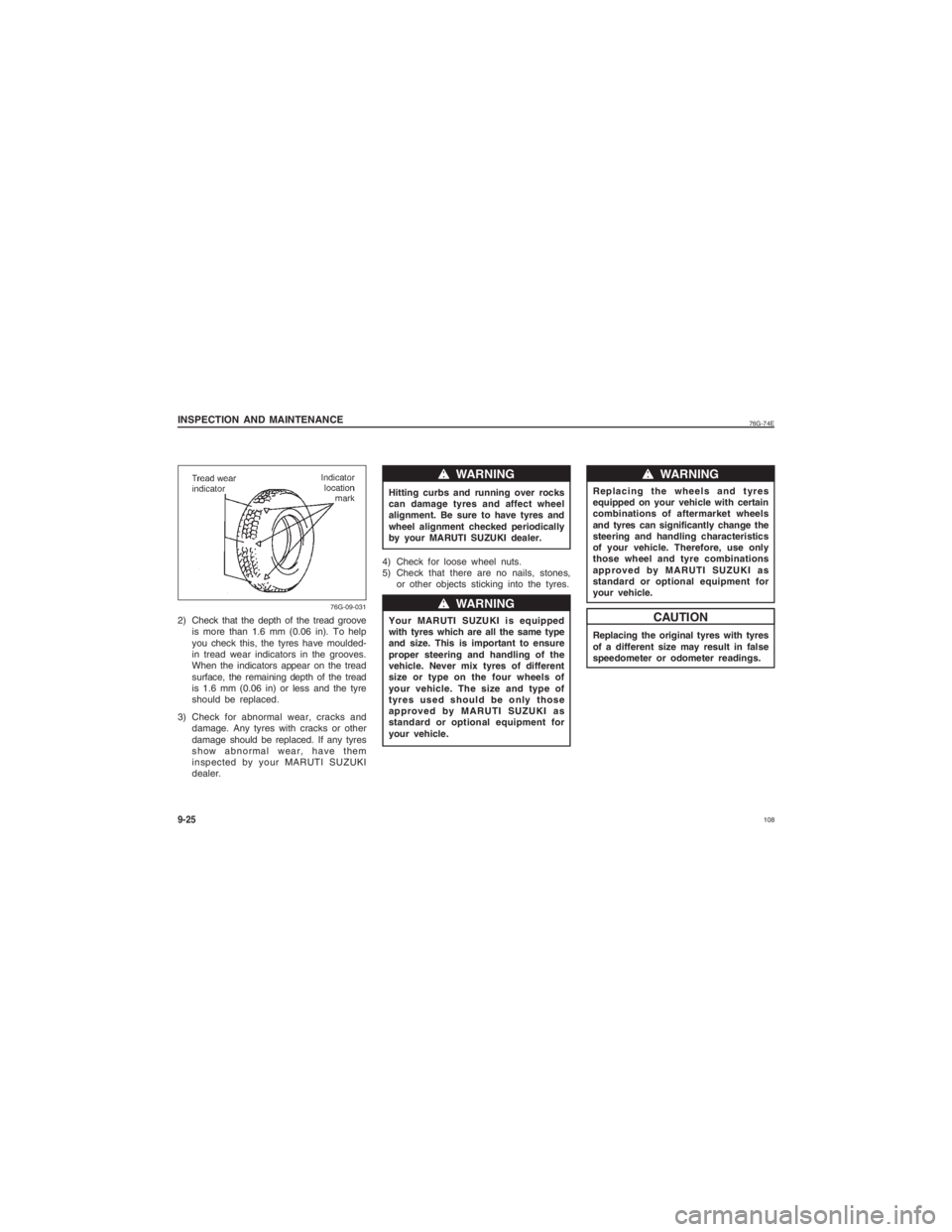
INSPECTION AND MAINTENANCE9-252) Check that the depth of the tread grooveis more than 1.6 mm (0.06 in). To help
you check this, the tyres have moulded-
in tread wear indicators in the grooves.
When the indicators appear on the tread
surface, the remaining depth of the tread
is 1.6 mm (0.06 in) or less and the tyre
should be replaced.
3) Check for abnormal wear, cracks and damage. Any tyres with cracks or other
damage should be replaced. If any tyres
show abnormal wear, have them
inspected by your MARUTI SUZUKI
dealer.
76G-09-031
Hitting curbs and running over rocks
can damage tyres and affect wheel
alignment. Be sure to have tyres and
wheel alignment checked periodically
by your MARUTI SUZUKI dealer.
4) Check for loose wheel nuts.
5) Check that there are no nails, stones, or other objects sticking into the tyres.
Your MARUTI SUZUKI is equipped
with tyres which are all the same type
and size. This is important to ensure
proper steering and handling of the
vehicle. Never mix tyres of different
size or type on the four wheels of
your vehicle. The size and type of
tyres used should be only those
approved by MARUTI SUZUKI as
standard or optional equipment for
your vehicle.
ww ww
w WARNINGww
ww
w WARNING
Replacing the wheels and tyres
equipped on your vehicle with certain
combinations of aftermarket wheels
and tyres can significantly change the
steering and handling characteristics
of your vehicle. Therefore, use only
those wheel and tyre combinations
approved by MARUTI SUZUKI as
standard or optional equipment for
your vehicle.
Replacing the original tyres with tyres
of a different size may result in false
speedometer or odometer readings.
ww ww
w WARNINGCAUTION
Page 108 of 139
10976G-74E
INSPECTION AND MAINTENANCE
9-26
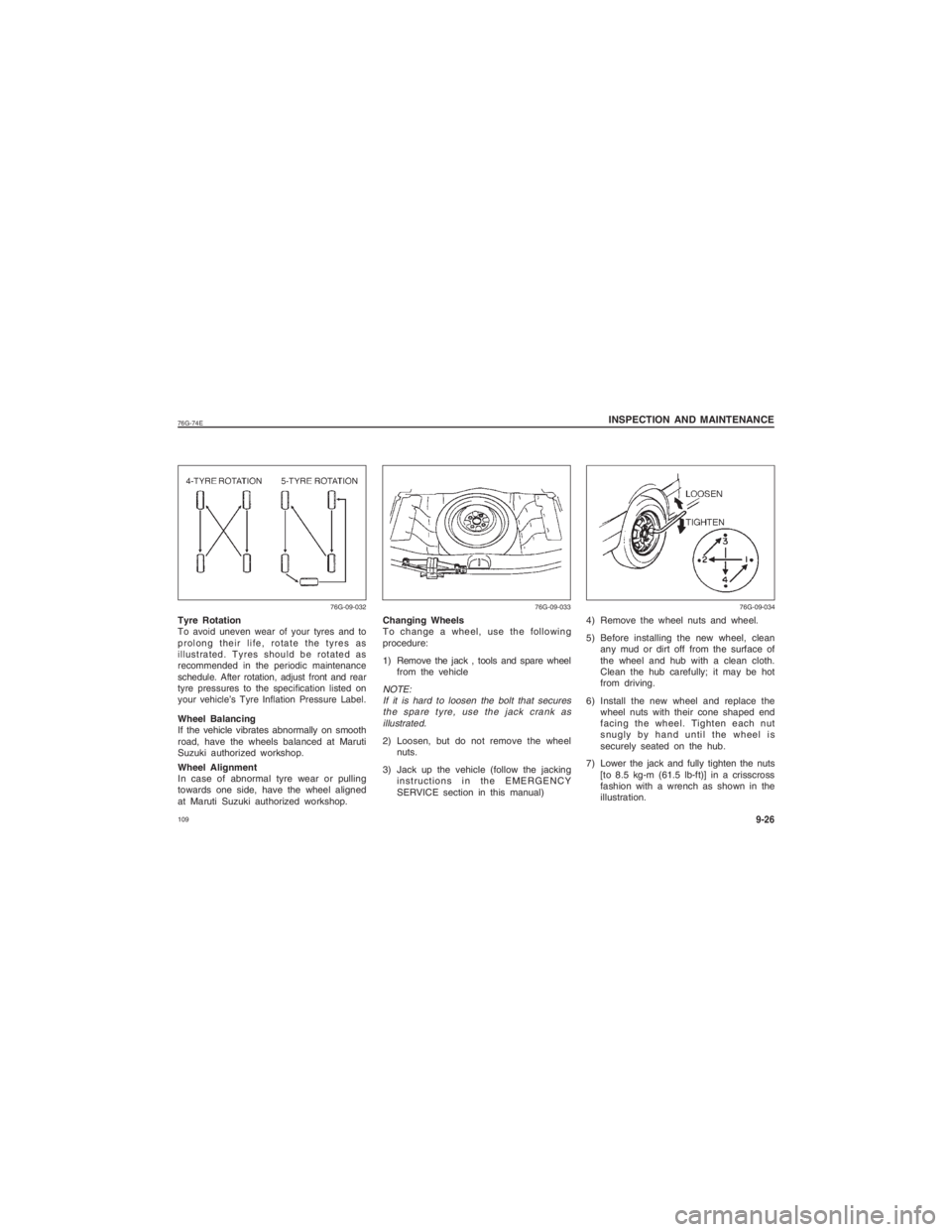
Tyre RotationTo avoid uneven wear of your tyres and to
prolong their life, rotate the tyres as
illustrated. Tyres should be rotated as
recommended in the periodic maintenance
schedule. After rotation, adjust front and rear
tyre pressures to the specification listed on
your vehicle’s Tyre Inflation Pressure Label.Wheel Balancing
If the vehicle vibrates abnormally on smooth
road, have the wheels balanced at Maruti
Suzuki authorized workshop.
Wheel Alignment
In case of abnormal tyre wear or pulling
towards one side, have the wheel aligned
at Maruti Suzuki authorized workshop.
76G-09-032
Changing Wheels
To change a wheel, use the following
procedure:
1) Remove the jack , tools and spare wheelfrom the vehicleNOTE:If it is hard to loosen the bolt that securesthe spare tyre, use the jack crank as
illustrated.2) Loosen, but do not remove the wheel nuts.
3) Jack up the vehicle (follow the jacking instructions in the EMERGENCY
SERVICE section in this manual)
76G-09-033
4) Remove the wheel nuts and wheel.
5) Before installing the new wheel, cleanany mud or dirt off from the surface of
the wheel and hub with a clean cloth.
Clean the hub carefully; it may be hot
from driving.
6) Install the new wheel and replace the wheel nuts with their cone shaped end
facing the wheel. Tighten each nut
snugly by hand until the wheel is
securely seated on the hub.
7) Lower the jack and fully tighten the nuts [to 8.5 kg-m (61.5 lb-ft)] in a crisscross
fashion with a wrench as shown in the
illustration.
76G-09-034