RON SUZUKI ALTO 2020 Owner's Manual
[x] Cancel search | Manufacturer: SUZUKI, Model Year: 2020, Model line: ALTO, Model: SUZUKI ALTO 2020Pages: 139, PDF Size: 2.22 MB
Page 63 of 139
64
76G-74E
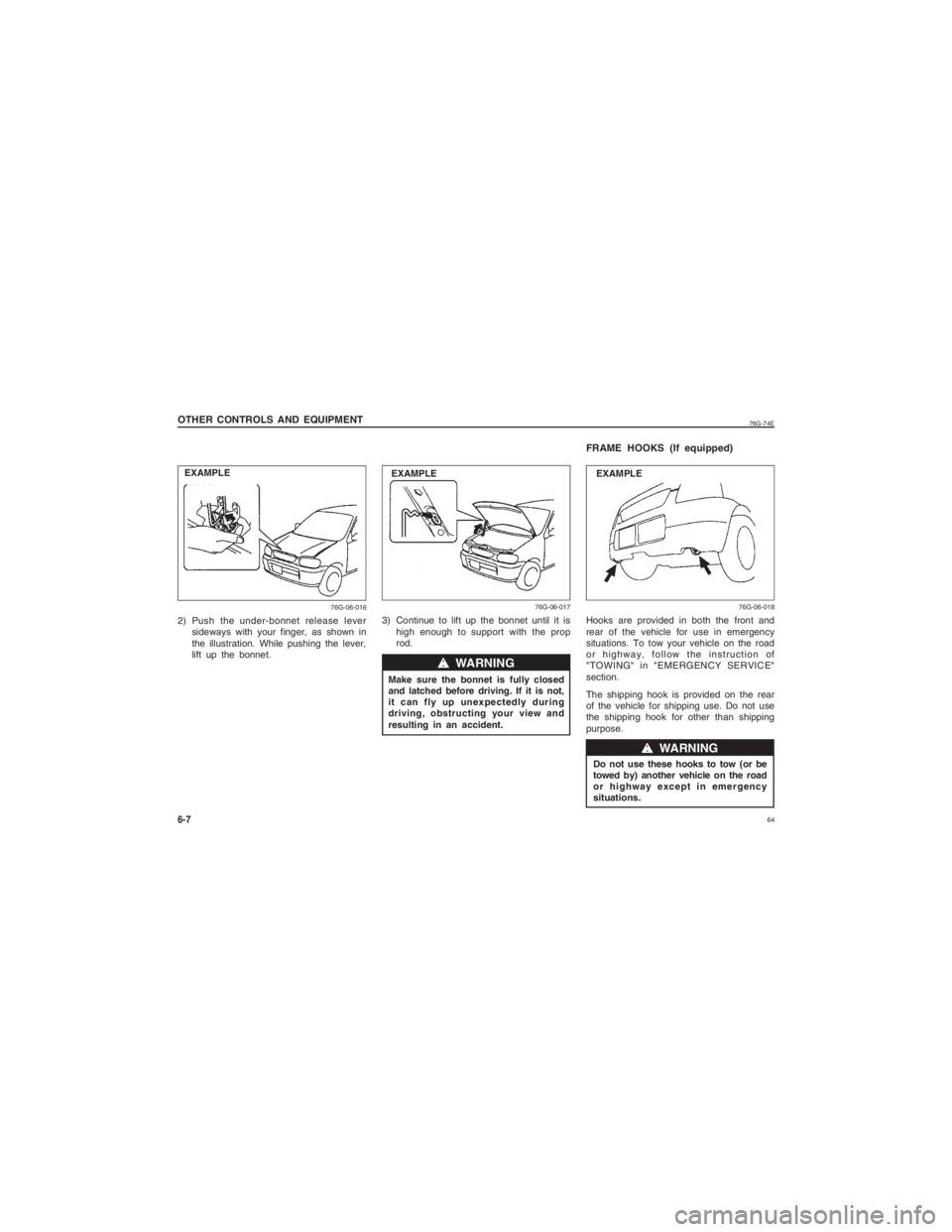
6-7OTHER CONTROLS AND EQUIPMENT2) Push the under-bonnet release leversideways with your finger, as shown in
the illustration. While pushing the lever,
lift up the bonnet.
76G-06-016
3) Continue to lift up the bonnet until it ishigh enough to support with the prop
rod.
Make sure the bonnet is fully closed
and latched before driving. If it is not,
it can fly up unexpectedly during
driving, obstructing your view and
resulting in an accident.
ww ww
w WARNING
FRAME HOOKS (If equipped)
ww
ww
w WARNING
Hooks are provided in both the front and
rear of the vehicle for use in emergency
situations. To tow your vehicle on the road
or highway, follow the instruction of
"TOWING" in "EMERGENCY SERVICE"
section.
The shipping hook is provided on the rear
of the vehicle for shipping use. Do not use
the shipping hook for other than shipping
purpose.
76G-06-017 76G-06-018
EXAMPLE
EXAMPLE EXAMPLE
Do not use these hooks to tow (or be
towed by) another vehicle on the road
or highway except in emergency
situations.
Page 69 of 139
70
76G-74E
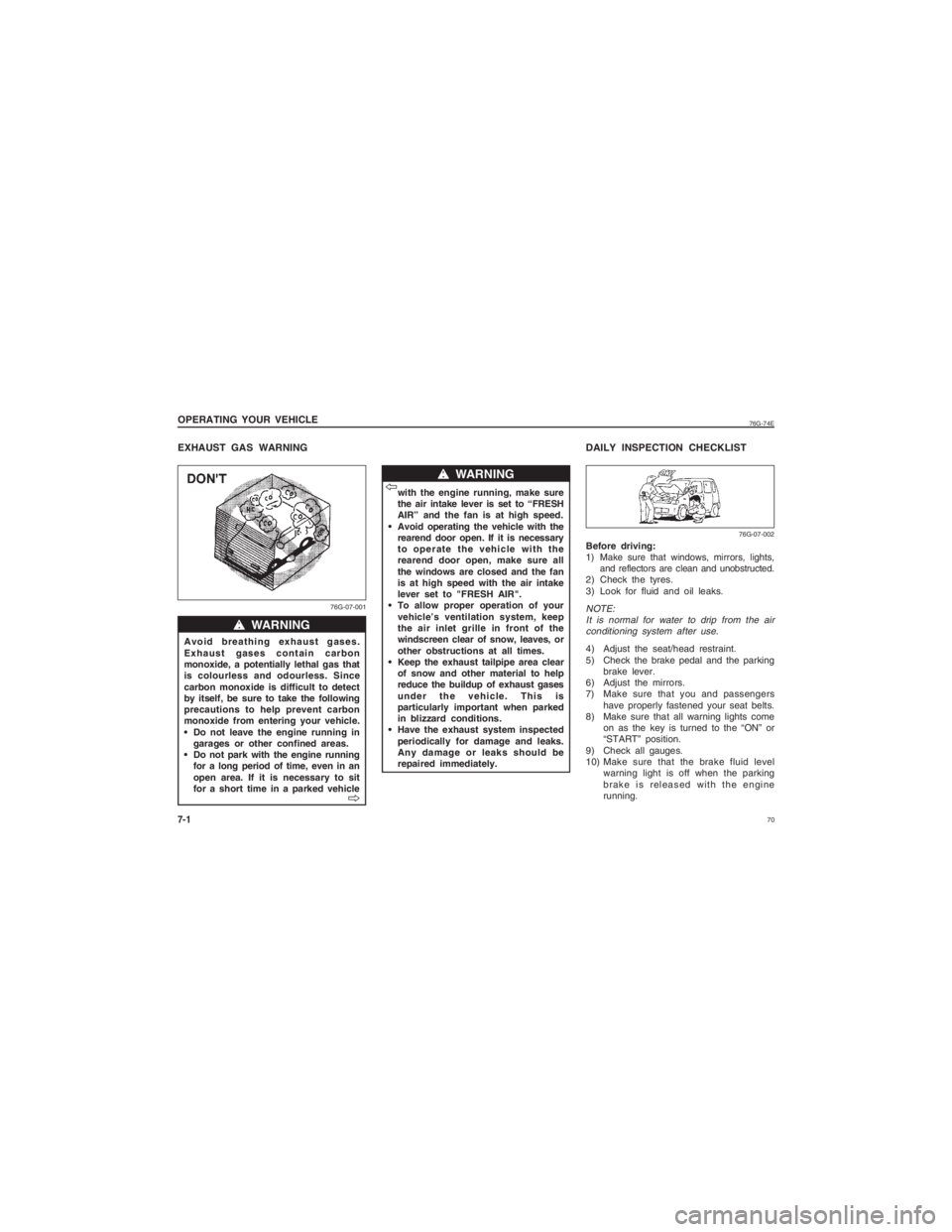
EXHAUST GAS WARNING
with the engine running, make sure
the air intake lever is set to “FRESH
AIR” and the fan is at high speed.
Avoid operating the vehicle with the rearend door open. If it is necessary
to operate the vehicle with the
rearend door open, make sure all
the windows are closed and the fan
is at high speed with the air intake
lever set to "FRESH AIR".
To allow proper operation of your vehicle’s ventilation system, keep
the air inlet grille in front of the
windscreen clear of snow, leaves, or
other obstructions at all times.
Keep the exhaust tailpipe area clear of snow and other material to help
reduce the buildup of exhaust gases
under the vehicle. This is
particularly important when parked
in blizzard conditions.
Have the exhaust system inspected
periodically for damage and leaks.
Any damage or leaks should be
repaired immediately.
DAILY INSPECTION CHECKLIST
ww ww
w WARNING
7-1
ww
ww
w WARNING
Before driving:
1)
Make sure that windows, mirrors, lights,
and reflectors are clean and unobstructed.
2) Check the tyres.
3) Look for fluid and oil leaks.NOTE:
It is normal for water to drip from the air
conditioning system after use.4) Adjust the seat/head restraint.
5) Check the brake pedal and the parking brake lever.
6) Adjust the mirrors.
7) Make sure that you and passengers have properly fastened your seat belts.
8) Make sure that all warning lights come on as the key is turned to the “ON” or
“START” position.
9) Check all gauges.
10) Make sure that the brake fluid level warning light is off when the parking
brake is released with the engine
running.
OPERATING YOUR VEHICLEAvoid breathing exhaust gases.
Exhaust gases contain carbon
monoxide, a potentially lethal gas that
is colourless and odourless. Since
carbon monoxide is difficult to detect
by itself, be sure to take the following
precautions to help prevent carbon
monoxide from entering your vehicle.
Do not leave the engine running ingarages or other confined areas.
Do not park with the engine running for a long period of time, even in an
open area. If it is necessary to sit
for a short time in a parked vehicle
VV VV
V
VV
VV
V
76G-07-001 76G-07-002
Page 70 of 139
7176G-74E
Before starting the engine:
1) Make sure the parking brake is appliedfully.
2) Manual Transmission - Shift into “N” (neutral) and depress the clutch pedal all
the way to the floor. Hold it while starting
the engine.
Make sure that the parking brake is
applied fully and the transmission is
in Neutral before attempting to start
the engine.
Stop turning the starter immediately after the engine has started or the
starter system can be damaged.
Do not crank the engine for more than 15 seconds at a time. If the
engine doesn’t start on the first try,
wait about 15 seconds before trying
again.
7-2
STARTING THE ENGINE
ww ww
w WARNING
OPERATING YOUR VEHICLE
Once a week, or each time you fill your fuel
tank, perform the following under-bonnet
checks:
1) Engine oil level.
2) Coolant level.
3) Brake fluid level.
4) Windscreen washer fluid level.
5) Battery solution level.
6) Bonnet latch operation.
Pull the bonnet release handle inside the
vehicle. Make sure that you can not
open the hood all the way without
releasing the secondary latch. Be sure
to close the hood securely after checking
for proper operation. See "All Latches,
Hinges & Locks" of "PERIODIC
MAINTENANCE SCHEDULE" in the
"INSPECTION AND MAINTENANCE"
section for lubrication schedule.
Make sure the bonnet is fully closed
and latched before driving. If it is not,
it can fly up unexpectedly during
driving, obstructing your view and
resulting in an accident.
ww ww
w WARNING
Starting a Cold Engine
Engine which is started after 6 hours should
be treated as cold engine.
For Electronic fuel injection models
With your foot off the accelerator pedal,
crank the engine by turning the ignition
key to “START”. Release the key when
the engine starts.
If the engine does not start after 15 seconds of cranking, wait about 15
seconds, then press down the
accelerator pedal to 1/3 of its travel and
try cranking the engine again. Release
the key and accelerator pedal when the
engine starts.
If the engine still does not start, try holding the accelerator pedal all the way
to the floor while cranking. This should
clear the engine if it is flooded.
Starting a Warm Engine
For Electronic fuel injection models:
Use the same procedure as for “Starting a
Cold Engine”.
CAUTION
Page 71 of 139
72
76G-74E
7-3OPERATING YOUR VEHICLE
ww ww
w WARNINGCAUTION
Starting off
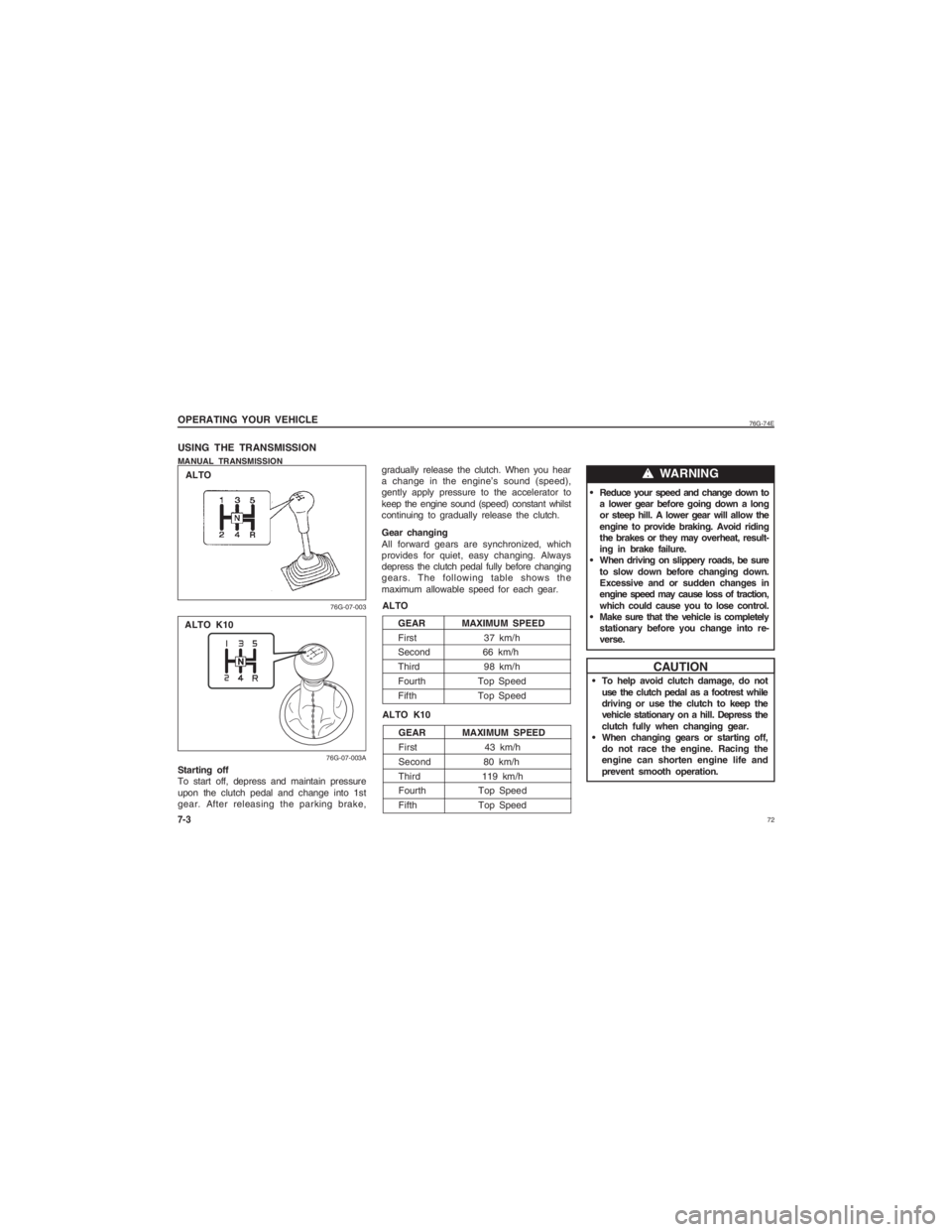
To start off, depress and maintain pressure
upon the clutch pedal and change into 1st
gear. After releasing the parking brake, GEAR MAXIMUM SPEED
First 37 km/h
Second 66 km/h
Third 98 km/h
Fourth Top Speed
Fifth
Top SpeedUSING THE TRANSMISSIONMANUAL TRANSMISSION
76G-07-00376G-07-003A
To help avoid clutch damage, do not
use the clutch pedal as a footrest while
driving or use the clutch to keep the
vehicle stationary on a hill. Depress the
clutch fully when changing gear.
When changing gears or starting off,
do not race the engine. Racing the
engine can shorten engine life and
prevent smooth operation.
Reduce your speed and change down to
a lower gear before going down a long
or steep hill. A lower gear will allow the
engine to provide braking. Avoid riding
the brakes or they may overheat, result-
ing in brake failure.
When driving on slippery roads, be sure to slow down before changing down.
Excessive and or sudden changes in
engine speed may cause loss of traction,
which could cause you to lose control.
Make sure that the vehicle is completely
stationary before you change into re-
verse.
gradually release the clutch. When you hear
a change in the engine’s sound (speed),
gently apply pressure to the accelerator to
keep the engine sound (speed) constant whilst
continuing to gradually release the clutch.
Gear changing
All forward gears are synchronized, which
provides for quiet, easy changing. Always
depress the clutch pedal fully before changing
gears. The following table shows the
maximum allowable speed for each gear.
ALTO
ALTO K10
GEAR MAXIMUM SPEED
First 43 km/h
Second 80 km/h
Third 119 km/h
Fourth Top Speed
Fifth Top Speed
ALTO
ALTO K10
Page 72 of 139
7376G-74E
7-4
OPERATING YOUR VEHICLE
BRAKINGww ww
w WARNING
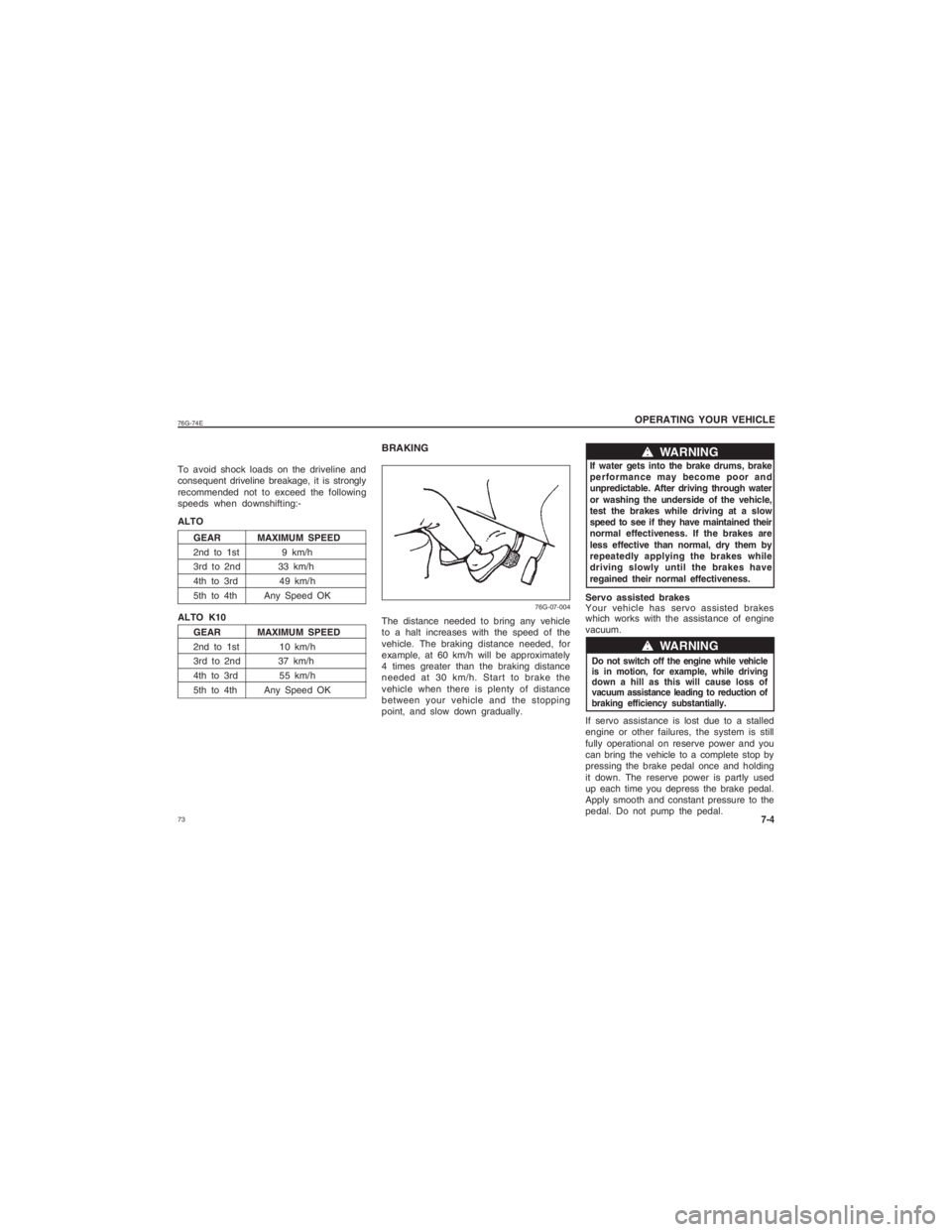
The distance needed to bring any vehicle
to a halt increases with the speed of the
vehicle. The braking distance needed, for
example, at 60 km/h will be approximately
4 times greater than the braking distance
needed at 30 km/h. Start to brake the
vehicle when there is plenty of distance
between your vehicle and the stopping
point, and slow down gradually.
If water gets into the brake drums, brake
performance may become poor and
unpredictable. After driving through water
or washing the underside of the vehicle,
test the brakes while driving at a slow
speed to see if they have maintained their
normal effectiveness. If the brakes are
less effective than normal, dry them by
repeatedly applying the brakes while
driving slowly until the brakes have
regained their normal effectiveness.Servo assisted brakes
Your vehicle has servo assisted brakes
which works with the assistance of engine
vacuum.Do not switch off the engine while vehicle
is in motion, for example, while driving
down a hill as this will cause loss of
vacuum assistance leading to reduction of
braking efficiency substantially.If servo assistance is lost due to a stalled
engine or other failures, the system is still
fully operational on reserve power and you
can bring the vehicle to a complete stop by
pressing the brake pedal once and holding
it down. The reserve power is partly used
up each time you depress the brake pedal.
Apply smooth and constant pressure to the
pedal. Do not pump the pedal.
ww ww
w WARNING
76G-07-004
To avoid shock loads on the driveline and
consequent driveline breakage, it is strongly
recommended not to exceed the following
speeds when downshifting:-
GEAR MAXIMUM SPEED
2nd to 1st 9 km/h
3rd to 2nd 33 km/h
4th to 3rd 49 km/h
5th to 4th Any Speed OK
ALTO
ALTO K10
GEAR MAXIMUM SPEED
2nd to 1st 10 km/h
3rd to 2nd 37 km/h
4th to 3rd 55 km/h
5th to 4th Any Speed OK
Page 78 of 139
7976G-74ESnow Chains
If you must use snow chains to increase tyre
traction, observe the following precautions:
Use cable type chains.
Choose a safe place away from traffic to install the chains.
When installing the chains carefully follow the manufacturer’s instructions.
Install the chains on the front tyres.
With the chains on, drive only at slow and moderate speeds.
If the chain hits the vehicle body while
driving, stop at a safe place and
retighten it as soon as possible.
If snow and/or ice on the road disappear, remove the chains as soon
as possible.
If Your Vehicle Gets Stuck If your vehicle gets stuck in snow, mud,
or sand, follow the directions below:
1) Change back and forth between a forward range (or first gear for manual
transmission) and reverse. This will
create a rocking motion which may give
you enough momentum to free the
vehicle. Press gently on the accelerator
to keep wheel spin to a minimum.
Remove your foot from the accelerator
while changing gear.
Do not race the engine. Excessive wheel
spin will cause the tyres to dig deeper,
making it more difficult to free the
vehicle. 2) If your vehicle remains stuck after a few
minutes of rocking, get another vehicle
to pull you out.
Do not allow anyone to stand near the
vehicle when you are rocking it, and
do not spin the wheels faster than an
indicated 40 km/h on the speedometer.
Personal injury and/or vehicle damage
may result from spinning the wheels
too fast.
Do not continue rocking the vehicle
for more than a few minutes.
Prolonged rocking can cause engine
overheating or transmission damage. Make sure your tyres are in good
condition and always maintain the
specified tyre pressure. Refer to
“TYRES” in the “INSPECTION AND
MAINTENANCE” section for details.
Do not use tyres other than those specified by MARUTI SUZUKI. Never
use different sizes or types of tyres
on the front and rear wheels. For
information regarding the specified
tyres, refer to the “SPECI-
FICATIONS” section.
Never use oversized tyres or special
shock absorbers and springs to
raise (jack up) your vehicle. This will
change the handling characteristics.
After driving through water, test the
brakes while driving at a slow speed
to see if they have maintained their
normal effectiveness. If the brakes
are less effective than normal, dry
them by repeatedly applying the
brakes while driving slowly until the
brakes have regained their normal
effectiveness.
ww ww
w WARNINGCAUTION
8-2
ww
ww
w WARNING
DRIVING TIPS AND SAFE DRIVING
DRIVING ON WET ROADS
When driving on wet roads, avoid driving through large amount of
standing water on the road. Large
amount of water entering the engine
compartment may cause damage to
the engine and or electrical
components.
If stuck in deep water, do not start till water level drops.
Water is incompressible substance, water inside engine is harmful to the
engine.
CAUTION
Page 81 of 139
82
76G-74E
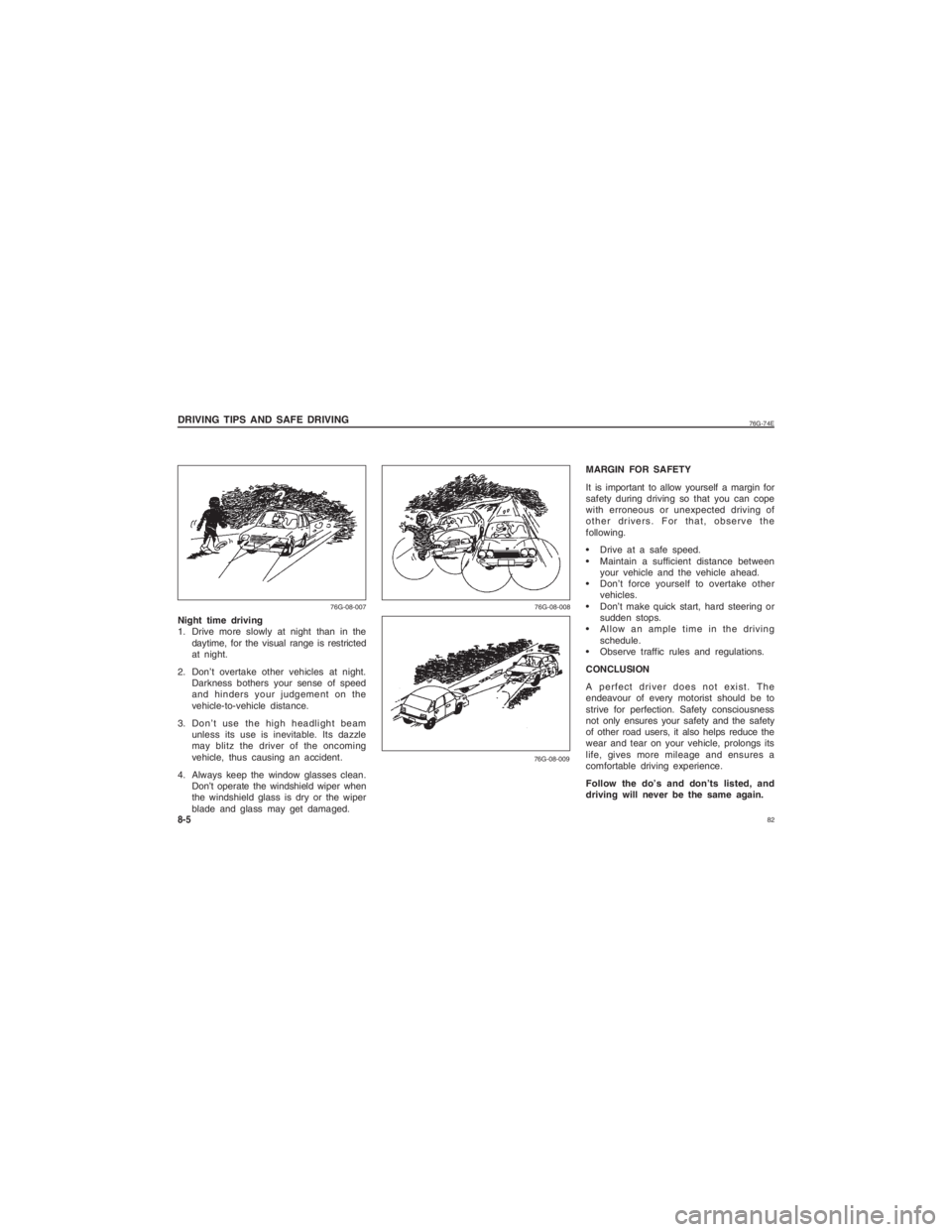
Night time driving
1. Drive more slowly at night than in thedaytime, for the visual range is restricted
at night.
2. Don’t overtake other vehicles at night. Darkness bothers your sense of speed
and hinders your judgement on the
vehicle-to-vehicle distance.
3. Don’t use the high headlight beam unless its use is inevitable. Its dazzle
may blitz the driver of the oncoming
vehicle, thus causing an accident.
4. Always keep the window glasses clean. Don’t operate the windshield wiper when
the windshield glass is dry or the wiper
blade and glass may get damaged.8-5DRIVING TIPS AND SAFE DRIVING
MARGIN FOR SAFETY
It is important to allow yourself a margin for
safety during driving so that you can cope
with erroneous or unexpected driving of
other drivers. For that, observe the
following.
Drive at a safe speed.
Maintain a sufficient distance between
your vehicle and the vehicle ahead.
Don’t force yourself to overtake other vehicles.
Don’t make quick start, hard steering or sudden stops.
Allow an ample time in the driving
schedule.
Observe traffic rules and regulations.
CONCLUSION
A perfect driver does not exist. The
endeavour of every motorist should be to
strive for perfection. Safety consciousness
not only ensures your safety and the safety
of other road users, it also helps reduce the
wear and tear on your vehicle, prolongs its
life, gives more mileage and ensures a
comfortable driving experience.
Follow the do’s and don’ts listed, and
driving will never be the same again.
76G-08-007 76G-08-008
76G-08-009
Page 86 of 139
8776G-74E
INSPECTION AND MAINTENANCE
9-4
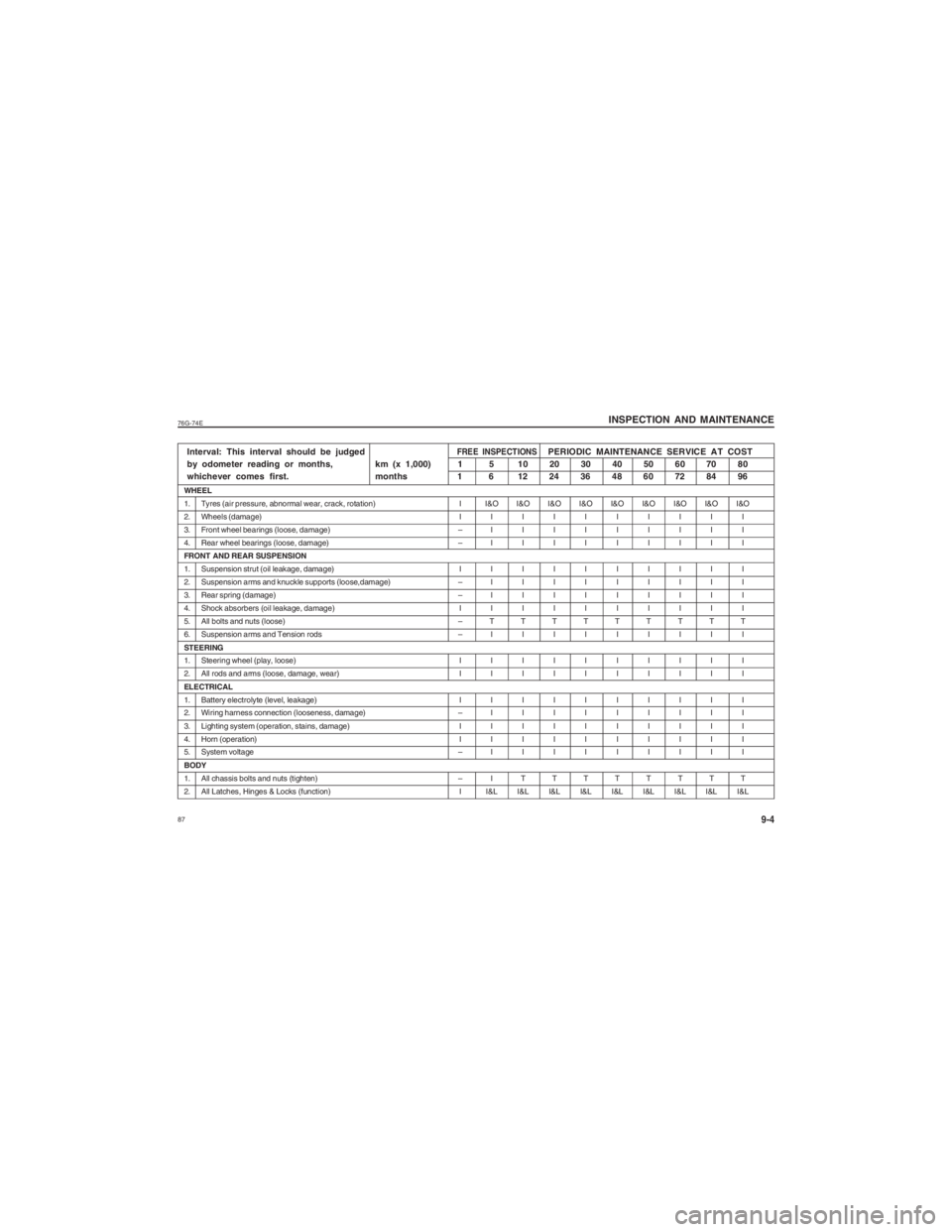
Interval: This interval should be judged
FREE INSPECTIONS
PERIODIC MAINTENANCE SERVICE AT COST
by odometer reading or months, km (x 1,000) 1 5 10 20 30 40 50 60 70 80
whichever comes first. months 1 6 12 24 36 48 60 72 84 96
WHEEL
1. Tyres (air pressure, abnormal wear, crack, rotation) I I&O I&O I&O I&O I&O I&O I&O I&O I&O
2. Wheels (damage) I I I I I I I I I I
3. Front wheel bearings (loose, damage) – I I I I I I I I I
4. Rear wheel bearings (loose, damage) – I I I I I I I I I
FRONT AND REAR SUSPENSION
1. Suspension strut (oil leakage, damage) I I I I I I I I I I
2. Suspension arms and knuckle supports (loose,damage) – I I I I I I I I I
3. Rear spring (damage) – I I I I I I I I I
4. Shock absorbers (oil leakage, damage) I I I I I I I I I I
5. All bolts and nuts (loose) – T T T T T T T T T
6. Suspension arms and Tension rods – I I I I I I I I I
STEERING
1. Steering wheel (play, loose) I I I I I I I I I I
2. All rods and arms (loose, damage, wear) I I I I I I I I I I
ELECTRICAL
1. Battery electrolyte (level, leakage) I I I I I I I I I I
2. Wiring harness connection (looseness, damage) – I I I I I I I I I
3. Lighting system (operation, stains, damage) I I I I I I I I I I
4. Horn (operation) I I I I I I I I I I
5. System voltage – I I I I I I I I I
BODY
1. All chassis bolts and nuts (tighten) – I T T T T T T T T
2. All Latches, Hinges & Locks (function) I I&L I&L I&L I&L I&L I&L I&L I&L I&L
Page 101 of 139
102
76G-74E
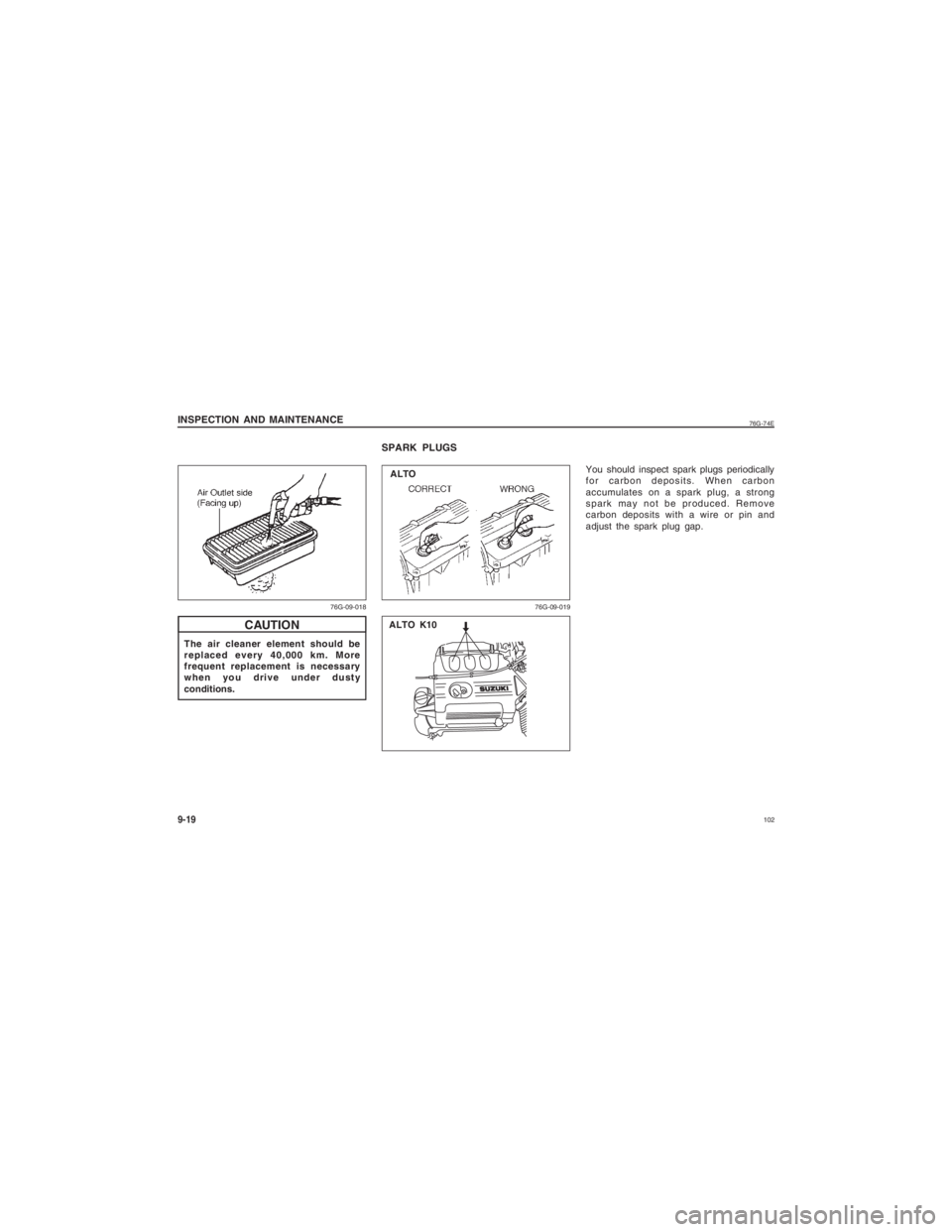
The air cleaner element should be
replaced every 40,000 km. More
frequent replacement is necessary
when you drive under dusty
conditions.
CAUTION
SPARK PLUGS
You should inspect spark plugs periodically
for carbon deposits. When carbon
accumulates on a spark plug, a strong
spark may not be produced. Remove
carbon deposits with a wire or pin and
adjust the spark plug gap.
76G-09-01876G-09-019
ALTO K10
INSPECTION AND MAINTENANCE9-19
ALTO
Page 102 of 139
10376G-74E
76G-09-020
ALTO K10EXAMPLE
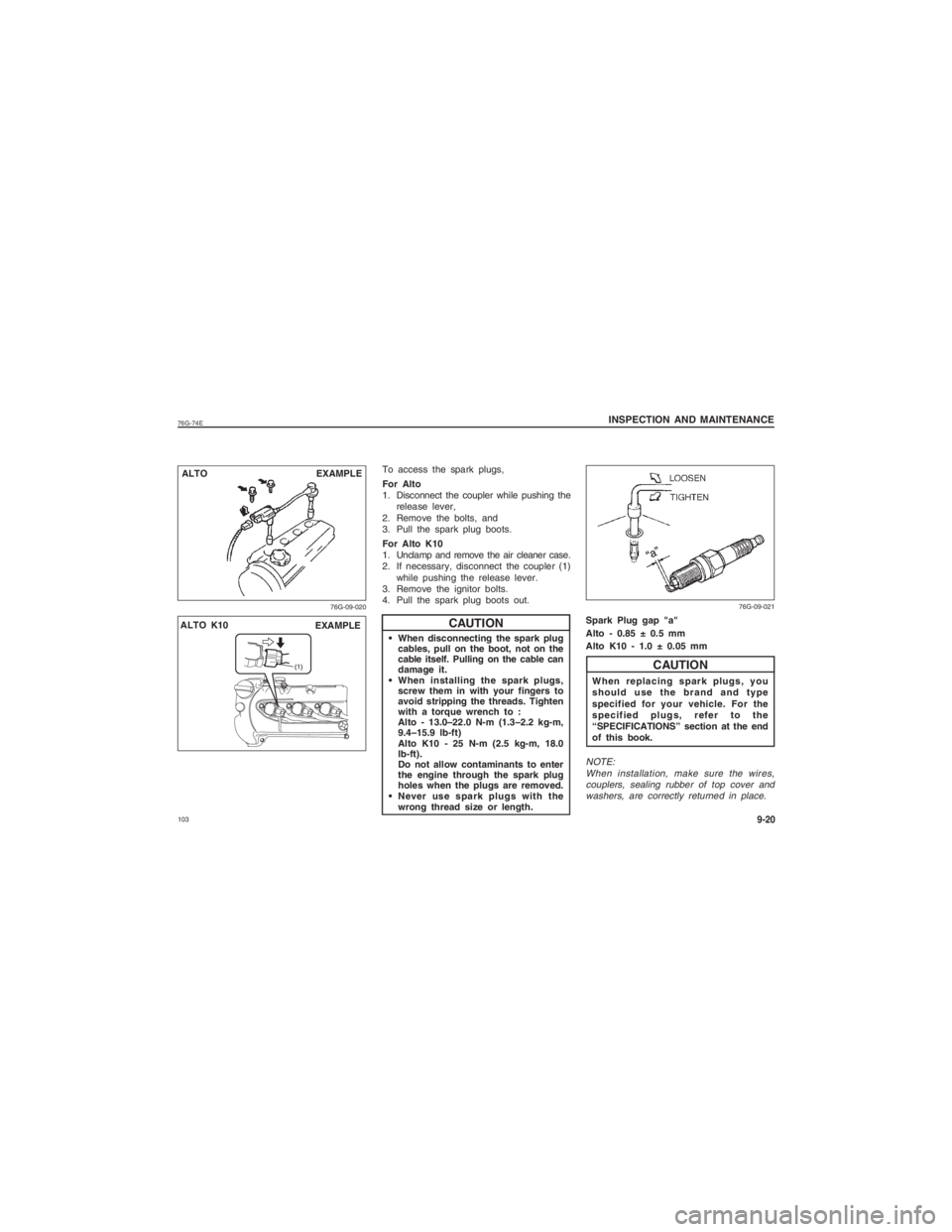
To access the spark plugs,
For Alto
1. Disconnect the coupler while pushing the
release lever,
2. Remove the bolts, and
3. Pull the spark plug boots.
For Alto K10
1. Unclamp and remove the air cleaner case.
2. If necessary, disconnect the coupler (1) while pushing the release lever.
3. Remove the ignitor bolts.
4. Pull the spark plug boots out.
CAUTION
76G-09-021
Spark Plug gap "a"
Alto - 0.85 ± 0.5 mm
Alto K10 - 1.0 ± 0.05 mm
INSPECTION AND MAINTENANCE
9-20
ALTO
EXAMPLE When disconnecting the spark plugcables, pull on the boot, not on the
cable itself. Pulling on the cable can
damage it.
When installing the spark plugs, screw them in with your fingers to
avoid stripping the threads. Tighten
with a torque wrench to :
Alto - 13.0–22.0 N-m (1.3–2.2 kg-m,
9.4–15.9 lb-ft)
Alto K10 - 25 N-m (2.5 kg-m, 18.0
lb-ft).
Do not allow contaminants to enter
the engine through the spark plug
holes when the plugs are removed.
Never use spark plugs with the
wrong thread size or length.
CAUTION
When replacing spark plugs, you
should use the brand and type
specified for your vehicle. For the
specified plugs, refer to the
“SPECIFICATIONS” section at the end
of this book.NOTE:
When installation, make sure the wires,couplers, sealing rubber of top cover and
washers, are correctly returned in place.