ECU SUZUKI BALENO 1999 1.G User Guide
[x] Cancel search | Manufacturer: SUZUKI, Model Year: 1999, Model line: BALENO, Model: SUZUKI BALENO 1999 1.GPages: 65, PDF Size: 3.28 MB
Page 29 of 65
OTHER CONTROLS AND EQUIPMENTS
60G-74E
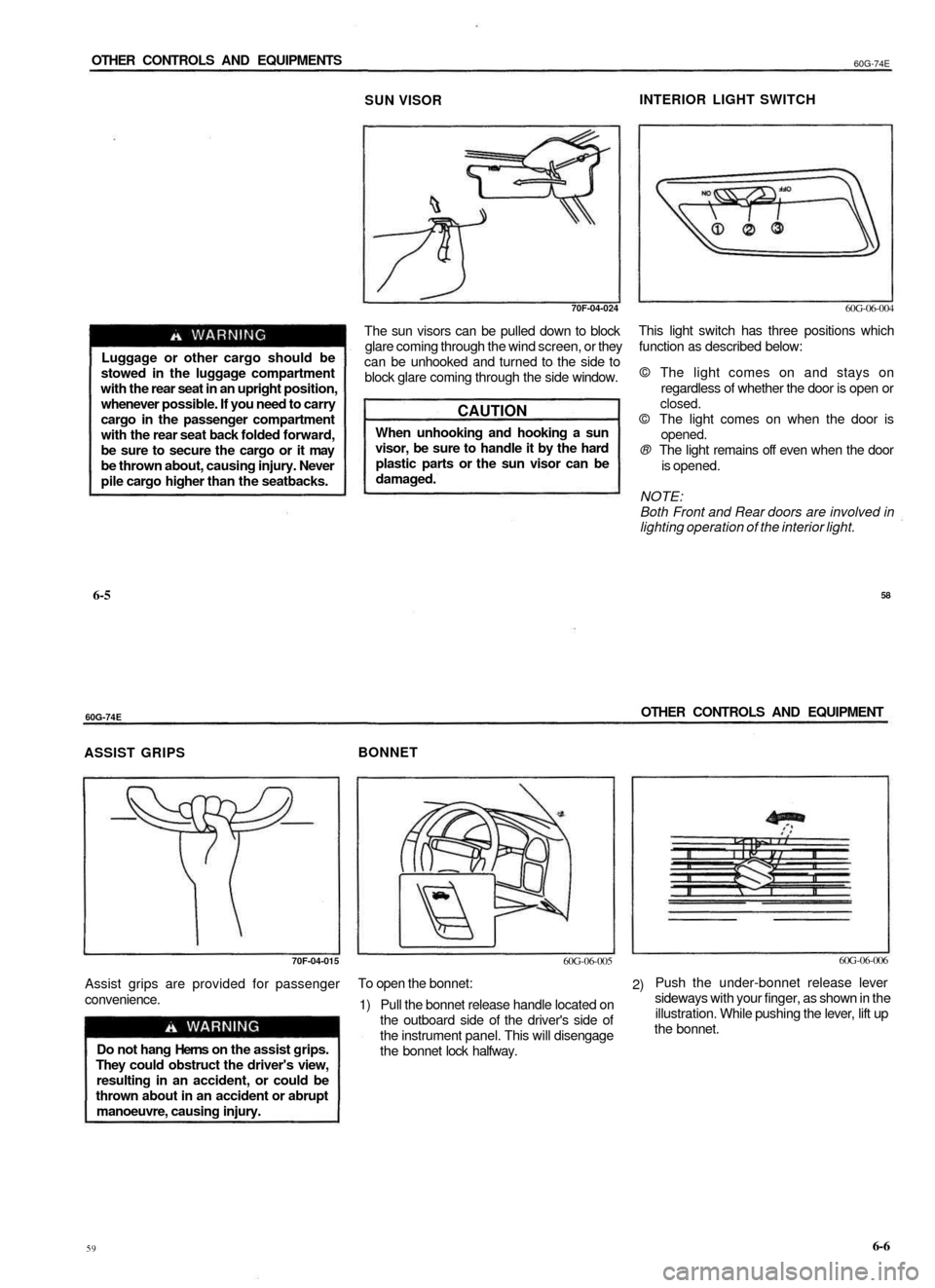
SUN VISOR
INTERIOR LIGHT SWITCH
70F-04-024
Luggage or other cargo should be
stowed in the luggage compartment
with the rear seat in an upright position,
whenever possible. If you need to carry
cargo in the passenger compartment
with the rear seat back folded forward,
be sure to secure the cargo or it may
be thrown about, causing injury. Never
pile cargo higher than the seatbacks.
The sun visors can be pulled down to block
glare coming through the wind screen, or they
can be unhooked and turned to the side to
block glare coming through the side window.
CAUTION
When unhooking and hooking a sun
visor, be sure to handle it by the hard
plastic parts or the sun visor can be
damaged.
60G-06-004
This light switch has three positions which
function as described below:
© The light comes on and stays on
regardless of whether the door is open or
closed.
© The light comes on when the door is
opened.
® The light remains off even when the door
is opened.
NOTE:
Both Front and Rear doors are involved in
lighting operation of the interior light.
6-5
58
60G-74E
OTHER CONTROLS AND EQUIPMENT
ASSIST GRIPS
BONNET
70F-04-015
Assist grips are provided for passenger
convenience.
Do not hang Herns on the assist grips.
They could obstruct the driver's view,
resulting in an accident, or could be
thrown about in an accident or abrupt
manoeuvre, causing injury.
60G-06-005
To open the bonnet:
1) Pull the bonnet release handle located on
the outboard side of the driver's side of
the instrument panel. This will disengage
the bonnet lock halfway.
60G-06-006
2)
Push the under-bonnet release lever
sideways with your finger, as shown in the
illustration. While pushing the lever, lift up
the bonnet.
59
6-6
Page 30 of 65
OTHER CONTROLS AND EQUIPMENTS
60G-74E
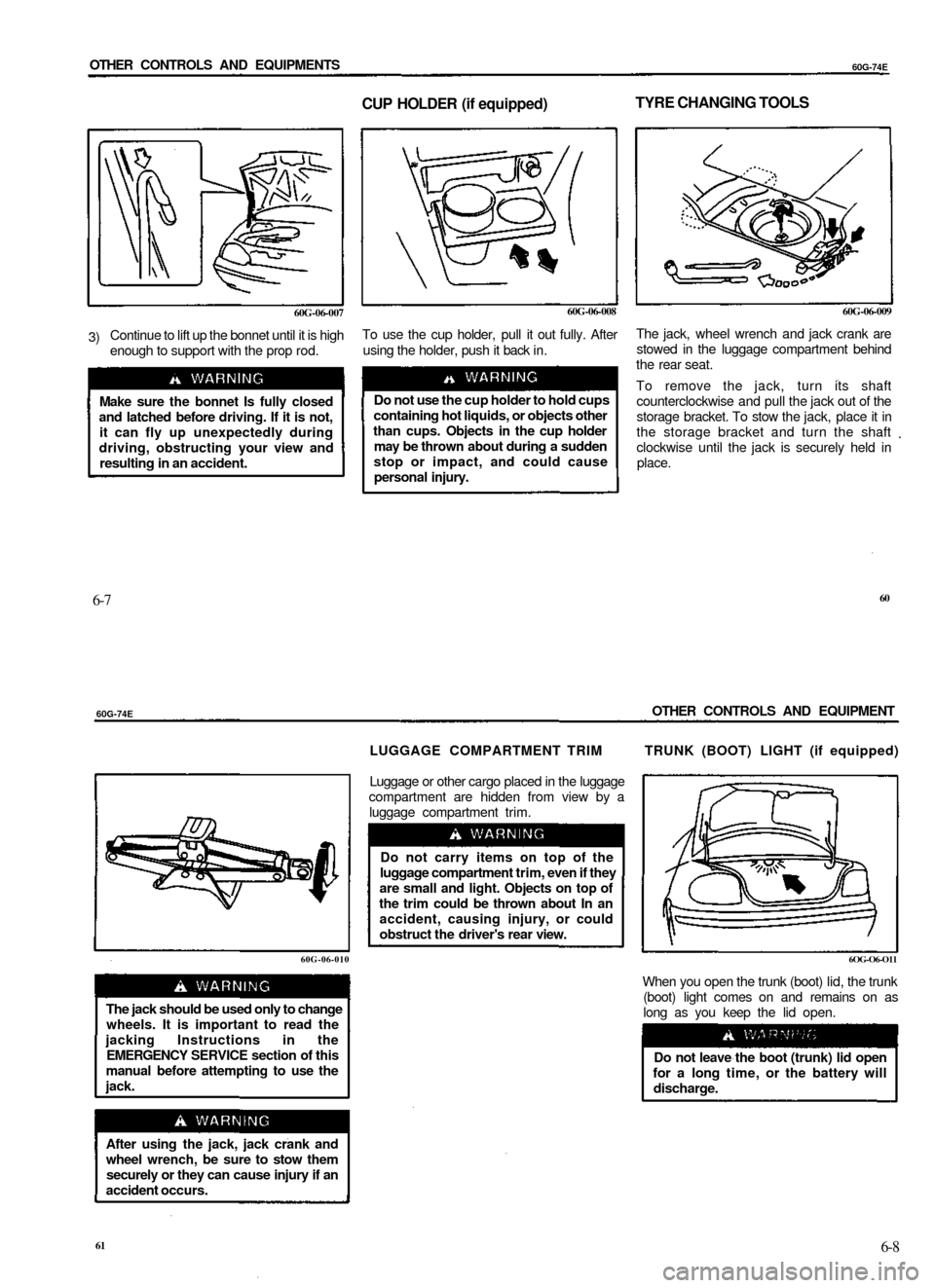
CUP HOLDER (if equipped)
TYRE CHANGING TOOLS
60G-06-007
3)
Continue to lift up the bonnet until it is high
enough to support with the prop rod.
Make sure the bonnet Is fully closed
and latched before driving. If it is not,
it can fly up unexpectedly during
driving, obstructing your view and
resulting in an accident.
60G-06-008
To use the cup holder, pull it out fully. After
using the holder, push it back in.
Do not use the cup holder to hold cups
containing hot liquids, or objects other
than cups. Objects in the cup holder
may be thrown about during a sudden
stop or impact, and could cause
personal injury.
60G-06-009
The jack, wheel wrench and jack crank are
stowed in the luggage compartment behind
the rear seat.
To remove the jack, turn its shaft
counterclockwise and pull the jack out of the
storage bracket. To stow the jack, place it in
the storage bracket and turn the shaft
clockwise until the jack is securely held in
place.
6-7
60
60G-74E
OTHER CONTROLS AND EQUIPMENT
LUGGAGE COMPARTMENT TRIM TRUNK (BOOT) LIGHT (if equipped)
Luggage or other cargo placed in the luggage
compartment are hidden from view by a
luggage compartment trim.
Do not carry items on top of the
luggage compartment trim, even if they
are small and light. Objects on top of
the trim could be thrown about In an
accident, causing injury, or could
obstruct the driver's rear view.
60G-06-010
6OG-O6-O11
The jack should be used only to change
wheels. It is important to read the
jacking Instructions in the
EMERGENCY SERVICE section of this
manual before attempting to use the
jack.
When you open the trunk (boot) lid, the trunk
(boot) light comes on and remains on as
long as you keep the lid open.
Do not leave the boot (trunk) lid open
for a long time, or the battery will
discharge.
After using the jack, jack crank and
wheel wrench, be sure to stow them
securely or they can cause injury if an
accident occurs.
61
6-8
Page 33 of 65
60G-74E
OPERATING YOUR VEHICLE
Once a week, or each time you fill your fuel
tank, perform the following under-bonnet
checks:
1) Engine oil level.
2) Coolant level.
3) Brake fluid level.
4) Power steering (if equipped) fluid level.
5) Windscreen washer fluid level.
6) Battery solution level.
7) Bonnet latch operation.
Pull the bonnet release handle inside the
vehicle. Make sure that you can not open
the hood all the way without releasing the
secondary latch. Be sure to close the hood
securely after checking for proper
operation. See "All Latches, Hinges &
Locks" of "PERIODIC MAINTENANCE
SCHEDULE" in the "INSPECTION AND
MAINTENANCE" section for lubrication
schedule.
Make sure the bonnet is fully closed
and latched before driving. If it is not,
it can fly up unexpectedly during
driving, obstructing your view and
resulting in an accident.
STARTING THE ENGINE
Before starting the engine:
1) Make sure the parking brake is applied
fully.
2) Manual Transmission - Shift into "N"
(neutral) and depress the clutch pedal all
the way to the floor. Hold it while starting
the engine.
Make sure that the parking brake is
applied fully and the transmission is in
Neutral before attempting to start the
engine.
CAUTION
Stop turning the starter immediately
after the engine has started or the
starter system can be damaged.
Do not crank the engine for more
than 15 seconds at a time. If the
engine doesn't start on the first try,
wait about 15 seconds before trying
again.
Starting a Cold Engine
Engine which is started after 6 hours should
be treated as cold engine.
For Electronic fuel injection models
• With your foot off the accelerator pedal,
crank the engine by turning the ignition
key to "START1. Release the key when the
engine starts.
• If the engine does not start after 15
seconds of cranking, wait about 15
seconds, then press down the accelerator
pedal to 1/3 of its travel and try cranking
the engine again. Release the key and
accelerator pedal when the engine starts.
• If the engine still does not start, try holding
the accelerator pedal all the way to the
floor while cranking. This should clear the
engine if it is flooded.
Starting a Warm Engine
For Electronic fuel injection models:
Use the same procedure as for "Starting a cold
Engine".
67
7-2
OPERATING YOUR VECHILE
60G-74E
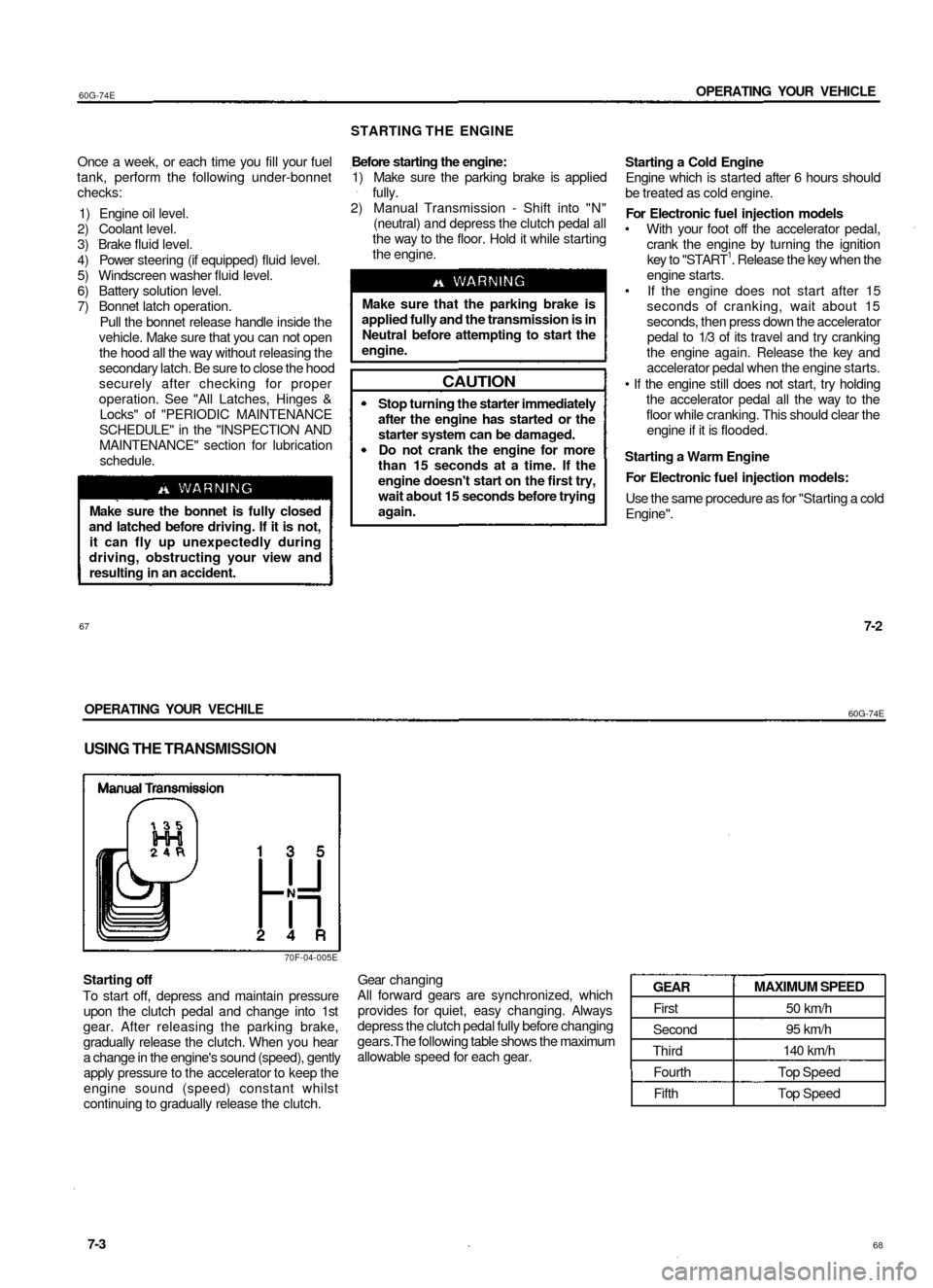
USING THE TRANSMISSION
70F-04-005E
Starting off
To start off, depress and maintain pressure
upon the clutch pedal and change into 1st
gear. After releasing the parking brake,
gradually release the clutch. When you hear
a change in the engine's sound (speed), gently
apply pressure to the accelerator to keep the
engine sound (speed) constant whilst
continuing to gradually release the clutch.
Gear changing
All forward gears are synchronized, which
provides for quiet, easy changing. Always
depress the clutch pedal fully before changing
gears.The following table shows the maximum
allowable speed for each gear.
GEAR
First
Second
Third
Fourth
Fifth
MAXIMUM SPEED
50 km/h
95 km/h
140 km/h
Top Speed
Top Speed
7-3
68
Page 44 of 65
60G-74E
INSPECTION AND MAINTENANCE
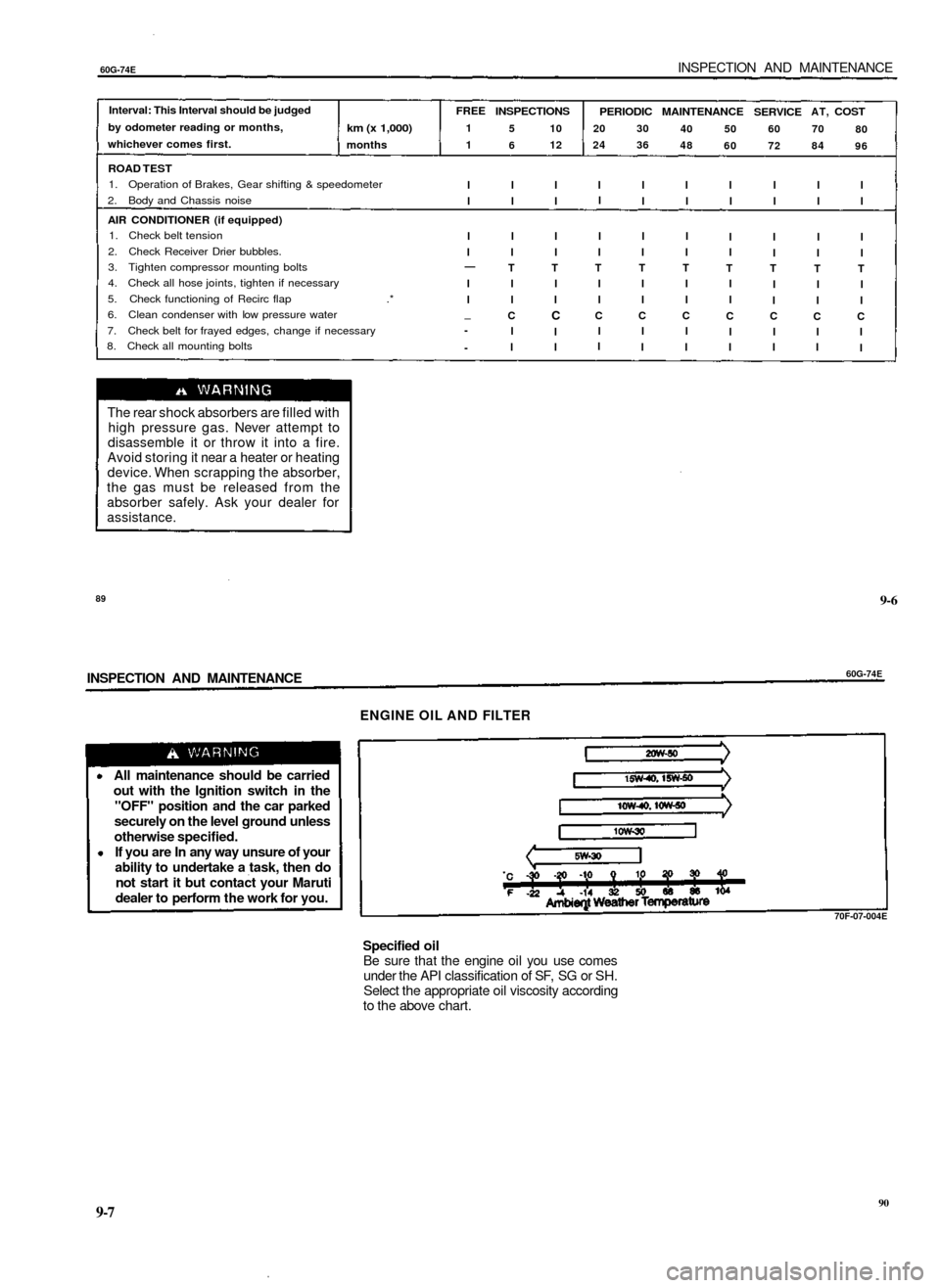
Interval: This Interval should be judged
by odometer reading or months,
whichever comes first.
km (x 1,000)
months
ROAD TEST
1. Operation of Brakes, Gear shifting & speedometer
2. Body and Chassis noise
AIR CONDITIONER (if equipped)
1. Check belt tension
2. Check Receiver Drier bubbles.
3. Tighten compressor mounting bolts
4. Check all hose joints, tighten if necessary
5. Check functioning of Recirc flap .*
6. Clean condenser with low pressure water
7. Check belt for frayed edges, change if necessary
8. Check all mounting bolts
FREE
1
1
I
I
I
I
—
I
I
_
-
-
INSPECTIONS
5
6
I
I
I
I
T
I
I
C
I
I
10
12
I
I
I
I
T
I
I
C
I
I
PERIODIC
20
24
I
I
I
I
T
I
I
C
I
I
30
36
I
I
I
I
T
I
I
C
I
I
MAINTENANCE
40
48
I
I
I
I
T
I
I
C
I
I
50
60
I
I
I
I
T
I
I
C
I
I
SERVICE
60
72
I
I
I
I
T
I
I
C
I
I
AT,
70
84
I
I
I
I
T
I
I
C
I
I
COST
80
96
I
I
I
I
T
I
I
C
I
I
The rear shock absorbers are filled with
high pressure gas. Never attempt to
disassemble it or throw it into a fire.
Avoid storing it near a heater or heating
device. When scrapping the absorber,
the gas must be released from the
absorber safely. Ask your dealer for
assistance.
89
9-6
INSPECTION AND MAINTENANCE
60G-74E
All maintenance should be carried
out with the Ignition switch in the
"OFF" position and the car parked
securely on the level ground unless
otherwise specified.
If you are In any way unsure of your
ability to undertake a task, then do
not start it but contact your Maruti
dealer to perform the work for you.
ENGINE OIL AND FILTER
Specified oil
Be sure that the engine oil you use comes
under the API classification of SF, SG or SH.
Select the appropriate oil viscosity according
to the above chart.
9-7
90
70F-07-004E
Page 49 of 65
60G-74E
INSPECTION AND MAINTENANCE
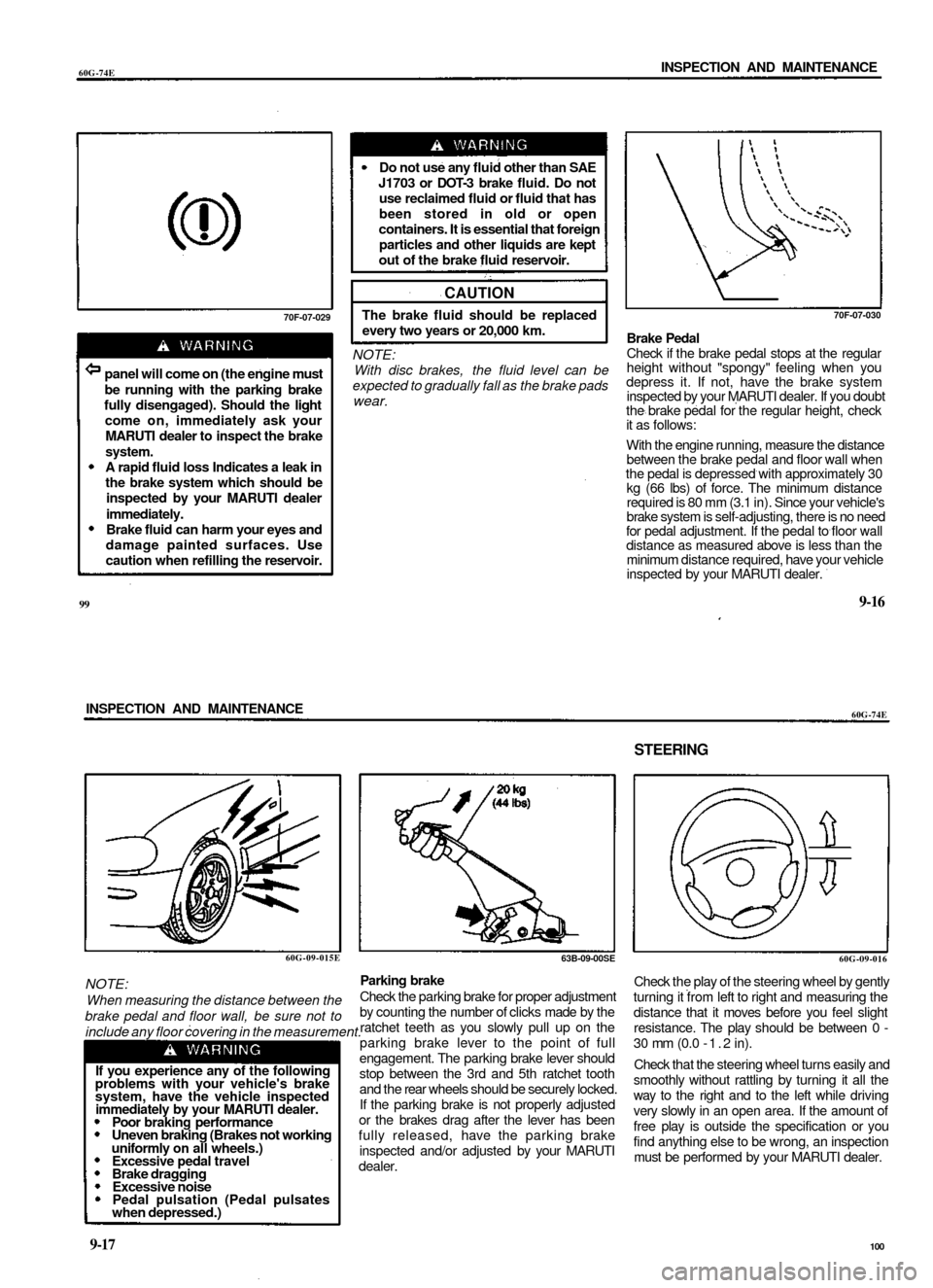
70F-07-029
Do not use any fluid other than SAE
J1703 or DOT-3 brake fluid. Do not
use reclaimed fluid or fluid that has
been stored in old or open
containers. It is essential that foreign
particles and other liquids are kept
out of the brake fluid reservoir.
CAUTION
The brake fluid should be replaced
every two years or 20,000 km.
panel will come on (the engine must
be running with the parking brake
fully disengaged). Should the light
come on, immediately ask your
MARUTI dealer to inspect the brake
system.
A rapid fluid loss Indicates a leak in
the brake system which should be
inspected by your MARUTI dealer
immediately.
Brake fluid can harm your eyes and
damage painted surfaces. Use
caution when refilling the reservoir.
NOTE:
With disc brakes, the fluid level can be
expected to gradually fall as the brake pads
wear.
99
70F-07-030
Brake Pedal
Check if the brake pedal stops at the regular
height without "spongy" feeling when you
depress it. If not, have the brake system
inspected by your MARUTI dealer. If you doubt
the brake pedal for the regular height, check
it as follows:
With the engine running, measure the distance
between the brake pedal and floor wall when
the pedal is depressed with approximately 30
kg (66 lbs) of force. The minimum distance
required is 80 mm (3.1 in). Since your vehicle's
brake system is self-adjusting, there is no need
for pedal adjustment. If the pedal to floor wall
distance as measured above is less than the
minimum distance required, have your vehicle
inspected by your MARUTI dealer.
9-16
INSPECTION AND MAINTENANCE
60G-74E
STEERING
60G-09-015E
NOTE:
When measuring the distance between the
brake pedal and floor wall, be sure not to
include any floor covering in the measurement.
If you experience any of the following
problems with your vehicle's brake
system, have the vehicle inspected
immediately by your MARUTI dealer.
Poor braking performance
Uneven braking (Brakes not working
uniformly on all wheels.)
Excessive pedal travel
Brake dragging
Excessive noise
Pedal pulsation (Pedal pulsates
when depressed.)
63B-09-00SE
Parking brake
Check the parking brake for proper adjustment
by counting the number of clicks made by the
ratchet teeth as you slowly pull up on the
parking brake lever to the point of full
engagement. The parking brake lever should
stop between the 3rd and 5th ratchet tooth
and the rear wheels should be securely locked.
If the parking brake is not properly adjusted
or the brakes drag after the lever has been
fully released, have the parking brake
inspected and/or adjusted by your MARUTI
dealer.
60G-09-016
Check the play of the steering wheel by gently
turning it from left to right and measuring the
distance that it moves before you feel slight
resistance. The play should be between 0 -
30
mm
(0.0 -1.2 in).
Check that the steering wheel turns easily and
smoothly without rattling by turning it all the
way to the right and to the left while driving
very slowly in an open area. If the amount of
free play is outside the specification or you
find anything else to be wrong, an inspection
must be performed by your MARUTI dealer.
9-17
100
Page 51 of 65
60G-74E
INSPECTION AND MAINTENANCE
Hitting curbs and running over rocks
can damage tyres and affect wheel
alignment. Be sure to have tyres and
wheel alignment checked periodically
by your MARUTI dealer.
4) Check for loose wheel nuts.
5) Check that there are no nails, stones, or
other objects sticking into the tyres.
Your MARUTI is equipped with tyres
which are all the same type and size.
This is important to ensure proper
steering and handling of the vehicle.
Never mix tyres of different size or type
on the four wheels of your vehicle. The
size and type of tyres used should be
only those approved by MARUTI as
standard or optional equipment for
your vehicle.
Replacing the wheels and tyres
equipped on your vehicle with certain
combinations of aftermarket wheels
and tyres can significantly change the
steering and handling characteristics
of your vehicle. Therefore, use only
those wheel and tyre combinations
approved by MARUTI as standard or
optional equipment for your vehicle.
CAUTION
Replacing the original tyres with tyres
of a different size may result in false
speedometer or odometer readings.
60G-09-019E
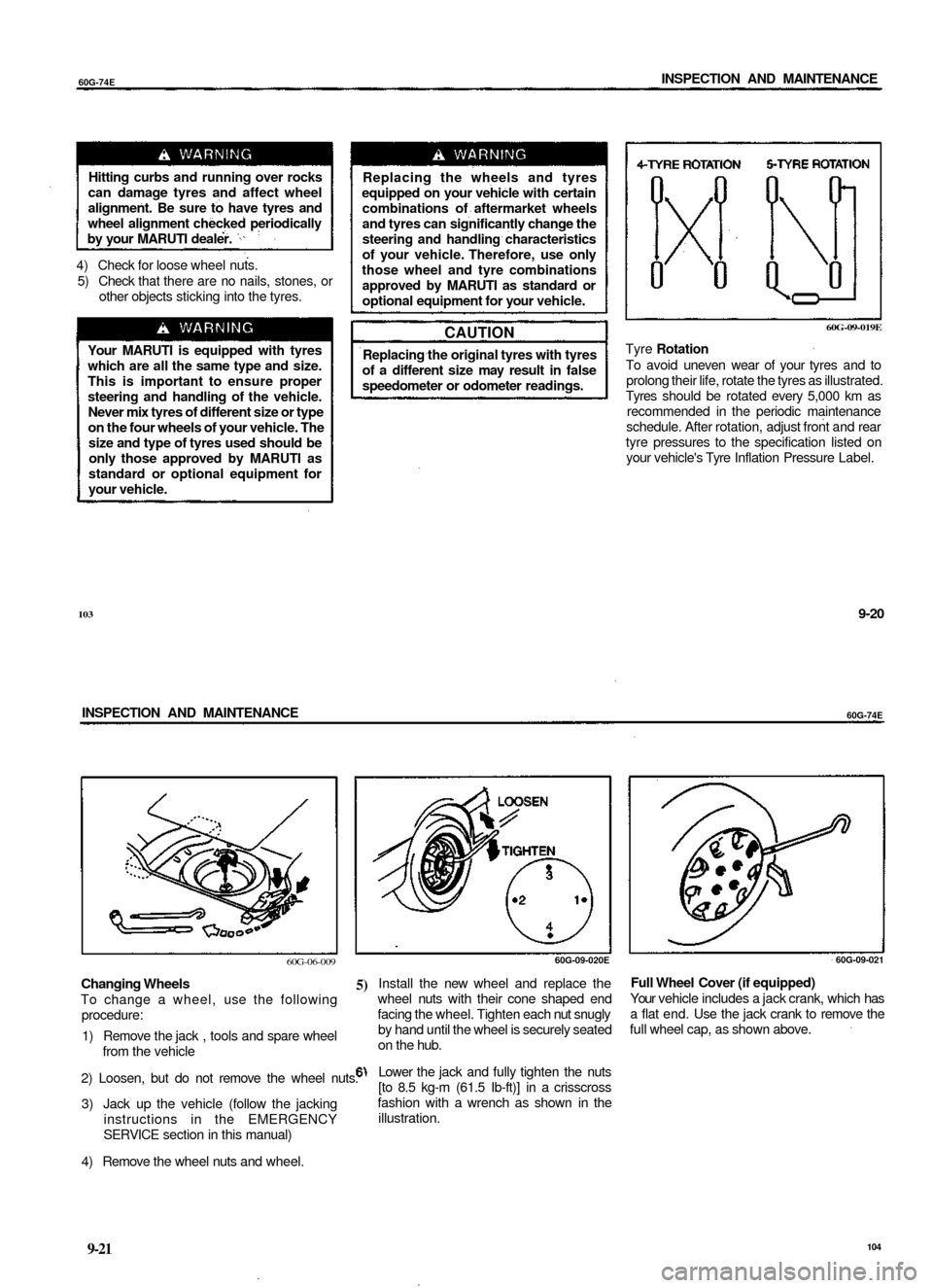
Tyre Rotation
To avoid uneven wear of your tyres and to
prolong their life, rotate the tyres as illustrated.
Tyres should be rotated every 5,000 km as
recommended in the periodic maintenance
schedule. After rotation, adjust front and rear
tyre pressures to the specification listed on
your vehicle's Tyre Inflation Pressure Label.
103
9-20
INSPECTION AND MAINTENANCE
60G-74E
60G-06-009
5)
Changing Wheels
To change a wheel, use the following
procedure:
1) Remove the jack , tools and spare wheel
from the vehicle
2) Loosen, but do not remove the wheel nuts. '
3) Jack up the vehicle (follow the jacking
instructions in the EMERGENCY
SERVICE section in this manual)
4) Remove the wheel nuts and wheel.
60G-09-020E
Install the new wheel and replace the
wheel nuts with their cone shaped end
facing the wheel. Tighten each nut snugly
by hand until the wheel is securely seated
on the hub.
Lower the jack and fully tighten the nuts
[to 8.5 kg-m (61.5 Ib-ft)] in a crisscross
fashion with a wrench as shown in the
illustration.
60G-09-021
Full Wheel Cover (if equipped)
Your vehicle includes a jack crank, which has
a flat end. Use the jack crank to remove the
full wheel cap, as shown above.
9-21
104
Page 53 of 65
60G-74E
INSPECTION AND MAINTENANCE
60G-09-026
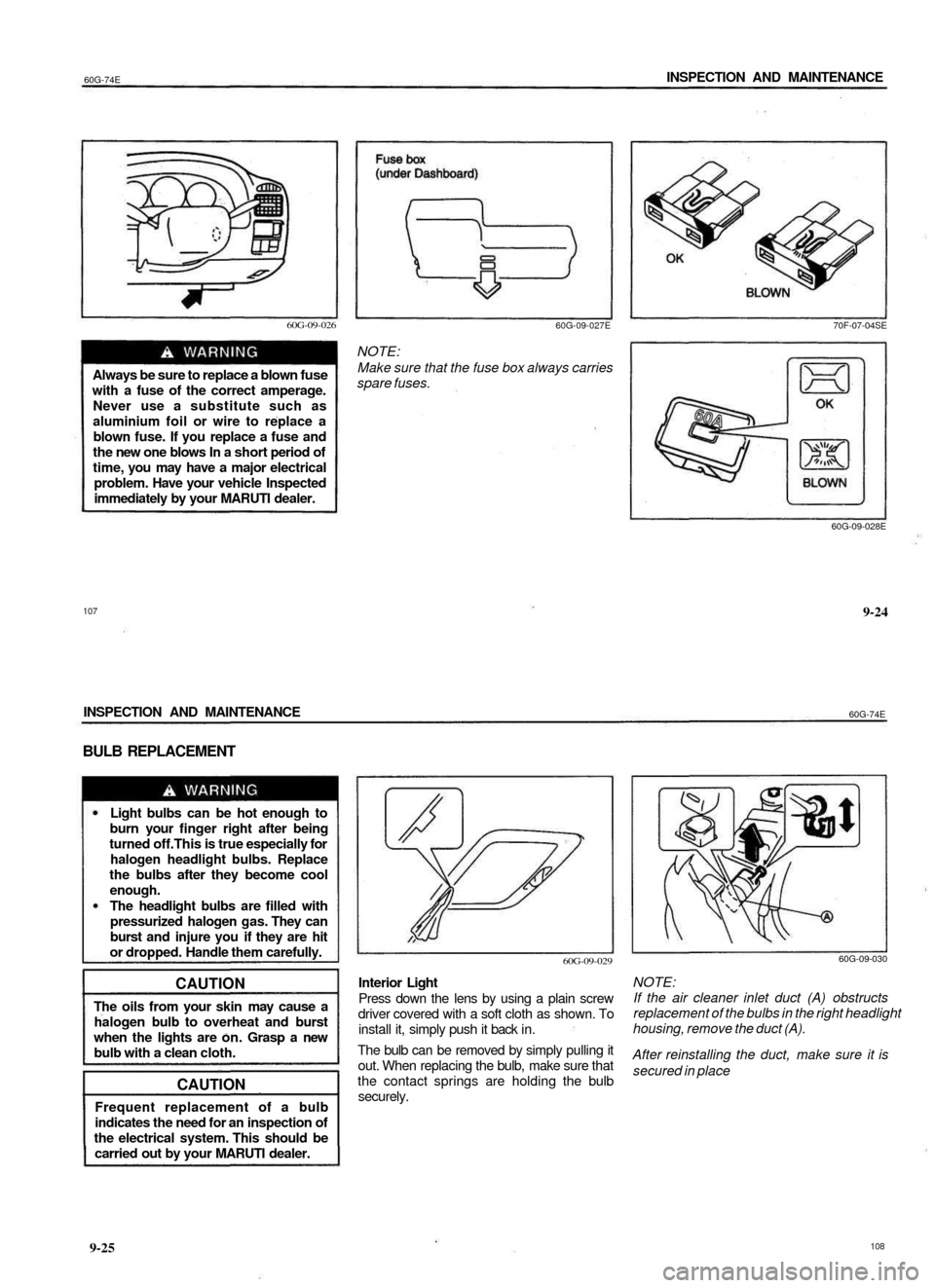
Always be sure to replace a blown fuse
with a fuse of the correct amperage.
Never use a substitute such as
aluminium foil or wire to replace a
blown fuse. If you replace a fuse and
the new one blows In a short period of
time, you may have a major electrical
problem. Have your vehicle Inspected
immediately by your MARUTI dealer.
60G-09-027E
NOTE:
Make sure that the fuse box always carries
spare fuses.
70F-07-04SE
60G-09-028E
107
9-24
INSPECTION AND MAINTENANCE
60G-74E
BULB REPLACEMENT
Light bulbs can be hot enough to
burn your finger right after being
turned off.This is true especially for
halogen headlight bulbs. Replace
the bulbs after they become cool
enough.
The headlight bulbs are filled with
pressurized halogen gas. They can
burst and injure you if they are hit
or dropped. Handle them carefully.
CAUTION
The oils from your skin may cause a
halogen bulb to overheat and burst
when the lights are on. Grasp a new
bulb with a clean cloth.
CAUTION
Frequent replacement of a bulb
indicates the need for an inspection of
the electrical system. This should be
carried out by your MARUTI dealer.
60G-09-029
Interior Light
Press down the lens by using a plain screw
driver covered with a soft cloth as shown. To
install it, simply push it back in.
The bulb can be removed by simply pulling it
out. When replacing the bulb, make sure that
the contact springs are holding the bulb
securely.
60G-09-030
NOTE:
If the air cleaner inlet duct (A) obstructs
replacement of the bulbs in the right headlight
housing, remove the duct (A).
After reinstalling the duct, make sure it is
secured in place
9-25
108
Page 55 of 65
60G-74E
INSPECTION AND MAINTENANCE
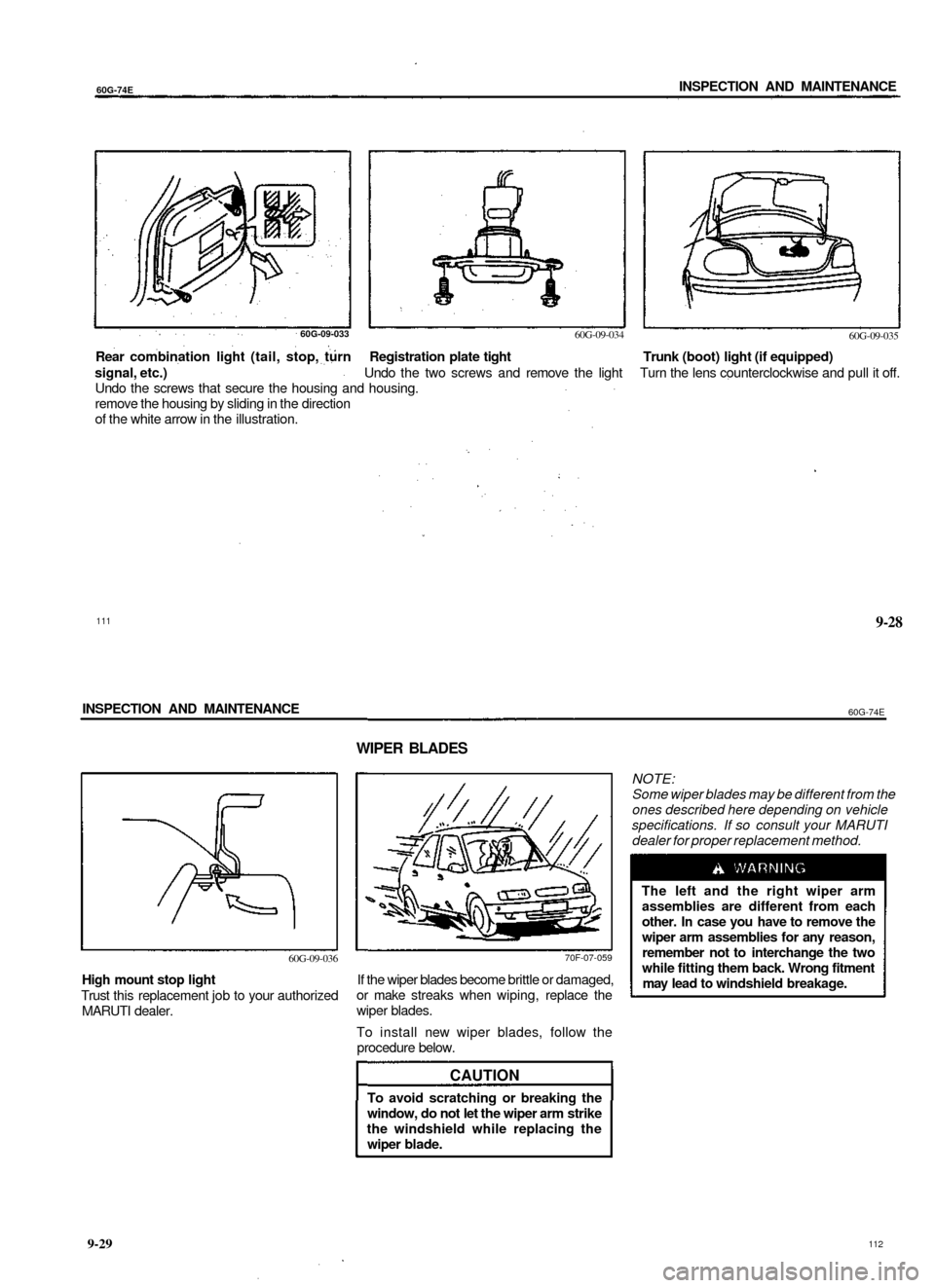
60G-09-033
60G-09-034
60G-09-035
Rear combination light (tail, stop, turn Registration plate tight Trunk (boot) light (if equipped)
signal, etc.) Undo the two screws and remove the light Turn the lens counterclockwise and pull it off.
Undo the screws that secure the housing and housing.
remove the housing by sliding in the direction
of the white arrow in the illustration.
111
9-28
INSPECTION AND MAINTENANCE
60G-74E
WIPER BLADES
60G-09-036
High mount stop light
Trust this replacement job to your authorized
MARUTI dealer.
70F-07-059
If the wiper blades become brittle or damaged,
or make streaks when wiping, replace the
wiper blades.
To install new wiper blades, follow the
procedure below.
CAUTION
To avoid scratching or breaking the
window, do not let the wiper arm strike
the windshield while replacing the
wiper blade.
NOTE:
Some wiper blades may be different from the
ones described here depending on vehicle
specifications. If so consult your MARUTI
dealer for proper replacement method.
The left and the right wiper arm
assemblies are different from each
other. In case you have to remove the
wiper arm assemblies for any reason,
remember not to interchange the two
while fitting them back. Wrong fitment
may lead to windshield breakage.
9-29
112
Page 58 of 65
EMERGENCY SERVICE
60G-74E
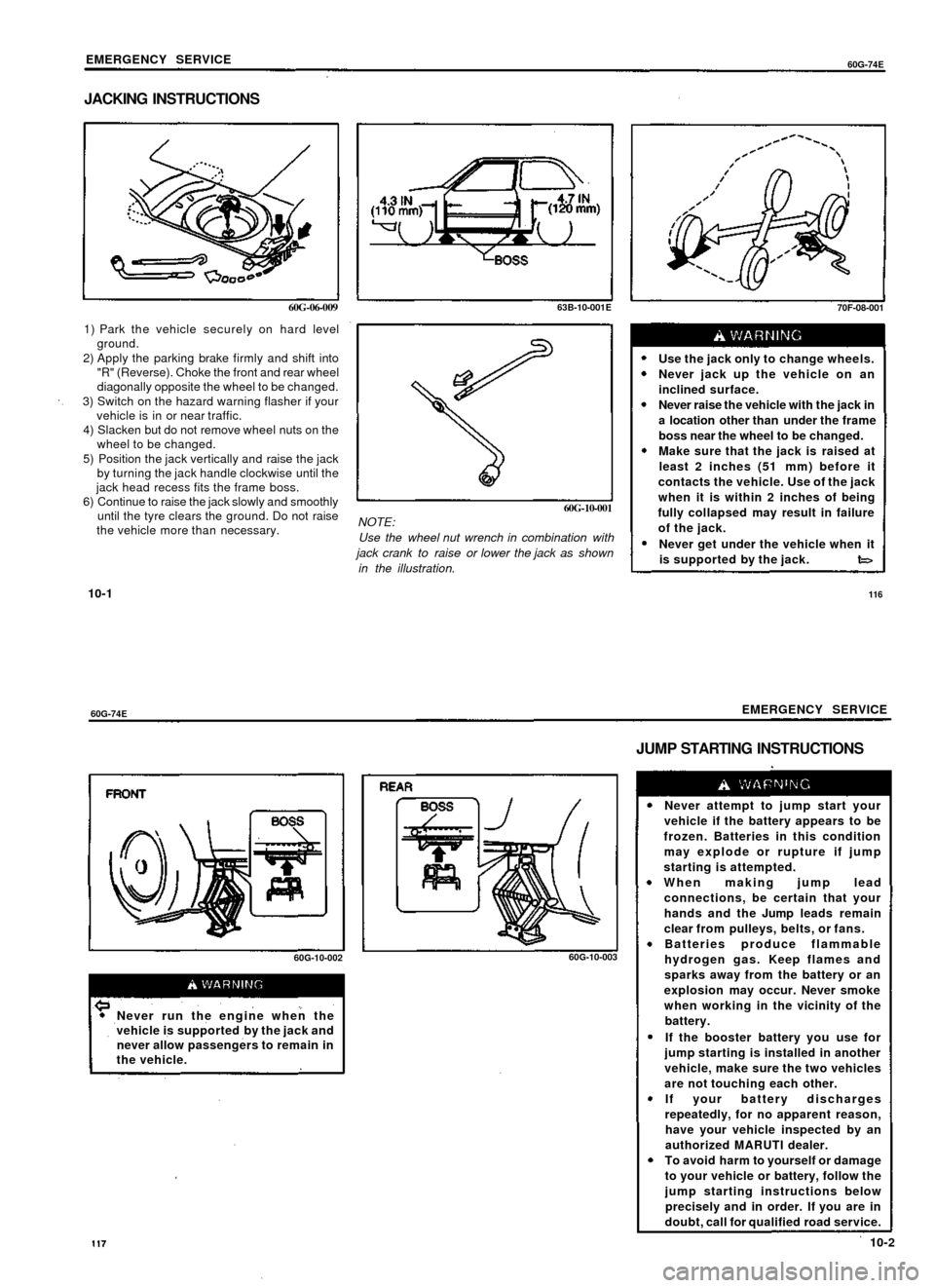
JACKING INSTRUCTIONS
60G-06-009
1) Park the vehicle securely on hard level
ground.
2) Apply the parking brake firmly and shift into
"R" (Reverse). Choke the front and rear wheel
diagonally opposite the wheel to be changed.
3) Switch on the hazard warning flasher if your
vehicle is in or near traffic.
4) Slacken but do not remove wheel nuts on the
wheel to be changed.
5) Position the jack vertically and raise the jack
by turning the jack handle clockwise until the
jack head recess fits the frame boss.
6) Continue to raise the jack slowly and smoothly
until the tyre clears the ground. Do not raise
the vehicle more than necessary.
10-1
63B-10-001E
70F-08-001
60G-10-001
NOTE:
Use the wheel nut wrench in combination with
jack crank to raise or lower the jack as shown
in the illustration.
Use the jack only to change wheels.
Never jack up the vehicle on an
inclined surface.
Never raise the vehicle with the jack in
a location other than under the frame
boss near the wheel to be changed.
Make sure that the jack is raised at
least 2 inches (51 mm) before it
contacts the vehicle. Use of the jack
when it is within 2 inches of being
fully collapsed may result in failure
of the jack.
Never get under the vehicle when it
is supported by the jack. t=>
116
60G-74E
EMERGENCY SERVICE
JUMP STARTING INSTRUCTIONS
60G-10-002
60G-10-003
Never run the engine when the
vehicle is supported by the jack and
never allow passengers to remain in
the vehicle.
Never attempt to jump start your
vehicle if the battery appears to be
frozen. Batteries in this condition
may explode or rupture if jump
starting is attempted.
When making jump lead
connections, be certain that your
hands and the Jump leads remain
clear from pulleys, belts, or fans.
Batteries produce flammable
hydrogen gas. Keep flames and
sparks away from the battery or an
explosion may occur. Never smoke
when working in the vicinity of the
battery.
If the booster battery you use for
jump starting is installed in another
vehicle, make sure the two vehicles
are not touching each other.
If your battery discharges
repeatedly, for no apparent reason,
have your vehicle inspected by an
authorized MARUTI dealer.
To avoid harm to yourself or damage
to your vehicle or battery, follow the
jump starting instructions below
precisely and in order. If you are in
doubt, call for qualified road service.
10-2