air condition SUZUKI CELERIO 2014 User Guide
[x] Cancel search | Manufacturer: SUZUKI, Model Year: 2014, Model line: CELERIO, Model: SUZUKI CELERIO 2014Pages: 201, PDF Size: 5.82 MB
Page 106 of 201

5-10
OTHER CONTROLS AND EQUIPMENT
76MH1-74E
76MH1-74E
Manual Heating and Air
Conditioning System (if
equipped)
Air outlet
76MH0A080
1. Windshield defroster outlet 2. Side defroster outlet 3. Side outlet 4. Center outlet5. Front floor outlet
Side outlet
76MH0A118
When “Open”, air comes out regardless of the air flow selector position.
Center outlet
76MH0A081
Move the knob (1) vertically or horizontally to adjust the direction of airflow as desired.
Description of Controls
76MH0A082
Temperature selector (1)
This is used to select the temperature by turning the selector.
Blower speed selector (2) This is used to turn on the blower and to select blower speed by turning the selec-tor.
Air flow selector (3)
61MM0A019
This is used to select one of the functions described below.
Ventilation (a)
76MH0A083
Temperature-controlled air comes out of the center and side air outlets.
1 1
22
334
55
EXAMPLE
(1) (1)
0 1 2 3 4
(3) (4) (1)
(2)(5)
(a)
(b)
(e)
(d)
(c)
95
Page 108 of 201

5-12
OTHER CONTROLS AND EQUIPMENT
76MH1-74E
76MH1-74E
Air conditioning switch (5) To turn on the air conditioning system, set the blower speed selector to a positionother than “OFF” and push in the “A/C” switch. With this “A/C” switch operation, a indicator light will come on when the airconditioning system is on. To turn off the air conditioning system, push the “A/C” switch again.
During operation of the air conditioner, you may notice slight changes in enginespeed. These changes are normal, the system is designed so that the compressor turns on or off to maintain the desired tem-perature.
Less operation of the compressor results in better fuel economy.
System Operating Instructions
Natural ventilationSelect “VENTILATION” and “FRESH AIR”, the temperature selector to the desired temperature position, and the blowerspeed selector to “OFF”. Fresh air will flow through the vehicle during driving.
Forced ventilation The control settings are the same as for natural ventilation except you set theblower speed selector to a position other than “OFF”.
Normal heating (using outside air) Select “HEAT” and “FRESH AIR”, the tem- perature selector to the desired tempera-ture position and the blower speed selector
to the desired blower speed position. Set- ting the blower speed selector to a higher blower speed position increases heatingefficiency.
Quick heating (using recirculated air) The control settings are the same as for normal heating except you select “RECIR- CULATED AIR”. If you use this heatingmethod for an extended period of time, the air in the vehicle can become contami- nated and the windows can become misty.Therefore, use this method only for quick heating and change to the normal heating method as soon as possible.
Head cooled/Feet warmed heating Select “BI-LEVEL” and “FRESH AIR”, thetemperature selector to the desired tem- perature position, and the blower speed selector to the desired blower speed posi-tion. Unless the temperature selector is in the fully COLD position or fully HOT posi- tion, the air that comes out of the centerand side outlets will be cooler than the air that comes out of the floor outlets.
Normal cooling Set the air flow selector to “VENTILA- TION”, the temperatur e selector to the desired temperature position and the blower speed selector to the desired blower speed position, and turn on the “A/C” switch. Setting the blower speed selec- tor to a higher blower speed position increases cooling efficiency.
You can switch the air intake selector to either “FRESH AIR” or “RECIRCULATED AIR” as you desire. Choosing “RECIRCU-LATED AIR” increases cooling efficiency.
Quick cooling (using recirculated air) The control settings are the same as for normal cooling except you select “RECIR- CULATED AIR” and the highest blowerspeed.
NOTE: • To turn on the air conditioning system, push in the “A/C” switch and set the blower speed selector to a position otherthan “OFF”. With this “A/C” switch opera- tion, an indicator light will come on when the air conditioning system is on. To turnoff the air conditioning system, push the “A/C” switch again. • During operation of the air conditioner,you may notice slight changes in engine speed. These changes are normal, the system is designed so that the compres-sor turns on or of f to maintain the desired temperature. Less operation of the compressor result s in better fuel economy.
NOTE: • If you select “RECIRCULATED AIR” for an extended period of time, the air in the vehicle can become contaminated.Therefore, you should occasionally select “FRESH AIR”. • If your vehicle has been left in the sunwith the windows closed, it will cool
97
Page 109 of 201
5-13
OTHER CONTROLS AND EQUIPMENT
76MH1-74E
76MH1-74E
faster if you open the windows briefly while you operate the air conditioner with the air intake selector at “FRESH AIR”and the blower at high speed.
DehumidifyingSet the air flow selector to a desired air flow selector position, the temperature selector to the desired temperature position and theblower speed selector to the desired blower speed position. Also select “FRESH AIR” and turn on the “A/C” switch.
NOTE:Because the air conditioner dehumidifiesthe air, turning it on will help keep the win- dows clear, even when blowing heated air using the “DEFROST” or “HEAT &DEFROST” functions.
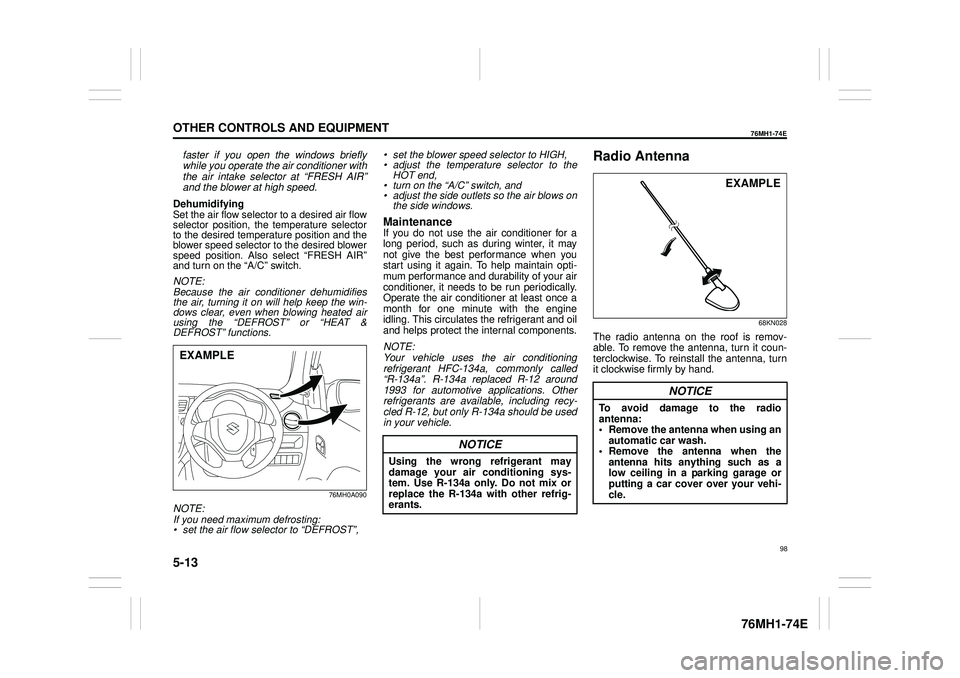
76MH0A090
NOTE:If you need maximum defrosting:• set the air flow selector to “DEFROST”,
• set the blower speed selector to HIGH, • adjust the temperature selector to the HOT end, • turn on the “A/C” switch, and• adjust the side outlets so the air blows on the side windows.
MaintenanceIf you do not use the air conditioner for a long period, such as during winter, it may not give the best performance when youstart using it again. To help maintain opti- mum performance and durability of your air conditioner, it needs to be run periodically.Operate the air conditioner at least once a month for one minute with the engine idling. This circulates the refrigerant and oiland helps protect the internal components.
NOTE: Your vehicle uses the air conditioning refrigerant HFC-134a, commonly called “R-134a”. R-134a replaced R-12 around1993 for automotive applications. Other refrigerants are available, including recy- cled R-12, but only R-134a should be usedin your vehicle.
Radio Antenna
68KN028
The radio antenna on the roof is remov-able. To remove the antenna, turn it coun-terclockwise. To reinstall the antenna, turn it clockwise firmly by hand.
EXAMPLE
NOTICE
Using the wrong refrigerant may damage your air conditioning sys- tem. Use R-134a only. Do not mix or replace the R-134a with other refrig-erants.
NOTICE
To avoid damage to the radio antenna: • Remove the antenna when using anautomatic car wash. • Remove the antenna when the antenna hits anything such as alow ceiling in a parking garage or putting a car cover over your vehi- cle.
EXAMPLE
98
Page 149 of 201
INSPECTION AND MAINTENANCE
76MH1-74E
76MH1-74E
138
INSPECTION AND MAINTENANCEMaintenance Schedule ....................................................... 7-2
Periodic Maintenance Schedule . ....................................... 7-2
Drive Belt ............................................................................. 7-6
Engine Oil and Filter ........................................................... 7-6
Engine Coolant .................................................................... 7-10
Air Cleaner ........................................................................... 7-12
Spark Plugs ......................................................................... 7-12
Gear Oil ................................................................................ 7-14
Clutch Pedal ........................................................................ 7-14
Fuel Filter (Diesel engine) .................................................. 7-15
Brakes .......... ........................................................................ 7-15
Steering ................................................................................ 7-17
Tires ...................................................................................... 7-18
Battery .................................................................................. 7-19
Fuses .................................................................................... 7-20
Bulb Replacement ............................................................... 7-23
Wiper Blades ....................................................................... 7-28
Windshield Washer Fluid ................................................... 7-31
Air Conditioning System .................................................... 7-31
Page 152 of 201
7-3
INSPECTION AND MAINTENANCE
76MH1-74E
76MH1-74E
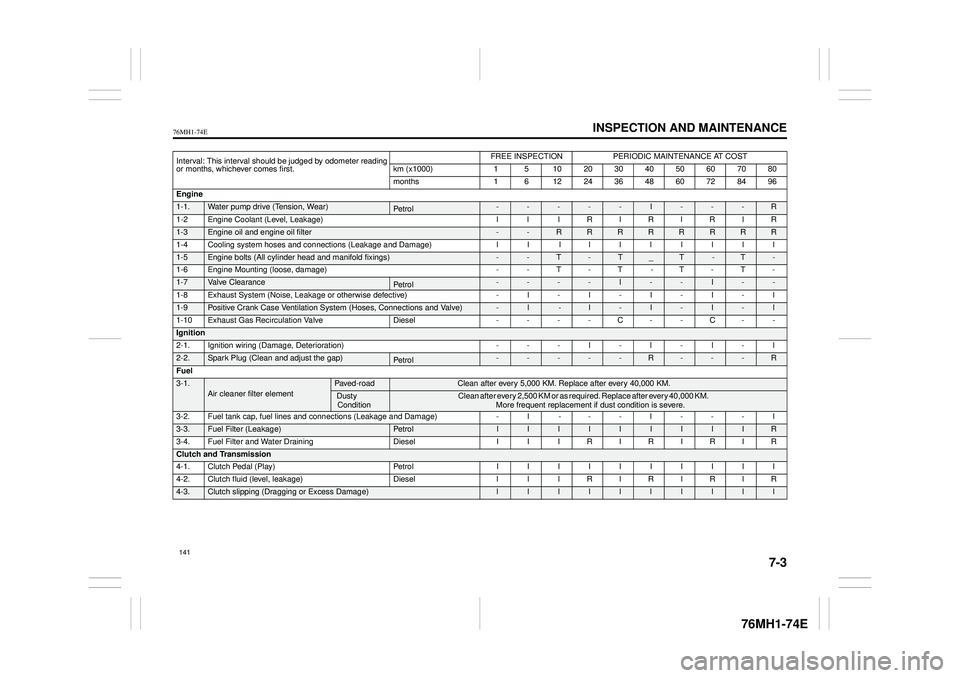
Interval: This interval should be judged by odometer reading or months, whichever comes first.
FREE INSPECTIONPERIODIC MAINTENANCE AT COST
km (x1000) 1 5 10 20 30 40 50 60 70 80
months 1 6 12 24 36 48 60 72 84 96
Engine
1-1.Water pump drive (Tension, Wear)Pe tro l-----I---R
1-2Engine Coolant (Level, Leakage) l l lRlRlRlR
1-3Engine oil and engine oil filter --RRRRRRRR
1-4 Cooling system hoses and connections (Leakage and Damage) l l l l llllll
1-5Engine bolts (All cylinder head and manifold fixings)--T-T_T -T-
1-6 Engine Mounting (loose, damage) - - T - T - T - T -
1-7Valve ClearancePe tro l----I--I--
1-8Exhaust System (Noise, Leakage or otherwise defective)
-l -l-I-I-l
1-10 Exhaust Gas Recirculation Valve Diesel - - - - C - - C - -
Ignition
2-1.Ignition wiring (Damage, Deterioration)---l-l-l-l
2-2.Spark Plug (Clean and adjust the gap)-----R---R
Fuel
3-1.Air cleaner filter elementPaved-road Clean after every 5,000 KM. Replace after every 40,000 KM.
Dusty Condition C l e a n a f t e r e v e r y 2 , 5 0 0 K M o r a s r e q u i r e d . R e p l a c e a f t e r e v e r y 4 0 , 0 0 0 K M . More frequent replacement if dust condition is severe.
3-2.Fuel tank cap, fuel lines and connections (Leakage and Damage)-l ---l---l
3-3.Fuel Filter (Leakage)Pe tro lIIIIIIIIIR
3-4.Fuel Filter and Water DrainingDieselIIIRIRIRIR
Clutch and Transmission
4-1.Clutch Pedal (Play)IIIIIIIIII
4-2.Clutch fluid (level, leakage)DiesellllRlRlRlR
4-3.Clutch slipping (Dragging or Excess Damage)llllllllll
141
Page 154 of 201
7-5
INSPECTION AND MAINTENANCE
76MH1-74E
76MH1-74E
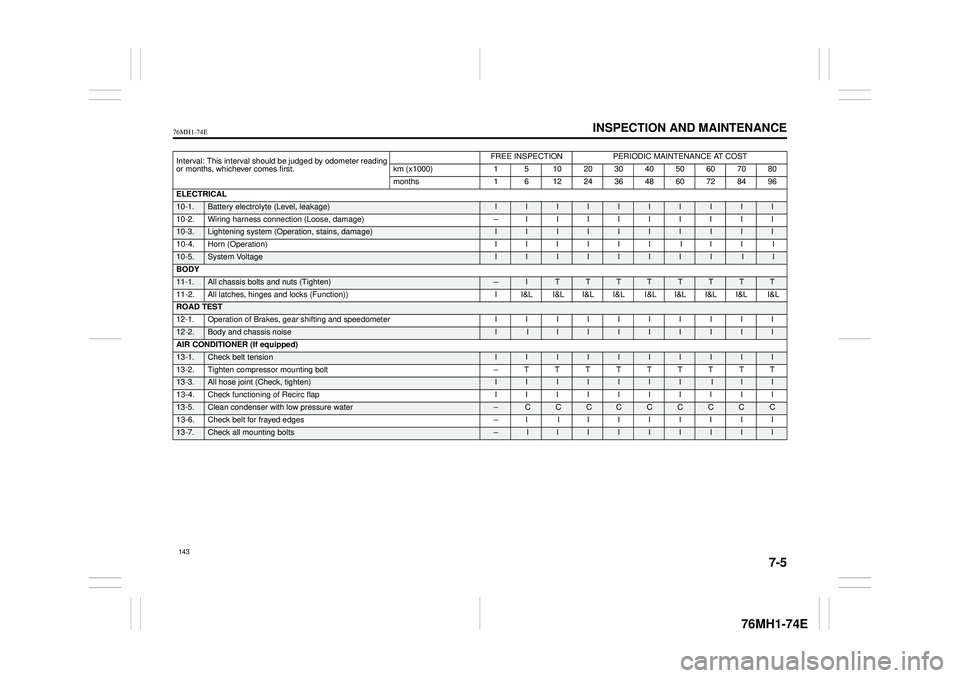
Interval: This interval should be judged by odometer reading or months, whichever comes first.
FREE INSPECTIONPERIODIC MAINTENANCE AT COST
km (x1000) 1 5 10 20 30 40 50 60 70 80
months 1 6 12 24 36 48 60 72 84 96
ELECTRICAL
10-1. Battery electrolyte (Level, leakage) I I I I I I I I I I
10-2. Wiring harness connection (Loose, damage) – I I I I I I I I I
10-3. Lightening system (Operat ion, stains, damage) I I I I I I I I I I
10-4. Horn (Operation) I I I I I I I I I I
10-5.System Voltage II I I I I I I I I
BODY
11-1. All chassis bolts and nuts (Tighten) – I T T T T T T T T
11-2. All latches, hinges and locks (Function)) I I&L I&L I&L I&L I&L I&L I&L I&L I&L
ROAD TEST
12-1. Operation of Brakes, gear shifting and speedometer I I I I I I I I I I
12-2.Body and chassis noise I I I I I I I I I I
AIR CONDITIONER (If equipped)
13-1. Check belt tension I I I I I I I I I I
13-2. Tighten compressor mounting bolt – T T T T T T T T T
13-3. All hose joint (Check, tighten) I I I I II I I I I
13-4. Check functioning of Recirc flap I I I I I I I I I I
13-5. Clean condenser with low pressure water – C C CCC C C C C
13-6. Check belt for frayed edges – I I I I I I I I I
13-7.Check all mounting bolts – I I I I I I I I I
143
Page 155 of 201
7-6
INSPECTION AND MAINTENANCE
76MH1-74E
76MH1-74E
Drive Belt
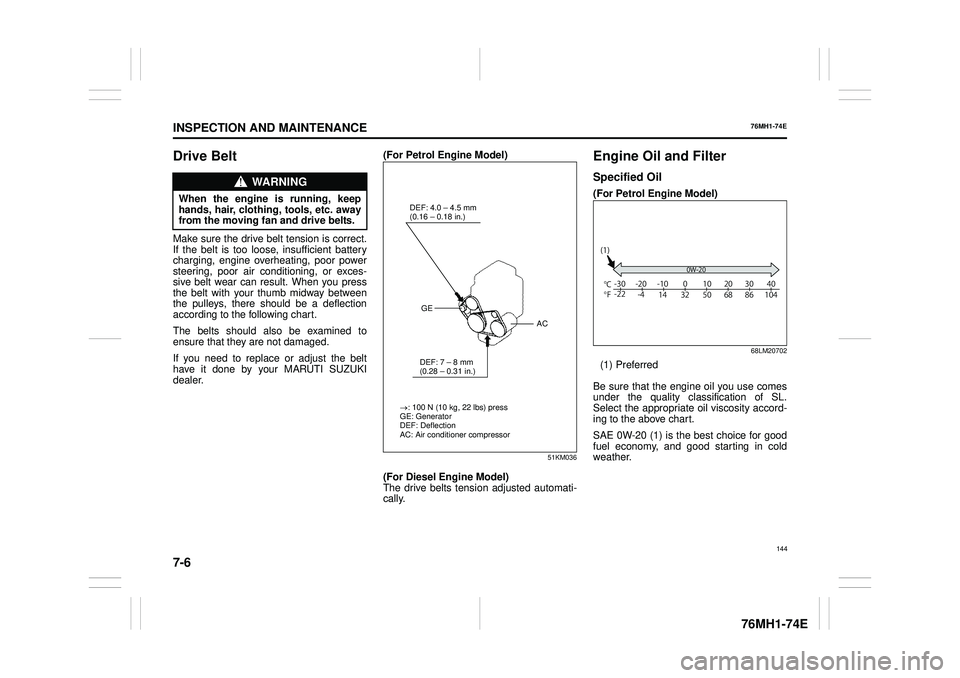
Make sure the drive belt tension is correct. If the belt is too loos e, insufficient battery charging, engine overheating, poor powersteering, poor air conditioning, or exces- sive belt wear can result. When you press the belt with your thumb midway betweenthe pulleys, there should be a deflection according to the following chart.
The belts should also be examined to ensure that they are not damaged.
If you need to replace or adjust the belt have it done by your MARUTI SUZUKI dealer.
(For Petrol Engine Model)
51KM036
(For Diesel Engine Model) The drive belts tens ion adjusted automati- cally.
Engine Oil and Filter
Specified Oil
(For Petrol Engine Model)
68LM20702
(1) Preferred
Be sure that the engine oil you use comes under the quality classification of SL.Select the appropriate oil viscosity accord- ing to the above chart.
SAE 0W-20 (1) is the best choice for good fuel economy, and good starting in cold weather.
WA R N I N G
When the engine is running, keephands, hair, clothing, tools, etc. away from the moving fan and drive belts.
: 100 N (10 kg, 22 lbs) press GE: Generator DEF: DeflectionAC: Air conditioner compressor
DEF: 4.0 – 4.5 mm (0.16
Page 180 of 201
7-31
INSPECTION AND MAINTENANCE
76MH1-74E
76MH1-74E
65D151
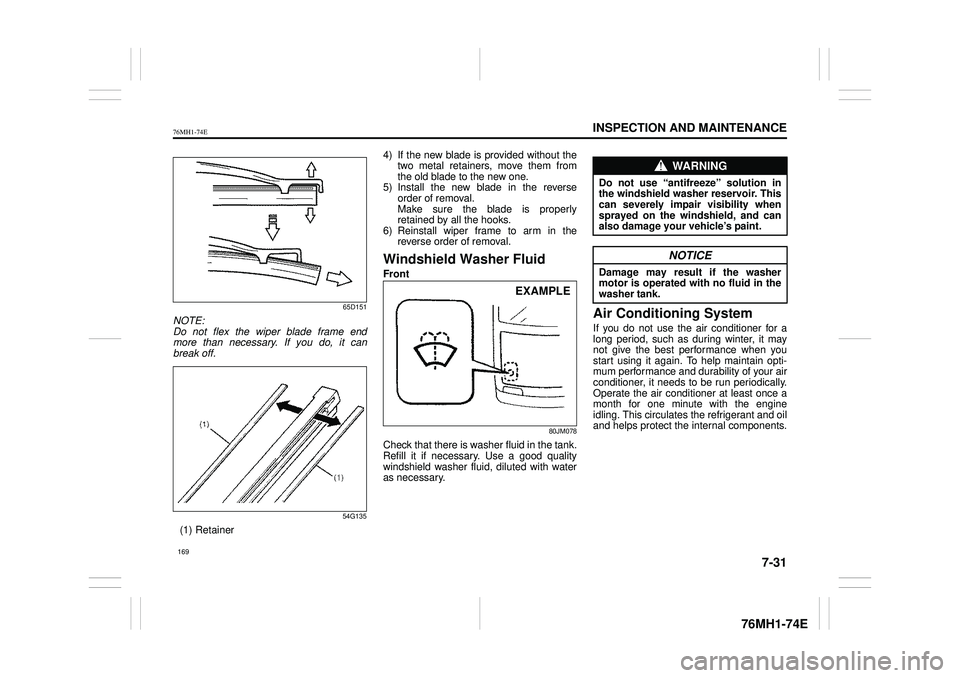
NOTE: Do not flex the wiper blade frame end more than necessary. If you do, it canbreak off.
54G135
(1) Retainer
4) If the new blade is provided without the two metal retainers, move them from the old blade to the new one.5) Install the new blade in the reverse order of removal. Make sure the blade is properlyretained by all the hooks. 6) Reinstall wiper frame to arm in the reverse order of removal.
Windshield Washer Fluid
Front
80JM078
Check that there is washer fluid in the tank.Refill it if necessary. Use a good quality windshield washer fluid, diluted with water as necessary.
Air Conditioning System
If you do not use the air conditioner for along period, such as during winter, it maynot give the best performance when you start using it again. To help maintain opti- mum performance and durability of your airconditioner, it needs to be run periodically. Operate the air condit ioner at least once a month for one minute with the engineidling. This circulates the refrigerant and oil and helps protect the internal components.
EXAMPLE
WA R N I N G
Do not use “antifreeze” solution in the windshield washer reservoir. Thiscan severely impair visibility when sprayed on the windshield, and can also damage your vehicle’s paint.
NOTICE
Damage may result if the washermotor is operated with no fluid in the washer tank.
169
Page 185 of 201

8-4
EMERGENCY SERVICE
76MH1-74E
76MH1-74E
Full Wheel Cover (if equipped)
60G309
Insert a piece of cloth between the spokes of the wheel cover and try to pull the cover outward (as shown in figure). Take out thedetached wheel cover from the wheel rim. For installation first match the slot at the wheel cover with the air filling nozzle of the wheel. Apply equal pressure at the circum- ference of the wheel cover to fix it in thewheel rim.
74LHT0860
When installing the cover, make sure that itis positioned so that it does not cover orfoul the air valve.
Jump Starting Instructions
When Jump Starting Your Vehicle,
Use the Following Procedure:1) Use only a 12-volt battery to jump start your vehicle. Position the good 12-volt battery close to your vehicle so that thejump leads will reach both batteries. When using a battery installed on another vehicle, DO NOT LET THEVEHICLES TOUCH. Set the parking brakes fully on both vehicles. 2) Turn off all vehicle accessories, exceptthose necessary for safety reasons (for example, headlights or hazard lights).
54MN259
EXAMPLE
EXAMPLE
WA R N I N G
• Never attempt to jump start your vehicle if the battery appears to be frozen. Batteries in this condition may explode or rupture if jumpstarting is attempted. • When making jump lead connec- tions, be certain that your handsand the jump leads remain clear from pulleys, belts, or fans. • Batteries produce flammablehydrogen gas. Keep flames and sparks away from the battery or an explosion may occur. Never smokewhen working in the vicinity of the battery. • If the booster battery you use forjump starting is installed in another vehicle, make sure the two vehicles are not touching each other.• If your battery discharges repeat- edly, for no apparent reason, have your vehicle inspected by anauthorized MARUTI SUZUKI dealer. • To avoid harm to yourself or dam- age to your vehicl e or battery, fol- low the jump starting instructions below precisely and in order. If you are in doubt, call for qualifiedroad service.
NOTICE
Your vehicle should not be started bypushing or towing. This startingmethod could result in permanent damage to the ca talytic converter. Use jump leads to start a vehicle witha weak or flat battery.
(2)
(1)
(3)2 3
4
1
EXAMPLE
174
Page 187 of 201
8-6
EMERGENCY SERVICE
76MH1-74E
76MH1-74E
If the Starter Does Not
Operate
1) Try turning the ignition switch to the “START” position with the headlights turned on to determine the battery con- dition. If the headlights go excessivelydim or go off, it usually means that either the battery is flat or the battery terminal contact is poor. Recharge thebattery or correct battery terminal con- tact as necessary. 2) If the headlights remain bright, checkthe fuses. If the reason for failure of the starter is not obvious, there may be a major electrical problem. Have the vehi-cle inspected by your authorized MAR- UTI SUZUKI dealer.
If the Engine is Flooded
If the engine is flooded with petrol, it may be hard to start. If this happens, press theaccelerator pedal all the way to the floor and hold it there while cranking the engine. For petrol engine model, do not operatethe starter motor for more than 12 sec- onds. For diesel engine model, do not operatethe starter motor for more than 30 sec- onds.
If the Engine Overheats
The engine could overheat temporarily under severe driving conditions. If the highengine coolant temperature warning light comes on as overheating during driving: 1) Turn off the air conditioner, if equipped.2) Take the vehicle to a safe place and park. 3) Let the engine run at the normal idlespeed for a few minutes until the high engine coolant temperature warning light goes off.
If the high engine coolant temperature warning light does not go off: 1) Turn off the engine and check that the water pump belt and pulleys are notdamaged or slipping. If any abnormality is found, correct it.
2) Check the coolant level in the reservoir. If it is found to be lower than the “LOW” line, look for leaks at the radiator, waterpump, and radiator and heater hoses. If you locate any leaks that may have caused the overheating, do not run theengine until these problems have been corrected. 3) If you do not find a leak, carefully addcoolant to the reservoir and then the radiator, if necessary. (Refer to “Engine Coolant” in the “INSPECTION ANDMAINTENANCE” section.)
NOTE: If your engine overheats and you are unsure what to do, contact your MARUTI SUZUKI dealer.
WA R N I N G
If you see or hear escaping steam,stop the vehicle in a safe place andimmediately turn off the engine to let it cool. Do not open the hood when steam is present. When the steamcan no longer be seen or heard, open the hood to see if the coolant is still boiling. If it is, you must wait until itstops boiling before you proceed.
176