lights SUZUKI CELERIO 2014 User Guide
[x] Cancel search | Manufacturer: SUZUKI, Model Year: 2014, Model line: CELERIO, Model: SUZUKI CELERIO 2014Pages: 201, PDF Size: 5.82 MB
Page 63 of 201
2-41
BEFORE DRIVING
76MH1-74E
76MH1-74E
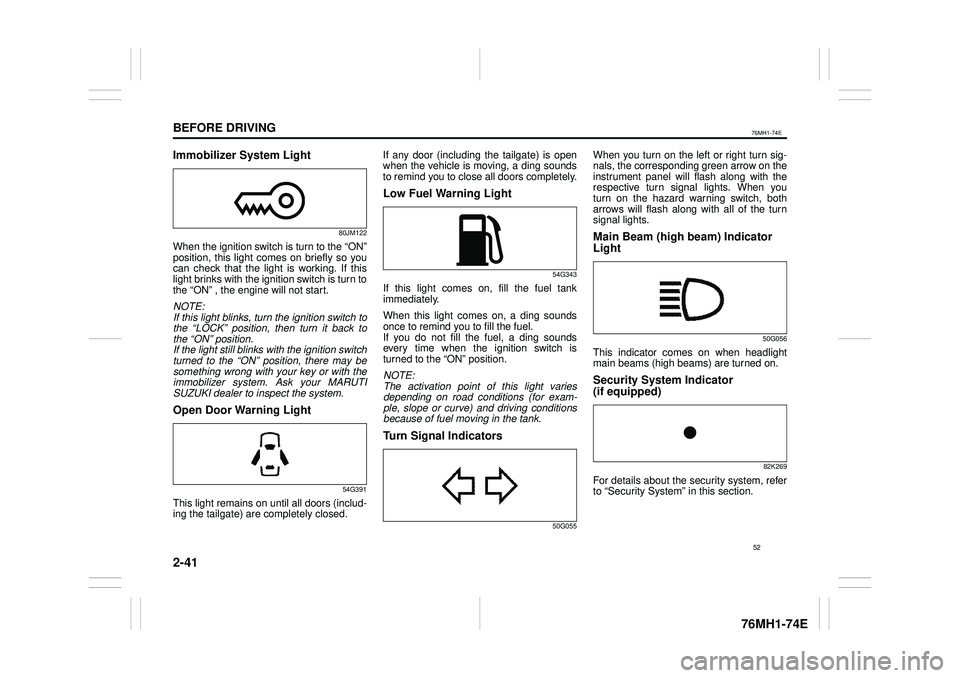
Immobilizer System Light
80JM122
When the ignition switch is turn to the “ON” position, this light comes on briefly so you can check that the light is working. If thislight brinks with the ignition switch is turn to the “ON” , the engine will not start.
NOTE: If this light blinks, turn the ignition switch to the “LOCK” position, then turn it back to the “ON” position. If the light still blinks with the ignition switchturned to the “ON” position, there may be something wrong with your key or with the immobilizer system. Ask your MARUTISUZUKI dealer to inspect the system.
Open Door Warning Light
54G391
This light remains on until all doors (includ-ing the tailgate) are completely closed.
If any door (including the tailgate) is open when the vehicle is moving, a ding sounds to remind you to close all doors completely.
Low Fuel Warning Light
54G343
If this light comes on, fill the fuel tankimmediately.
When this light comes on, a ding sounds once to remind you to fill the fuel. If you do not fill the fuel, a ding sounds every time when the ignition switch isturned to the “ON” position.
NOTE: The activation point of this light varies depending on road conditions (for exam- ple, slope or curve) and driving conditionsbecause of fuel moving in the tank.
Turn Signal Indicators
50G055
When you turn on the left or right turn sig- nals, the corresponding green arrow on the instrument panel will flash along with therespective turn signal lights. When you turn on the hazard warning switch, both arrows will flash along with all of the turnsignal lights.
Main Beam (high beam) Indicator
Light
50G056
This indicator comes on when headlight main beams (high beams) are turned on.
Security System Indicator
(if equipped)
82K269
For details about the security system, referto “Security System” in this section.
52
Page 64 of 201
2-42
BEFORE DRIVING
76MH1-74E
76MH1-74E
NOTE: If the security system indicator blinks whenthe ignition switch is in the “ON” position, there may be something wrong with the security system. Ask your MARUTI SUZUKI dealer to inspect the system.
Depress Brake Pedal Indicator (if equipped)
76MH0A047
Refer to “Auto Gear Shift” in the “OPERAT- ING YOUR VEHICLE” section for details.
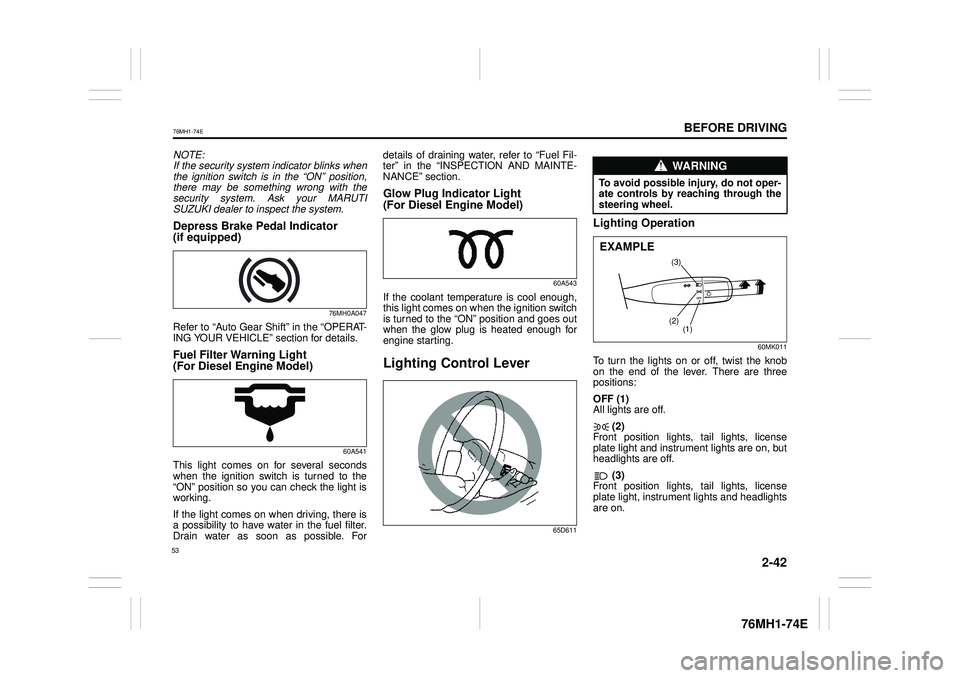
Fuel Filter Warning Light (For Diesel Engine Model)
60A541
This light comes on for several seconds when the ignition switch is turned to the “ON” position so you can check the light is working.
If the light comes on when driving, there is a possibility to have water in the fuel filter.Drain water as soon as possible. For
details of draining water, refer to “Fuel Fil- ter” in the “INSPECTION AND MAINTE- NANCE” section.
Glow Plug Indicator Light (For Diesel Engine Model)
60A543
If the coolant temperature is cool enough, this light comes on when the ignition switch is turned to the “ON” position and goes out when the glow plug is heated enough forengine starting.
Lighting Control Lever
65D611
Lighting Operation
60MK011
To turn the lights on or off, twist the knobon the end of the lever. There are threepositions:
OFF (1) All lights are off.
(2)Front position lights, tail lights, license plate light and instrument lights are on, but headlights are off.
(3)Front position lights, tail lights, licenseplate light, instrument lights and headlights are on.
WA R N I N G
To avoid possible injury, do not oper- ate controls by reaching through thesteering wheel.
(3)
(2)(1)
EXAMPLE
53
Page 65 of 201
2-43
BEFORE DRIVING
76MH1-74E
76MH1-74E
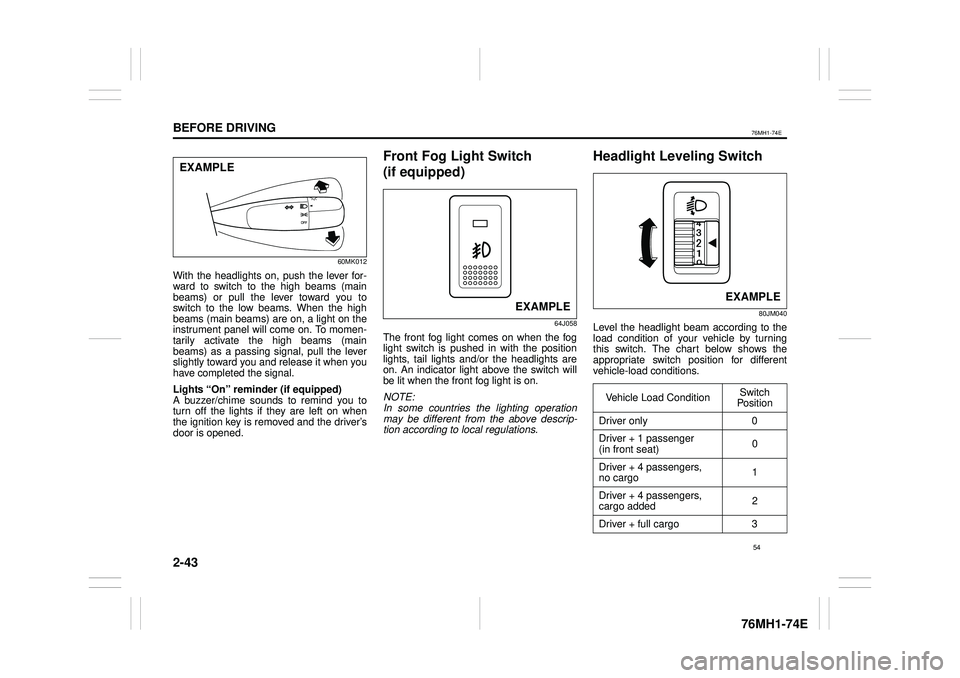
60MK012
With the headlights on, push the lever for- ward to switch to the high beams (mainbeams) or pull the lever toward you to switch to the low beams. When the high beams (main beams) are on, a light on theinstrument panel will come on. To momen- tarily activate the high beams (main beams) as a passing signal, pull the lever slightly toward you and release it when you have completed the signal.
Lights
Page 67 of 201
2-45
BEFORE DRIVING
76MH1-74E
76MH1-74E
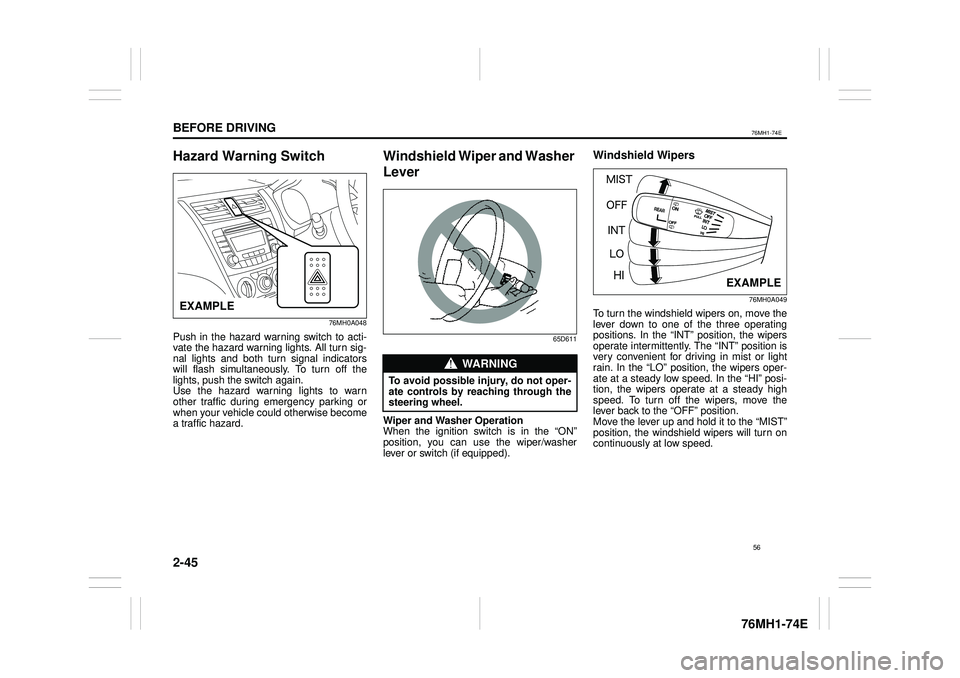
Hazard Warning Switch
76MH0A048
Push in the hazard warning switch to acti- vate the hazard warning lights. All turn sig-nal lights and both turn signal indicators will flash simultaneously. To turn off the lights, push the switch again.Use the hazard warning lights to warn other traffic during emergency parking or when your vehicle could otherwise becomea traffic hazard.
Windshield Wiper and Washer
Lever
65D611
Wiper and Washer Operation When the ignition switch is in the “ON”position, you can use the wiper/washer lever or switch (if equipped).
Windshield Wipers
76MH0A049
To turn the windshield wipers on, move the lever down to one of the three operating positions. In the “INT” position, the wipers operate intermittently. The “INT” position isvery convenient for driving in mist or light rain. In the “LO” position, the wipers oper- ate at a steady low speed. In the “HI” posi-tion, the wipers operate at a steady high speed. To turn off the wipers, move the lever back to the “OFF” position.Move the lever up and hold it to the “MIST” position, the windshield wipers will turn on continuously at low speed.
EXAMPLE
WA R N I N G
To avoid possible injury, do not oper- ate controls by reaching through the steering wheel.
EXAMPLE
56
Page 71 of 201
3-1
OPERATING YOUR VEHICLE
76MH1-74E
76MH1-74E
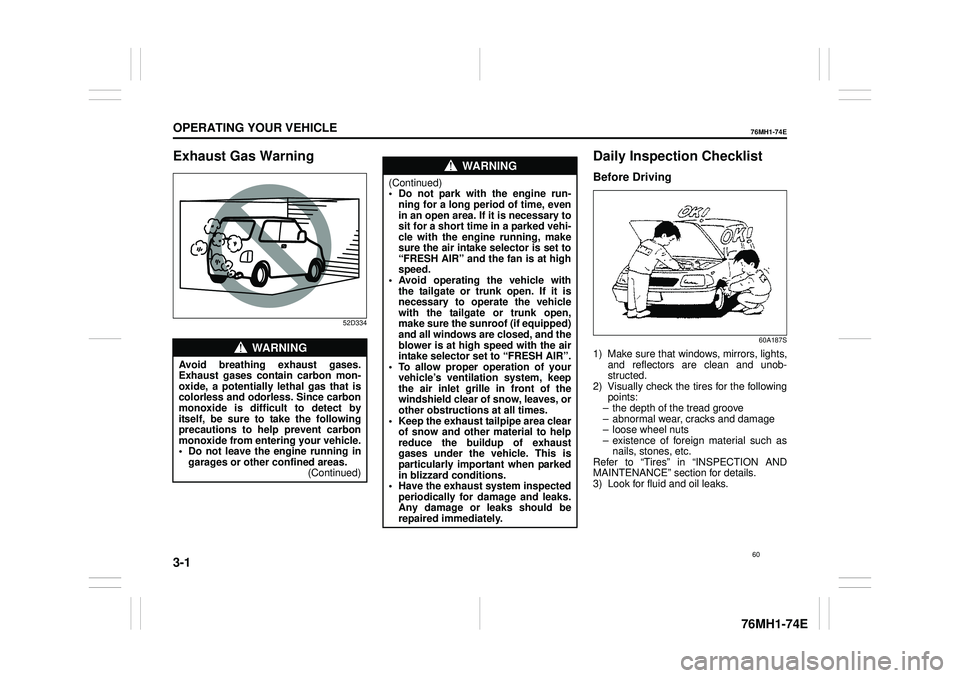
Exhaust Gas Warning
52D334
Daily Inspection Checklist
Before Driving
60A187S
1) Make sure that windows, mirrors, lights, and reflectors are clean and unob-structed. 2) Visually check the tires for the following points:– the depth of the tread groove – abnormal wear, cracks and damage – loose wheel nuts– existence of foreign material such as nails, stones, etc. Refer to “Tires” in “INSPECTION ANDMAINTENANCE” section for details. 3) Look for fluid and oil leaks.
WA R N I N G
Avoid breathing exhaust gases. Exhaust gases contain carbon mon- oxide, a potentially lethal gas that is colorless and odorless. Since carbonmonoxide is difficult to detect by itself, be sure to take the following precautions to help prevent carbonmonoxide from entering your vehicle. • Do not leave the engine running in garages or other confined areas.(Continued)
WA R N I N G
(Continued)• Do not park with the engine run- ning for a long period of time, even in an open area. If it is necessary to sit for a short time in a parked vehi- cle with the engine running, make sure the air intake selector is set to “FRESH AIR” and the fan is at highspeed. • Avoid operating the vehicle with the tailgate or trunk open. If it isnecessary to operate the vehicle with the tailgate or trunk open, make sure the sunroof (if equipped)and all windows are closed, and the blower is at high speed with the air intake selector set to “FRESH AIR”.• To allow proper operation of your vehicle’s ventilation system, keep the air inlet grille in front of thewindshield clear of snow, leaves, or other obstructions at all times. • Keep the exhaust tailpipe area clearof snow and other material to help reduce the buildup of exhaust gases under the vehicle. This isparticularly important when parked in blizzard conditions. • Have the exhaust system inspectedperiodically for damage and leaks. Any damage or leaks should be repaired immediately.
60
Page 72 of 201
3-2
OPERATING YOUR VEHICLE
76MH1-74E
76MH1-74E
NOTE: It is normal for water to drip from the air conditioning system after use.
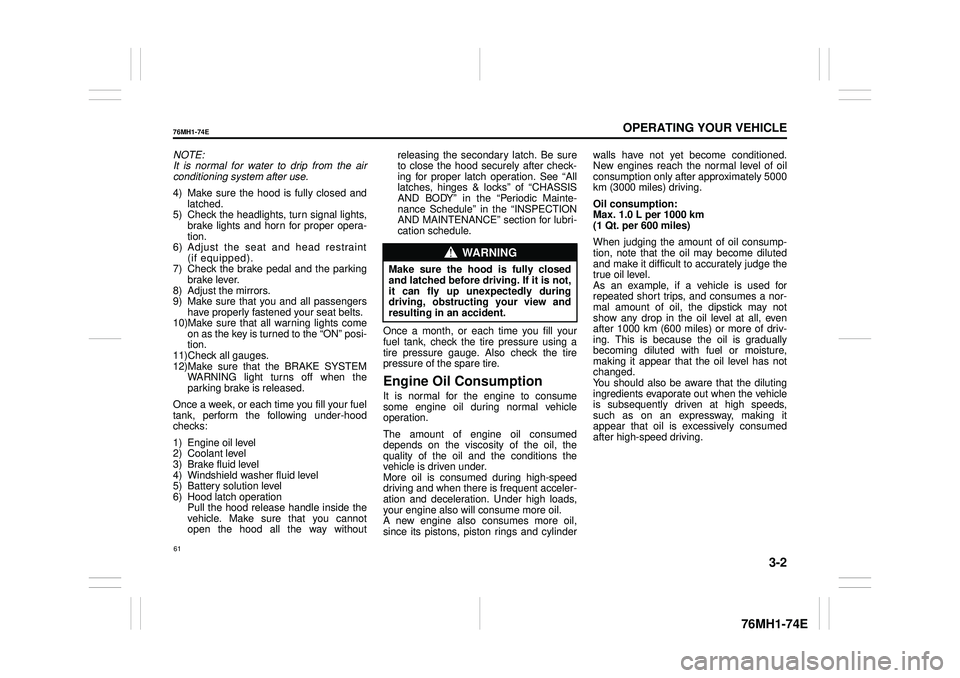
4) Make sure the hood is fully closed and latched.5) Check the headlights, turn signal lights, brake lights and horn for proper opera- tion.6) Adjust the seat and head restraint (if equipped). 7) Check the brake pedal and the parkingbrake lever. 8) Adjust the mirrors. 9) Make sure that you and all passengershave properly fastened your seat belts. 10)Make sure that all warning lights come on as the key is turned to the “ON” posi-tion. 11)Check all gauges. 12)Make sure that the BRAKE SYSTEMWARNING light turns off when the parking brake is released.
Once a week, or each time you fill your fuel tank, perform the following under-hood checks:
1) Engine oil level 2) Coolant level3) Brake fluid level 4) Windshield washer fluid level 5) Battery solution level6) Hood latch operation Pull the hood release handle inside the vehicle. Make sure that you cannotopen the hood all the way without
releasing the secondary latch. Be sure to close the hood securely after check- ing for proper latch operation. See “Alllatches, hinges & locks” of “CHASSIS AND BODY” in the “Periodic Mainte- nance Schedule” in the “INSPECTIONAND MAINTENANCE” section for lubri- cation schedule.
Once a month, or each time you fill your fuel tank, check the tire pressure using a tire pressure gauge. Also check the tirepressure of the spare tire.
Engine Oil Consumption
It is normal for the engine to consume some engine oil during normal vehicle operation.
The amount of engine oil consumed depends on the viscosity of the oil, thequality of the oil and the conditions the vehicle is driven under. More oil is consumed during high-speeddriving and when there is frequent acceler- ation and deceleration. Under high loads, your engine also will consume more oil.A new engine also consumes more oil, since its pistons, piston rings and cylinder
walls have not yet become conditioned. New engines reach the normal level of oil consumption only after approximately 5000km (3000 miles) driving.
Oil consumption: Max. 1.0 L per 1000 km (1 Qt. per 600 miles)
When judging the amount of oil consump- tion, note that the oil may become diluted and make it difficult to accurately judge thetrue oil level. As an example, if a vehicle is used for repeated short trips, and consumes a nor-mal amount of oil, the dipstick may not show any drop in the oil level at all, even after 1000 km (600 miles) or more of driv-ing. This is because the oil is gradually becoming diluted with fuel or moisture, making it appear that the oil level has notchanged. You should also be aware that the diluting ingredients evaporate out when the vehicleis subsequently driven at high speeds, such as on an expressway, making it appear that oil is excessively consumedafter high-speed driving.
WA R N I N G
Make sure the hood is fully closed and latched before driv ing. If it is not, it can fly up unexpectedly duringdriving, obstructing your view and resulting in an accident.
61
Page 90 of 201

4-2
DRIVING TIPS
76MH1-74E
76MH1-74E
54G584S
Improving Fuel Economy
The following instructions will help you improve fuel economy.
Avoid excessive idling If you are to wait for more than a minutewhile you are parked, stop the engine and start it again later. When warming up a cold engine, do not allow the engine to idleor apply full throttle until the engine has reached operating temperature. Allow the engine to warm up by driving.
Avoid “fast” starts Fast starts away from lights or stop signs will consume fuel unnecessarily andshorten engine life. Start off slowly.
Avoid unnecessary stops Avoid unnecessary deceleration and stop- ping. Try to maintain a slow, steady speed whenever possible. Slowing down and thenaccelerating again uses more fuel.
Keep a steady cruising speed Keep as constant a speed as road and traf- fic conditions will permit.
Keep the air cleaner clean
60A183S
If the air cleaner is clogged with dust, there will be greater intake resistance, resulting in decreased power output and increased fuel consumption.
NOTICE
To avoid damaging catalyst or othervehicle damage:• Maintain the engine in the properoperating condition.• In the event of an engine malfunc-tion, particularly one involving engine misfiring or other apparent loss of performance, have the vehi-cle serviced promptly.• Do not turn off the engine or inter-rupt the ignition when the transaxleis in gear and the vehicle is in motion.• Do not try to start the engine bypushing or towing the vehicle, orcoasting down a hill.• Do not idle the engine with anyspark plug wires disconnected orremoved, such as during diagnos- tic testing.• Do not idle the vehicle for pro-longed periods if idling seemsrough or there are other malfunc-tions.• Do not allow the fuel tank to getnear the empty level.• Avoid driving your vehicle atexcessively high engine speed inor around the red zone of thetachometer (if equipped).
WA R N I N G
Be careful in areas where you parkand drive; the catalytic converter and other exhaust components can get very hot. As with any vehicle, do not park or operate this vehicle in areas where combustible materials such asdry grass or leaves can come in con- tact with a hot exhaust system.
EXAMPLE
79
Page 172 of 201
7-23
INSPECTION AND MAINTENANCE
76MH1-74E
76MH1-74E
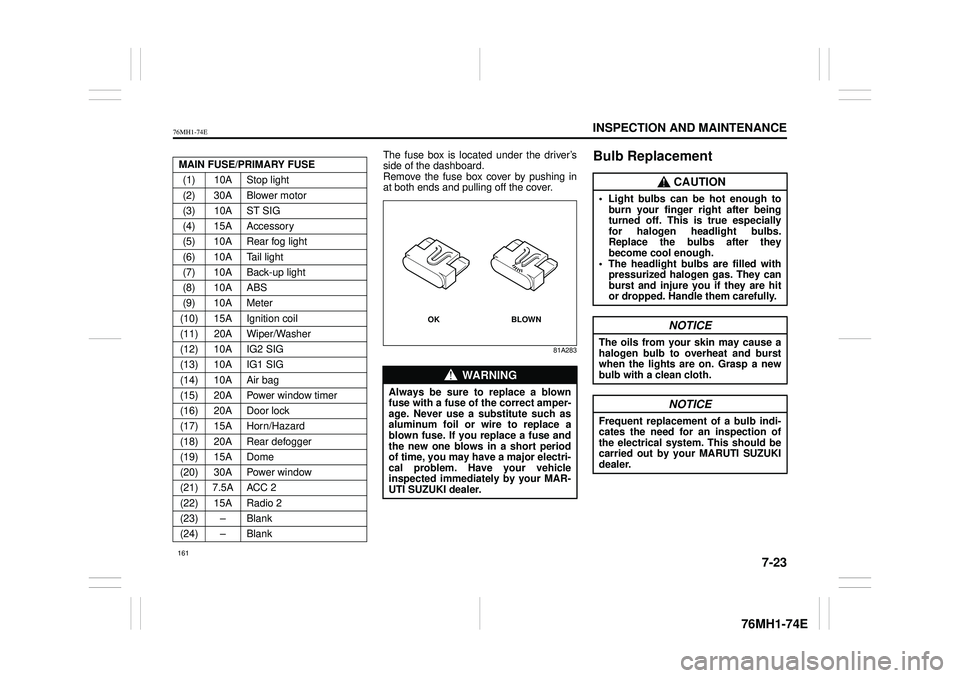
The fuse box is located under the driver’s side of the dashboard. Remove the fuse box cover by pushing inat both ends and pulling off the cover.
81A283
Bulb ReplacementMAIN FUSE/PRIMARY FUSE
(1) 10A Stop light
(2) 30A Blower motor
(3) 10A ST SIG
(4) 15A Accessory
(5) 10A Rear fog light
(6) 10A Tail light
(7) 10A Back-up light
(8) 10A ABS
(9) 10A Meter
(10) 15A Ignition coil
(11) 20A Wiper/Washer
(12) 10A IG2 SIG
(13) 10A IG1 SIG
(14) 10A Air bag
(15) 20A Power window timer
(16) 20A Door lock
(17) 15A Horn/Hazard
(18) 20A Rear defogger
(19) 15A Dome
(20) 30A Power window
(21) 7.5A ACC 2
(22) 15A Radio 2
(23) – Blank
(24) – Blank
WA R N I N G
Always be sure to replace a blown fuse with a fuse of the correct amper- age. Never use a substitute such as aluminum foil or wire to replace ablown fuse. If you replace a fuse and the new one blows in a short period of time, you may have a major electri-cal problem. Have your vehicle inspected immediately by your MAR- UTI SUZUKI dealer.
BLOWN OK
CAUTION
• Light bulbs can be hot enough toburn your finger right after being turned off. This is true especially for halogen headlight bulbs.Replace the bulbs after they become cool enough. • The headlight bulbs are filled withpressurized halogen gas. They can burst and injure you if they are hit or dropped. Handle them carefully.
NOTICE
The oils from your skin may cause ahalogen bulb to overheat and burst when the lights are on. Grasp a new bulb with a clean cloth.
NOTICE
Frequent replacement of a bulb indi-cates the need for an inspection of the electrical system. This should be carried out by your MARUTI SUZUKIdealer.
161
Page 173 of 201
7-24
INSPECTION AND MAINTENANCE
76MH1-74E
76MH1-74E
Headlights
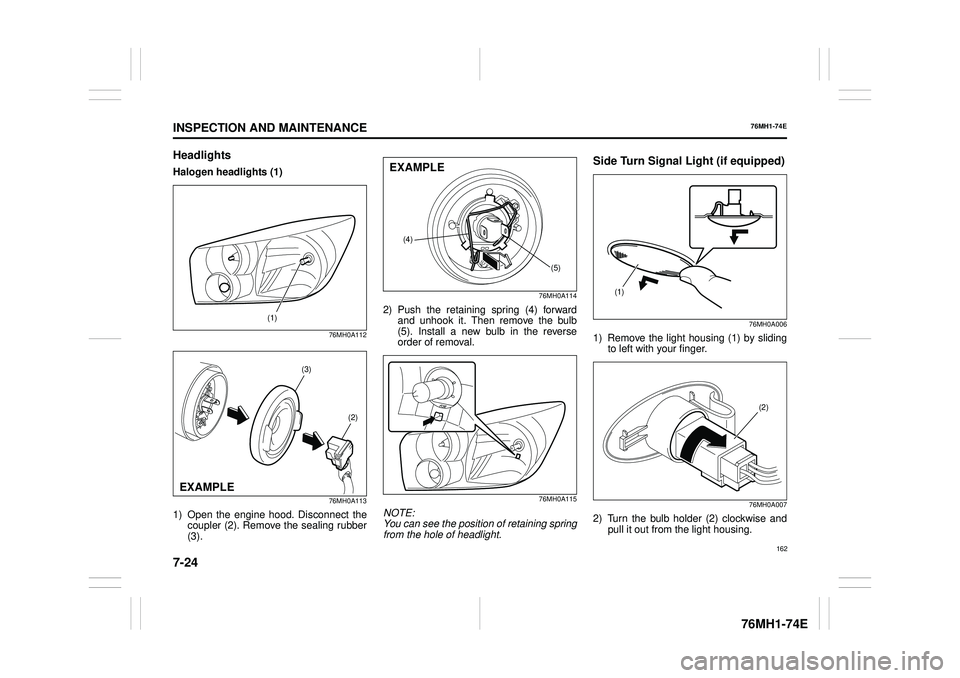
Halogen headlights (1)
76MH0A112
76MH0A113
1) Open the engine hood. Disconnect the coupler (2). Remove the sealing rubber(3).
76MH0A114
2) Push the retaining spring (4) forward and unhook it. Then remove the bulb(5). Install a new bulb in the reverse order of removal.
76MH0A115
NOTE: You can see the position of retaining springfrom the hole of headlight.
Side Turn Signal Light (if equipped)
76MH0A006
1) Remove the light housing (1) by sliding to left with your finger.
76MH0A007
2) Turn the bulb holder (2) clockwise and pull it out from the light housing.
(1)
(3)
(2)
EXAMPLE
(4)
(5)
EXAMPLE
(1)
(2)
162
Page 185 of 201

8-4
EMERGENCY SERVICE
76MH1-74E
76MH1-74E
Full Wheel Cover (if equipped)
60G309
Insert a piece of cloth between the spokes of the wheel cover and try to pull the cover outward (as shown in figure). Take out thedetached wheel cover from the wheel rim. For installation first match the slot at the wheel cover with the air filling nozzle of the wheel. Apply equal pressure at the circum- ference of the wheel cover to fix it in thewheel rim.
74LHT0860
When installing the cover, make sure that itis positioned so that it does not cover orfoul the air valve.
Jump Starting Instructions
When Jump Starting Your Vehicle,
Use the Following Procedure:1) Use only a 12-volt battery to jump start your vehicle. Position the good 12-volt battery close to your vehicle so that thejump leads will reach both batteries. When using a battery installed on another vehicle, DO NOT LET THEVEHICLES TOUCH. Set the parking brakes fully on both vehicles. 2) Turn off all vehicle accessories, exceptthose necessary for safety reasons (for example, headlights or hazard lights).
54MN259
EXAMPLE
EXAMPLE
WA R N I N G
• Never attempt to jump start your vehicle if the battery appears to be frozen. Batteries in this condition may explode or rupture if jumpstarting is attempted. • When making jump lead connec- tions, be certain that your handsand the jump leads remain clear from pulleys, belts, or fans. • Batteries produce flammablehydrogen gas. Keep flames and sparks away from the battery or an explosion may occur. Never smokewhen working in the vicinity of the battery. • If the booster battery you use forjump starting is installed in another vehicle, make sure the two vehicles are not touching each other.• If your battery discharges repeat- edly, for no apparent reason, have your vehicle inspected by anauthorized MARUTI SUZUKI dealer. • To avoid harm to yourself or dam- age to your vehicl e or battery, fol- low the jump starting instructions below precisely and in order. If you are in doubt, call for qualifiedroad service.
NOTICE
Your vehicle should not be started bypushing or towing. This startingmethod could result in permanent damage to the ca talytic converter. Use jump leads to start a vehicle witha weak or flat battery.
(2)
(1)
(3)2 3
4
1
EXAMPLE
174