battery SUZUKI CELERIO 2014 Owner's Manual
[x] Cancel search | Manufacturer: SUZUKI, Model Year: 2014, Model line: CELERIO, Model: SUZUKI CELERIO 2014Pages: 201, PDF Size: 5.82 MB
Page 168 of 201
7-19
INSPECTION AND MAINTENANCE
76MH1-74E
76MH1-74E
Tire Rotation
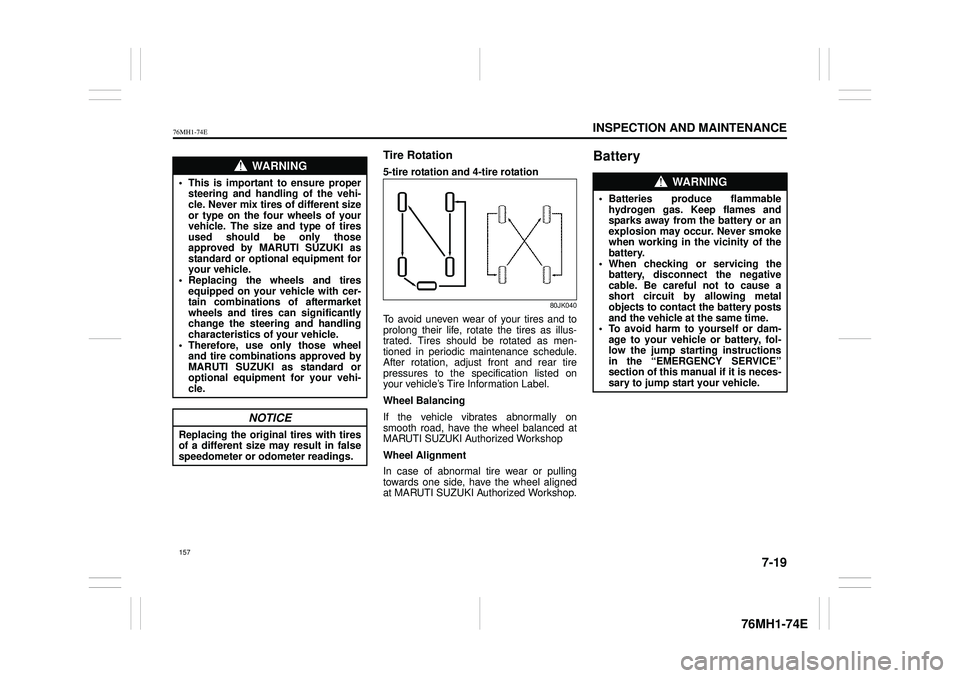
5-tire rotation and 4-tire rotation
80JK040
To avoid uneven wear of your tires and to prolong their life, rotate the tires as illus- trated. Tires should be rotated as men-tioned in periodic maintenance schedule. After rotation, adjust front and rear tire pressures to the specification listed onyour vehicle’s Tire Information Label.
Wheel Balancing
If the vehicle vibrates abnormally on smooth road, have the wheel balanced atMARUTI SUZUKI Authorized Workshop
Wheel Alignment
In case of abnormal tire wear or pulling towards one side, have the wheel aligned at MARUTI SUZUKI Authorized Workshop.
BatteryWA R N I N G
• This is important to ensure propersteering and handling of the vehi-cle. Never mix tires of different size or type on the four wheels of your vehicle. The size and type of tiresused should be only those approved by MARUTI SUZUKI as standard or optional equipment foryour vehicle. • Replacing the wheels and tires equipped on your vehicle with cer-tain combinations of aftermarket wheels and tires can significantly change the steering and handlingcharacteristics of your vehicle. • Therefore, use only those wheel and tire combinations approved byMARUTI SUZUKI as standard or optional equipment for your vehi- cle.
NOTICE
Replacing the original tires with tires of a different size may result in false speedometer or odometer readings.
WA R N I N G
• Batteries produce flammable hydrogen gas. Keep flames and sparks away from the battery or an explosion may occur. Never smokewhen working in the vicinity of the battery. • When checking or servicing thebattery, disconnect the negative cable. Be careful not to cause a short circuit by allowing metalobjects to contact the battery posts and the vehicle at the same time. • To avoid harm to yourself or dam-age to your vehicl e or battery, fol- low the jump starting instructions in the “EMERGENCY SERVICE”section of this manual if it is neces- sary to jump start your vehicle.
157
Page 169 of 201
7-20
INSPECTION AND MAINTENANCE
76MH1-74E
76MH1-74E
76MH0A136
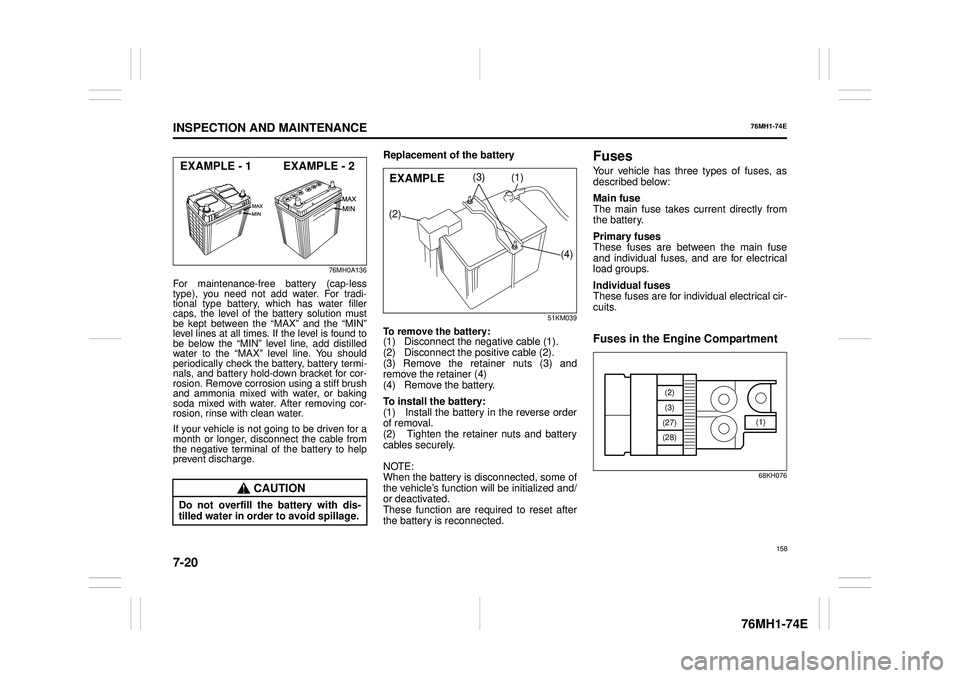
For maintenance-free battery (cap-less type), you need not add water. For tradi-tional type battery, which has water filler caps, the level of the battery solution must be kept between the “MAX” and the “MIN”level lines at all times. If the level is found tobe below the “MIN” level line, add distilledwater to the “MAX” level line. You shouldperiodically check the battery, battery termi- nals, and battery hold-down bracket for cor- rosion. Remove corrosion using a stiff brushand ammonia mixed with water, or bakingsoda mixed with water. After removing cor-rosion, rinse with clean water.
If your vehicle is not going to be driven for amonth or longer, disconnect the cable fromthe negative terminal of the battery to help prevent discharge.
Replacement of the battery
51KM039
To remove the battery: (1) Disconnect the negative cable (1). (2) Disconnect the positive cable (2). (3) Remove the retainer nuts (3) andremove the retainer (4) (4) Remove the battery.
To install the battery: (1) Install the battery in the reverse order of removal. (2) Tighten the retainer nuts and battery cables securely.
NOTE: When the battery is disconnected, some of the vehicle’s function will be initialized and/or deactivated. These function are required to reset after the battery is reconnected.
Fuses
Your vehicle has three types of fuses, asdescribed below:
Main fuse The main fuse takes current directly fromthe battery.
Primary fuses These fuses are between the main fuse and individual fuses, and are for electrical load groups.
Individual fuses These fuses are for individual electrical cir-cuits.
Fuses in the Engine Compartment
68KH076
CAUTION
Do not overfill th e battery with dis- tilled water in order to avoid spillage.
EXAMPLE - 1 EXAMPLE - 2(1)
(2)
(3)
(4)
EXAMPLE
(1)
(2)
(3)
(27)
(28)
158
Page 185 of 201

8-4
EMERGENCY SERVICE
76MH1-74E
76MH1-74E
Full Wheel Cover (if equipped)
60G309
Insert a piece of cloth between the spokes of the wheel cover and try to pull the cover outward (as shown in figure). Take out thedetached wheel cover from the wheel rim. For installation first match the slot at the wheel cover with the air filling nozzle of the wheel. Apply equal pressure at the circum- ference of the wheel cover to fix it in thewheel rim.
74LHT0860
When installing the cover, make sure that itis positioned so that it does not cover orfoul the air valve.
Jump Starting Instructions
When Jump Starting Your Vehicle,
Use the Following Procedure:1) Use only a 12-volt battery to jump start your vehicle. Position the good 12-volt battery close to your vehicle so that thejump leads will reach both batteries. When using a battery installed on another vehicle, DO NOT LET THEVEHICLES TOUCH. Set the parking brakes fully on both vehicles. 2) Turn off all vehicle accessories, exceptthose necessary for safety reasons (for example, headlights or hazard lights).
54MN259
EXAMPLE
EXAMPLE
WA R N I N G
• Never attempt to jump start your vehicle if the battery appears to be frozen. Batteries in this condition may explode or rupture if jumpstarting is attempted. • When making jump lead connec- tions, be certain that your handsand the jump leads remain clear from pulleys, belts, or fans. • Batteries produce flammablehydrogen gas. Keep flames and sparks away from the battery or an explosion may occur. Never smokewhen working in the vicinity of the battery. • If the booster battery you use forjump starting is installed in another vehicle, make sure the two vehicles are not touching each other.• If your battery discharges repeat- edly, for no apparent reason, have your vehicle inspected by anauthorized MARUTI SUZUKI dealer. • To avoid harm to yourself or dam- age to your vehicl e or battery, fol- low the jump starting instructions below precisely and in order. If you are in doubt, call for qualifiedroad service.
NOTICE
Your vehicle should not be started bypushing or towing. This startingmethod could result in permanent damage to the ca talytic converter. Use jump leads to start a vehicle witha weak or flat battery.
(2)
(1)
(3)2 3
4
1
EXAMPLE
174
Page 186 of 201
8-5
EMERGENCY SERVICE
76MH1-74E
76MH1-74E
3) Make jump lead connections as follows:
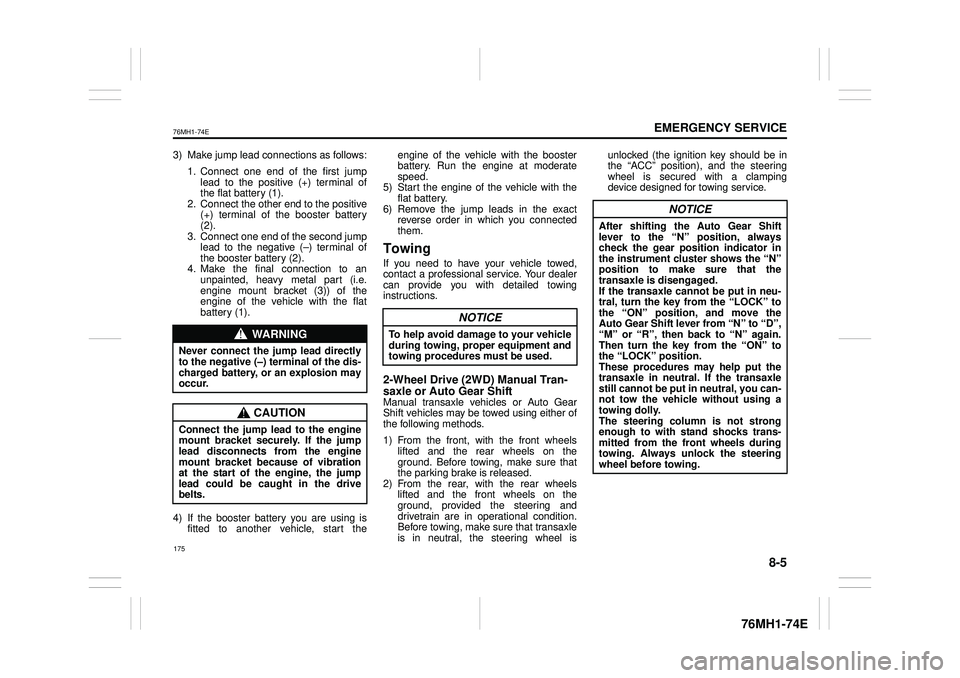
1. Connect one end of the first jump lead to the positive (+) terminal of the flat battery (1). 2. Connect the other end to the positive(+) terminal of the booster battery (2). 3. Connect one end of the second jumplead to the negative (–) terminal of the booster battery (2). 4. Make the final connection to anunpainted, heavy metal part (i.e. engine mount bracket (3)) of the engine of the vehicle with the flatbattery (1).
4) If the booster battery you are using is fitted to another vehicle, start the
engine of the vehicle with the booster battery. Run the engine at moderate speed.5) Start the engine of the vehicle with the flat battery. 6) Remove the jump leads in the exactreverse order in which you connected them.
Towing
If you need to have your vehicle towed, contact a professional service. Your dealercan provide you with detailed towing instructions.
2-Wheel Drive (2WD) Manual Tran- saxle or Auto Gear ShiftManual transaxle vehicles or Auto Gear Shift vehicles may be towed using either of the following methods.
1) From the front, with the front wheels lifted and the rear wheels on the ground. Before towing, make sure thatthe parking brake is released. 2) From the rear, with the rear wheels lifted and the front wheels on theground, provided the steering and drivetrain are in operational condition. Before towing, make sure that transaxleis in neutral, the steering wheel is
unlocked (the ignition key should be in the “ACC” position), and the steering wheel is secured with a clampingdevice designed for towing service.
WA R N I N G
Never connect the jump lead directlyto the negative (–) terminal of the dis- charged battery, or an explosion may occur.
CAUTION
Connect the jump le ad to the engine mount bracket securely. If the jump lead disconnects from the engine mount bracket because of vibrationat the start of the engine, the jump lead could be caught in the drive belts.
NOTICE
To help avoid damage to your vehicle during towing, proper equipment and towing procedures must be used.
NOTICE
After shifting the Auto Gear Shiftlever to the “N” position, always check the gear position indicator in the instrument cluster shows the “N”position to make sure that the transaxle is disengaged. If the transaxle cannot be put in neu-tral, turn the key from the “LOCK” to the “ON” position, and move the Auto Gear Shift lever from “N” to “D”,“M” or “R”, then back to “N” again. Then turn the key from the “ON” to the “LOCK” position.These procedures may help put the transaxle in neutral. If the transaxle still cannot be put in neutral, you can-not tow the vehicle without using a towing dolly. The steering column is not strongenough to with stand shocks trans- mitted from the fr ont wheels during towing. Always unlock the steeringwheel before towing.
175
Page 187 of 201
8-6
EMERGENCY SERVICE
76MH1-74E
76MH1-74E
If the Starter Does Not
Operate
1) Try turning the ignition switch to the “START” position with the headlights turned on to determine the battery con- dition. If the headlights go excessivelydim or go off, it usually means that either the battery is flat or the battery terminal contact is poor. Recharge thebattery or correct battery terminal con- tact as necessary. 2) If the headlights remain bright, checkthe fuses. If the reason for failure of the starter is not obvious, there may be a major electrical problem. Have the vehi-cle inspected by your authorized MAR- UTI SUZUKI dealer.
If the Engine is Flooded
If the engine is flooded with petrol, it may be hard to start. If this happens, press theaccelerator pedal all the way to the floor and hold it there while cranking the engine. For petrol engine model, do not operatethe starter motor for more than 12 sec- onds. For diesel engine model, do not operatethe starter motor for more than 30 sec- onds.
If the Engine Overheats
The engine could overheat temporarily under severe driving conditions. If the highengine coolant temperature warning light comes on as overheating during driving: 1) Turn off the air conditioner, if equipped.2) Take the vehicle to a safe place and park. 3) Let the engine run at the normal idlespeed for a few minutes until the high engine coolant temperature warning light goes off.
If the high engine coolant temperature warning light does not go off: 1) Turn off the engine and check that the water pump belt and pulleys are notdamaged or slipping. If any abnormality is found, correct it.
2) Check the coolant level in the reservoir. If it is found to be lower than the “LOW” line, look for leaks at the radiator, waterpump, and radiator and heater hoses. If you locate any leaks that may have caused the overheating, do not run theengine until these problems have been corrected. 3) If you do not find a leak, carefully addcoolant to the reservoir and then the radiator, if necessary. (Refer to “Engine Coolant” in the “INSPECTION ANDMAINTENANCE” section.)
NOTE: If your engine overheats and you are unsure what to do, contact your MARUTI SUZUKI dealer.
WA R N I N G
If you see or hear escaping steam,stop the vehicle in a safe place andimmediately turn off the engine to let it cool. Do not open the hood when steam is present. When the steamcan no longer be seen or heard, open the hood to see if the coolant is still boiling. If it is, you must wait until itstops boiling before you proceed.
176
Page 197 of 201
11-2
SPECIFICATIONS
76MH1-74E
76MH1-74E
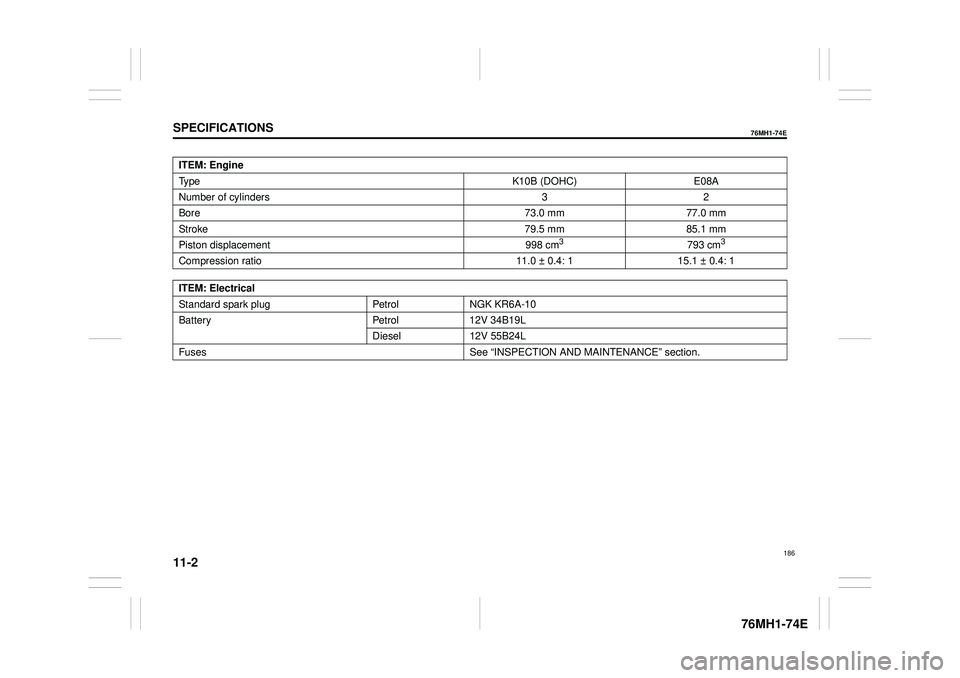
ITEM: Engine
Type K10B (DOHC) E08A
Number of cylinders 3 2
Bore 73.0 mm 77.0 mm
Stroke 79.5 mm 85.1 mm
Piston displacement 998 cm3793 cm3
Compression ratio 11.0 ± 0.4: 1 15.1 ± 0.4: 1
ITEM: Electrical
Standard spark plug Petrol NGK KR6A-10
Battery Petrol 12V 34B19L
Diesel 12V 55B24L
Fuses See “INSPECTION AND MAINTENANCE” section.
186