Control SUZUKI CELERIO 2015 Owner's Manual
[x] Cancel search | Manufacturer: SUZUKI, Model Year: 2015, Model line: CELERIO, Model: SUZUKI CELERIO 2015Pages: 201, PDF Size: 5.82 MB
Page 73 of 201
3-3
OPERATING YOUR VEHICLE
76MH1-74E
76MH1-74E
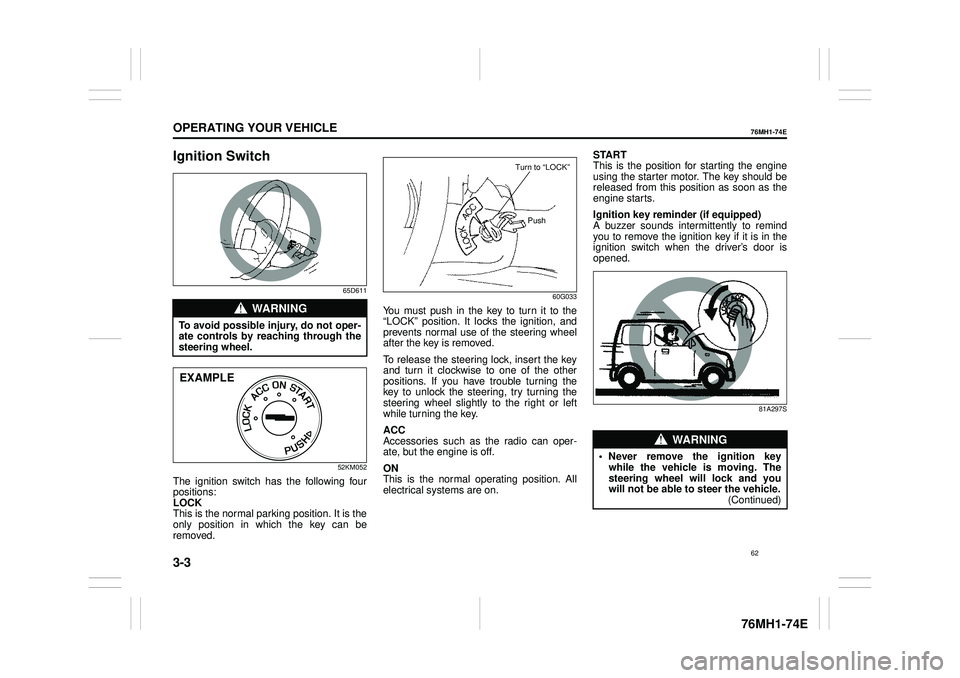
Ignition Switch
65D611
52KM052
The ignition switch has the following four positions: LOCK This is the normal parking position. It is theonly position in which the key can be removed.
60G033
You must push in the key to turn it to the “LOCK” position. It lo cks the ignition, and prevents normal use of the steering wheel after the key is removed.
To release the steering lock, insert the key and turn it clockwise to one of the other positions. If you have trouble turning thekey to unlock the steering, try turning the steering wheel slightly to the right or left while turning the key.
ACC Accessories such as the radio can oper-ate, but the engine is off.
ON This is the normal operating position. All electrical systems are on.
START This is the position for starting the engine using the starter motor. The key should bereleased from this position as soon as the engine starts.
Ignition key reminder (if equipped) A buzzer sounds intermittently to remind you to remove the ignition key if it is in theignition switch when the driver’s door is opened.
81A297S
WA R N I N G
To avoid possible injury, do not oper- ate controls by reaching through thesteering wheel.
EXAMPLE
Turn to “LOCK”
Push
WA R N I N G
• Never remove the ignition keywhile the vehicle is moving. The steering wheel will lock and you will not be able to steer the vehicle.(Continued)
62
Page 76 of 201

3-6
OPERATING YOUR VEHICLE
76MH1-74E
76MH1-74E
Accelerator Pedal (3)This pedal controls the speed of the engine. Depressing the accelerator pedal increases power output and speed.
Starting the Engine
Before Starting the Engine
76MH021
1) Make sure the parking brake is set fully.2) Manual transaxle
Page 78 of 201
3-8
OPERATING YOUR VEHICLE
76MH1-74E
76MH1-74E
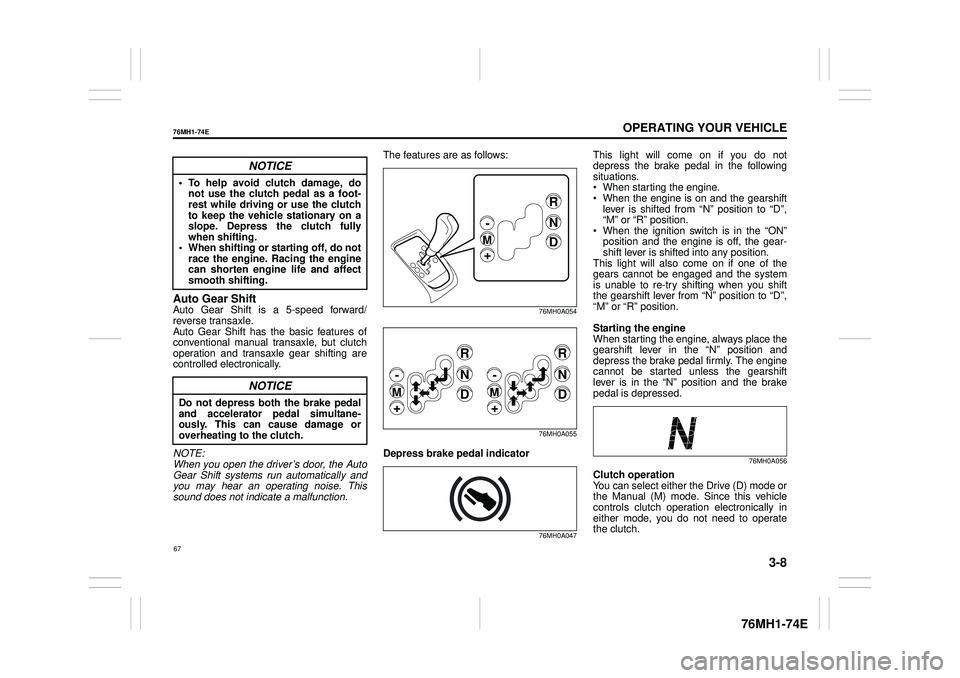
Auto Gear ShiftAuto Gear Shift is a 5-speed forward/ reverse transaxle. Auto Gear Shift has the basic features of conventional manual transaxle, but clutchoperation and transaxle gear shifting are controlled electronically.
NOTE: When you open the driver’s door, the Auto Gear Shift systems run automatically and you may hear an operating noise. Thissound does not indicate a malfunction.
The features are as follows:
76MH0A054
76MH0A055
Depress brake pedal indicator
76MH0A047
This light will come on if you do not depress the brake pedal in the following situations. When starting the engine. When the engine is on and the gearshift lever is shifted from “N” position to “D”,“M” or “R” position. When the ignition switch is in the “ON” position and the engine is off, the gear-shift lever is shifte d into any position. This light will also come on if one of the gears cannot be engaged and the systemis unable to re-try shifting when you shift the gearshift lever from “N” position to “D”, “M” or “R” position.
Starting the engine When starting the engine, always place thegearshift lever in the “N” position and depress the brake pedal firmly. The engine cannot be started unless the gearshiftlever is in the “N” position and the brake pedal is depressed.
76MH0A056
Clutch operationYou can select either the Drive (D) mode or the Manual (M) mode. Since this vehiclecontrols clutch operation electronically in either mode, you do not need to operate the clutch.
NOTICE
• To help avoid clutch damage, donot use the clutch pedal as a foot-rest while driving or use the clutch to keep the vehicle stationary on a slope. Depress the clutch fullywhen shifting. • When shifting or starting off, do not race the engine. Racing the enginecan shorten engine life and affect smooth shifting.
NOTICE
Do not depress both the brake pedaland accelerator pedal simultane- ously. This can cause damage oroverheating to the clutch.
R
N
D
-
M
+
R
N
D
-
M
+
R
N
D
-
M
+
67
Page 86 of 201
3-16
OPERATING YOUR VEHICLE
76MH1-74E
76MH1-74E
Brake Assist System (if equipped)When you slam the brakes on, the brake assist system judges as an emergencystop and provides more powerful braking for a driver who cannot hold down the brake pedal firmly.
NOTE: If you quickly and forcefully depress thebrakes, you may hear a clicking sound in the brake pedal. This is normal and indi- cates that the brake a ssist system is acti- vated properly.
Anti-Lock Brake System (ABS)
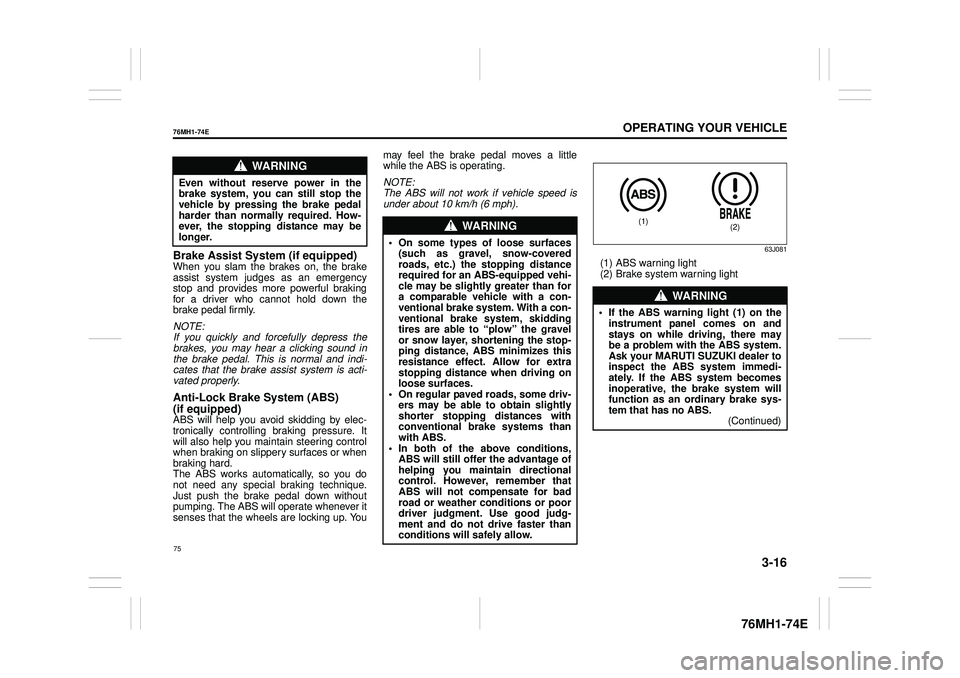
(if equipped)ABS will help you avoid skidding by elec- tronically controlling braking pressure. It will also help you maintain steering controlwhen braking on slippery surfaces or when braking hard. The ABS works automatically, so you donot need any special braking technique. Just push the brake pedal down without pumping. The ABS will operate whenever itsenses that the wheels are locking up. You
may feel the brake pedal moves a little while the ABS is operating.
NOTE: The ABS will not work if vehicle speed is under about 10 km/h (6 mph).
63J081
(1) ABS warning light (2) Brake system warning light
WA R N I N G
Even without reserve power in the brake system, you can still stop thevehicle by pressing the brake pedal harder than normally required. How- ever, the stopping distance may belonger.WA R N I N G
• On some types of loose surfaces(such as gravel, snow-coveredroads, etc.) the stopping distance required for an ABS-equipped vehi- cle may be slightly greater than fora comparable vehicle with a con- ventional brake system. With a con- ventional brake system, skiddingtires are able to “plow” the gravel or snow layer, shortening the stop- ping distance, ABS minimizes thisresistance effect. Allow for extra stopping distance when driving on loose surfaces.• On regular paved roads, some driv- ers may be able to obtain slightly shorter stopping distances withconventional brake systems than with ABS. • In both of the above conditions,ABS will still offer the advantage of helping you maintain directional control. However, remember thatABS will not compensate for bad road or weather conditions or poor driver judgment. Use good judg-ment and do not drive faster than conditions will safely allow.
WA R N I N G
• If the ABS warning light (1) on the instrument panel comes on and stays on while driving, there maybe a problem with the ABS system. Ask your MARUTI SUZUKI dealer to inspect the ABS system immedi-ately. If the ABS system becomes inoperative, the brake system will function as an ordinary brake sys-tem that has no ABS. (Continued)
(1)(2)
75
Page 87 of 201
3-17
OPERATING YOUR VEHICLE
76MH1-74E
76MH1-74E
How the ABS WorksA computer continuously monitors wheel speed. The computer compares the changes in wheel speed when braking. If the wheels slow suddenly, indicating askidding situation, the computer will change braking pressure several times each second to prevent the wheels fromlocking. When you start your vehicle after a stop you may hear a momentary motor noise as the system checks itself.
WA R N I N G
(Continued)• If the ABS warning light (1) and theBrake system warning light (2) on the instrument panel simultane- ously stays on or comes on whendriving, both anti-lock function and rear brake force control function (proportioning val ve function) of the ABS system may have failed. If so, the rear wheels may easily skid or the vehicle can even spin in theworst case when braking on a slip- pery road or when hard braking even on a dry paved road. Ask yourMARUTI SUZUKI dealer to inspect the ABS system immediately. Drive carefully, avoiding hard braking asmuch as possible.
WA R N I N G
The ABS may not work properly iftires or wheels other than thosespecified in the owner’s manual are used. This is because the ABS works by comparing changes in wheelspeed. When replacing tires or wheels, use only the size and type specified in this owner’s manual.
76
Page 91 of 201
4-3
DRIVING TIPS
76MH1-74E
76MH1-74E
Keep weight to a minimum The heavier the load, the more fuel the vehicle consumes. Take out any luggageor cargo when it is not necessary.
Keep tire pressures correct Underinflation of the tires can waste fuel due to increased running resistance of the tires. Keep your tires inflated to the correctpressure shown on the label on the driver’s side door or the driver’s door lock pillar.
Highway Driving
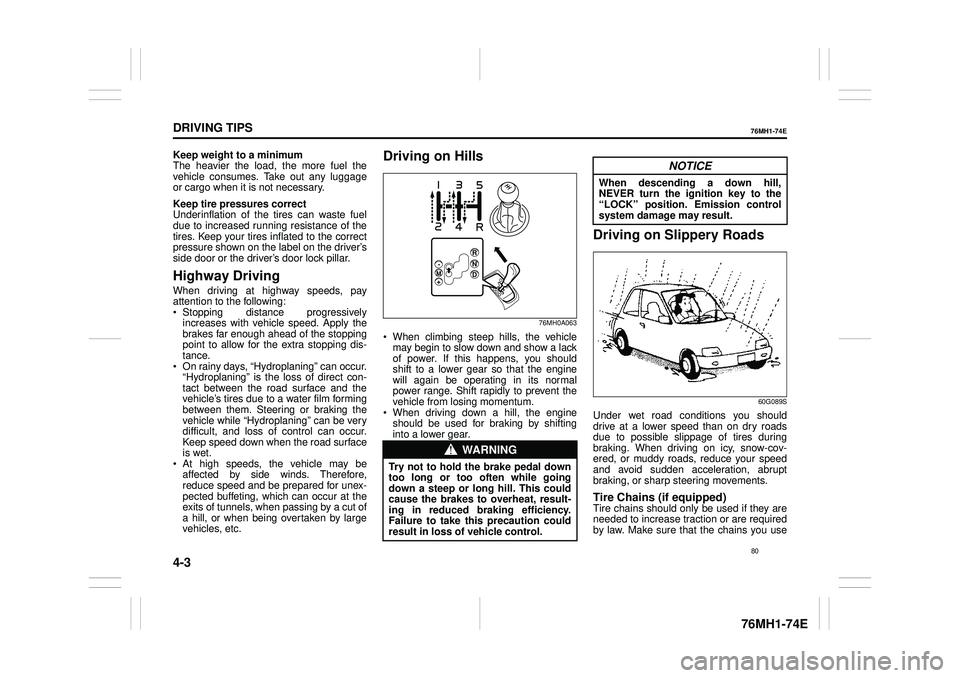
When driving at highway speeds, pay attention to the following: Stopping distance progressively increases with vehicle speed. Apply the brakes far enough ahead of the stoppingpoint to allow for the extra stopping dis- tance. On rainy days, “Hydroplaning” can occur.“Hydroplaning” is the loss of direct con- tact between the road surface and the vehicle’s tires due to a water film formingbetween them. Steering or braking the vehicle while “Hydroplaning” can be very difficult, and loss of control can occur.Keep speed down when the road surface is wet. At high speeds, the vehicle may beaffected by side winds. Therefore, reduce speed and be prepared for unex- pected buffeting, which can occur at theexits of tunnels, when passing by a cut of a hill, or when being overtaken by large vehicles, etc.
Driving on Hills
76MH0A063
When climbing steep hills, the vehiclemay begin to slow down and show a lackof power. If this happens, you should shift to a lower gear so that the engine will again be operating in its normalpower range. Shift rapidly to prevent the vehicle from losing momentum. When driving down a hill, the engineshould be used for braking by shifting into a lower gear.
Driving on Slippery Roads
60G089S
Under wet road conditions you should drive at a lower speed than on dry roadsdue to possible slippage of tires during braking. When driving on icy, snow-cov- ered, or muddy roads, reduce your speedand avoid sudden acceleration, abrupt braking, or sharp steering movements.
Tire Chains (if equipped)Tire chains should only be used if they are needed to increase traction or are required by law. Make sure that the chains you use
WA R N I N G
Try not to hold the brake pedal down too long or too often while goingdown a steep or long hill. This could cause the brakes to overheat, result- ing in reduced braking efficiency.Failure to take this precaution could result in loss of vehicle control.
R N D -M+
NOTICE
When descending a down hill, NEVER turn the igni tion key to the “LOCK” position. Emission control system damage may result.
80
Page 96 of 201
OTHER CONTROLS AND EQUIPMENT
76MH1-74E
76MH1-74E
OTHER CONTROLS AND EQUIPMENTFuel Filler Cap ..................................................................... 5-1
Engine Hood ........................................................................ 5-2
Sun Visor ............................................................................. 5-3
Interior Light ........................................................................ 5-4
Accessory Socket ........ ....................................................... 5-5
AUX/USB Socket (if equipped) ........................................... 5-5
Assist Grips (if equipped) .................................................. 5-5
Glove Box ............................................................................ 5-6
Cup Holder and Storage Area ............................................ 5-6
Floor Mats (if equipped) ..................................................... 5-7
Luggage Compartment Hooks ........................................... 5-8
Luggage Compartment Cover (if equipped) ..................... 5-8
Frame Hooks ....................................................................... 5-9
Manual Heating and Air Conditioning System ................. 5-10
Radio Antenna ..................................................................... 5-13
Audio System (if equipped) ................................................ 5-14
85
Page 97 of 201

5-1
OTHER CONTROLS AND EQUIPMENT
76MH1-74E
76MH1-74E
Fuel Filler Cap
76MH0A064
74LHT0511
The fuel filler cap is lo cated on the left rear side of the vehicle. The fuel filler door can be unlocked by pulling up the opener leverlocated on the outboard side of the driver’s seat and locked by simply closing the door.
68KN048
To remove the fuel filler cap: 1) Open the fuel filler door. 2) Remove the cap by turning it counter- clockwise.
76MH0A065
NOTE: If the cap holder (1) is equipped with the fuel filler door, hold the fuel filler cap whenrefueling.
To reinstall the fuel filler cap: 1) Turn the cap clockwise until you hear several clicks. 2) Close the fuel filler door.
EXAMPLE
EXAMPLE
CAUTION
Remove the fuel fill er cap slowly. The fuel may be under pressure and mayspray out, causing injury.
Open Close
EXAMPLE
WA R N I N G
Fuel is extremely flammable. Do notsmoke when refueling, and makesure there are no open flames or sparks in the area.
(1)
EXAMPLE
86
Page 98 of 201
5-2
OTHER CONTROLS AND EQUIPMENT
76MH1-74E
76MH1-74E
Engine Hood
76MH0A066
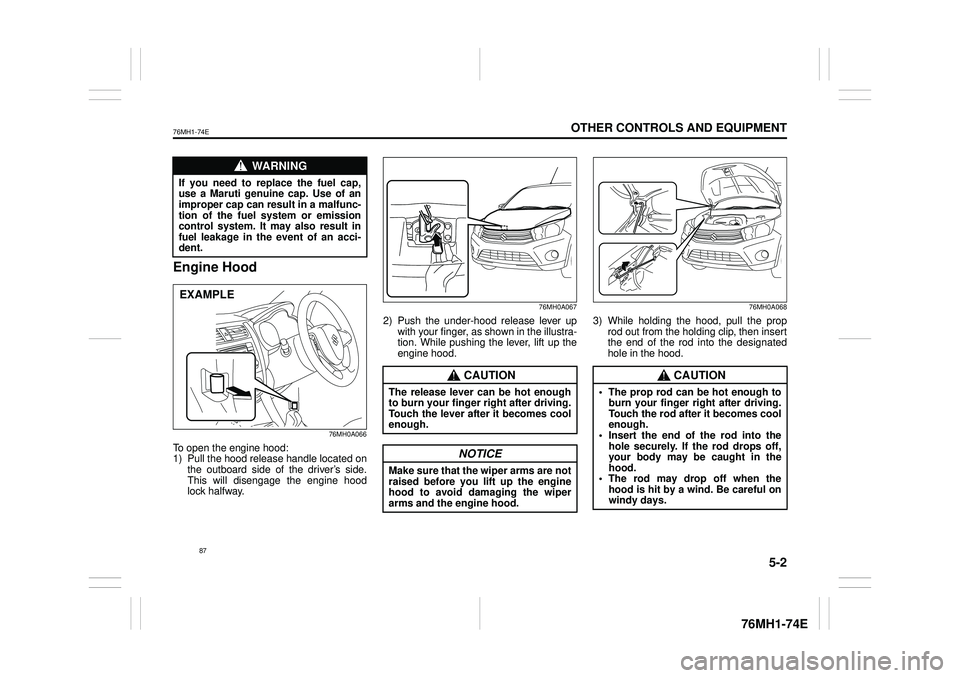
To open the engine hood: 1) Pull the hood release handle located onthe outboard side of the driver’s side. This will disengage the engine hood lock halfway.
76MH0A067
2) Push the under-hood release lever up with your finger, as shown in the illustra- tion. While pushing the lever, lift up theengine hood.
76MH0A068
3) While holding the hood, pull the prop rod out from the holding clip, then insert the end of the rod into the designatedhole in the hood.
WA R N I N G
If you need to replace the fuel cap,use a Maruti genuine cap. Use of animproper cap can result in a malfunc- tion of the fuel system or emission control system. It may also result infuel leakage in the event of an acci- dent.
EXAMPLE
CAUTION
The release lever can be hot enough to burn your finger right after driving. Touch the lever after it becomes cool enough.
NOTICE
Make sure that the wiper arms are notraised before you lift up the engine hood to avoid damaging the wiper arms and the engine hood.
CAUTION
• The prop rod can be hot enough toburn your finger right after driving. Touch the rod after it becomes cool enough.• Insert the end of the rod into the hole securely. If the rod drops off, your body may be caught in thehood. • The rod may drop off when the hood is hit by a wind. Be careful onwindy days.
87
Page 99 of 201

5-3
OTHER CONTROLS AND EQUIPMENT
76MH1-74E
76MH1-74E
To close the engine hood: 1) Lift the hood up slightly and remove the prop rod from the hole. Put the prop rodback to the holding clip.
76MS014
2) Lower the hood to about 20 cm abovethe hood latch, then let it drop down. Make sure the hood is securely latched after closing.
Sun Visor
79J161
The sun visors can be pulled down to block glare coming through the windshield, orthey can be unhooked and turned to the side to block glare coming through the side window.
Card holder (if equipped)
67LH064
(1) Card holder
You can put a card in the card holder (1) on the back of the sun visor.
WA R N I N G
Make sure the hood is fully closedand latched before driv ing. If it is not, it can fly up unexpectedly duringdriving, obstructing your view and resulting in an accident.
EXAMPLE
CAUTION
To avoid injury, be sure no part of the occupant’s body such as hands orhead is in the path of the hood when closing it.
NOTICE
Pressing the hood from above may damage the hood.
EXAMPLE
NOTICE
When unhooking and hooking a sunvisor, be sure to handle it by the hardplastic parts or the sun visor can be damaged.
NOTICE
When you park your vehicle outdoorsin direct sunlight or in hot weather, do not leave plastic cards in theholder. The heat may distort them.
(1)
EXAMPLE
88