parking brake SUZUKI CELERIO 2016 User Guide
[x] Cancel search | Manufacturer: SUZUKI, Model Year: 2016, Model line: CELERIO, Model: SUZUKI CELERIO 2016Pages: 201, PDF Size: 5.82 MB
Page 81 of 201
3-11
OPERATING YOUR VEHICLE
76MH1-74E
76MH1-74E
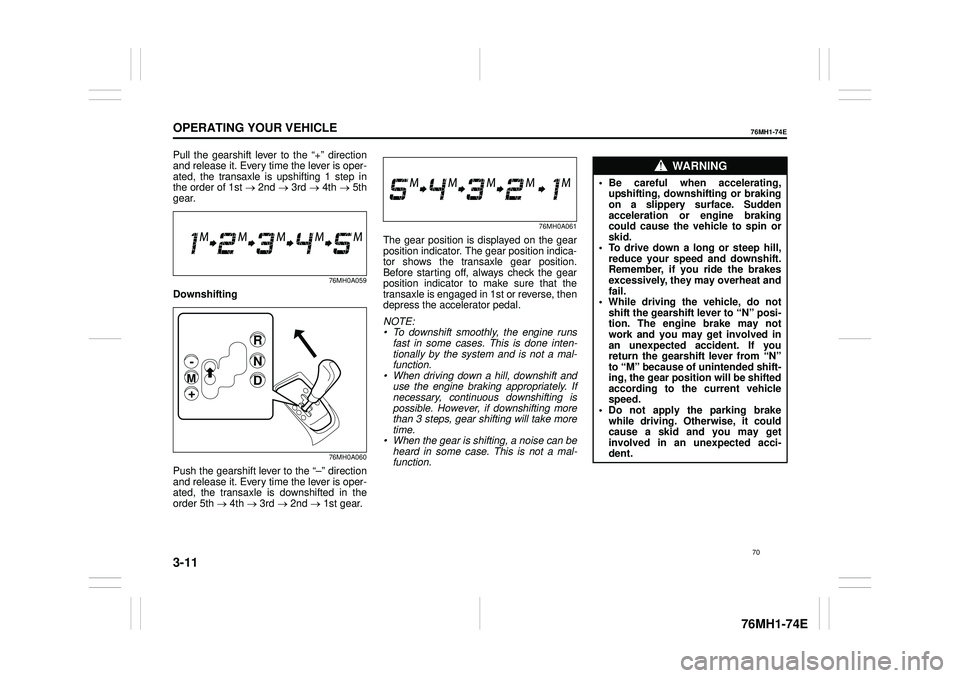
Pull the gearshift lever to the “+” direction and release it. Every time the lever is oper- ated, the transaxle is upshifting 1 step inthe order of 1st 2nd 3rd 4th 5th gear.
76MH0A059
Downshifting
76MH0A060
Push the gearshift lever to the “–” directionand release it. Every time the lever is oper- ated, the transaxle is downshifted in theorder 5th 4th 3rd 2nd 1st gear.
76MH0A061
The gear position is displayed on the gear position indicator. The gear position indica- tor shows the transaxle gear position.Before starting off, always check the gear position indicator to make sure that the transaxle is engaged in 1st or reverse, thendepress the accelerator pedal.
NOTE: • To downshift smoothly, the engine runs fast in some cases. This is done inten- tionally by the system and is not a mal-function. • When driving down a hill, downshift and use the engine braking appropriately. Ifnecessary, continuous downshifting is possible. However, if downshifting more than 3 steps, gear shifting will take moretime. • When the gear is shifting, a noise can be heard in some case. This is not a mal-function.
R
N
D
-
M
+
WA R N I N G
• Be careful when accelerating,upshifting, downshifting or brakingon a slippery surface. Sudden acceleration or engine braking could cause the vehicle to spin orskid. • To drive down a long or steep hill, reduce your speed and downshift.Remember, if you ride the brakes excessively, they may overheat and fail.• While driving the vehicle, do not shift the gearshift lever to “N” posi- tion. The engine brake may notwork and you may get involved in an unexpected accident. If you return the gearshif t lever from “N” to “M” because of unintended shift- ing, the gear position will be shifted according to the current vehiclespeed. • Do not apply the parking brake while driving. Otherwise, it couldcause a skid and you may get involved in an unexpected acci- dent.
70
Page 83 of 201

3-13
OPERATING YOUR VEHICLE
76MH1-74E
76MH1-74E
Starting off on an uphill/downhill slope:
Uphill 1) Apply the parking brake firmly so that the vehicle does not roll backwards. 2) Shift the gearshift lever to the “M” posi-tion while depressing the brake pedal. Make sure that the gear position indica- tor in the instrument al cluster displays 1st gear. 3) Release the brake pedal and depress the accelerator pedal gradually, andwhen the vehicle starts to move, release the parking brake and depress the accelerator pedal to start off.
Downhill 1) Depress the brake pedal and shift thegearshift lever to the “M” position. Check the gear position indicator to make sure that the gear is in 1st.2) Release the brake pedal and depress the accelerator pedal slowly. Even though the accelerator pedal is notdepressed, the clutch will be engaged when the vehicle speed increases.
Backing up After the vehicle has stopped completely, depress the brake pedal and shift the gear-shift lever to the “R” position. Depress the accelerator pedal slowly as when starting off in 1st gear. Before backing up, makesure that reverse gear is selected by checking the gear position indicator.
76MH0A062
NOTE: • If reverse gear cannot be engaged even though the gearshift lever has been shifted from the “N” to the “R” position,the system will re-try shifting automati- cally. This will take some time, noise may be heard from the gears, and shift-ing gear shock may occur. However, they do not indicate a malfunction. • The “N” indicator will flash, the depressbrake pedal indicator will come on and a warning buzzer (long pulse sound) will sound if any of the following casesoccur; – If you shift the gearshift lever from the “N” to the “R” position without depress-ing the brake pedal – If the system is unable to re-try shifting You should depress the brake pedal andshift the gearshift lever to “N” position,
then shift to “R” position again a few sec- onds later. • The system will not allow shifting to the“R” position if the vehicle speed is over about 3 km/h (2 mph). If the gearshift lever is operated under this condition,the “N” indicator in the instrument cluster will blink. However, when the vehicle speed drops below about 3 km/h (2mph), the gear will be shifted to reverse. Make sure that the vehicle has stopped completely before shifting to the “R”position.
Stopping The vehicle can be stopped by depressing the brake pedal regardless of the gearposition. This is because the clutch is auto- matically disengaged to prevent the engine from stopping. If the gearshift lever is in the “D” position, the gear will be downshifted to 1st when the vehicle stops.
NOTICE
On an uphill slope, never hold thevehicle at a stop using only the accel-erator pedal or creeping function. If you perform this operation for a cer- tain period of time, a warning buzzerwill sound, and in some cases the engine will stall. This can also cause excessive damage to the clutch.
NOTICE
On a downhill slope, never hold thevehicle at a stop using only the accel- erator pedal or the creeping function. If you perform this operation for acertain period of time, a warning buzzer will sound, and in some cases the engine will stall. This can alsocause excessive damage to the clutch.
72
Page 84 of 201

3-14
OPERATING YOUR VEHICLE
76MH1-74E
76MH1-74E
If the gearshift lever is in the “M” posi- tion, the gear will be downshifted to 1st when the vehicle stops.
Parking Unlike an automatic transaxle, Auto GearShift does not have a parking position. The vehicle can be parked with the gearshift lever in any position.1) Apply the parking brake firmly. 2) While depressing the brake pedal, shift the gearshift lever to the “R” position ona downhill slope, and to the 1st position in the drive (D) mode or the “M(1)” posi- tion in the manual (M) mode on anuphill slope and confirm the gear posi- tion by checking the gear position indi- cator.3) Stop the engine.
NOTE: • After the engine is stopped, the gear in the transaxle does not change even ifyou shift the gearshift lever in any posi- tion. Always shift the gearshift lever before stop the engine.• Check the transaxle gear position by looking at the gear position indicator, then turn the ignition switch off to stopthe engine. Release the brake pedal after a few seconds. The gearshift lever will be locked in the position it was inwhen the ignition switch was turned off.
Parking cancel Depress the brake pedal, turn the ignition switch to the “ON” position, and shift thegearshift lever to the “N” position. The gear will be disengaged.
WA R N I N G
• When stopping, for example, at a traffic light, be su re to depress the brake pedal firmly. For your safety, apply the parking brake, too, when stopping on a hill.• When racing the engine, make sure that the gear is in the “N” position by checking the gear position indi- cator. If the accelerator is operated with the gear in any other position, the vehicle may move resulting inan unexpected accident. • Do not leave your vehicle unat- tended while the engine is running.• When leaving the vehicle, stop the engine and park the vehicle with a gear engaged. If you need to leavethe vehicle with the engine running, apply the parking brakes firmly, and shift the gearshift lever to the“N” position. Otherwise, the vehi- cle may move unexpectedly and may cause an accident.
NOTICE
• On a slope, never hold the vehicleat a stop using only the acceleratorpedal or the creeping function. If you perform this operation for a certain period of time, a warningbuzzer will sound, and in some cases the engine will stall. This can also cause excessive damage tothe clutch. • If the gearshift lever is operated more than necessary, the systemmay not allow operation of the gearshift lever for a certain period of time, and the gear may not beshifted appropriately. Therefore, do not operate the gearshift lever if not necessary.
WA R N I N G
• If the gear is not engaged properlyand completely be fore the ignition switch is turned off, the vehicle may not be parked with the gearengaged. Always confirm the gear position by checking the gear posi- tion indicator when parking.• On a downhill slope, the gear should be put in reverse, and in 1st gear on an uphill slope. Otherwise,the vehicle may move, and cause an unexpected accident. If the gear is left in the “N” position, the vehi-cle cannot be parked with a gear engaged.
73
Page 94 of 201
4-6
DRIVING TIPS
76MH1-74E
76MH1-74E
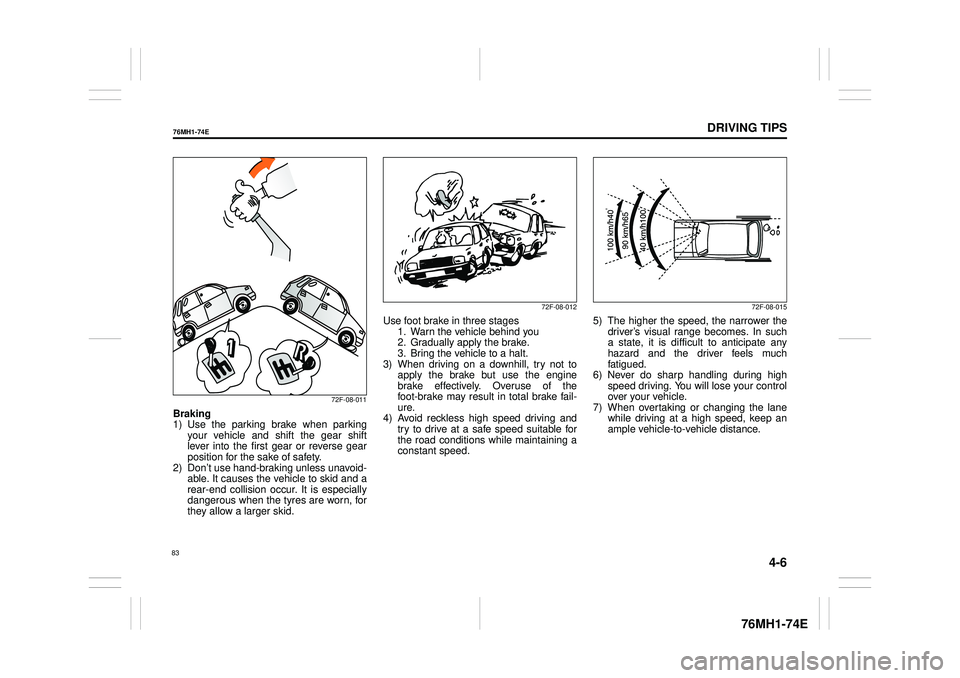
72F-08-011
Braking 1) Use the parking brake when parking your vehicle and shift the gear shift lever into the first gear or reverse gearposition for the sake of safety. 2) Don
Page 148 of 201

6-2
VEHICLE LOADING AND TOWING
76MH1-74E
76MH1-74E
TOWING INSTRUCTION TABLE
76MH022
A: 2WD VEHICLES WITH MANUAL TRANSAXLE OR AUTO GEAR SHIFT 1) Secure the front wheels on a towingdolly according to the instructions pro- vided by the dolly manufacturer. 2) Release the parking brake.
76MH023
B: 2WD VEHICLES WITH MANUAL TRANSAXLE OR AUTO GEAR SHIFT 1) Shift the gearshift lever into neutral. 2) Turn the ignition key to the
Page 150 of 201
7-1
INSPECTION AND MAINTENANCE
76MH1-74E
76MH1-74E
60A187S
WA R N I N G
You should take extreme care when working on your vehicle to preventaccidental injury. Here are a few pre- cautions that you should be espe- cially careful to observe:(Continued)
WA R N I N G
(Continued)• To prevent damage or unintendedactivation of the air bag system be sure the battery is disconnected and the ignition switch has been inthe “LOCK” position for at least 90 seconds before performing any electrical service work on yourMARUTI SUZUKI. Do not touch air bag system components, or wires. The wires are wrapped with yellowtape or yellow tubing, and the cou- plers are yellow for easy identifica- tion.• Do not leave the engine running in garages or other confined areas. • When the engine is running, keephands, clothing, tools, and other objects away from the fan and drive belt. Even though the fan may notbe moving, it can automatically turn on without warning. • When it is necessary to do servicework with the engine running, make sure that the parking brake is set fully and the transaxle is in Neutral.• Do not touch ignition wires or other ignition system parts when start- ing the engine or when the engineis running, or you could receive an electric shock. (Continued)
WA R N I N G
(Continued)• Be careful not to touch a hotengine, exhaust manifold and pipes, muffler, radiator and water hoses.• Do not allow smoking, sparks, or flames around fuel or the battery. Flammable fumes are present.• Do not get under your vehicle if it is supported only with the portable jack provided in your vehicle.• Be careful not to cause accidental short circuits be tween the positive and negative battery terminals.• Keep used oil, coolant, and other fluids away from children and pets. Dispose of used fluids properly;never pour them on the ground, into sewers, etc.
139
Page 153 of 201
7-4
INSPECTION AND MAINTENANCE
76MH1-74E
76MH1-74E
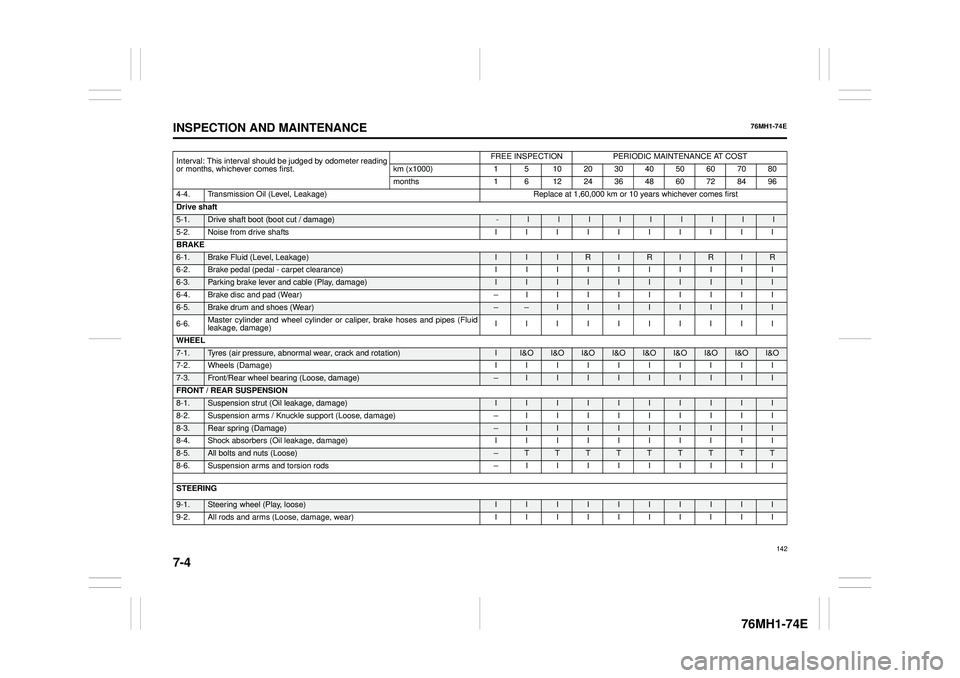
Interval: This interval should be judged by odometer reading or months, whichever comes first.
FREE INSPECTIONPERIODIC MAINTENANCE AT COST
km (x1000) 1 5 10 20 30 40 50 60 70 80
months 1 6 12 24 36 48 60 72 84 96
4-4. Transmission Oil (Level, Leakage)Replace at 1,60,000 km or 10 years whichever comes first
Drive shaft
5-1.Drive shaft boot (boot cut / damage)-lllllllll
5-2. Noise from drive shafts I I I I I I I I I I
BRAKE
6-1. Brake Fluid (Level, Leakage) I I I R I R I R I R
6-2. Brake pedal (pedal - carpet clearance) I I I I I I I I I I
6-3. Parking brake lever and cable (Play, damage) I I I I I I I I I I
6-4. Brake disc and pad (Wear) – I I I I I I I I I
6-5.Brake drum and shoes (Wear) – – I I I I I I I I
6-6. Master cylinder and wheel cylinder or caliper, brake hoses and pipes (Fluid leakage, damage) IIIIIIIIII
WHEEL
7-1. Tyres (air pressure, abnormal wear, crack and rotation) II&O I&OI&OI&OI&OI&OI&O I&OI&O
7-2. Wheels (Damage) I I I I I I I I I I
7-3. Front/Rear wheel bearing (Loose, damage) –I I I I I I I I I
FRONT / REAR SUSPENSION
8-1. Suspension strut (Oil leakage, damage) I I I I I I I I I I
8-2. Suspension arms / Knuckle supp ort (Loose, damage) – I I I I I I I I I
8-3. Rear spring (Damage) – I I I I I I I I I
8-4. Shock absorbers (Oil leakage, damage) I I I I I I I I I I
8-5.All bolts and nuts (Loose)– T T T T T T T T T
8-6. Suspension arms and torsion rods – I I I I I I I I I
STEERING 9-1.Steering wheel (Play, loose) I I I I I I I I I I
9-2. All rods and arms (Loose, damage, wear) I I I I I I I I I I
142
Page 163 of 201
7-14
INSPECTION AND MAINTENANCE
76MH1-74E
76MH1-74E
Gear Oil
Manual Transaxle Oil/
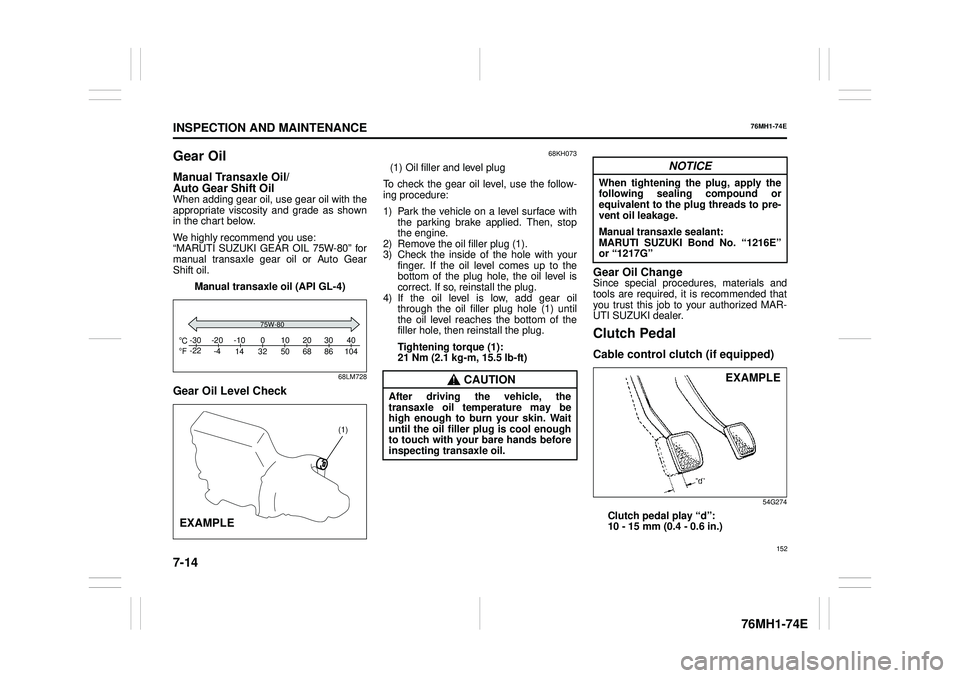
Auto Gear Shift OilWhen adding gear oil, use gear oil with the appropriate viscosity and grade as shown in the chart below.
We highly recommend you use: “MARUTI SUZUKI GEAR OIL 75W-80” formanual transaxle gear oil or Auto Gear Shift oil.
Manual transaxle oil (API GL-4)
68LM728
Gear Oil Level Check
68KH073
(1) Oil filler and level plug
To check the gear oil level, use the follow- ing procedure:
1) Park the vehicle on a level surface with the parking brake applied. Then, stop the engine.2) Remove the oil filler plug (1). 3) Check the inside of the hole with your finger. If the oil level comes up to thebottom of the plug hole, the oil level is correct. If so, reinstall the plug. 4) If the oil level is low, add gear oilthrough the oil filler plug hole (1) until the oil level reaches the bottom of the filler hole, then reinstall the plug.
Tightening torque (1): 21 Nm (2.1 kg -m, 15.5 lb-ft)
Gear Oil ChangeSince special procedures, materials and tools are required, it is recommended that you trust this job to your authorized MAR-UTI SUZUKI dealer.
Clutch Pedal
Cable control clutch (if equipped)
54G274
Clutch pedal play “d”: 10 - 15 mm (0.4 - 0.6 in.)
C Fo o-30 -22 -20 -4 -10 14 32 50 68 86 104 010203040
75W-80
(1)
EXAMPLE
CAUTION
After driving the vehicle, the transaxle oil temperature may behigh enough to burn your skin. Wait until the oil filler plug is cool enough to touch with your bare hands beforeinspecting transaxle oil.
NOTICE
When tightening the plug, apply thefollowing sealing compound orequivalent to the plug threads to pre- vent oil leakage.
Manual transaxle sealant: MARUTI SUZUKI Bond No. “1216E” or “1217G”
EXAMPLE
152
Page 165 of 201
7-16
INSPECTION AND MAINTENANCE
76MH1-74E
76MH1-74E
“MAX” and “MIN” lines. If the brake fluid level is near the “MIN” line, fill it up to the “MAX” line with Maruti genuine brake fluid.
NOTE: With disc brakes, the fluid level can beexpected to gradually fall as the brake pads wear.
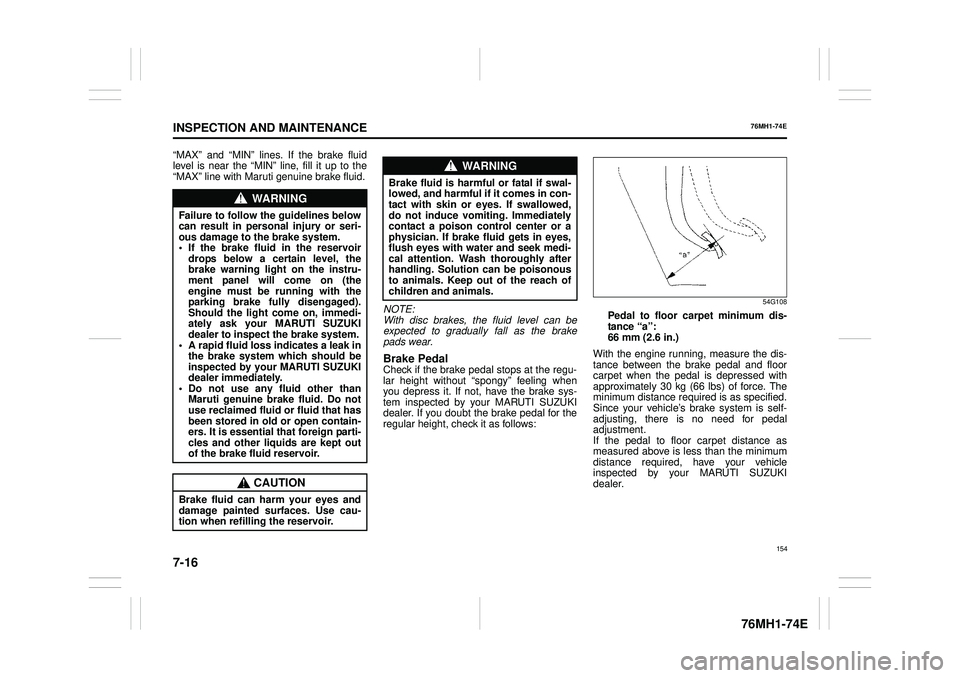
Brake PedalCheck if the brake peda l stops at the regu- lar height without “spongy” feeling when you depress it. If not, have the brake sys- tem inspected by your MARUTI SUZUKIdealer. If you doubt the brake pedal for the regular height, check it as follows:
54G108
Pedal to floor car pet minimum dis- tance “a”: 66 mm (2.6 in.)
With the engine running, measure the dis- tance between the brake pedal and floorcarpet when the pedal is depressed with approximately 30 kg (66 lbs) of force. The minimum distance required is as specified.Since your vehicle’s brake system is self- adjusting, there is no need for pedal adjustment. If the pedal to floor carpet distance as measured above is less than the minimum distance required, have your vehicleinspected by your MARUTI SUZUKI dealer.
WA R N I N G
Failure to follow the guidelines below can result in personal injury or seri-ous damage to the brake system. • If the brake fluid in the reservoir drops below a certain level, thebrake warning light on the instru- ment panel will come on (the engine must be running with theparking brake fully disengaged). Should the light come on, immedi- ately ask your MARUTI SUZUKIdealer to inspect the brake system. • A rapid fluid loss indicates a leak in the brake system which should beinspected by your MARUTI SUZUKI dealer immediately. • Do not use any fluid other thanMaruti genuine brake fluid. Do not use reclaimed fluid or fluid that has been stored in old or open contain-ers. It is essential that foreign parti- cles and other liquids are kept out of the brake fluid reservoir.
CAUTION
Brake fluid can harm your eyes anddamage painted surfaces. Use cau- tion when refilling the reservoir.
WA R N I N G
Brake fluid is harmful or fatal if swal- lowed, and harmful if it comes in con-tact with skin or e yes. If swallowed, do not induce vomiting. Immediately contact a poison control center or aphysician. If brake fluid gets in eyes, flush eyes with water and seek medi- cal attention. Wash thoroughly afterhandling. Solution can be poisonous to animals. Keep out of the reach of children and animals.
154
Page 166 of 201
7-17
INSPECTION AND MAINTENANCE
76MH1-74E
76MH1-74E
NOTE: When measuring the distance between the brake pedal and floor wall, be sure not toinclude the floor mat or rubber on the floor wall in your measurement.
60G104S
Parking Brake
54G109
Ratchet tooth speci fication “b”: 4th – 9th Lever pull force (1): 200 N (20 kg, 45 lbs)
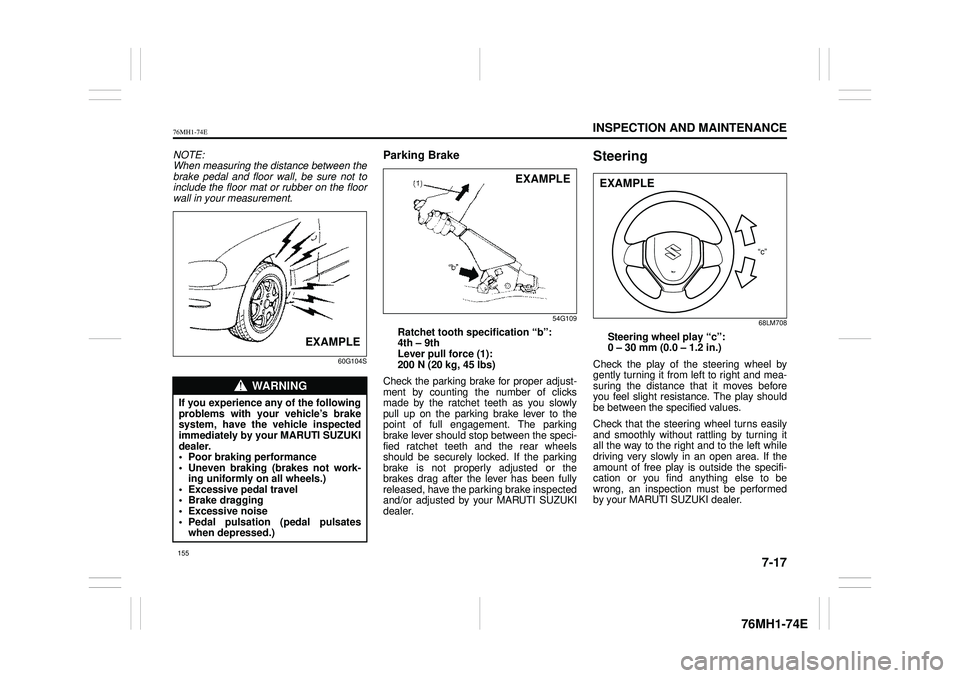
Check the parking brake for proper adjust- ment by counting the number of clicksmade by the ratchet teeth as you slowly pull up on the parking brake lever to the point of full engagement. The parkingbrake lever should stop between the speci- fied ratchet teeth and the rear wheels should be securely locked. If the parkingbrake is not properly adjusted or the brakes drag after the lever has been fully released, have the parking brake inspectedand/or adjusted by your MARUTI SUZUKI dealer.
Steering
68LM708
Steering wheel play “c”: 0 – 30 mm (0.0 – 1.2 in.)
Check the play of the steering wheel by gently turning it from left to right and mea-suring the distance that it moves before you feel slight resistance. The play should be between the specified values.
Check that the steering wheel turns easily and smoothly without rattling by turning itall the way to the right and to the left while driving very slowly in an open area. If the amount of free play is outside the specifi-cation or you find anything else to be wrong, an inspection must be performed by your MARUTI SUZUKI dealer.
WA R N I N G
If you experience any of the following problems with your vehicle’s brake system, have the vehicle inspectedimmediately by your MARUTI SUZUKI dealer. • Poor braking performance• Uneven braking (brakes not work- ing uniformly on all wheels.) • Excessive pedal travel• Brake dragging • Excessive noise • Pedal pulsation (pedal pulsateswhen depressed.)
EXAMPLE
EXAMPLE
“c”
EXAMPLE
155