oil SUZUKI CELERIO 2016 Owner's Manual
[x] Cancel search | Manufacturer: SUZUKI, Model Year: 2016, Model line: CELERIO, Model: SUZUKI CELERIO 2016Pages: 201, PDF Size: 5.82 MB
Page 161 of 201
7-12
INSPECTION AND MAINTENANCE
76MH1-74E
76MH1-74E
Coolant ReplacementSince special procedures are required, we recommend you take your vehicle to your MARUTI SUZUKI dealer for coolant replacement.
Air Cleaner
If the air cleaner is clogged with dust, therewill be greater intake resistance, resulting in decreased power output and increased fuel consumption.
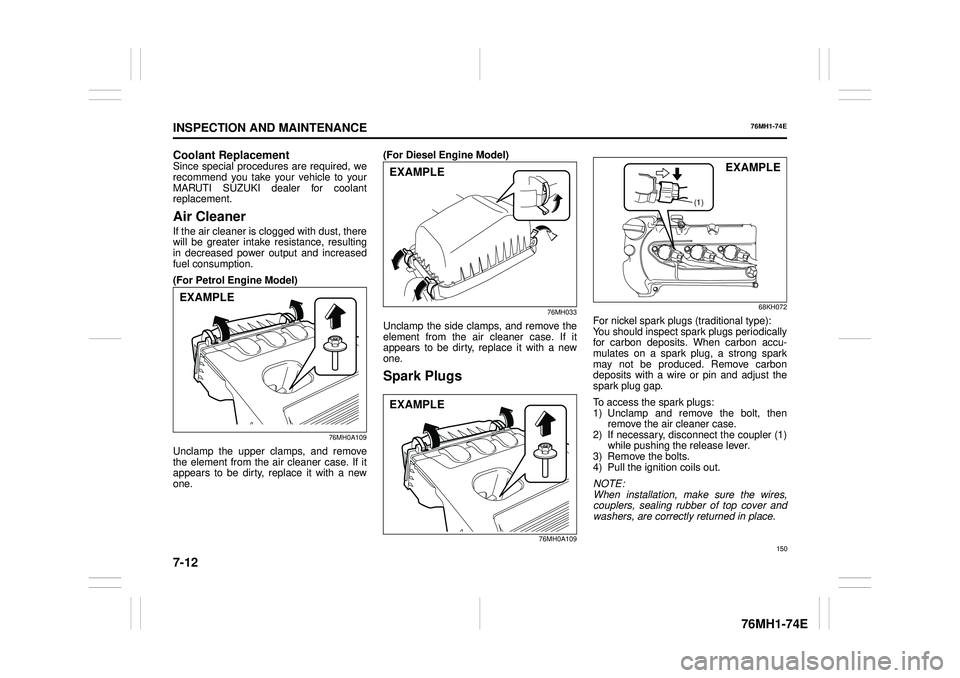
(For Petrol Engine Model)
76MH0A109
Unclamp the upper clamps, and remove the element from the air cleaner case. If itappears to be dirty, replace it with a new one.
(For Diesel Engine Model)
76MH033
Unclamp the side clamps, and remove the element from the air cleaner case. If it appears to be dirty, replace it with a newone.
Spark Plugs
76MH0A109
68KH072
For nickel spark plugs (traditional type): You should inspect spark plugs periodically for carbon deposits. When carbon accu-mulates on a spark plug, a strong spark may not be produced. Remove carbon deposits with a wire or pin and adjust thespark plug gap.
To access the spark plugs: 1) Unclamp and remove the bolt, then remove the air cleaner case. 2) If necessary, disconnect the coupler (1)while pushing the release lever. 3) Remove the bolts. 4) Pull the ignition coils out.
NOTE: When installation, make sure the wires,couplers, sealing rubber of top cover and washers, are correctly returned in place.
EXAMPLE
EXAMPLE
EXAMPLE
(1)
EXAMPLE
150
Page 162 of 201

7-13
INSPECTION AND MAINTENANCE
76MH1-74E
76MH1-74E
78K179 60G160S 60B307
Spark plug gap “a” NGK KR6A-10: 0.95 – 1.05 mm (0.037 – 0.041 in.)NOTICE
• When pulling the ignition coils out,do not pull on the cable. Pulling onthe cable can damage it. • When servicing the iridium/plati- num spark plugs (slender centerelectrode type plugs), do not touch the center electrode, as it is easy to damage.
Correct Wrong
EXAMPLE
NOTICE
• When installing the spark plugs,screw them in with your fingers to avoid stripping the threads. Tighten with a torque wrench to 17.5 Nm (1.8 kg-m, 12.9 lb-ft). Donot allow contaminants to enter the engine through the spark plug holes when the plugs are removed.• Never use spark plugs with the wrong thread size.
Loosen
Tighten
NOTICE
When replacing spark plugs, you should use the brand and type speci-fied for your vehicle. For the speci- fied plugs, refer to the “SPECIFICATIONS” section at theend of this book. If you wish to use a brand of spark plug other than the specified plugs, consult your MAR-UTI SUZUKI dealer.
151
Page 163 of 201
7-14
INSPECTION AND MAINTENANCE
76MH1-74E
76MH1-74E
Gear Oil
Manual Transaxle Oil/
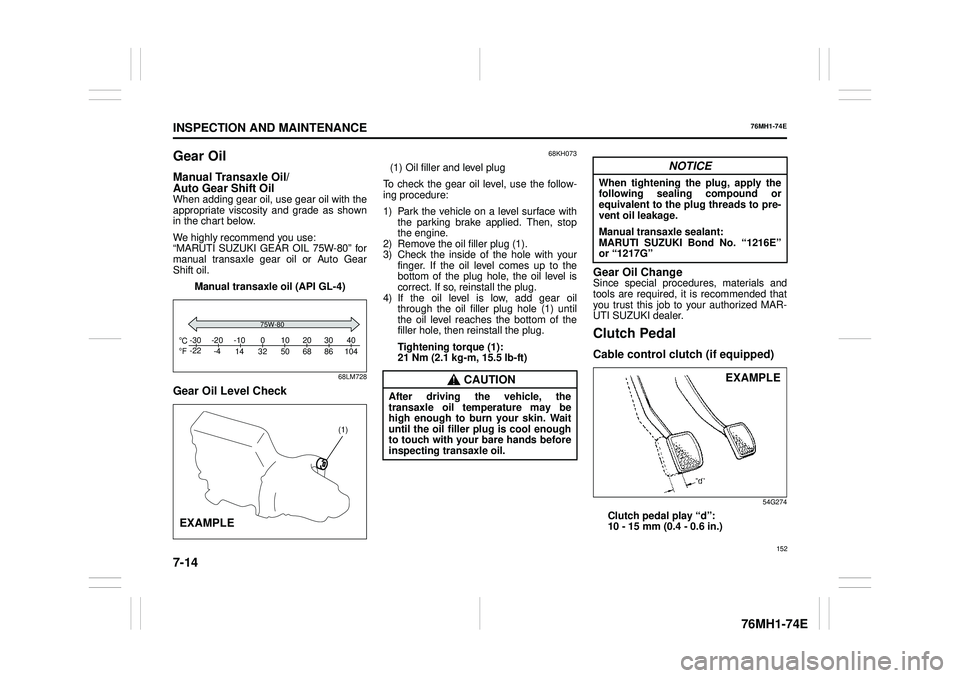
Auto Gear Shift OilWhen adding gear oil, use gear oil with the appropriate viscosity and grade as shown in the chart below.
We highly recommend you use: “MARUTI SUZUKI GEAR OIL 75W-80” formanual transaxle gear oil or Auto Gear Shift oil.
Manual transaxle oil (API GL-4)
68LM728
Gear Oil Level Check
68KH073
(1) Oil filler and level plug
To check the gear oil level, use the follow- ing procedure:
1) Park the vehicle on a level surface with the parking brake applied. Then, stop the engine.2) Remove the oil filler plug (1). 3) Check the inside of the hole with your finger. If the oil level comes up to thebottom of the plug hole, the oil level is correct. If so, reinstall the plug. 4) If the oil level is low, add gear oilthrough the oil filler plug hole (1) until the oil level reaches the bottom of the filler hole, then reinstall the plug.
Tightening torque (1): 21 Nm (2.1 kg -m, 15.5 lb-ft)
Gear Oil ChangeSince special procedures, materials and tools are required, it is recommended that you trust this job to your authorized MAR-UTI SUZUKI dealer.
Clutch Pedal
Cable control clutch (if equipped)
54G274
Clutch pedal play “d”: 10 - 15 mm (0.4 - 0.6 in.)
C Fo o-30 -22 -20 -4 -10 14 32 50 68 86 104 010203040
75W-80
(1)
EXAMPLE
CAUTION
After driving the vehicle, the transaxle oil temperature may behigh enough to burn your skin. Wait until the oil filler plug is cool enough to touch with your bare hands beforeinspecting transaxle oil.
NOTICE
When tightening the plug, apply thefollowing sealing compound orequivalent to the plug threads to pre- vent oil leakage.
Manual transaxle sealant: MARUTI SUZUKI Bond No. “1216E” or “1217G”
EXAMPLE
152
Page 172 of 201
7-23
INSPECTION AND MAINTENANCE
76MH1-74E
76MH1-74E
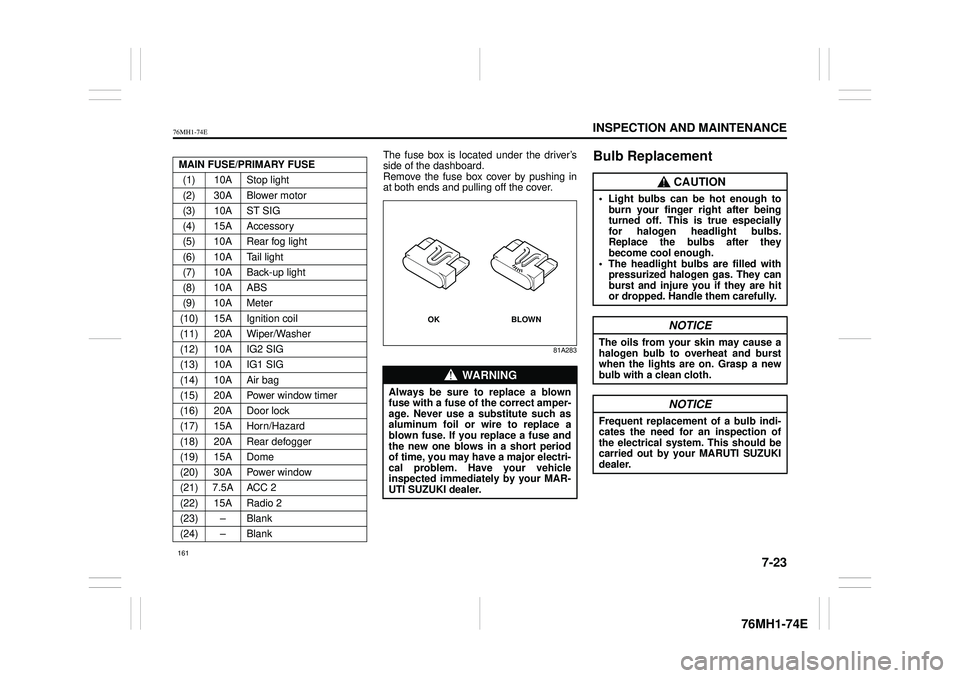
The fuse box is located under the driver’s side of the dashboard. Remove the fuse box cover by pushing inat both ends and pulling off the cover.
81A283
Bulb ReplacementMAIN FUSE/PRIMARY FUSE
(1) 10A Stop light
(2) 30A Blower motor
(3) 10A ST SIG
(4) 15A Accessory
(5) 10A Rear fog light
(6) 10A Tail light
(7) 10A Back-up light
(8) 10A ABS
(9) 10A Meter
(10) 15A Ignition coil
(11) 20A Wiper/Washer
(12) 10A IG2 SIG
(13) 10A IG1 SIG
(14) 10A Air bag
(15) 20A Power window timer
(16) 20A Door lock
(17) 15A Horn/Hazard
(18) 20A Rear defogger
(19) 15A Dome
(20) 30A Power window
(21) 7.5A ACC 2
(22) 15A Radio 2
(23) – Blank
(24) – Blank
WA R N I N G
Always be sure to replace a blown fuse with a fuse of the correct amper- age. Never use a substitute such as aluminum foil or wire to replace ablown fuse. If you replace a fuse and the new one blows in a short period of time, you may have a major electri-cal problem. Have your vehicle inspected immediately by your MAR- UTI SUZUKI dealer.
BLOWN OK
CAUTION
• Light bulbs can be hot enough toburn your finger right after being turned off. This is true especially for halogen headlight bulbs.Replace the bulbs after they become cool enough. • The headlight bulbs are filled withpressurized halogen gas. They can burst and injure you if they are hit or dropped. Handle them carefully.
NOTICE
The oils from your skin may cause ahalogen bulb to overheat and burst when the lights are on. Grasp a new bulb with a clean cloth.
NOTICE
Frequent replacement of a bulb indi-cates the need for an inspection of the electrical system. This should be carried out by your MARUTI SUZUKIdealer.
161
Page 180 of 201
7-31
INSPECTION AND MAINTENANCE
76MH1-74E
76MH1-74E
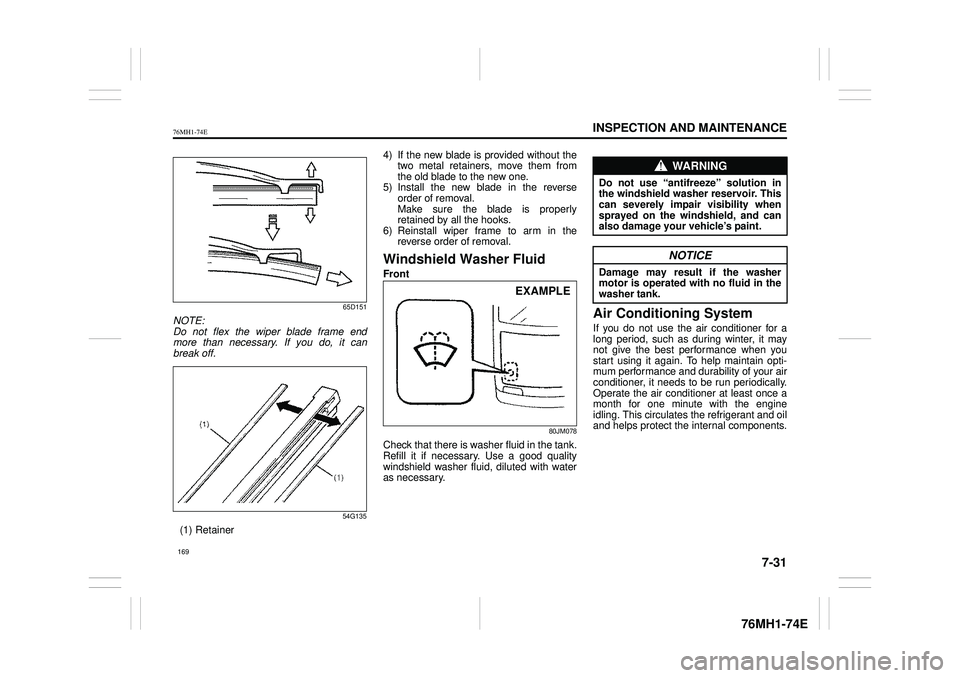
65D151
NOTE: Do not flex the wiper blade frame end more than necessary. If you do, it canbreak off.
54G135
(1) Retainer
4) If the new blade is provided without the two metal retainers, move them from the old blade to the new one.5) Install the new blade in the reverse order of removal. Make sure the blade is properlyretained by all the hooks. 6) Reinstall wiper frame to arm in the reverse order of removal.
Windshield Washer Fluid
Front
80JM078
Check that there is washer fluid in the tank.Refill it if necessary. Use a good quality windshield washer fluid, diluted with water as necessary.
Air Conditioning System
If you do not use the air conditioner for along period, such as during winter, it maynot give the best performance when you start using it again. To help maintain opti- mum performance and durability of your airconditioner, it needs to be run periodically. Operate the air condit ioner at least once a month for one minute with the engineidling. This circulates the refrigerant and oil and helps protect the internal components.
EXAMPLE
WA R N I N G
Do not use “antifreeze” solution in the windshield washer reservoir. Thiscan severely impair visibility when sprayed on the windshield, and can also damage your vehicle’s paint.
NOTICE
Damage may result if the washermotor is operated with no fluid in the washer tank.
169
Page 184 of 201
8-3
EMERGENCY SERVICE
76MH1-74E
76MH1-74E
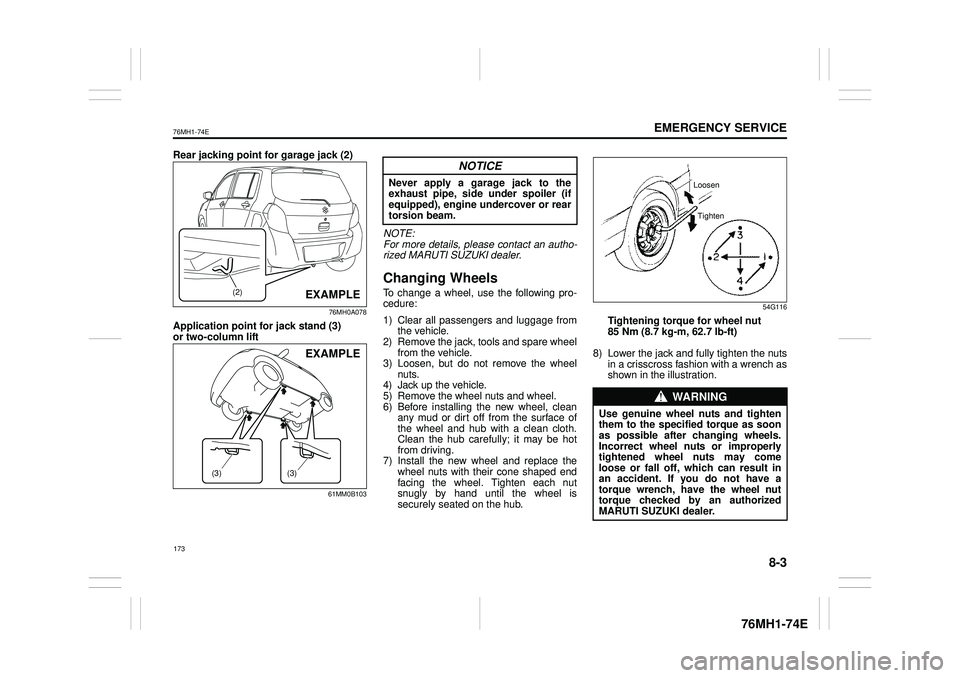
Rear jacking point for garage jack (2)
76MH0A078
Application point for jack stand (3) or two-column lift
61MM0B103
NOTE:For more details, please contact an autho- rized MARUTI SUZUKI dealer.
Changing Wheels
To change a wheel, use the following pro-cedure:
1) Clear all passengers and luggage from the vehicle. 2) Remove the jack, tools and spare wheel from the vehicle.3) Loosen, but do not remove the wheel nuts. 4) Jack up the vehicle.5) Remove the wheel nuts and wheel. 6) Before installing the new wheel, clean any mud or dirt off from the surface ofthe wheel and hub with a clean cloth. Clean the hub carefully; it may be hot from driving.7) Install the new wheel and replace the wheel nuts with their cone shaped end facing the wheel. Tighten each nutsnugly by hand until the wheel is securely seated on the hub.
54G116
Tightening torque for wheel nut85 Nm (8.7 kg -m, 62.7 lb-ft)
8) Lower the jack and fully tighten the nuts in a crisscross fashion with a wrench as shown in the illustration.
(2)EXAMPLE
(3)(3)
EXAMPLE
NOTICE
Never apply a garage jack to theexhaust pipe, side under spoiler (ifequipped), engine undercover or rear torsion beam.
WA R N I N G
Use genuine wheel nuts and tighten them to the specified torque as soonas possible after changing wheels. Incorrect wheel nuts or improperly tightened wheel nuts may comeloose or fall off, which can result in an accident. If you do not have a torque wrench, have the wheel nuttorque checked by an authorized MARUTI SUZUKI dealer.
Loosen
Tighten
173
Page 187 of 201
8-6
EMERGENCY SERVICE
76MH1-74E
76MH1-74E
If the Starter Does Not
Operate
1) Try turning the ignition switch to the “START” position with the headlights turned on to determine the battery con- dition. If the headlights go excessivelydim or go off, it usually means that either the battery is flat or the battery terminal contact is poor. Recharge thebattery or correct battery terminal con- tact as necessary. 2) If the headlights remain bright, checkthe fuses. If the reason for failure of the starter is not obvious, there may be a major electrical problem. Have the vehi-cle inspected by your authorized MAR- UTI SUZUKI dealer.
If the Engine is Flooded
If the engine is flooded with petrol, it may be hard to start. If this happens, press theaccelerator pedal all the way to the floor and hold it there while cranking the engine. For petrol engine model, do not operatethe starter motor for more than 12 sec- onds. For diesel engine model, do not operatethe starter motor for more than 30 sec- onds.
If the Engine Overheats
The engine could overheat temporarily under severe driving conditions. If the highengine coolant temperature warning light comes on as overheating during driving: 1) Turn off the air conditioner, if equipped.2) Take the vehicle to a safe place and park. 3) Let the engine run at the normal idlespeed for a few minutes until the high engine coolant temperature warning light goes off.
If the high engine coolant temperature warning light does not go off: 1) Turn off the engine and check that the water pump belt and pulleys are notdamaged or slipping. If any abnormality is found, correct it.
2) Check the coolant level in the reservoir. If it is found to be lower than the “LOW” line, look for leaks at the radiator, waterpump, and radiator and heater hoses. If you locate any leaks that may have caused the overheating, do not run theengine until these problems have been corrected. 3) If you do not find a leak, carefully addcoolant to the reservoir and then the radiator, if necessary. (Refer to “Engine Coolant” in the “INSPECTION ANDMAINTENANCE” section.)
NOTE: If your engine overheats and you are unsure what to do, contact your MARUTI SUZUKI dealer.
WA R N I N G
If you see or hear escaping steam,stop the vehicle in a safe place andimmediately turn off the engine to let it cool. Do not open the hood when steam is present. When the steamcan no longer be seen or heard, open the hood to see if the coolant is still boiling. If it is, you must wait until itstops boiling before you proceed.
176
Page 190 of 201
9-1
APPEARANCE CARE
76MH1-74E
76MH1-74E
APPEARANCE CARE
Corrosion Prevention
It is important to take good care of your vehicle to protect it from corrosion. Listedbelow are instructions for how to maintain your vehicle to prevent corrosion. Please read and follow these instructions carefully.
Important Information About Corrosion
Common causes of corrosion 1) Accumulation of road salt, dirt, mois- ture, or chemicals in hard-to-reachareas of the vehicle underbody or frame. 2) Chipping, scratches and any damage totreated or painted metal surfaces resulting from minor accidents or abra- sion by stones and gravel.
Environmental conditions which accel- erate corrosion1) Road salt, dust control chemicals, sea air or industrial pollution will all acceler- ate the corrosion of metal.2) High humidity will increase the rate of corrosion particularly when the tem- perature range is just above the freez-ing point. 3) Moisture in certain areas of a vehicle for an extended period of time may pro-mote corrosion even though other body sections may be completely dry.
4) High temperatures will cause an accel- erated rate of corrosion to parts of the vehicle which are not well ventilated topermit quick drying.
This information illustrates the necessity of keeping your vehicle (particularly the underbody) as clean and dry as possible. It is equally important to repair any damageto the paint or protective coatings as soon as possible.
How to Help Prevent Corrosion
Wash your vehicle frequentlyThe best way to preserve the finish on your vehicle and to help avoid corrosion is tokeep it clean with frequent washing. Wash your vehicle at least once during the winter and once immediately after the win-ter. Keep your vehicle, particularly the underside, as clean and dry as possible. If you frequently drive on salted roads, yourvehicle should be washed at least once a month during the winter. If you live near the ocean, your vehicle should be washed atleast once a month throughout the year.
For washing instructions, refer to the “Vehi- cle Cleaning” section.
Remove foreign ma terial depositsForeign material such as salts, chemicals, road oil or tar, tree sap, bird droppings andindustrial fall-out may damage the finish of your vehicle if it is left on painted surfaces. Remove these types of deposits as quicklyas possible. If these deposits are difficult to wash off, an additional cleaner may be required. Be sure that any cleaner you use
is not harmful to painted surfaces and is specifically intended for your purposes. Fol- low the manufacturer’s directions when using these special cleaners.
Repair finish damage Carefully examine your vehicle for damage to the painted surfaces. Should you findany chips or scratches in the paint, touch them up immediately to prevent corrosion from starting. If the chips or scratches havegone through to the bare metal, have a qualified body shop make the repair.
Keep passenger and luggage compart- ments cleanMoisture, dirt or mud can accumulate under the floor mats and may cause corrosion. Occasionally, check under these mats toensure that this area is clean and dry. More frequent checks are necessary if the vehicle is used off road or in wet weather.Certain cargos such as chemicals, fertiliz- ers, cleaners, salts, etc. are extremely cor- rosive by nature. These products should betransported in sealed containers. If a spill or leak does occur, clean and dry the area immediately.
Store your vehicle in a dry, well-venti- lated area Do not park your vehicle in a damp, poorlyventilated area. If you often wash your vehicle in the garage or if you frequently drive it in when wet, your garage may bedamp. The high humidity in the garage may cause or accelerate corrosion. A wet vehicle may corrode even in a heatedgarage if the ventilation is poor.
179
Page 191 of 201

9-2
APPEARANCE CARE
76MH1-74E
76MH1-74E
Vehicle Cleaning
76G044S
Cleaning the Interior
Vinyl upholstery Prepare a solution of soap or mild deter-gent mixed with warm water. Apply the solution to the vinyl with a sponge or soft cloth and let it soak for a few minutes toloosen dirt. Rub the surface with a clean, damp cloth to remove dirt and the soap solution. If somedirt still remains on the surface, repeat this procedure.
Fabric upholstery Remove loose dirt with a vacuum cleaner. Using a mild soap solution, rub stainedareas with a clean damp cloth. To remove soap, rub the areas again with a cloth dampened with water. Repeat this until thestain is removed, or use a commercial fab- ric cleaner for tougher stains. If you use a fabric cleaner, carefully follow the manu-facturer’s instructions and precautions.
Seat belts Clean seat belts with a mild soap and water. Do not use bleach or dye on the belts. They may weaken the fabric in thebelts.
Vinyl floor mats Ordinary dirt can be removed from vinyl with water or mild soap. Use a brush to help loosen dirt. After the dirt is loosened,rinse the mat thoroughly with water and dry it in the shade.
Carpets Remove dirt and soil as much as possible with a vacuum cleaner. Using a mild soapsolution, rub stained areas with a clean damp cloth. To remove soap, rub the areas again with a cloth dampened with water.Repeat this until the stain is removed, or use a commercial carpet cleaner for tougher stains. If you use a carpet cleaner,carefully follow the manufacturer’s instruc- tions and precautions.
Instrument panel and console Remove loose dirt with a vacuum cleaner. Gently wipe dirt off with a tightly squeezed damp clean cloth. Repeat this until the dirt is removed.
Cleaning the Exterior
WA R N I N G
Do not apply additional undercoating or rust preventive coating on oraround exhaust system components such as the catalytic converter, exhaust pipes, etc. A fire could bestarted if the undercoating substance becomes overheated.
WA R N I N G
When cleaning the interior or exterior of the vehicle, NEVER USE flammablesolvents such as lacquer thinners, petrol, benzene or cleaning materials such as bleaches or strong householddetergents. The materials could cause personal injury or damage to the vehi- cle.
NOTICE
Do not use chemical products that contain silicon to wipe electrical components such as the air condi-tioning system, audio, navigation system, or other switches. These will cause damage to the components.
NOTICE
It is important that your vehicle bekept clean and free from dirt. Failureto keep your vehicle clean may result in fading of the pa int or corrosion to various parts of the vehicle body.
180
Page 193 of 201
9-4
APPEARANCE CARE
76MH1-74E
76MH1-74E
1. Clean all damaged spots and allow them to dry. 2. Stir the paint and “touch-up” thedamaged spots lightly using a small brush. 3. Allow the paint to dry completely.
Waxing
60B211S
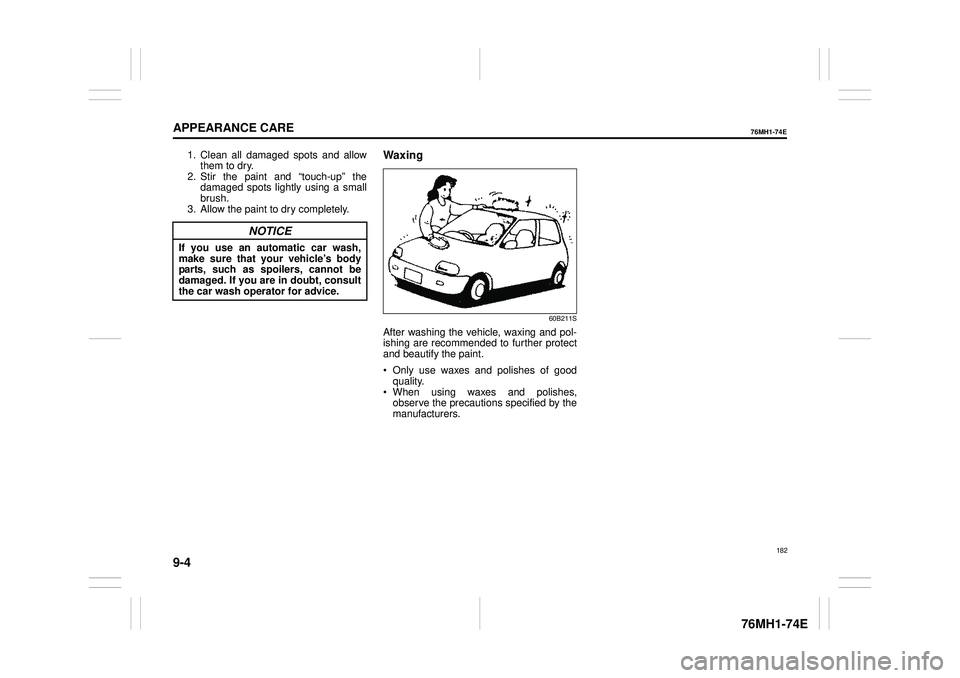
After washing the vehicle, waxing and pol-ishing are recommended to further protect and beautify the paint.
Only use waxes and polishes of good quality. When using waxes and polishes,observe the precautions specified by the manufacturers.
NOTICE
If you use an automatic car wash, make sure that your vehicle’s bodyparts, such as spoilers, cannot be damaged. If you are in doubt, consult the car wash operator for advice.
182