water SUZUKI CELERIO 2016 Owner's Manual
[x] Cancel search | Manufacturer: SUZUKI, Model Year: 2016, Model line: CELERIO, Model: SUZUKI CELERIO 2016Pages: 201, PDF Size: 5.82 MB
Page 187 of 201
8-6
EMERGENCY SERVICE
76MH1-74E
76MH1-74E
If the Starter Does Not
Operate
1) Try turning the ignition switch to the “START” position with the headlights turned on to determine the battery con- dition. If the headlights go excessivelydim or go off, it usually means that either the battery is flat or the battery terminal contact is poor. Recharge thebattery or correct battery terminal con- tact as necessary. 2) If the headlights remain bright, checkthe fuses. If the reason for failure of the starter is not obvious, there may be a major electrical problem. Have the vehi-cle inspected by your authorized MAR- UTI SUZUKI dealer.
If the Engine is Flooded
If the engine is flooded with petrol, it may be hard to start. If this happens, press theaccelerator pedal all the way to the floor and hold it there while cranking the engine. For petrol engine model, do not operatethe starter motor for more than 12 sec- onds. For diesel engine model, do not operatethe starter motor for more than 30 sec- onds.
If the Engine Overheats
The engine could overheat temporarily under severe driving conditions. If the highengine coolant temperature warning light comes on as overheating during driving: 1) Turn off the air conditioner, if equipped.2) Take the vehicle to a safe place and park. 3) Let the engine run at the normal idlespeed for a few minutes until the high engine coolant temperature warning light goes off.
If the high engine coolant temperature warning light does not go off: 1) Turn off the engine and check that the water pump belt and pulleys are notdamaged or slipping. If any abnormality is found, correct it.
2) Check the coolant level in the reservoir. If it is found to be lower than the “LOW” line, look for leaks at the radiator, waterpump, and radiator and heater hoses. If you locate any leaks that may have caused the overheating, do not run theengine until these problems have been corrected. 3) If you do not find a leak, carefully addcoolant to the reservoir and then the radiator, if necessary. (Refer to “Engine Coolant” in the “INSPECTION ANDMAINTENANCE” section.)
NOTE: If your engine overheats and you are unsure what to do, contact your MARUTI SUZUKI dealer.
WA R N I N G
If you see or hear escaping steam,stop the vehicle in a safe place andimmediately turn off the engine to let it cool. Do not open the hood when steam is present. When the steamcan no longer be seen or heard, open the hood to see if the coolant is still boiling. If it is, you must wait until itstops boiling before you proceed.
176
Page 188 of 201
8-7
EMERGENCY SERVICE
76MH1-74E
76MH1-74E
65D614
Warning Triangle
MHO-07-001
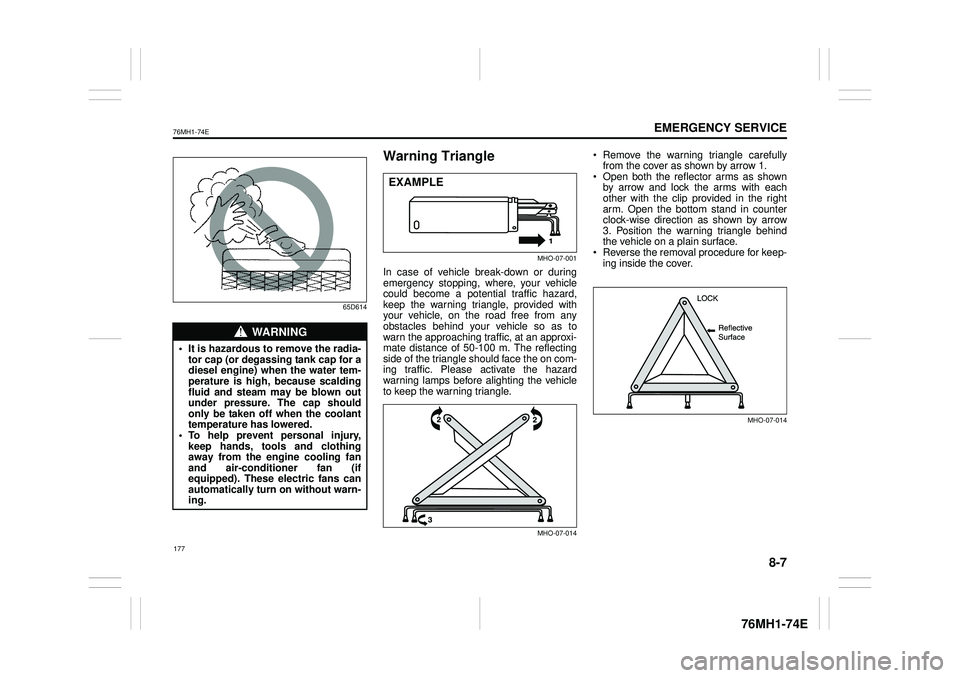
In case of vehicle break-down or during emergency stopping, where, your vehiclecould become a potential traffic hazard, keep the warning triangle, provided with your vehicle, on the road free from anyobstacles behind your vehicle so as to warn the approaching traffic, at an approxi- mate distance of 50-100 m. The reflecting side of the triangle should face the on com- ing traffic. Please activate the hazardwarning lamps before alighting the vehicle to keep the warning triangle.
MHO-07-014
Remove the warning triangle carefullyfrom the cover as shown by arrow 1. Open both the reflector arms as shownby arrow and lock the arms with each other with the clip provided in the right arm. Open the bottom stand in counterclock-wise direction as shown by arrow 3. Position the warning triangle behind the vehicle on a plain surface. Reverse the removal procedure for keep- ing inside the cover.
MHO-07-014
WA R N I N G
• It is hazardous to remove the radia- tor cap (or degassing tank cap for adiesel engine) when the water tem- perature is high, because scalding fluid and steam may be blown outunder pressure. The cap should only be taken off when the coolant temperature has lowered.• To help prevent personal injury, keep hands, tools and clothing away from the engine cooling fanand air-conditioner fan (if equipped). These electric fans can automatically turn on without warn- ing.
EXAMPLE
177
Page 191 of 201

9-2
APPEARANCE CARE
76MH1-74E
76MH1-74E
Vehicle Cleaning
76G044S
Cleaning the Interior
Vinyl upholstery Prepare a solution of soap or mild deter-gent mixed with warm water. Apply the solution to the vinyl with a sponge or soft cloth and let it soak for a few minutes toloosen dirt. Rub the surface with a clean, damp cloth to remove dirt and the soap solution. If somedirt still remains on the surface, repeat this procedure.
Fabric upholstery Remove loose dirt with a vacuum cleaner. Using a mild soap solution, rub stainedareas with a clean damp cloth. To remove soap, rub the areas again with a cloth dampened with water. Repeat this until thestain is removed, or use a commercial fab- ric cleaner for tougher stains. If you use a fabric cleaner, carefully follow the manu-facturer’s instructions and precautions.
Seat belts Clean seat belts with a mild soap and water. Do not use bleach or dye on the belts. They may weaken the fabric in thebelts.
Vinyl floor mats Ordinary dirt can be removed from vinyl with water or mild soap. Use a brush to help loosen dirt. After the dirt is loosened,rinse the mat thoroughly with water and dry it in the shade.
Carpets Remove dirt and soil as much as possible with a vacuum cleaner. Using a mild soapsolution, rub stained areas with a clean damp cloth. To remove soap, rub the areas again with a cloth dampened with water.Repeat this until the stain is removed, or use a commercial carpet cleaner for tougher stains. If you use a carpet cleaner,carefully follow the manufacturer’s instruc- tions and precautions.
Instrument panel and console Remove loose dirt with a vacuum cleaner. Gently wipe dirt off with a tightly squeezed damp clean cloth. Repeat this until the dirt is removed.
Cleaning the Exterior
WA R N I N G
Do not apply additional undercoating or rust preventive coating on oraround exhaust system components such as the catalytic converter, exhaust pipes, etc. A fire could bestarted if the undercoating substance becomes overheated.
WA R N I N G
When cleaning the interior or exterior of the vehicle, NEVER USE flammablesolvents such as lacquer thinners, petrol, benzene or cleaning materials such as bleaches or strong householddetergents. The materials could cause personal injury or damage to the vehi- cle.
NOTICE
Do not use chemical products that contain silicon to wipe electrical components such as the air condi-tioning system, audio, navigation system, or other switches. These will cause damage to the components.
NOTICE
It is important that your vehicle bekept clean and free from dirt. Failureto keep your vehicle clean may result in fading of the pa int or corrosion to various parts of the vehicle body.
180
Page 192 of 201
9-3
APPEARANCE CARE
76MH1-74E
76MH1-74E
Caring for Aluminum Wheels
NOTE: • Do not use an acidic or alkaline deter- gent to wash aluminum wheels. These types of detergent will cause permanentspots, discoloration and cracks on fin- ished surfaces. • Do not use a bristle brush and soap con-taining an abrasive material. These will damage finished surfaces.
Washing
60B212S
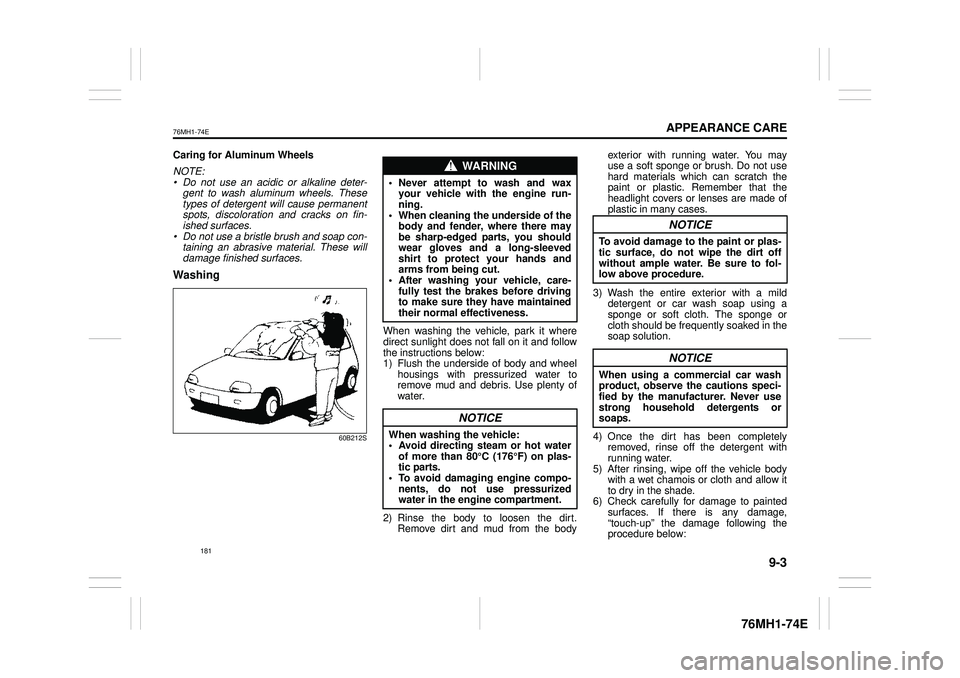
When washing the vehicle, park it wheredirect sunlight does not fall on it and follow the instructions below:1) Flush the underside of body and wheel housings with pressurized water to remove mud and debris. Use plenty ofwater.
2) Rinse the body to loosen the dirt. Remove dirt and mud from the body
exterior with running water. You may use a soft sponge or brush. Do not use hard materials which can scratch thepaint or plastic. Remember that the headlight covers or lenses are made of plastic in many cases.
3) Wash the entire exterior with a mild detergent or car wash soap using a sponge or soft cloth. The sponge or cloth should be frequently soaked in thesoap solution.
4) Once the dirt has been completely removed, rinse off the detergent with running water. 5) After rinsing, wipe off the vehicle bodywith a wet chamois or cloth and allow it to dry in the shade. 6) Check carefully for damage to paintedsurfaces. If there is any damage, “touch-up” the damage following the procedure below:
WA R N I N G
• Never attempt to wash and waxyour vehicle with the engine run-ning. • When cleaning the underside of the body and fender, where there maybe sharp-edged parts, you should wear gloves and a long-sleeved shirt to protect your hands andarms from being cut. • After washing your vehicle, care- fully test the brakes before drivingto make sure they have maintained their normal effectiveness.
NOTICE
When washing the vehicle: • Avoid directing steam or hot water of more than 80