door lock SUZUKI CELERIO 2018 User Guide
[x] Cancel search | Manufacturer: SUZUKI, Model Year: 2018, Model line: CELERIO, Model: SUZUKI CELERIO 2018Pages: 201, PDF Size: 5.82 MB
Page 33 of 201
2-11
BEFORE DRIVING
76MH1-74E
76MH1-74E
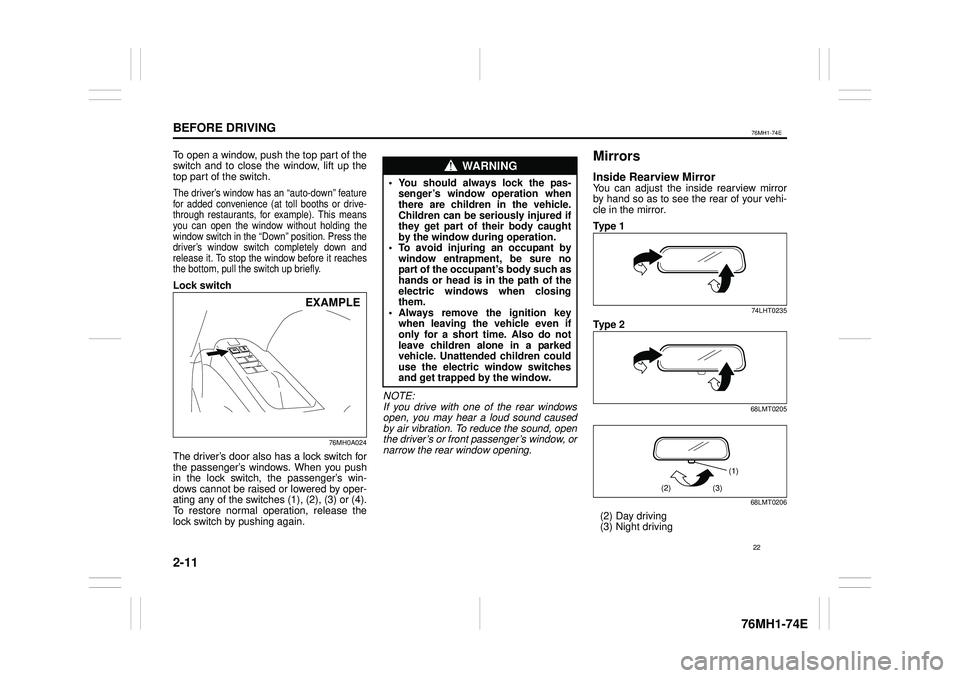
To open a window, push the top part of the switch and to close the window, lift up the top part of the switch.
The driver’s window has an “auto-down” featurefor added convenience (at toll booths or drive-through restaurants, for example). This means you can open the window without holding the window switch in the “Down” position. Press thedriver’s window switch completely down and release it. To stop the window before it reaches the bottom, pull the switch up briefly.
Lock switch
76MH0A024
The driver’s door also has a lock switch forthe passenger’s windows. When you pushin the lock switch, the passenger’s win- dows cannot be raised or lowered by oper- ating any of the switches (1), (2), (3) or (4).To restore normal operation, release the lock switch by pushing again.
NOTE:If you drive with one of the rear windows open, you may hear a loud sound causedby air vibration. To reduce the sound, open the driver’s or front passenger’s window, or narrow the rear window opening.
Mirrors
Inside Rearview MirrorYou can adjust the inside rearview mirrorby hand so as to see the rear of your vehi-cle in the mirror.
Ty p e 1
74LHT0235
Ty p e 2
68LMT0205
68LMT0206
(2) Day driving (3) Night driving
EXAMPLE
WA R N I N G
• You should always lock the pas-senger’s window operation whenthere are children in the vehicle. Children can be seriously injured if they get part of their body caughtby the window during operation.• To avoid injuring an occupant bywindow entrapment, be sure nopart of the occupant’s body such as hands or head is in the path of the electric windows when closingthem.• Always remove the ignition keywhen leaving the vehicle even ifonly for a short time. Also do not leave children alone in a parked vehicle. Unattended children coulduse the electric window switches and get trapped by the window.
(1)
(2)(3)
22
Page 56 of 201

2-34
BEFORE DRIVING
76MH1-74E
76MH1-74E
Setting ModeIn the setting mode, you can set up the following functions.
Indication Functions
Temperature unit (if equipped) “tE”
Time indication of clock “CL”
Central door locking system “d1”
Automatic door locking function “d2”
Automatic door unlocking function “d3”
Door locking and unlocking siren “d5”
45
Page 63 of 201
2-41
BEFORE DRIVING
76MH1-74E
76MH1-74E
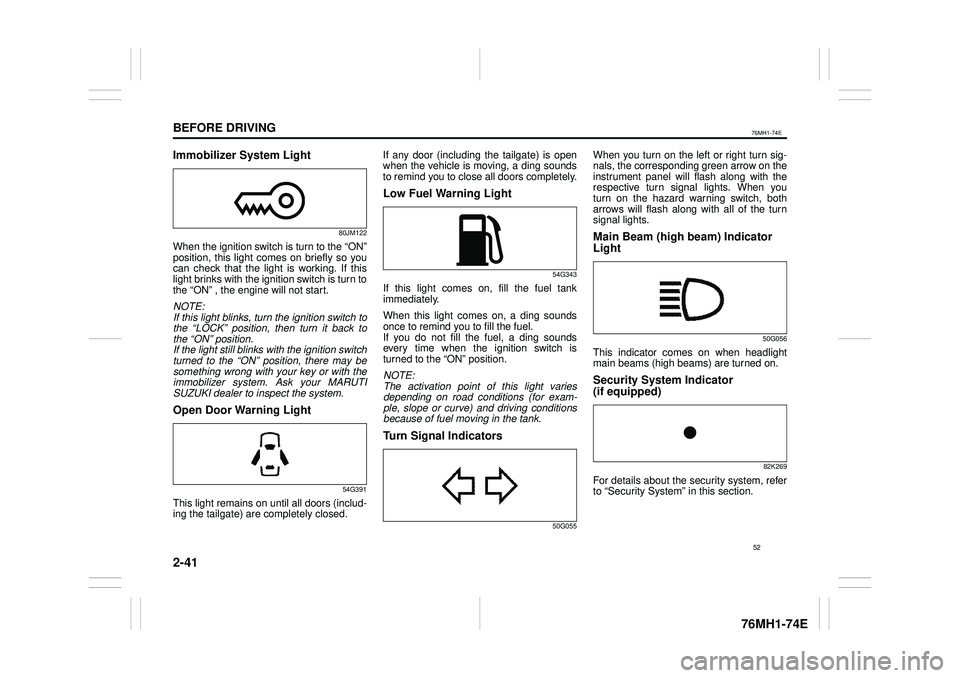
Immobilizer System Light
80JM122
When the ignition switch is turn to the “ON” position, this light comes on briefly so you can check that the light is working. If thislight brinks with the ignition switch is turn to the “ON” , the engine will not start.
NOTE: If this light blinks, turn the ignition switch to the “LOCK” position, then turn it back to the “ON” position. If the light still blinks with the ignition switchturned to the “ON” position, there may be something wrong with your key or with the immobilizer system. Ask your MARUTISUZUKI dealer to inspect the system.
Open Door Warning Light
54G391
This light remains on until all doors (includ-ing the tailgate) are completely closed.
If any door (including the tailgate) is open when the vehicle is moving, a ding sounds to remind you to close all doors completely.
Low Fuel Warning Light
54G343
If this light comes on, fill the fuel tankimmediately.
When this light comes on, a ding sounds once to remind you to fill the fuel. If you do not fill the fuel, a ding sounds every time when the ignition switch isturned to the “ON” position.
NOTE: The activation point of this light varies depending on road conditions (for exam- ple, slope or curve) and driving conditionsbecause of fuel moving in the tank.
Turn Signal Indicators
50G055
When you turn on the left or right turn sig- nals, the corresponding green arrow on the instrument panel will flash along with therespective turn signal lights. When you turn on the hazard warning switch, both arrows will flash along with all of the turnsignal lights.
Main Beam (high beam) Indicator
Light
50G056
This indicator comes on when headlight main beams (high beams) are turned on.
Security System Indicator
(if equipped)
82K269
For details about the security system, referto “Security System” in this section.
52
Page 73 of 201
3-3
OPERATING YOUR VEHICLE
76MH1-74E
76MH1-74E
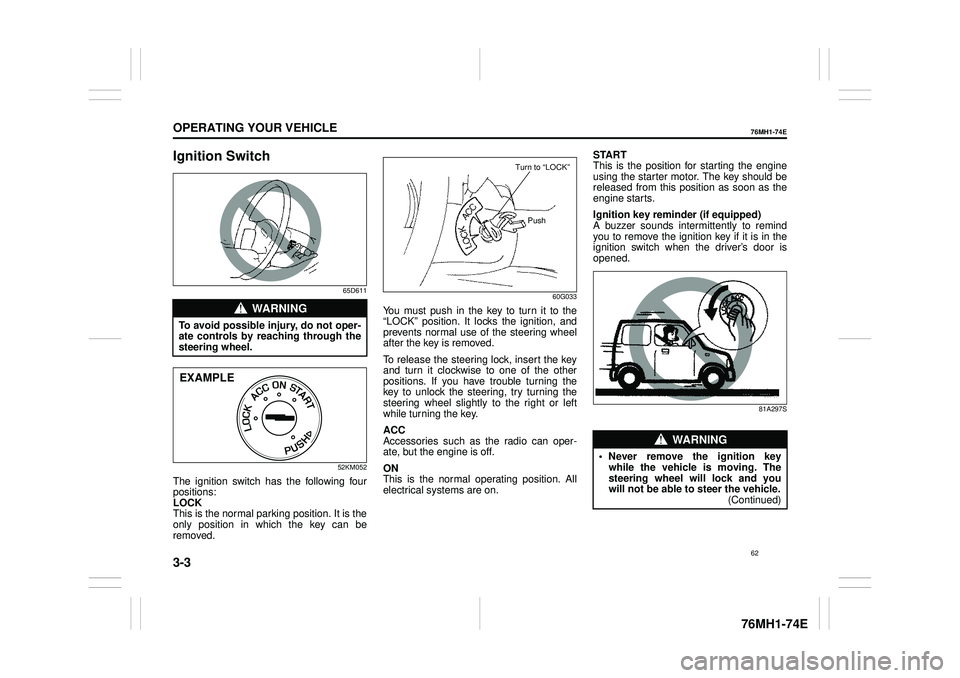
Ignition Switch
65D611
52KM052
The ignition switch has the following four positions: LOCK This is the normal parking position. It is theonly position in which the key can be removed.
60G033
You must push in the key to turn it to the “LOCK” position. It lo cks the ignition, and prevents normal use of the steering wheel after the key is removed.
To release the steering lock, insert the key and turn it clockwise to one of the other positions. If you have trouble turning thekey to unlock the steering, try turning the steering wheel slightly to the right or left while turning the key.
ACC Accessories such as the radio can oper-ate, but the engine is off.
ON This is the normal operating position. All electrical systems are on.
START This is the position for starting the engine using the starter motor. The key should bereleased from this position as soon as the engine starts.
Ignition key reminder (if equipped) A buzzer sounds intermittently to remind you to remove the ignition key if it is in theignition switch when the driver’s door is opened.
81A297S
WA R N I N G
To avoid possible injury, do not oper- ate controls by reaching through thesteering wheel.
EXAMPLE
Turn to “LOCK”
Push
WA R N I N G
• Never remove the ignition keywhile the vehicle is moving. The steering wheel will lock and you will not be able to steer the vehicle.(Continued)
62
Page 85 of 201

3-15
OPERATING YOUR VEHICLE
76MH1-74E
76MH1-74E
Warning functions A warning buzzer will sound or the indica- tor will blink under the following conditions.
Warning buzzer The clutch is heated due to excessiveload. The creeping function is being activated for a long period of time.
The ignition switch is turned to the “LOCK” position with the gear in 2nd, 3rd, 4th or 5th. In this case, turn the igni- tion switch to the “ON” position and shiftthe gearshift lever in the “N” position, shift it to the “D” or “M” or “R” position, then turn the ignition switch to “LOCK”. During a stop, the driver’s door is opened with the gearshift lever in the “R”, “D” or “M” positi on while the engine is running.
“N” indicato r blinking When the gear indicator lamp blinks “N”, you should depress the brake pedal and shift the gearshift lever to “N” position.
“1st” indicator blinking
When the gear indicator lamp blinks “1st”, you should depress the brake pedal and shift the gearshift lever to “N” position, thenshift to “D” or “M” position again a few sec- onds later.
“R” indicator blinking When the gear indicator lamp blinks “R”, you should depress the brake pedal andshift the gearshift lever to “N” position, then shift to “R” position again a few seconds later.
Braking
60G165S
The distance needed to bring any vehicleto a halt increases with the speed of the vehicle. The braking distance needed, for example, at 60 km/h (37 mph) will beapproximately 4 times greater than the braking distance needed at 30 km/h (19 mph). Start to brake the vehicle when thereis plenty of distance between your vehicle
and the stopping point, and slow down gradually.
Power-Assisted BrakesYour vehicle has power-assisted brakes. If power assistance is lost due to a stalledengine or other failur es, the system is still fully operational on reserve power and you can bring the vehicle to a complete stop bypressing the brake pedal once and holding it down. The reserve power is partly used up when you depress the brake pedal andreduces each time the pedal is pressed. Apply smooth and even pressure to the pedal. Do not pump the pedal.
NOTICE
In the above cases, pull over to theside of the road and stop the engine,and then ask your MARUTI SUZUKI dealer to inspect your vehicle. Other- wise, the clutch disc may be dam-aged.EXAMPLE
WA R N I N G
If water gets into the brake drums, brake performance may become poorand unpredictable. After driving through water or washingthe underside of the vehicle, test thebrakes while driving at a slow speedto see if they have maintained their normal effectiveness. If the brakes are less effective than normal, dry themby repeatedly applying the brakeswhile driving slowly until the brakeshave regained their normal effective-ness.
74
Page 91 of 201
4-3
DRIVING TIPS
76MH1-74E
76MH1-74E
Keep weight to a minimum The heavier the load, the more fuel the vehicle consumes. Take out any luggageor cargo when it is not necessary.
Keep tire pressures correct Underinflation of the tires can waste fuel due to increased running resistance of the tires. Keep your tires inflated to the correctpressure shown on the label on the driver’s side door or the driver’s door lock pillar.
Highway Driving
When driving at highway speeds, pay attention to the following: Stopping distance progressively increases with vehicle speed. Apply the brakes far enough ahead of the stoppingpoint to allow for the extra stopping dis- tance. On rainy days, “Hydroplaning” can occur.“Hydroplaning” is the loss of direct con- tact between the road surface and the vehicle’s tires due to a water film formingbetween them. Steering or braking the vehicle while “Hydroplaning” can be very difficult, and loss of control can occur.Keep speed down when the road surface is wet. At high speeds, the vehicle may beaffected by side winds. Therefore, reduce speed and be prepared for unex- pected buffeting, which can occur at theexits of tunnels, when passing by a cut of a hill, or when being overtaken by large vehicles, etc.
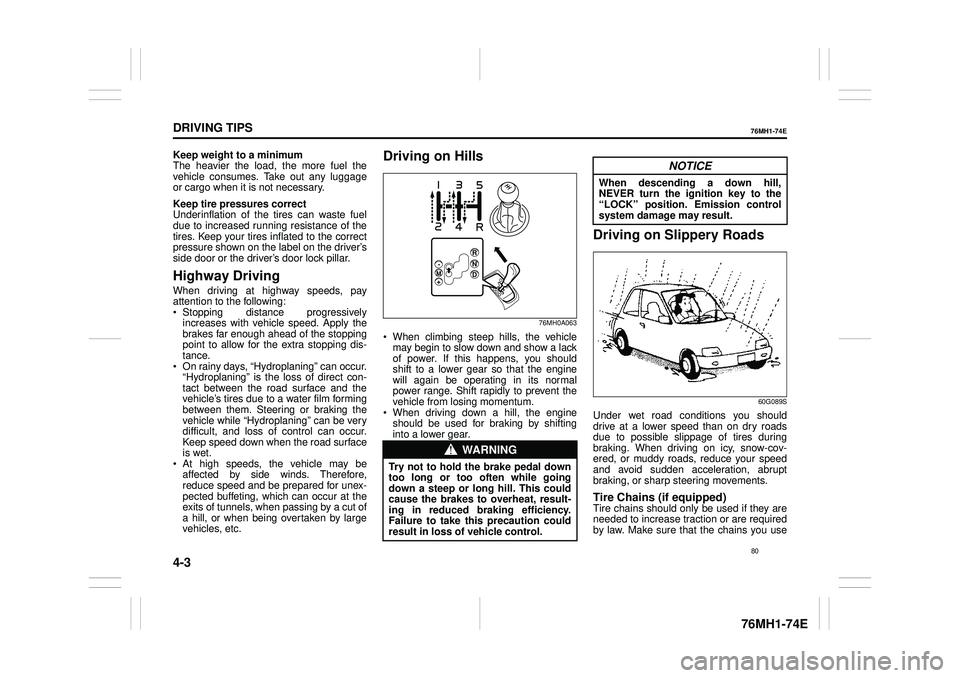
Driving on Hills
76MH0A063
When climbing steep hills, the vehiclemay begin to slow down and show a lackof power. If this happens, you should shift to a lower gear so that the engine will again be operating in its normalpower range. Shift rapidly to prevent the vehicle from losing momentum. When driving down a hill, the engineshould be used for braking by shifting into a lower gear.
Driving on Slippery Roads
60G089S
Under wet road conditions you should drive at a lower speed than on dry roadsdue to possible slippage of tires during braking. When driving on icy, snow-cov- ered, or muddy roads, reduce your speedand avoid sudden acceleration, abrupt braking, or sharp steering movements.
Tire Chains (if equipped)Tire chains should only be used if they are needed to increase traction or are required by law. Make sure that the chains you use
WA R N I N G
Try not to hold the brake pedal down too long or too often while goingdown a steep or long hill. This could cause the brakes to overheat, result- ing in reduced braking efficiency.Failure to take this precaution could result in loss of vehicle control.
R N D -M+
NOTICE
When descending a down hill, NEVER turn the igni tion key to the “LOCK” position. Emission control system damage may result.
80
Page 92 of 201
4-4
DRIVING TIPS
76MH1-74E
76MH1-74E
are the correct size for your vehicle’s tires. Also make sure that there is enough clear- ance between the fenders and the chainsas installed on the tires.
Install the chains on the front tires tightly, according to the chain manufacturer’s instructions. Retight en the chains after driving about 1.0 km (1/2 mile) if neces-sary. With the chains installed, drive slowly.
If Your Vehicle Gets StuckIf your vehicle gets stuck in snow, mud, orsand, follow the directions below:
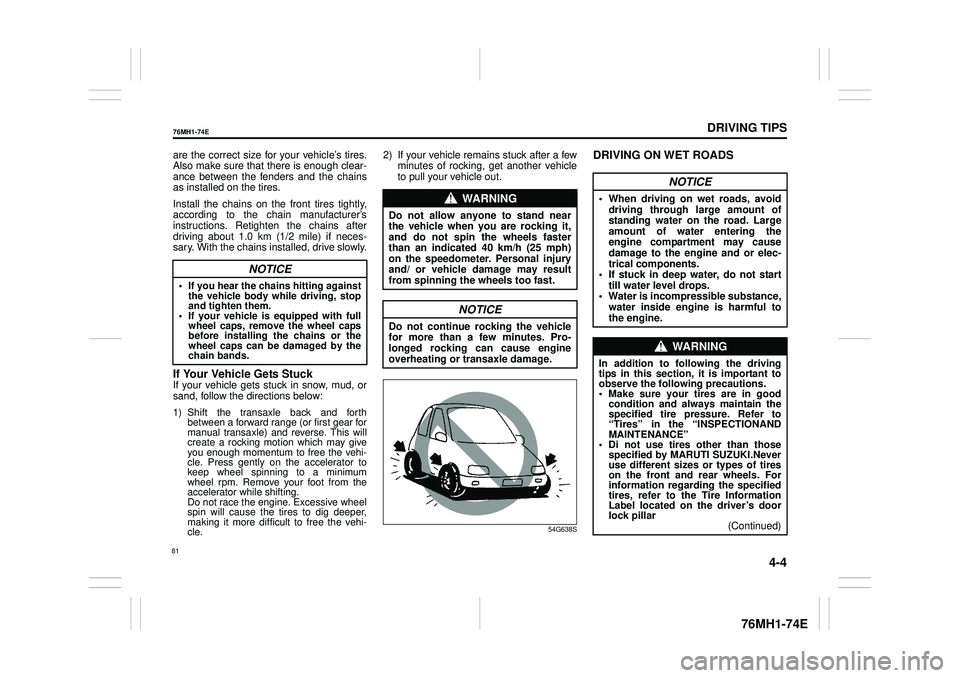
1) Shift the transaxle back and forth between a forward range (or first gear formanual transaxle) and reverse. This willcreate a rocking motion which may giveyou enough momentum to free the vehi- cle. Press gently on the accelerator to keep wheel spinning to a minimumwheel rpm. Remove your foot from theaccelerator while shifting. Do not race the engine. Excessive wheelspin will cause the tires to dig deeper,making it more difficult to free the vehi- cle.
2) If your vehicle remains stuck after a few minutes of rocking, get another vehicle to pull your vehicle out.
54G638S
DRIVING ON WET ROADS
NOTICE
• If you hear the chains hitting against the vehicle body while driving, stopand tighten them.• If your vehicle is equipped with fullwheel caps, remove the wheel caps before installing the chains or the wheel caps can be damaged by thechain bands.
WA R N I N G
Do not allow anyone to stand near the vehicle when you are rocking it,and do not spin the wheels faster than an indicated 40 km/h (25 mph) on the speedometer. Personal injuryand/ or vehicle damage may result from spinning the wheels too fast.
NOTICE
Do not continue rocking the vehicle for more than a few minutes. Pro-longed rocking can cause engine overheating or transaxle damage.
NOTICE
• When driving on wet roads, avoid driving through large amount of standing water on the road. Large amount of water entering theengine compartment may cause damage to the engine and or elec- trical components.• If stuck in deep water, do not start till water level drops. • Water is incompressible substance,water inside engine is harmful to the engine.
WA R N I N G
In addition to following the driving tips in this section, it is important to observe the following precautions. • Make sure your tires are in good condition and always maintain the specified tire pressure. Refer to“Tires” in the “INSPECTIONAND MAINTENANCE” • Di not use tires other than thosespecified by MARUTI SUZUKI.Never use different sizes or types of tires on the front and rear wheels. Forinformation regard ing the specified tires, refer to the Tire Information Label located on the driver’s doorlock pillar(Continued)
81
Page 97 of 201

5-1
OTHER CONTROLS AND EQUIPMENT
76MH1-74E
76MH1-74E
Fuel Filler Cap
76MH0A064
74LHT0511
The fuel filler cap is lo cated on the left rear side of the vehicle. The fuel filler door can be unlocked by pulling up the opener leverlocated on the outboard side of the driver’s seat and locked by simply closing the door.
68KN048
To remove the fuel filler cap: 1) Open the fuel filler door. 2) Remove the cap by turning it counter- clockwise.
76MH0A065
NOTE: If the cap holder (1) is equipped with the fuel filler door, hold the fuel filler cap whenrefueling.
To reinstall the fuel filler cap: 1) Turn the cap clockwise until you hear several clicks. 2) Close the fuel filler door.
EXAMPLE
EXAMPLE
CAUTION
Remove the fuel fill er cap slowly. The fuel may be under pressure and mayspray out, causing injury.
Open Close
EXAMPLE
WA R N I N G
Fuel is extremely flammable. Do notsmoke when refueling, and makesure there are no open flames or sparks in the area.
(1)
EXAMPLE
86
Page 99 of 201

5-3
OTHER CONTROLS AND EQUIPMENT
76MH1-74E
76MH1-74E
To close the engine hood: 1) Lift the hood up slightly and remove the prop rod from the hole. Put the prop rodback to the holding clip.
76MS014
2) Lower the hood to about 20 cm abovethe hood latch, then let it drop down. Make sure the hood is securely latched after closing.
Sun Visor
79J161
The sun visors can be pulled down to block glare coming through the windshield, orthey can be unhooked and turned to the side to block glare coming through the side window.
Card holder (if equipped)
67LH064
(1) Card holder
You can put a card in the card holder (1) on the back of the sun visor.
WA R N I N G
Make sure the hood is fully closedand latched before driv ing. If it is not, it can fly up unexpectedly duringdriving, obstructing your view and resulting in an accident.
EXAMPLE
CAUTION
To avoid injury, be sure no part of the occupant’s body such as hands orhead is in the path of the hood when closing it.
NOTICE
Pressing the hood from above may damage the hood.
EXAMPLE
NOTICE
When unhooking and hooking a sunvisor, be sure to handle it by the hardplastic parts or the sun visor can be damaged.
NOTICE
When you park your vehicle outdoorsin direct sunlight or in hot weather, do not leave plastic cards in theholder. The heat may distort them.
(1)
EXAMPLE
88
Page 172 of 201
7-23
INSPECTION AND MAINTENANCE
76MH1-74E
76MH1-74E
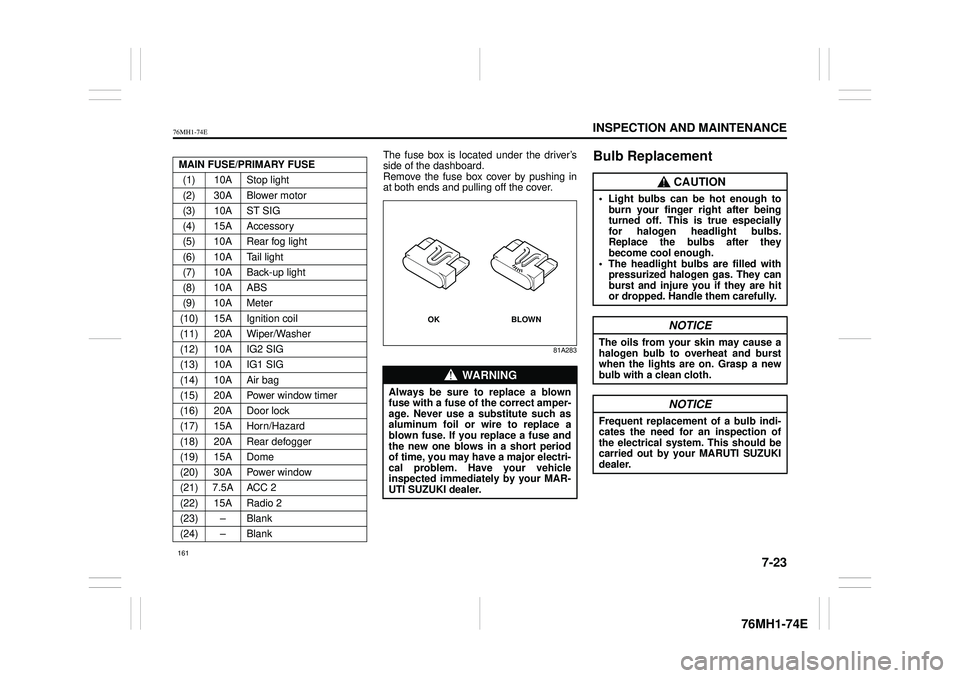
The fuse box is located under the driver’s side of the dashboard. Remove the fuse box cover by pushing inat both ends and pulling off the cover.
81A283
Bulb ReplacementMAIN FUSE/PRIMARY FUSE
(1) 10A Stop light
(2) 30A Blower motor
(3) 10A ST SIG
(4) 15A Accessory
(5) 10A Rear fog light
(6) 10A Tail light
(7) 10A Back-up light
(8) 10A ABS
(9) 10A Meter
(10) 15A Ignition coil
(11) 20A Wiper/Washer
(12) 10A IG2 SIG
(13) 10A IG1 SIG
(14) 10A Air bag
(15) 20A Power window timer
(16) 20A Door lock
(17) 15A Horn/Hazard
(18) 20A Rear defogger
(19) 15A Dome
(20) 30A Power window
(21) 7.5A ACC 2
(22) 15A Radio 2
(23) – Blank
(24) – Blank
WA R N I N G
Always be sure to replace a blown fuse with a fuse of the correct amper- age. Never use a substitute such as aluminum foil or wire to replace ablown fuse. If you replace a fuse and the new one blows in a short period of time, you may have a major electri-cal problem. Have your vehicle inspected immediately by your MAR- UTI SUZUKI dealer.
BLOWN OK
CAUTION
• Light bulbs can be hot enough toburn your finger right after being turned off. This is true especially for halogen headlight bulbs.Replace the bulbs after they become cool enough. • The headlight bulbs are filled withpressurized halogen gas. They can burst and injure you if they are hit or dropped. Handle them carefully.
NOTICE
The oils from your skin may cause ahalogen bulb to overheat and burst when the lights are on. Grasp a new bulb with a clean cloth.
NOTICE
Frequent replacement of a bulb indi-cates the need for an inspection of the electrical system. This should be carried out by your MARUTI SUZUKIdealer.
161