Oul SUZUKI CELERIO 2019 User Guide
[x] Cancel search | Manufacturer: SUZUKI, Model Year: 2019, Model line: CELERIO, Model: SUZUKI CELERIO 2019Pages: 201, PDF Size: 5.82 MB
Page 38 of 201
2-16
BEFORE DRIVING
76MH1-74E
76MH1-74E
65D199
Lap-Shoulder Belt
Emergency Locking Retractor (ELR) The seat belt has an emergency locking retractor (ELR), which is designed to lock the seat belt only during a sudden stop orimpact. It also may lock if you pull the belt across your body very quickly. If this hap- pens, let the belt go back to unlock it, thenpull the belt across your body more slowly.
WA R N I N G
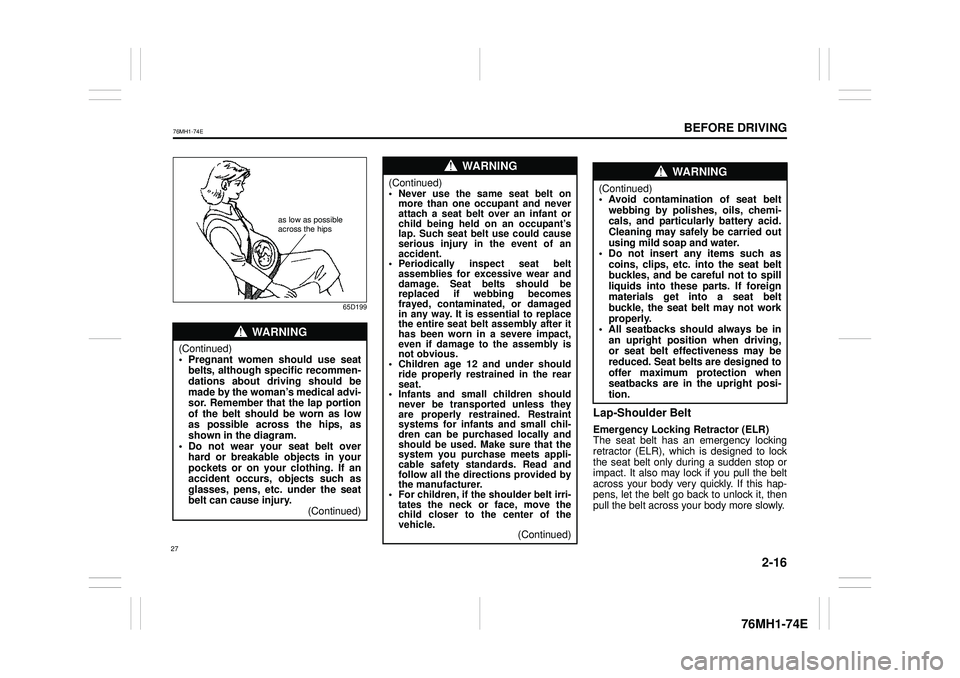
(Continued)• Pregnant women should use seatbelts, although specific recommen- dations about driving should be made by the woman’s medical advi-sor. Remember that the lap portion of the belt should be worn as low as possible across the hips, asshown in the diagram.• Do not wear your seat belt overhard or breakable objects in yourpockets or on your clothing. If an accident occurs, objects such as glasses, pens, etc. under the seatbelt can cause injury.(Continued)
as low as possible across the hips
WA R N I N G
(Continued)• Never use the same seat belt onmore than one occupant and never attach a seat belt over an infant orchild being held on an occupant’s lap. Such seat belt use could cause serious injury in the event of anaccident.• Periodically inspect seat beltassemblies for excessive wear anddamage. Seat belts should be replaced if webbing becomes frayed, contaminated, or damagedin any way. It is essential to replace the entire seat belt assembly after it has been worn in a severe impact,even if damage to the assembly is not obvious.• Children age 12 and under shouldride properly restrained in the rearseat.• Infants and small children shouldnever be transported unless theyare properly restrained. Restraint systems for infants and small chil-dren can be purchased locally andshould be used. Make sure that the system you purchase meets appli- cable safety standards. Read andfollow all the directions provided by the manufacturer.• For children, if the shoulder belt irri-tates the neck or face, move thechild closer to the center of the vehicle.(Continued)
WA R N I N G
(Continued) • Avoid contamination of seat beltwebbing by polishes, oils, chemi-cals, and particularly battery acid.Cleaning may safely be carried out using mild soap and water.• Do not insert any items such ascoins, clips, etc. into the seat beltbuckles, and be careful not to spill liquids into these parts. If foreignmaterials get into a seat belt buckle, the seat belt may not work properly.• All seatbacks should always be inan upright position when driving,or seat belt effectiveness may bereduced. Seat belts are designed to offer maximum protection whenseatbacks are in the upright posi- tion.
27
Page 39 of 201

2-17
BEFORE DRIVING
76MH1-74E
76MH1-74E
Safety reminder
60A038
60A040
To reduce the risk of sliding under the belt during a collision, position the lap portion of the belt across your lap as low on yourhips as possible and adjust it to a snug fit by pulling the shoulder portion of the belt upward through the latch plate. The length
of the diagonal shoulder strap adjusts itself to allow freedom of movement.
All Seat Belts Except Rear CenterAll seat belts except rear center are the lap-shoulder belt.
60A036
To fasten the seat belt, sit up straight andwell back in the seat, pull the latch plateattached to the seat belt across your body and press it straight into the buckle until you hear a “click”.
60A039
To unfasten the seat belt, push the button on the buckle and retract the belt slowly while attaching a hand to the belt or/andthe latch plate.
Rear Center Seat Belt
Rear center seat belt is the lap belt.To fasten the belt, pull the latch plate attached to the seat belt across your hips and press it straight into the buckle untilyou hear a “click”. To reduce the risk of sliding under the belt during a collision, position the belt across your lap as low onyour hips as possible and adjust it to a snug fit.
80JS028
To tighten the belt, pull the free end of the belt across alongside the lap strap.
Sit up straight and fully back
Low on hips
Low on hipsTO TIGHTEN
Low on hips
28
Page 40 of 201

2-18
BEFORE DRIVING
76MH1-74E
76MH1-74E
80JS029
To lengthen, release the latch plate from the buckle, pull the latch plate (adjuster) in the direction of the arrow, at right angles tothe belt. The latch plate should then be refitted into the buckle and the belt tight- ened as previously described.
To unfasten the belt, press the release but- ton on the buckle catch.
80JS031
NOTE: To identify the center seat belt buckle and latch plate in the rear seat, “CENTER” ismarked on the buckle and latch plate of the center lap belt. The buckles are designed so a latch plate cannot be inserted into thewrong buckle.
Driver’s Seat Belt Reminder
(if equipped)
With tachometer
76MH028
Without tachometer
76MS013
When the driver doesn’t buckle his or her seat belt with the ignition switch in the “ON” position, the driver’s seat belt reminderlight in the instrument cluster will blink until the driver’s seat belt is buckled.
TO LOOSEN
Right angleEXAMPLE
WA R N I N G
It is absolutely essential that thedriver and passengers wear their seat belts at all times. Persons who arenot wearing seat belts have a much greater risk of injury if an accident occurs. Make a regular habit of buck-ling your seat belt before putting the key in the ignition.
EXAMPLE
29
Page 41 of 201
2-19
BEFORE DRIVING
76MH1-74E
76MH1-74E
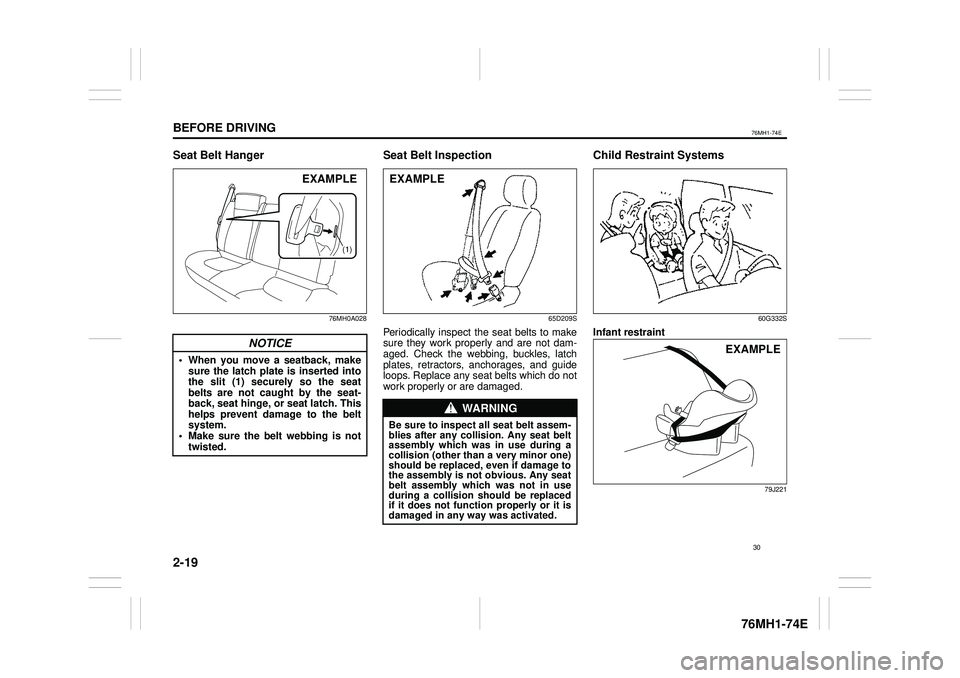
Seat Belt Hanger
76MH0A028
Seat Belt Inspection
65D209S
Periodically inspect the seat belts to make sure they work properly and are not dam- aged. Check the webbing, buckles, latch plates, retractors, anchorages, and guideloops. Replace any seat belts which do not work properly or are damaged.
Child Restraint Systems
60G332S
Infant restraint
79J221
NOTICE
• When you move a seatback, makesure the latch plate is inserted into the slit (1) securely so the seatbelts are not caught by the seat- back, seat hinge, or seat latch. This helps prevent damage to the beltsystem.• Make sure the belt webbing is nottwisted.
(1)
EXAMPLE
WA R N I N G
Be sure to inspect all seat belt assem- blies after any collision. Any seat beltassembly which was in use during a collision (other than a very minor one) should be replaced, even if damage tothe assembly is not obvious. Any seat belt assembly which was not in use during a collision should be replacedif it does not function properly or it is damaged in any way was activated.
EXAMPLE
EXAMPLE
30
Page 42 of 201
2-20
BEFORE DRIVING
76MH1-74E
76MH1-74E
Child restraint
79J222
Booster seat
79J223
MARUTI SUZUKI highly recommends that you use a child restraint system to restrain infants and small children. Many differenttypes of child restraint systems are avail-
able; make sure that the restraint systemyou select meets applicable safety stan-dards.
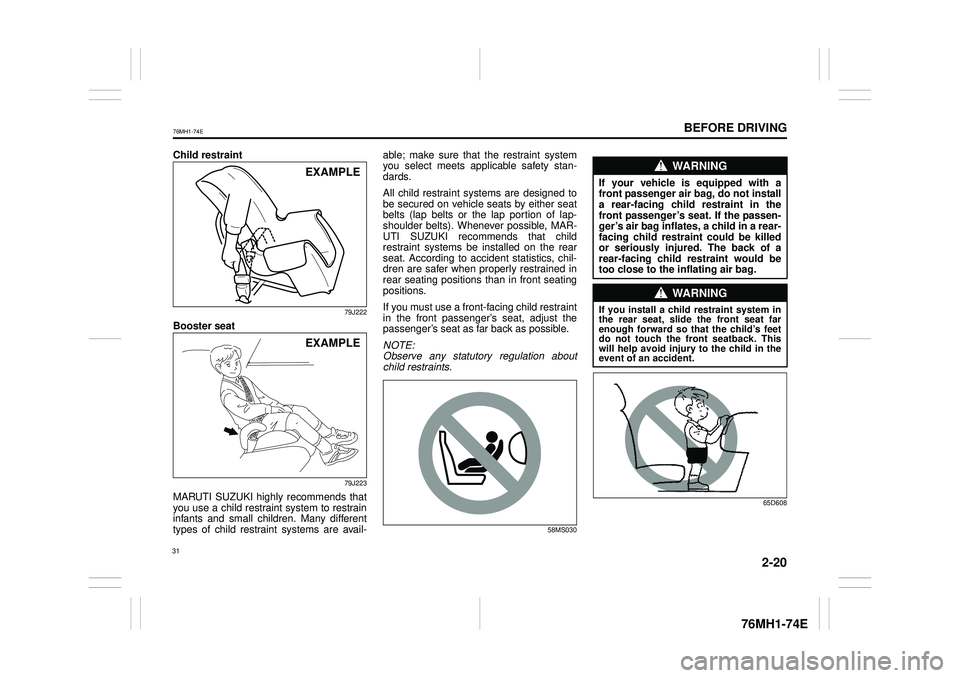
All child restraint systems are designed tobe secured on vehicle seats by either seat belts (lap belts or the lap portion of lap- shoulder belts). Whenever possible, MAR- UTI SUZUKI recommends that childrestraint systems be installed on the rear seat. According to accident statistics, chil- dren are safer when properly restrained inrear seating positions than in front seating positions.
If you must use a front-facing child restraint in the front passenger’s seat, adjust the passenger’s seat as far back as possible.
NOTE: Observe any statutory regulation aboutchild restraints.
58MS030
65D608
EXAMPLE
EXAMPLE
WA R N I N G
If your vehicle is equipped with afront passenger air bag, do not installa rear-facing child restraint in the front passenger’s seat. If the passen- ger’s air bag inflates, a child in a rear-facing child restraint could be killed or seriously injured. The back of a rear-facing child restraint would betoo close to the inflating air bag.
WA R N I N G
If you install a child restraint system in the rear seat, slide the front seat farenough forward so that the child’s feet do not touch the front seatback. This will help avoid injury to the child in theevent of an accident.
31
Page 43 of 201
2-21
BEFORE DRIVING
76MH1-74E
76MH1-74E
65D609
Installation with Lap-Shoulder Seat
Belts
ELR type belt
80JC021
Install your child restraint system accord- ing to the instructions provided by the child restraint system manufacturer.
Make sure that the seat belt is securely latched.
Try to move the child restraint system in all directions to make sure it is securely installed.
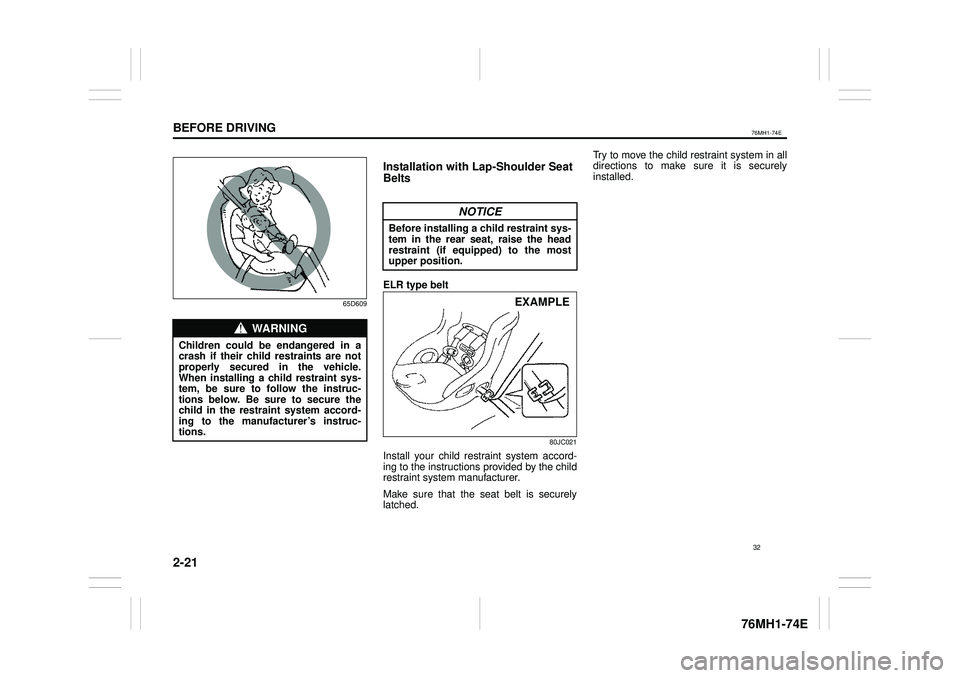
WA R N I N G
Children could be endangered in acrash if their child restraints are notproperly secured in the vehicle. When installing a child restraint sys- tem, be sure to follow the instruc-tions below. Be sure to secure the child in the restraint system accord- ing to the manufacturer’s instruc-tions.
NOTICE
Before installing a child restraint sys- tem in the rear seat, raise the head restraint (if equipped) to the mostupper position.
EXAMPLE
32
Page 45 of 201
2-23
BEFORE DRIVING
76MH1-74E
76MH1-74E
Supplemental Restraint
System (air bags)
(if equipped)
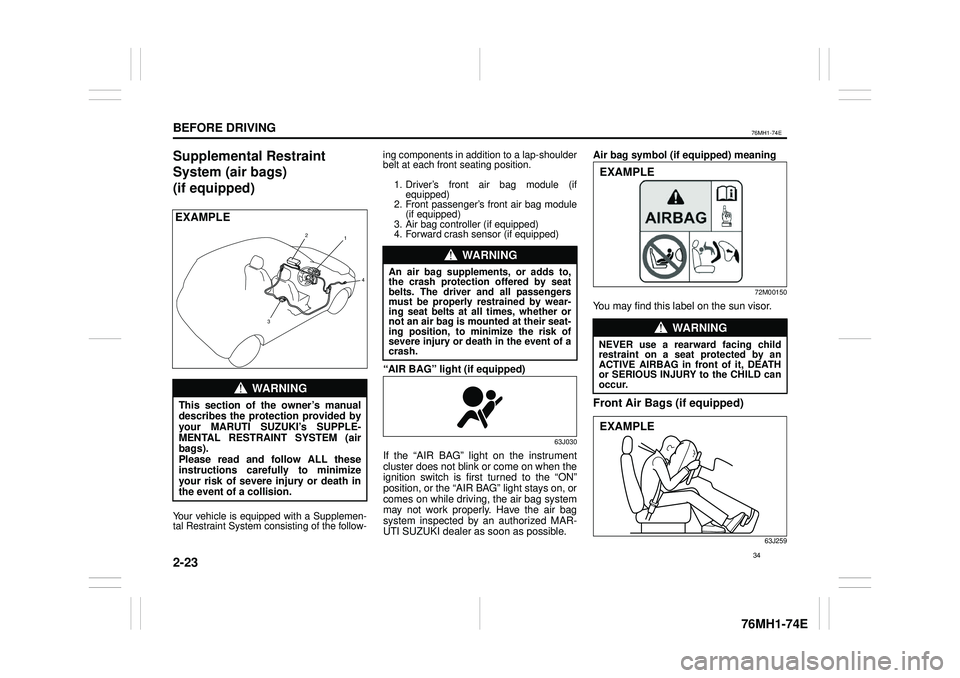
Your vehicle is equipped with a Supplemen- tal Restraint System consisting of the follow-
ing components in addition to a lap-shoulderbelt at each front seating position.
1. Driver’s front air bag module (ifequipped)2. Front passenger’s front air bag module(if equipped)3. Air bag controller (if equipped)4. Forward crash sensor (if equipped)
Page 46 of 201
2-24
BEFORE DRIVING
76MH1-74E
76MH1-74E
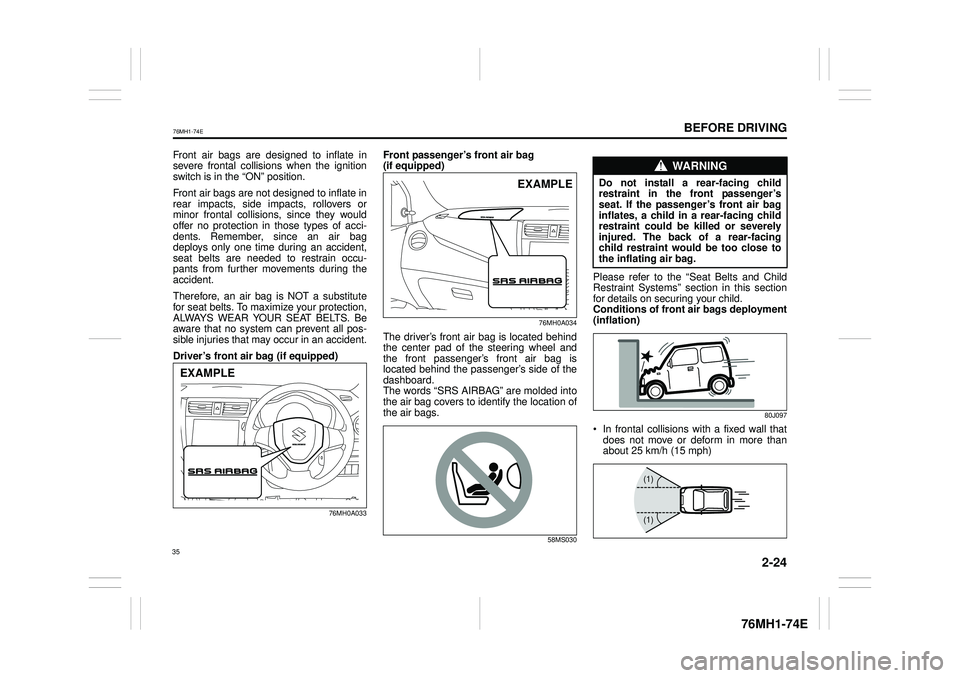
Front air bags are designed to inflate in severe frontal collisions when the ignition switch is in the “ON” position.
Front air bags are not designed to inflate in rear impacts, side impacts, rollovers orminor frontal collisions, since they would offer no protection in those types of acci- dents. Remember, since an air bagdeploys only one time during an accident, seat belts are needed to restrain occu- pants from further movements during theaccident.
Therefore, an air bag is NOT a substitute for seat belts. To maximize your protection, ALWAYS WEAR YOUR SEAT BELTS. Be aware that no system can prevent all pos-sible injuries that may occur in an accident.
Driver
Page 48 of 201
2-26
BEFORE DRIVING
76MH1-74E
76MH1-74E
80J105E
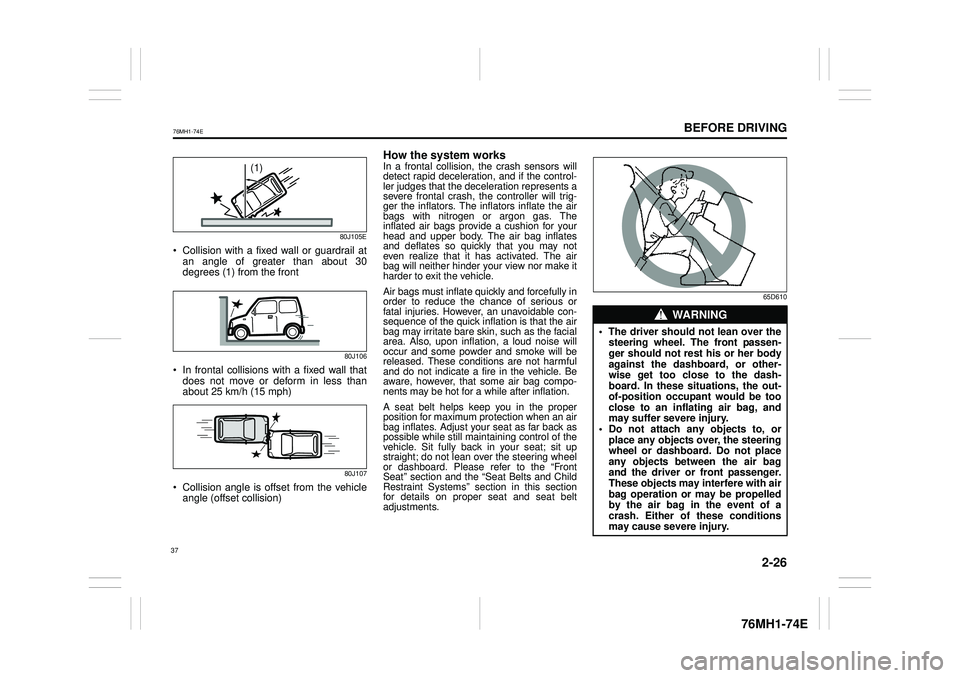
Collision with a fixed wall or guardrail atan angle of greater than about 30 degrees (1) from the front
80J106
In frontal collisions with a fixed wall thatdoes not move or deform in less thanabout 25 km/h (15 mph)
80J107
Collision angle is offset from the vehicleangle (offset collision)
How the system worksIn a frontal collision, the crash sensors will detect rapid deceleration, and if the control-ler judges that the deceleration represents asevere frontal crash, the controller will trig- ger the inflators. The inflators inflate the airbags with nitrogen or argon gas. The inflated air bags provide a cushion for yourhead and upper body. The air bag inflatesand deflates so quickly that you may noteven realize that it has activated. The airbag will neither hinder your view nor make itharder to exit the vehicle.
Air bags must inflate quickly and forcefully in order to reduce the chance of serious or fatal injuries. However, an unavoidable con-sequence of the quick inflation is that the airbag may irritate bare skin, such as the facialarea. Also, upon inflation, a loud noise willoccur and some powder and smoke will be released. These conditions are not harmful and do not indicate a fire in the vehicle. Beaware, however, that some air bag compo-nents may be hot for a while after inflation.
A seat belt helps keep you in the proper position for maximum protection when an airbag inflates. Adjust your seat as far back aspossible while still maintaining control of the vehicle. Sit fully back in your seat; sit upstraight; do not lean over the steering wheel or dashboard. Please refer to the “FrontSeat” section and the “Seat Belts and ChildRestraint Systems” section in this sectionfor details on proper seat and seat belt adjustments.
65D610
(1)
WA R N I N G
• The driver should not lean over thesteering wheel. The front passen- ger should not rest his or her body against the dashboard, or other- wise get too close to the dash-board. In these situations, the out- of-position occupant would be too close to an inflating air bag, andmay suffer severe injury.• Do not attach any objects to, orplace any objects over, the steeringwheel or dashboard. Do not place any objects between the air bag and the driver or front passenger.These objects may interfere with air bag operation or may be propelled by the air bag in the event of acrash. Either of these conditions may cause severe injury.
37
Page 49 of 201
2-27
BEFORE DRIVING
76MH1-74E
76MH1-74E
Note that even though your vehicle may be moderately damaged in a frontal collision,the collision may not have been severe enough to trigger the air bags to inflate. If your vehicle sustains ANY front-end dam-age, have the air bag system inspected by an authorized MARUTI SUZUKI dealer to ensure it is in proper working order.
Your vehicle is equipped with a diagnostic module which records information aboutthe air bag system if the air bags deploy ina crash. The module records informationabout overall system status, which sensorsactivated the deployment, and for a certain vehicle only, whether the driver’s seat belt was in use.
Servicing the air bag system If the air bags inflate, have the air bags andrelated components replaced by an autho- rized MARUTI SUZUKI dealer as soon as possible.
If your vehicle ever gets in deep water and the driver’s floor is submerged, the air bagcontroller could be damaged. If it does, have the air bag system inspected by theMARUTI SUZUKI dealer as soon as possi- ble.
Special procedures are required for servic- ing or replacing an air bag. For that reason, only an authorized MARUTI SUZUKI dealer should be allowed to service orreplace your air bags. Please remind any-
one who services your vehicle that it has air bags.
Service on or around air bag components or wiring must be performed only by an authorized MARUTI SUZUKI dealer.Improper service could result in unin- tended air bag deployment or could render the air bag inoperative. Either of these twoconditions may result in severe injury.
To prevent damage or unintended inflation of the air bag system, be sure the batteryis disconnected and the ignition switch hasbeen in the “LOCK” position for at least 90seconds before performing any electrical service work on your vehicle. Do not touch air bag system components or wires. Thewires are wrapped with yellow tape or yel- low tubing, and the couplers are yellow for easy identification.
Scrapping a vehicle that has an uninflated air bag can be hazardous. Ask your dealer,body repair shop or scrap yard for help with disposal.
38