Back seat SUZUKI ERTIGA 2013 1.G User Guide
[x] Cancel search | Manufacturer: SUZUKI, Model Year: 2013, Model line: ERTIGA, Model: SUZUKI ERTIGA 2013 1.GPages: 207, PDF Size: 5.14 MB
Page 42 of 207
Downloaded from www.Manualslib.com manuals search engine 2-27BEFORE DRIVING
60MK0-14E
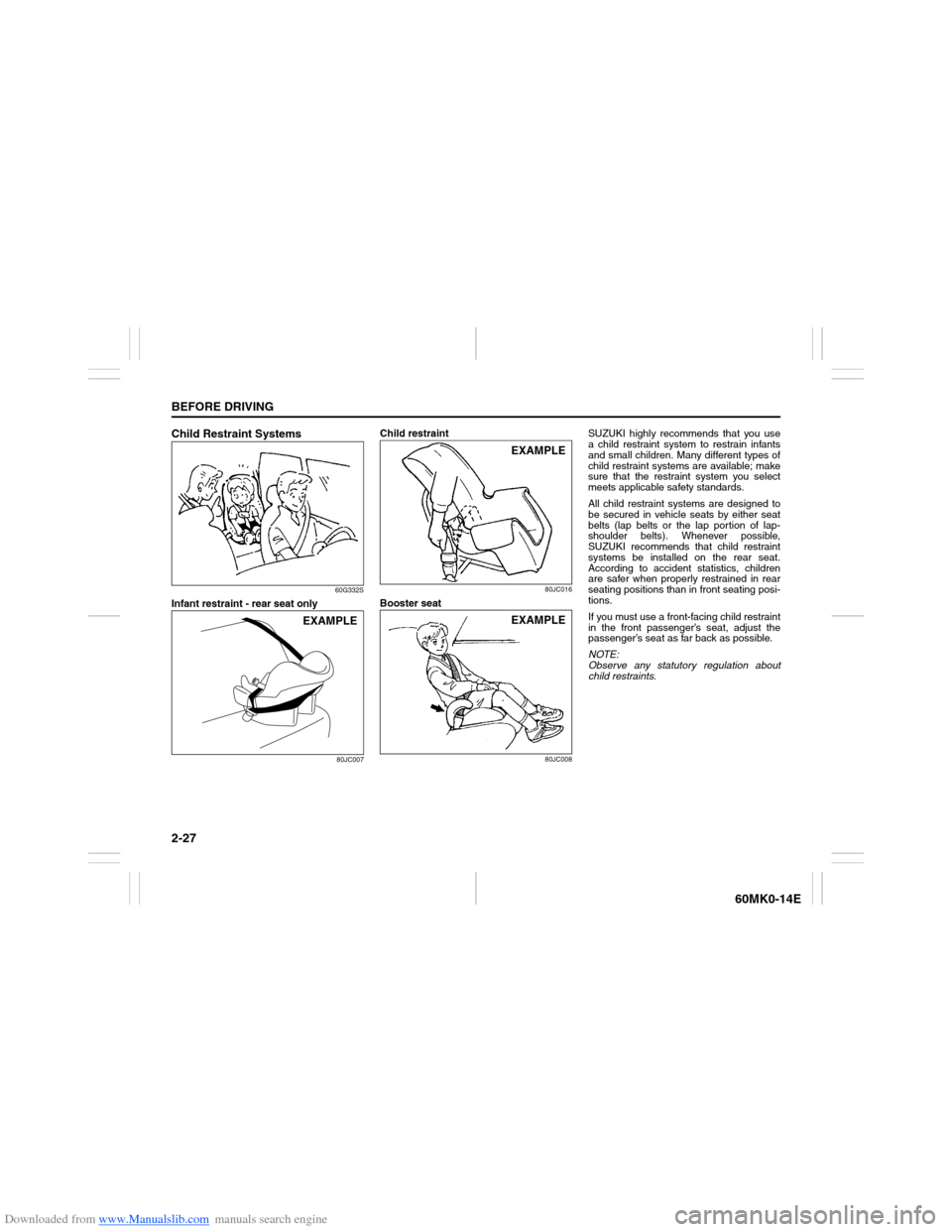
Child Restraint Systems
60G332S
Infant restraint - rear seat only
80JC007
Child restraint
80JC016
Booster seat
80JC008
SUZUKI highly recommends that you use
a child restraint system to restrain infants
and small children. Many different types of
child restraint systems are available; make
sure that the restraint system you select
meets applicable safety standards.
All child restraint systems are designed to
be secured in vehicle seats by either seat
belts (lap belts or the lap portion of lap-
shoulder belts). Whenever possible,
SUZUKI recommends that child restraint
systems be installed on the rear seat.
According to accident statistics, children
are safer when properly restrained in rear
seating positions than in front seating posi-
tions.
If you must use a front-facing child restraint
in the front passenger’s seat, adjust the
passenger’s seat as far back as possible.
NOTE:
Observe any statutory regulation about
child restraints.
EXAMPLE
EXAMPLEEXAMPLE
Page 43 of 207
Downloaded from www.Manualslib.com manuals search engine 2-28
BEFORE DRIVING
60MK0-14E
58MS03065D608
65D609
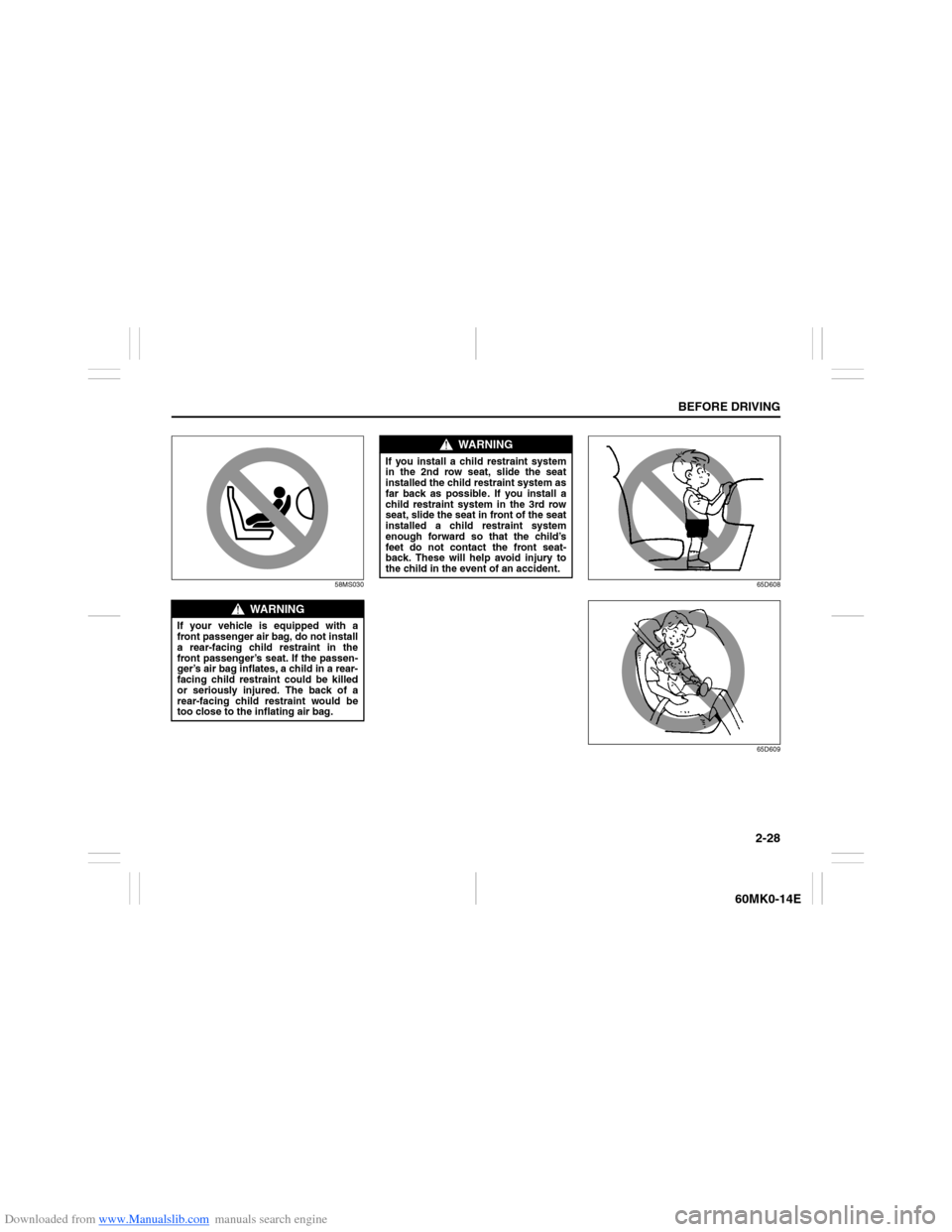
WARNING
If your vehicle is equipped with a
front passenger air bag, do not install
a rear-facing child restraint in the
front passenger’s seat. If the passen-
ger’s air bag inflates, a child in a rear-
facing child restraint could be killed
or seriously injured. The back of a
rear-facing child restraint would be
too close to the inflating air bag.
WARNING
If you install a child restraint system
in the 2nd row seat, slide the seat
installed the child restraint system as
far back as possible. If you install a
child restraint system in the 3rd row
seat, slide the seat in front of the seat
installed a child restraint system
enough forward so that the child’s
feet do not contact the front seat-
back. These will help avoid injury to
the child in the event of an accident.
Page 44 of 207
Downloaded from www.Manualslib.com manuals search engine 2-29BEFORE DRIVING
60MK0-14E
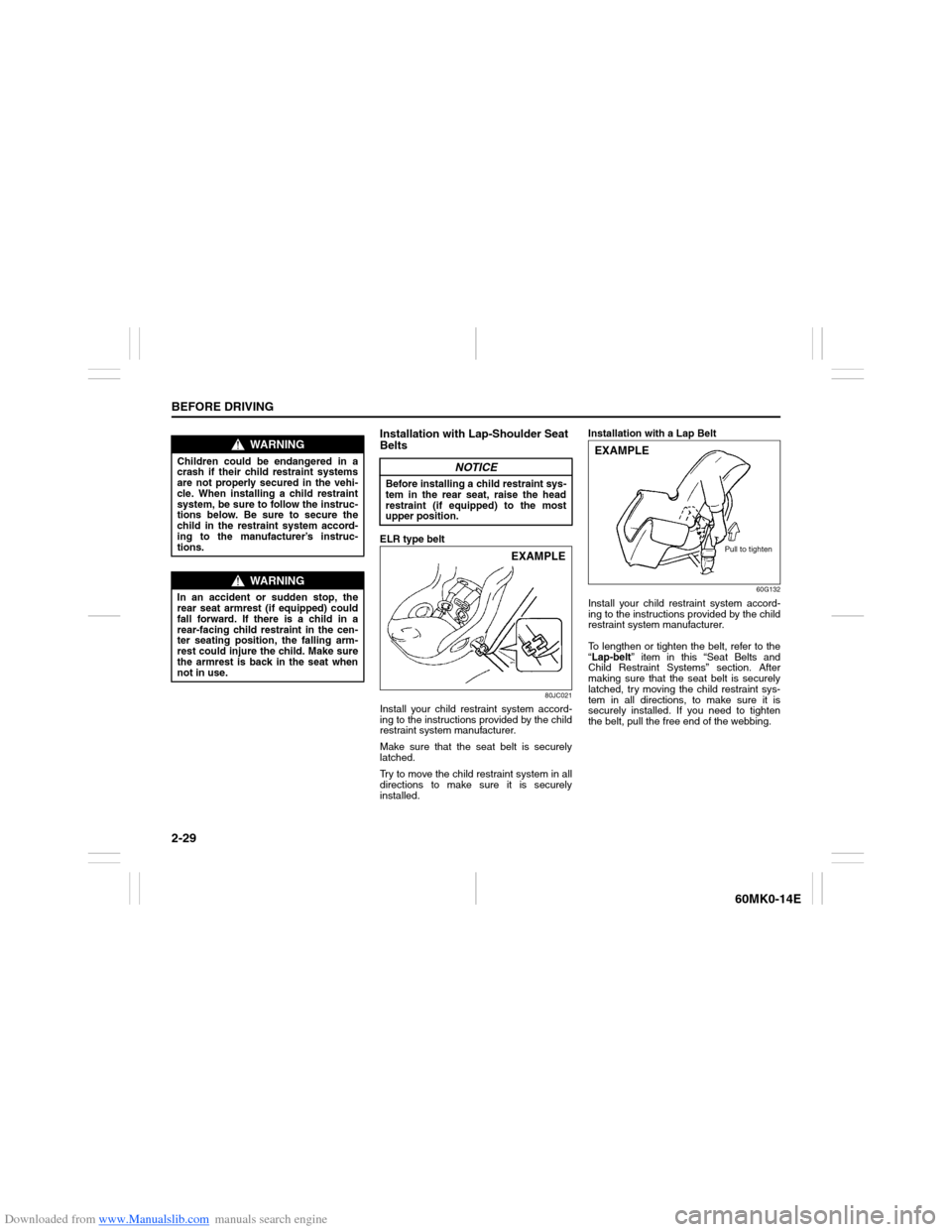
Installation with Lap-Shoulder Seat
BeltsELR type belt
80JC021
Install your child restraint system accord-
ing to the instructions provided by the child
restraint system manufacturer.
Make sure that the seat belt is securely
latched.
Try to move the child restraint system in all
directions to make sure it is securely
installed.Installation with a Lap Belt
60G132
Install your child restraint system accord-
ing to the instructions provided by the child
restraint system manufacturer.
To lengthen or tighten the belt, refer to the
“Lap-belt” item in this “Seat Belts and
Child Restraint Systems” section. After
making sure that the seat belt is securely
latched, try moving the child restraint sys-
tem in all directions, to make sure it is
securely installed. If you need to tighten
the belt, pull the free end of the webbing.
WARNING
Children could be endangered in a
crash if their child restraint systems
are not properly secured in the vehi-
cle. When installing a child restraint
system, be sure to follow the instruc-
tions below. Be sure to secure the
child in the restraint system accord-
ing to the manufacturer’s instruc-
tions.
WARNING
In an accident or sudden stop, the
rear seat armrest (if equipped) could
fall forward. If there is a child in a
rear-facing child restraint in the cen-
ter seating position, the falling arm-
rest could injure the child. Make sure
the armrest is back in the seat when
not in use.
NOTICE
Before installing a child restraint sys-
tem in the rear seat, raise the head
restraint (if equipped) to the most
upper position.
EXAMPLE
EXAMPLE
Pull to tighten
Page 48 of 207
Downloaded from www.Manualslib.com manuals search engine 2-33BEFORE DRIVING
60MK0-14E
58MS030
If you must use a front-facing child restraint
in the front passenger’s seat, be sure to
move the front passenger’s seat as far
back as possible. Please refer to “Seat
Belts and Child Restraint Systems” in this
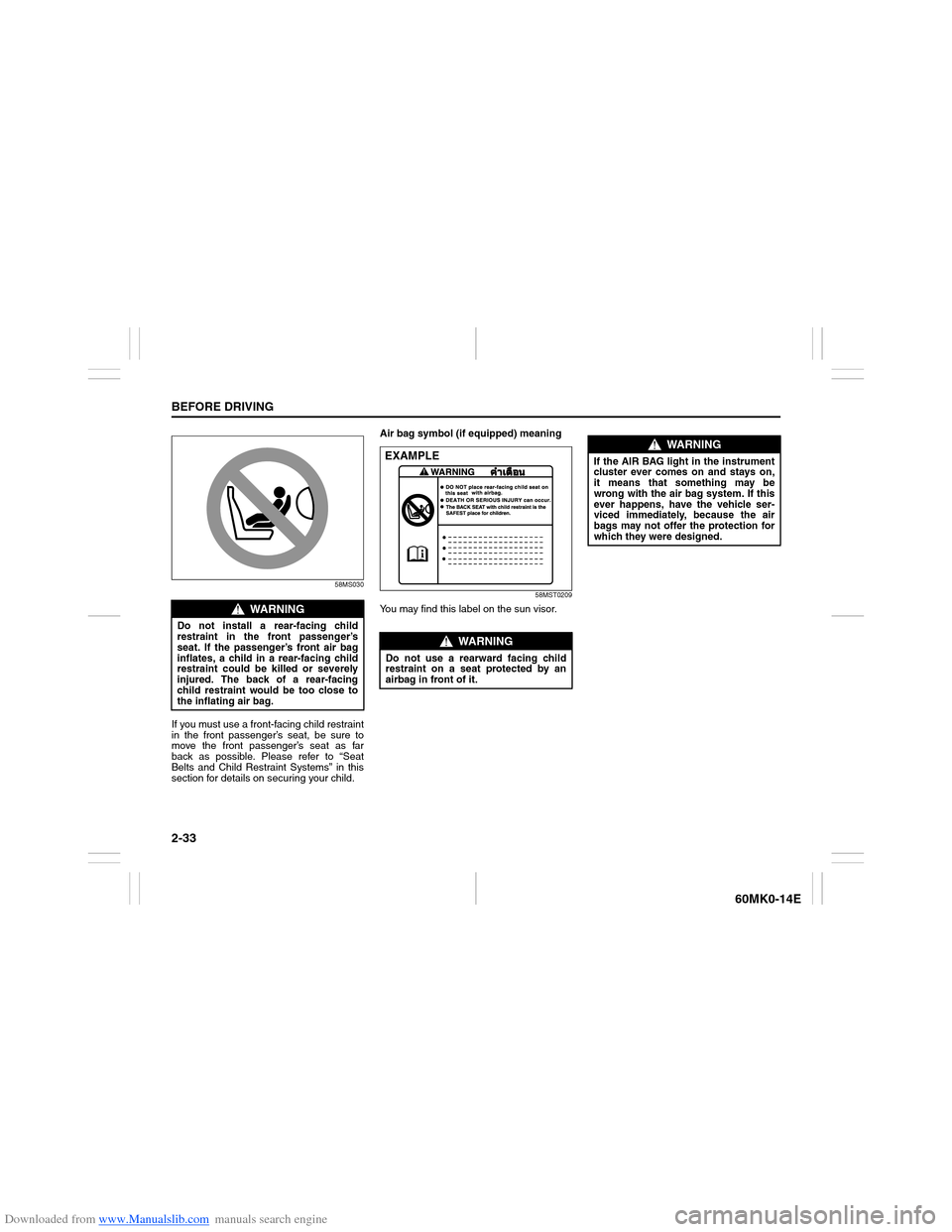
section for details on securing your child.Air bag symbol (if equipped) meaning
58MST0209
You may find this label on the sun visor.
WARNING
Do not install a rear-facing child
restraint in the front passenger’s
seat. If the passenger’s front air bag
inflates, a child in a rear-facing child
restraint could be killed or severely
injured. The back of a rear-facing
child restraint would be too close to
the inflating air bag.
WARNING
Do not use a rearward facing child
restraint on a seat protected by an
airbag in front of it.EXAMPLE
WARNING
If the AIR BAG light in the instrument
cluster ever comes on and stays on,
it means that something may be
wrong with the air bag system. If this
ever happens, have the vehicle ser-
viced immediately, because the air
bags may not offer the protection for
which they were designed.
Page 49 of 207
Downloaded from www.Manualslib.com manuals search engine 2-34
BEFORE DRIVING
60MK0-14E
How the System WorksIn a frontal collision, the crash sensors will
detect rapid deceleration, and if the con-
troller judges that the deceleration repre-
sents a severe frontal crash, the controller
will trigger the inflators. The inflators inflate
the appropriate air bags with nitrogen or
argon gas. The inflated air bags provide a
cushion for your head and upper body. The
air bag inflates and deflates so quickly that
you may not even realize that it has acti-
vated. The air bag will neither hinder your
view nor make it harder to exit the vehicle.
Air bags must inflate quickly and forcefully
in order to reduce the chance of serious or
fatal injuries. However, an unavoidable
consequence of the quick inflation is that
the air bag may irritate bare skin, such as
the facial area against a front air bag. Also,
upon inflation, a loud noise will occur and
some powder and smoke will be released.
These conditions are not harmful and do
not indicate a fire in the vehicle. Be aware,
however, that some air bag components
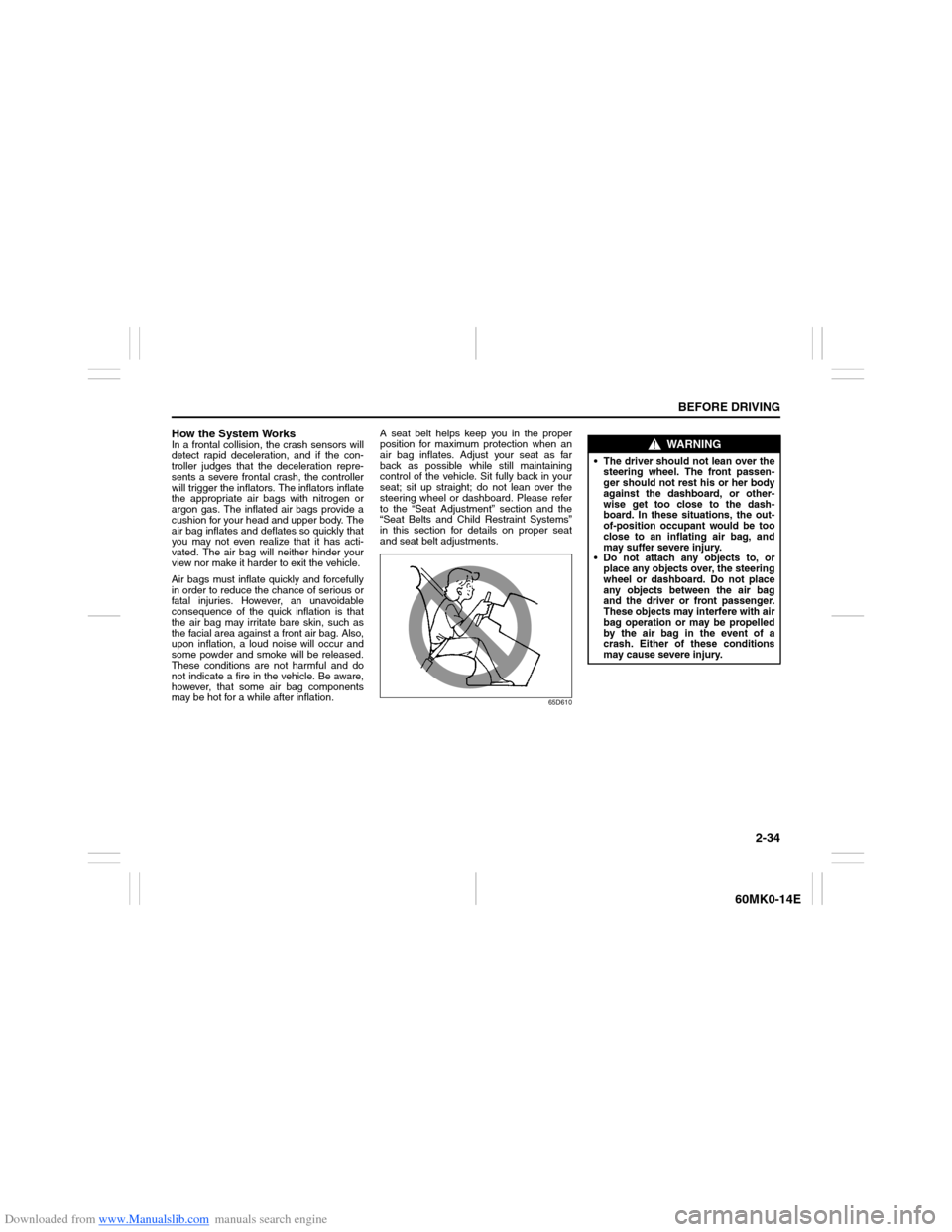
may be hot for a while after inflation.A seat belt helps keep you in the proper
position for maximum protection when an
air bag inflates. Adjust your seat as far
back as possible while still maintaining
control of the vehicle. Sit fully back in your
seat; sit up straight; do not lean over the
steering wheel or dashboard. Please refer
to the “Seat Adjustment” section and the
“Seat Belts and Child Restraint Systems”
in this section for details on proper seat
and seat belt adjustments.
65D610
WARNING
The driver should not lean over the
steering wheel. The front passen-
ger should not rest his or her body
against the dashboard, or other-
wise get too close to the dash-
board. In these situations, the out-
of-position occupant would be too
close to an inflating air bag, and
may suffer severe injury.
Do not attach any objects to, or
place any objects over, the steering
wheel or dashboard. Do not place
any objects between the air bag
and the driver or front passenger.
These objects may interfere with air
bag operation or may be propelled
by the air bag in the event of a
crash. Either of these conditions
may cause severe injury.
Page 95 of 207
Downloaded from www.Manualslib.com manuals search engine OTHER CONTROLS AND EQUIPMENT
5
60MK0-14E
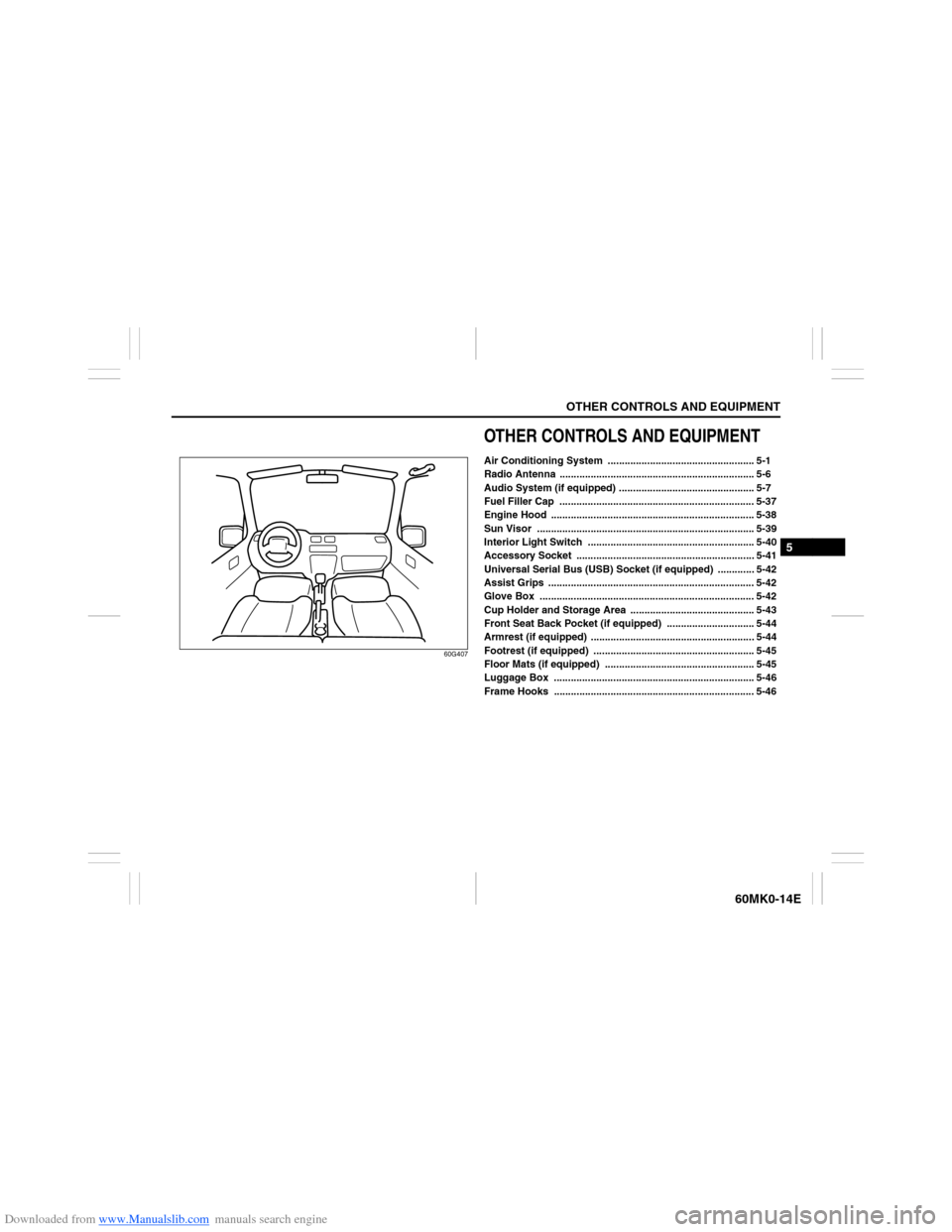
60G407
OTHER CONTROLS AND EQUIPMENTAir Conditioning System .................................................... 5-1
Radio Antenna ..................................................................... 5-6
Audio System (if equipped) ................................................ 5-7
Fuel Filler Cap ..................................................................... 5-37
Engine Hood ........................................................................ 5-38
Sun Visor ............................................................................. 5-39
Interior Light Switch ........................................................... 5-40
Accessory Socket ............................................................... 5-41
Universal Serial Bus (USB) Socket (if equipped) ............. 5-42
Assist Grips ......................................................................... 5-42
Glove Box ............................................................................ 5-42
Cup Holder and Storage Area ............................................ 5-43
Front Seat Back Pocket (if equipped) ............................... 5-44
Armrest (if equipped) .......................................................... 5-44
Footrest (if equipped) ......................................................... 5-45
Floor Mats (if equipped) ..................................................... 5-45
Luggage Box ....................................................................... 5-46
Frame Hooks ....................................................................... 5-46
Page 138 of 207
Downloaded from www.Manualslib.com manuals search engine 5-43OTHER CONTROLS AND EQUIPMENT
60MK0-14E
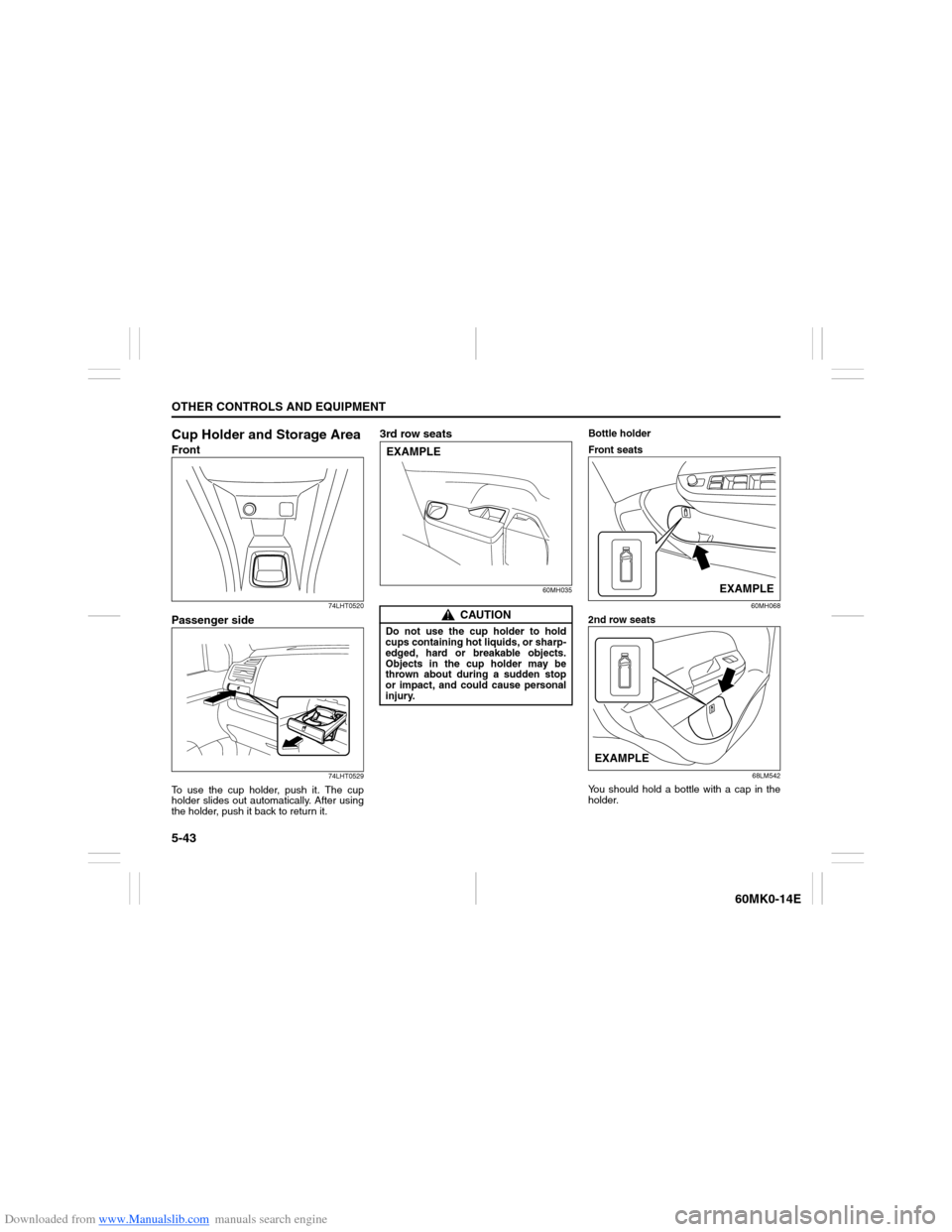
Cup Holder and Storage AreaFront
74LHT0520
Passenger side
74LHT0529
To use the cup holder, push it. The cup
holder slides out automatically. After using
the holder, push it back to return it.
3rd row seats
60MH035
Bottle holder
Front seats
60MH068
2nd row seats
68LM542
You should hold a bottle with a cap in the
holder.
CAUTION
Do not use the cup holder to hold
cups containing hot liquids, or sharp-
edged, hard or breakable objects.
Objects in the cup holder may be
thrown about during a sudden stop
or impact, and could cause personal
injury.EXAMPLE
EXAMPLE
EXAMPLE
Page 139 of 207
Downloaded from www.Manualslib.com manuals search engine 5-44
OTHER CONTROLS AND EQUIPMENT
60MK0-14E
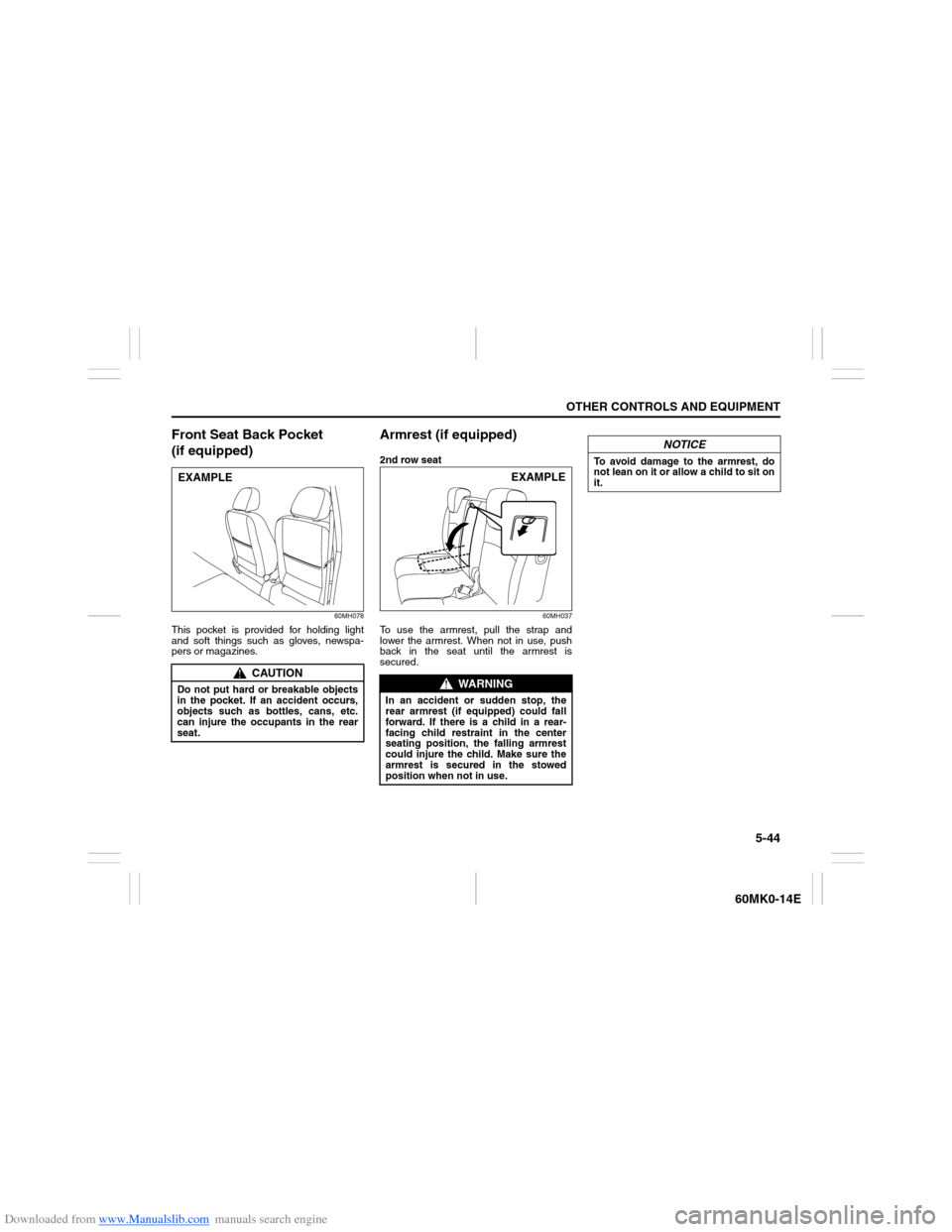
Front Seat Back Pocket
(if equipped)
60MH078
This pocket is provided for holding light
and soft things such as gloves, newspa-
pers or magazines.
Armrest (if equipped)2nd row seat
60MH037
To use the armrest, pull the strap and
lower the armrest. When not in use, push
back in the seat until the armrest is
secured.
CAUTION
Do not put hard or breakable objects
in the pocket. If an accident occurs,
objects such as bottles, cans, etc.
can injure the occupants in the rear
seat.EXAMPLE
WARNING
In an accident or sudden stop, the
rear armrest (if equipped) could fall
forward. If there is a child in a rear-
facing child restraint in the center
seating position, the falling armrest
could injure the child. Make sure the
armrest is secured in the stowed
position when not in use.
EXAMPLE
NOTICE
To avoid damage to the armrest, do
not lean on it or allow a child to sit on
it.
Page 144 of 207
Downloaded from www.Manualslib.com manuals search engine 6-1VEHICLE LOADING AND TOWING
60MK0-14E
Vehicle LoadingYour vehicle was designed for specific
weight capacities. The weight capacities of
your vehicle are indicated by the Gross
Vehicle Weight Rating (GVWR) and the
Gross Axle Weight Rating (GAWR, front
and rear). The GVWR and GAWR (front
and rear) are listed in the “SPECIFICA-
TIONS” section.
GVWR – Maximum permissible overall
weight of the fully loaded vehicle (including
all the occupants, accessories and cargo
plus the trailer nose weight if towing a
trailer).
GAWR – (Front and Rear) Maximum per-
missible weight on an individual axle.
Actual weight of the loaded vehicle and
actual loads at the front and rear axles can
only be determined by weighing the vehi-
cle. Compare these weights to the GVWR
and GAWR (front and rear). If the gross
vehicle weight or the load on either axle
exceeds these ratings, you must remove
enough weight to bring the load down to
the rated capacity.
Trailer TowingYour SUZUKI was originally designed to
carry people and a normal amount of
cargo, not to tow a trailer. SUZUKI does
not recommend you use your vehicle to
tow a trailer. Towing a trailer can adversely
affect handling, durability, and fuel econ-
omy.
WARNING
Never overload your vehicle. The
gross vehicle weight (sum of the
weights of the vehicle, all the occu-
pants, accessories, cargo plus trailer
nose weight if towing a trailer) must
never exceed the Gross Vehicle
Weight Rating (GVWR). In addition,
never distribute a load so that the
weight on either the front or rear axle
exceeds the Gross Axle Weight Rat-
ing (GAWR).
WARNING
Always distribute cargo evenly. To
avoid personal injury or damage to
your vehicle, always secure cargo to
prevent it from shifting if the vehicle
moves suddenly. Place heavier
objects on the floor and as far for-
ward in the cargo area as possible.
Never pile cargo higher than the top
of the seat backs.
Page 162 of 207
Downloaded from www.Manualslib.com manuals search engine 7-17INSPECTION AND MAINTENANCE
60MK0-14E
68LM707
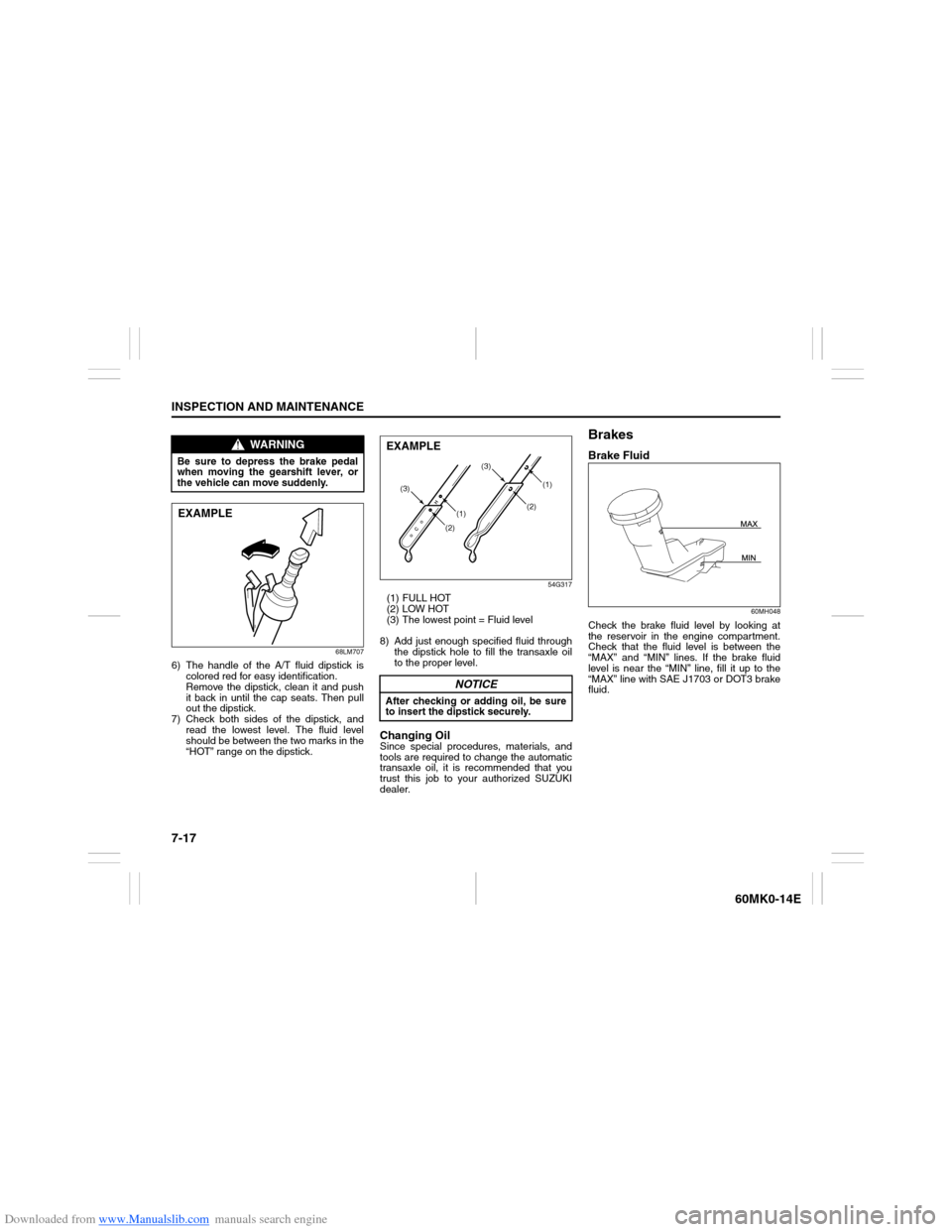
6) The handle of the A/T fluid dipstick is
colored red for easy identification.
Remove the dipstick, clean it and push
it back in until the cap seats. Then pull
out the dipstick.
7) Check both sides of the dipstick, and
read the lowest level. The fluid level
should be between the two marks in the
“HOT” range on the dipstick.
54G317
(1) FULL HOT
(2) LOW HOT
(3) The lowest point = Fluid level
8) Add just enough specified fluid through
the dipstick hole to fill the transaxle oil
to the proper level.Changing OilSince special procedures, materials, and
tools are required to change the automatic
transaxle oil, it is recommended that you
trust this job to your authorized SUZUKI
dealer.
BrakesBrake Fluid
60MH048
Check the brake fluid level by looking at
the reservoir in the engine compartment.
Check that the fluid level is between the
“MAX” and “MIN” lines. If the brake fluid
level is near the “MIN” line, fill it up to the
“MAX” line with SAE J1703 or DOT3 brake
fluid.
WARNING
Be sure to depress the brake pedal
when moving the gearshift lever, or
the vehicle can move suddenly.EXAMPLE
NOTICE
After checking or adding oil, be sure
to insert the dipstick securely.
(1)(2) (3)(1)
(2)(3)
EXAMPLE