lights SUZUKI ERTIGA 2013 1.G User Guide
[x] Cancel search | Manufacturer: SUZUKI, Model Year: 2013, Model line: ERTIGA, Model: SUZUKI ERTIGA 2013 1.GPages: 207, PDF Size: 5.14 MB
Page 68 of 207
Downloaded from www.Manualslib.com manuals search engine 2-53BEFORE DRIVING
60MK0-14E
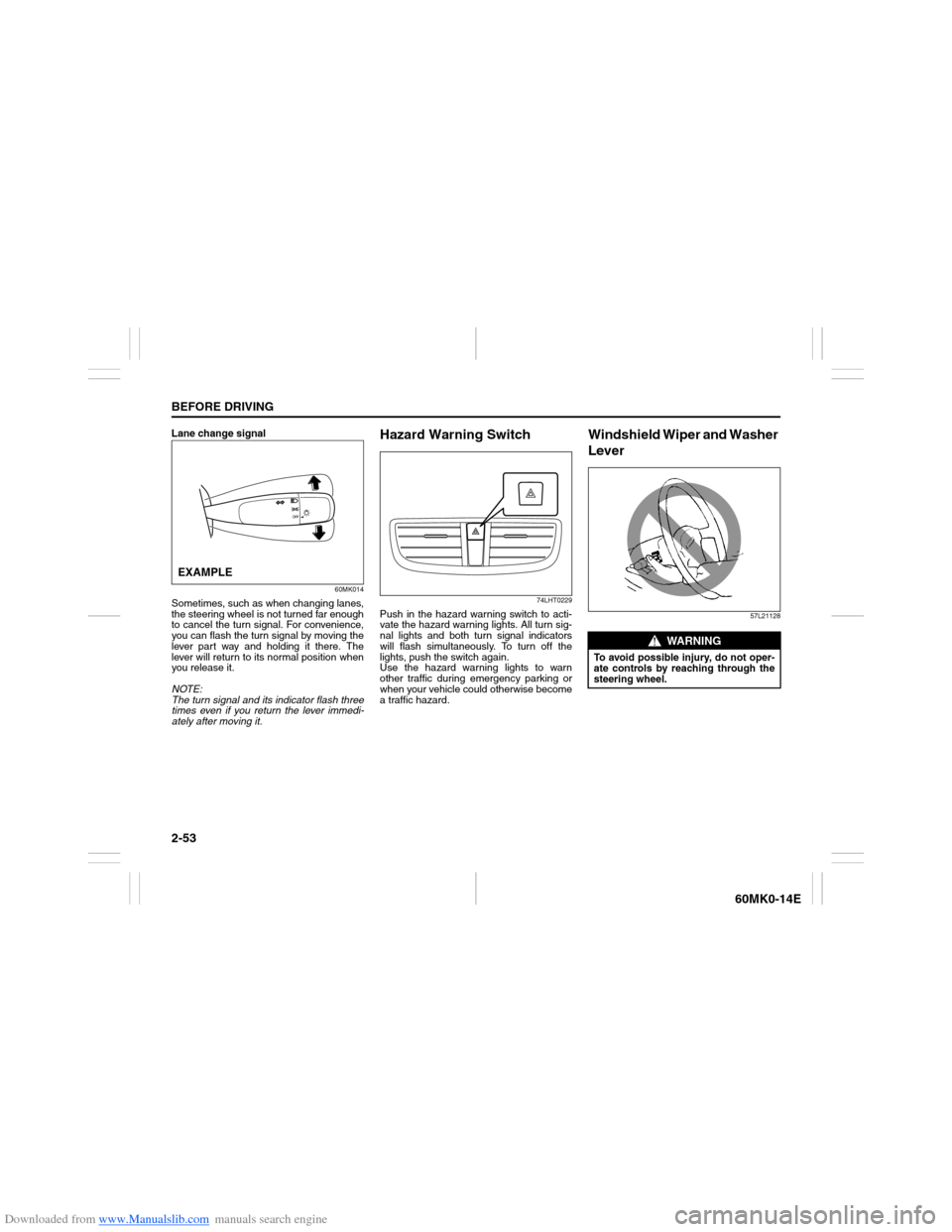
Lane change signal
60MK014
Sometimes, such as when changing lanes,
the steering wheel is not turned far enough
to cancel the turn signal. For convenience,
you can flash the turn signal by moving the
lever part way and holding it there. The
lever will return to its normal position when
you release it.
NOTE:
The turn signal and its indicator flash three
times even if you return the lever immedi-
ately after moving it.
Hazard Warning Switch
74LHT0229
Push in the hazard warning switch to acti-
vate the hazard warning lights. All turn sig-
nal lights and both turn signal indicators
will flash simultaneously. To turn off the
lights, push the switch again.
Use the hazard warning lights to warn
other traffic during emergency parking or
when your vehicle could otherwise become
a traffic hazard.
Windshield Wiper and Washer
Lever
57L21128
EXAMPLE
WARNING
To avoid possible injury, do not oper-
ate controls by reaching through the
steering wheel.
Page 74 of 207
Downloaded from www.Manualslib.com manuals search engine 3-1OPERATING YOUR VEHICLE
60MK0-14E
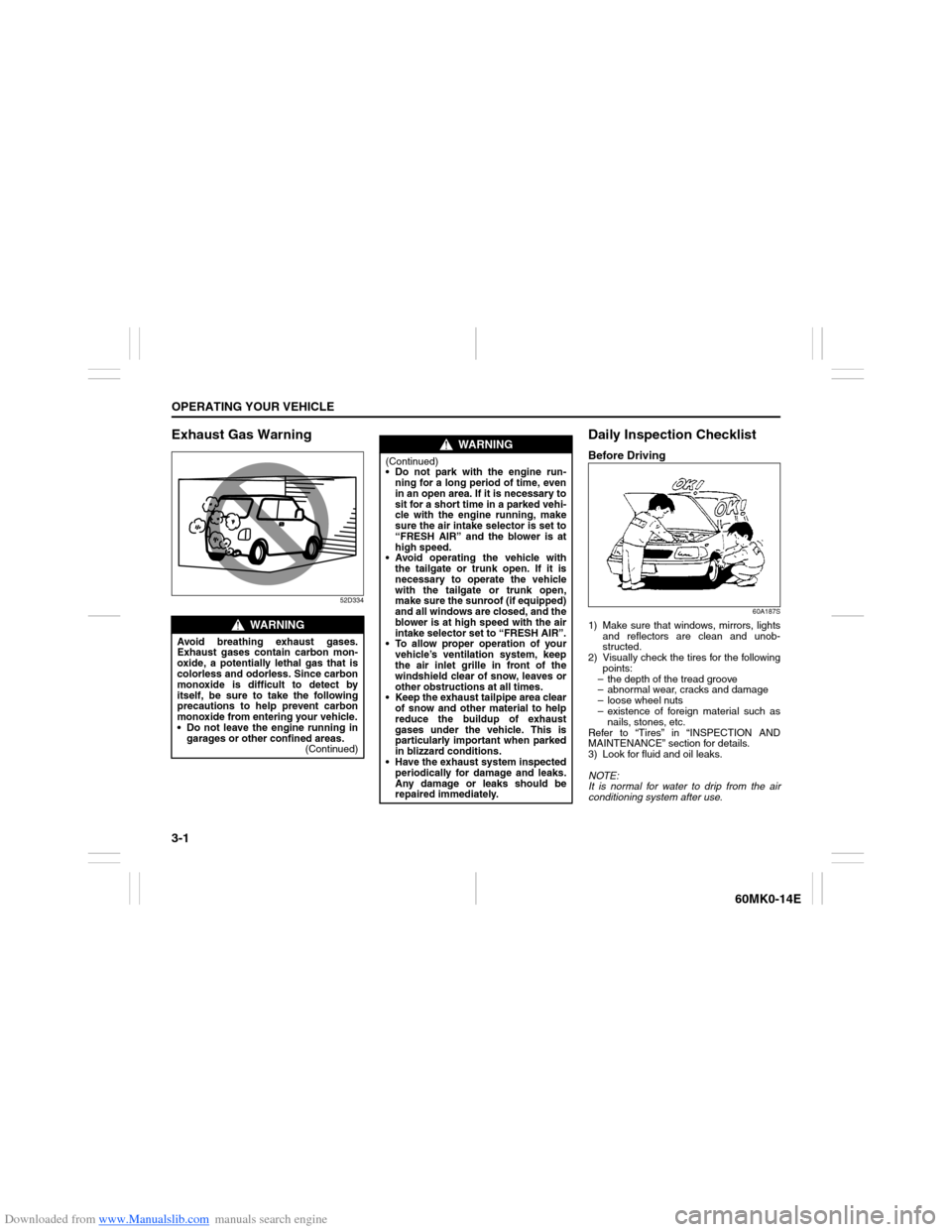
Exhaust Gas Warning
52D334
Daily Inspection ChecklistBefore Driving
60A187S
1) Make sure that windows, mirrors, lights
and reflectors are clean and unob-
structed.
2) Visually check the tires for the following
points:
– the depth of the tread groove
– abnormal wear, cracks and damage
– loose wheel nuts
– existence of foreign material such as
nails, stones, etc.
Refer to “Tires” in “INSPECTION AND
MAINTENANCE” section for details.
3) Look for fluid and oil leaks.
NOTE:
It is normal for water to drip from the air
conditioning system after use.
WARNING
Avoid breathing exhaust gases.
Exhaust gases contain carbon mon-
oxide, a potentially lethal gas that is
colorless and odorless. Since carbon
monoxide is difficult to detect by
itself, be sure to take the following
precautions to help prevent carbon
monoxide from entering your vehicle.
Do not leave the engine running in
garages or other confined areas.
(Continued)
WARNING
(Continued)
Do not park with the engine run-
ning for a long period of time, even
in an open area. If it is necessary to
sit for a short time in a parked vehi-
cle with the engine running, make
sure the air intake selector is set to
“FRESH AIR” and the blower is at
high speed.
Avoid operating the vehicle with
the tailgate or trunk open. If it is
necessary to operate the vehicle
with the tailgate or trunk open,
make sure the sunroof (if equipped)
and all windows are closed, and the
blower is at high speed with the air
intake selector set to “FRESH AIR”.
To allow proper operation of your
vehicle’s ventilation system, keep
the air inlet grille in front of the
windshield clear of snow, leaves or
other obstructions at all times.
Keep the exhaust tailpipe area clear
of snow and other material to help
reduce the buildup of exhaust
gases under the vehicle. This is
particularly important when parked
in blizzard conditions.
Have the exhaust system inspected
periodically for damage and leaks.
Any damage or leaks should be
repaired immediately.
Page 75 of 207
Downloaded from www.Manualslib.com manuals search engine 3-2
OPERATING YOUR VEHICLE
60MK0-14E
4) Make sure the hood is fully closed and
latched.
5) Check the headlights, turn signal lights,
brake lights and horn for proper opera-
tion.
6) Adjust the seat and head restraint (if
equipped).
7) Check the brake pedal and the parking
brake lever.
8) Adjust the mirrors.
9) Make sure that you and all passengers
have properly fastened your seat belts.
10)Make sure that all warning lights come
on as the key is turned to the “ON” posi-
tion.
11)Check all gauges.
12)Make sure that the BRAKE SYSTEM
WARNING light turns off when the
parking brake is released.
Once a week, or each time you fill your fuel
tank, perform the following under-hood
checks:
1) Engine oil level
2) Coolant level
3) Brake fluid level
4) Battery solution level
5) Windshield washer fluid level
6) Hood latch operation
Pull the hood release handle inside the
vehicle. Make sure that you cannot
open the hood all the way without
releasing the secondary latch. Be sure
to close the hood securely after check-
ing for proper latch operation. See theitem “All latches, hinges and locks” of
“CHASSIS AND BODY” in the “Periodic
Maintenance Schedule” in the
“INSPECTION AND MAINTENANCE”
section for lubrication schedule.
Once a month, or each time you fill your
fuel tank, check the tire pressure using a
tire pressure gauge. Also check the tire
pressure of the spare tire.
Engine Oil ConsumptionIt is normal for the engine to consume
some engine oil during normal vehicle
operation.
The amount of engine oil consumed
depends on the viscosity of the oil, the
quality of the oil and the conditions the
vehicle is driven under.
More oil is consumed during high-speed
driving and when there is frequent acceler-
ation and deceleration. Under high loads,
your engine also will consume more oil.
A new engine also consumes more oil,
since its pistons, piston rings and cylinder
walls have not yet become conditioned.
New engines reach the normal level of oil
consumption only after approximately 5000
km (3000 miles) driving.
Oil consumption:
Max. 1.0 L per 1000 km
(1 Qt. per 600 miles)
When judging the amount of oil consump-
tion, note that the oil may become diluted
and make it difficult to accurately judge the
true oil level.
As an example, if a vehicle is used for
repeated short trips, and consumes a nor-
mal amount of oil, the dipstick may not
show any drop in the oil level at all, even
after 1000 km (600 miles) or more of driv-
ing. This is because the oil is gradually
becoming diluted with fuel or moisture,
WARNING
Make sure the hood is fully closed
and latched before driving. If it is not,
it can fly up unexpectedly during
driving, obstructing your view and
resulting in an accident.
Page 91 of 207
Downloaded from www.Manualslib.com manuals search engine 4-2
DRIVING TIPS
60MK0-14E
54G584S
Improving Fuel EconomyThe following instructions will help you
improve fuel economy.
Avoid excessive idling
If you are to wait for more than a minute
while you are parked, stop the engine and
start it again later. When warming up a
cold engine, allow the engine to idle until
the temperature gauge pointer comes up
to the “C” position (if the idling is not pro-
hibited). In this position, the engine is suffi-
ciently warm for starting off.
Avoid “fast” starts
Fast starts away from lights or stop signs
will consume fuel unnecessarily and
shorten engine life. Start off slowly.
Avoid unnecessary stops
Avoid unnecessary deceleration and stop-
ping. Try to maintain a slow, steady speed
whenever possible. Slowing down and then
accelerating again uses more fuel.
Keep a steady cruising speed
Keep as constant a speed as road and traf-
fic conditions will permit.
NOTICE
To avoid damaging catalyst or other
vehicle damage:
Maintain the engine in the proper
operating condition.
In the event of an engine malfunc-
tion, particularly one involving
engine misfiring or other apparent
loss of performance, have the vehi-
cle serviced promptly.
Do not turn off the engine or inter-
rupt the ignition when the transaxle
is in gear and the vehicle is in
motion.
Do not try to start the engine by
pushing or towing the vehicle, or
coasting down a hill.
Do not idle the engine with any
spark plug wires disconnected or
removed, such as during diagnos-
tic testing.
Do not idle the vehicle for pro-
longed periods if idling seems
rough or there are other malfunc-
tions.
Do not allow the fuel tank to get
near the empty level.
Avoid driving your vehicle at exces-
sively high engine speed in or
around the red zone of the tachom-
eter (if equipped).
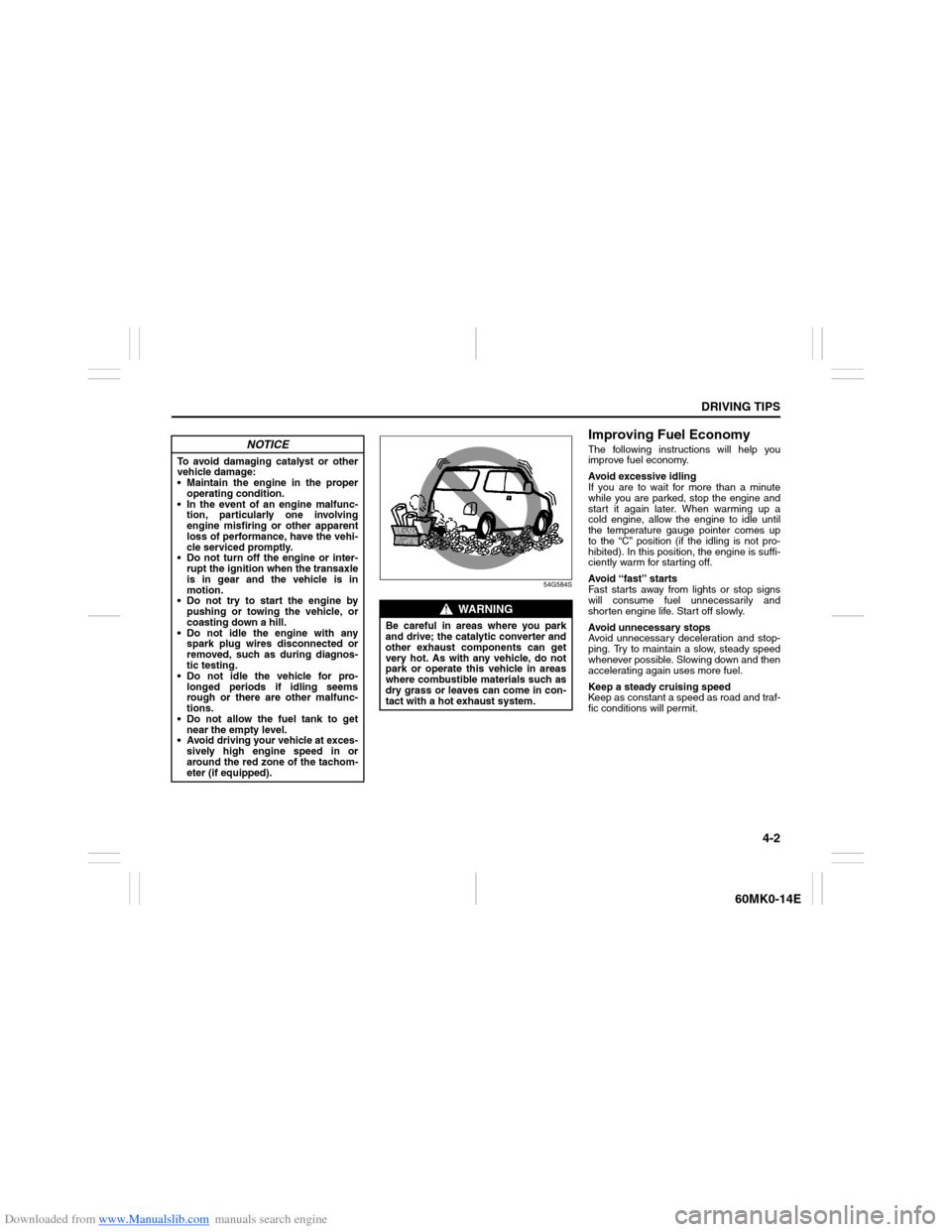
WARNING
Be careful in areas where you park
and drive; the catalytic converter and
other exhaust components can get
very hot. As with any vehicle, do not
park or operate this vehicle in areas
where combustible materials such as
dry grass or leaves can come in con-
tact with a hot exhaust system.
Page 171 of 207
Downloaded from www.Manualslib.com manuals search engine 7-26
INSPECTION AND MAINTENANCE
60MK0-14E
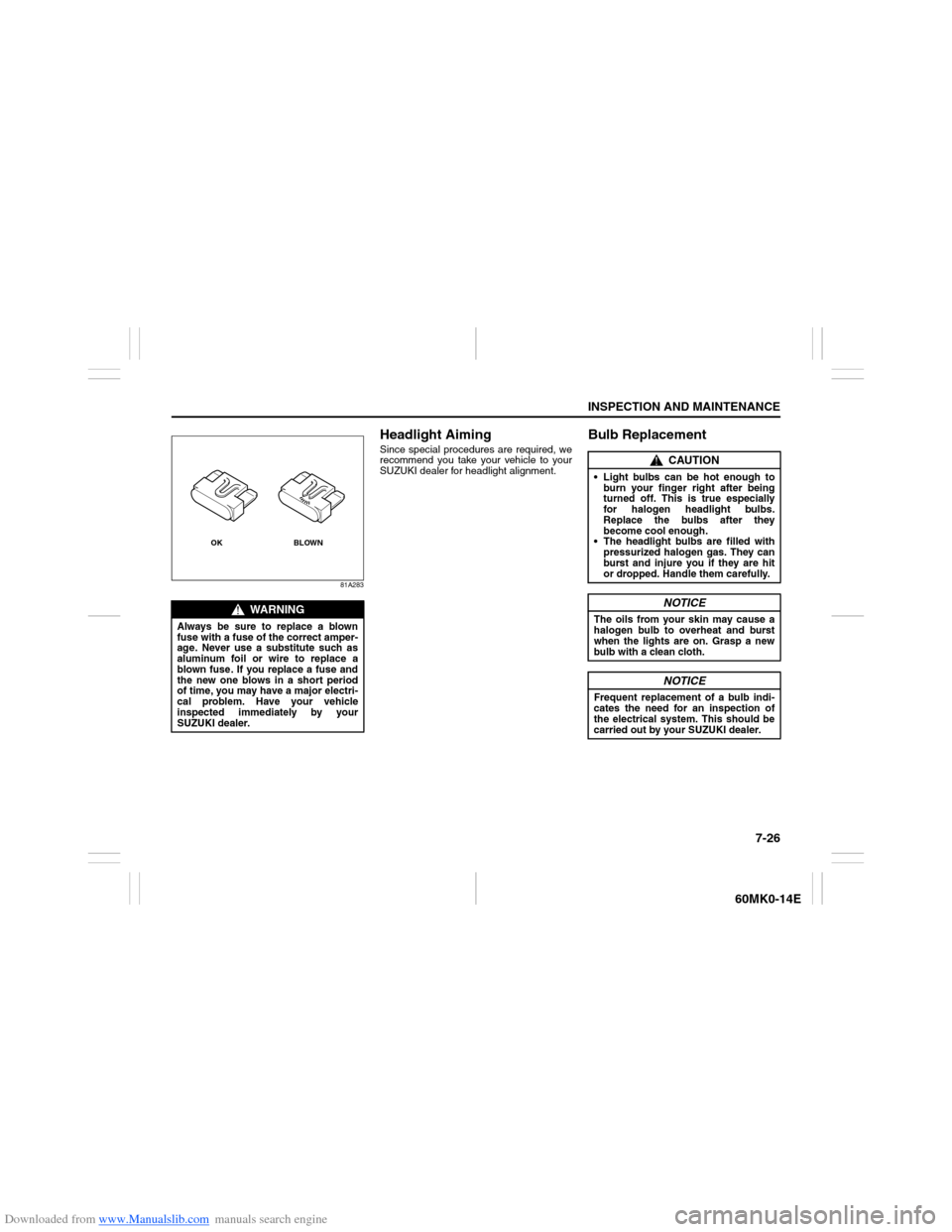
81A283
Headlight AimingSince special procedures are required, we
recommend you take your vehicle to your
SUZUKI dealer for headlight alignment.
Bulb Replacement
WARNING
Always be sure to replace a blown
fuse with a fuse of the correct amper-
age. Never use a substitute such as
aluminum foil or wire to replace a
blown fuse. If you replace a fuse and
the new one blows in a short period
of time, you may have a major electri-
cal problem. Have your vehicle
inspected immediately by your
SUZUKI dealer.
BLOWN OK
CAUTION
Light bulbs can be hot enough to
burn your finger right after being
turned off. This is true especially
for halogen headlight bulbs.
Replace the bulbs after they
become cool enough.
The headlight bulbs are filled with
pressurized halogen gas. They can
burst and injure you if they are hit
or dropped. Handle them carefully.
NOTICE
The oils from your skin may cause a
halogen bulb to overheat and burst
when the lights are on. Grasp a new
bulb with a clean cloth.
NOTICE
Frequent replacement of a bulb indi-
cates the need for an inspection of
the electrical system. This should be
carried out by your SUZUKI dealer.
Page 173 of 207
Downloaded from www.Manualslib.com manuals search engine 7-28
INSPECTION AND MAINTENANCE
60MK0-14E
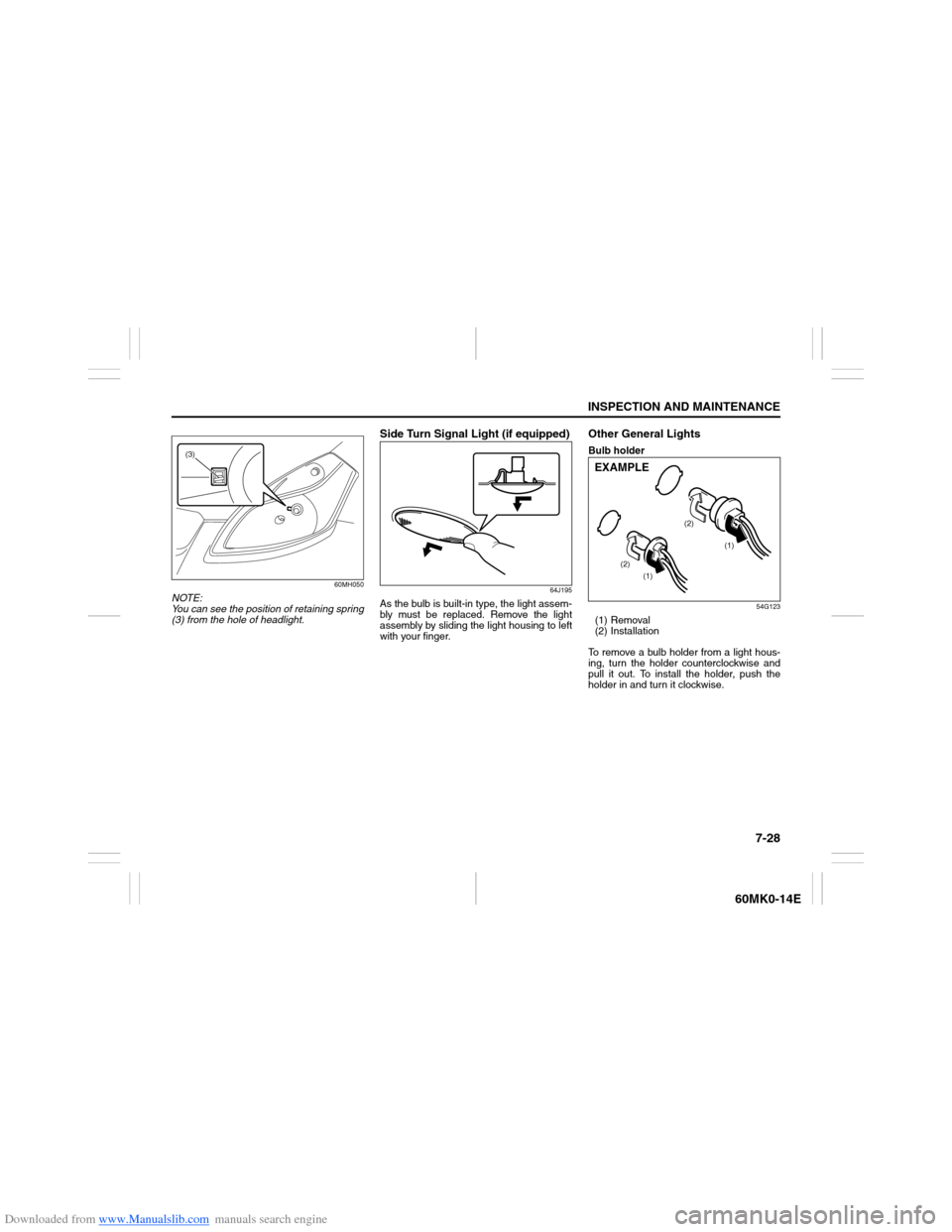
60MH050
NOTE:
You can see the position of retaining spring
(3) from the hole of headlight.
Side Turn Signal Light (if equipped)
64J195
As the bulb is built-in type, the light assem-
bly must be replaced. Remove the light
assembly by sliding the light housing to left
with your finger.
Other General LightsBulb holder
54G123
(1) Removal
(2) Installation
To remove a bulb holder from a light hous-
ing, turn the holder counterclockwise and
pull it out. To install the holder, push the
holder in and turn it clockwise.
(3)
(1)
(1) (2)(2)
EXAMPLE
Page 187 of 207
Downloaded from www.Manualslib.com manuals search engine 8-6
EMERGENCY SERVICE
60MK0-14E
After Changing Wheels
Stow the tire changing tools (jack, jack
handle and lug wrench) in place. Also,
stow the flat tire in the spare tire stowed
position. Refer to “Tire Changing Tool” in
this section.
Jump Starting Instructions
When Jump Starting Your Vehicle,
Use the Following Procedure:1) Use only a 12-volt battery to jump start
your vehicle. Position the good 12-volt
battery close to your vehicle so that the
jump leads will reach both batteries.
When using a battery installed on
another vehicle, DO NOT LET THE
VEHICLES TOUCH. Set the parking
brakes fully on both vehicles.
2) Turn off all vehicle accessories, except
those necessary for safety reasons (for
example, headlights or hazard lights).
NOTICE
Repair or replace the flat tire immedi-
ately. If the flat tire is placed in the
spare tire stowed position for long
time, it can cause vehicle shakiness,
noise, or scratches.
WARNING
Never attempt to jump start your
vehicle if the battery appears to be
frozen. Batteries in this condition
may explode or rupture if jump
starting is attempted.
When making jump lead connec-
tions, be certain that your hands
and the jump leads remain clear
from pulleys, belts, or fans.
Batteries produce flammable
hydrogen gas. Keep flames and
sparks away from the battery or an
explosion may occur. Never smoke
when working in the vicinity of the
battery.
If the booster battery you use for
jump starting is installed in another
vehicle, make sure the two vehicles
are not touching each other.
If your battery discharges repeat-
edly, for no apparent reason, have
your vehicle inspected by an autho-
rized SUZUKI dealer.
To avoid harm to yourself or dam-
age to your vehicle or battery, fol-
low the jump starting instructions
below precisely and in order.
If you are in doubt, call for qualified
road service.
NOTICE
Your vehicle should not be started by
pushing or towing. This starting
method could result in permanent
damage to the catalytic converter.
Use jump leads to start a vehicle with
a weak or flat battery.
Page 189 of 207
Downloaded from www.Manualslib.com manuals search engine 8-8
EMERGENCY SERVICE
60MK0-14E
2-Wheel Drive (2WD) Manual Tran-
saxleManual transaxle vehicles may be towed
using either of the following methods.
1) From the front, with the front wheels
lifted and the rear wheels on the
ground. Before towing, make sure that
the parking brake is released.
2) From the rear, with the rear wheels
lifted and the front wheels on the
ground, provided the steering and driv-
etrain are in operational condition.
Before towing, make sure that transaxle
is in neutral, the steering wheel is
unlocked (the ignition key should be in
the “ACC” position), and the steering
wheel is secured with a clamping
device designed for towing service.
If the Starter Does Not
Operate1) Try turning the ignition switch to the
“START” position with the headlights
turned on to determine the battery con-
dition. If the headlights go excessively
dim or go off, it usually means that
either the battery is flat or the battery
terminal contact is poor. Recharge the
battery or correct battery terminal con-
tact as necessary.
2) If the headlights remain bright, check
the fuses. If the reason for failure of the
starter is not obvious, there may be a
major electrical problem. Have the vehi-
cle inspected by your authorized
SUZUKI dealer.
If the Engine is FloodedIf the engine is flooded with gasoline, it
may be hard to start. If this happens, press
the accelerator pedal all the way to the
floor and hold it there while cranking the
engine. (Do not operate the starter motor
for more than 15 seconds).
NOTICE
The steering column is not strong
enough to withstand shocks trans-
mitted from the front wheels during
towing. Always unlock the steering
wheel before towing.
Page 201 of 207
Downloaded from www.Manualslib.com manuals search engine 11-3
SPECIFICATIONS
60MK0-14E
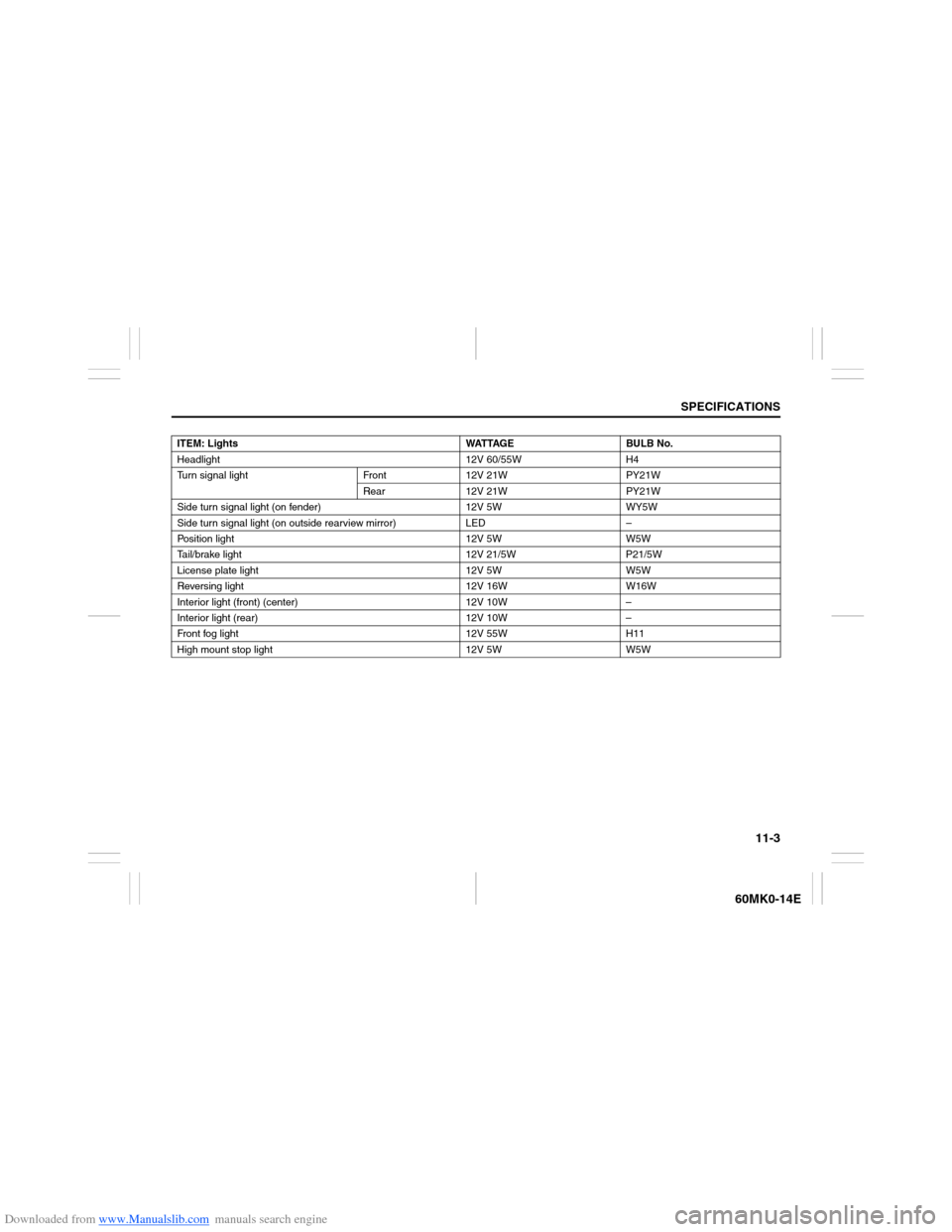
ITEM: Lights WATTAGE BULB No.
Headlight 12V 60/55W H4
Turn signal light Front 12V 21W PY21W
Rear 12V 21W PY21W
Side turn signal light (on fender) 12V 5W WY5W
Side turn signal light (on outside rearview mirror) LED –
Position light 12V 5W W5W
Tail/brake light 12V 21/5W P21/5W
License plate light 12V 5W W5W
Reversing light 12V 16W W16W
Interior light (front) (center) 12V 10W –
Interior light (rear) 12V 10W –
Front fog light 12V 55W H11
High mount stop light 12V 5W W5W
Page 206 of 207
Downloaded from www.Manualslib.com manuals search engine 12-4INDEX
60MK0-14E
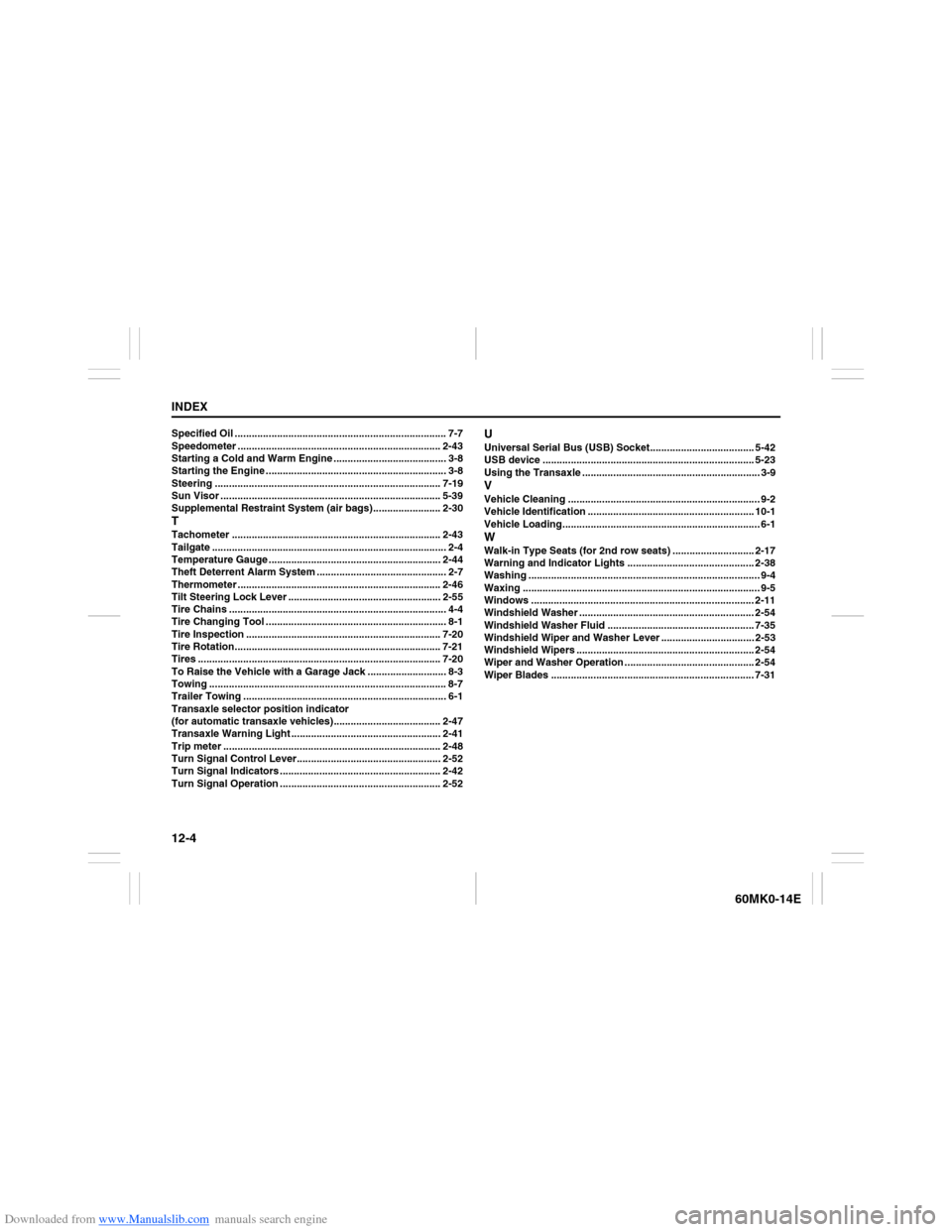
Specified Oil ........................................................................... 7-7
Speedometer ........................................................................ 2-43
Starting a Cold and Warm Engine ........................................ 3-8
Starting the Engine ................................................................ 3-8
Steering ................................................................................ 7-19
Sun Visor .............................................................................. 5-39
Supplemental Restraint System (air bags)........................ 2-30TTachometer .......................................................................... 2-43
Tailgate ................................................................................... 2-4
Temperature Gauge ............................................................. 2-44
Theft Deterrent Alarm System .............................................. 2-7
Thermometer ........................................................................ 2-46
Tilt Steering Lock Lever...................................................... 2-55
Tire Chains ............................................................................. 4-4
Tire Changing Tool ................................................................ 8-1
Tire Inspection ..................................................................... 7-20
Tire Rotation......................................................................... 7-21
Tires ...................................................................................... 7-20
To Raise the Vehicle with a Garage Jack ............................ 8-3
Towing .................................................................................... 8-7
Trailer Towing ........................................................................ 6-1
Transaxle selector position indicator
(for automatic transaxle vehicles)...................................... 2-47
Transaxle Warning Light ..................................................... 2-41
Trip meter ............................................................................. 2-48
Turn Signal Control Lever................................................... 2-52
Turn Signal Indicators ......................................................... 2-42
Turn Signal Operation ......................................................... 2-52
UUniversal Serial Bus (USB) Socket..................................... 5-42
USB device ........................................................................... 5-23
Using the Transaxle ............................................................... 3-9VVehicle Cleaning .................................................................... 9-2
Vehicle Identification ........................................................... 10-1
Vehicle Loading...................................................................... 6-1WWalk-in Type Seats (for 2nd row seats) ............................. 2-17
Warning and Indicator Lights ............................................. 2-38
Washing .................................................................................. 9-4
Waxing .................................................................................... 9-5
Windows ............................................................................... 2-11
Windshield Washer .............................................................. 2-54
Windshield Washer Fluid .................................................... 7-35
Windshield Wiper and Washer Lever ................................. 2-53
Windshield Wipers ............................................................... 2-54
Wiper and Washer Operation .............................................. 2-54
Wiper Blades ........................................................................ 7-31