Air SUZUKI ERTIGA 2013 1.G Service Manual
[x] Cancel search | Manufacturer: SUZUKI, Model Year: 2013, Model line: ERTIGA, Model: SUZUKI ERTIGA 2013 1.GPages: 207, PDF Size: 5.14 MB
Page 165 of 207
Downloaded from www.Manualslib.com manuals search engine 7-20
INSPECTION AND MAINTENANCE
60MK0-14E
Tires
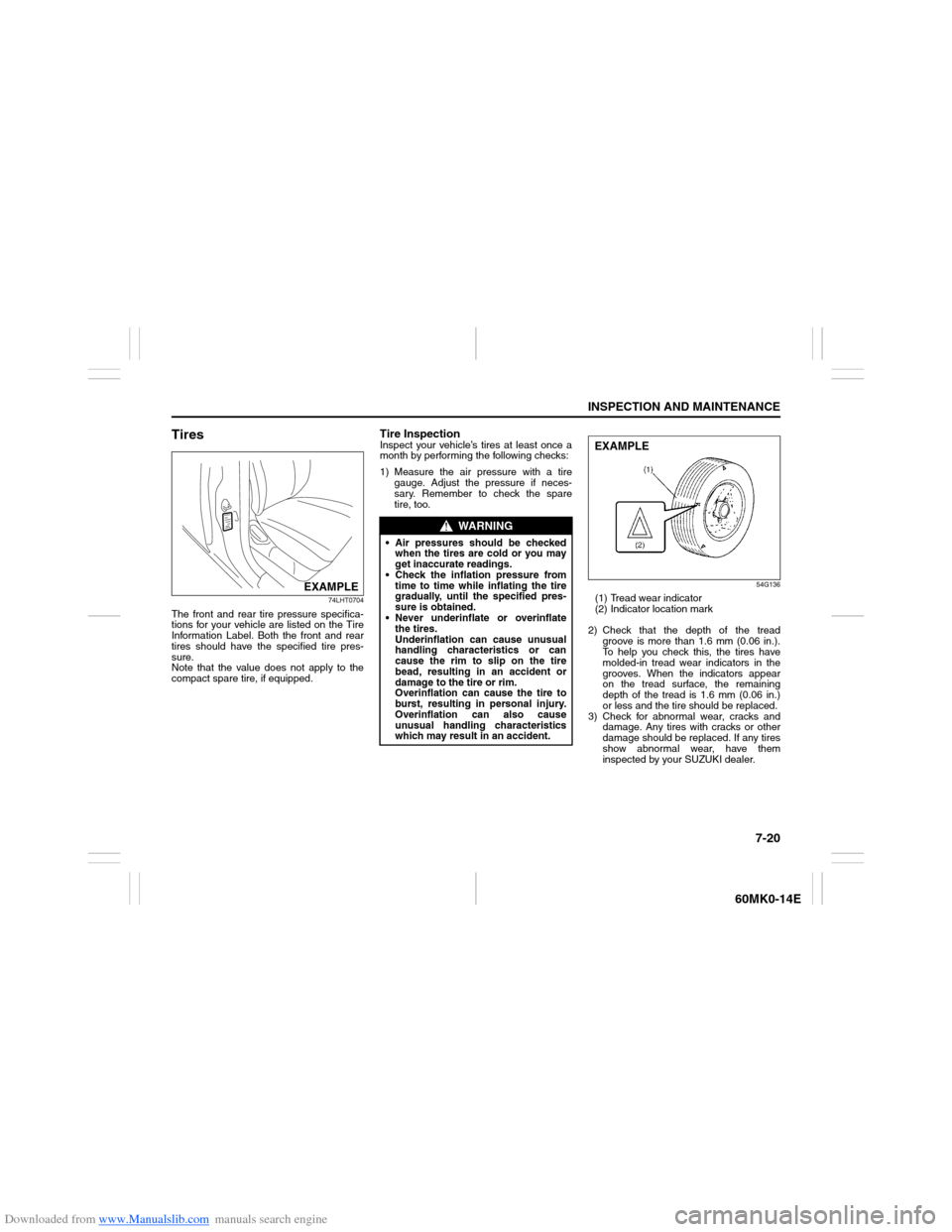
74LHT0704
The front and rear tire pressure specifica-
tions for your vehicle are listed on the Tire
Information Label. Both the front and rear
tires should have the specified tire pres-
sure.
Note that the value does not apply to the
compact spare tire, if equipped.
Tire InspectionInspect your vehicle’s tires at least once a
month by performing the following checks:
1) Measure the air pressure with a tire
gauge. Adjust the pressure if neces-
sary. Remember to check the spare
tire, too.
54G136
(1) Tread wear indicator
(2) Indicator location mark
2) Check that the depth of the tread
groove is more than 1.6 mm (0.06 in.).
To help you check this, the tires have
molded-in tread wear indicators in the
grooves. When the indicators appear
on the tread surface, the remaining
depth of the tread is 1.6 mm (0.06 in.)
or less and the tire should be replaced.
3) Check for abnormal wear, cracks and
damage. Any tires with cracks or other
damage should be replaced. If any tires
show abnormal wear, have them
inspected by your SUZUKI dealer.
EXAMPLE
WARNING
Air pressures should be checked
when the tires are cold or you may
get inaccurate readings.
Check the inflation pressure from
time to time while inflating the tire
gradually, until the specified pres-
sure is obtained.
Never underinflate or overinflate
the tires.
Underinflation can cause unusual
handling characteristics or can
cause the rim to slip on the tire
bead, resulting in an accident or
damage to the tire or rim.
Overinflation can cause the tire to
burst, resulting in personal injury.
Overinflation can also cause
unusual handling characteristics
which may result in an accident.
EXAMPLE
Page 168 of 207
Downloaded from www.Manualslib.com manuals search engine 7-23INSPECTION AND MAINTENANCE
60MK0-14E
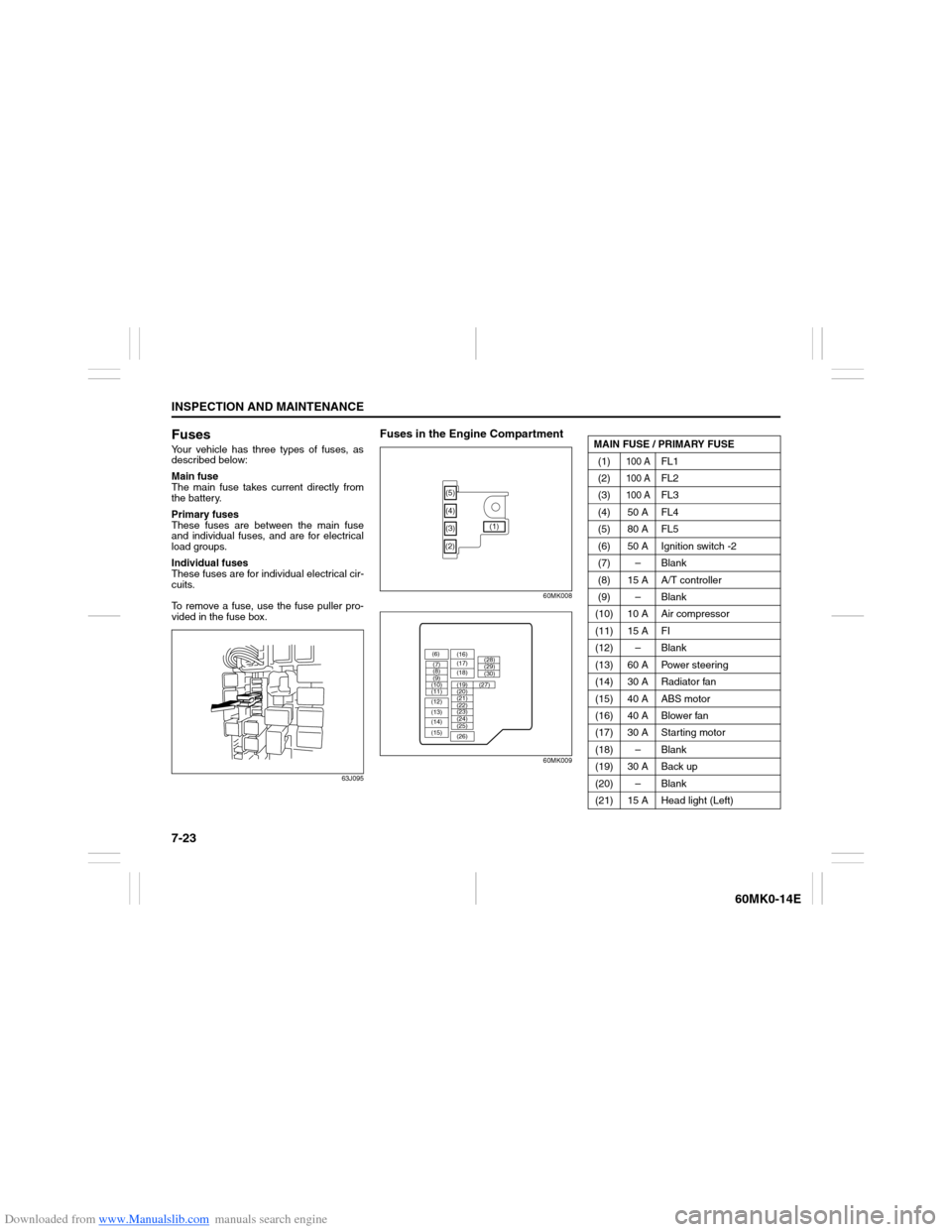
FusesYour vehicle has three types of fuses, as
described below:
Main fuse
The main fuse takes current directly from
the battery.
Primary fuses
These fuses are between the main fuse
and individual fuses, and are for electrical
load groups.
Individual fuses
These fuses are for individual electrical cir-
cuits.
To remove a fuse, use the fuse puller pro-
vided in the fuse box.
63J095
Fuses in the Engine Compartment
60MK008
60MK009
(5)
(3) (4)
(2)(1)
(6)
(7)(8)
(9)
(10)
(11)
(12)
(13)
(14)
(15)(16)
(17)
(19) (18)
(20)
(21)
(22)
(24) (23)
(25)
(26)(27)(28)
(29)
(30)
MAIN FUSE / PRIMARY FUSE
(1)
100 A
FL1
(2)
100 A
FL2
(3)
100 A
FL3
(4) 50 A FL4
(5) 80 A FL5
(6) 50 A Ignition switch -2
(7) – Blank
(8) 15 A A/T controller
(9) – Blank
(10) 10 A Air compressor
(11) 15 A FI
(12) – Blank
(13) 60 A Power steering
(14) 30 A Radiator fan
(15) 40 A ABS motor
(16) 40 A Blower fan
(17) 30 A Starting motor
(18) – Blank
(19) 30 A Back up
(20) – Blank
(21) 15 A Head light (Left)
Page 169 of 207
Downloaded from www.Manualslib.com manuals search engine 7-24
INSPECTION AND MAINTENANCE
60MK0-14E
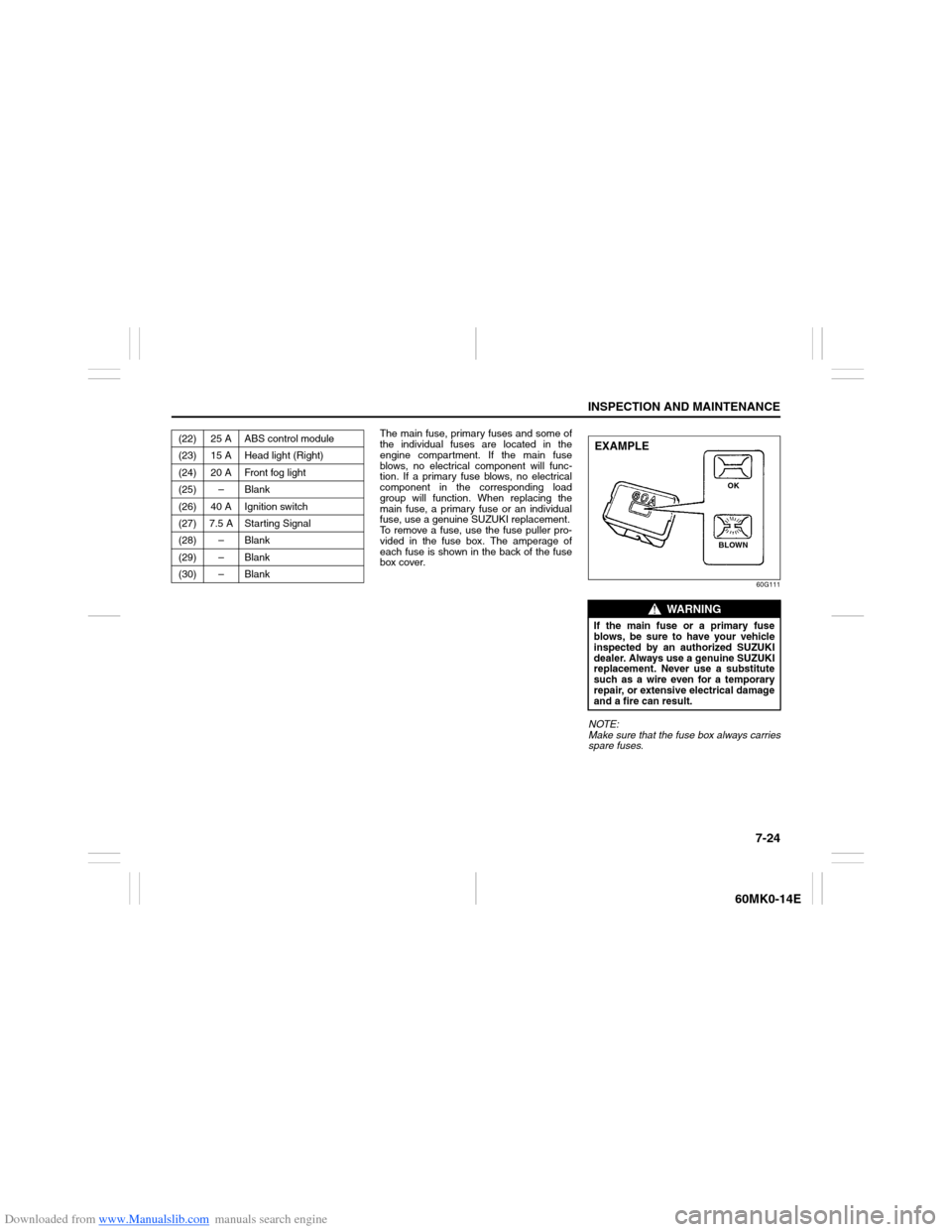
The main fuse, primary fuses and some of
the individual fuses are located in the
engine compartment. If the main fuse
blows, no electrical component will func-
tion. If a primary fuse blows, no electrical
component in the corresponding load
group will function. When replacing the
main fuse, a primary fuse or an individual
fuse, use a genuine SUZUKI replacement.
To remove a fuse, use the fuse puller pro-
vided in the fuse box. The amperage of
each fuse is shown in the back of the fuse
box cover.
60G111
NOTE:
Make sure that the fuse box always carries
spare fuses. (22) 25 A ABS control module
(23) 15 A Head light (Right)
(24) 20 A Front fog light
(25) – Blank
(26) 40 A Ignition switch
(27) 7.5 A Starting Signal
(28) – Blank
(29) – Blank
(30) – Blank
WARNING
If the main fuse or a primary fuse
blows, be sure to have your vehicle
inspected by an authorized SUZUKI
dealer. Always use a genuine SUZUKI
replacement. Never use a substitute
such as a wire even for a temporary
repair, or extensive electrical damage
and a fire can result.EXAMPLE
BLOWNOK
Page 170 of 207
Downloaded from www.Manualslib.com manuals search engine 7-25INSPECTION AND MAINTENANCE
60MK0-14E
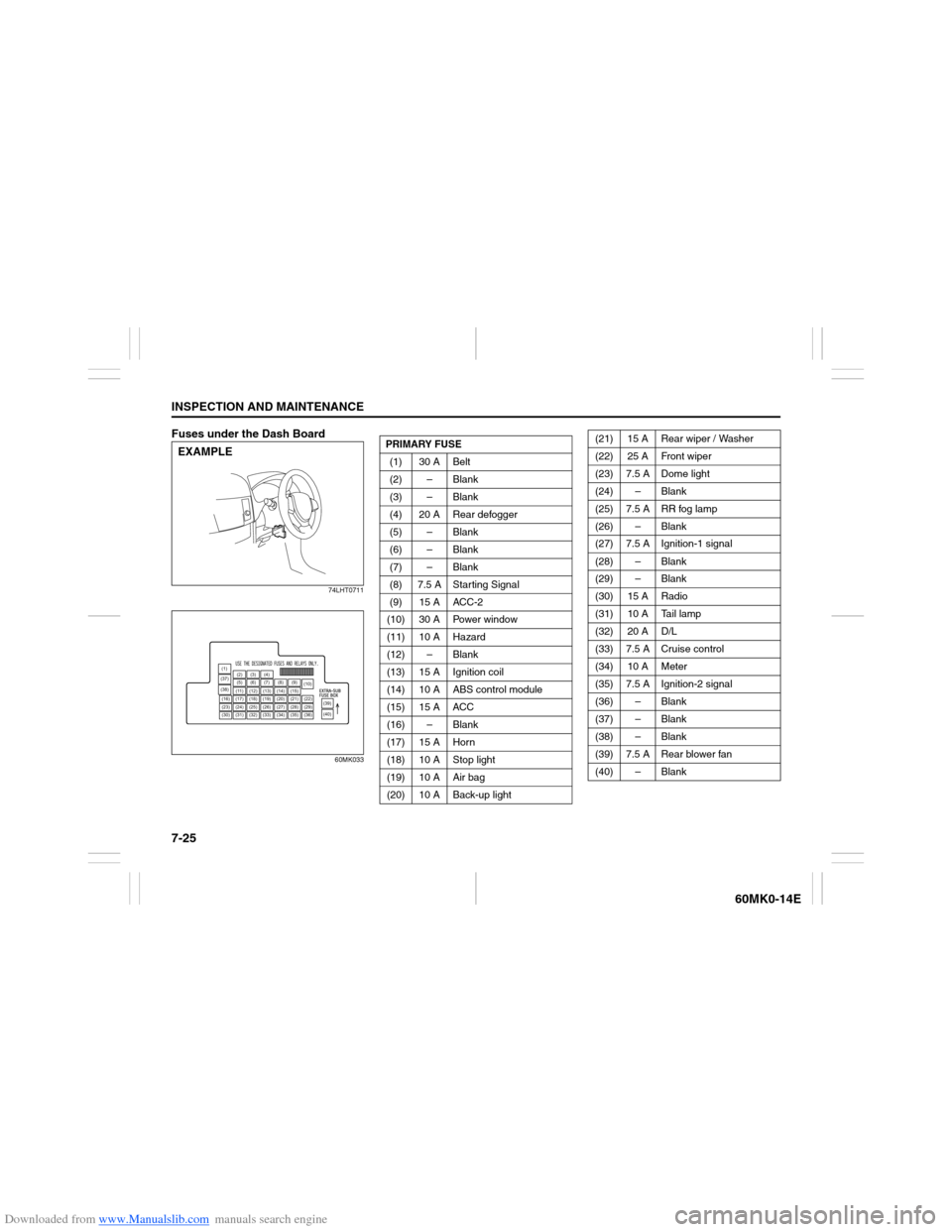
Fuses under the Dash Board
74LHT0711
60MK033
EXAMPLE
(1)
(12)(10)
(13)
(36) (2) (3)
(4)
(5)(6)
(7) (8)(9)
(11) (14) (15)
(16) (17) (18) (19) (20) (21) (22)
(23) (24) (25) (26) (27) (28) (29)
(30) (31) (32) (33) (34) (35) (37)
(38)
(39)
(40)
PRIMARY FUSE
(1) 30 A Belt
(2) – Blank
(3) – Blank
(4) 20 A Rear defogger
(5) – Blank
(6) – Blank
(7) – Blank
(8) 7.5 A Starting Signal
(9) 15 A ACC-2
(10) 30 A Power window
(11) 10 A Hazard
(12) – Blank
(13) 15 A Ignition coil
(14) 10 A ABS control module
(15) 15 A ACC
(16) – Blank
(17) 15 A Horn
(18) 10 A Stop light
(19) 10 A Air bag
(20) 10 A Back-up light
(21) 15 A Rear wiper / Washer
(22) 25 A Front wiper
(23) 7.5 A Dome light
(24) – Blank
(25) 7.5 A RR fog lamp
(26) – Blank
(27) 7.5 A Ignition-1 signal
(28) – Blank
(29) – Blank
(30) 15 A Radio
(31) 10 A Tail lamp
(32) 20 A D/L
(33) 7.5 A Cruise control
(34) 10 A Meter
(35) 7.5 A Ignition-2 signal
(36) – Blank
(37) – Blank
(38) – Blank
(39) 7.5 A Rear blower fan
(40) – Blank
Page 180 of 207
Downloaded from www.Manualslib.com manuals search engine 7-35INSPECTION AND MAINTENANCE
60MK0-14E
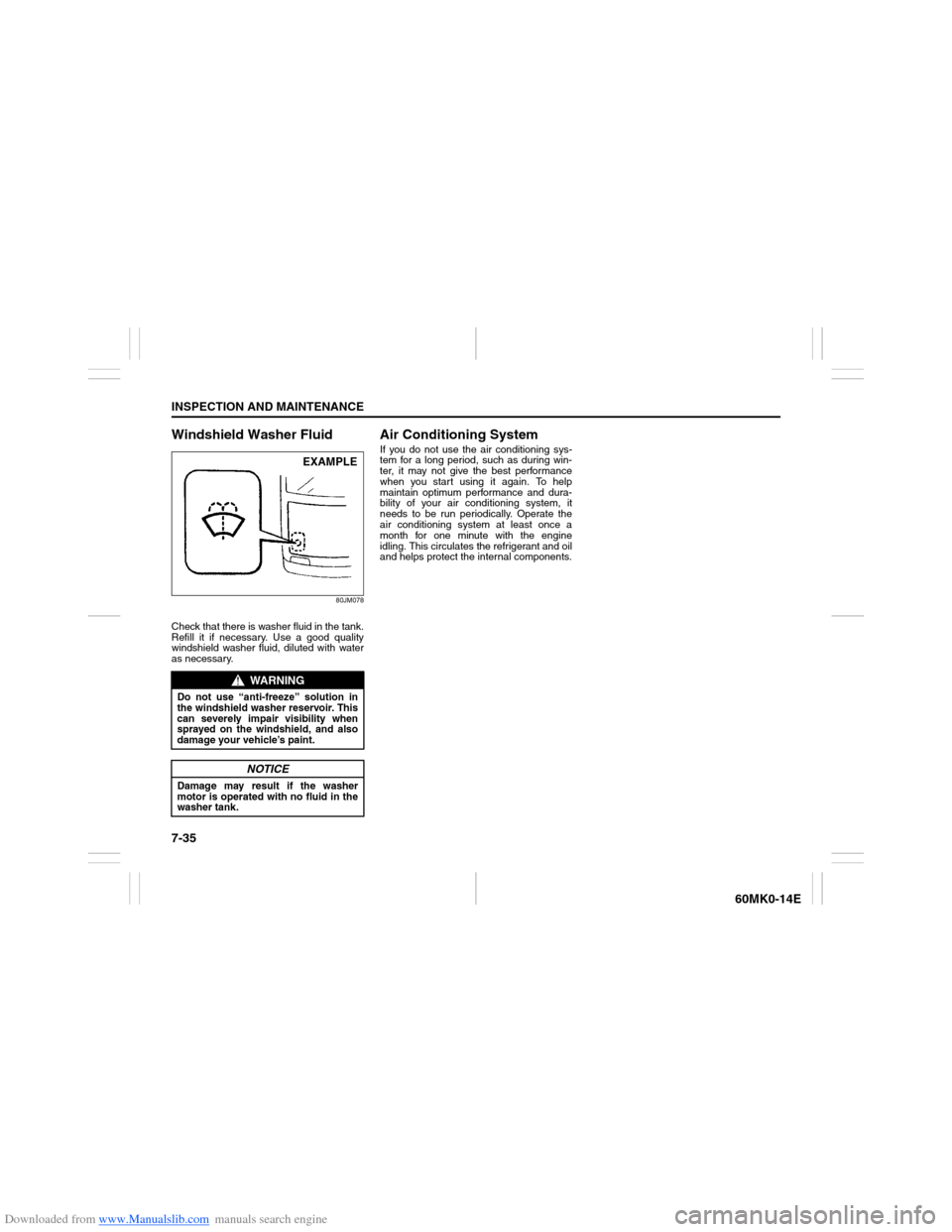
Windshield Washer Fluid
80JM078
Check that there is washer fluid in the tank.
Refill it if necessary. Use a good quality
windshield washer fluid, diluted with water
as necessary.
Air Conditioning SystemIf you do not use the air conditioning sys-
tem for a long period, such as during win-
ter, it may not give the best performance
when you start using it again. To help
maintain optimum performance and dura-
bility of your air conditioning system, it
needs to be run periodically. Operate the
air conditioning system at least once a
month for one minute with the engine
idling. This circulates the refrigerant and oil
and helps protect the internal components.
WARNING
Do not use “anti-freeze” solution in
the windshield washer reservoir. This
can severely impair visibility when
sprayed on the windshield, and also
damage your vehicle’s paint.
NOTICE
Damage may result if the washer
motor is operated with no fluid in the
washer tank.
EXAMPLE
Page 186 of 207
Downloaded from www.Manualslib.com manuals search engine 8-5EMERGENCY SERVICE
60MK0-14E
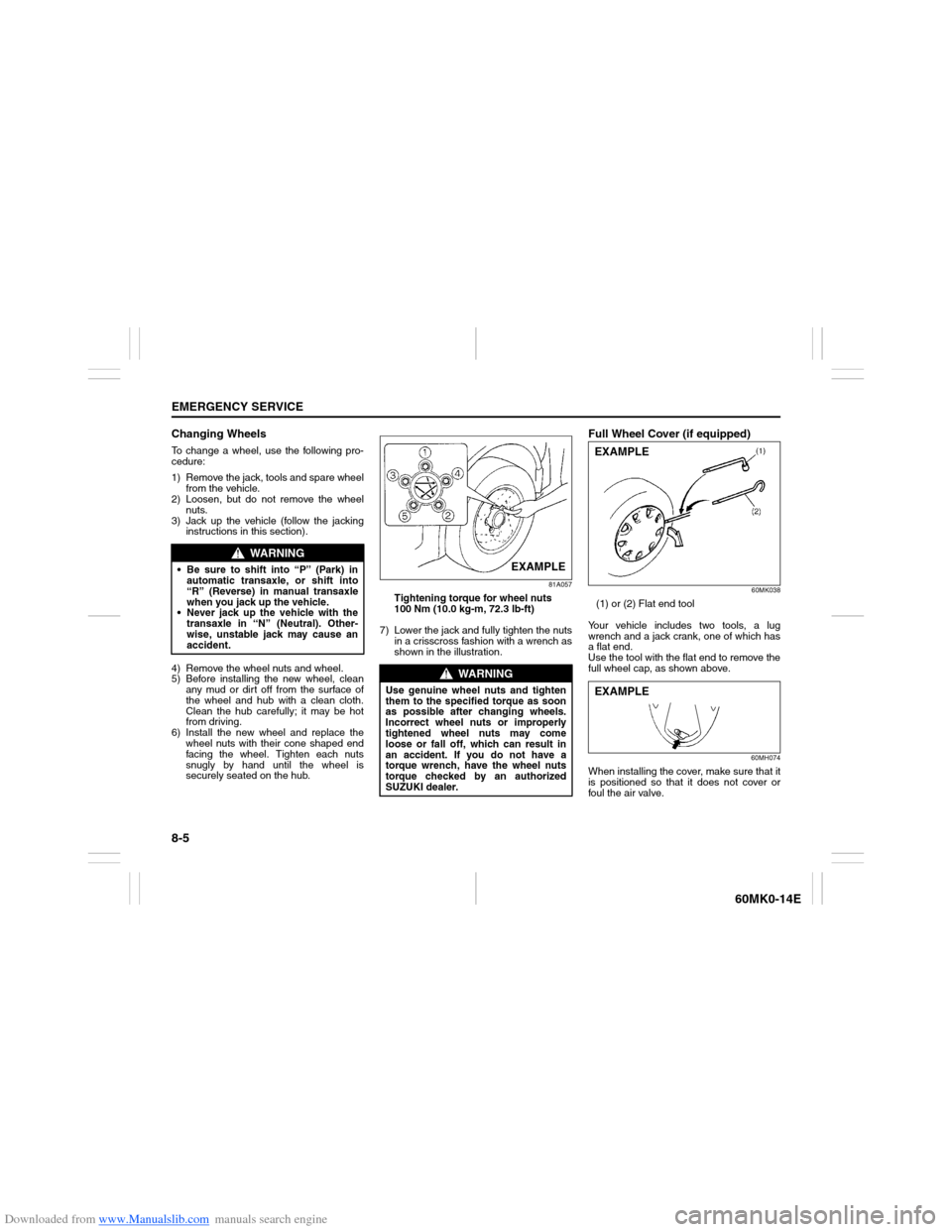
Changing WheelsTo change a wheel, use the following pro-
cedure:
1) Remove the jack, tools and spare wheel
from the vehicle.
2) Loosen, but do not remove the wheel
nuts.
3) Jack up the vehicle (follow the jacking
instructions in this section).
4) Remove the wheel nuts and wheel.
5) Before installing the new wheel, clean
any mud or dirt off from the surface of
the wheel and hub with a clean cloth.
Clean the hub carefully; it may be hot
from driving.
6) Install the new wheel and replace the
wheel nuts with their cone shaped end
facing the wheel. Tighten each nuts
snugly by hand until the wheel is
securely seated on the hub.
81A057
Tightening torque for wheel nuts
100 Nm (10.0 kg-m, 72.3 lb-ft)
7) Lower the jack and fully tighten the nuts
in a crisscross fashion with a wrench as
shown in the illustration.
Full Wheel Cover (if equipped)
60MK038
(1) or (2) Flat end tool
Your vehicle includes two tools, a lug
wrench and a jack crank, one of which has
a flat end.
Use the tool with the flat end to remove the
full wheel cap, as shown above.
60MH074
When installing the cover, make sure that it
is positioned so that it does not cover or
foul the air valve.
WARNING
Be sure to shift into “P” (Park) in
automatic transaxle, or shift into
“R” (Reverse) in manual transaxle
when you jack up the vehicle.
Never jack up the vehicle with the
transaxle in “N” (Neutral). Other-
wise, unstable jack may cause an
accident.
WARNING
Use genuine wheel nuts and tighten
them to the specified torque as soon
as possible after changing wheels.
Incorrect wheel nuts or improperly
tightened wheel nuts may come
loose or fall off, which can result in
an accident. If you do not have a
torque wrench, have the wheel nuts
torque checked by an authorized
SUZUKI dealer.
EXAMPLE
EXAMPLEEXAMPLE
Page 187 of 207
Downloaded from www.Manualslib.com manuals search engine 8-6
EMERGENCY SERVICE
60MK0-14E
After Changing Wheels
Stow the tire changing tools (jack, jack
handle and lug wrench) in place. Also,
stow the flat tire in the spare tire stowed
position. Refer to “Tire Changing Tool” in
this section.
Jump Starting Instructions
When Jump Starting Your Vehicle,
Use the Following Procedure:1) Use only a 12-volt battery to jump start
your vehicle. Position the good 12-volt
battery close to your vehicle so that the
jump leads will reach both batteries.
When using a battery installed on
another vehicle, DO NOT LET THE
VEHICLES TOUCH. Set the parking
brakes fully on both vehicles.
2) Turn off all vehicle accessories, except
those necessary for safety reasons (for
example, headlights or hazard lights).
NOTICE
Repair or replace the flat tire immedi-
ately. If the flat tire is placed in the
spare tire stowed position for long
time, it can cause vehicle shakiness,
noise, or scratches.
WARNING
Never attempt to jump start your
vehicle if the battery appears to be
frozen. Batteries in this condition
may explode or rupture if jump
starting is attempted.
When making jump lead connec-
tions, be certain that your hands
and the jump leads remain clear
from pulleys, belts, or fans.
Batteries produce flammable
hydrogen gas. Keep flames and
sparks away from the battery or an
explosion may occur. Never smoke
when working in the vicinity of the
battery.
If the booster battery you use for
jump starting is installed in another
vehicle, make sure the two vehicles
are not touching each other.
If your battery discharges repeat-
edly, for no apparent reason, have
your vehicle inspected by an autho-
rized SUZUKI dealer.
To avoid harm to yourself or dam-
age to your vehicle or battery, fol-
low the jump starting instructions
below precisely and in order.
If you are in doubt, call for qualified
road service.
NOTICE
Your vehicle should not be started by
pushing or towing. This starting
method could result in permanent
damage to the catalytic converter.
Use jump leads to start a vehicle with
a weak or flat battery.
Page 190 of 207
Downloaded from www.Manualslib.com manuals search engine 8-9EMERGENCY SERVICE
60MK0-14E
If the Engine OverheatsThe engine could overheat temporarily
under severe driving conditions. If the
engine coolant temperature gauge indi-
cates overheating during driving:
1) Turn off the air conditioner, if equipped.
2) Take the vehicle to a safe place and
park.
3) Let the engine run at the normal idle
speed for a few minutes until the indica-
tor is within the normal, acceptable
temperature range between “H” and
“C”.If the temperature indication does not
come down to within the normal, accept-
able range:
1) Turn off the engine and check that the
water pump belt and pulleys are not
damaged or slipping. If any abnormality
is found, correct it.
2) Check the coolant level in the reservoir.
If it is found to be lower than the “LOW”
line, look for leaks at the radiator, water
pump, and radiator and heater hoses. If
you locate any leaks that may have
caused the overheating, do not run the
engine until these problems have been
corrected.
3) If you do not find a leak, carefully add
coolant to the reservoir and then the
radiator, if necessary. (Refer to “Engine
Coolant” in the “INSPECTION AND
MAINTENANCE” section.)
NOTE:
If your engine overheats and you are
unsure what to do, contact your SUZUKI
dealer.
79J007
WARNING
If you see or hear escaping steam,
stop the vehicle in a safe place and
immediately turn off the engine to let
it cool. Do not open the hood when
steam is present. When the steam
can no longer be seen or heard, open
the hood to see if the coolant is still
boiling. If it is, you must wait until it
stops boiling before you proceed.
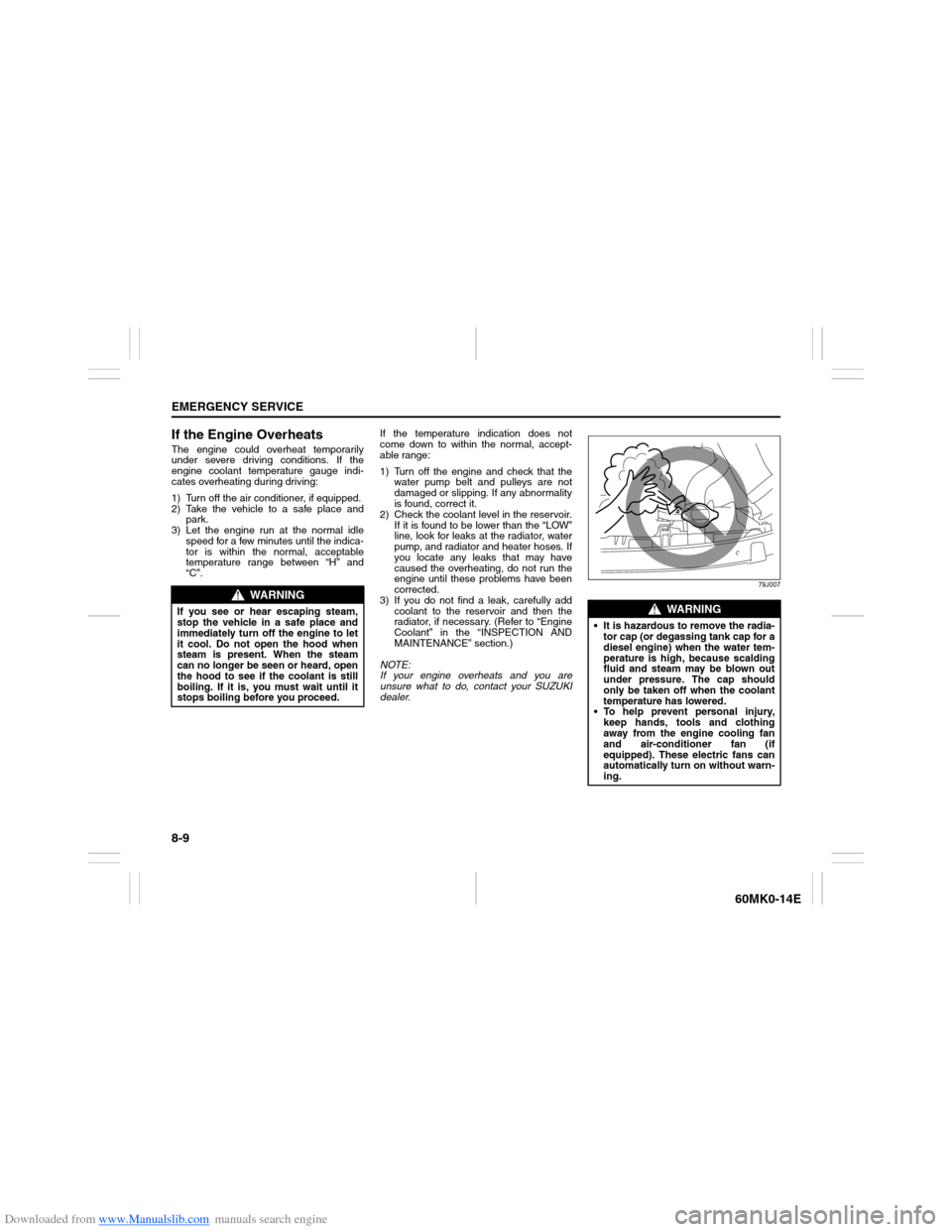
WARNING
It is hazardous to remove the radia-
tor cap (or degassing tank cap for a
diesel engine) when the water tem-
perature is high, because scalding
fluid and steam may be blown out
under pressure. The cap should
only be taken off when the coolant
temperature has lowered.
To help prevent personal injury,
keep hands, tools and clothing
away from the engine cooling fan
and air-conditioner fan (if
equipped). These electric fans can
automatically turn on without warn-
ing.
Page 192 of 207
Downloaded from www.Manualslib.com manuals search engine 9-1APPEARANCE CARE
60MK0-14E
Corrosion PreventionIt is important to take good care of your
vehicle to protect it from corrosion. Listed
below are instructions for how to maintain
your vehicle to prevent corrosion. Please
read and follow these instructions carefully.Important Information About Corro-
sionCommon causes of corrosion
1) Accumulation of road salt, dirt, mois-
ture, or chemicals in hard-to-reach
areas of the vehicle underbody or
frame.
2) Chipping, scratches and any damage to
treated or painted metal surfaces
resulting from minor accidents or abra-
sion by stones and gravel.
Environmental conditions which accel-
erate corrosion
1) Road salt, dust control chemicals, sea
air or industrial pollution will all acceler-
ate the corrosion of metal.
2) High humidity will increase the rate of
corrosion particularly when the temper-
ature range is just above the freezing
point.
3) Moisture in certain areas of a vehicle
for an extended period of time may pro-
mote corrosion even though other body
sections may be completely dry.
4) High temperatures will cause an accel-
erated rate of corrosion to parts of thevehicle which are not well ventilated to
permit quick drying.
This information illustrates the necessity of
keeping your vehicle (particularly the
underbody) as clean and dry as possible. It
is equally important to repair any damage
to the paint or protective coatings as soon
as possible.
How to Help Prevent CorrosionWash your vehicle frequently
The best way to preserve the finish on your
vehicle and to help avoid corrosion is to
keep it clean with frequent washing.
Wash your vehicle at least once during the
winter and once immediately after the win-
ter. Keep your vehicle, particularly the
underside, as clean and dry as possible.
If you frequently drive on salted roads, your
vehicle should be washed at least once a
month during the winter. If you live near the
ocean, your vehicle should be washed at
least once a month throughout the year.
For washing instructions, refer to the “Vehi-
cle Cleaning” section.
Remove foreign material deposits
Foreign material such as salts, chemicals,
road oil or tar, tree sap, bird droppings and
industrial fall-out may damage the finish of
your vehicle if it is left on painted surfaces.
Remove these types of deposits as quickly
as possible. If these deposits are difficult to
wash off, an additional cleaner may berequired. Be sure that any cleaner you use
is not harmful to painted surfaces and is
specifically intended for your purposes.
Follow the manufacturer’s directions when
using these special cleaners.
Repair finish damage
Carefully examine your vehicle for damage
to the painted surfaces. Should you find
any chips or scratches in the paint, touch
them up immediately to prevent corrosion
from starting. If the chips or scratches have
gone through to the bare metal, have a
qualified body shop make the repair.
Keep passenger and luggage compart-
ments clean
Moisture, dirt or mud can accumulate
under the floor mats and may cause corro-
sion. Occasionally, check under these
mats to ensure that this area is clean and
dry. More frequent checks are necessary if
the vehicle is used off road or in wet
weather.
Certain cargos such as chemicals, fertiliz-
ers, cleaners, salts, etc. are extremely cor-
rosive by nature. These products should
be transported in sealed containers. If a
spill or leak does occur, clean and dry the
area immediately.
Page 203 of 207
Downloaded from www.Manualslib.com manuals search engine 12-1
INDEX
12
60MK0-14E
INDEXSymbols“AIR BAG” Light .................................................................. 2-40Numerics4-Speed Automatic Transaxle ............................................ 3-10AAccelerator Pedal .................................................................. 3-7
Accessory Socket ................................................................ 5-41
Adding Coolant .................................................................... 7-12
Adjusting Seat Position ...................................................... 2-14
Adjusting Seat Position (for 2nd row seats) ..................... 2-16
Adjusting Seatbacks .................................................. 2-15, 2-16
Air Cleaner............................................................................ 7-13
Air Conditioning System .............................................. 5-1, 7-35
All Seat Belts Except Center of 2nd Row Seat.................. 2-23
Anti-Lock Brake System (ABS) .......................................... 3-13
Anti-Lock Brake System (ABS) Warning Light ................. 2-39
Anti-Theft Feature ................................................................ 5-31
Armrest ................................................................................. 5-44
Assist Grips.......................................................................... 5-42
Audio System ......................................................................... 5-7
Automatic Transaxle ........................................................... 3-10
Automatic Transaxle (AT) Fluid.......................................... 7-16
Average fuel consumption......................................... 2-47, 2-49BBattery .................................................................................. 7-22
Bottle holder......................................................................... 5-43
Brake Assist System ........................................................... 3-13
Brake Fluid ........................................................................... 7-17
Brake Pedal ................................................................... 3-7, 7-18Brake System Warning Light .............................................. 2-38
Brakes ................................................................................... 7-17
Braking .................................................................................. 3-12
Brightness Control............................................................... 2-45
Bulb Replacement ................................................................ 7-26
CCatalytic Converter ................................................................ 4-1
CD Player .............................................................................. 5-15
Center Seat Belt of 2nd Row Seat ...................................... 2-24
Central Door Locking System ............................................... 2-3
Changing Engine Oil and Filter............................................. 7-9
Changing Wheels ................................................................... 8-5
Charging Light...................................................................... 2-40
Chassis Serial Number ........................................................ 10-1
Child Restraint Systems ...................................................... 2-27
Child-Proof Locks (rear door) ............................................... 2-3
Clock ..................................................................................... 2-50
Clutch Pedal .................................................................. 3-7, 7-16
Coolant Level Check ............................................................ 7-12
Coolant Replacement .......................................................... 7-12
Corrosion Prevention ............................................................ 9-1
Cup Holder and Storage Area ............................................. 5-43DDaily Inspection Checklist..................................................... 3-1
Door Locks ............................................................................. 2-2
Downshifting maximum allowable speeds .......................... 3-9
Drive Belt ................................................................................ 7-7
Driver’s Seat Belt Reminder ................................................ 2-25
Driver’s Seat Belt Reminder Light ...................................... 2-40
Driving on Hills ....................................................................... 4-3
Driving on Slippery Roads .................................................... 4-4