Head SUZUKI ERTIGA 2013 1.G Owners Manual
[x] Cancel search | Manufacturer: SUZUKI, Model Year: 2013, Model line: ERTIGA, Model: SUZUKI ERTIGA 2013 1.GPages: 207, PDF Size: 5.14 MB
Page 10 of 207
Downloaded from www.Manualslib.com manuals search engine ILLUSTRATED TABLE OF CONTENTS
60MK0-14E
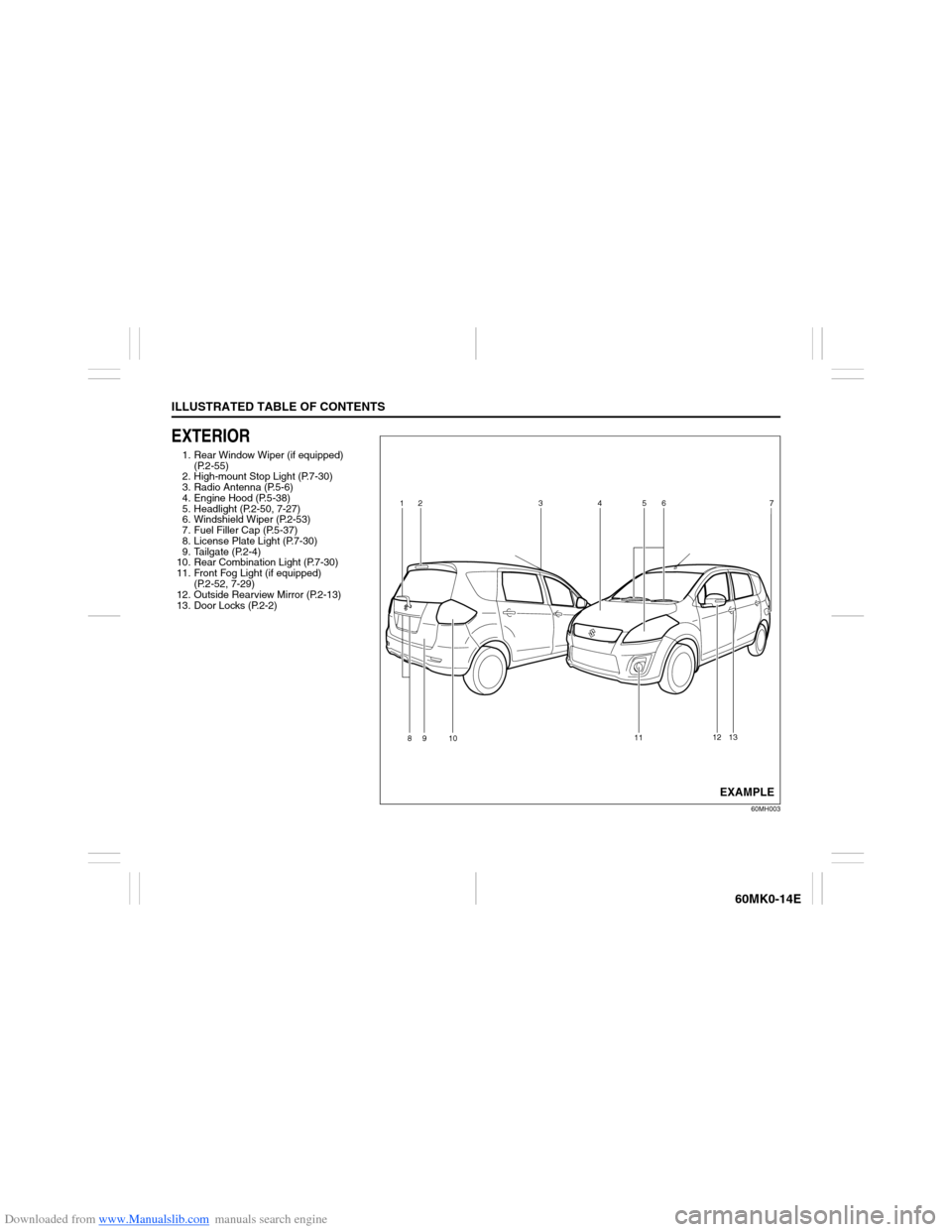
EXTERIOR1. Rear Window Wiper (if equipped)
(P.2-55)
2. High-mount Stop Light (P.7-30)
3. Radio Antenna (P.5-6)
4. Engine Hood (P.5-38)
5. Headlight (P.2-50, 7-27)
6. Windshield Wiper (P.2-53)
7. Fuel Filler Cap (P.5-37)
8. License Plate Light (P.7-30)
9. Tailgate (P.2-4)
10. Rear Combination Light (P.7-30)
11. Front Fog Light (if equipped)
(P.2-52, 7-29)
12. Outside Rearview Mirror (P.2-13)
13. Door Locks (P.2-2)
60MH003
12
456 3
7
89
10
11
12
13EXAMPLE
Page 11 of 207
Downloaded from www.Manualslib.com manuals search engine ILLUSTRATED TABLE OF CONTENTS
60MK0-14E
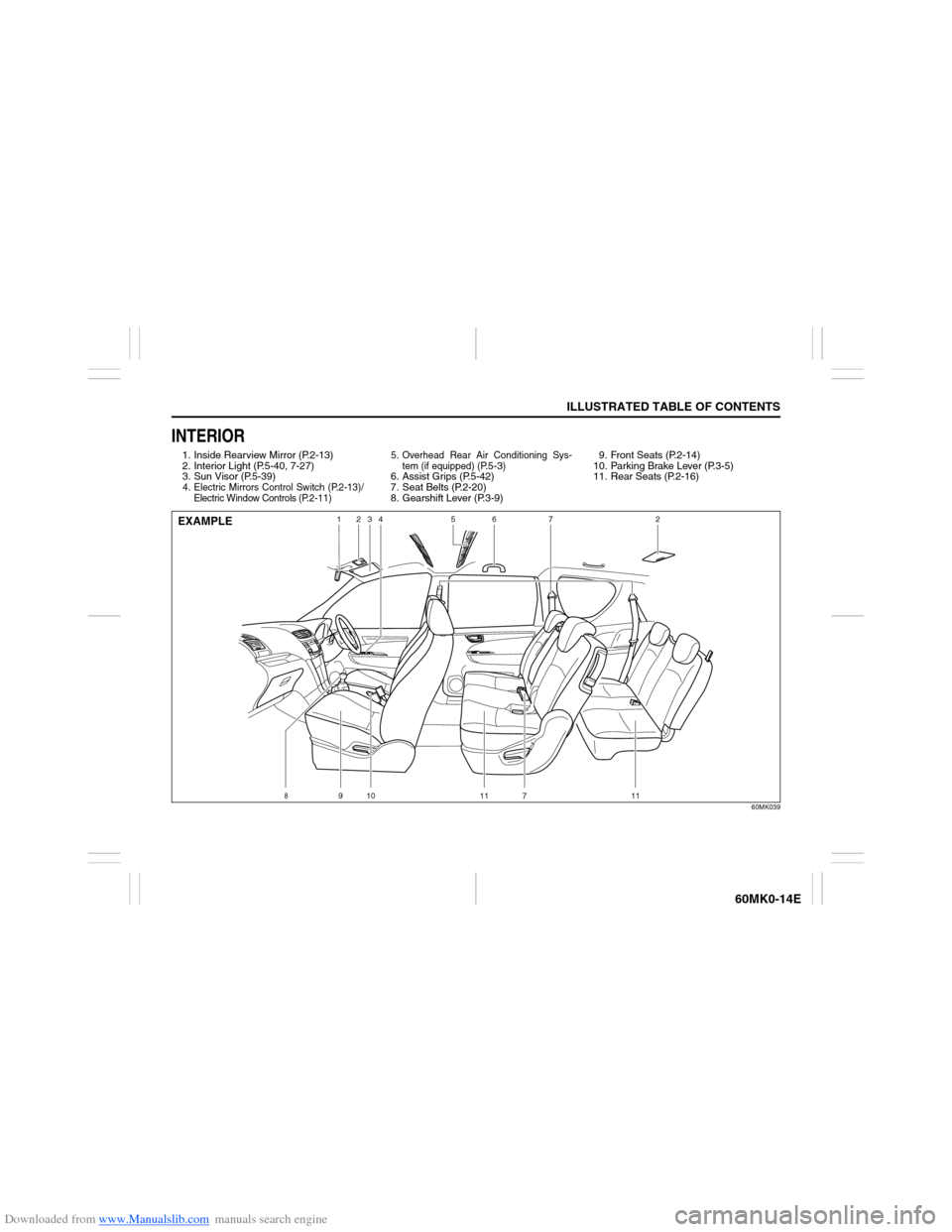
INTERIOR1. Inside Rearview Mirror (P.2-13)
2. Interior Light (P.5-40, 7-27)
3. Sun Visor (P.5-39)4. Electric Mirrors Control Switch (P.2-13)/
Electric Window Controls (P.2-11)5. Overhead Rear Air Conditioning Sys-
tem (if equipped) (P.
5-3
)
6. Assist Grips (P.5-42)
7. Seat Belts (P.2-20)
8. Gearshift Lever (P.3-9)9. Front Seats (P.2-14)
10. Parking Brake Lever (P.3-5)
11. Rear Seats (P.2-16)
60MK039
13
4
2
2
6
7
8
9
11
11
10
7
5
EXAMPLE
Page 27 of 207
Downloaded from www.Manualslib.com manuals search engine 2-12
BEFORE DRIVING
60MK0-14E
81A009
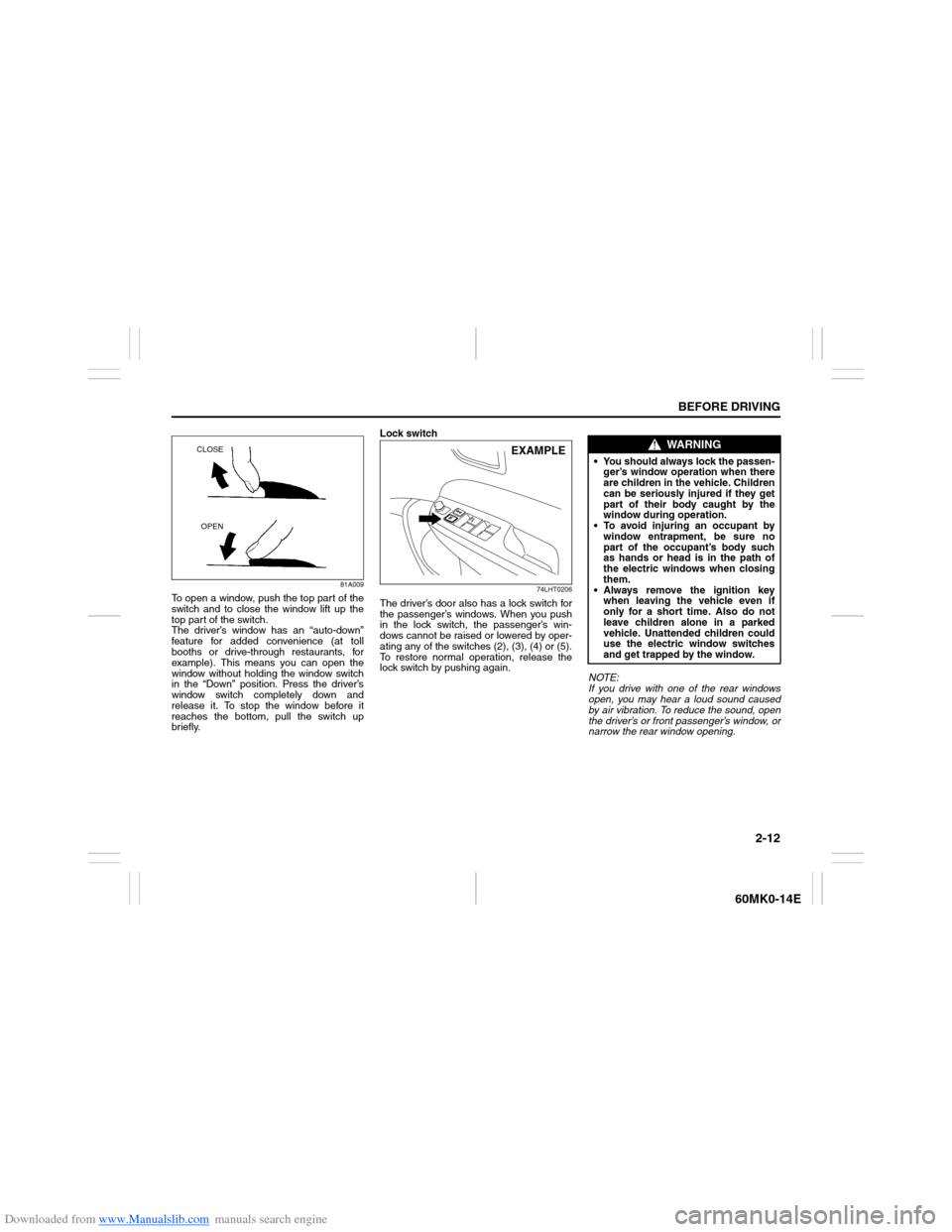
To open a window, push the top part of the
switch and to close the window lift up the
top part of the switch.
The driver’s window has an “auto-down”
feature for added convenience (at toll
booths or drive-through restaurants, for
example). This means you can open the
window without holding the window switch
in the “Down” position. Press the driver’s
window switch completely down and
release it. To stop the window before it
reaches the bottom, pull the switch up
briefly.Lock switch
74LHT0206
The driver’s door also has a lock switch for
the passenger’s windows. When you push
in the lock switch, the passenger’s win-
dows cannot be raised or lowered by oper-
ating any of the switches (2), (3), (4) or (5).
To restore normal operation, release the
lock switch by pushing again.
NOTE:
If you drive with one of the rear windows
open, you may hear a loud sound caused
by air vibration. To reduce the sound, open
the driver’s or front passenger’s window, or
narrow the rear window opening.
CLOSE
OPEN
EXAMPLE
WARNING
You should always lock the passen-
ger’s window operation when there
are children in the vehicle. Children
can be seriously injured if they get
part of their body caught by the
window during operation.
To avoid injuring an occupant by
window entrapment, be sure no
part of the occupant’s body such
as hands or head is in the path of
the electric windows when closing
them.
Always remove the ignition key
when leaving the vehicle even if
only for a short time. Also do not
leave children alone in a parked
vehicle. Unattended children could
use the electric window switches
and get trapped by the window.
Page 30 of 207
Downloaded from www.Manualslib.com manuals search engine 2-15BEFORE DRIVING
60MK0-14E
Adjusting Seatbacks
60MH013
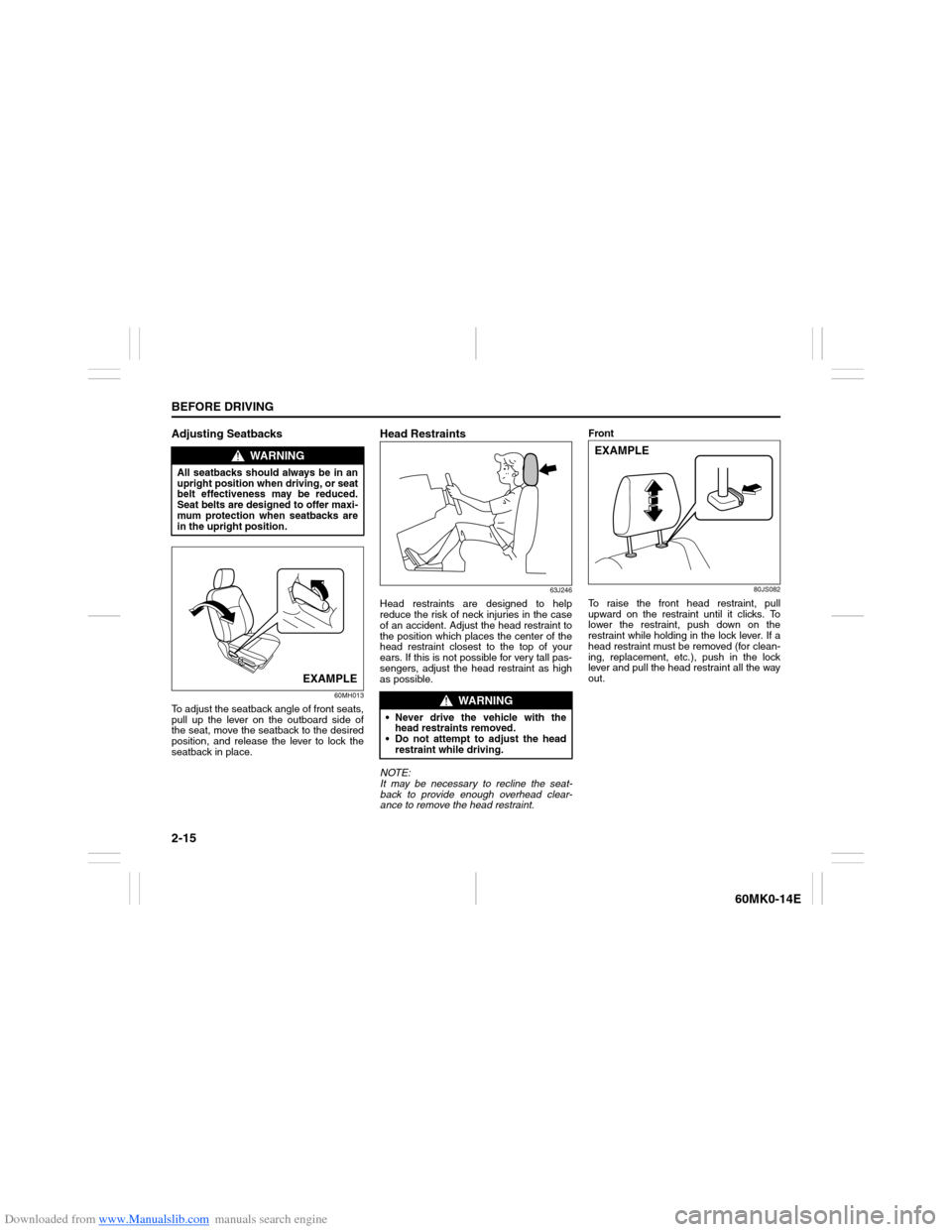
To adjust the seatback angle of front seats,
pull up the lever on the outboard side of
the seat, move the seatback to the desired
position, and release the lever to lock the
seatback in place.
Head Restraints
63J246
Head restraints are designed to help
reduce the risk of neck injuries in the case
of an accident. Adjust the head restraint to
the position which places the center of the
head restraint closest to the top of your
ears. If this is not possible for very tall pas-
sengers, adjust the head restraint as high
as possible.
NOTE:
It may be necessary to recline the seat-
back to provide enough overhead clear-
ance to remove the head restraint.Front
80JS082
To raise the front head restraint, pull
upward on the restraint until it clicks. To
lower the restraint, push down on the
restraint while holding in the lock lever. If a
head restraint must be removed (for clean-
ing, replacement, etc.), push in the lock
lever and pull the head restraint all the way
out.
WARNING
All seatbacks should always be in an
upright position when driving, or seat
belt effectiveness may be reduced.
Seat belts are designed to offer maxi-
mum protection when seatbacks are
in the upright position.
EXAMPLE
WARNING
Never drive the vehicle with the
head restraints removed.
Do not attempt to adjust the head
restraint while driving.
EXAMPLE
Page 32 of 207
Downloaded from www.Manualslib.com manuals search engine 2-17BEFORE DRIVING
60MK0-14E
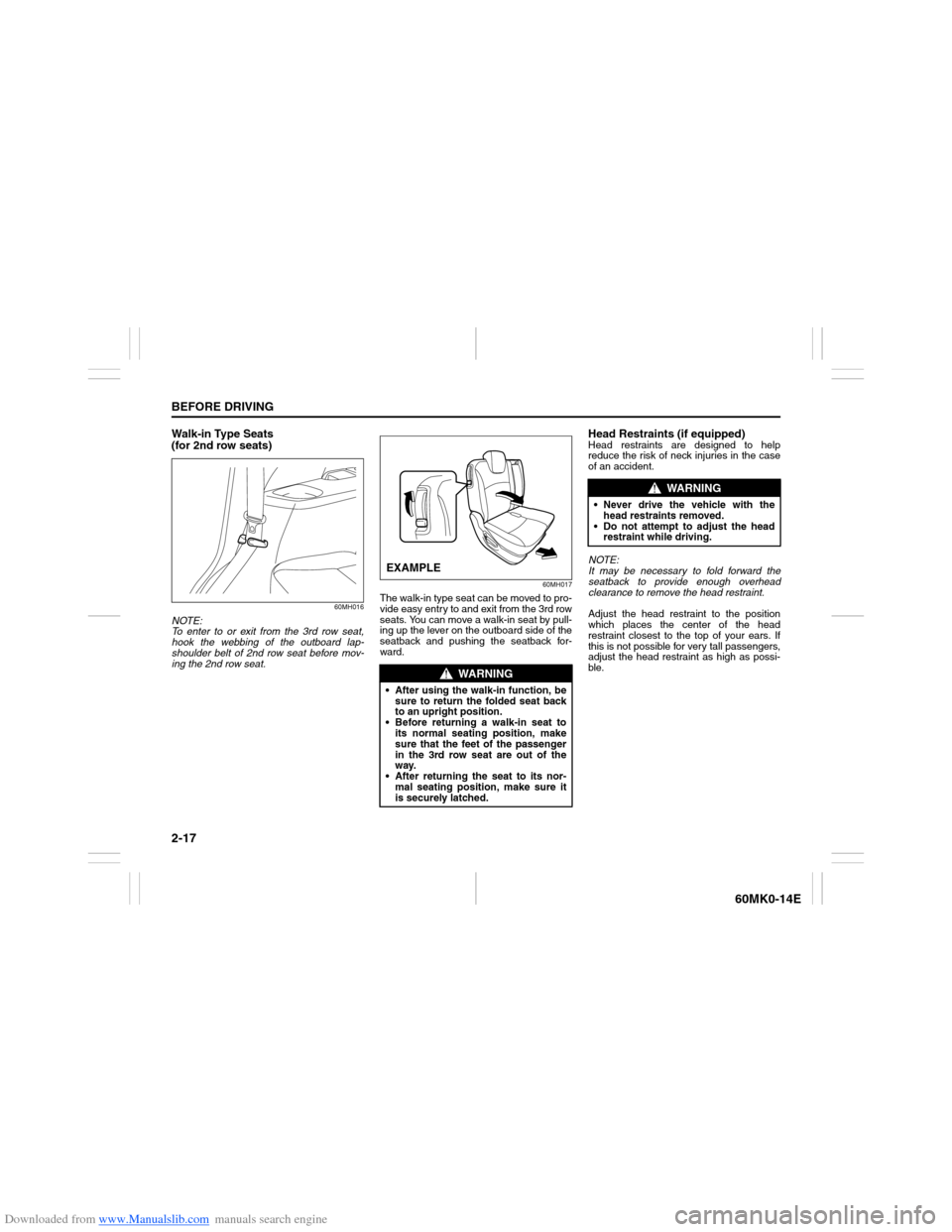
Walk-in Type Seats
(for 2nd row seats)
60MH016
NOTE:
To enter to or exit from the 3rd row seat,
hook the webbing of the outboard lap-
shoulder belt of 2nd row seat before mov-
ing the 2nd row seat.
60MH017
The walk-in type seat can be moved to pro-
vide easy entry to and exit from the 3rd row
seats. You can move a walk-in seat by pull-
ing up the lever on the outboard side of the
seatback and pushing the seatback for-
ward.
Head Restraints (if equipped)Head restraints are designed to help
reduce the risk of neck injuries in the case
of an accident.
NOTE:
It may be necessary to fold forward the
seatback to provide enough overhead
clearance to remove the head restraint.
Adjust the head restraint to the position
which places the center of the head
restraint closest to the top of your ears. If
this is not possible for very tall passengers,
adjust the head restraint as high as possi-
ble.
WARNING
After using the walk-in function, be
sure to return the folded seat back
to an upright position.
Before returning a walk-in seat to
its normal seating position, make
sure that the feet of the passenger
in the 3rd row seat are out of the
way.
After returning the seat to its nor-
mal seating position, make sure it
is securely latched.EXAMPLE
WARNING
Never drive the vehicle with the
head restraints removed.
Do not attempt to adjust the head
restraint while driving.
Page 33 of 207
Downloaded from www.Manualslib.com manuals search engine 2-18
BEFORE DRIVING
60MK0-14E
2nd row seats (if equipped)
60MH018
3rd row seats (if equipped)
60MH019
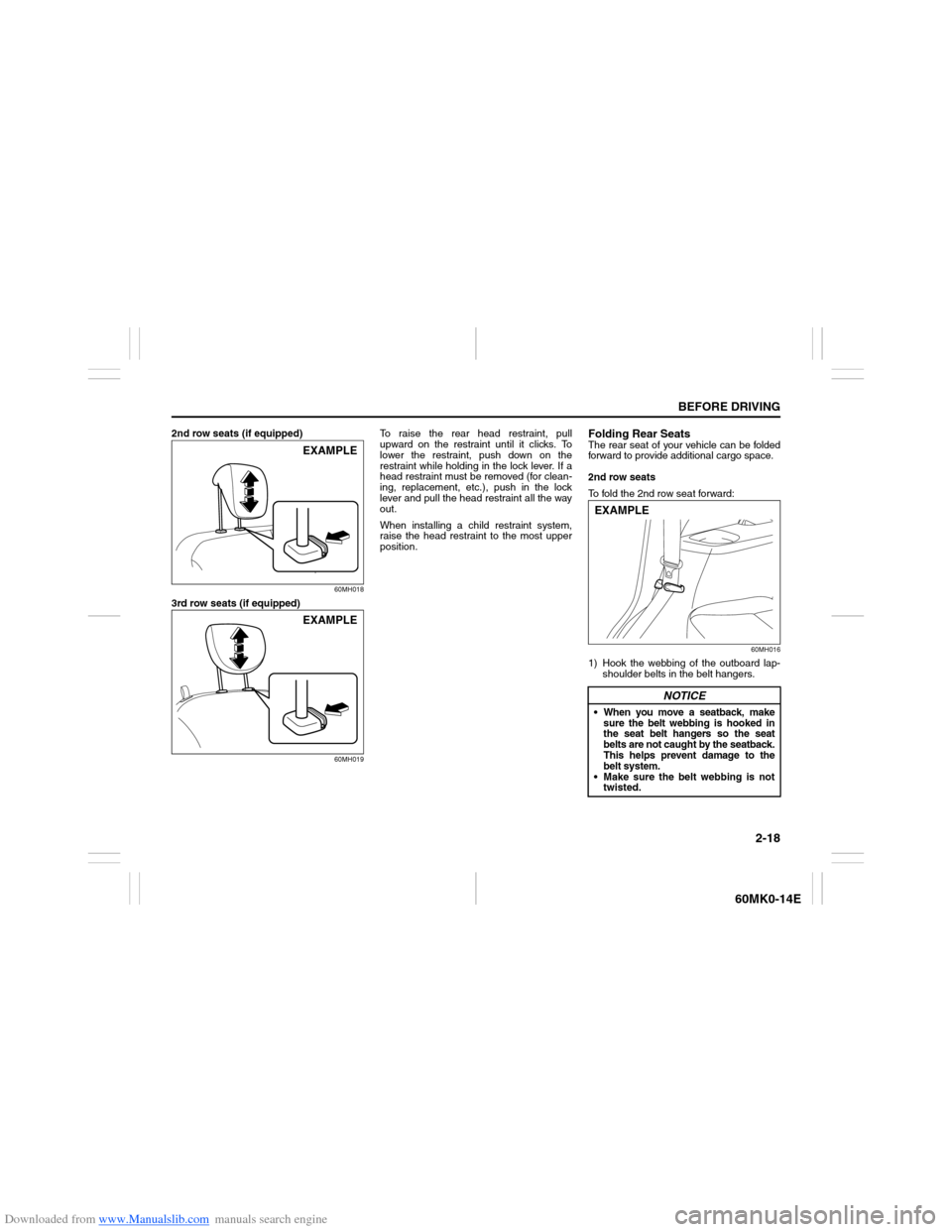
To raise the rear head restraint, pull
upward on the restraint until it clicks. To
lower the restraint, push down on the
restraint while holding in the lock lever. If a
head restraint must be removed (for clean-
ing, replacement, etc.), push in the lock
lever and pull the head restraint all the way
out.
When installing a child restraint system,
raise the head restraint to the most upper
position.
Folding Rear SeatsThe rear seat of your vehicle can be folded
forward to provide additional cargo space.
2nd row seats
To fold the 2nd row seat forward:
60MH016
1) Hook the webbing of the outboard lap-
shoulder belts in the belt hangers.
EXAMPLEEXAMPLE
NOTICE
When you move a seatback, make
sure the belt webbing is hooked in
the seat belt hangers so the seat
belts are not caught by the seatback.
This helps prevent damage to the
belt system.
Make sure the belt webbing is not
twisted.EXAMPLE
Page 34 of 207
Downloaded from www.Manualslib.com manuals search engine 2-19BEFORE DRIVING
60MK0-14E
2) Lower the head restraint (if equipped)
fully.
3) Store the seat belt buckles in the seat
cushion slit.
60MH060
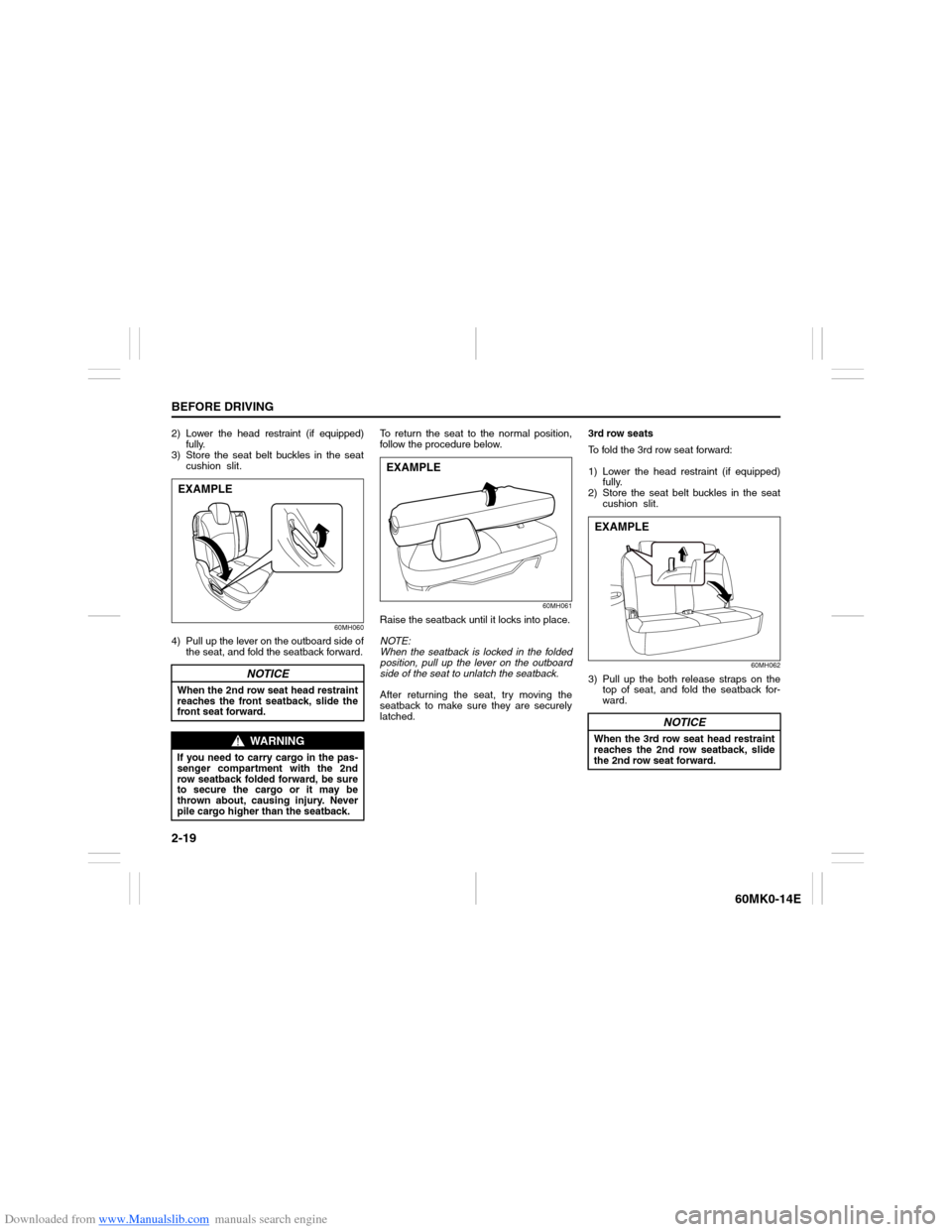
4) Pull up the lever on the outboard side of
the seat, and fold the seatback forward.To return the seat to the normal position,
follow the procedure below.
60MH061
Raise the seatback until it locks into place.
NOTE:
When the seatback is locked in the folded
position, pull up the lever on the outboard
side of the seat to unlatch the seatback.
After returning the seat, try moving the
seatback to make sure they are securely
latched.3rd row seats
To fold the 3rd row seat forward:
1) Lower the head restraint (if equipped)
fully.
2) Store the seat belt buckles in the seat
cushion slit.
60MH062
3) Pull up the both release straps on the
top of seat, and fold the seatback for-
ward.
NOTICE
When the 2nd row seat head restraint
reaches the front seatback, slide the
front seat forward.
WARNING
If you need to carry cargo in the pas-
senger compartment with the 2nd
row seatback folded forward, be sure
to secure the cargo or it may be
thrown about, causing injury. Never
pile cargo higher than the seatback.EXAMPLE
EXAMPLE
NOTICE
When the 3rd row seat head restraint
reaches the 2nd row seatback, slide
the 2nd row seat forward.EXAMPLE
Page 44 of 207
Downloaded from www.Manualslib.com manuals search engine 2-29BEFORE DRIVING
60MK0-14E
Installation with Lap-Shoulder Seat
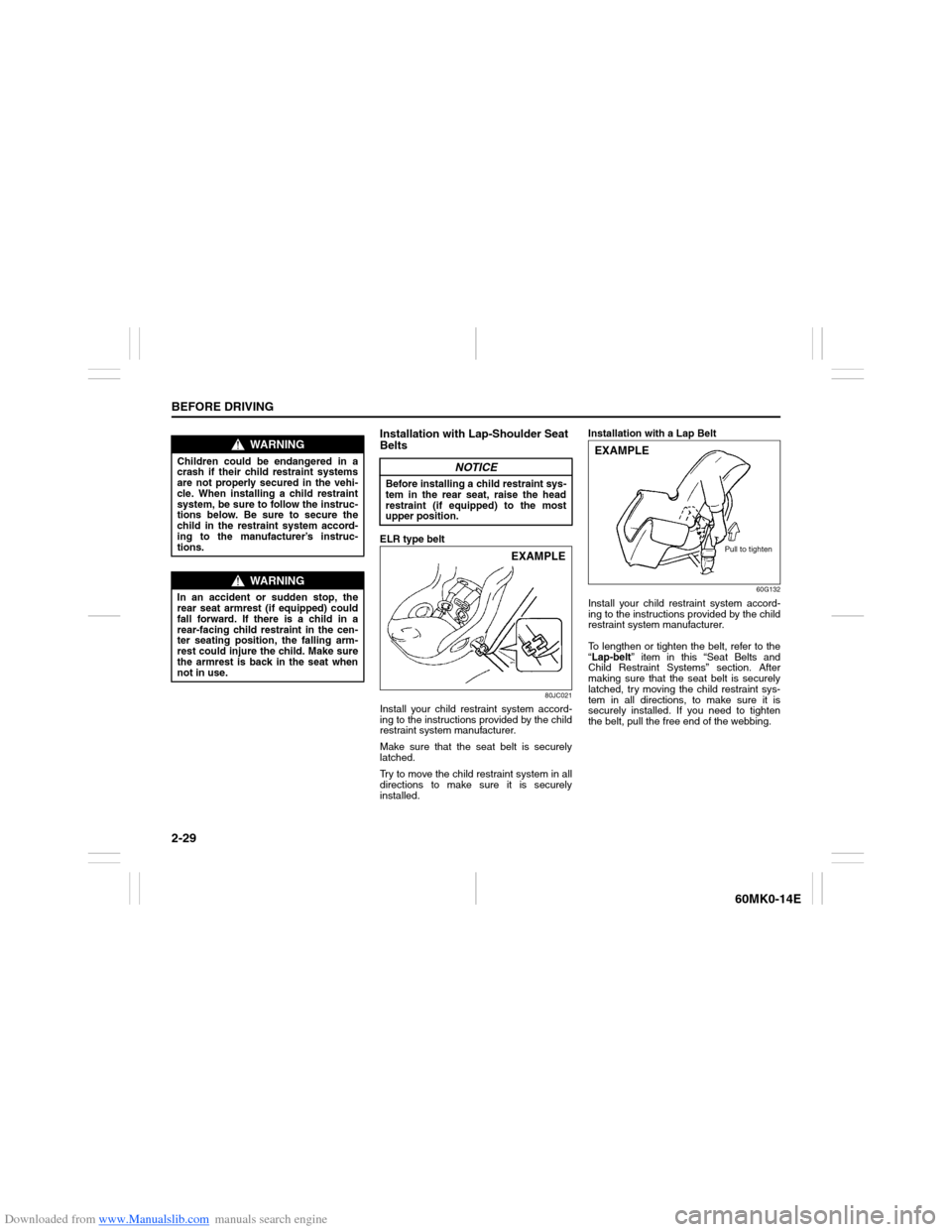
BeltsELR type belt
80JC021
Install your child restraint system accord-
ing to the instructions provided by the child
restraint system manufacturer.
Make sure that the seat belt is securely
latched.
Try to move the child restraint system in all
directions to make sure it is securely
installed.Installation with a Lap Belt
60G132
Install your child restraint system accord-
ing to the instructions provided by the child
restraint system manufacturer.
To lengthen or tighten the belt, refer to the
“Lap-belt” item in this “Seat Belts and
Child Restraint Systems” section. After
making sure that the seat belt is securely
latched, try moving the child restraint sys-
tem in all directions, to make sure it is
securely installed. If you need to tighten
the belt, pull the free end of the webbing.
WARNING
Children could be endangered in a
crash if their child restraint systems
are not properly secured in the vehi-
cle. When installing a child restraint
system, be sure to follow the instruc-
tions below. Be sure to secure the
child in the restraint system accord-
ing to the manufacturer’s instruc-
tions.
WARNING
In an accident or sudden stop, the
rear seat armrest (if equipped) could
fall forward. If there is a child in a
rear-facing child restraint in the cen-
ter seating position, the falling arm-
rest could injure the child. Make sure
the armrest is back in the seat when
not in use.
NOTICE
Before installing a child restraint sys-
tem in the rear seat, raise the head
restraint (if equipped) to the most
upper position.
EXAMPLE
EXAMPLE
Pull to tighten
Page 49 of 207
Downloaded from www.Manualslib.com manuals search engine 2-34
BEFORE DRIVING
60MK0-14E
How the System WorksIn a frontal collision, the crash sensors will
detect rapid deceleration, and if the con-
troller judges that the deceleration repre-
sents a severe frontal crash, the controller
will trigger the inflators. The inflators inflate
the appropriate air bags with nitrogen or
argon gas. The inflated air bags provide a
cushion for your head and upper body. The
air bag inflates and deflates so quickly that
you may not even realize that it has acti-
vated. The air bag will neither hinder your
view nor make it harder to exit the vehicle.
Air bags must inflate quickly and forcefully
in order to reduce the chance of serious or
fatal injuries. However, an unavoidable
consequence of the quick inflation is that
the air bag may irritate bare skin, such as
the facial area against a front air bag. Also,
upon inflation, a loud noise will occur and
some powder and smoke will be released.
These conditions are not harmful and do
not indicate a fire in the vehicle. Be aware,
however, that some air bag components
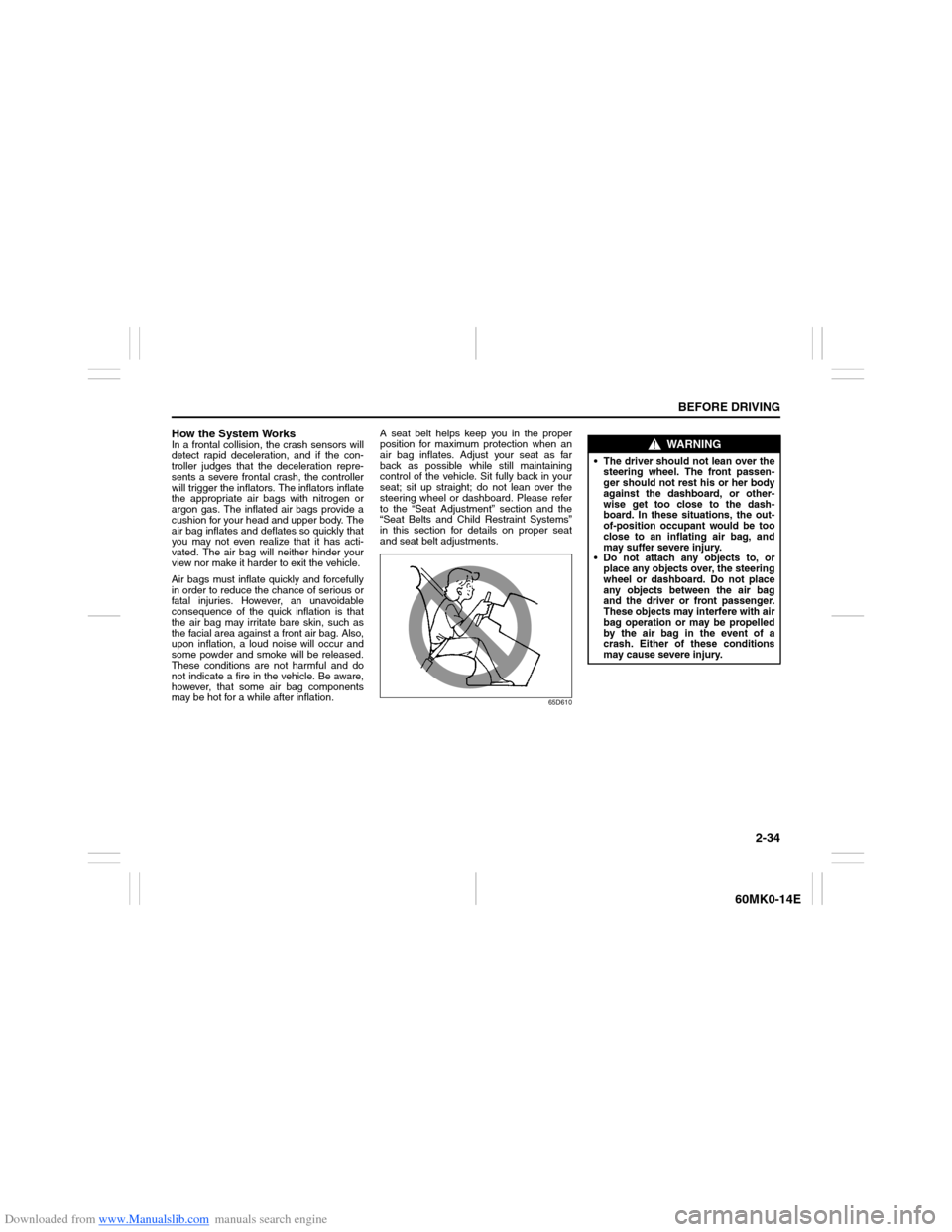
may be hot for a while after inflation.A seat belt helps keep you in the proper
position for maximum protection when an
air bag inflates. Adjust your seat as far
back as possible while still maintaining
control of the vehicle. Sit fully back in your
seat; sit up straight; do not lean over the
steering wheel or dashboard. Please refer
to the “Seat Adjustment” section and the
“Seat Belts and Child Restraint Systems”
in this section for details on proper seat
and seat belt adjustments.
65D610
WARNING
The driver should not lean over the
steering wheel. The front passen-
ger should not rest his or her body
against the dashboard, or other-
wise get too close to the dash-
board. In these situations, the out-
of-position occupant would be too
close to an inflating air bag, and
may suffer severe injury.
Do not attach any objects to, or
place any objects over, the steering
wheel or dashboard. Do not place
any objects between the air bag
and the driver or front passenger.
These objects may interfere with air
bag operation or may be propelled
by the air bag in the event of a
crash. Either of these conditions
may cause severe injury.
Page 57 of 207
Downloaded from www.Manualslib.com manuals search engine 2-42
BEFORE DRIVING
60MK0-14E
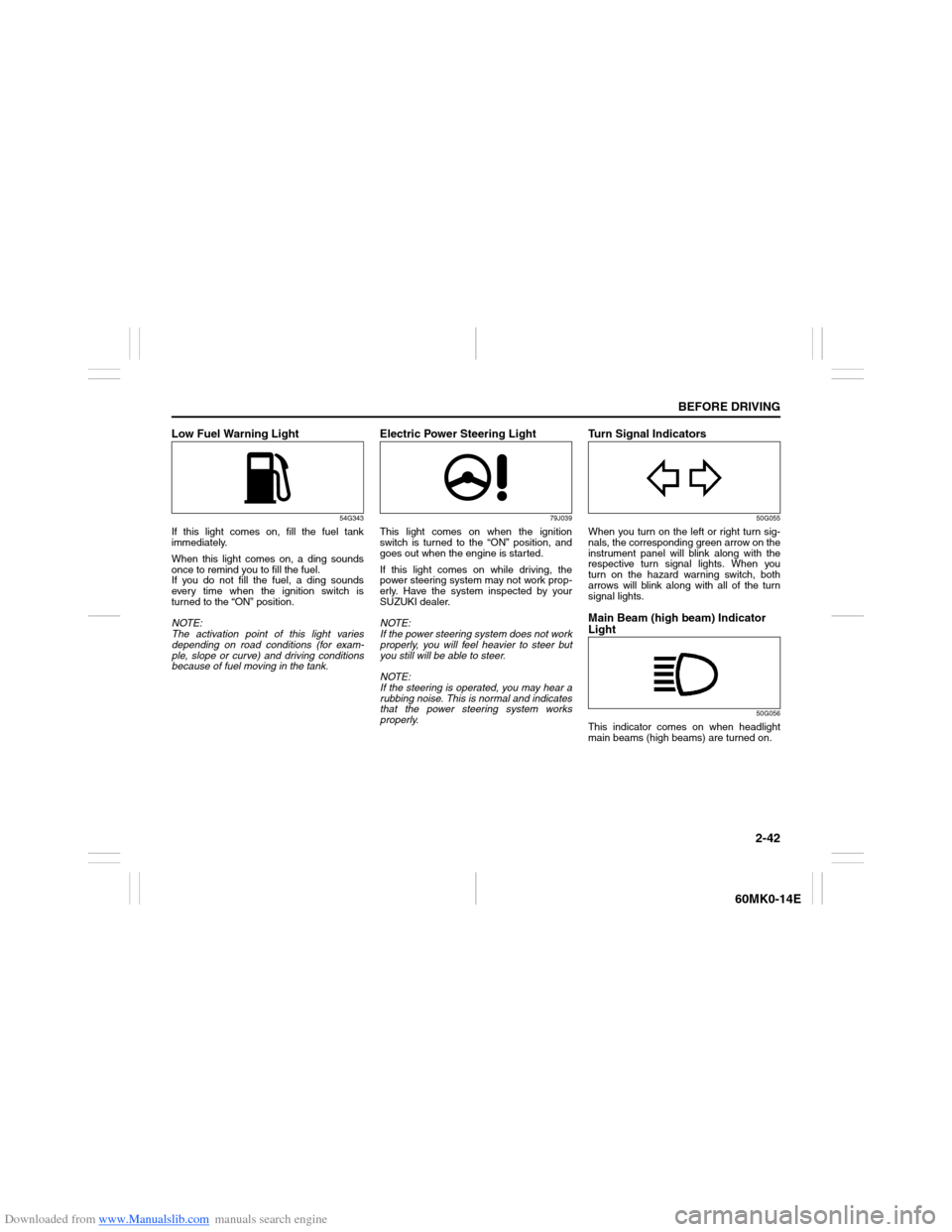
Low Fuel Warning Light
54G343
If this light comes on, fill the fuel tank
immediately.
When this light comes on, a ding sounds
once to remind you to fill the fuel.
If you do not fill the fuel, a ding sounds
every time when the ignition switch is
turned to the “ON” position.
NOTE:
The activation point of this light varies
depending on road conditions (for exam-
ple, slope or curve) and driving conditions
because of fuel moving in the tank.
Electric Power Steering Light
79J039
This light comes on when the ignition
switch is turned to the “ON” position, and
goes out when the engine is started.
If this light comes on while driving, the
power steering system may not work prop-
erly. Have the system inspected by your
SUZUKI dealer.
NOTE:
If the power steering system does not work
properly, you will feel heavier to steer but
you still will be able to steer.
NOTE:
If the steering is operated, you may hear a
rubbing noise. This is normal and indicates
that the power steering system works
properly.
Turn Signal Indicators
50G055
When you turn on the left or right turn sig-
nals, the corresponding green arrow on the
instrument panel will blink along with the
respective turn signal lights. When you
turn on the hazard warning switch, both
arrows will blink along with all of the turn
signal lights.Main Beam (high beam) Indicator
Light
50G056
This indicator comes on when headlight
main beams (high beams) are turned on.