warning SUZUKI FORENZA 2007 Owners Manual
[x] Cancel search | Manufacturer: SUZUKI, Model Year: 2007, Model line: FORENZA, Model: SUZUKI FORENZA 2007Pages: 225, PDF Size: 4.39 MB
Page 163 of 225
5-19 SERVICE AND APPEARANCE CARE
85Z03-03E
When your brake fluid falls to a low level,
your brake warning light will come on. See
“Brake System Warning Light” in section 3.
What to Add
When you do need brake fluid, use only
DOT-3 brake fluid. Use new brake fluid
from a sealed container only. See “Recom-
mended Fluids and Lubricants” in section
6.
Always clean the brake fluid reservoir cap
and the area around the cap before remov-
ing it. This will help keep dirt from entering
the reservoir.Brake Wear
Your vehicle has front and rear disc brakes.
Disc brake pads have built-in wear indica-
tors that make a high-pitched warning
sound when the brake pads are worn and
new pads are needed. The sound may
come and go or be heard all the time your
vehicle is moving (except when you are
pushing on the brake pedal firmly).Some driving conditions or climates may
cause a brake squeal when the brakes are
first applied or lightly applied. This does
not mean something is wrong with your
brakes.
Properly torqued wheel nuts are necessary
to help prevent brake pulsation. When tires
are rotated, inspect brake pads for wear
and evenly tighten wheel nuts in the proper
sequence to SUZUKI torque specifica-
tions.
Brake linings should always be replaced as
complete axle sets.
See “Brake System Inspection” in section
6.
WARNING
If you have too much brake fluid, it
can spill on the engine. The fluid will
burn if the engine is hot enough. You
or others could be burned, and your
vehicle could be damaged.
WARNING
With the wrong kind of fluid in your
brake system, your brakes may not
work well, or they may not even work
at all. This could cause a crash.
Always use the proper brake fluid.
CAUTION
Using the wrong fluid can badly
damage brake system parts. For
example, just a few drops of min-
eral-based oil, such as engine oil,
in your brake system can damage
brake system parts so badly that
they’ll have to be replaced. Don’t let
someone put in the wrong kind of
fluid.
If you spill brake fluid on your vehi-
cle’s painted surfaces, the paint fin-
ish can be damaged. Be careful not
to spill brake fluid on your vehicle.
If you do, wash it off immediately.
See “Appearance Care” in the
Index.
WARNING
The brake wear warning sound
means that soon your brakes won’t
work well. That could lead to an acci-
dent. When you hear the brake wear
warning sound, have your vehicle
serviced.
CAUTION
Continuing to drive with worn-out
brake pads could result in costly
brake repair.
Checking Things Under the Hood:
Page 164 of 225
5-20 SERVICE AND APPEARANCE CARE
85Z03-03E
Brake Pedal Travel
See your SUZUKI dealer if the brake pedal
does not return to normal height, or if there
is a rapid increase in pedal travel. This
could be a sign of brake trouble.
Brake Adjustment
Every time you make a moderate brake
stop, your disc brakes adjust for wear. If
you rarely make a moderate or heavier
stop, then your brakes might not adjust
correctly. If you drive in that way, then –
very carefully – make a few moderate
brake stops about every 1,000 miles
(1,600 km), so your brakes will adjust prop-
erly.
Replacing Brake System Parts
The braking system on a vehicle is com-
plex. Its many parts have to be of top qual-
ity and work well together if the vehicle is
to have really good braking. When you
replace parts of your braking system – for
example, when your brake linings wear
down and you need new ones put in – be
sure you get new approved SUZUKI
replacement parts. If you don’t, your
brakes may no longer work properly. For
example, if someone puts in brake linings
that are wrong for your vehicle, the balance
between your front and rear brakes can
change – for the worse. The braking per-
formance you’ve come to expect can
change in many other ways if someone
puts in the wrong replacement brake parts.
BatteryYour new vehicle comes with a mainte-
nance free battery. When it’s time for a new
battery, get one that has the replacement
number shown on the original battery’s
label. See “Engine Compartment Over-
view” in this section for battery location.
Vehicle Storage
If you’re not going to drive your vehicle for
25 days or more, remove the black, nega-
tive (–) cable from the battery. This will
help keep your battery from running down.
Contact your SUZUKI dealer to learn how
to prepare your vehicle for longer storage
periods.
Jump StartingIf your battery has run down, you may want
to use another vehicle and some jumper
cables to start your vehicle. Be sure to fol-
low the steps below to do it safely.
1) Check the other vehicle. It must have a
12-volt battery with a negative ground
system.
WARNING
Battery posts, terminals and related
accessories contain lead and lead
compounds, chemicals known to the
State of California to cause cancer
and reproductive harm. Wash hands
after handling.
WARNING
Batteries have acid that can burn you
and gas that can explode. You can be
badly hurt if you aren’t careful. See
the next section, “Jump Starting”, for
tips on working around a battery
without getting hurt.
WARNING
Batteries can hurt you. They can be
dangerous because:
They contain acid that can burn
you.
They contain gas that can explode
or ignite.
They contain enough electricity to
burn you.
If you don’t follow these steps
exactly, some or all of these things
can hurt you.
CAUTION
Ignoring the following steps could
result in costly damage to your vehi-
cle that wouldn’t be covered by your
warranty.
Trying to start your vehicle by push-
ing or pulling it won’t work, and it
could damage your vehicle.
Checking Things Under the Hood:
Page 165 of 225
5-21 SERVICE AND APPEARANCE CARE
85Z03-03E
2) Get the vehicles close enough so the
jumper cables can reach, but be sure
the vehicles aren’t touching each other.
If they are, it could cause a ground con-
nection you don’t want. You wouldn’t be
able to start your vehicle, and the bad
grounding could damage the electrical
systems.
To avoid the possibility of the vehicles
rolling, set the parking brake firmly on
both vehicles involved in the jump start
procedure. Put an automatic transmis-
sion in PARK (P) or a manual transmis-
sion in NEUTRAL before setting the
parking brake.3) Turn off the ignition on both vehicles.
Unplug unnecessary accessories
plugged into the cigarette lighter or in
the accessory power outlet. Turn off the
radio and all lamps that aren’t needed.
This will avoid sparks and help save
both batteries. And it could save your
radio!
4) Open the hoods and locate the batter-
ies. Find the positive (+) and negative
(–) terminal locations on each vehicle.
Your vehicle’s positive (+) terminal is
located under a red tethered cap on the
battery. The negative (–) terminal is
located under a black tethered cap on
the battery. See “Engine Compartment
Overview” in this section for more infor-
mation on location. Flip the caps up to
access the positive (+) and negative (–)
terminals.
5) Check that the jumper cables don’t
have loose or missing insulation. If they
do, you could get a shock. The vehicles
could be damaged, too.
Before you connect the cables, here are
some basic things you should know.
Positive (+) will go to positive (+) or to a
remote positive (+) terminal if the vehi-
cle has one. Negative (–) will go to a
heavy, unpainted metal engine part or
to a remote negative (–) terminal if the
vehicle with the dead battery has one.
Don’t connect positive (+) to negative
(–) or you’ll get a short that would dam-
CAUTION
If the other system isn’t a 12-volt sys-
tem with a negative ground, both
vehicles can be damaged. Only use
vehicles with 12-volt systems with
negative grounds to jump start your
vehicle.
CAUTION
If you leave your radio or other acces-
sories on during the jump starting
procedure, they could be damaged.
The repairs wouldn’t be covered by
your warranty. Always turn off your
radio and other accessories when
jump starting your vehicle.
WARNING
An electric fan under the hood can
start up and injure you even when the
engine is not running. Keep hands,
clothing and tools away from any
underhood electric fan.
WARNING
Using a match near a battery can
cause battery gas to explode. People
have been hurt doing this, and some
have been blinded. Use a flashlight if
you need more light.
Be sure the battery has enough
water. You don’t need to add water to
the battery installed in your new vehi-
cle. But if a battery has filler caps, be
sure the right amount of fluid is
there. If it is low, add water to take
care of that first. If you don’t, explo-
sive gas could be present.
Battery fluid contains acid that can
burn you. Don’t get it on you. If you
accidentally get it in your eyes or on
your skin, flush the place with water
and get medical help immediately.
Checking Things Under the Hood:
Page 166 of 225
5-22 SERVICE AND APPEARANCE CARE
85Z03-03E
age the battery and maybe other parts,
too. And don’t connect the negative (–)
cable to the negative (–) terminal on the
dead battery because this can cause
sparks.
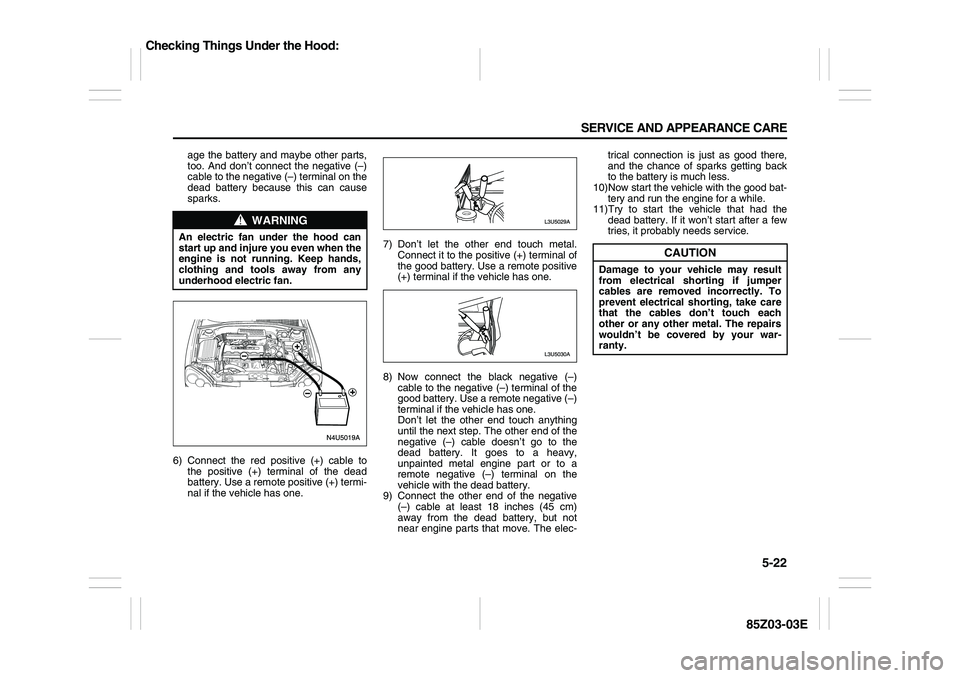
6) Connect the red positive (+) cable to
the positive (+) terminal of the dead
battery. Use a remote positive (+) termi-
nal if the vehicle has one.7) Don’t let the other end touch metal.
Connect it to the positive (+) terminal of
the good battery. Use a remote positive
(+) terminal if the vehicle has one.
8) Now connect the black negative (–)
cable to the negative (–) terminal of the
good battery. Use a remote negative (–)
terminal if the vehicle has one.
Don’t let the other end touch anything
until the next step. The other end of the
negative (–) cable doesn’t go to the
dead battery. It goes to a heavy,
unpainted metal engine part or to a
remote negative (–) terminal on the
vehicle with the dead battery.
9) Connect the other end of the negative
(–) cable at least 18 inches (45 cm)
away from the dead battery, but not
near engine parts that move. The elec-trical connection is just as good there,
and the chance of sparks getting back
to the battery is much less.
10)Now start the vehicle with the good bat-
tery and run the engine for a while.
11)Try to start the vehicle that had the
dead battery. If it won’t start after a few
tries, it probably needs service.
WARNING
An electric fan under the hood can
start up and injure you even when the
engine is not running. Keep hands,
clothing and tools away from any
underhood electric fan.
CAUTION
Damage to your vehicle may result
from electrical shorting if jumper
cables are removed incorrectly. To
prevent electrical shorting, take care
that the cables don’t touch each
other or any other metal. The repairs
wouldn’t be covered by your war-
ranty.
Checking Things Under the Hood:
Page 167 of 225
5-23 SERVICE AND APPEARANCE CARE
85Z03-03E
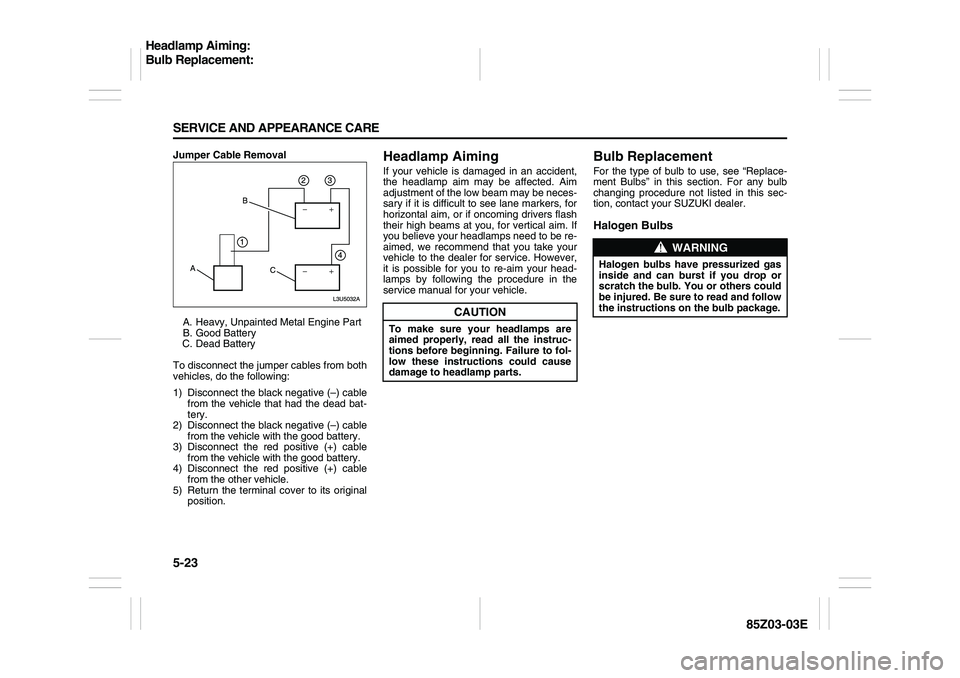
Jumper Cable Removal
A. Heavy, Unpainted Metal Engine Part
B. Good Battery
C. Dead Battery
To disconnect the jumper cables from both
vehicles, do the following:
1) Disconnect the black negative (–) cable
from the vehicle that had the dead bat-
tery.
2) Disconnect the black negative (–) cable
from the vehicle with the good battery.
3) Disconnect the red positive (+) cable
from the vehicle with the good battery.
4) Disconnect the red positive (+) cable
from the other vehicle.
5) Return the terminal cover to its original
position.
Headlamp AimingIf your vehicle is damaged in an accident,
the headlamp aim may be affected. Aim
adjustment of the low beam may be neces-
sary if it is difficult to see lane markers, for
horizontal aim, or if oncoming drivers flash
their high beams at you, for vertical aim. If
you believe your headlamps need to be re-
aimed, we recommend that you take your
vehicle to the dealer for service. However,
it is possible for you to re-aim your head-
lamps by following the procedure in the
service manual for your vehicle.
Bulb ReplacementFor the type of bulb to use, see “Replace-
ment Bulbs” in this section. For any bulb
changing procedure not listed in this sec-
tion, contact your SUZUKI dealer.Halogen Bulbs
CAUTION
To make sure your headlamps are
aimed properly, read all the instruc-
tions before beginning. Failure to fol-
low these instructions could cause
damage to headlamp parts.
WARNING
Halogen bulbs have pressurized gas
inside and can burst if you drop or
scratch the bulb. You or others could
be injured. Be sure to read and follow
the instructions on the bulb package.
Headlamp Aiming:
Bulb Replacement:
Page 172 of 225
5-28 SERVICE AND APPEARANCE CARE
85Z03-03E
Windshield Wiper Blade
ReplacementWindshield wiper blades should be
inspected at least twice a year for wear or
cracking. If the wiper blades become brittle
or damaged, or make streaks when wiping,
replace the wiper blades for optimum driv-
ing visibility. Replacement blades come in
different types and are removed in different
ways.
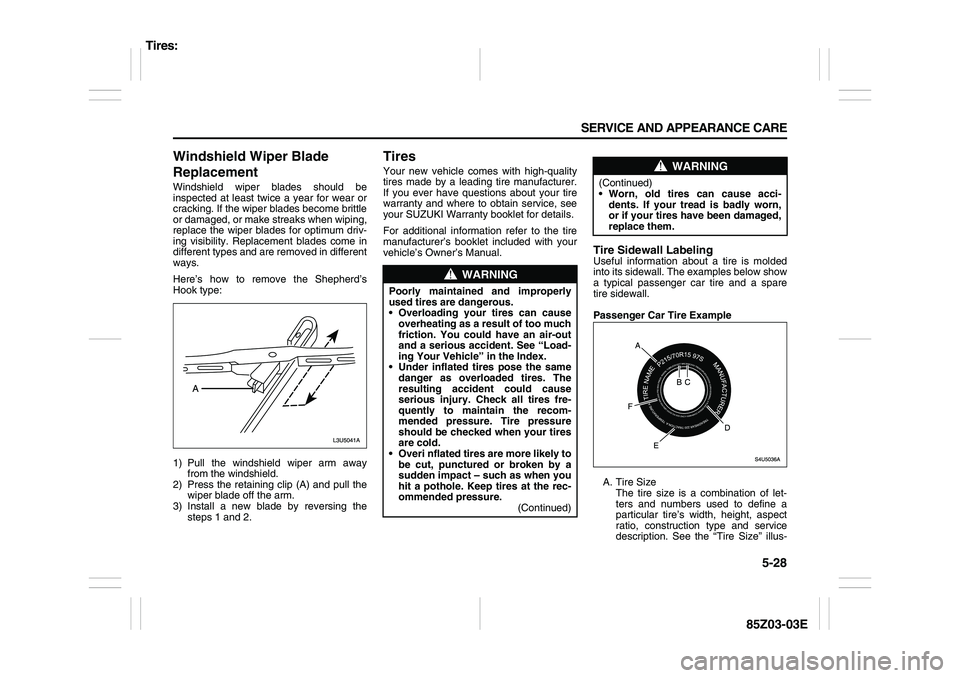
Here’s how to remove the Shepherd’s
Hook type:
1) Pull the windshield wiper arm away
from the windshield.
2) Press the retaining clip (A) and pull the
wiper blade off the arm.
3) Install a new blade by reversing the
steps 1 and 2.
TiresYour new vehicle comes with high-quality
tires made by a leading tire manufacturer.
If you ever have questions about your tire
warranty and where to obtain service, see
your SUZUKI Warranty booklet for details.
For additional information refer to the tire
manufacturer’s booklet included with your
vehicle’s Owner’s Manual.
Tire Sidewall LabelingUseful information about a tire is molded
into its sidewall. The examples below show
a typical passenger car tire and a spare
tire sidewall.
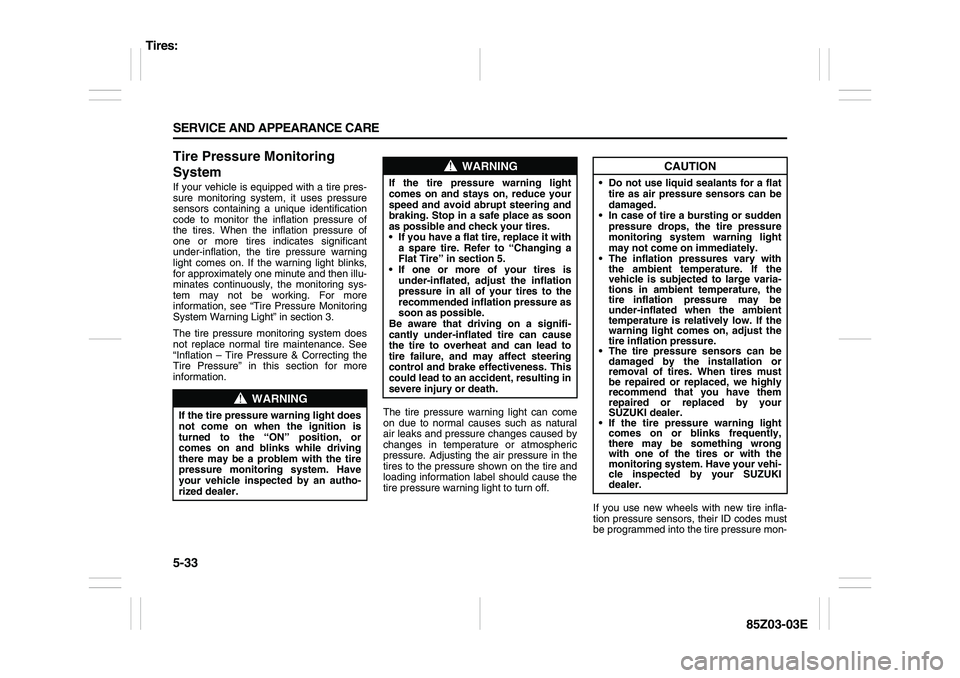
Passenger Car Tire Example
A. Tire Size
The tire size is a combination of let-
ters and numbers used to define a
particular tire’s width, height, aspect
ratio, construction type and service
description. See the “Tire Size” illus-
WARNING
Poorly maintained and improperly
used tires are dangerous.
Overloading your tires can cause
overheating as a result of too much
friction. You could have an air-out
and a serious accident. See “Load-
ing Your Vehicle” in the Index.
Under inflated tires pose the same
danger as overloaded tires. The
resulting accident could cause
serious injury. Check all tires fre-
quently to maintain the recom-
mended pressure. Tire pressure
should be checked when your tires
are cold.
Overi nflated tires are more likely to
be cut, punctured or broken by a
sudden impact – such as when you
hit a pothole. Keep tires at the rec-
ommended pressure.
(Continued)
WARNING
(Continued)
Worn, old tires can cause acci-
dents. If your tread is badly worn,
or if your tires have been damaged,
replace them.
Tires:
Page 174 of 225
5-30 SERVICE AND APPEARANCE CARE
85Z03-03E
and the maximum pressure needed to
support that load. See “Compact
Spare Tire” in this section and “Load-
ing Your Vehicle” in section 4.
E. Tire Inflation Pressure
The temporary use tire or compact
spare tire should be inflated to 60 psi
(420 kPa). For more information on
tire pressure and inflation, see “Tire
Inflation Pressure” in this section.
F. Tire Size
A combination of letters and numbers
defining a tire’s width, height, aspect
ratio, construction type and service
description. The letter “T” as the first
character in the tire size means the
tire is for temporary use only.
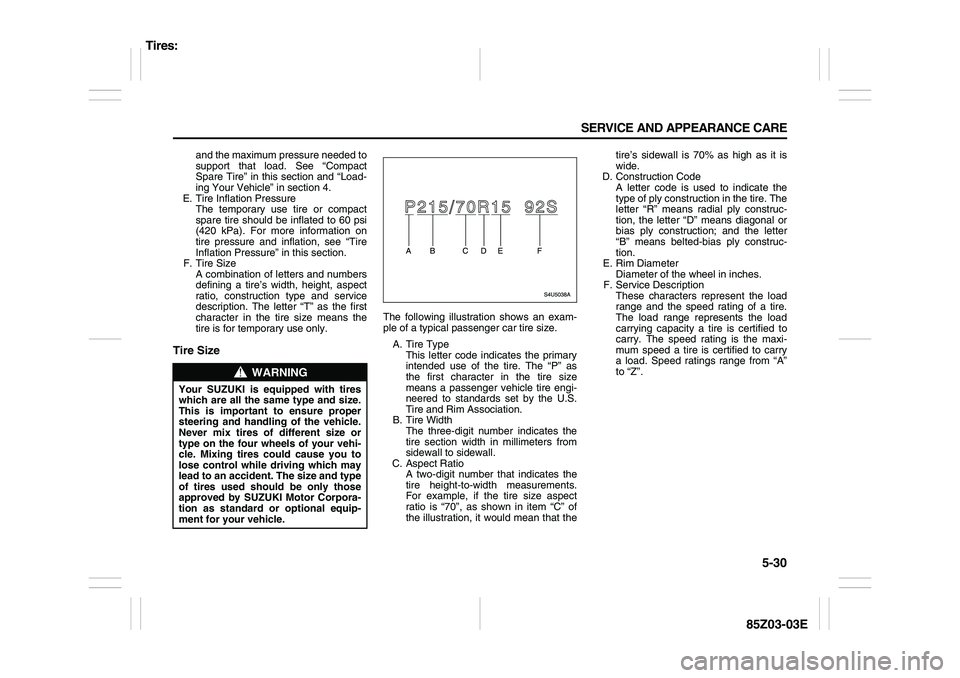
Tire Size
The following illustration shows an exam-
ple of a typical passenger car tire size.
A. Tire Type
This letter code indicates the primary
intended use of the tire. The “P” as
the first character in the tire size
means a passenger vehicle tire engi-
neered to standards set by the U.S.
Tire and Rim Association.
B. Tire Width
The three-digit number indicates the
tire section width in millimeters from
sidewall to sidewall.
C. Aspect Ratio
A two-digit number that indicates the
tire height-to-width measurements.
For example, if the tire size aspect
ratio is “70”, as shown in item “C” of
the illustration, it would mean that thetire’s sidewall is 70% as high as it is
wide.
D. Construction Code
A letter code is used to indicate the
type of ply construction in the tire. The
letter “R” means radial ply construc-
tion, the letter “D” means diagonal or
bias ply construction; and the letter
“B” means belted-bias ply construc-
tion.
E. Rim Diameter
Diameter of the wheel in inches.
F. Service Description
These characters represent the load
range and the speed rating of a tire.
The load range represents the load
carrying capacity a tire is certified to
carry. The speed rating is the maxi-
mum speed a tire is certified to carry
a load. Speed ratings range from “A”
to “Z”.
WARNING
Your SUZUKI is equipped with tires
which are all the same type and size.
This is important to ensure proper
steering and handling of the vehicle.
Never mix tires of different size or
type on the four wheels of your vehi-
cle. Mixing tires could cause you to
lose control while driving which may
lead to an accident. The size and type
of tires used should be only those
approved by SUZUKI Motor Corpora-
tion as standard or optional equip-
ment for your vehicle.
Tires:
Page 177 of 225
5-33 SERVICE AND APPEARANCE CARE
85Z03-03E
Tire Pressure Monitoring
SystemIf your vehicle is equipped with a tire pres-
sure monitoring system, it uses pressure
sensors containing a unique identification
code to monitor the inflation pressure of
the tires. When the inflation pressure of
one or more tires indicates significant
under-inflation, the tire pressure warning
light comes on. If the warning light blinks,
for approximately one minute and then illu-
minates continuously, the monitoring sys-
tem may not be working. For more
information, see “Tire Pressure Monitoring
System Warning Light” in section 3.
The tire pressure monitoring system does
not replace normal tire maintenance. See
“Inflation – Tire Pressure & Correcting the
Tire Pressure” in this section for more
information.
The tire pressure warning light can come
on due to normal causes such as natural
air leaks and pressure changes caused by
changes in temperature or atmospheric
pressure. Adjusting the air pressure in the
tires to the pressure shown on the tire and
loading information label should cause the
tire pressure warning light to turn off.
If you use new wheels with new tire infla-
tion pressure sensors, their ID codes must
be programmed into the tire pressure mon-
WARNING
If the tire pressure warning light does
not come on when the ignition is
turned to the “ON” position, or
comes on and blinks while driving
there may be a problem with the tire
pressure monitoring system. Have
your vehicle inspected by an autho-
rized dealer.
WARNING
If the tire pressure warning light
comes on and stays on, reduce your
speed and avoid abrupt steering and
braking. Stop in a safe place as soon
as possible and check your tires.
If you have a flat tire, replace it with
a spare tire. Refer to “Changing a
Flat Tire” in section 5.
If one or more of your tires is
under-inflated, adjust the inflation
pressure in all of your tires to the
recommended inflation pressure as
soon as possible.
Be aware that driving on a signifi-
cantly under-inflated tire can cause
the tire to overheat and can lead to
tire failure, and may affect steering
control and brake effectiveness. This
could lead to an accident, resulting in
severe injury or death.
CAUTION
Do not use liquid sealants for a flat
tire as air pressure sensors can be
damaged.
In case of tire a bursting or sudden
pressure drops, the tire pressure
monitoring system warning light
may not come on immediately.
The inflation pressures vary with
the ambient temperature. If the
vehicle is subjected to large varia-
tions in ambient temperature, the
tire
inflation pressure may be
under-inflated when the ambient
temperature is relatively low. If the
warning light comes on, adjust the
tire inflation pressure.
The tire pressure sensors can be
damaged by the installation or
removal of tires. When tires must
be repaired or replaced, we highly
recommend that you have them
repaired or replaced by your
SUZUKI dealer.
If the tire pressure warning light
comes on or blinks frequently,
there may be something wrong
with one of the tires or with the
monitoring system. Have your vehi-
cle inspected by your SUZUKI
dealer.
Tires:
Page 178 of 225
5-34 SERVICE AND APPEARANCE CARE
85Z03-03E
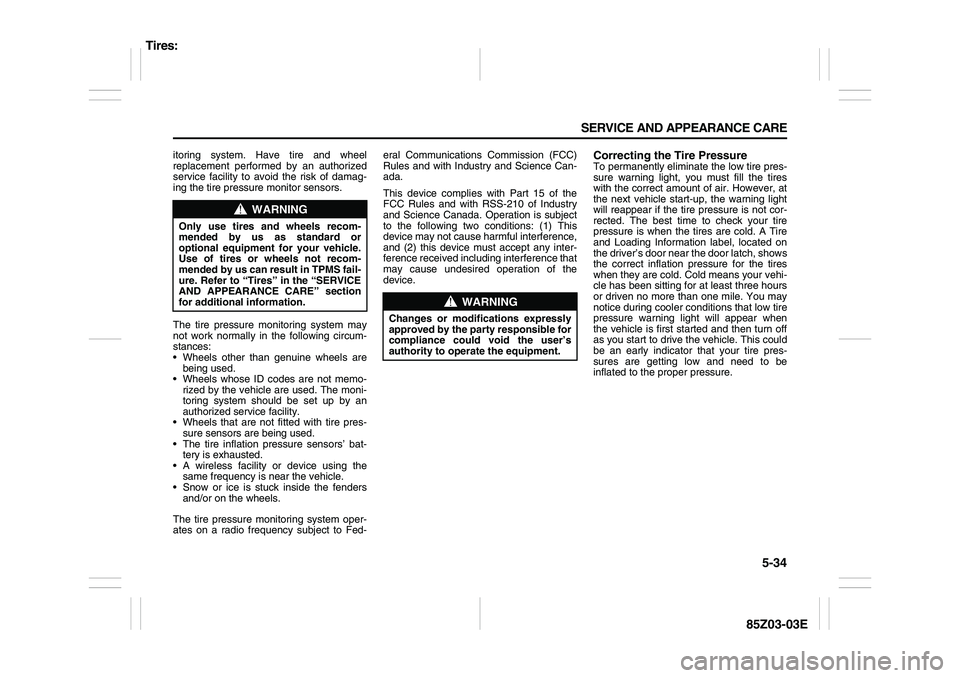
itoring system. Have tire and wheel
replacement performed by an authorized
service facility to avoid the risk of damag-
ing the tire pressure monitor sensors.
The tire pressure monitoring system may
not work normally in the following circum-
stances:
Wheels other than genuine wheels are
being used.
Wheels whose ID codes are not memo-
rized by the vehicle are used. The moni-
toring system should be set up by an
authorized service facility.
Wheels that are not fitted with tire pres-
sure sensors are being used.
The tire inflation pressure sensors’ bat-
tery is exhausted.
A wireless facility or device using the
same frequency is near the vehicle.
Snow or ice is stuck inside the fenders
and/or on the wheels.
The tire pressure monitoring system oper-
ates on a radio frequency subject to Fed-eral Communications Commission (FCC)
Rules and with Industry and Science Can-
ada.
This device complies with Part 15 of the
FCC Rules and with RSS-210 of Industry
and Science Canada. Operation is subject
to the following two conditions: (1) This
device may not cause harmful interference,
and (2) this device must accept any inter-
ference received including interference that
may cause undesired operation of the
device.
Correcting the Tire PressureTo permanently eliminate the low tire pres-
sure warning light, you must fill the tires
with the correct amount of air. However, at
the next vehicle start-up, the warning light
will reappear if the tire pressure is not cor-
rected. The best time to check your tire
pressure is when the tires are cold. A Tire
and Loading Information label, located on
the driver’s door near the door latch, shows
the correct inflation pressure for the tires
when they are cold. Cold means your vehi-
cle has been sitting for at least three hours
or driven no more than one mile. You may
notice during cooler conditions that low tire
pressure warning light will appear when
the vehicle is first started and then turn off
as you start to drive the vehicle. This could
be an early indicator that your tire pres-
sures are getting low and need to be
inflated to the proper pressure.
WARNING
Only use tires and wheels recom-
mended by us as standard or
optional equipment for your vehicle.
Use of tires or wheels not recom-
mended by us can result in TPMS fail-
ure. Refer to “Tires” in the “SERVICE
AND APPEARANCE CARE” section
for additional information.
WARNING
Changes or modifications expressly
approved by the party responsible for
compliance could void the user’s
authority to operate the equipment.
Tires:
Page 179 of 225
5-35 SERVICE AND APPEARANCE CARE
85Z03-03E
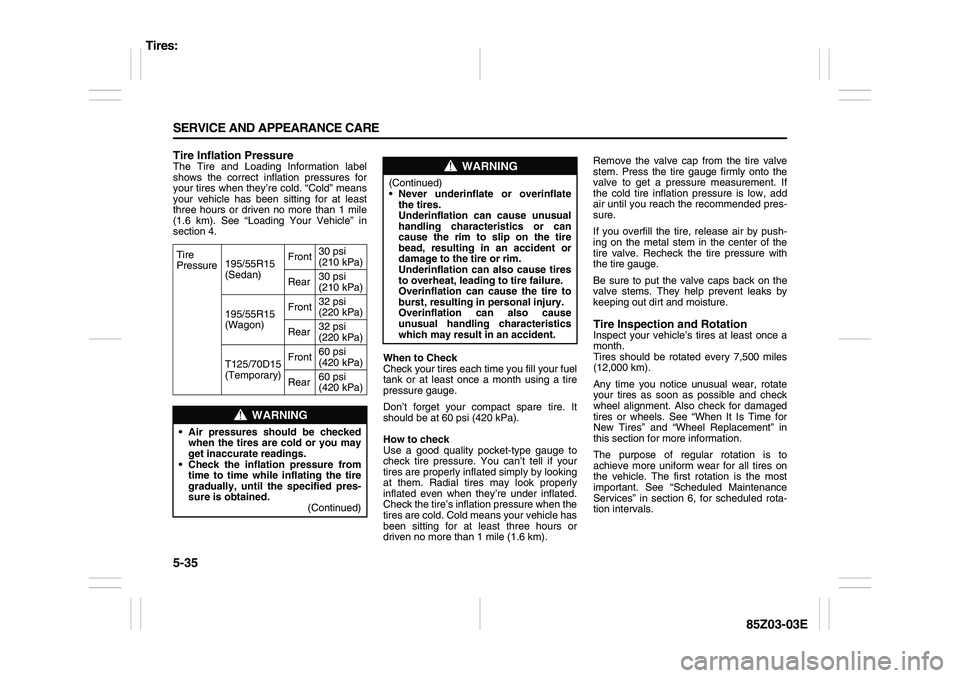
Tire Inflation PressureThe Tire and Loading Information label
shows the correct inflation pressures for
your tires when they’re cold. “Cold” means
your vehicle has been sitting for at least
three hours or driven no more than 1 mile
(1.6 km). See “Loading Your Vehicle” in
section 4.
When to Check
Check your tires each time you fill your fuel
tank or at least once a month using a tire
pressure gauge.
Don’t forget your compact spare tire. It
should be at 60 psi (420 kPa).
How to check
Use a good quality pocket-type gauge to
check tire pressure. You can’t tell if your
tires are properly inflated simply by looking
at them. Radial tires may look properly
inflated even when they’re under inflated.
Check the tire’s inflation pressure when the
tires are cold. Cold means your vehicle has
been sitting for at least three hours or
driven no more than 1 mile (1.6 km).Remove the valve cap from the tire valve
stem. Press the tire gauge firmly onto the
valve to get a pressure measurement. If
the cold tire inflation pressure is low, add
air until you reach the recommended pres-
sure.
If you overfill the tire, release air by push-
ing on the metal stem in the center of the
tire valve. Recheck the tire pressure with
the tire gauge.
Be sure to put the valve caps back on the
valve stems. They help prevent leaks by
keeping out dirt and moisture.
Tire Inspection and RotationInspect your vehicle’s tires at least once a
month.
Tires should be rotated every 7,500 miles
(12,000 km).
Any time you notice unusual wear, rotate
your tires as soon as possible and check
wheel alignment. Also check for damaged
tires or wheels. See “When It Is Time for
New Tires” and “Wheel Replacement” in
this section for more information.
The purpose of regular rotation is to
achieve more uniform wear for all tires on
the vehicle. The first rotation is the most
important. See “Scheduled Maintenance
Services” in section 6, for scheduled rota-
tion intervals. Tire
Pressure195/55R15
(Sedan)Front30 psi
(210 kPa)
Rear30 psi
(210 kPa)
195/55R15
(Wagon)Front32 psi
(220 kPa)
Rear32 psi
(220 kPa)
T125/70D15
(Temporary)Front60 psi
(420 kPa)
Rear60 psi
(420 kPa)
WARNING
Air pressures should be checked
when the tires are cold or you may
get inaccurate readings.
Check the inflation pressure from
time to time while inflating the tire
gradually, until the specified pres-
sure is obtained.
(Continued)
WARNING
(Continued)
Never underinflate or overinflate
the tires.
Underinflation can cause unusual
handling characteristics or can
cause the rim to slip on the tire
bead, resulting in an accident or
damage to the tire or rim.
Underinflation can also cause tires
to overheat, leading to tire failure.
Overinflation can cause the tire to
burst, resulting in personal injury.
Overinflation can also cause
unusual handling characteristics
which may result in an accident.
Tires: