ECU SUZUKI FORENZA 2007 User Guide
[x] Cancel search | Manufacturer: SUZUKI, Model Year: 2007, Model line: FORENZA, Model: SUZUKI FORENZA 2007Pages: 225, PDF Size: 4.39 MB
Page 34 of 225
1-22 SEATS AND RESTRAINT SYSTEMS
85Z03-03E
Once you have the top strap anchored,
you’ll be ready to secure the child restraint
itself. Tighten the top strap when and as
the child restraint manufacturer’s instruc-
tions say.Top Strap Anchor LocationTop strap anchors are already installed in
your vehicle for the three rear seating posi-
tions.
Do not use a child restraint with a top strap
in the right front passenger’s position
because there is no place to anchor the
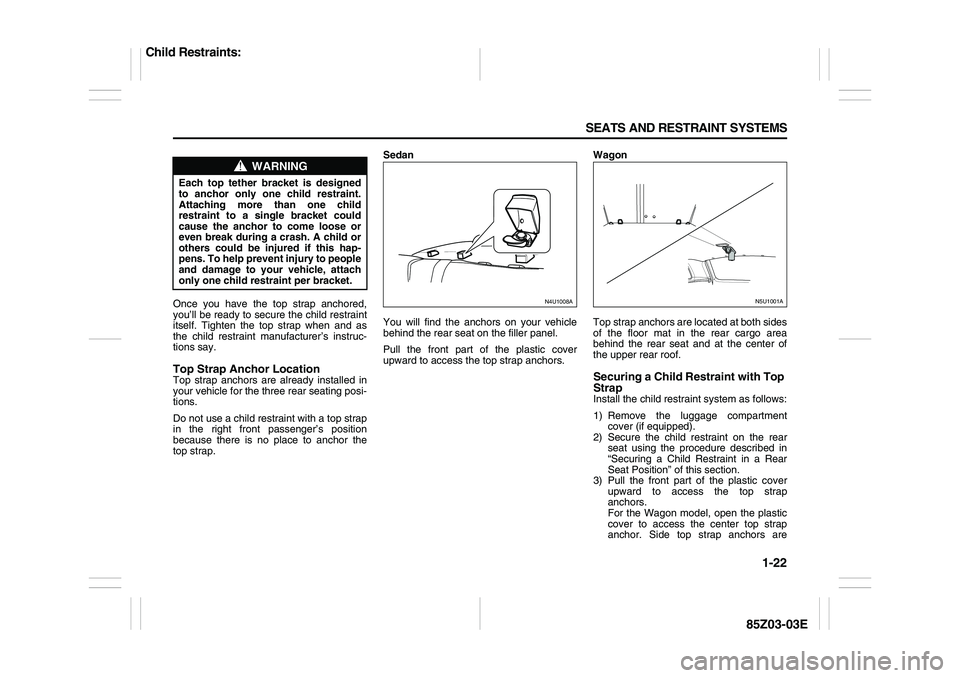
top strap.Sedan
You will find the anchors on your vehicle
behind the rear seat on the filler panel.
Pull the front part of the plastic cover
upward to access the top strap anchors.Wagon
Top strap anchors are located at both sides
of the floor mat in the rear cargo area
behind the rear seat and at the center of
the upper rear roof.
Securing a Child Restraint with Top
StrapInstall the child restraint system as follows:
1) Remove the luggage compartment
cover (if equipped).
2) Secure the child restraint on the rear
seat using the procedure described in
“Securing a Child Restraint in a Rear
Seat Position” of this section.
3) Pull the front part of the plastic cover
upward to access the top strap
anchors.
For the Wagon model, open the plastic
cover to access the center top strap
anchor. Side top strap anchors are
WARNING
Each top tether bracket is designed
to anchor only one child restraint.
Attaching more than one child
restraint to a single bracket could
cause the anchor to come loose or
even break during a crash. A child or
others could be injured if this hap-
pens. To help prevent injury to people
and damage to your vehicle, attach
only one child restraint per bracket.
N4U1008A
N5U1001A
Child Restraints:
Page 36 of 225
1-24 SEATS AND RESTRAINT SYSTEMS
85Z03-03E
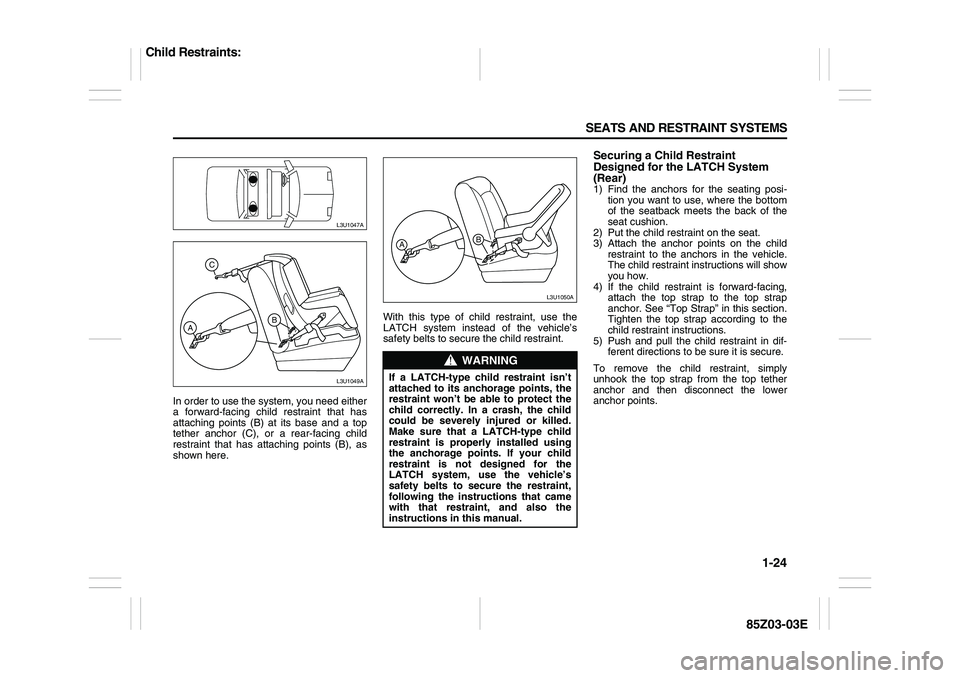
In order to use the system, you need either
a forward-facing child restraint that has
attaching points (B) at its base and a top
tether anchor (C), or a rear-facing child
restraint that has attaching points (B), as
shown here.With this type of child restraint, use the
LATCH system instead of the vehicle’s
safety belts to secure the child restraint.
Securing a Child Restraint
Designed for the LATCH System
(Rear)1) Find the anchors for the seating posi-
tion you want to use, where the bottom
of the seatback meets the back of the
seat cushion.
2) Put the child restraint on the seat.
3) Attach the anchor points on the child
restraint to the anchors in the vehicle.
The child restraint instructions will show
you how.
4) If the child restraint is forward-facing,
attach the top strap to the top strap
anchor. See “Top Strap” in this section.
Tighten the top strap according to the
child restraint instructions.
5) Push and pull the child restraint in dif-
ferent directions to be sure it is secure.
To remove the child restraint, simply
unhook the top strap from the top tether
anchor and then disconnect the lower
anchor points.
L3U1047A
AB C
L3U1049A
WARNING
If a LATCH-type child restraint isn’t
attached to its anchorage points, the
restraint won’t be able to protect the
child correctly. In a crash, the child
could be severely injured or killed.
Make sure that a LATCH-type child
restraint is properly installed using
the anchorage points. If your child
restraint is not designed for the
LATCH system, use the vehicle’s
safety belts to secure the restraint,
following the instructions that came
with that restraint, and also the
instructions in this manual.AB
L3U1050A
Child Restraints:
Page 37 of 225
1-25 SEATS AND RESTRAINT SYSTEMS
85Z03-03E
Securing a Child Restraint in a Rear
Seat PositionIf your child restraint is equipped with the
LATCH system, see “Lower Anchorages
and Top Tethers for Children (LATCH Sys-
tem)” in this section. See “Top Strap” in this
section if the child restraint has one.
If your child restraint does not have the
LATCH system, you will be using the lap-
shoulder belt to secure the child restraint in
this position. Be sure to follow the instruc-
tions that came with the child restraint.
Secure the child in the child restraint when
and as the instructions say.
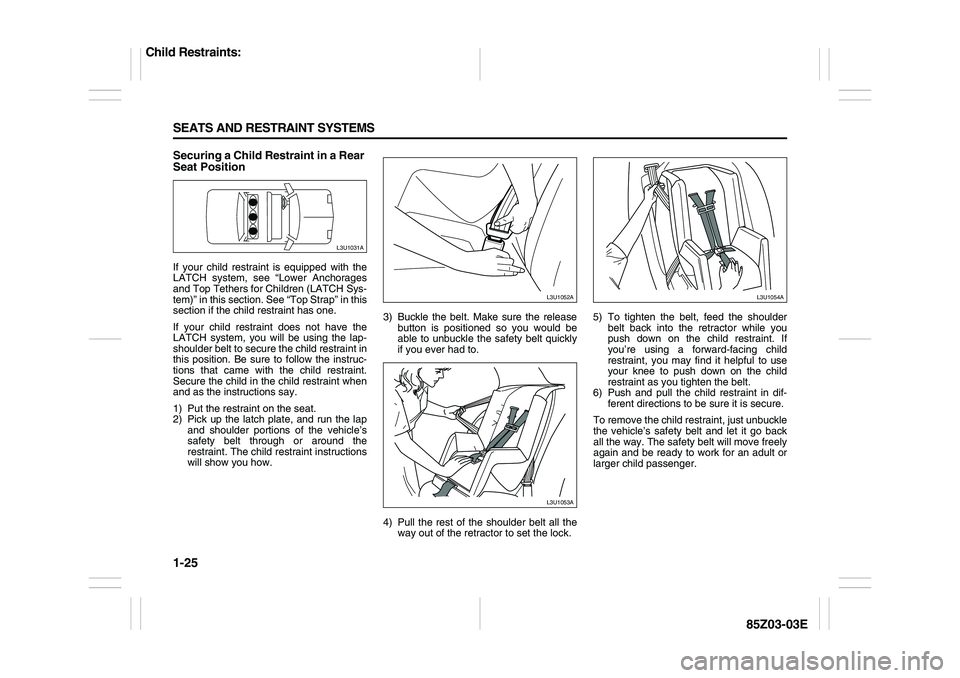
1) Put the restraint on the seat.
2) Pick up the latch plate, and run the lap
and shoulder portions of the vehicle’s
safety belt through or around the
restraint. The child restraint instructions
will show you how. 3) Buckle the belt. Make sure the release
button is positioned so you would be
able to unbuckle the safety belt quickly
if you ever had to.
4) Pull the rest of the shoulder belt all the
way out of the retractor to set the lock.5) To tighten the belt, feed the shoulder
belt back into the retractor while you
push down on the child restraint. If
you’re using a forward-facing child
restraint, you may find it helpful to use
your knee to push down on the child
restraint as you tighten the belt.
6) Push and pull the child restraint in dif-
ferent directions to be sure it is secure.
To remove the child restraint, just unbuckle
the vehicle’s safety belt and let it go back
all the way. The safety belt will move freely
again and be ready to work for an adult or
larger child passenger.
L3U1031A
L3U1052AL3U1053A
L3U1054A
Child Restraints:
Page 38 of 225
1-26 SEATS AND RESTRAINT SYSTEMS
85Z03-03E
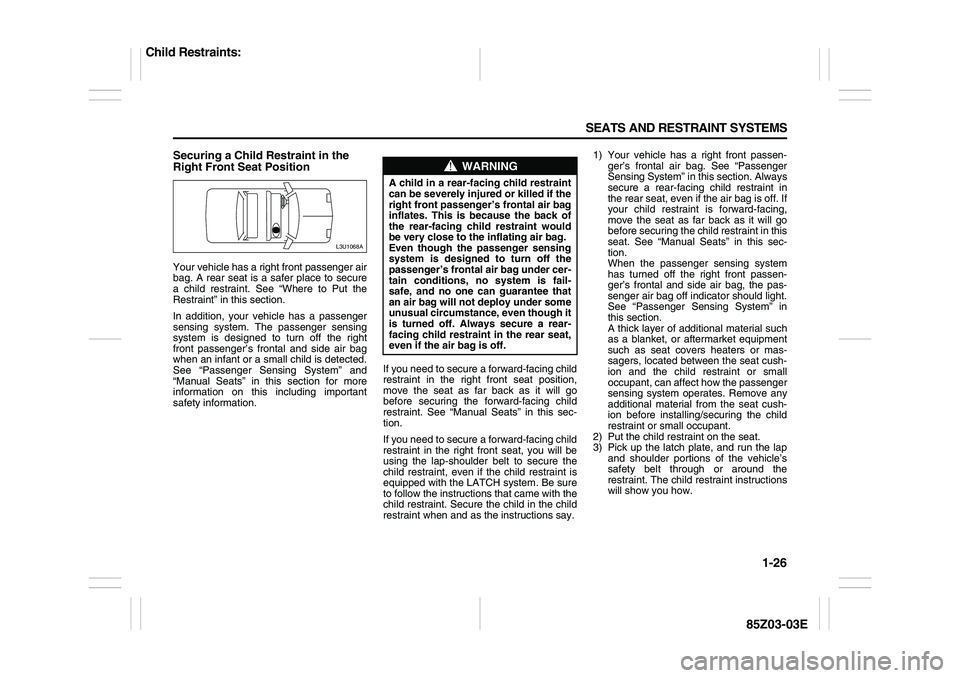
Securing a Child Restraint in the
Right Front Seat PositionYour vehicle has a right front passenger air
bag. A rear seat is a safer place to secure
a child restraint. See “Where to Put the
Restraint” in this section.
In addition, your vehicle has a passenger
sensing system. The passenger sensing
system is designed to turn off the right
front passenger’s frontal and side air bag
when an infant or a small child is detected.
See “Passenger Sensing System” and
“Manual Seats” in this section for more
information on this including important
safety information.If you need to secure a forward-facing child
restraint in the right front seat position,
move the seat as far back as it will go
before securing the forward-facing child
restraint. See “Manual Seats” in this sec-
tion.
If you need to secure a forward-facing child
restraint in the right front seat, you will be
using the lap-shoulder belt to secure the
child restraint, even if the child restraint is
equipped with the LATCH system. Be sure
to follow the instructions that came with the
child restraint. Secure the child in the child
restraint when and as the instructions say.1) Your vehicle has a right front passen-
ger’s frontal air bag. See “Passenger
Sensing System” in this section. Always
secure a rear-facing child restraint in
the rear seat, even if the air bag is off. If
your child restraint is forward-facing,
move the seat as far back as it will go
before securing the child restraint in this
seat. See “Manual Seats” in this sec-
tion.
When the passenger sensing system
has turned off the right front passen-
ger’s frontal and side air bag, the pas-
senger air bag off indicator should light.
See “Passenger Sensing System” in
this section.
A thick layer of additional material such
as a blanket, or aftermarket equipment
such as seat covers heaters or mas-
sagers, located between the seat cush-
ion and the child restraint or small
occupant, can affect how the passenger
sensing system operates. Remove any
additional material from the seat cush-
ion before installing/securing the child
restraint or small occupant.
2) Put the child restraint on the seat.
3) Pick up the latch plate, and run the lap
and shoulder portions of the vehicle’s
safety belt through or around the
restraint. The child restraint instructions
will show you how.
L3U1068A
WARNING
A child in a rear-facing child restraint
can be severely injured or killed if the
right front passenger’s frontal air bag
inflates. This is because the back of
the rear-facing child restraint would
be very close to the inflating air bag.
Even though the passenger sensing
system is designed to turn off the
passenger’s frontal air bag under cer-
tain conditions, no system is fail-
safe, and no one can guarantee that
an air bag will not deploy under some
unusual circumstance, even though it
is turned off. Always secure a rear-
facing child restraint in the rear seat,
even if the air bag is off.
Child Restraints:
Page 39 of 225
1-27 SEATS AND RESTRAINT SYSTEMS
85Z03-03E
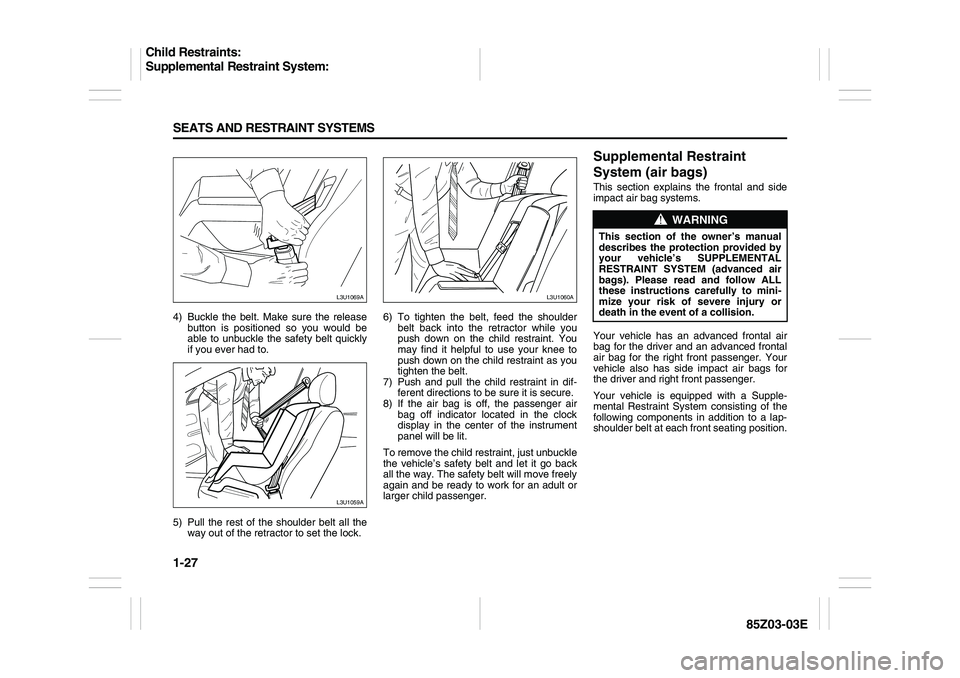
4) Buckle the belt. Make sure the release
button is positioned so you would be
able to unbuckle the safety belt quickly
if you ever had to.
5) Pull the rest of the shoulder belt all the
way out of the retractor to set the lock.6) To tighten the belt, feed the shoulder
belt back into the retractor while you
push down on the child restraint. You
may find it helpful to use your knee to
push down on the child restraint as you
tighten the belt.
7) Push and pull the child restraint in dif-
ferent directions to be sure it is secure.
8) If the air bag is off, the passenger air
bag off indicator located in the clock
display in the center of the instrument
panel will be lit.
To remove the child restraint, just unbuckle
the vehicle’s safety belt and let it go back
all the way. The safety belt will move freely
again and be ready to work for an adult or
larger child passenger.
Supplemental Restraint
System (air bags)This section explains the frontal and side
impact air bag systems.
Your vehicle has an advanced frontal air
bag for the driver and an advanced frontal
air bag for the right front passenger. Your
vehicle also has side impact air bags for
the driver and right front passenger.
Your vehicle is equipped with a Supple-
mental Restraint System consisting of the
following components in addition to a lap-
shoulder belt at each front seating position.
L3U1069AL3U1059A
L3U1061AL3U1060A
WARNING
This section of the owner’s manual
describes the protection provided by
your vehicle’s SUPPLEMENTAL
RESTRAINT SYSTEM (advanced air
bags). Please read and follow ALL
these instructions carefully to mini-
mize your risk of severe injury or
death in the event of a collision.
Child Restraints:
Supplemental Restraint System:
Page 41 of 225
1-29 SEATS AND RESTRAINT SYSTEMS
85Z03-03E
these air bags must inflate very quickly to
do their job. Here are the most important
things to know about the air bag systems.
WARNING
You can be severely injured or killed
in a crash if you aren’t wearing your
safety belt – even if you have air
bags. Wearing your safety belt during
a crash helps reduce your chance of
hitting things inside the vehicle or
being ejected from it. Air bags are
designed to work with safety belts
but don’t replace them.
Frontal air bags for the driver and
right front passenger are designed to
deploy only in moderate to severe
frontal and near frontal crashes. They
aren’t designed to inflate at all in roll-
over, rear or low-speed frontal
crashes, or in many side crashes.
And, for some unrestrained occu-
pants, frontal air bags may provide
less protection in frontal crashes
than more forceful air bags have pro-
vided in the past.
(Continued)
WARNING
(Continued)
The side impact air bags are
designed to inflate only in moderate
to severe crashes where something
hits the side of your vehicle. They
aren’t designed to inflate in frontal, in
rollover or in rear crashes.
Everyone in your vehicle should wear
a safety belt properly – whether or
not there’s an air bag for that person.
WARNING
Air bags inflate with great force,
faster than the blink of an eye. If
you’re too close to an inflating air
bag, as you would be if you were
leaning forward, it could severely
injure you. Safety belts help keep you
in position for air bag inflation before
and during a crash. Always wear your
safety belt, even with frontal air bags.
The driver should sit as far back as
possible while still maintaining con-
trol of the vehicle. Front occupants
should not lean on or sleep against
the door.
WARNING
Do not attach any objects to, or place
any objects over, the steering wheel
or dashboard. Do not place any
objects between the air bag and the
driver or front passenger. These
objects may interfere with air bag
operation or may be propelled by the
air bag in the event of a crash. Either
of these conditions may cause
severe injury.
WARNING
Anyone who is up against, or very
close to, any air bag when it inflates
can be severely injured or killed. Air
bags plus lap-shoulder belts offer the
best protection for adults, but not for
young children and infants. Neither
the vehicle’s safety belt system nor
its air bag system is designed for
them. Young children and infants
need the protection that a child
restraint system can provide. Always
secure children properly in your vehi-
cle. To read how, see the part of this
manual called “Older Children” or
“Infants and Young Children.”
Supplemental Restraint System:
Page 43 of 225
1-31 SEATS AND RESTRAINT SYSTEMS
85Z03-03E
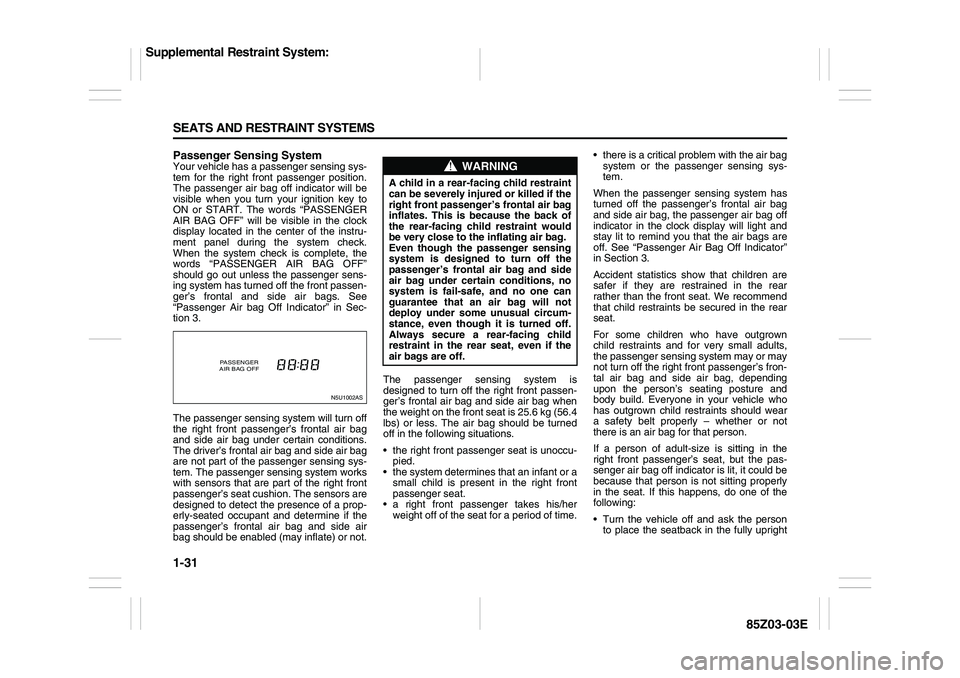
Passenger Sensing SystemYour vehicle has a passenger sensing sys-
tem for the right front passenger position.
The passenger air bag off indicator will be
visible when you turn your ignition key to
ON or START. The words “PASSENGER
AIR BAG OFF” will be visible in the clock
display located in the center of the instru-
ment panel during the system check.
When the system check is complete, the
words “PASSENGER AIR BAG OFF”
should go out unless the passenger sens-
ing system has turned off the front passen-
ger’s frontal and side air bags. See
“Passenger Air bag Off Indicator” in Sec-
tion 3.
The passenger sensing system will turn off
the right front passenger’s frontal air bag
and side air bag under certain conditions.
The driver’s frontal air bag and side air bag
are not part of the passenger sensing sys-
tem. The passenger sensing system works
with sensors that are part of the right front
passenger’s seat cushion. The sensors are
designed to detect the presence of a prop-
erly-seated occupant and determine if the
passenger’s frontal air bag and side air
bag should be enabled (may inflate) or not.The passenger sensing system is
designed to turn off the right front passen-
ger’s frontal air bag and side air bag when
the weight on the front seat is 25.6 kg (56.4
lbs) or less. The air bag should be turned
off in the following situations.
the right front passenger seat is unoccu-
pied.
the system determines that an infant or a
small child is present in the right front
passenger seat.
a right front passenger takes his/her
weight off of the seat for a period of time. there is a critical problem with the air bag
system or the passenger sensing sys-
tem.
When the passenger sensing system has
turned off the passenger’s frontal air bag
and side air bag, the passenger air bag off
indicator in the clock display will light and
stay lit to remind you that the air bags are
off. See “Passenger Air Bag Off Indicator”
in Section 3.
Accident statistics show that children are
safer if they are restrained in the rear
rather than the front seat. We recommend
that child restraints be secured in the rear
seat.
For some children who have outgrown
child restraints and for very small adults,
the passenger sensing system may or may
not turn off the right front passenger’s fron-
tal air bag and side air bag, depending
upon the person’s seating posture and
body build. Everyone in your vehicle who
has outgrown child restraints should wear
a safety belt properly – whether or not
there is an air bag for that person.
If a person of adult-size is sitting in the
right front passenger’s seat, but the pas-
senger air bag off indicator is lit, it could be
because that person is not sitting properly
in the seat. If this happens, do one of the
following:
Turn the vehicle off and ask the person
to place the seatback in the fully upright
N5U1002AS
PASSENGER
AIR BAG OFF
WARNING
A child in a rear-facing child restraint
can be severely injured or killed if the
right front passenger’s frontal air bag
inflates. This is because the back of
the rear-facing child restraint would
be very close to the inflating air bag.
Even though the passenger sensing
system is designed to turn off the
passenger’s frontal air bag and side
air bag under certain conditions, no
system is fail-safe, and no one can
guarantee that an air bag will not
deploy under some unusual circum-
stance, even though it is turned off.
Always secure a rear-facing child
restraint in the rear seat, even if the
air bags are off.
Supplemental Restraint System:
Page 49 of 225
2-1 FEATURES AND CONTROLS
85Z03-03E
Keys
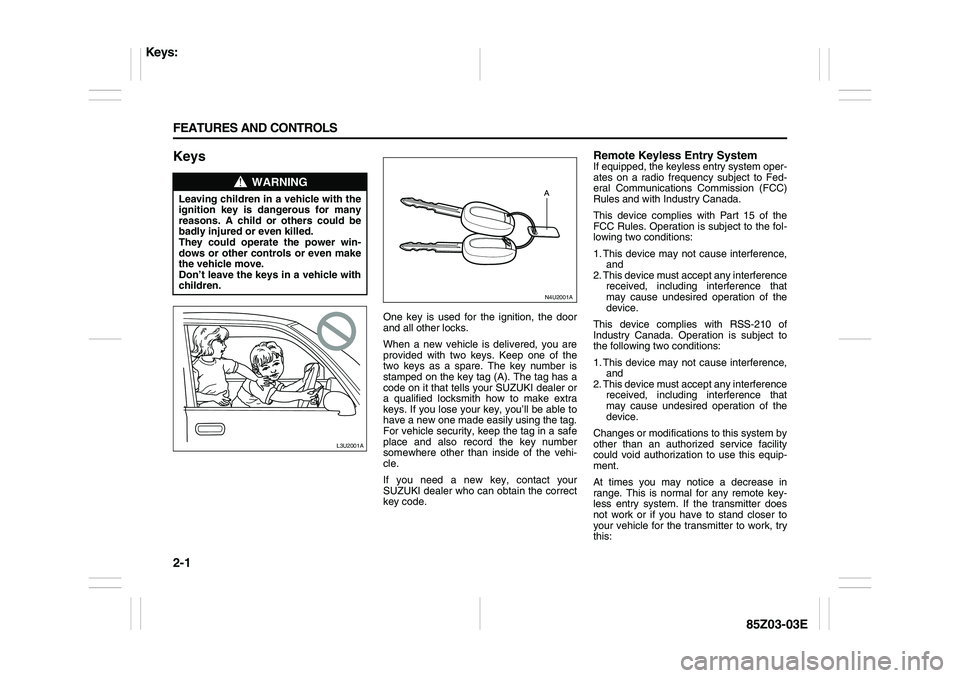
One key is used for the ignition, the door
and all other locks.
When a new vehicle is delivered, you are
provided with two keys. Keep one of the
two keys as a spare. The key number is
stamped on the key tag (A). The tag has a
code on it that tells your SUZUKI dealer or
a qualified locksmith how to make extra
keys. If you lose your key, you’ll be able to
have a new one made easily using the tag.
For vehicle security, keep the tag in a safe
place and also record the key number
somewhere other than inside of the vehi-
cle.
If you need a new key, contact your
SUZUKI dealer who can obtain the correct
key code.
Remote Keyless Entry SystemIf equipped, the keyless entry system oper-
ates on a radio frequency subject to Fed-
eral Communications Commission (FCC)
Rules and with Industry Canada.
This device complies with Part 15 of the
FCC Rules. Operation is subject to the fol-
lowing two conditions:
1. This device may not cause interference,
and
2. This device must accept any interference
received, including interference that
may cause undesired operation of the
device.
This device complies with RSS-210 of
Industry Canada. Operation is subject to
the following two conditions:
1. This device may not cause interference,
and
2. This device must accept any interference
received, including interference that
may cause undesired operation of the
device.
Changes or modifications to this system by
other than an authorized service facility
could void authorization to use this equip-
ment.
At times you may notice a decrease in
range. This is normal for any remote key-
less entry system. If the transmitter does
not work or if you have to stand closer to
your vehicle for the transmitter to work, try
this:
WARNING
Leaving children in a vehicle with the
ignition key is dangerous for many
reasons. A child or others could be
badly injured or even killed.
They could operate the power win-
dows or other controls or even make
the vehicle move.
Don’t leave the keys in a vehicle with
children.
L3U2001A
N4U2001A
Keys:
Page 50 of 225
2-2 FEATURES AND CONTROLS
85Z03-03E
Check the distance. You may be too far
from your vehicle. You may need to
stand closer during rainy or snowy
weather.
Check the location. Other vehicles or
objects may be blocking the signal. Take
a few steps to the left or right, hold the
transmitter higher, and try again.
Check to determine if battery replace-
ment is necessary. See “Battery
Replacement” under Remote Keyless
Entry System Operation in this section.
If you are still having trouble, see your
SUZUKI dealer or a qualified technician
for service.
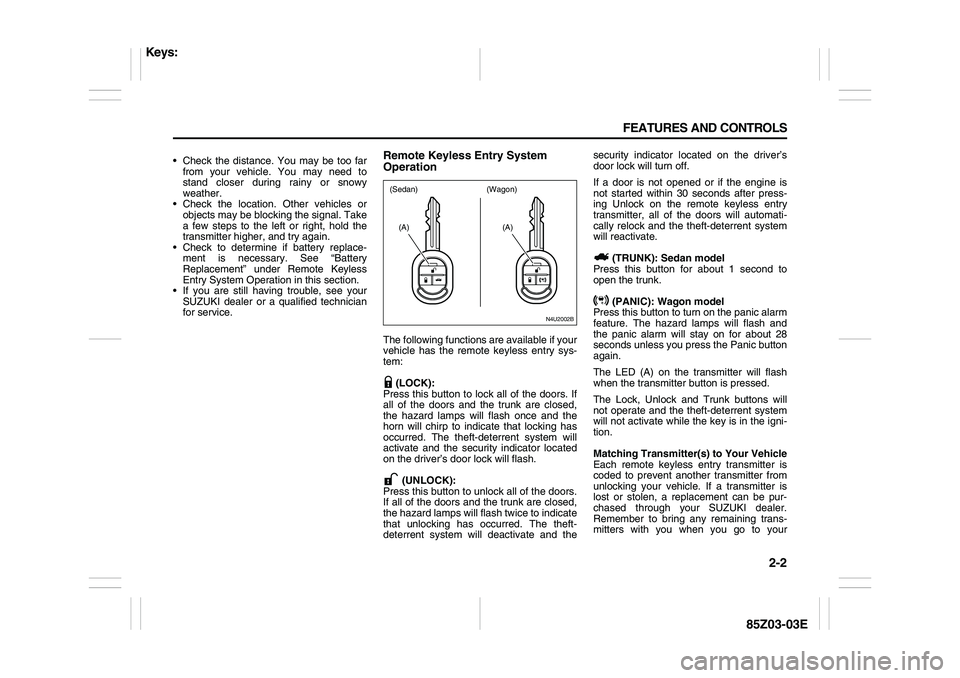
Remote Keyless Entry System
OperationThe following functions are available if your
vehicle has the remote keyless entry sys-
tem:
(LOCK):
Press this button to lock all of the doors. If
all of the doors and the trunk are closed,
the hazard lamps will flash once and the
horn will chirp to indicate that locking has
occurred. The theft-deterrent system will
activate and the security indicator located
on the driver’s door lock will flash.
(UNLOCK):
Press this button to unlock all of the doors.
If all of the doors and the trunk are closed,
the hazard lamps will flash twice to indicate
that unlocking has occurred. The theft-
deterrent system will deactivate and thesecurity indicator located on the driver’s
door lock will turn off.
If a door is not opened or if the engine is
not started within 30 seconds after press-
ing Unlock on the remote keyless entry
transmitter, all of the doors will automati-
cally relock and the theft-deterrent system
will reactivate.
(TRUNK): Sedan model
Press this button for about 1 second to
open the trunk.
(PANIC): Wagon model
Press this button to turn on the panic alarm
feature. The hazard lamps will flash and
the panic alarm will stay on for about 28
seconds unless you press the Panic button
again.
The LED (A) on the transmitter will flash
when the transmitter button is pressed.
The Lock, Unlock and Trunk buttons will
not operate and the theft-deterrent system
will not activate while the key is in the igni-
tion.
Matching Transmitter(s) to Your Vehicle
Each remote keyless entry transmitter is
coded to prevent another transmitter from
unlocking your vehicle. If a transmitter is
lost or stolen, a replacement can be pur-
chased through your SUZUKI dealer.
Remember to bring any remaining trans-
mitters with you when you go to your
N4U2002B
(A)
(A)
(Sedan) (Wagon)
Keys:
Page 52 of 225
2-4 FEATURES AND CONTROLS
85Z03-03E
Doors and LocksDoor LocksThere are several ways to lock and unlock
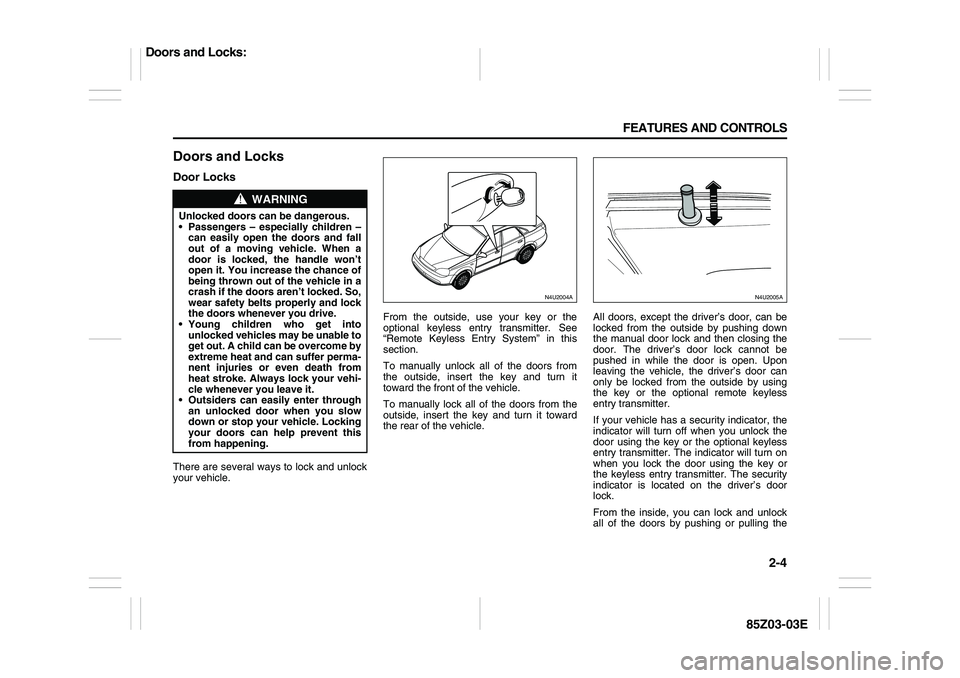
your vehicle.From the outside, use your key or the
optional keyless entry transmitter. See
“Remote Keyless Entry System” in this
section.
To manually unlock all of the doors from
the outside, insert the key and turn it
toward the front of the vehicle.
To manually lock all of the doors from the
outside, insert the key and turn it toward
the rear of the vehicle.All doors, except the driver’s door, can be
locked from the outside by pushing down
the manual door lock and then closing the
door. The driver’s door lock cannot be
pushed in while the door is open. Upon
leaving the vehicle, the driver’s door can
only be locked from the outside by using
the key or the optional remote keyless
entry transmitter.
If your vehicle has a security indicator, the
indicator will turn off when you unlock the
door using the key or the optional keyless
entry transmitter. The indicator will turn on
when you lock the door using the key or
the keyless entry transmitter. The security
indicator is located on the driver’s door
lock.
From the inside, you can lock and unlock
all of the doors by pushing or pulling the
WARNING
Unlocked doors can be dangerous.
Passengers – especially children –
can easily open the doors and fall
out of a moving vehicle. When a
door is locked, the handle won’t
open it. You increase the chance of
being thrown out of the vehicle in a
crash if the doors aren’t locked. So,
wear safety belts properly and lock
the doors whenever you drive.
Young children who get into
unlocked vehicles may be unable to
get out. A child can be overcome by
extreme heat and can suffer perma-
nent injuries or even death from
heat stroke. Always lock your vehi-
cle whenever you leave it.
Outsiders can easily enter through
an unlocked door when you slow
down or stop your vehicle. Locking
your doors can help prevent this
from happening.
N4U2004A
N4U2005A
Doors and Locks: