brake fluid SUZUKI FORENZA 2007 User Guide
[x] Cancel search | Manufacturer: SUZUKI, Model Year: 2007, Model line: FORENZA, Model: SUZUKI FORENZA 2007Pages: 225, PDF Size: 4.39 MB
Page 162 of 225
5-18 SERVICE AND APPEARANCE CARE
85Z03-03E
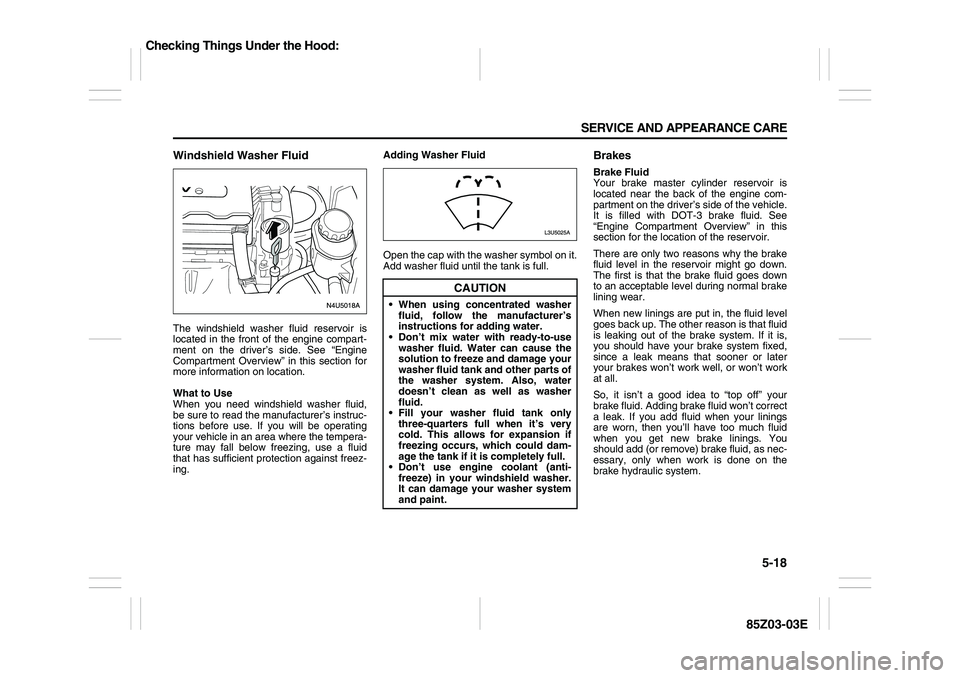
Windshield Washer FluidThe windshield washer fluid reservoir is
located in the front of the engine compart-
ment on the driver’s side. See “Engine
Compartment Overview” in this section for
more information on location.
What to Use
When you need windshield washer fluid,
be sure to read the manufacturer’s instruc-
tions before use. If you will be operating
your vehicle in an area where the tempera-
ture may fall below freezing, use a fluid
that has sufficient protection against freez-
ing.Adding Washer Fluid
Open the cap with the washer symbol on it.
Add washer fluid until the tank is full.
BrakesBrake Fluid
Your brake master cylinder reservoir is
located near the back of the engine com-
partment on the driver’s side of the vehicle.
It is filled with DOT-3 brake fluid. See
“Engine Compartment Overview” in this
section for the location of the reservoir.
There are only two reasons why the brake
fluid level in the reservoir might go down.
The first is that the brake fluid goes down
to an acceptable level during normal brake
lining wear.
When new linings are put in, the fluid level
goes back up. The other reason is that fluid
is leaking out of the brake system. If it is,
you should have your brake system fixed,
since a leak means that sooner or later
your brakes won’t work well, or won’t work
at all.
So, it isn’t a good idea to “top off” your
brake fluid. Adding brake fluid won’t correct
a leak. If you add fluid when your linings
are worn, then you’ll have too much fluid
when you get new brake linings. You
should add (or remove) brake fluid, as nec-
essary, only when work is done on the
brake hydraulic system.
CAUTION
When using concentrated washer
fluid, follow the manufacturer’s
instructions for adding water.
Don’t mix water with ready-to-use
washer fluid. Water can cause the
solution to freeze and damage your
washer fluid tank and other parts of
the washer system. Also, water
doesn’t clean as well as washer
fluid.
Fill your washer fluid tank only
three-quarters full when it’s very
cold. This allows for expansion if
freezing occurs, which could dam-
age the tank if it is completely full.
Don’t use engine coolant (anti-
freeze) in your windshield washer.
It can damage your washer system
and paint.
Checking Things Under the Hood:
Page 163 of 225
5-19 SERVICE AND APPEARANCE CARE
85Z03-03E
When your brake fluid falls to a low level,
your brake warning light will come on. See
“Brake System Warning Light” in section 3.
What to Add
When you do need brake fluid, use only
DOT-3 brake fluid. Use new brake fluid
from a sealed container only. See “Recom-
mended Fluids and Lubricants” in section
6.
Always clean the brake fluid reservoir cap
and the area around the cap before remov-
ing it. This will help keep dirt from entering
the reservoir.Brake Wear
Your vehicle has front and rear disc brakes.
Disc brake pads have built-in wear indica-
tors that make a high-pitched warning
sound when the brake pads are worn and
new pads are needed. The sound may
come and go or be heard all the time your
vehicle is moving (except when you are
pushing on the brake pedal firmly).Some driving conditions or climates may
cause a brake squeal when the brakes are
first applied or lightly applied. This does
not mean something is wrong with your
brakes.
Properly torqued wheel nuts are necessary
to help prevent brake pulsation. When tires
are rotated, inspect brake pads for wear
and evenly tighten wheel nuts in the proper
sequence to SUZUKI torque specifica-
tions.
Brake linings should always be replaced as
complete axle sets.
See “Brake System Inspection” in section
6.
WARNING
If you have too much brake fluid, it
can spill on the engine. The fluid will
burn if the engine is hot enough. You
or others could be burned, and your
vehicle could be damaged.
WARNING
With the wrong kind of fluid in your
brake system, your brakes may not
work well, or they may not even work
at all. This could cause a crash.
Always use the proper brake fluid.
CAUTION
Using the wrong fluid can badly
damage brake system parts. For
example, just a few drops of min-
eral-based oil, such as engine oil,
in your brake system can damage
brake system parts so badly that
they’ll have to be replaced. Don’t let
someone put in the wrong kind of
fluid.
If you spill brake fluid on your vehi-
cle’s painted surfaces, the paint fin-
ish can be damaged. Be careful not
to spill brake fluid on your vehicle.
If you do, wash it off immediately.
See “Appearance Care” in the
Index.
WARNING
The brake wear warning sound
means that soon your brakes won’t
work well. That could lead to an acci-
dent. When you hear the brake wear
warning sound, have your vehicle
serviced.
CAUTION
Continuing to drive with worn-out
brake pads could result in costly
brake repair.
Checking Things Under the Hood:
Page 165 of 225
5-21 SERVICE AND APPEARANCE CARE
85Z03-03E
2) Get the vehicles close enough so the
jumper cables can reach, but be sure
the vehicles aren’t touching each other.
If they are, it could cause a ground con-
nection you don’t want. You wouldn’t be
able to start your vehicle, and the bad
grounding could damage the electrical
systems.
To avoid the possibility of the vehicles
rolling, set the parking brake firmly on
both vehicles involved in the jump start
procedure. Put an automatic transmis-
sion in PARK (P) or a manual transmis-
sion in NEUTRAL before setting the
parking brake.3) Turn off the ignition on both vehicles.
Unplug unnecessary accessories
plugged into the cigarette lighter or in
the accessory power outlet. Turn off the
radio and all lamps that aren’t needed.
This will avoid sparks and help save
both batteries. And it could save your
radio!
4) Open the hoods and locate the batter-
ies. Find the positive (+) and negative
(–) terminal locations on each vehicle.
Your vehicle’s positive (+) terminal is
located under a red tethered cap on the
battery. The negative (–) terminal is
located under a black tethered cap on
the battery. See “Engine Compartment
Overview” in this section for more infor-
mation on location. Flip the caps up to
access the positive (+) and negative (–)
terminals.
5) Check that the jumper cables don’t
have loose or missing insulation. If they
do, you could get a shock. The vehicles
could be damaged, too.
Before you connect the cables, here are
some basic things you should know.
Positive (+) will go to positive (+) or to a
remote positive (+) terminal if the vehi-
cle has one. Negative (–) will go to a
heavy, unpainted metal engine part or
to a remote negative (–) terminal if the
vehicle with the dead battery has one.
Don’t connect positive (+) to negative
(–) or you’ll get a short that would dam-
CAUTION
If the other system isn’t a 12-volt sys-
tem with a negative ground, both
vehicles can be damaged. Only use
vehicles with 12-volt systems with
negative grounds to jump start your
vehicle.
CAUTION
If you leave your radio or other acces-
sories on during the jump starting
procedure, they could be damaged.
The repairs wouldn’t be covered by
your warranty. Always turn off your
radio and other accessories when
jump starting your vehicle.
WARNING
An electric fan under the hood can
start up and injure you even when the
engine is not running. Keep hands,
clothing and tools away from any
underhood electric fan.
WARNING
Using a match near a battery can
cause battery gas to explode. People
have been hurt doing this, and some
have been blinded. Use a flashlight if
you need more light.
Be sure the battery has enough
water. You don’t need to add water to
the battery installed in your new vehi-
cle. But if a battery has filler caps, be
sure the right amount of fluid is
there. If it is low, add water to take
care of that first. If you don’t, explo-
sive gas could be present.
Battery fluid contains acid that can
burn you. Don’t get it on you. If you
accidentally get it in your eyes or on
your skin, flush the place with water
and get medical help immediately.
Checking Things Under the Hood:
Page 198 of 225
5-54 SERVICE AND APPEARANCE CARE
85Z03-03E
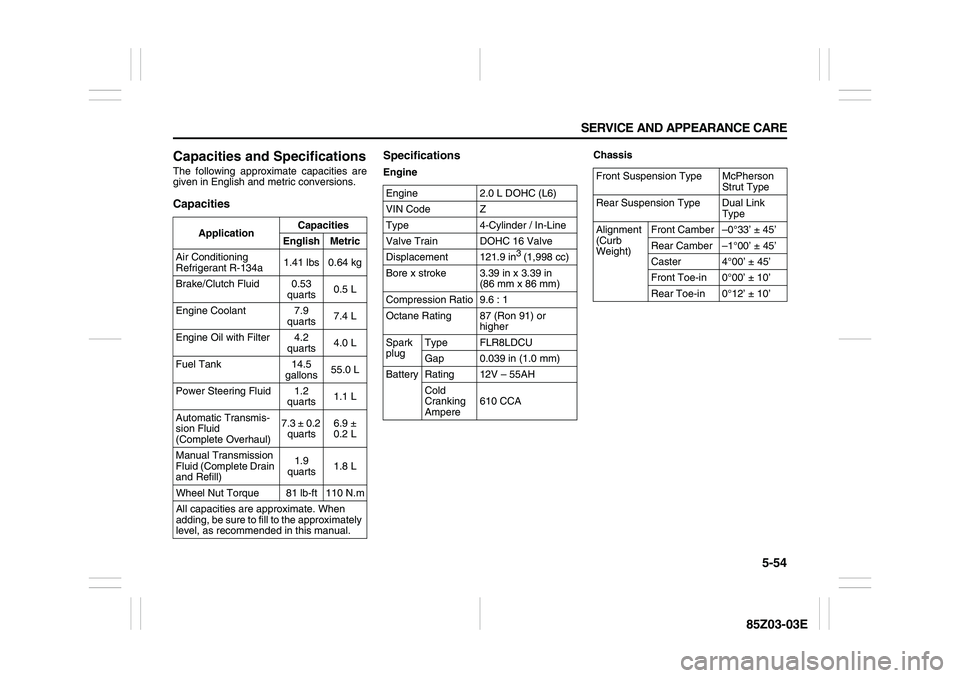
Capacities and SpecificationsThe following approximate capacities are
given in English and metric conversions. CapacitiesSpecifications
EngineChassis
ApplicationCapacities
English Metric
Air Conditioning
Refrigerant R-134a1.41 lbs 0.64 kg
Brake/Clutch Fluid 0.53
quarts0.5 L
Engine Coolant 7.9
quarts7.4 L
Engine Oil with Filter 4.2
quarts4.0 L
Fuel Tank 14.5
gallons55.0 L
Power Steering Fluid 1.2
quarts1.1 L
Automatic Transmis-
sion Fluid
(Complete Overhaul)7.3 ± 0.2
quarts6.9 ±
0.2 L
Manual Transmission
Fluid (Complete Drain
and Refill)1.9
quarts1.8 L
Wheel Nut Torque 81 lb-ft 110 N.m
All capacities are approximate. When
adding, be sure to fill to the approximately
level, as recommended in this manual. Engine 2.0 L DOHC (L6)
VIN Code Z
Type 4-Cylinder / In-Line
Valve Train DOHC 16 Valve
Displacement 121.9 in
3 (1,998 cc)
Bore x stroke 3.39 in x 3.39 in
(86 mm x 86 mm)
Compression Ratio 9.6 : 1
Octane Rating 87 (Ron 91) or
higher
Spark
plugType FLR8LDCU
Gap 0.039 in (1.0 mm)
Battery Rating 12V – 55AH
Cold
Cranking
Ampere610 CCA
Front Suspension Type McPherson
Strut Type
Rear Suspension Type Dual Link
Type
Alignment
(Curb
Weight)Front Camber –0°33’ ± 45’
Rear Camber –1°00’ ± 45’
Caster 4°00’ ± 45’
Front Toe-in 0°00’ ± 10’
Rear Toe-in 0°12’ ± 10’
Page 204 of 225
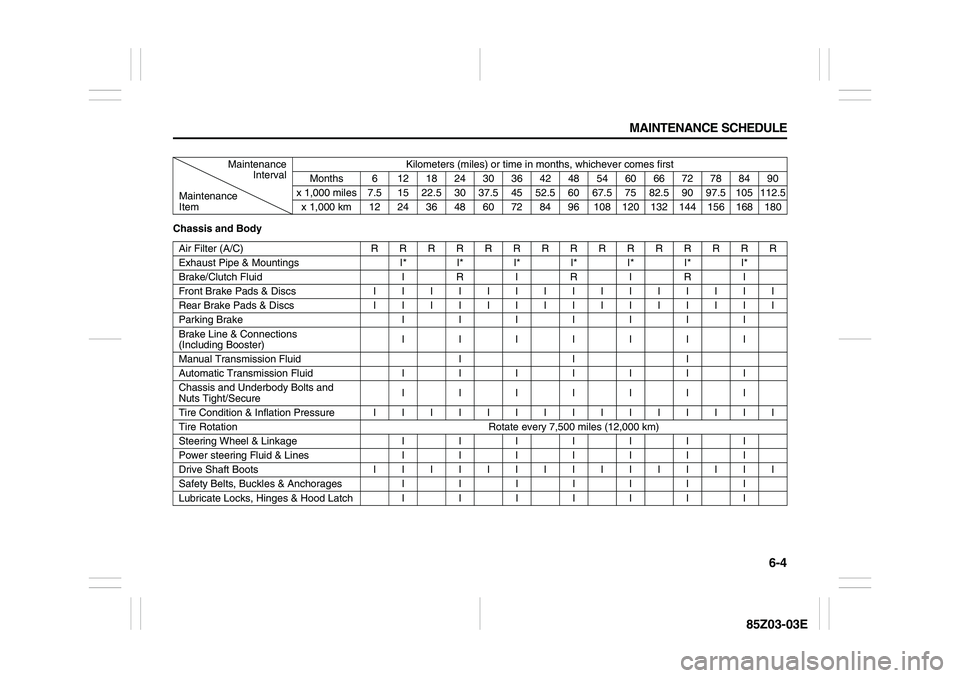
6-4 MAINTENANCE SCHEDULE
85Z03-03E
Chassis and BodyMaintenance
IntervalKilometers (miles) or time in months, whichever comes first
Months 6 1218243036424854606672788490
Maintenance
Itemx 1,000 miles 7.5 15 22.5 30 37.5 45 52.5 60 67.5 75 82.5 90 97.5 105 112.5
x 1,000 km 12 24 36 48 60 72 84 96 108 120 132 144 156 168 180
Air Filter (A/C) RRRRRRRRRRRRRRR
Exhaust Pipe & Mountings I* I* I* I* I* I* I*
Brake/Clutch Fluid I R I R I R I
Front Brake Pads & Discs IIIIIIIIIIIIIII
Rear Brake Pads & Discs IIIIIIIIIIIIIII
Parking Brake IIIIIII
Brake Line & Connections
(Including Booster)IIIIIII
Manual Transmission Fluid I I I
Automatic Transmission Fluid IIIIIII
Chassis and Underbody Bolts and
Nuts Tight/SecureIIIIIII
Tire Condition & Inflation Pressure IIIIIIIIIIIIIII
Tire Rotation Rotate every 7,500 miles (12,000 km)
Steering Wheel & Linkage I I I I I I I
Power steering Fluid & Lines I I I I I I I
Drive Shaft Boots IIIIIIIIIIIIIII
Safety Belts, Buckles & Anchorages I I I I I I I
Lubricate Locks, Hinges & Hood Latch I I I I I I I
Page 205 of 225
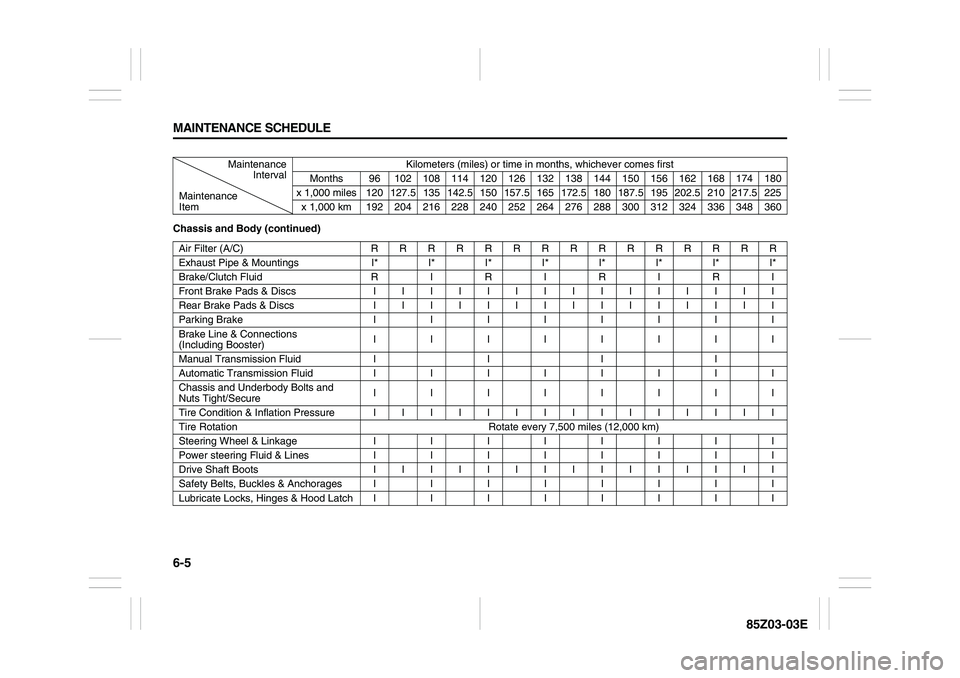
6-5 MAINTENANCE SCHEDULE
85Z03-03E
Chassis and Body (continued)Maintenance
IntervalKilometers (miles) or time in months, whichever comes first
Months 96 102 108 114 120 126 132 138 144 150 156 162 168 174 180
Maintenance
Itemx 1,000 miles 120 127.5 135 142.5 150 157.5 165 172.5 180 187.5 195 202.5 210 217.5 225
x 1,000 km 192 204 216 228 240 252 264 276 288 300 312 324 336 348 360
Air Filter (A/C) RRRRRRRRRRRRRRR
Exhaust Pipe & Mountings I* I* I* I* I* I* I* I*
Brake/Clutch Fluid R I R I R I R I
Front Brake Pads & Discs IIIIIIIIIIIIIII
Rear Brake Pads & Discs IIIIIIIIIIIIIII
Parking Brake IIIIIIII
Brake Line & Connections
(Including Booster)IIIIIIII
Manual Transmission Fluid I I I I
Automatic Transmission Fluid IIIIIIII
Chassis and Underbody Bolts and
Nuts Tight/SecureIIIIIIII
Tire Condition & Inflation Pressure IIIIIIIIIIIIIII
Tire Rotation Rotate every 7,500 miles (12,000 km)
Steering Wheel & Linkage I I I I I I I I
Power steering Fluid & Lines I I I I I I I I
Drive Shaft Boots IIIIIIIIIIIIIII
Safety Belts, Buckles & Anchorages I I I I I I I I
Lubricate Locks, Hinges & Hood Latch I I I I I I I I
Page 208 of 225
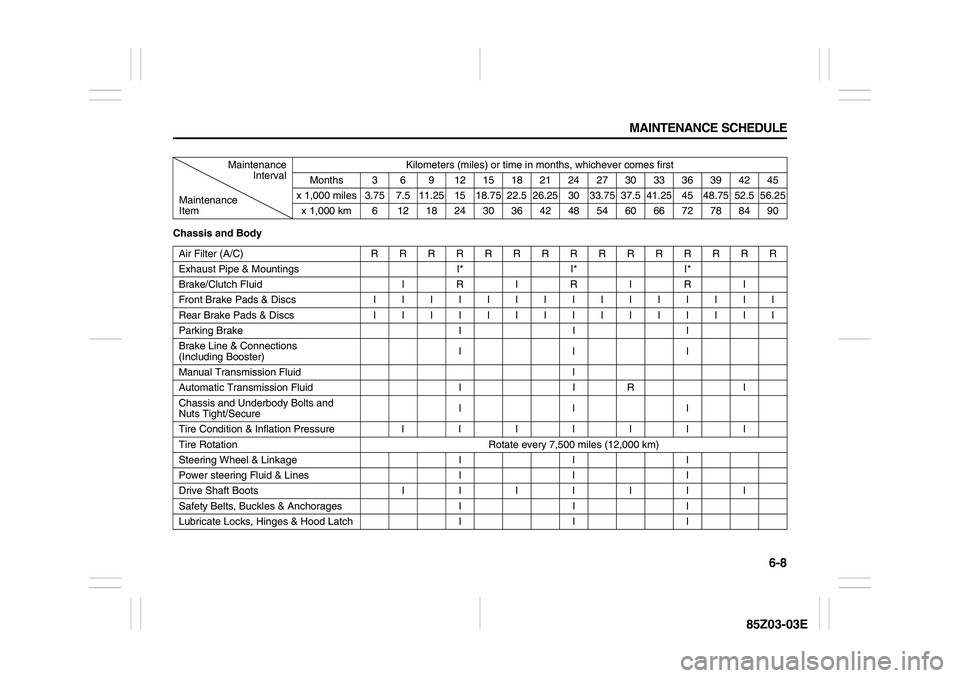
6-8 MAINTENANCE SCHEDULE
85Z03-03E
Chassis and BodyMaintenance
IntervalKilometers (miles) or time in months, whichever comes first
Months 3 6 9 121518212427303336394245
Maintenance
Itemx 1,000 miles 3.75 7.5 11.25 15 18.75 22.526.25 30 33.75 37.5 41.25 45 48.75 52.5 56.25
x 1,000 km 6 1218243036424854606672788490
Air Filter (A/C) RRRRRRRRRRRRRRR
Exhaust Pipe & Mountings I* I* I*
Brake/Clutch Fluid I R I R I R I
Front Brake Pads & Discs IIIIIIIIIIIIIII
Rear Brake Pads & Discs IIIIIIIIIIIIIII
Parking Brake I I I
Brake Line & Connections
(Including Booster)III
Manual Transmission Fluid I
Automatic Transmission Fluid I I R I
Chassis and Underbody Bolts and
Nuts Tight/SecureIII
Tire Condition & Inflation Pressure I I I I I I I
Tire Rotation Rotate every 7,500 miles (12,000 km)
Steering Wheel & Linkage I I I
Power steering Fluid & Lines I I I
Drive Shaft Boots IIIIIII
Safety Belts, Buckles & Anchorages I I I
Lubricate Locks, Hinges & Hood Latch I I I
Page 209 of 225
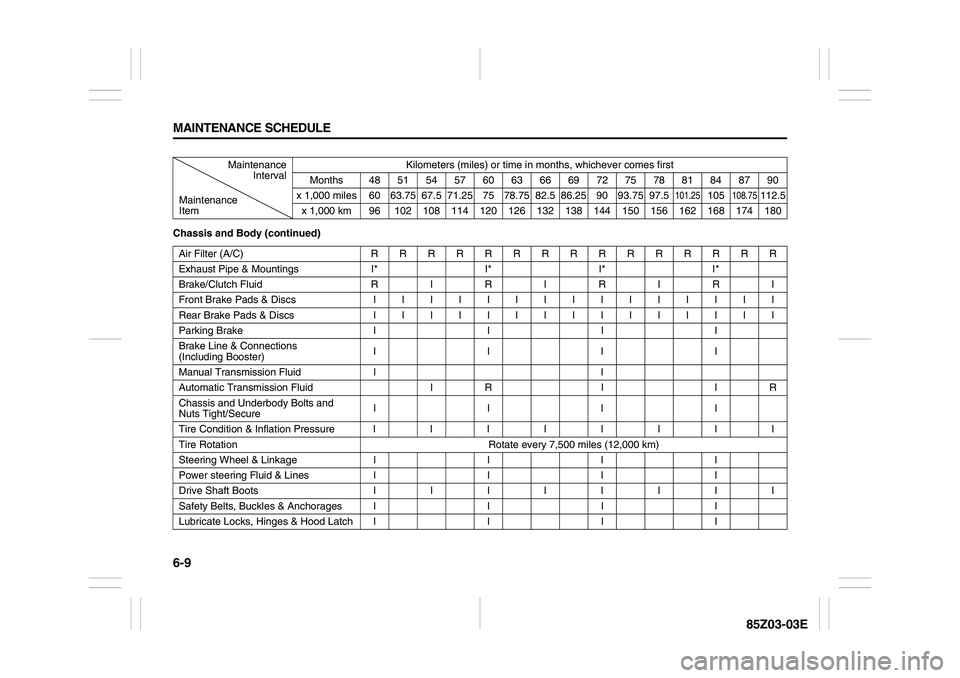
6-9 MAINTENANCE SCHEDULE
85Z03-03E
Chassis and Body (continued)Maintenance
IntervalKilometers (miles) or time in months, whichever comes first
Months 48 51 54 57 60 63 66 69 72 75 78 81 84 87 90
Maintenance
Itemx 1,000 miles 60 63.75 67.5 71.25 75 78.75 82.5 86.25 90 93.75 97.5
101.25
105
108.75
112.5
x 1,000 km 96 102 108 114 120 126 132 138 144 150 156 162 168 174 180
Air Filter (A/C) RRRRRRRRRRRRRRR
Exhaust Pipe & Mountings I* I* I* I*
Brake/Clutch Fluid R I R I R I R I
Front Brake Pads & Discs IIIIIIIIIIIIIII
Rear Brake Pads & Discs IIIIIIIIIIIIIII
Parking Brake I I I I
Brake Line & Connections
(Including Booster)IIII
Manual Transmission Fluid I I
Automatic Transmission Fluid I R I I R
Chassis and Underbody Bolts and
Nuts Tight/SecureIIII
Tire Condition & Inflation Pressure I I I I I I I I
Tire Rotation Rotate every 7,500 miles (12,000 km)
Steering Wheel & Linkage I I I I
Power steering Fluid & Lines I I I I
Drive Shaft Boots IIIIIIII
Safety Belts, Buckles & Anchorages I I I I
Lubricate Locks, Hinges & Hood Latch I I I I
Page 210 of 225
6-10 MAINTENANCE SCHEDULE
85Z03-03E
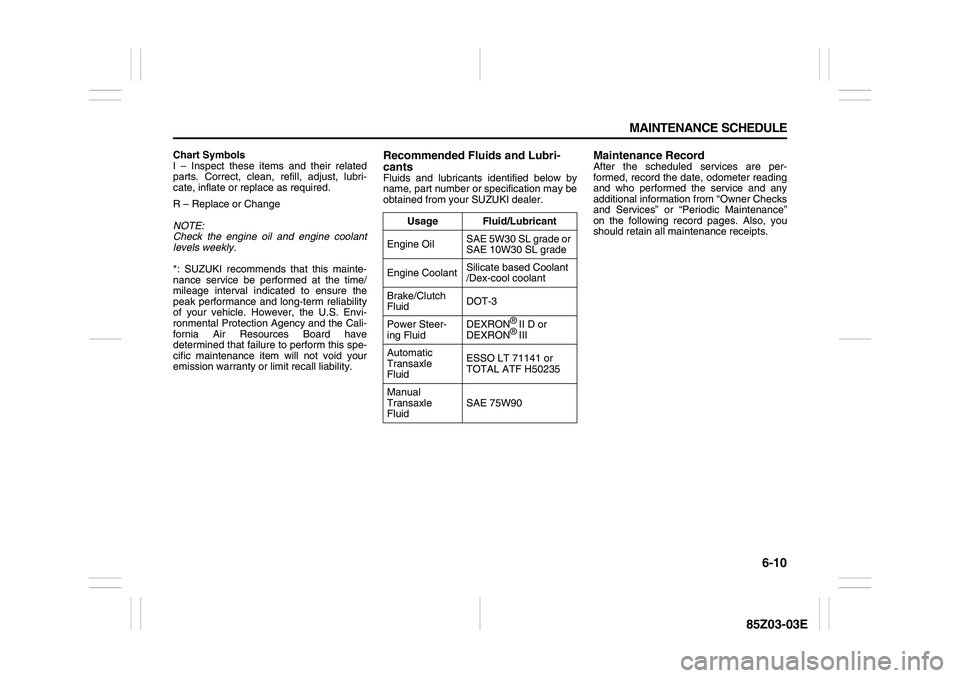
Chart Symbols
I – Inspect these items and their related
parts. Correct, clean, refill, adjust, lubri-
cate, inflate or replace as required.
R – Replace or Change
NOTE:
Check the engine oil and engine coolant
levels weekly.
*: SUZUKI recommends that this mainte-
nance service be performed at the time/
mileage interval indicated to ensure the
peak performance and long-term reliability
of your vehicle. However, the U.S. Envi-
ronmental Protection Agency and the Cali-
fornia Air Resources Board have
determined that failure to perform this spe-
cific maintenance item will not void your
emission warranty or limit recall liability.
Recommended Fluids and Lubri-
cantsFluids and lubricants identified below by
name, part number or specification may be
obtained from your SUZUKI dealer.
Maintenance RecordAfter the scheduled services are per-
formed, record the date, odometer reading
and who performed the service and any
additional information from “Owner Checks
and Services” or “Periodic Maintenance”
on the following record pages. Also, you
should retain all maintenance receipts. Usage Fluid/Lubricant
Engine OilSAE 5W30 SL grade or
SAE 10W30 SL grade
Engine CoolantSilicate based Coolant
/Dex-cool coolant
Brake/Clutch
FluidDOT-3
Power Steer-
ing FluidDEXRON
® II D or
DEXRON® III
Automatic
Transaxle
FluidESSO LT 71141 or
TOTAL ATF H50235
Manual
Transaxle
FluidSAE 75W90
Page 217 of 225
7-3 GENERAL INFORMATION
85Z03-03E
On-Board Vehicle Computers
and Event Data RecordersYour vehicle is equipped with on-board
computer systems which monitor and
control several aspects of vehicle per-
formance, including the following:
Emission-related components and
engine parameters such as engine
speed and throttle position are moni-
tored to provide emissions control
and to provide optimum fuel econ-
omy. Your vehicle also has an on-
board diagnostic system which mon-
itors and records information about
emission-related malfunctions.
Signals from various sensors are
monitored to provide air bag deploy-
ment.
If your vehicle is equipped with
antilock brakes, conditions such as
vehicle speed and brake perfor-
mance are monitored, so that the
ABS system can provide effective
antilock braking. If your vehicle has
an Electronic Stability Program
(ESP
®) system, conditions such as
yaw rate, lateral acceleration, and
brake fluid pressure are monitored,
so that the ESP
® system can help
the driver control the vehicle in diffi-
cult driving situations.
Some information may be stored by
the on-board computers during normaloperation of the vehicle. This stored
information can assist technicians in
repairing the vehicle when malfunc-
tions occur. Other information is stored
only in the event of crash, by computer
systems that are commonly called
Event Data Recorders (EDRs).
In a crash event, EDRs such as the
Airbag Sensing and Diagnostic Mod-
ule (SDM) in your vehicle may record
information about the condition of the
vehicle and how it was operated, such
as data related to airbag readiness,
airbag performance, safety belt usage,
and the severity of the collision. These
data can help provide a better under-
standing of the circumstances in which
crashes and injuries occur and lead to
the designing of safer vehicles. The
SDM in your vehicle does not collect
or store personal information.
To read the stored information, special
equipment is needed and access to
the vehicle or storage device is
required. SUZUKI will not access infor-
mation about a crash event or share it
with others other than with the consent
of the vehicle owner or lessee, in
response to an official request from
the police or similar government office,
as part of SUZUKI’s defense of litiga-
tion through the discovery process, or
as required by law.In addition, once SUZUKI collects or
receives data, SUZUKI may use the
data for research conducted by
SUZUKI, make the data available for
outside research if need is shown and
confidentiality is assured, or make
summary data which does not identify
specific vehicles available for outside
research.
Others, such as law enforcement per-
sonnel, may have access to the spe-
cial equipment that can read the
information if they have access to the
vehicle or storage device.