check oil SUZUKI FORENZA 2007 User Guide
[x] Cancel search | Manufacturer: SUZUKI, Model Year: 2007, Model line: FORENZA, Model: SUZUKI FORENZA 2007Pages: 225, PDF Size: 4.39 MB
Page 157 of 225
5-13 SERVICE AND APPEARANCE CARE
85Z03-03E
If you have to add coolant more than four
times a year, have your SUZUKI dealer
check your cooling system.Checking Coolant
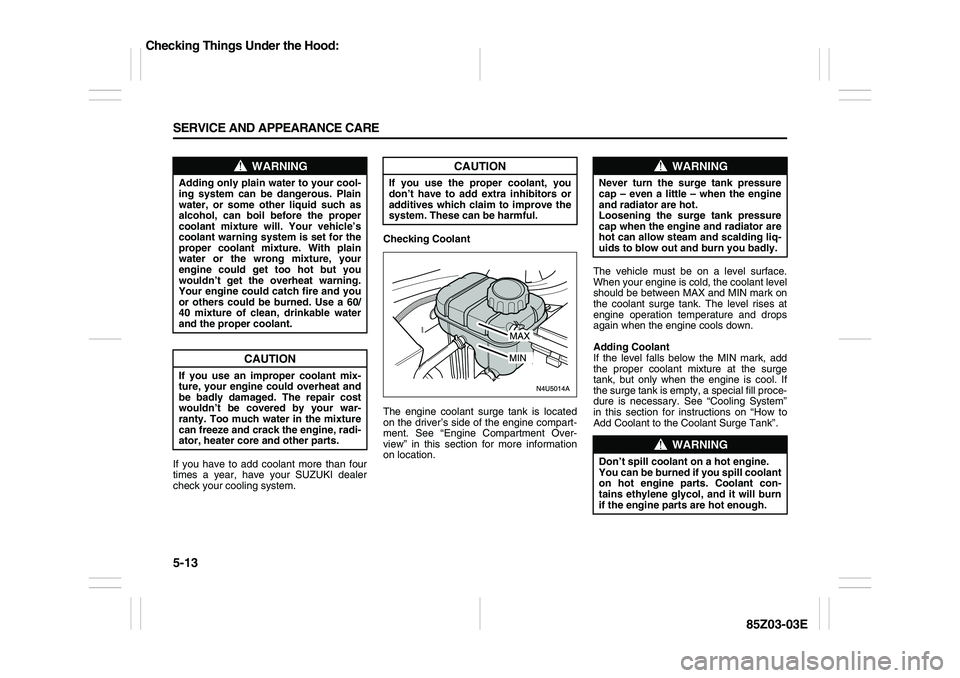
The engine coolant surge tank is located
on the driver’s side of the engine compart-
ment. See “Engine Compartment Over-
view” in this section for more information
on location.The vehicle must be on a level surface.
When your engine is cold, the coolant level
should be between MAX and MIN mark on
the coolant surge tank. The level rises at
engine operation temperature and drops
again when the engine cools down.
Adding Coolant
If the level falls below the MIN mark, add
the proper coolant mixture at the surge
tank, but only when the engine is cool. If
the surge tank is empty, a special fill proce-
dure is necessary. See “Cooling System”
in this section for instructions on “How to
Add Coolant to the Coolant Surge Tank”.
WARNING
Adding only plain water to your cool-
ing system can be dangerous. Plain
water, or some other liquid such as
alcohol, can boil before the proper
coolant mixture will. Your vehicle’s
coolant warning system is set for the
proper coolant mixture. With plain
water or the wrong mixture, your
engine could get too hot but you
wouldn’t get the overheat warning.
Your engine could catch fire and you
or others could be burned. Use a 60/
40 mixture of clean, drinkable water
and the proper coolant.
CAUTION
If you use an improper coolant mix-
ture, your engine could overheat and
be badly damaged. The repair cost
wouldn’t be covered by your war-
ranty. Too much water in the mixture
can freeze and crack the engine, radi-
ator, heater core and other parts.
CAUTION
If you use the proper coolant, you
don’t have to add extra inhibitors or
additives which claim to improve the
system. These can be harmful.
WARNING
Never turn the surge tank pressure
cap – even a little – when the engine
and radiator are hot.
Loosening the surge tank pressure
cap when the engine and radiator are
hot can allow steam and scalding liq-
uids to blow out and burn you badly.
WARNING
Don’t spill coolant on a hot engine.
You can be burned if you spill coolant
on hot engine parts. Coolant con-
tains ethylene glycol, and it will burn
if the engine parts are hot enough.
Checking Things Under the Hood:
Page 159 of 225
5-15 SERVICE AND APPEARANCE CARE
85Z03-03E
If the warning continues and you have not
stopped, pull over, stop, and park your
vehicle right away.
If there’s still no sign of steam, you can idle
the engine for three minutes while you’re
parked. If you still have the warning, turn
off the engine and get everyone out of the
vehicle until it cools down.
You may decide not to lift the hood, but to
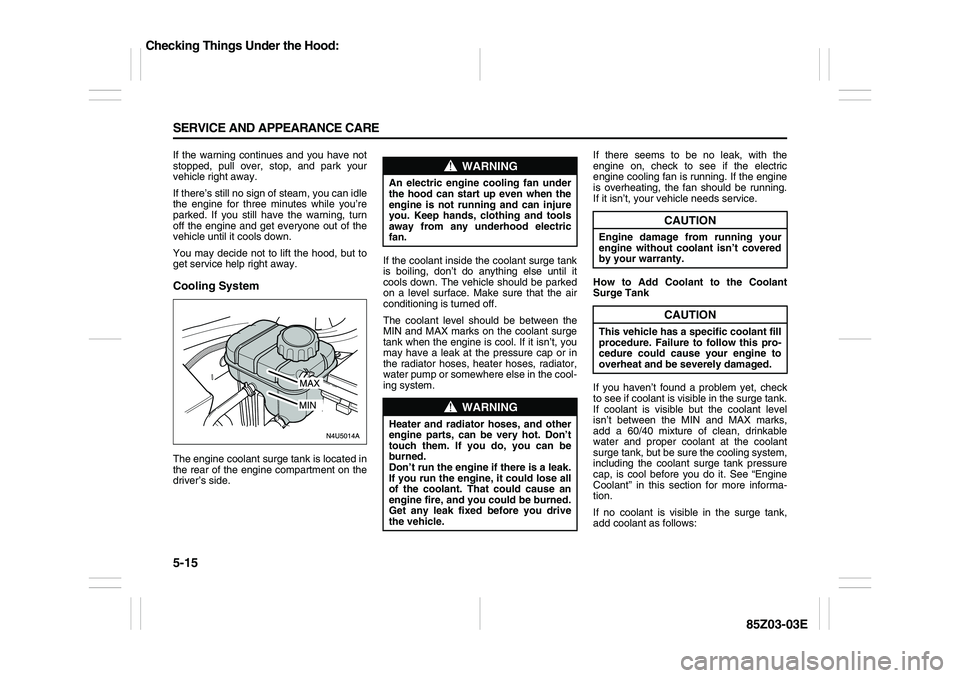
get service help right away.Cooling SystemThe engine coolant surge tank is located in
the rear of the engine compartment on the
driver’s side.If the coolant inside the coolant surge tank
is boiling, don’t do anything else until it
cools down. The vehicle should be parked
on a level surface. Make sure that the air
conditioning is turned off.
The coolant level should be between the
MIN and MAX marks on the coolant surge
tank when the engine is cool. If it isn’t, you
may have a leak at the pressure cap or in
the radiator hoses, heater hoses, radiator,
water pump or somewhere else in the cool-
ing system.If there seems to be no leak, with the
engine on, check to see if the electric
engine cooling fan is running. If the engine
is overheating, the fan should be running.
If it isn’t, your vehicle needs service.
How to Add Coolant to the Coolant
Surge Tank
If you haven’t found a problem yet, check
to see if coolant is visible in the surge tank.
If coolant is visible but the coolant level
isn’t between the MIN and MAX marks,
add a 60/40 mixture of clean, drinkable
water and proper coolant at the coolant
surge tank, but be sure the cooling system,
including the coolant surge tank pressure
cap, is cool before you do it. See “Engine
Coolant” in this section for more informa-
tion.
If no coolant is visible in the surge tank,
add coolant as follows:
WARNING
An electric engine cooling fan under
the hood can start up even when the
engine is not running and can injure
you. Keep hands, clothing and tools
away from any underhood electric
fan.
WARNING
Heater and radiator hoses, and other
engine parts, can be very hot. Don’t
touch them. If you do, you can be
burned.
Don’t run the engine if there is a leak.
If you run the engine, it could lose all
of the coolant. That could cause an
engine fire, and you could be burned.
Get any leak fixed before you drive
the vehicle.
CAUTION
Engine damage from running your
engine without coolant isn’t covered
by your warranty.
CAUTION
This vehicle has a specific coolant fill
procedure. Failure to follow this pro-
cedure could cause your engine to
overheat and be severely damaged.
Checking Things Under the Hood:
Page 160 of 225
5-16 SERVICE AND APPEARANCE CARE
85Z03-03E
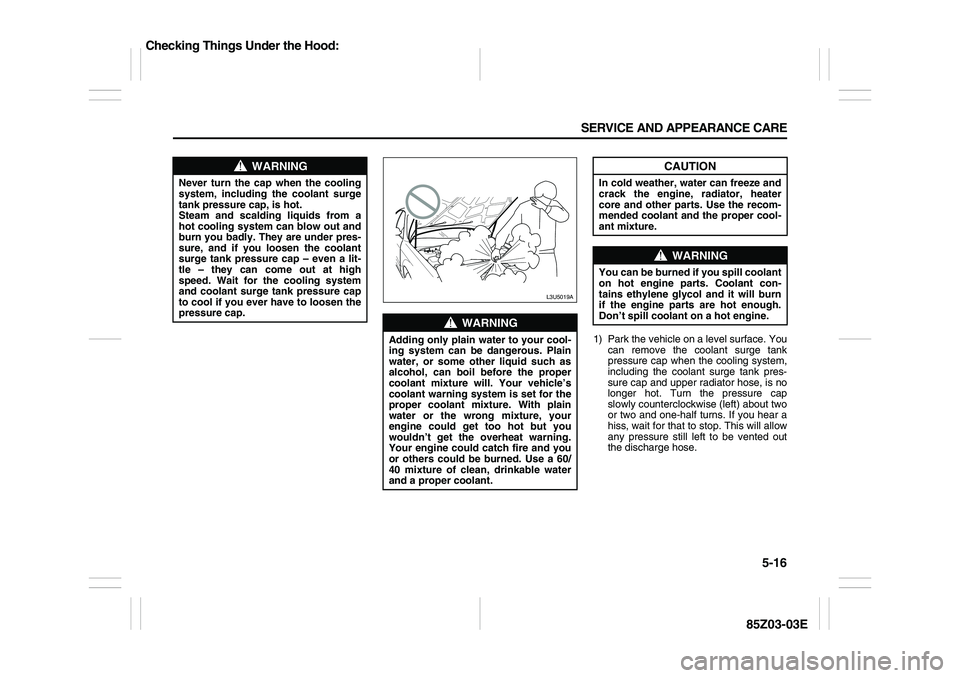
1) Park the vehicle on a level surface. You
can remove the coolant surge tank
pressure cap when the cooling system,
including the coolant surge tank pres-
sure cap and upper radiator hose, is no
longer hot. Turn the pressure cap
slowly counterclockwise (left) about two
or two and one-half turns. If you hear a
hiss, wait for that to stop. This will allow
any pressure still left to be vented out
the discharge hose.
WARNING
Never turn the cap when the cooling
system, including the coolant surge
tank pressure cap, is hot.
Steam and scalding liquids from a
hot cooling system can blow out and
burn you badly. They are under pres-
sure, and if you loosen the coolant
surge tank pressure cap – even a lit-
tle – they can come out at high
speed. Wait for the cooling system
and coolant surge tank pressure cap
to cool if you ever have to loosen the
pressure cap.
WARNING
Adding only plain water to your cool-
ing system can be dangerous. Plain
water, or some other liquid such as
alcohol, can boil before the proper
coolant mixture will. Your vehicle’s
coolant warning system is set for the
proper coolant mixture. With plain
water or the wrong mixture, your
engine could get too hot but you
wouldn’t get the overheat warning.
Your engine could catch fire and you
or others could be burned. Use a 60/
40 mixture of clean, drinkable water
and a proper coolant.
L3U5019A
CAUTION
In cold weather, water can freeze and
crack the engine, radiator, heater
core and other parts. Use the recom-
mended coolant and the proper cool-
ant mixture.
WARNING
You can be burned if you spill coolant
on hot engine parts. Coolant con-
tains ethylene glycol and it will burn
if the engine parts are hot enough.
Don’t spill coolant on a hot engine.
Checking Things Under the Hood:
Page 163 of 225
5-19 SERVICE AND APPEARANCE CARE
85Z03-03E
When your brake fluid falls to a low level,
your brake warning light will come on. See
“Brake System Warning Light” in section 3.
What to Add
When you do need brake fluid, use only
DOT-3 brake fluid. Use new brake fluid
from a sealed container only. See “Recom-
mended Fluids and Lubricants” in section
6.
Always clean the brake fluid reservoir cap
and the area around the cap before remov-
ing it. This will help keep dirt from entering
the reservoir.Brake Wear
Your vehicle has front and rear disc brakes.
Disc brake pads have built-in wear indica-
tors that make a high-pitched warning
sound when the brake pads are worn and
new pads are needed. The sound may
come and go or be heard all the time your
vehicle is moving (except when you are
pushing on the brake pedal firmly).Some driving conditions or climates may
cause a brake squeal when the brakes are
first applied or lightly applied. This does
not mean something is wrong with your
brakes.
Properly torqued wheel nuts are necessary
to help prevent brake pulsation. When tires
are rotated, inspect brake pads for wear
and evenly tighten wheel nuts in the proper
sequence to SUZUKI torque specifica-
tions.
Brake linings should always be replaced as
complete axle sets.
See “Brake System Inspection” in section
6.
WARNING
If you have too much brake fluid, it
can spill on the engine. The fluid will
burn if the engine is hot enough. You
or others could be burned, and your
vehicle could be damaged.
WARNING
With the wrong kind of fluid in your
brake system, your brakes may not
work well, or they may not even work
at all. This could cause a crash.
Always use the proper brake fluid.
CAUTION
Using the wrong fluid can badly
damage brake system parts. For
example, just a few drops of min-
eral-based oil, such as engine oil,
in your brake system can damage
brake system parts so badly that
they’ll have to be replaced. Don’t let
someone put in the wrong kind of
fluid.
If you spill brake fluid on your vehi-
cle’s painted surfaces, the paint fin-
ish can be damaged. Be careful not
to spill brake fluid on your vehicle.
If you do, wash it off immediately.
See “Appearance Care” in the
Index.
WARNING
The brake wear warning sound
means that soon your brakes won’t
work well. That could lead to an acci-
dent. When you hear the brake wear
warning sound, have your vehicle
serviced.
CAUTION
Continuing to drive with worn-out
brake pads could result in costly
brake repair.
Checking Things Under the Hood:
Page 191 of 225
5-47 SERVICE AND APPEARANCE CARE
85Z03-03E
SUZUKI dealer. See “Vehicle Care/
Appearance Materials” later in this section.
Don’t use cleaning agents that are petro-
leum based, or that contain acid or abra-
sives. All cleaning agents should be
flushed promptly and not allowed to dry on
the surface, or they could stain. Dry the fin-
ish with a soft, clean chamois or an all-cot-
ton towel to avoid surface scratches and
water spotting.
High pressure car washes may cause
water to enter your vehicle.
Cleaning Exterior Lamps/Lenses
Use only lukewarm or cold water, a soft
cloth and a car washing soap to clean
exterior lamps and lenses. Follow instruc-
tions under Washing Your Vehicle.
Finish Care
Occasional waxing or mild polishing of
your vehicle by hand may be necessary to
remove residue from the paint finish. You
can get SUZUKI-approved cleaning prod-
ucts from your SUZUKI dealer. See “Vehi-
cle Care/Appearance Materials” later in
this section.
Your vehicle has a “basecoat/clear coat”
paint finish. The clear coat gives more
depth and gloss to the colored basecoat.
Always use waxes and polishes that are
non-abrasive and made for a basecoat/
clear coat paint finish.Foreign materials such as calcium chloride
and other salts, ice melting agents, road oil
and tar, tree sap, bird droppings, chemicals
from industrial chimneys, etc., can damage
your vehicle’s finish if they remain on
painted surfaces. Wash the vehicle as
soon as possible. If necessary, use non-
abrasive cleaners that are marked safe for
painted surfaces to remove foreign matter.
Exterior painted surfaces are subject to
aging, weather and chemical fallout that
can take their toll over a period of years.
You can help to keep the paint finish look-
ing new by keeping your vehicle garaged
or covered whenever possible.
Cleaning Windshield and Wiper Blades
If the windshield is not clear after using the
windshield washer, or if the wiper blade
chatters when running, wax, sap or other
material may be on the blade or wind-
shield.
Clean the outside of the windshield with a
full-strength glass cleaning liquid. The
windshield is clean if beads do not form
when you rinse it with water.Grime from the windshield will stick to the
wiper blades and affect their performance.
Clean the blades by wiping vigorously with
a cloth soaked in full-strength windshield
washer solvent. Then rinse the blades with
water.
Check the wiper blades and clean them as
necessary; replace blades that look worn.
Cleaning Aluminum Wheels
Keep your wheels clean using a soft clean
cloth with mild soap and water. Rinse with
clean water. After rinsing thoroughly, dry
with a soft clean towel. A wax may then be
applied.
The surface of these wheels is similar to
the painted surface of your vehicle. Don’t
use strong soaps, chemicals, abrasive pol-
ishes, abrasive cleaners, cleaners with
acid, or abrasive cleaning brushes on them
because you could damage the surface.
Do not use chrome polish on aluminum
wheels.
Don’t take your vehicle through an auto-
matic car wash that has silicone carbide
tire cleaning brushes. These brushes can
also damage the surface of these wheels.
Cleaning Tires
To clean your tires, use a stiff brush with
tire cleaner.
CAUTION
Machine compounding or aggressive
polishing on a basecoat/clearcoat
paint finish may dull the finish or
leave swirl marks.
Appearance Care:
Vehicle Identification:
Electrical System:
Page 210 of 225
6-10 MAINTENANCE SCHEDULE
85Z03-03E
Chart Symbols
I – Inspect these items and their related
parts. Correct, clean, refill, adjust, lubri-
cate, inflate or replace as required.
R – Replace or Change
NOTE:
Check the engine oil and engine coolant
levels weekly.
*: SUZUKI recommends that this mainte-
nance service be performed at the time/
mileage interval indicated to ensure the
peak performance and long-term reliability
of your vehicle. However, the U.S. Envi-
ronmental Protection Agency and the Cali-
fornia Air Resources Board have
determined that failure to perform this spe-
cific maintenance item will not void your
emission warranty or limit recall liability.
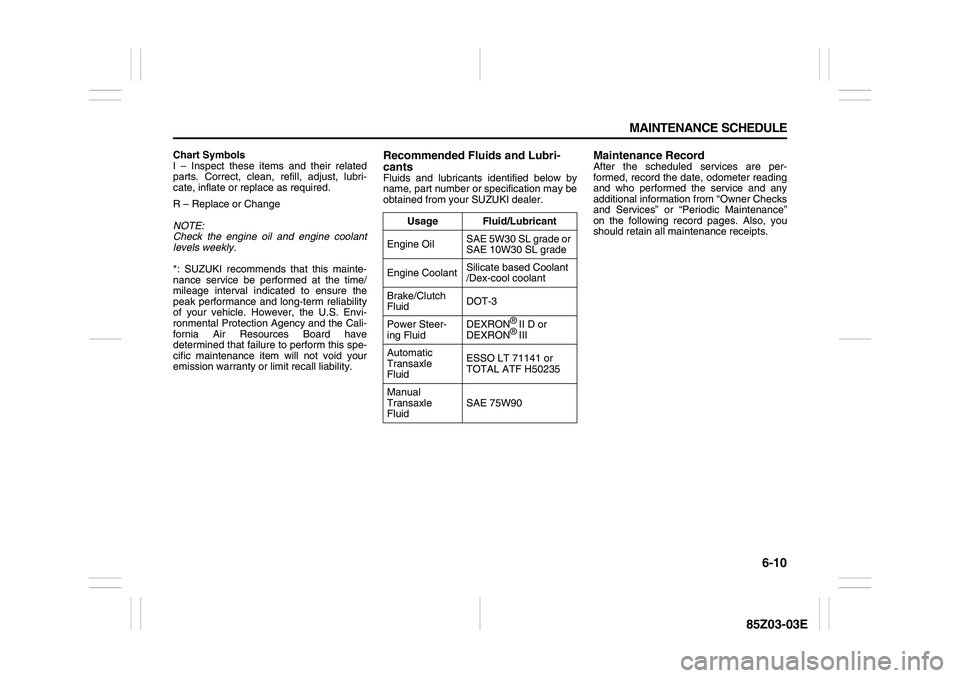
Recommended Fluids and Lubri-
cantsFluids and lubricants identified below by
name, part number or specification may be
obtained from your SUZUKI dealer.
Maintenance RecordAfter the scheduled services are per-
formed, record the date, odometer reading
and who performed the service and any
additional information from “Owner Checks
and Services” or “Periodic Maintenance”
on the following record pages. Also, you
should retain all maintenance receipts. Usage Fluid/Lubricant
Engine OilSAE 5W30 SL grade or
SAE 10W30 SL grade
Engine CoolantSilicate based Coolant
/Dex-cool coolant
Brake/Clutch
FluidDOT-3
Power Steer-
ing FluidDEXRON
® II D or
DEXRON® III
Automatic
Transaxle
FluidESSO LT 71141 or
TOTAL ATF H50235
Manual
Transaxle
FluidSAE 75W90