engine coolant SUZUKI FORENZA 2007 User Guide
[x] Cancel search | Manufacturer: SUZUKI, Model Year: 2007, Model line: FORENZA, Model: SUZUKI FORENZA 2007Pages: 225, PDF Size: 4.39 MB
Page 160 of 225
5-16 SERVICE AND APPEARANCE CARE
85Z03-03E
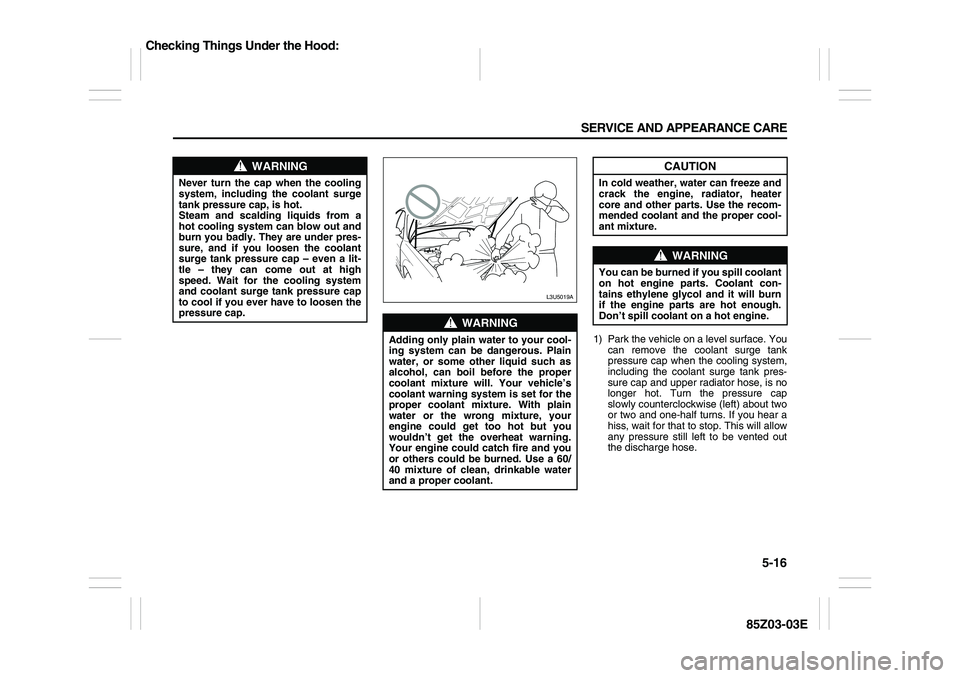
1) Park the vehicle on a level surface. You
can remove the coolant surge tank
pressure cap when the cooling system,
including the coolant surge tank pres-
sure cap and upper radiator hose, is no
longer hot. Turn the pressure cap
slowly counterclockwise (left) about two
or two and one-half turns. If you hear a
hiss, wait for that to stop. This will allow
any pressure still left to be vented out
the discharge hose.
WARNING
Never turn the cap when the cooling
system, including the coolant surge
tank pressure cap, is hot.
Steam and scalding liquids from a
hot cooling system can blow out and
burn you badly. They are under pres-
sure, and if you loosen the coolant
surge tank pressure cap – even a lit-
tle – they can come out at high
speed. Wait for the cooling system
and coolant surge tank pressure cap
to cool if you ever have to loosen the
pressure cap.
WARNING
Adding only plain water to your cool-
ing system can be dangerous. Plain
water, or some other liquid such as
alcohol, can boil before the proper
coolant mixture will. Your vehicle’s
coolant warning system is set for the
proper coolant mixture. With plain
water or the wrong mixture, your
engine could get too hot but you
wouldn’t get the overheat warning.
Your engine could catch fire and you
or others could be burned. Use a 60/
40 mixture of clean, drinkable water
and a proper coolant.
L3U5019A
CAUTION
In cold weather, water can freeze and
crack the engine, radiator, heater
core and other parts. Use the recom-
mended coolant and the proper cool-
ant mixture.
WARNING
You can be burned if you spill coolant
on hot engine parts. Coolant con-
tains ethylene glycol and it will burn
if the engine parts are hot enough.
Don’t spill coolant on a hot engine.
Checking Things Under the Hood:
Page 161 of 225
5-17 SERVICE AND APPEARANCE CARE
85Z03-03E
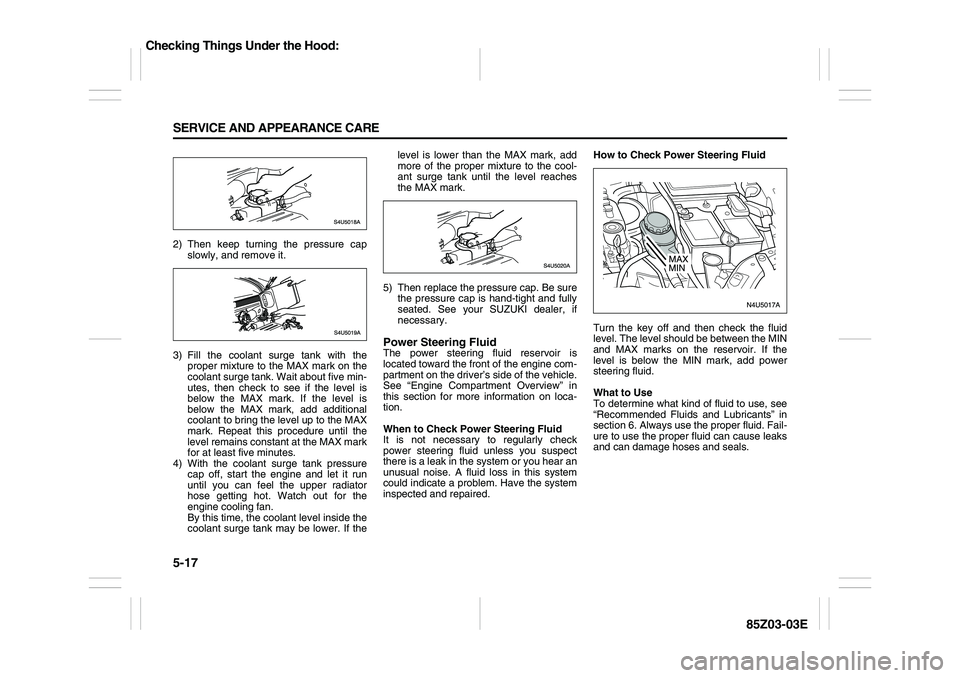
2) Then keep turning the pressure cap
slowly, and remove it.
3) Fill the coolant surge tank with the
proper mixture to the MAX mark on the
coolant surge tank. Wait about five min-
utes, then check to see if the level is
below the MAX mark. If the level is
below the MAX mark, add additional
coolant to bring the level up to the MAX
mark. Repeat this procedure until the
level remains constant at the MAX mark
for at least five minutes.
4) With the coolant surge tank pressure
cap off, start the engine and let it run
until you can feel the upper radiator
hose getting hot. Watch out for the
engine cooling fan.
By this time, the coolant level inside the
coolant surge tank may be lower. If thelevel is lower than the MAX mark, add
more of the proper mixture to the cool-
ant surge tank until the level reaches
the MAX mark.
5) Then replace the pressure cap. Be sure
the pressure cap is hand-tight and fully
seated. See your SUZUKI dealer, if
necessary.
Power Steering FluidThe power steering fluid reservoir is
located toward the front of the engine com-
partment on the driver’s side of the vehicle.
See “Engine Compartment Overview” in
this section for more information on loca-
tion.
When to Check Power Steering Fluid
It is not necessary to regularly check
power steering fluid unless you suspect
there is a leak in the system or you hear an
unusual noise. A fluid loss in this system
could indicate a problem. Have the system
inspected and repaired.How to Check Power Steering Fluid
Turn the key off and then check the fluid
level. The level should be between the MIN
and MAX marks on the reservoir. If the
level is below the MIN mark, add power
steering fluid.
What to Use
To determine what kind of fluid to use, see
“Recommended Fluids and Lubricants” in
section 6. Always use the proper fluid. Fail-
ure to use the proper fluid can cause leaks
and can damage hoses and seals.
Checking Things Under the Hood:
Page 162 of 225
5-18 SERVICE AND APPEARANCE CARE
85Z03-03E
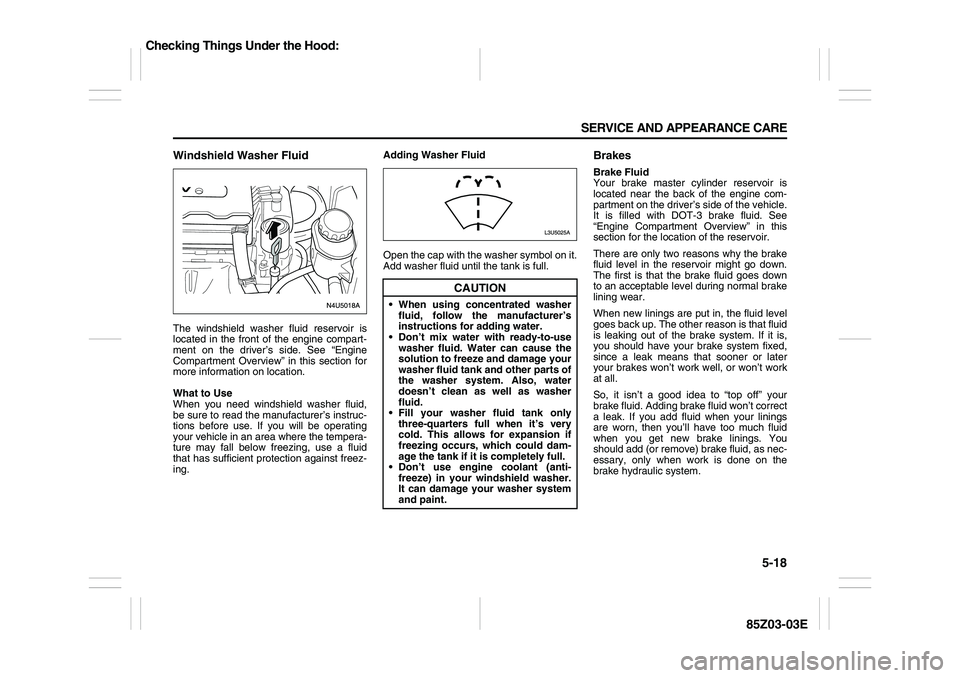
Windshield Washer FluidThe windshield washer fluid reservoir is
located in the front of the engine compart-
ment on the driver’s side. See “Engine
Compartment Overview” in this section for
more information on location.
What to Use
When you need windshield washer fluid,
be sure to read the manufacturer’s instruc-
tions before use. If you will be operating
your vehicle in an area where the tempera-
ture may fall below freezing, use a fluid
that has sufficient protection against freez-
ing.Adding Washer Fluid
Open the cap with the washer symbol on it.
Add washer fluid until the tank is full.
BrakesBrake Fluid
Your brake master cylinder reservoir is
located near the back of the engine com-
partment on the driver’s side of the vehicle.
It is filled with DOT-3 brake fluid. See
“Engine Compartment Overview” in this
section for the location of the reservoir.
There are only two reasons why the brake
fluid level in the reservoir might go down.
The first is that the brake fluid goes down
to an acceptable level during normal brake
lining wear.
When new linings are put in, the fluid level
goes back up. The other reason is that fluid
is leaking out of the brake system. If it is,
you should have your brake system fixed,
since a leak means that sooner or later
your brakes won’t work well, or won’t work
at all.
So, it isn’t a good idea to “top off” your
brake fluid. Adding brake fluid won’t correct
a leak. If you add fluid when your linings
are worn, then you’ll have too much fluid
when you get new brake linings. You
should add (or remove) brake fluid, as nec-
essary, only when work is done on the
brake hydraulic system.
CAUTION
When using concentrated washer
fluid, follow the manufacturer’s
instructions for adding water.
Don’t mix water with ready-to-use
washer fluid. Water can cause the
solution to freeze and damage your
washer fluid tank and other parts of
the washer system. Also, water
doesn’t clean as well as washer
fluid.
Fill your washer fluid tank only
three-quarters full when it’s very
cold. This allows for expansion if
freezing occurs, which could dam-
age the tank if it is completely full.
Don’t use engine coolant (anti-
freeze) in your windshield washer.
It can damage your washer system
and paint.
Checking Things Under the Hood:
Page 198 of 225
5-54 SERVICE AND APPEARANCE CARE
85Z03-03E
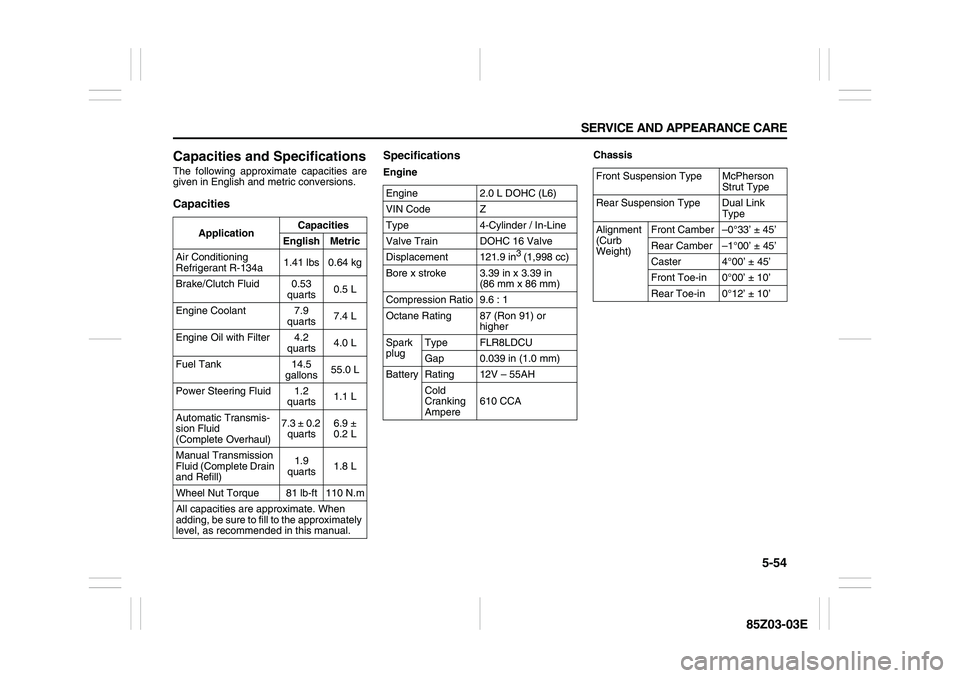
Capacities and SpecificationsThe following approximate capacities are
given in English and metric conversions. CapacitiesSpecifications
EngineChassis
ApplicationCapacities
English Metric
Air Conditioning
Refrigerant R-134a1.41 lbs 0.64 kg
Brake/Clutch Fluid 0.53
quarts0.5 L
Engine Coolant 7.9
quarts7.4 L
Engine Oil with Filter 4.2
quarts4.0 L
Fuel Tank 14.5
gallons55.0 L
Power Steering Fluid 1.2
quarts1.1 L
Automatic Transmis-
sion Fluid
(Complete Overhaul)7.3 ± 0.2
quarts6.9 ±
0.2 L
Manual Transmission
Fluid (Complete Drain
and Refill)1.9
quarts1.8 L
Wheel Nut Torque 81 lb-ft 110 N.m
All capacities are approximate. When
adding, be sure to fill to the approximately
level, as recommended in this manual. Engine 2.0 L DOHC (L6)
VIN Code Z
Type 4-Cylinder / In-Line
Valve Train DOHC 16 Valve
Displacement 121.9 in
3 (1,998 cc)
Bore x stroke 3.39 in x 3.39 in
(86 mm x 86 mm)
Compression Ratio 9.6 : 1
Octane Rating 87 (Ron 91) or
higher
Spark
plugType FLR8LDCU
Gap 0.039 in (1.0 mm)
Battery Rating 12V – 55AH
Cold
Cranking
Ampere610 CCA
Front Suspension Type McPherson
Strut Type
Rear Suspension Type Dual Link
Type
Alignment
(Curb
Weight)Front Camber –0°33’ ± 45’
Rear Camber –1°00’ ± 45’
Caster 4°00’ ± 45’
Front Toe-in 0°00’ ± 10’
Rear Toe-in 0°12’ ± 10’
Page 202 of 225
6-2 MAINTENANCE SCHEDULE
85Z03-03E
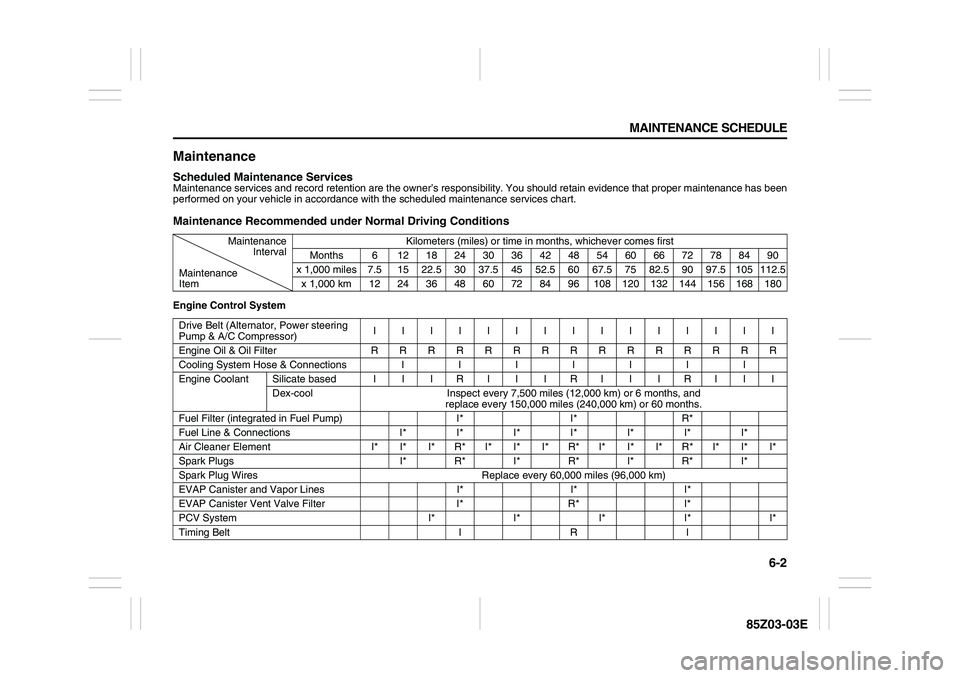
MaintenanceScheduled Maintenance ServicesMaintenance services and record retention are the owner’s responsibility. You should retain evidence that proper maintenance has been
performed on your vehicle in accordance with the scheduled maintenance services chart.Maintenance Recommended under Normal Driving ConditionsEngine Control SystemMaintenance
IntervalKilometers (miles) or time in months, whichever comes first
Months 6 1218243036424854606672788490
Maintenance
Itemx 1,000 miles 7.5 15 22.5 30 37.5 45 52.5 60 67.5 75 82.5 90 97.5 105 112.5
x 1,000 km 12 24 36 48 60 72 84 96 108 120 132 144 156 168 180
Drive Belt (Alternator, Power steering
Pump & A/C Compressor)IIIIIIIIIIIIIII
Engine Oil & Oil Filter RRRRRRRRRRRRRRR
Cooling System Hose & Connections I I I I I I I
Engine Coolant Silicate based I I I R I I I R I I I R I I I
Dex-cool Inspect every 7,500 miles (12,000 km) or 6 months, and
replace every 150,000 miles (240,000 km) or 60 months.
Fuel Filter (integrated in Fuel Pump) I* I* R*
Fuel Line & Connections I* I* I* I* I* I* I*
Air Cleaner Element I* I* I* R* I* I* I* R* I* I* I* R* I* I* I*
Spark Plugs I* R* I* R* I* R* I*
Spark Plug Wires Replace every 60,000 miles (96,000 km)
EVAP Canister and Vapor Lines I* I* I*
EVAP Canister Vent Valve Filter I* R* I*
PCV System I* I* I* I* I*
Timing Belt I R I
Page 203 of 225
6-3 MAINTENANCE SCHEDULE
85Z03-03E
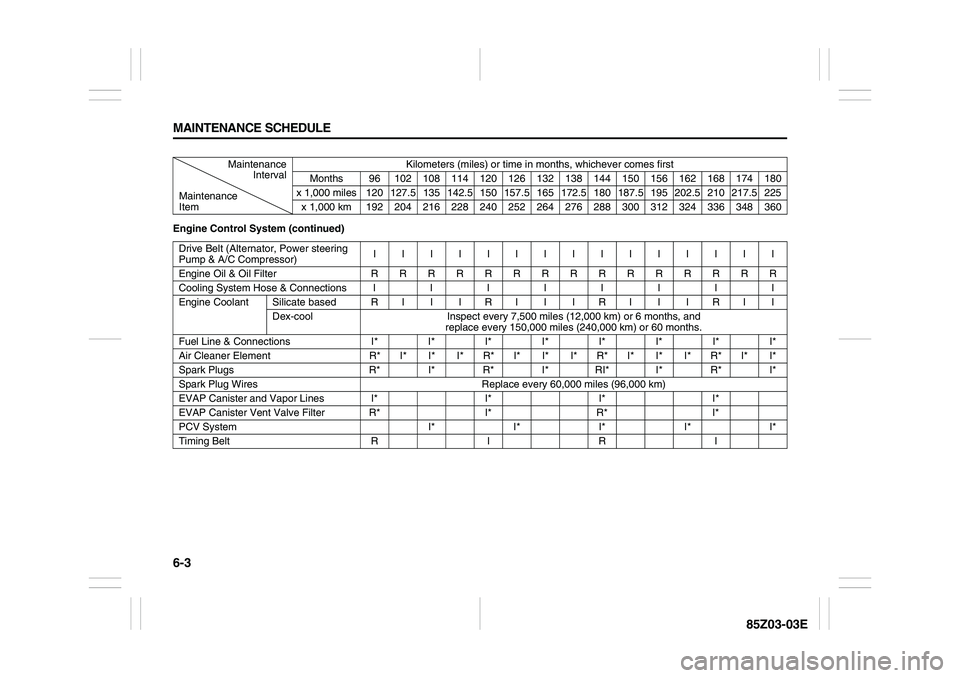
Engine Control System (continued)Maintenance
IntervalKilometers (miles) or time in months, whichever comes first
Months 96 102 108 114 120 126 132 138 144 150 156 162 168 174 180
Maintenance
Itemx 1,000 miles 120 127.5 135 142.5 150 157.5 165 172.5 180 187.5 195 202.5 210 217.5 225
x 1,000 km 192 204 216 228 240 252 264 276 288 300 312 324 336 348 360
Drive Belt (Alternator, Power steering
Pump & A/C Compressor)IIIIIIIIIIIIIII
Engine Oil & Oil Filter RRRRRRRRRRRRRRR
Cooling System Hose & Connections I I I I I I I I
Engine Coolant Silicate based R I I I R I I I R I I I R I I
Dex-cool Inspect every 7,500 miles (12,000 km) or 6 months, and
replace every 150,000 miles (240,000 km) or 60 months.
Fuel Line & Connections I* I* I* I* I* I* I* I*
Air Cleaner Element R* I* I* I* R* I* I* I* R* I* I* I* R* I* I*
Spark Plugs R* I* R* I* RI* I* R* I*
Spark Plug Wires Replace every 60,000 miles (96,000 km)
EVAP Canister and Vapor Lines I* I* I* I*
EVAP Canister Vent Valve Filter R* I* R* I*
PCV System I* I* I* I* I*
Timing Belt RIRI
Page 206 of 225
6-6 MAINTENANCE SCHEDULE
85Z03-03E
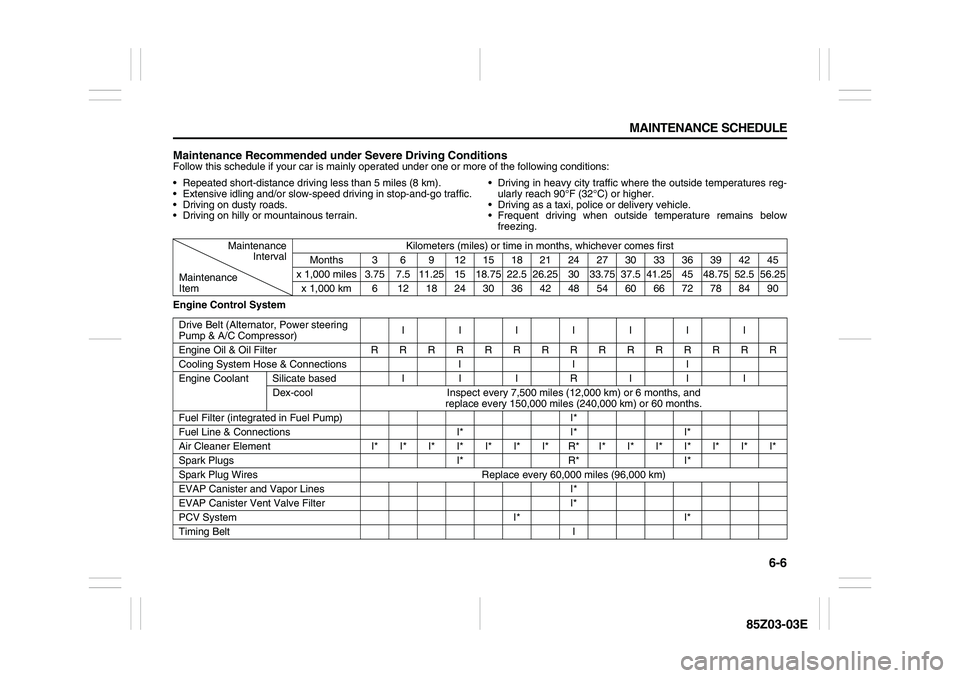
Maintenance Recommended under Severe Driving ConditionsFollow this schedule if your car is mainly operated under one or more of the following conditions:
Engine Control System Repeated short-distance driving less than 5 miles (8 km).
Extensive idling and/or slow-speed driving in stop-and-go traffic.
Driving on dusty roads.
Driving on hilly or mountainous terrain. Driving in heavy city traffic where the outside temperatures reg-
ularly reach 90°F (32°C) or higher.
Driving as a taxi, police or delivery vehicle.
Frequent driving when outside temperature remains below
freezing.
Maintenance
IntervalKilometers (miles) or time in months, whichever comes first
Months 3 6 9 121518212427303336394245
Maintenance
Itemx 1,000 miles 3.75 7.5 11.25 15 18.75 22.526.25 30 33.75 37.5 41.25 45 48.75 52.5 56.25
x 1,000 km 6 1218243036424854606672788490Drive Belt (Alternator, Power steering
Pump & A/C Compressor)IIIIIII
Engine Oil & Oil Filter RRRRRRRRRRRRRRR
Cooling System Hose & Connections I I I
Engine Coolant Silicate based I I I R I I I
Dex-cool Inspect every 7,500 miles (12,000 km) or 6 months, and
replace every 150,000 miles (240,000 km) or 60 months.
Fuel Filter (integrated in Fuel Pump) I*
Fuel Line & Connections I* I* I*
Air Cleaner Element I* I* I* I* I* I* I* R* I* I* I* I* I* I* I*
Spark Plugs I* R* I*
Spark Plug Wires Replace every 60,000 miles (96,000 km)
EVAP Canister and Vapor Lines I*
EVAP Canister Vent Valve Filter I*
PCV System I* I*
Timing BeltI
Page 207 of 225
6-7 MAINTENANCE SCHEDULE
85Z03-03E
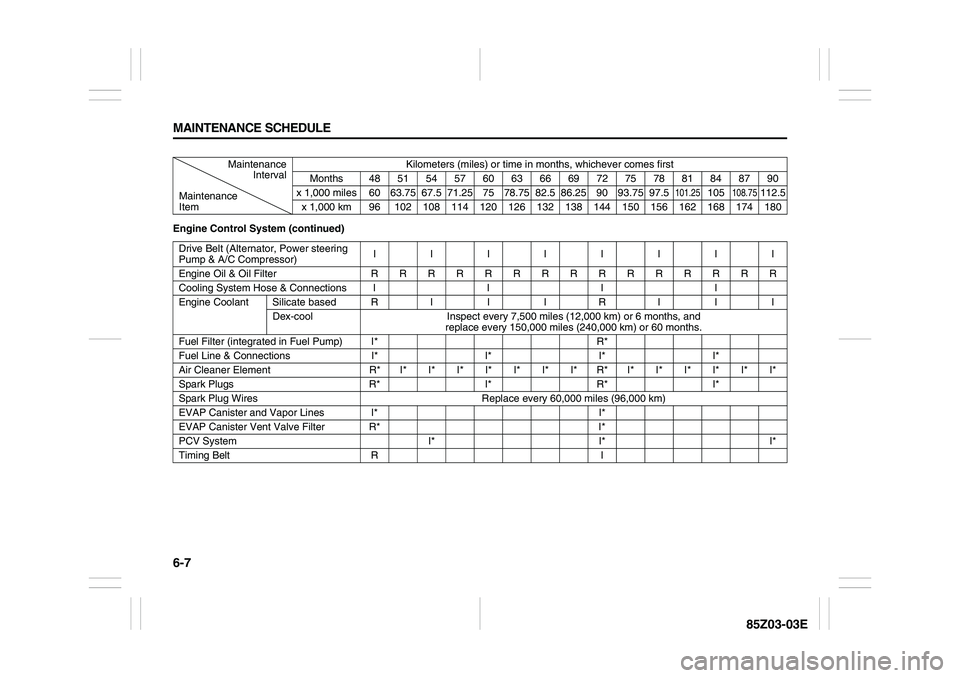
Engine Control System (continued)Maintenance
IntervalKilometers (miles) or time in months, whichever comes first
Months 48 51 54 57 60 63 66 69 72 75 78 81 84 87 90
Maintenance
Itemx 1,000 miles 60 63.75 67.5 71.25 75 78.75 82.5 86.25 90 93.75 97.5
101.25
105
108.75
112.5
x 1,000 km 96 102 108 114 120 126 132 138 144 150 156 162 168 174 180
Drive Belt (Alternator, Power steering
Pump & A/C Compressor)IIIIIIII
Engine Oil & Oil Filter RRRRRRRRRRRRRRR
Cooling System Hose & Connections I I I I
Engine Coolant Silicate based R I I I R I I I
Dex-cool Inspect every 7,500 miles (12,000 km) or 6 months, and
replace every 150,000 miles (240,000 km) or 60 months.
Fuel Filter (integrated in Fuel Pump) I* R*
Fuel Line & Connections I* I* I* I*
Air Cleaner Element R* I* I* I* I* I* I* I* R* I* I* I* I* I* I*
Spark Plugs R* I* R* I*
Spark Plug Wires Replace every 60,000 miles (96,000 km)
EVAP Canister and Vapor Lines I* I*
EVAP Canister Vent Valve Filter R* I*
PCV System I* I* I*
Timing Belt R I
Page 210 of 225
6-10 MAINTENANCE SCHEDULE
85Z03-03E
Chart Symbols
I – Inspect these items and their related
parts. Correct, clean, refill, adjust, lubri-
cate, inflate or replace as required.
R – Replace or Change
NOTE:
Check the engine oil and engine coolant
levels weekly.
*: SUZUKI recommends that this mainte-
nance service be performed at the time/
mileage interval indicated to ensure the
peak performance and long-term reliability
of your vehicle. However, the U.S. Envi-
ronmental Protection Agency and the Cali-
fornia Air Resources Board have
determined that failure to perform this spe-
cific maintenance item will not void your
emission warranty or limit recall liability.
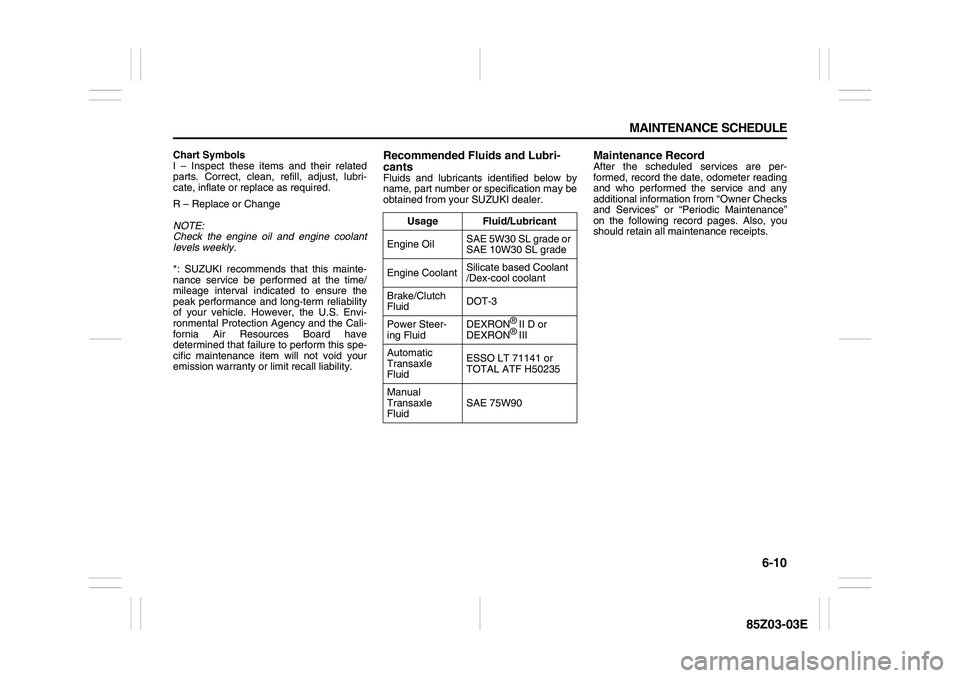
Recommended Fluids and Lubri-
cantsFluids and lubricants identified below by
name, part number or specification may be
obtained from your SUZUKI dealer.
Maintenance RecordAfter the scheduled services are per-
formed, record the date, odometer reading
and who performed the service and any
additional information from “Owner Checks
and Services” or “Periodic Maintenance”
on the following record pages. Also, you
should retain all maintenance receipts. Usage Fluid/Lubricant
Engine OilSAE 5W30 SL grade or
SAE 10W30 SL grade
Engine CoolantSilicate based Coolant
/Dex-cool coolant
Brake/Clutch
FluidDOT-3
Power Steer-
ing FluidDEXRON
® II D or
DEXRON® III
Automatic
Transaxle
FluidESSO LT 71141 or
TOTAL ATF H50235
Manual
Transaxle
FluidSAE 75W90
Page 221 of 225
8-2 INDEX
85Z03-03E
Doing Your Own Service Work
...........................................5-1
Door Ajar Light
....................................................................3-26
Door Ajar Reminder
.............................................................2-5
Door Locks
...........................................................................2-4
Doors and Locks
.................................................................2-4
Driver Position
.....................................................................1-7
Driver Seat Height Adjuster
................................................1-2
Driving at Night
....................................................................4-8
Driving in Rain and on Wet Roads
.....................................4-9
Drunken Driving
...................................................................4-1
EElectrical System
.................................................................5-49
Emission Compliance Label (for U.S.A.)
...........................7-2
Engine Air Cleaner/Filter
.....................................................5-9
Engine Compartment Overview
.........................................5-6
Engine Coolant
....................................................................5-12
Engine Coolant Temperature Gauge
.................................3-22
Engine Exhaust
....................................................................2-20
Engine Oil
.............................................................................5-7
Engine Overheating
.............................................................5-14
Engine Serial Number .........................................................7-1
Exterior Lamps
....................................................................3-9
FFilling a Portable Fuel Container
.......................................5-4
Filling Your Tank
.................................................................5-2
Finish Damage
.....................................................................5-48
Floor Net (Wagon only)
.......................................................2-24
Fog Lamp Light
....................................................................3-24
Folding Rear Seat ................................................................1-4
Freeway Driving
...................................................................4-11
Front Armrest Storage Area
...............................................2-23Front Fog Lamps
................................................................. 5-25
Front Seats
.......................................................................... 1-1
Front Sidemarker Lamps
.................................................... 5-24
Front Storage Area
............................................................. 2-23
Front Turn Signal Lamps
................................................... 5-24
Fuel
....................................................................................... 5-1
Fuel Gauge
.......................................................................... 3-25
Fuels in Foreign Countries
................................................ 5-2
Fuses and Circuit Breakers ............................................... 5-50
GGasoline Octane
.................................................................. 5-1
General Information
............................................................ 6-1
Glossary of Tire Terminology
............................................ 5-31
Glove Box
............................................................................ 2-22
HHalogen Bulbs
..................................................................... 5-23
Hazard Warning Flashers
................................................... 3-3
Head Restraints
................................................................... 1-3
Headlamp Aiming ................................................................ 5-23
Headlamp Wiring ................................................................. 5-49
Headlamps
........................................................................... 5-24
Highbeam On Light
............................................................. 3-25
Highway Hypnosis .............................................................. 4-12
Hill and Mountain Roads
.................................................... 4-12
Hold Mode Light
.................................................................. 3-22
Hood Release
...................................................................... 5-4
Horn
...................................................................................... 3-3
How Does an Air Bag Restrain?
........................................ 1-33
How to Wear Safety Belts Properly ................................... 1-7
Hydraulic Clutch
................................................................. 5-12