lock SUZUKI FORENZA 2007 User Guide
[x] Cancel search | Manufacturer: SUZUKI, Model Year: 2007, Model line: FORENZA, Model: SUZUKI FORENZA 2007Pages: 225, PDF Size: 4.39 MB
Page 26 of 225
1-14 SEATS AND RESTRAINT SYSTEMS
85Z03-03E
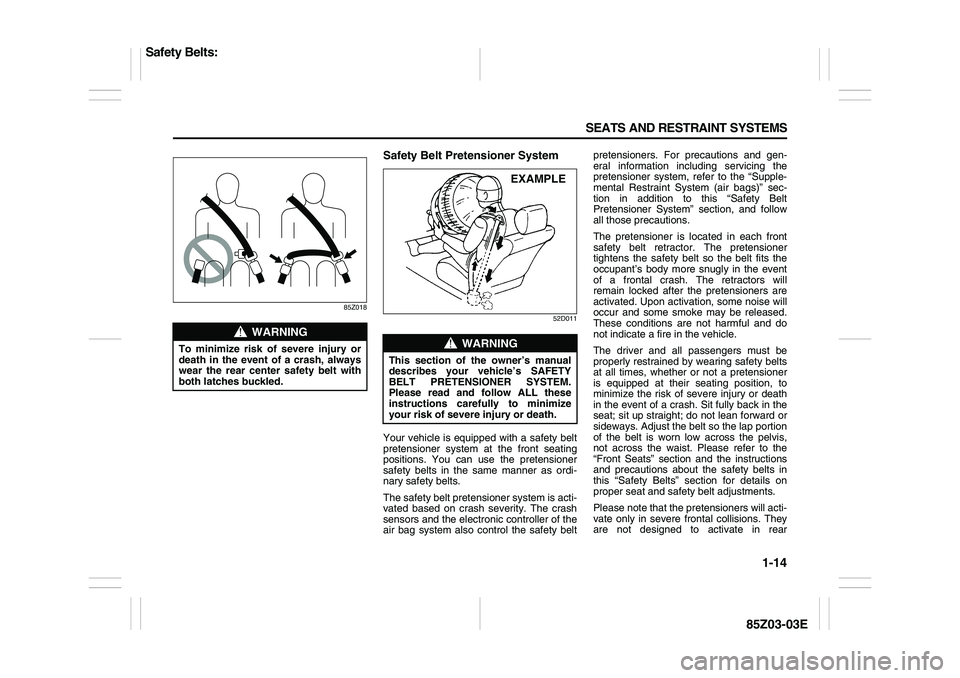
85Z018
Safety Belt Pretensioner System
52D011
Your vehicle is equipped with a safety belt
pretensioner system at the front seating
positions. You can use the pretensioner
safety belts in the same manner as ordi-
nary safety belts.
The safety belt pretensioner system is acti-
vated based on crash severity. The crash
sensors and the electronic controller of the
air bag system also control the safety beltpretensioners. For precautions and gen-
eral information including servicing the
pretensioner system, refer to the “Supple-
mental Restraint System (air bags)” sec-
tion in addition to this “Safety Belt
Pretensioner System” section, and follow
all those precautions.
The pretensioner is located in each front
safety belt retractor. The pretensioner
tightens the safety belt so the belt fits the
occupant’s body more snugly in the event
of a frontal crash. The retractors will
remain locked after the pretensioners are
activated. Upon activation, some noise will
occur and some smoke may be released.
These conditions are not harmful and do
not indicate a fire in the vehicle.
The driver and all passengers must be
properly restrained by wearing safety belts
at all times, whether or not a pretensioner
is equipped at their seating position, to
minimize the risk of severe injury or death
in the event of a crash. Sit fully back in the
seat; sit up straight; do not lean forward or
sideways. Adjust the belt so the lap portion
of the belt is worn low across the pelvis,
not across the waist. Please refer to the
“Front Seats” section and the instructions
and precautions about the safety belts in
this “Safety Belts” section for details on
proper seat and safety belt adjustments.
Please note that the pretensioners will acti-
vate only in severe frontal collisions. They
are not designed to activate in rear
WARNING
To minimize risk of severe injury or
death in the event of a crash, always
wear the rear center safety belt with
both latches buckled.
WARNING
This section of the owner’s manual
describes your vehicle’s SAFETY
BELT PRETENSIONER SYSTEM.
Please read and follow ALL these
instructions carefully to minimize
your risk of severe injury or death.
EXAMPLE
Safety Belts:
Page 27 of 225
1-15 SEATS AND RESTRAINT SYSTEMS
85Z03-03E
impacts, side impacts, rollovers or minor
frontal collisions. The pretensioners can be
activated only once. If the pretensioners
are activated, have the pretensioner sys-
tem serviced by an authorized SUZUKI
dealer as soon as possible.
If the air bag readiness light on the instru-
ment cluster does not blink or come on
briefly when the ignition switch is turned to
the “ON” position, stays on for more than
10 seconds, or comes on while driving, the
pretensioner system or the air bag system
may not work properly. Have both systems
inspected by an authorized SUZUKI dealer
as soon as possible.
Service on or around the pretensioner sys-
tem components or wiring must be per-
formed only by an authorized SUZUKI
dealer who is specially trained. Improper
service could result in unintended activa-
tion of pretensioners or could render the
pretensioners inoperative. Either of these
two conditions may result in personal
injury.
To prevent damage or unintended activa-
tion of the pretensioners, be sure the bat-
tery is disconnected and the ignition switch
has been in the “LOCK” position for at least
60 seconds before performing any electri-
cal service work on your SUZUKI. Do not
touch pretensioner system components or
wiring. The wires are wrapped with yellow
tape or yellow tubing, and the couplers are
yellow. When scrapping your SUZUKI, askyour SUZUKI dealer, body repair shop or
scrap yard for assistance.
Safety Belt Extender
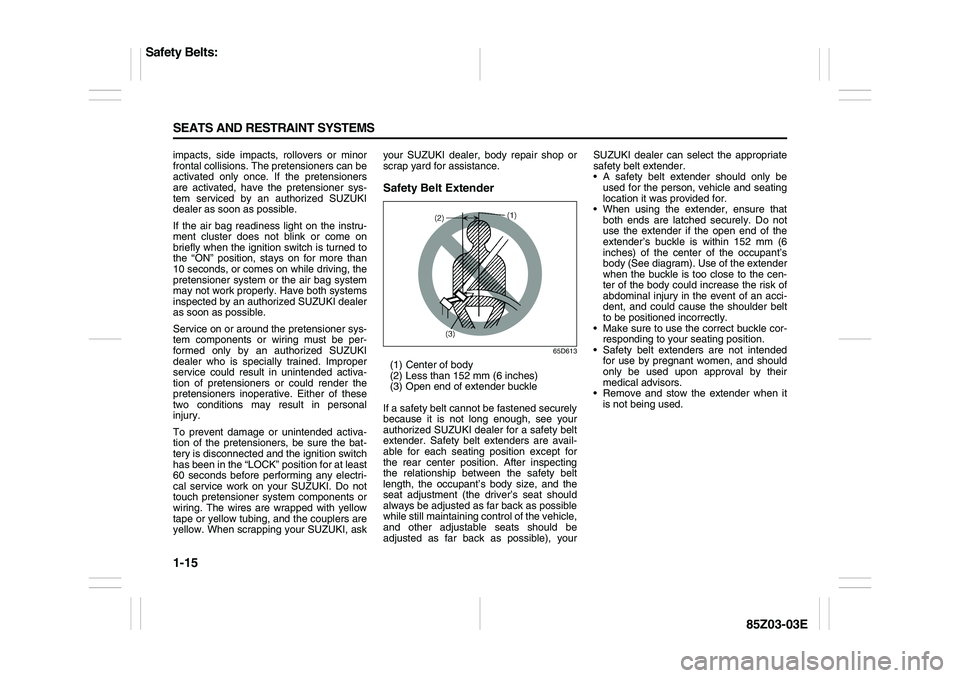
65D613
(1) Center of body
(2) Less than 152 mm (6 inches)
(3) Open end of extender buckle
If a safety belt cannot be fastened securely
because it is not long enough, see your
authorized SUZUKI dealer for a safety belt
extender. Safety belt extenders are avail-
able for each seating position except for
the rear center position. After inspecting
the relationship between the safety belt
length, the occupant’s body size, and the
seat adjustment (the driver’s seat should
always be adjusted as far back as possible
while still maintaining control of the vehicle,
and other adjustable seats should be
adjusted as far back as possible), yourSUZUKI dealer can select the appropriate
safety belt extender.
A safety belt extender should only be
used for the person, vehicle and seating
location it was provided for.
When using the extender, ensure that
both ends are latched securely. Do not
use the extender if the open end of the
extender’s buckle is within 152 mm (6
inches) of the center of the occupant’s
body (See diagram). Use of the extender
when the buckle is too close to the cen-
ter of the body could increase the risk of
abdominal injury in the event of an acci-
dent, and could cause the shoulder belt
to be positioned incorrectly.
Make sure to use the correct buckle cor-
responding to your seating position.
Safety belt extenders are not intended
for use by pregnant women, and should
only be used upon approval by their
medical advisors.
Remove and stow the extender when it
is not being used.
Safety Belts:
Page 37 of 225
1-25 SEATS AND RESTRAINT SYSTEMS
85Z03-03E
Securing a Child Restraint in a Rear
Seat PositionIf your child restraint is equipped with the
LATCH system, see “Lower Anchorages
and Top Tethers for Children (LATCH Sys-
tem)” in this section. See “Top Strap” in this
section if the child restraint has one.
If your child restraint does not have the
LATCH system, you will be using the lap-
shoulder belt to secure the child restraint in
this position. Be sure to follow the instruc-
tions that came with the child restraint.
Secure the child in the child restraint when
and as the instructions say.
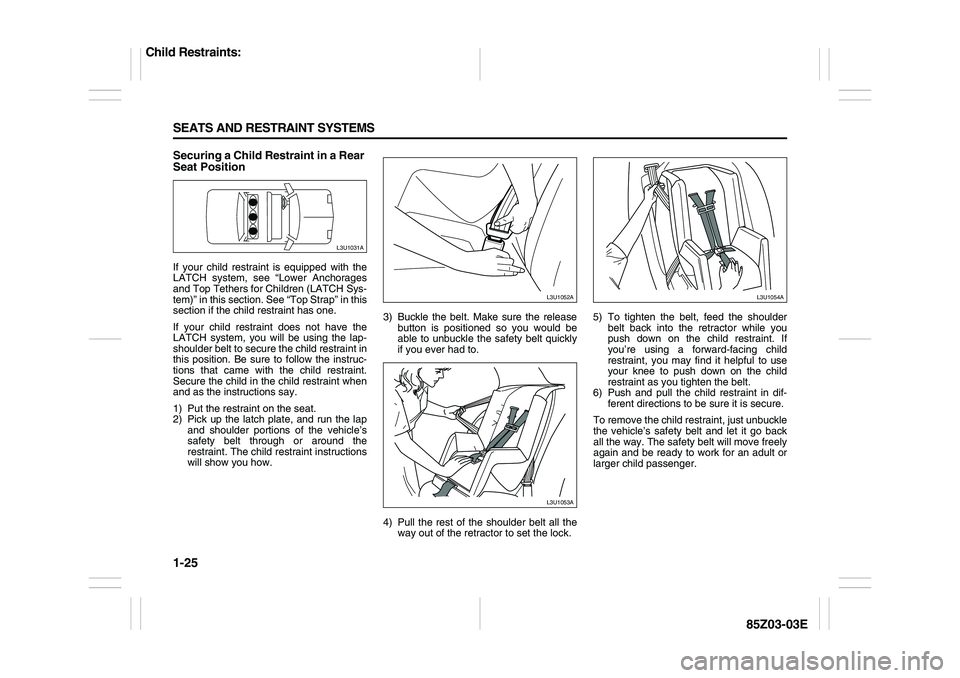
1) Put the restraint on the seat.
2) Pick up the latch plate, and run the lap
and shoulder portions of the vehicle’s
safety belt through or around the
restraint. The child restraint instructions
will show you how. 3) Buckle the belt. Make sure the release
button is positioned so you would be
able to unbuckle the safety belt quickly
if you ever had to.
4) Pull the rest of the shoulder belt all the
way out of the retractor to set the lock.5) To tighten the belt, feed the shoulder
belt back into the retractor while you
push down on the child restraint. If
you’re using a forward-facing child
restraint, you may find it helpful to use
your knee to push down on the child
restraint as you tighten the belt.
6) Push and pull the child restraint in dif-
ferent directions to be sure it is secure.
To remove the child restraint, just unbuckle
the vehicle’s safety belt and let it go back
all the way. The safety belt will move freely
again and be ready to work for an adult or
larger child passenger.
L3U1031A
L3U1052AL3U1053A
L3U1054A
Child Restraints:
Page 39 of 225
1-27 SEATS AND RESTRAINT SYSTEMS
85Z03-03E
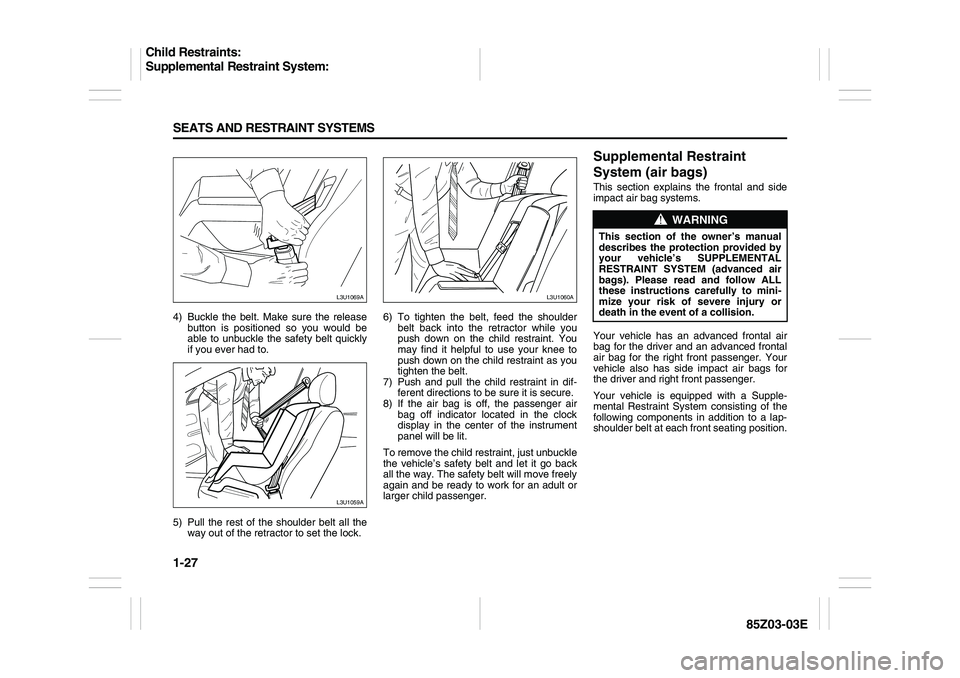
4) Buckle the belt. Make sure the release
button is positioned so you would be
able to unbuckle the safety belt quickly
if you ever had to.
5) Pull the rest of the shoulder belt all the
way out of the retractor to set the lock.6) To tighten the belt, feed the shoulder
belt back into the retractor while you
push down on the child restraint. You
may find it helpful to use your knee to
push down on the child restraint as you
tighten the belt.
7) Push and pull the child restraint in dif-
ferent directions to be sure it is secure.
8) If the air bag is off, the passenger air
bag off indicator located in the clock
display in the center of the instrument
panel will be lit.
To remove the child restraint, just unbuckle
the vehicle’s safety belt and let it go back
all the way. The safety belt will move freely
again and be ready to work for an adult or
larger child passenger.
Supplemental Restraint
System (air bags)This section explains the frontal and side
impact air bag systems.
Your vehicle has an advanced frontal air
bag for the driver and an advanced frontal
air bag for the right front passenger. Your
vehicle also has side impact air bags for
the driver and right front passenger.
Your vehicle is equipped with a Supple-
mental Restraint System consisting of the
following components in addition to a lap-
shoulder belt at each front seating position.
L3U1069AL3U1059A
L3U1061AL3U1060A
WARNING
This section of the owner’s manual
describes the protection provided by
your vehicle’s SUPPLEMENTAL
RESTRAINT SYSTEM (advanced air
bags). Please read and follow ALL
these instructions carefully to mini-
mize your risk of severe injury or
death in the event of a collision.
Child Restraints:
Supplemental Restraint System:
Page 43 of 225
1-31 SEATS AND RESTRAINT SYSTEMS
85Z03-03E
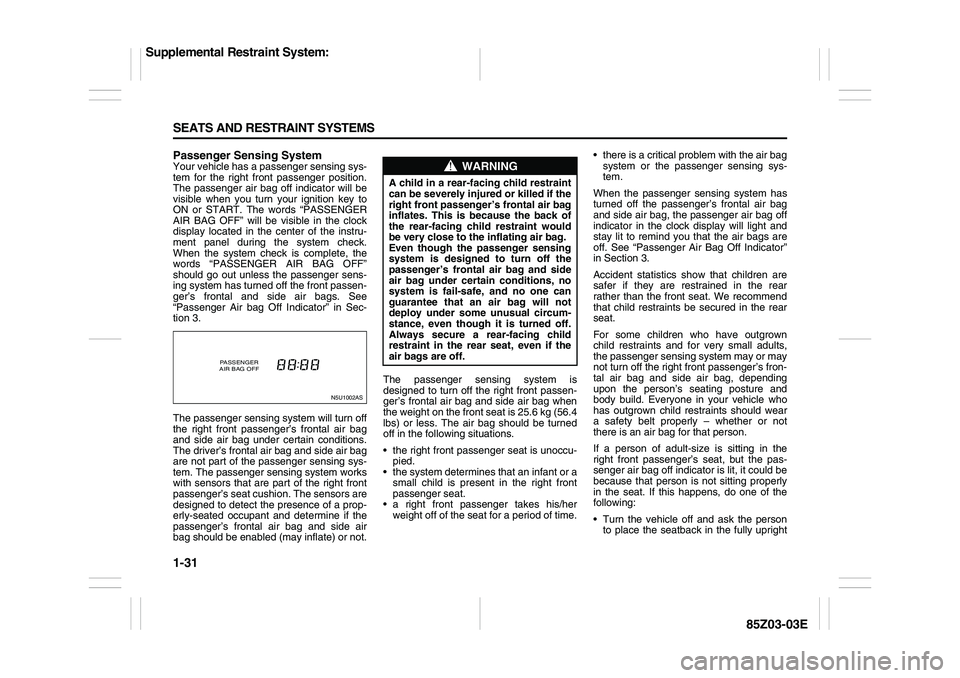
Passenger Sensing SystemYour vehicle has a passenger sensing sys-
tem for the right front passenger position.
The passenger air bag off indicator will be
visible when you turn your ignition key to
ON or START. The words “PASSENGER
AIR BAG OFF” will be visible in the clock
display located in the center of the instru-
ment panel during the system check.
When the system check is complete, the
words “PASSENGER AIR BAG OFF”
should go out unless the passenger sens-
ing system has turned off the front passen-
ger’s frontal and side air bags. See
“Passenger Air bag Off Indicator” in Sec-
tion 3.
The passenger sensing system will turn off
the right front passenger’s frontal air bag
and side air bag under certain conditions.
The driver’s frontal air bag and side air bag
are not part of the passenger sensing sys-
tem. The passenger sensing system works
with sensors that are part of the right front
passenger’s seat cushion. The sensors are
designed to detect the presence of a prop-
erly-seated occupant and determine if the
passenger’s frontal air bag and side air
bag should be enabled (may inflate) or not.The passenger sensing system is
designed to turn off the right front passen-
ger’s frontal air bag and side air bag when
the weight on the front seat is 25.6 kg (56.4
lbs) or less. The air bag should be turned
off in the following situations.
the right front passenger seat is unoccu-
pied.
the system determines that an infant or a
small child is present in the right front
passenger seat.
a right front passenger takes his/her
weight off of the seat for a period of time. there is a critical problem with the air bag
system or the passenger sensing sys-
tem.
When the passenger sensing system has
turned off the passenger’s frontal air bag
and side air bag, the passenger air bag off
indicator in the clock display will light and
stay lit to remind you that the air bags are
off. See “Passenger Air Bag Off Indicator”
in Section 3.
Accident statistics show that children are
safer if they are restrained in the rear
rather than the front seat. We recommend
that child restraints be secured in the rear
seat.
For some children who have outgrown
child restraints and for very small adults,
the passenger sensing system may or may
not turn off the right front passenger’s fron-
tal air bag and side air bag, depending
upon the person’s seating posture and
body build. Everyone in your vehicle who
has outgrown child restraints should wear
a safety belt properly – whether or not
there is an air bag for that person.
If a person of adult-size is sitting in the
right front passenger’s seat, but the pas-
senger air bag off indicator is lit, it could be
because that person is not sitting properly
in the seat. If this happens, do one of the
following:
Turn the vehicle off and ask the person
to place the seatback in the fully upright
N5U1002AS
PASSENGER
AIR BAG OFF
WARNING
A child in a rear-facing child restraint
can be severely injured or killed if the
right front passenger’s frontal air bag
inflates. This is because the back of
the rear-facing child restraint would
be very close to the inflating air bag.
Even though the passenger sensing
system is designed to turn off the
passenger’s frontal air bag and side
air bag under certain conditions, no
system is fail-safe, and no one can
guarantee that an air bag will not
deploy under some unusual circum-
stance, even though it is turned off.
Always secure a rear-facing child
restraint in the rear seat, even if the
air bags are off.
Supplemental Restraint System:
Page 48 of 225
FEATURES AND CONTROLS
2
85Z03-03E
FEATURES AND CONTROLSKeys ...................................................................................... 2-1
Doors and Locks ................................................................. 2-4
Windows .............................................................................. 2-8
Theft-Deterrent Systems .................................................... 2-10
Daily Inspection Checklist .................................................. 2-11
Starting and Operating Your Vehicle ................................ 2-12
Mirrors .................................................................................. 2-21
Storage Areas ...................................................................... 2-22
Sunroof ................................................................................ 2-26
Page 49 of 225
2-1 FEATURES AND CONTROLS
85Z03-03E
Keys
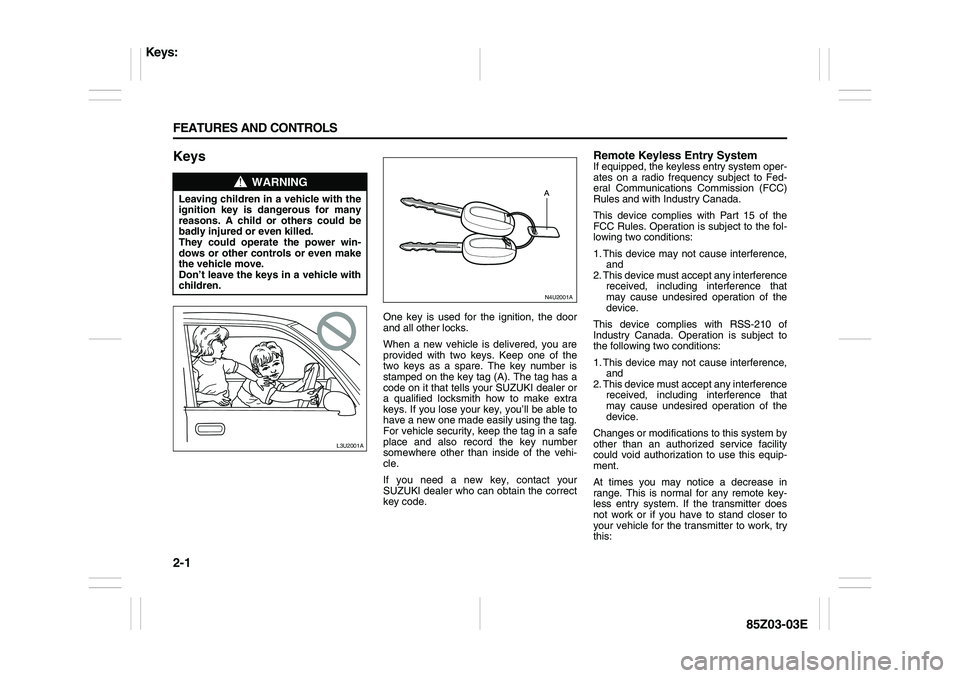
One key is used for the ignition, the door
and all other locks.
When a new vehicle is delivered, you are
provided with two keys. Keep one of the
two keys as a spare. The key number is
stamped on the key tag (A). The tag has a
code on it that tells your SUZUKI dealer or
a qualified locksmith how to make extra
keys. If you lose your key, you’ll be able to
have a new one made easily using the tag.
For vehicle security, keep the tag in a safe
place and also record the key number
somewhere other than inside of the vehi-
cle.
If you need a new key, contact your
SUZUKI dealer who can obtain the correct
key code.
Remote Keyless Entry SystemIf equipped, the keyless entry system oper-
ates on a radio frequency subject to Fed-
eral Communications Commission (FCC)
Rules and with Industry Canada.
This device complies with Part 15 of the
FCC Rules. Operation is subject to the fol-
lowing two conditions:
1. This device may not cause interference,
and
2. This device must accept any interference
received, including interference that
may cause undesired operation of the
device.
This device complies with RSS-210 of
Industry Canada. Operation is subject to
the following two conditions:
1. This device may not cause interference,
and
2. This device must accept any interference
received, including interference that
may cause undesired operation of the
device.
Changes or modifications to this system by
other than an authorized service facility
could void authorization to use this equip-
ment.
At times you may notice a decrease in
range. This is normal for any remote key-
less entry system. If the transmitter does
not work or if you have to stand closer to
your vehicle for the transmitter to work, try
this:
WARNING
Leaving children in a vehicle with the
ignition key is dangerous for many
reasons. A child or others could be
badly injured or even killed.
They could operate the power win-
dows or other controls or even make
the vehicle move.
Don’t leave the keys in a vehicle with
children.
L3U2001A
N4U2001A
Keys:
Page 50 of 225
2-2 FEATURES AND CONTROLS
85Z03-03E
Check the distance. You may be too far
from your vehicle. You may need to
stand closer during rainy or snowy
weather.
Check the location. Other vehicles or
objects may be blocking the signal. Take
a few steps to the left or right, hold the
transmitter higher, and try again.
Check to determine if battery replace-
ment is necessary. See “Battery
Replacement” under Remote Keyless
Entry System Operation in this section.
If you are still having trouble, see your
SUZUKI dealer or a qualified technician
for service.
Remote Keyless Entry System
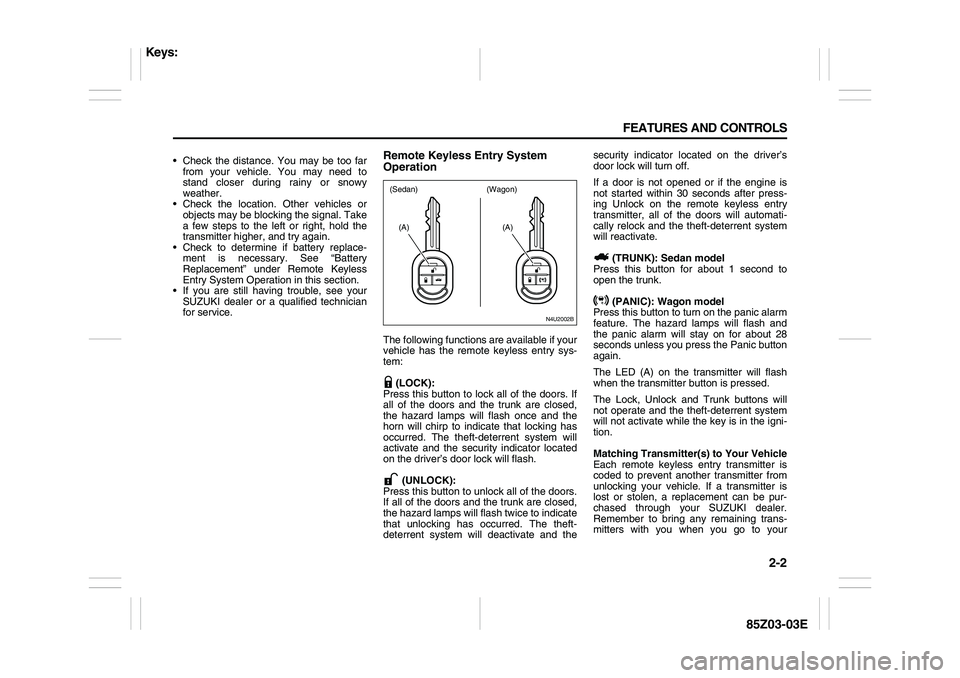
OperationThe following functions are available if your
vehicle has the remote keyless entry sys-
tem:
(LOCK):
Press this button to lock all of the doors. If
all of the doors and the trunk are closed,
the hazard lamps will flash once and the
horn will chirp to indicate that locking has
occurred. The theft-deterrent system will
activate and the security indicator located
on the driver’s door lock will flash.
(UNLOCK):
Press this button to unlock all of the doors.
If all of the doors and the trunk are closed,
the hazard lamps will flash twice to indicate
that unlocking has occurred. The theft-
deterrent system will deactivate and thesecurity indicator located on the driver’s
door lock will turn off.
If a door is not opened or if the engine is
not started within 30 seconds after press-
ing Unlock on the remote keyless entry
transmitter, all of the doors will automati-
cally relock and the theft-deterrent system
will reactivate.
(TRUNK): Sedan model
Press this button for about 1 second to
open the trunk.
(PANIC): Wagon model
Press this button to turn on the panic alarm
feature. The hazard lamps will flash and
the panic alarm will stay on for about 28
seconds unless you press the Panic button
again.
The LED (A) on the transmitter will flash
when the transmitter button is pressed.
The Lock, Unlock and Trunk buttons will
not operate and the theft-deterrent system
will not activate while the key is in the igni-
tion.
Matching Transmitter(s) to Your Vehicle
Each remote keyless entry transmitter is
coded to prevent another transmitter from
unlocking your vehicle. If a transmitter is
lost or stolen, a replacement can be pur-
chased through your SUZUKI dealer.
Remember to bring any remaining trans-
mitters with you when you go to your
N4U2002B
(A)
(A)
(Sedan) (Wagon)
Keys:
Page 51 of 225
2-3 FEATURES AND CONTROLS
85Z03-03E
SUZUKI dealer. When the dealer matches
the replacement transmitter to your vehi-
cle, any remaining transmitters must also
be matched. Once your SUZUKI dealer
has coded the new transmitter, the lost
transmitter will not unlock your vehicle.
Each vehicle can have a maximum of four
transmitters matched to it.
Battery Replacement
Under normal use, the battery in your
remote keyless entry transmitter should
last about two years.
You can tell the battery is weak if the LED
(A) fails to illuminate or if the transmitter
won’t work at the normal range in any loca-
tion. If you have to get close to your vehicle
before the transmitter works, it’s probably
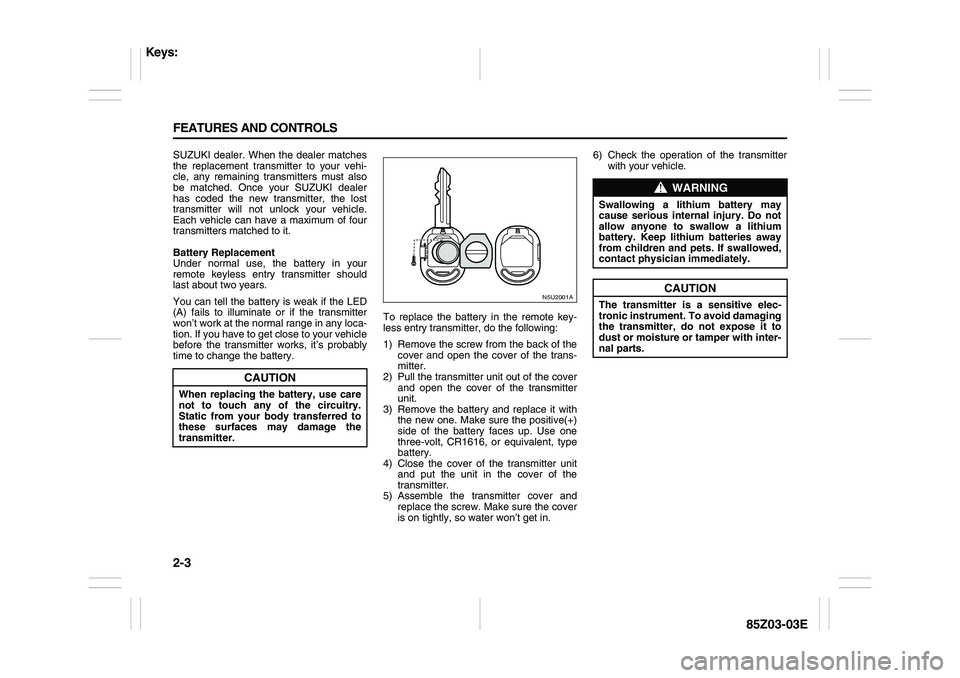
time to change the battery.To replace the battery in the remote key-
less entry transmitter, do the following:
1) Remove the screw from the back of the
cover and open the cover of the trans-
mitter.
2) Pull the transmitter unit out of the cover
and open the cover of the transmitter
unit.
3) Remove the battery and replace it with
the new one. Make sure the positive(+)
side of the battery faces up. Use one
three-volt, CR1616, or equivalent, type
battery.
4) Close the cover of the transmitter unit
and put the unit in the cover of the
transmitter.
5) Assemble the transmitter cover and
replace the screw. Make sure the cover
is on tightly, so water won’t get in.6) Check the operation of the transmitter
with your vehicle.
CAUTION
When replacing the battery, use care
not to touch any of the circuitry.
Static from your body transferred to
these surfaces may damage the
transmitter.
N5U2001A
WARNING
Swallowing a lithium battery may
cause serious internal injury. Do not
allow anyone to swallow a lithium
battery. Keep lithium batteries away
from children and pets. If swallowed,
contact physician immediately.
CAUTION
The transmitter is a sensitive elec-
tronic instrument. To avoid damaging
the transmitter, do not expose it to
dust or moisture or tamper with inter-
nal parts.
Keys:
Page 52 of 225
2-4 FEATURES AND CONTROLS
85Z03-03E
Doors and LocksDoor LocksThere are several ways to lock and unlock
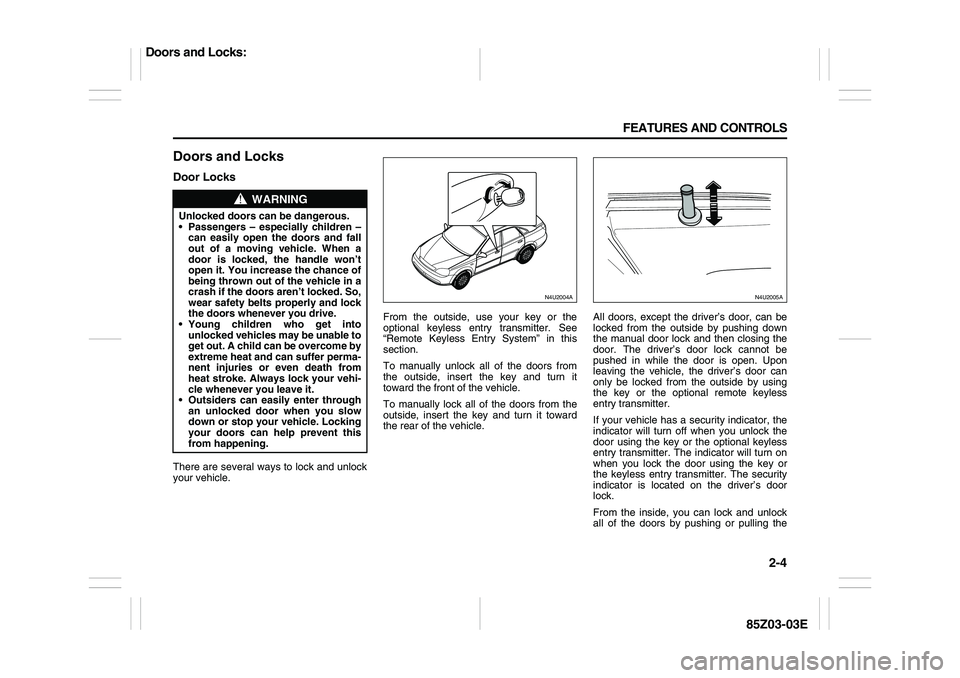
your vehicle.From the outside, use your key or the
optional keyless entry transmitter. See
“Remote Keyless Entry System” in this
section.
To manually unlock all of the doors from
the outside, insert the key and turn it
toward the front of the vehicle.
To manually lock all of the doors from the
outside, insert the key and turn it toward
the rear of the vehicle.All doors, except the driver’s door, can be
locked from the outside by pushing down
the manual door lock and then closing the
door. The driver’s door lock cannot be
pushed in while the door is open. Upon
leaving the vehicle, the driver’s door can
only be locked from the outside by using
the key or the optional remote keyless
entry transmitter.
If your vehicle has a security indicator, the
indicator will turn off when you unlock the
door using the key or the optional keyless
entry transmitter. The indicator will turn on
when you lock the door using the key or
the keyless entry transmitter. The security
indicator is located on the driver’s door
lock.
From the inside, you can lock and unlock
all of the doors by pushing or pulling the
WARNING
Unlocked doors can be dangerous.
Passengers – especially children –
can easily open the doors and fall
out of a moving vehicle. When a
door is locked, the handle won’t
open it. You increase the chance of
being thrown out of the vehicle in a
crash if the doors aren’t locked. So,
wear safety belts properly and lock
the doors whenever you drive.
Young children who get into
unlocked vehicles may be unable to
get out. A child can be overcome by
extreme heat and can suffer perma-
nent injuries or even death from
heat stroke. Always lock your vehi-
cle whenever you leave it.
Outsiders can easily enter through
an unlocked door when you slow
down or stop your vehicle. Locking
your doors can help prevent this
from happening.
N4U2004A
N4U2005A
Doors and Locks: