service indicator SUZUKI FORENZA 2007 User Guide
[x] Cancel search | Manufacturer: SUZUKI, Model Year: 2007, Model line: FORENZA, Model: SUZUKI FORENZA 2007Pages: 225, PDF Size: 4.39 MB
Page 146 of 225
5-2 SERVICE AND APPEARANCE CARE
85Z03-03E
AdditivesTo provide cleaner air, all gasolines in the
United States are now required to contain
additives that will help prevent engine and
fuel system deposits from forming, allow-
ing your emission control system to work
properly. You should not have to add any-
thing to your fuel. However, some gaso-
lines contain only the minimum amount of
additive required to meet U.S. Environ-
mental Protection Agency regulations.
SUZUKI recommends that you buy gaso-
lines that are advertised to help keep fuel
injectors and intake valves clean. If your
vehicle experiences problems due to dirty
injectors or valves, try a different brand of
gasoline.
Gasoline containing oxygenates, such as
ethers and ethanol, and reformulated gas-
olines may be available in your area to
contribute to clean air. SUZUKI recom-
mends that you use these gasolines.
Some gasolines that are not reformulated
for low emissions may contain an octane-
enhancing additive called methylcyclopen-tadienyl manganese tricarbonyl (MMT);
ask the attendant where you buy gasoline
whether the fuel contains MMT. SUZUKI
does not recommend the use of such gas-
olines. Fuels containing MMT can reduce
the life of spark plugs and the performance
of the emission control system may be
affected. The malfunction indicator lamp
may turn on. If this occurs, return to your
SUZUKI dealer for service.
Fuels in Foreign CountriesIf you plan on driving in another country
outside the United States or Canada, the
proper fuel may be hard to find. Never use
leaded gasoline or any other fuel not rec-
ommended in the previous text on fuel.
Costly repairs caused by use of improper
fuel wouldn’t be covered by your warranty.
To check the fuel availability, ask an auto
club, or contact a major oil company that
does business in the country where you’ll
be driving.
Filling Your Tank
CAUTION
Your vehicle was not designed for
fuel that contains methanol. Don’t
use fuel containing methanol. It can
corrode metal parts in your fuel sys-
tem and also damage the plastic and
rubber parts. That damage wouldn’t
be covered under your warranty.
WARNING
Fuel vapor burns violently and a fuel
fire can cause severe injuries. To help
avoid injuries to you and others, read
and follow all the instructions on the
pump island. Turn off your engine
when you are refueling. Don’t smoke
if you’re near fuel or are refueling
your vehicle. Keep sparks, flames
and smoking materials away from
fuel. Don’t leave the fuel pump unat-
tended when refueling your vehicle –
this is against the law in some
places. Keep children away from the
fuel pump; never let children pump
fuel.
Fuel:
Page 147 of 225
5-3 SERVICE AND APPEARANCE CARE
85Z03-03E
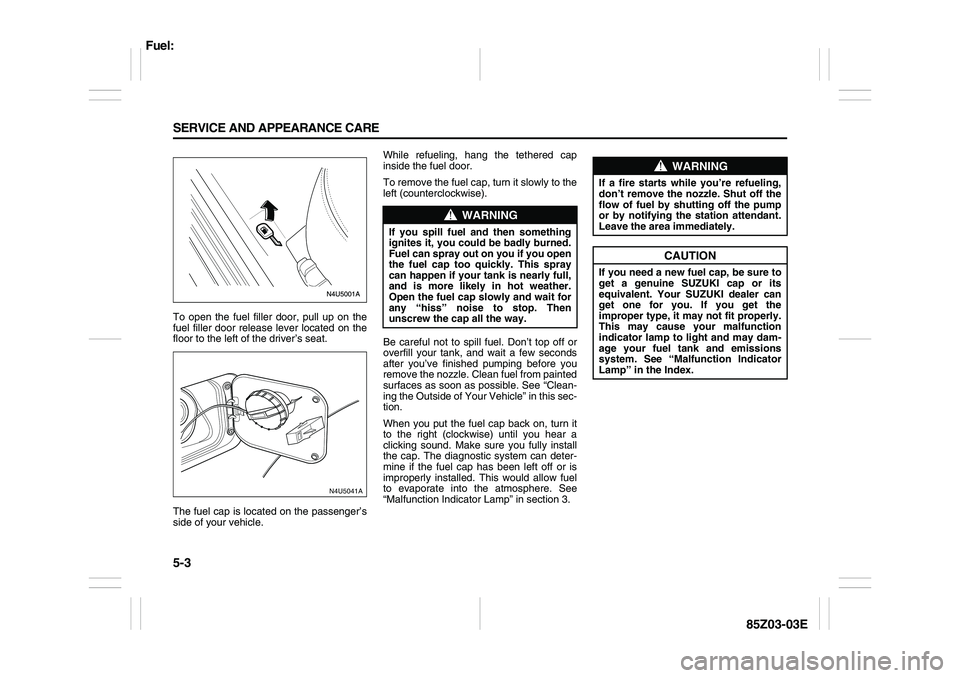
To open the fuel filler door, pull up on the
fuel filler door release lever located on the
floor to the left of the driver’s seat.
The fuel cap is located on the passenger’s
side of your vehicle.While refueling, hang the tethered cap
inside the fuel door.
To remove the fuel cap, turn it slowly to the
left (counterclockwise).
Be careful not to spill fuel. Don’t top off or
overfill your tank, and wait a few seconds
after you’ve finished pumping before you
remove the nozzle. Clean fuel from painted
surfaces as soon as possible. See “Clean-
ing the Outside of Your Vehicle” in this sec-
tion.
When you put the fuel cap back on, turn it
to the right (clockwise) until you hear a
clicking sound. Make sure you fully install
the cap. The diagnostic system can deter-
mine if the fuel cap has been left off or is
improperly installed. This would allow fuel
to evaporate into the atmosphere. See
“Malfunction Indicator Lamp” in section 3.
N4U5041A
WARNING
If you spill fuel and then something
ignites it, you could be badly burned.
Fuel can spray out on you if you open
the fuel cap too quickly. This spray
can happen if your tank is nearly full,
and is more likely in hot weather.
Open the fuel cap slowly and wait for
any “hiss” noise to stop. Then
unscrew the cap all the way.
WARNING
If a fire starts while you’re refueling,
don’t remove the nozzle. Shut off the
flow of fuel by shutting off the pump
or by notifying the station attendant.
Leave the area immediately.
CAUTION
If you need a new fuel cap, be sure to
get a genuine SUZUKI cap or its
equivalent. Your SUZUKI dealer can
get one for you. If you get the
improper type, it may not fit properly.
This may cause your malfunction
indicator lamp to light and may dam-
age your fuel tank and emissions
system. See “Malfunction Indicator
Lamp” in the Index.
Fuel:
Page 176 of 225
5-32 SERVICE AND APPEARANCE CARE
85Z03-03E
mounted on a vehicle. The side of the tire
that contains a whitewall, bears white let-
tering or bears manufacturer, brand and or
model name molding that is higher or
deeper than the same moldings on the
other sidewall of the tire.
Passenger (P-Metric) Tire:
A tire used on passenger cars and some
light duty trucks and multipurpose vehicles.
Production Options Weight:
The combined weight of those installed
regular production options weighing over
2.3 kilograms in excess of those standard
items which they replace, not previously
considered in curb weight or accessory
weight, including heavy duty brakes, ride
levelers, roof rack, heavy duty battery, and
special trim.
Recommended Inflation Pressure:
Vehicle manufacturer’s recommended tire
inflation pressure shown on the tire plac-
ard.
Radial Ply Tire:
A pneumatic tire in which the ply cords that
extend to the beads are laid at 90 degrees
to the centerline of the tread.
Rim:
A metal support for a tire and upon which
the tire beads are seated.
Sidewall:
The portion of a tire between the tread and
the bead.Speed Rating:
An alphanumeric code assigned to a tire
indicating the maximum speed at which a
tire can operate.
Traction:
The friction between the tire and the road
surface. The amount of grip provided.
Tread:
The portion of a tire that comes into con-
tact with the road.
Tread wear Indicators:
Narrow bands, sometimes called “wear
bars,” that show across the tread of a tire
when only 2/32 inch of tread remains.
UTQGS:
Uniform Tire Quality Grading Standards, a
tire information system that provides con-
sumers with ratings for a tire’s traction,
temperature and tread wear. Ratings are
determined by tire manufacturers using
government testing procedures. The rat-
ings are molded into the sidewall of the
tire.
Vehicle Capacity Weight:
The number of designated seating posi-
tions multiplied by 150 lbs (68 kg) plus the
rated cargo load.
Vehicle Maximum Load on the Tire:
The load on an individual tire that is deter-
mined by distributing to each axle its share
of the maximum loaded vehicle weight and
dividing by two.Vehicle Normal Load on the Tire:
The load on an individual tire that is deter-
mined by distributing to each axle its share
of the curb weight, accessory weight, and
normal occupant weight (distributed in
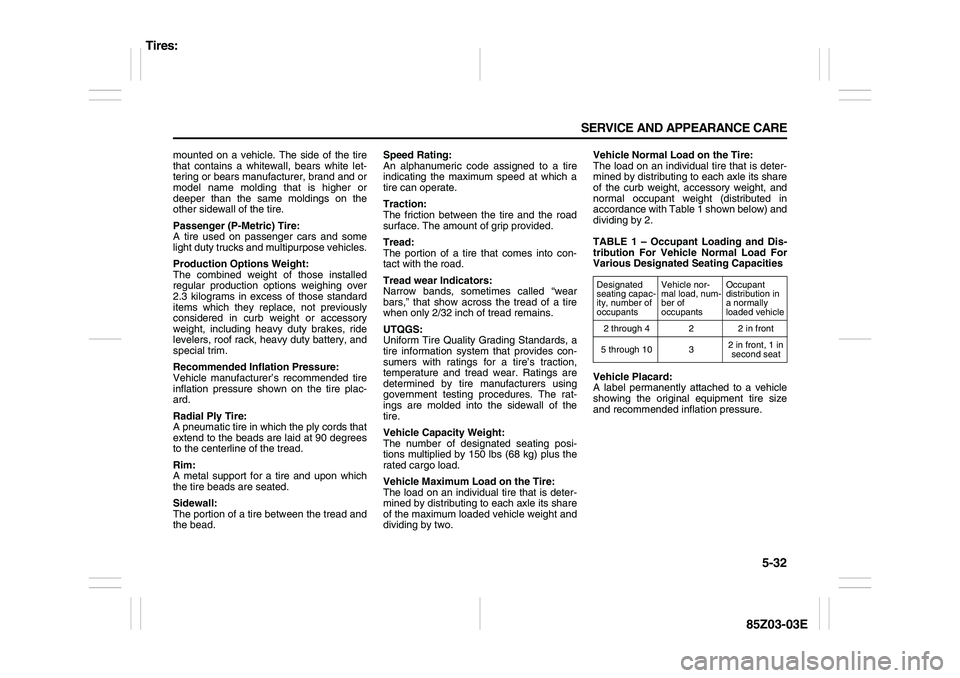
accordance with Table 1 shown below) and
dividing by 2.
TABLE 1 – Occupant Loading and Dis-
tribution For Vehicle Normal Load For
Various Designated Seating Capacities
Vehicle Placard:
A label permanently attached to a vehicle
showing the original equipment tire size
and recommended inflation pressure.
Designated
seating capac-
ity, number of
occupantsVehicle nor-
mal load, num-
ber of
occupantsOccupant
distribution in
a normally
loaded vehicle
2 through 4 2 2 in front
5 through 10 32 in front, 1 in
second seat
Tires:
Page 178 of 225
5-34 SERVICE AND APPEARANCE CARE
85Z03-03E
itoring system. Have tire and wheel
replacement performed by an authorized
service facility to avoid the risk of damag-
ing the tire pressure monitor sensors.
The tire pressure monitoring system may
not work normally in the following circum-
stances:
Wheels other than genuine wheels are
being used.
Wheels whose ID codes are not memo-
rized by the vehicle are used. The moni-
toring system should be set up by an
authorized service facility.
Wheels that are not fitted with tire pres-
sure sensors are being used.
The tire inflation pressure sensors’ bat-
tery is exhausted.
A wireless facility or device using the
same frequency is near the vehicle.
Snow or ice is stuck inside the fenders
and/or on the wheels.
The tire pressure monitoring system oper-
ates on a radio frequency subject to Fed-eral Communications Commission (FCC)
Rules and with Industry and Science Can-
ada.
This device complies with Part 15 of the
FCC Rules and with RSS-210 of Industry
and Science Canada. Operation is subject
to the following two conditions: (1) This
device may not cause harmful interference,
and (2) this device must accept any inter-
ference received including interference that
may cause undesired operation of the
device.
Correcting the Tire PressureTo permanently eliminate the low tire pres-
sure warning light, you must fill the tires
with the correct amount of air. However, at
the next vehicle start-up, the warning light
will reappear if the tire pressure is not cor-
rected. The best time to check your tire
pressure is when the tires are cold. A Tire
and Loading Information label, located on
the driver’s door near the door latch, shows
the correct inflation pressure for the tires
when they are cold. Cold means your vehi-
cle has been sitting for at least three hours
or driven no more than one mile. You may
notice during cooler conditions that low tire
pressure warning light will appear when
the vehicle is first started and then turn off
as you start to drive the vehicle. This could
be an early indicator that your tire pres-
sures are getting low and need to be
inflated to the proper pressure.
WARNING
Only use tires and wheels recom-
mended by us as standard or
optional equipment for your vehicle.
Use of tires or wheels not recom-
mended by us can result in TPMS fail-
ure. Refer to “Tires” in the “SERVICE
AND APPEARANCE CARE” section
for additional information.
WARNING
Changes or modifications expressly
approved by the party responsible for
compliance could void the user’s
authority to operate the equipment.
Tires:
Page 180 of 225
5-36 SERVICE AND APPEARANCE CARE
85Z03-03E
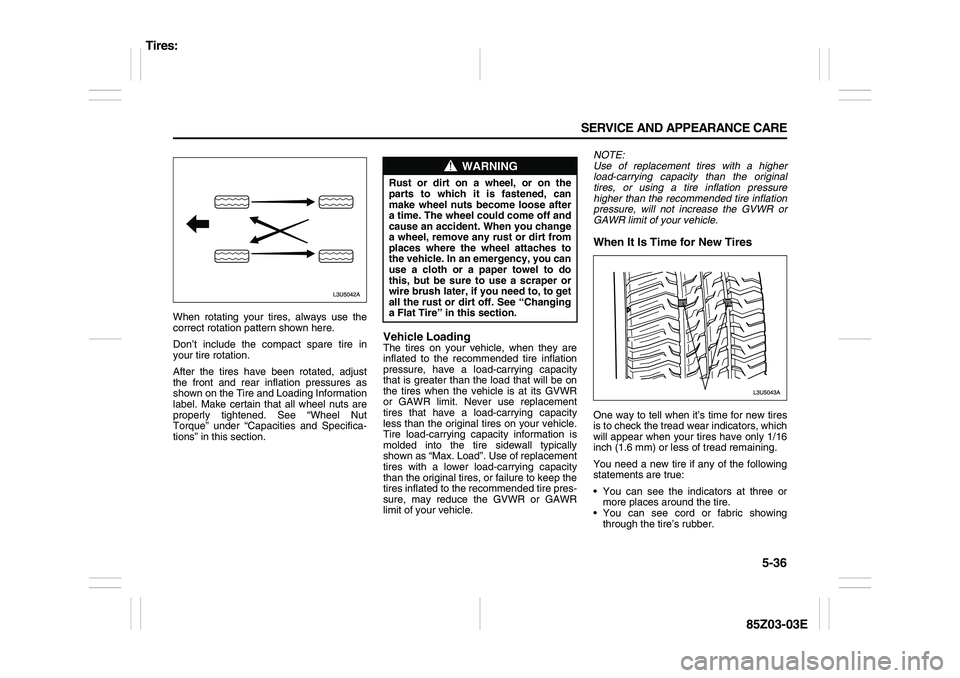
When rotating your tires, always use the
correct rotation pattern shown here.
Don’t include the compact spare tire in
your tire rotation.
After the tires have been rotated, adjust
the front and rear inflation pressures as
shown on the Tire and Loading Information
label. Make certain that all wheel nuts are
properly tightened. See “Wheel Nut
Torque” under “Capacities and Specifica-
tions” in this section.
Vehicle LoadingThe tires on your vehicle, when they are
inflated to the recommended tire inflation
pressure, have a load-carrying capacity
that is greater than the load that will be on
the tires when the vehicle is at its GVWR
or GAWR limit. Never use replacement
tires that have a load-carrying capacity
less than the original tires on your vehicle.
Tire load-carrying capacity information is
molded into the tire sidewall typically
shown as “Max. Load”. Use of replacement
tires with a lower load-carrying capacity
than the original tires, or failure to keep the
tires inflated to the recommended tire pres-
sure, may reduce the GVWR or GAWR
limit of your vehicle.NOTE:
Use of replacement tires with a higher
load-carrying capacity than the original
tires, or using a tire inflation pressure
higher than the recommended tire inflation
pressure, will not increase the GVWR or
GAWR limit of your vehicle.
When It Is Time for New TiresOne way to tell when it’s time for new tires
is to check the tread wear indicators, which
will appear when your tires have only 1/16
inch (1.6 mm) or less of tread remaining.
You need a new tire if any of the following
statements are true:
You can see the indicators at three or
more places around the tire.
You can see cord or fabric showing
through the tire’s rubber.
WARNING
Rust or dirt on a wheel, or on the
parts to which it is fastened, can
make wheel nuts become loose after
a time. The wheel could come off and
cause an accident. When you change
a wheel, remove any rust or dirt from
places where the wheel attaches to
the vehicle. In an emergency, you can
use a cloth or a paper towel to do
this, but be sure to use a scraper or
wire brush later, if you need to, to get
all the rust or dirt off. See “Changing
a Flat Tire” in this section.
Tires:
Page 188 of 225
5-44 SERVICE AND APPEARANCE CARE
85Z03-03E
Compact Spare TireAlthough the compact spare tire was fully
inflated when your vehicle was new, it can
lose air after a time. Check the inflation
pressure regularly. It should be 60 psi (420
kPa).
After installing the compact spare tire on
your vehicle, you should stop as soon as
possible and make sure your compact
spare tire is correctly inflated. The compact
spare tire is made to perform well at
speeds up to 50 mph (80 km/h), so you
can finish your trip and have your full-size
tire repaired or replaced where you want.
Of course, it’s best to replace your spare
with a full-size tire as soon as you can.
Your spare will last longer and be in good
shape in case you need it again.
Don’t use your compact spare tire on other
vehicles.
And don’t mix your compact spare tire or
wheel with other wheels or tires. They
won’t fit. Keep your compact spare tire and
its wheel together.
CAUTION
When the compact spare Tire is
installed, don’t take your vehicle
through an automatic car wash with
guide rails. The compact spare can
get caught on the rails. That can
damage the tire and wheel, and
maybe other parts of your vehicle.
CAUTION
Tire chains won’t fit your compact
spare tire. Using them can damage
your vehicle and can damage the
chains too. Don’t use tire chains on
your compact spare.
WARNING
The compact spare tire and wheel are
intended for temporary emergency
use only. Continuous use of the com-
pact spare tire can result in tire fail-
ure and loss of control. Always
observe these precautions when
using the compact spare tire:
Your vehicle will handle differently
with this temporary spare.
Do not exceed 80 km/h (50 mph)
speed.
Replace the compact spare tire
with a standard tire and wheel as
soon as possible.
Use of the compact spare tire will
reduce ground clearance.
Recommended air pressure for the
compact spare tire is 420 kPa (60
psi).
(Continued)
WARNING
(Continued)
Do not use tire chains on the com-
pact spare tire. If you must use tire
chains, rearrange the wheels so
standard tires and wheels are fitted
to the front axle.
The compact spare tire has a much
shorter tread life than the conven-
tional tires on your vehicle.
Replace the tire as soon as the
tread wear indicator appears.
When replacing the compact spare
tire, use a replacement tire with the
exact same size and construction.
Appearance Care:
Page 223 of 225
8-4 INDEX
85Z03-03E
Passenger Air Bag Off Indicator
........................................3-26
Passenger Compartment Air Filter ....................................3-17
Passenger Sensing System
................................................1-31
Power Door Locks
...............................................................2-5
Power Steering Fluid ...........................................................5-17
Power Windows
...................................................................2-9
Power Windows and Other Power Options
.......................5-50
QQuestions and Answers About Safety Belts
.....................1-7
RRadio with Six-Disc CD (Double Display, MP3/WMA)
(AGH-5400)
...........................................................................3-37
Rear Center Safety Belt (Sedan only)
................................1-13
Rear Door Security Locks
...................................................2-5
Rear Seat Armrest
...............................................................2-23
Rear Seat Passengers
.........................................................1-11
Rear Seats
............................................................................1-4
Rear Sidemarker Lamps
.....................................................5-27
Rear Window and Outside Rearview Mirror Defogger
.....3-16
Rear Window Washer/Wiper
...............................................3-7
Reclining Seatbacks
............................................................1-2
Recommended Fluids and Lubricants
..............................6-10
Recreational Vehicle Towing
..............................................4-16
Remote Keyless Entry System ...........................................2-1
Remote Keyless Entry System Operation
.........................2-2
Replacement Bulbs
.............................................................5-27
Replacing Restraint System Parts After a Crash
.............1-35
Reporting Safety Defects
....................................................7-4
Restraint System Check .....................................................1-34
Right Front Passenger Position
.........................................1-11
Roof Rack (Wagon only)
.....................................................2-25Running Your Engine While You Are Parked
................... 2-20
SSafety Belt: They are for Everyone .................................... 1-5
Safety Belt Extender
........................................................... 1-15
Safety Belt Pretensioner System
....................................... 1-14
Safety Belt Reminder Light
................................................ 3-19
Safety Belt Reminder Tone ................................................ 3-19
Safety Belt Use During Pregnancy
.................................... 1-10
Safety Belts
......................................................................... 1-5
Safety Certification Label
................................................... 7-2
Scheduled Maintenance Services
..................................... 6-2
Securing a Child Restraint Designed for the LATCH
System
................................................................................. 1-24
Securing a Child Restraint in a Rear Seat Position
......... 1-25
Securing a Child Restraint in the Right Front Seat
Position
................................................................................ 1-26
Securing a Child Restraint with Top Strap
....................... 1-22
Selecting the Right Condition
............................................ 6-1
Service
................................................................................. 5-1
Servicing Your Air Bag-Equipped Vehicle
........................ 1-34
Sheet Metal Damage
........................................................... 5-48
Shifting Into Park (P) .......................................................... 2-18
Shifting Out of Park (P) ...................................................... 2-18
Side Storage Box (Wagon only)
........................................ 2-24
Spare Tire
............................................................................ 5-44
Specifications
...................................................................... 5-54
Speed Sensitive Power Steering (SSPS) Warning
Light
..................................................................................... 3-22
Speedometer and Odometer
.............................................. 3-18
Starting and Operating Your Vehicle
................................ 2-12
Starting Your Engine
.......................................................... 2-13