warning SUZUKI FORENZA 2007 User Guide
[x] Cancel search | Manufacturer: SUZUKI, Model Year: 2007, Model line: FORENZA, Model: SUZUKI FORENZA 2007Pages: 225, PDF Size: 4.39 MB
Page 25 of 225
1-13 SEATS AND RESTRAINT SYSTEMS
85Z03-03E
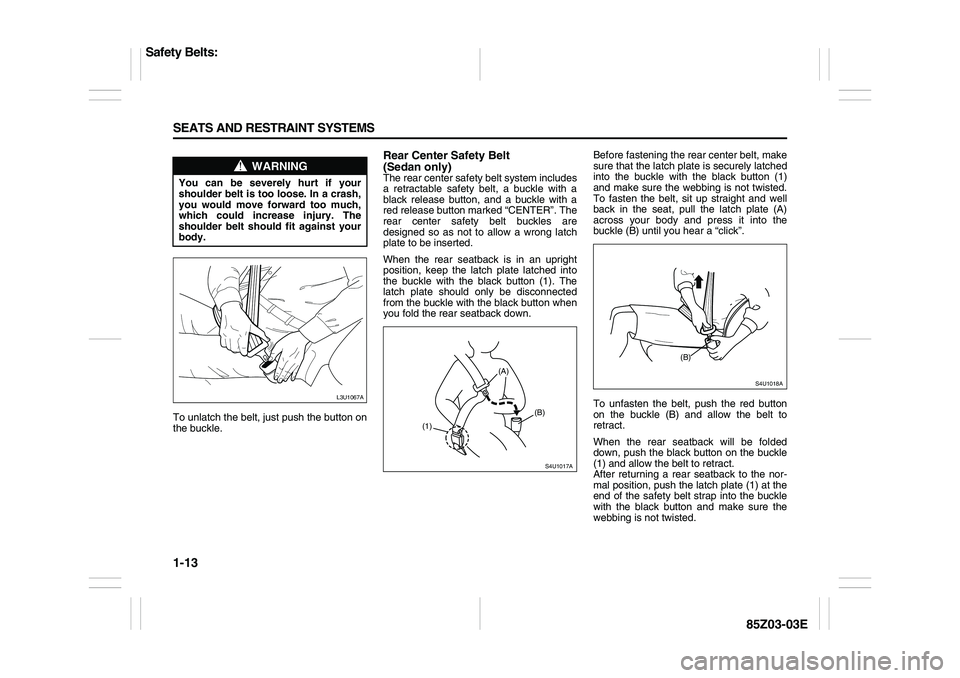
To unlatch the belt, just push the button on
the buckle.
Rear Center Safety Belt
(Sedan only)The rear center safety belt system includes
a retractable safety belt, a buckle with a
black release button, and a buckle with a
red release button marked “CENTER”. The
rear center safety belt buckles are
designed so as not to allow a wrong latch
plate to be inserted.
When the rear seatback is in an upright
position, keep the latch plate latched into
the buckle with the black button (1). The
latch plate should only be disconnected
from the buckle with the black button when
you fold the rear seatback down.Before fastening the rear center belt, make
sure that the latch plate is securely latched
into the buckle with the black button (1)
and make sure the webbing is not twisted.
To fasten the belt, sit up straight and well
back in the seat, pull the latch plate (A)
across your body and press it into the
buckle (B) until you hear a “click”.
To unfasten the belt, push the red button
on the buckle (B) and allow the belt to
retract.
When the rear seatback will be folded
down, push the black button on the buckle
(1) and allow the belt to retract.
After returning a rear seatback to the nor-
mal position, push the latch plate (1) at the
end of the safety belt strap into the buckle
with the black button and make sure the
webbing is not twisted.
WARNING
You can be severely hurt if your
shoulder belt is too loose. In a crash,
you would move forward too much,
which could increase injury. The
shoulder belt should fit against your
body.
L3U1067A
S4U1017A
(1)(A)
(B)
S4U1018A
(B)
Safety Belts:
Page 26 of 225
1-14 SEATS AND RESTRAINT SYSTEMS
85Z03-03E
85Z018
Safety Belt Pretensioner System
52D011
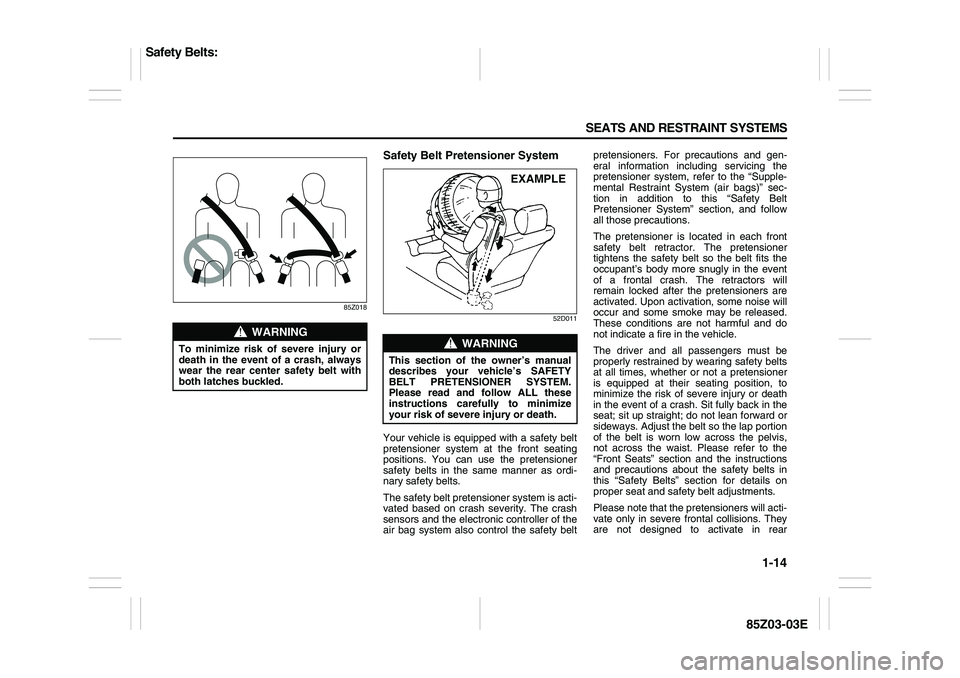
Your vehicle is equipped with a safety belt
pretensioner system at the front seating
positions. You can use the pretensioner
safety belts in the same manner as ordi-
nary safety belts.
The safety belt pretensioner system is acti-
vated based on crash severity. The crash
sensors and the electronic controller of the
air bag system also control the safety beltpretensioners. For precautions and gen-
eral information including servicing the
pretensioner system, refer to the “Supple-
mental Restraint System (air bags)” sec-
tion in addition to this “Safety Belt
Pretensioner System” section, and follow
all those precautions.
The pretensioner is located in each front
safety belt retractor. The pretensioner
tightens the safety belt so the belt fits the
occupant’s body more snugly in the event
of a frontal crash. The retractors will
remain locked after the pretensioners are
activated. Upon activation, some noise will
occur and some smoke may be released.
These conditions are not harmful and do
not indicate a fire in the vehicle.
The driver and all passengers must be
properly restrained by wearing safety belts
at all times, whether or not a pretensioner
is equipped at their seating position, to
minimize the risk of severe injury or death
in the event of a crash. Sit fully back in the
seat; sit up straight; do not lean forward or
sideways. Adjust the belt so the lap portion
of the belt is worn low across the pelvis,
not across the waist. Please refer to the
“Front Seats” section and the instructions
and precautions about the safety belts in
this “Safety Belts” section for details on
proper seat and safety belt adjustments.
Please note that the pretensioners will acti-
vate only in severe frontal collisions. They
are not designed to activate in rear
WARNING
To minimize risk of severe injury or
death in the event of a crash, always
wear the rear center safety belt with
both latches buckled.
WARNING
This section of the owner’s manual
describes your vehicle’s SAFETY
BELT PRETENSIONER SYSTEM.
Please read and follow ALL these
instructions carefully to minimize
your risk of severe injury or death.
EXAMPLE
Safety Belts:
Page 28 of 225
1-16 SEATS AND RESTRAINT SYSTEMS
85Z03-03E
Child RestraintsOlder ChildrenOlder children who have outgrown booster
seats should wear the vehicle’s safety
belts.
Question: What is the proper way to
wear safety belts?
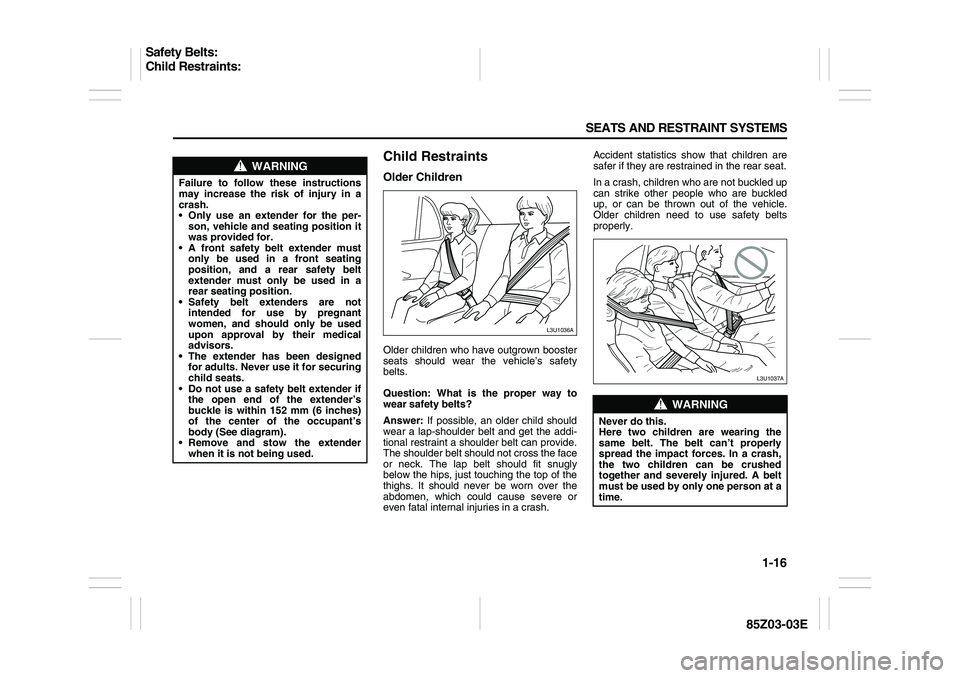
Answer: If possible, an older child should
wear a lap-shoulder belt and get the addi-
tional restraint a shoulder belt can provide.
The shoulder belt should not cross the face
or neck. The lap belt should fit snugly
below the hips, just touching the top of the
thighs. It should never be worn over the
abdomen, which could cause severe or
even fatal internal injuries in a crash.Accident statistics show that children are
safer if they are restrained in the rear seat.
In a crash, children who are not buckled up
can strike other people who are buckled
up, or can be thrown out of the vehicle.
Older children need to use safety belts
properly.
WARNING
Failure to follow these instructions
may increase the risk of injury in a
crash.
Only use an extender for the per-
son, vehicle and seating position it
was provided for.
A front safety belt extender must
only be used in a front seating
position, and a rear safety belt
extender must only be used in a
rear seating position.
Safety belt extenders are not
intended for use by pregnant
women, and should only be used
upon approval by their medical
advisors.
The extender has been designed
for adults. Never use it for securing
child seats.
Do not use a safety belt extender if
the open end of the extender’s
buckle is within 152 mm (6 inches)
of the center of the occupant’s
body (See diagram).
Remove and stow the extender
when it is not being used.
L3U1036A
WARNING
Never do this.
Here two children are wearing the
same belt. The belt can’t properly
spread the impact forces. In a crash,
the two children can be crushed
together and severely injured. A belt
must be used by only one person at a
time.
L3U1037A
Safety Belts:
Child Restraints:
Page 29 of 225
1-17 SEATS AND RESTRAINT SYSTEMS
85Z03-03E
Question: What if a child is wearing a
lap-shoulder belt, but the child is so
small that the shoulder belt is very
close to the child’s face or neck?
Answer: If the child is sitting in a seat next
to a window, move the child toward the
center of the vehicle. If the child is sitting in
the center rear seat passenger position,
move the child toward the safety belt
buckle. In either case, be sure that the
shoulder belt still is on the child’s shoulder,
so that in a crash the child’s upper body
would have the restraint that belts provide.
If the child is so small that the shoulder belt
is still very close to the child’s face or neck,
you might want to place the child in a seat
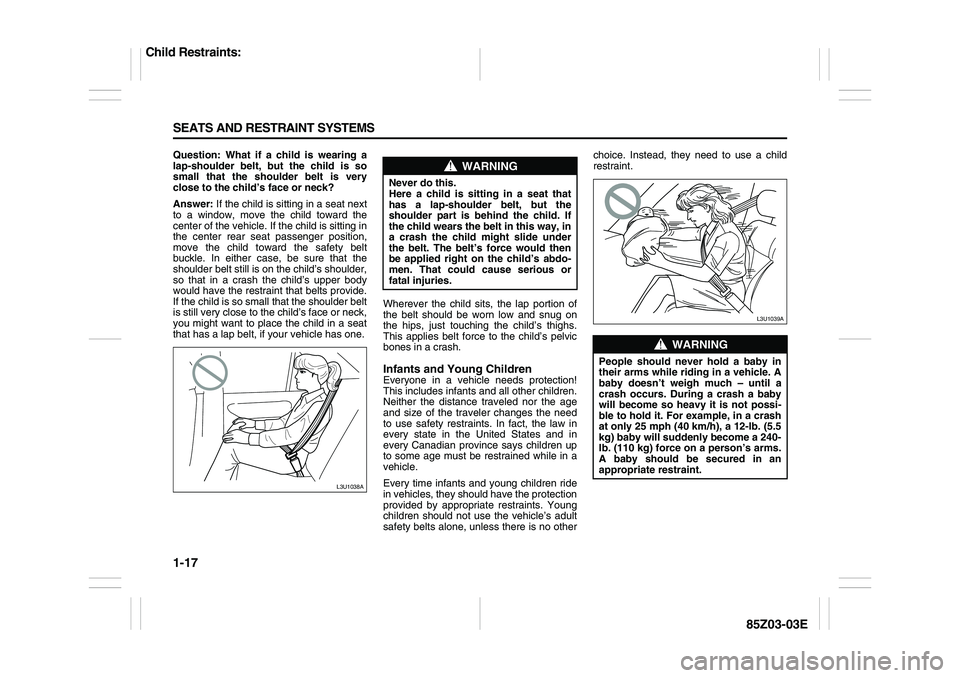
that has a lap belt, if your vehicle has one.Wherever the child sits, the lap portion of
the belt should be worn low and snug on
the hips, just touching the child’s thighs.
This applies belt force to the child’s pelvic
bones in a crash.
Infants and Young ChildrenEveryone in a vehicle needs protection!
This includes infants and all other children.
Neither the distance traveled nor the age
and size of the traveler changes the need
to use safety restraints. In fact, the law in
every state in the United States and in
every Canadian province says children up
to some age must be restrained while in a
vehicle.
Every time infants and young children ride
in vehicles, they should have the protection
provided by appropriate restraints. Young
children should not use the vehicle’s adult
safety belts alone, unless there is no otherchoice. Instead, they need to use a child
restraint.
L3U1038A
WARNING
Never do this.
Here a child is sitting in a seat that
has a lap-shoulder belt, but the
shoulder part is behind the child. If
the child wears the belt in this way, in
a crash the child might slide under
the belt. The belt’s force would then
be applied right on the child’s abdo-
men. That could cause serious or
fatal injuries.
WARNING
People should never hold a baby in
their arms while riding in a vehicle. A
baby doesn’t weigh much – until a
crash occurs. During a crash a baby
will become so heavy it is not possi-
ble to hold it. For example, in a crash
at only 25 mph (40 km/h), a 12-lb. (5.5
kg) baby will suddenly become a 240-
lb. (110 kg) force on a person’s arms.
A baby should be secured in an
appropriate restraint.
L3U1039A
Child Restraints:
Page 30 of 225
1-18 SEATS AND RESTRAINT SYSTEMS
85Z03-03E
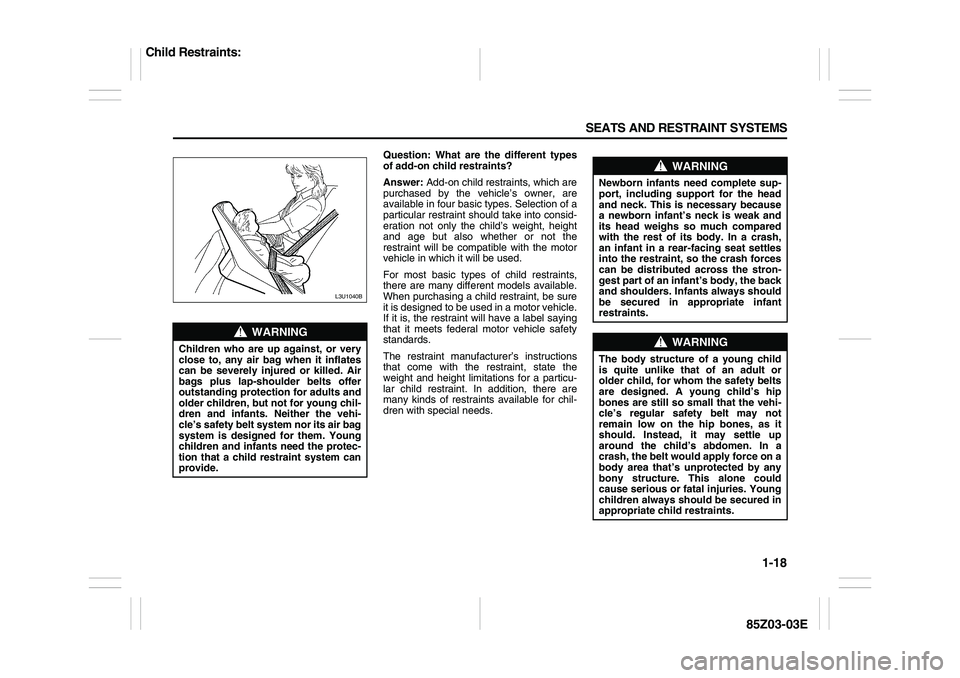
Question: What are the different types
of add-on child restraints?
Answer: Add-on child restraints, which are
purchased by the vehicle’s owner, are
available in four basic types. Selection of a
particular restraint should take into consid-
eration not only the child’s weight, height
and age but also whether or not the
restraint will be compatible with the motor
vehicle in which it will be used.
For most basic types of child restraints,
there are many different models available.
When purchasing a child restraint, be sure
it is designed to be used in a motor vehicle.
If it is, the restraint will have a label saying
that it meets federal motor vehicle safety
standards.
The restraint manufacturer’s instructions
that come with the restraint, state the
weight and height limitations for a particu-
lar child restraint. In addition, there are
many kinds of restraints available for chil-
dren with special needs.
WARNING
Children who are up against, or very
close to, any air bag when it inflates
can be severely injured or killed. Air
bags plus lap-shoulder belts offer
outstanding protection for adults and
older children, but not for young chil-
dren and infants. Neither the vehi-
cle’s safety belt system nor its air bag
system is designed for them. Young
children and infants need the protec-
tion that a child restraint system can
provide.
L3U1040B
WARNING
Newborn infants need complete sup-
port, including support for the head
and neck. This is necessary because
a newborn infant’s neck is weak and
its head weighs so much compared
with the rest of its body. In a crash,
an infant in a rear-facing seat settles
into the restraint, so the crash forces
can be distributed across the stron-
gest part of an infant’s body, the back
and shoulders. Infants always should
be secured in appropriate infant
restraints.
WARNING
The body structure of a young child
is quite unlike that of an adult or
older child, for whom the safety belts
are designed. A young child’s hip
bones are still so small that the vehi-
cle’s regular safety belt may not
remain low on the hip bones, as it
should. Instead, it may settle up
around the child’s abdomen. In a
crash, the belt would apply force on a
body area that’s unprotected by any
bony structure. This alone could
cause serious or fatal injuries. Young
children always should be secured in
appropriate child restraints.
Child Restraints:
Page 32 of 225
1-20 SEATS AND RESTRAINT SYSTEMS
85Z03-03E
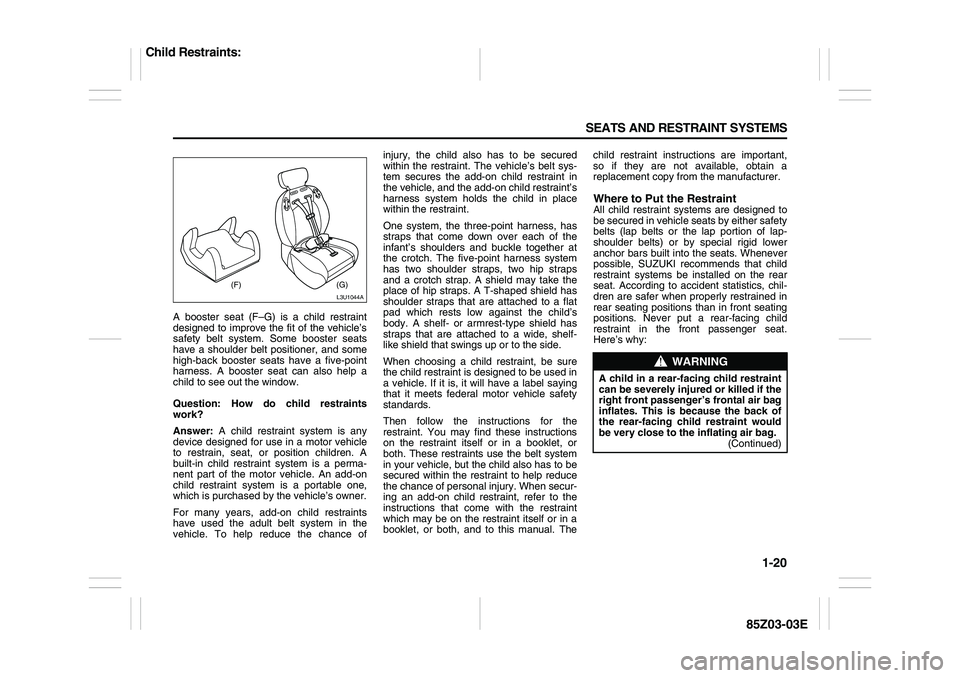
A booster seat (F–G) is a child restraint
designed to improve the fit of the vehicle’s
safety belt system. Some booster seats
have a shoulder belt positioner, and some
high-back booster seats have a five-point
harness. A booster seat can also help a
child to see out the window.
Question: How do child restraints
work?
Answer: A child restraint system is any
device designed for use in a motor vehicle
to restrain, seat, or position children. A
built-in child restraint system is a perma-
nent part of the motor vehicle. An add-on
child restraint system is a portable one,
which is purchased by the vehicle’s owner.
For many years, add-on child restraints
have used the adult belt system in the
vehicle. To help reduce the chance ofinjury, the child also has to be secured
within the restraint. The vehicle’s belt sys-
tem secures the add-on child restraint in
the vehicle, and the add-on child restraint’s
harness system holds the child in place
within the restraint.
One system, the three-point harness, has
straps that come down over each of the
infant’s shoulders and buckle together at
the crotch. The five-point harness system
has two shoulder straps, two hip straps
and a crotch strap. A shield may take the
place of hip straps. A T-shaped shield has
shoulder straps that are attached to a flat
pad which rests low against the child’s
body. A shelf- or armrest-type shield has
straps that are attached to a wide, shelf-
like shield that swings up or to the side.
When choosing a child restraint, be sure
the child restraint is designed to be used in
a vehicle. If it is, it will have a label saying
that it meets federal motor vehicle safety
standards.
Then follow the instructions for the
restraint. You may find these instructions
on the restraint itself or in a booklet, or
both. These restraints use the belt system
in your vehicle, but the child also has to be
secured within the restraint to help reduce
the chance of personal injury. When secur-
ing an add-on child restraint, refer to the
instructions that come with the restraint
which may be on the restraint itself or in a
booklet, or both, and to this manual. Thechild restraint instructions are important,
so if they are not available, obtain a
replacement copy from the manufacturer.
Where to Put the RestraintAll child restraint systems are designed to
be secured in vehicle seats by either safety
belts (lap belts or the lap portion of lap-
shoulder belts) or by special rigid lower
anchor bars built into the seats. Whenever
possible, SUZUKI recommends that child
restraint systems be installed on the rear
seat. According to accident statistics, chil-
dren are safer when properly restrained in
rear seating positions than in front seating
positions. Never put a rear-facing child
restraint in the front passenger seat.
Here’s why:
(F) (G)
L3U1044A
WARNING
A child in a rear-facing child restraint
can be severely injured or killed if the
right front passenger’s frontal air bag
inflates. This is because the back of
the rear-facing child restraint would
be very close to the inflating air bag.
(Continued)
Child Restraints:
Page 33 of 225
1-21 SEATS AND RESTRAINT SYSTEMS
85Z03-03E
Wherever you install it, be sure to secure
the child restraint properly.
Keep in mind that an unsecured child
restraint can move around in a collision or
sudden stop and injure people in the vehi-
cle. Be sure to properly secure any child
restraint in your vehicle – even when no
child is in it.
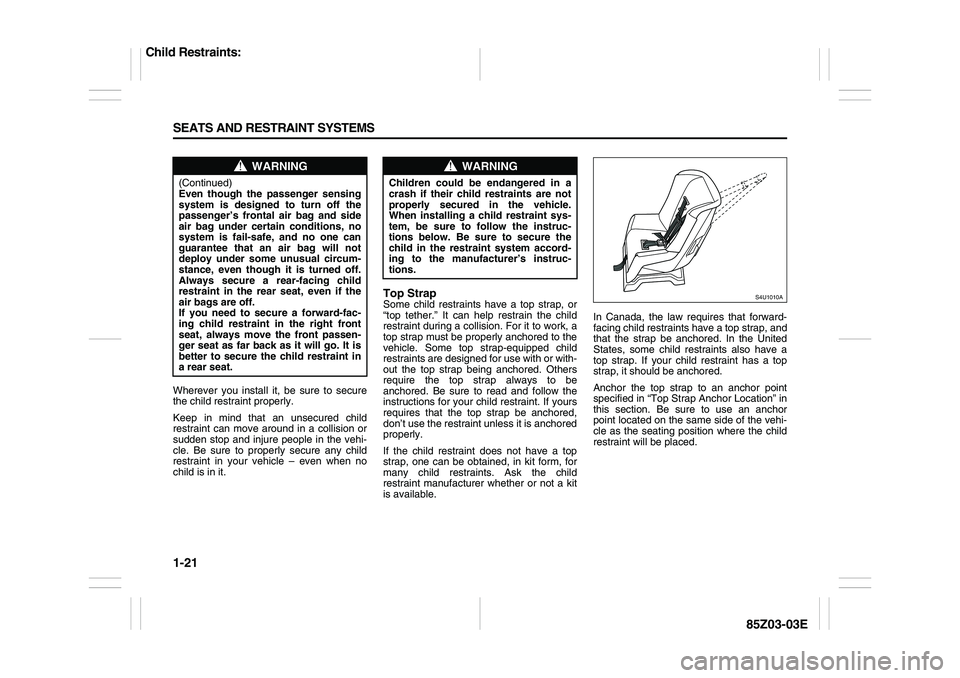
Top StrapSome child restraints have a top strap, or
“top tether.” It can help restrain the child
restraint during a collision. For it to work, a
top strap must be properly anchored to the
vehicle. Some top strap-equipped child
restraints are designed for use with or with-
out the top strap being anchored. Others
require the top strap always to be
anchored. Be sure to read and follow the
instructions for your child restraint. If yours
requires that the top strap be anchored,
don’t use the restraint unless it is anchored
properly.
If the child restraint does not have a top
strap, one can be obtained, in kit form, for
many child restraints. Ask the child
restraint manufacturer whether or not a kit
is available.In Canada, the law requires that forward-
facing child restraints have a top strap, and
that the strap be anchored. In the United
States, some child restraints also have a
top strap. If your child restraint has a top
strap, it should be anchored.
Anchor the top strap to an anchor point
specified in “Top Strap Anchor Location” in
this section. Be sure to use an anchor
point located on the same side of the vehi-
cle as the seating position where the child
restraint will be placed.
WARNING
(Continued)
Even though the passenger sensing
system is designed to turn off the
passenger’s frontal air bag and side
air bag under certain conditions, no
system is fail-safe, and no one can
guarantee that an air bag will not
deploy under some unusual circum-
stance, even though it is turned off.
Always secure a rear-facing child
restraint in the rear seat, even if the
air bags are off.
If you need to secure a forward-fac-
ing child restraint in the right front
seat, always move the front passen-
ger seat as far back as it will go. It is
better to secure the child restraint in
a rear seat.
WARNING
Children could be endangered in a
crash if their child restraints are not
properly secured in the vehicle.
When installing a child restraint sys-
tem, be sure to follow the instruc-
tions below. Be sure to secure the
child in the restraint system accord-
ing to the manufacturer’s instruc-
tions.
S4U1010A
Child Restraints:
Page 34 of 225
1-22 SEATS AND RESTRAINT SYSTEMS
85Z03-03E
Once you have the top strap anchored,
you’ll be ready to secure the child restraint
itself. Tighten the top strap when and as
the child restraint manufacturer’s instruc-
tions say.Top Strap Anchor LocationTop strap anchors are already installed in
your vehicle for the three rear seating posi-
tions.
Do not use a child restraint with a top strap
in the right front passenger’s position
because there is no place to anchor the
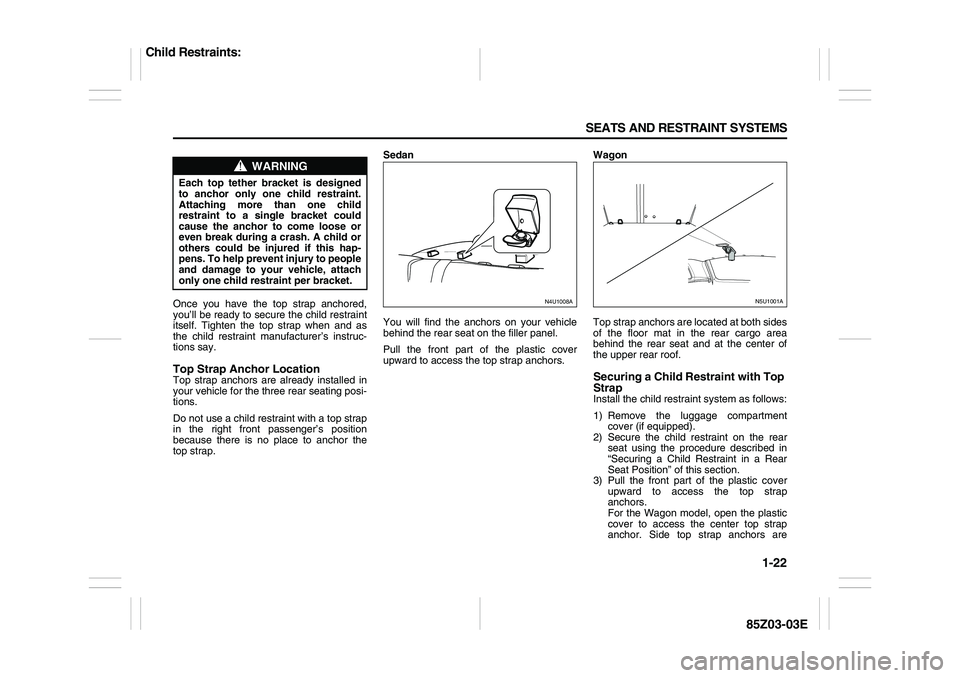
top strap.Sedan
You will find the anchors on your vehicle
behind the rear seat on the filler panel.
Pull the front part of the plastic cover
upward to access the top strap anchors.Wagon
Top strap anchors are located at both sides
of the floor mat in the rear cargo area
behind the rear seat and at the center of
the upper rear roof.
Securing a Child Restraint with Top
StrapInstall the child restraint system as follows:
1) Remove the luggage compartment
cover (if equipped).
2) Secure the child restraint on the rear
seat using the procedure described in
“Securing a Child Restraint in a Rear
Seat Position” of this section.
3) Pull the front part of the plastic cover
upward to access the top strap
anchors.
For the Wagon model, open the plastic
cover to access the center top strap
anchor. Side top strap anchors are
WARNING
Each top tether bracket is designed
to anchor only one child restraint.
Attaching more than one child
restraint to a single bracket could
cause the anchor to come loose or
even break during a crash. A child or
others could be injured if this hap-
pens. To help prevent injury to people
and damage to your vehicle, attach
only one child restraint per bracket.
N4U1008A
N5U1001A
Child Restraints:
Page 35 of 225
1-23 SEATS AND RESTRAINT SYSTEMS
85Z03-03E
located at both sides of the luggage
compartment floor.
4) Hook the top strap to the anchor
bracket and tighten the top strap
according to the instructions provided
by the child restraint system manufac-
turer. Be sure to attach the top strap to
the corresponding anchor located
directly behind the child restraint.
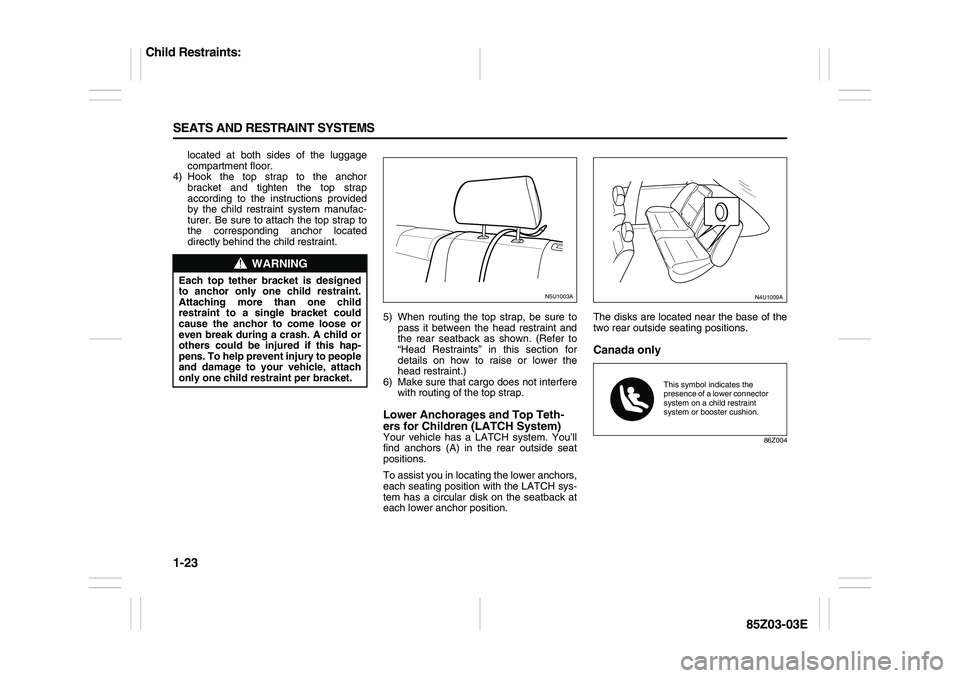
5) When routing the top strap, be sure to
pass it between the head restraint and
the rear seatback as shown. (Refer to
“Head Restraints” in this section for
details on how to raise or lower the
head restraint.)
6) Make sure that cargo does not interfere
with routing of the top strap.
Lower Anchorages and Top Teth-
ers for Children (LATCH System)Your vehicle has a LATCH system. You’ll
find anchors (A) in the rear outside seat
positions.
To assist you in locating the lower anchors,
each seating position with the LATCH sys-
tem has a circular disk on the seatback at
each lower anchor position.The disks are located near the base of the
two rear outside seating positions.
Canada only
86Z004
WARNING
Each top tether bracket is designed
to anchor only one child restraint.
Attaching more than one child
restraint to a single bracket could
cause the anchor to come loose or
even break during a crash. A child or
others could be injured if this hap-
pens. To help prevent injury to people
and damage to your vehicle, attach
only one child restraint per bracket.
N5U1003A
N4U1009A
This symbol indicates the
presence of a lower connector
system on a child restraint
system or booster cushion.
Child Restraints:
Page 36 of 225
1-24 SEATS AND RESTRAINT SYSTEMS
85Z03-03E
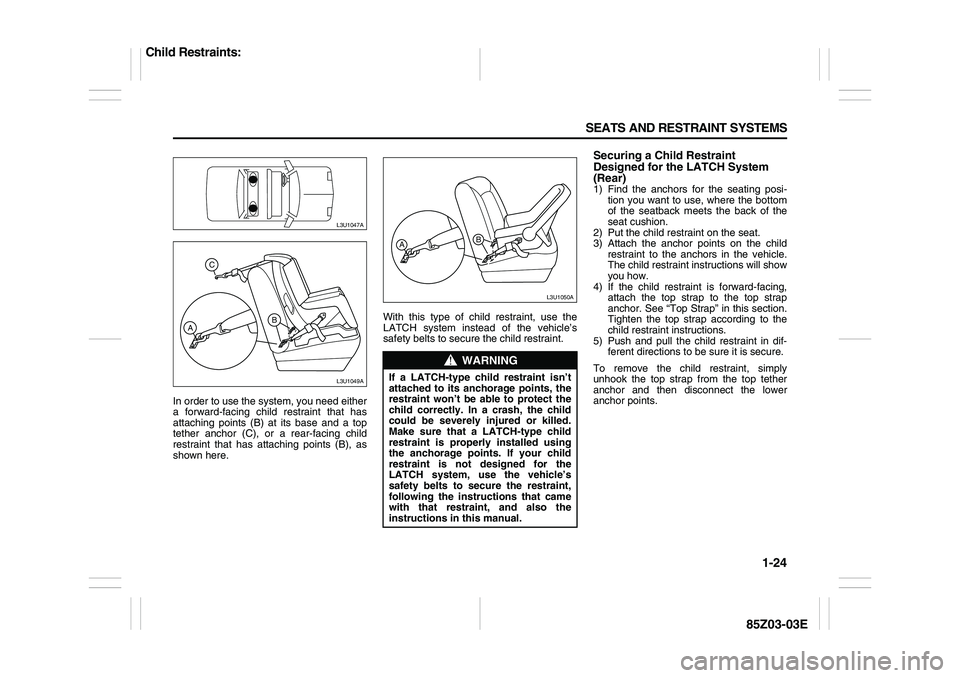
In order to use the system, you need either
a forward-facing child restraint that has
attaching points (B) at its base and a top
tether anchor (C), or a rear-facing child
restraint that has attaching points (B), as
shown here.With this type of child restraint, use the
LATCH system instead of the vehicle’s
safety belts to secure the child restraint.
Securing a Child Restraint
Designed for the LATCH System
(Rear)1) Find the anchors for the seating posi-
tion you want to use, where the bottom
of the seatback meets the back of the
seat cushion.
2) Put the child restraint on the seat.
3) Attach the anchor points on the child
restraint to the anchors in the vehicle.
The child restraint instructions will show
you how.
4) If the child restraint is forward-facing,
attach the top strap to the top strap
anchor. See “Top Strap” in this section.
Tighten the top strap according to the
child restraint instructions.
5) Push and pull the child restraint in dif-
ferent directions to be sure it is secure.
To remove the child restraint, simply
unhook the top strap from the top tether
anchor and then disconnect the lower
anchor points.
L3U1047A
AB C
L3U1049A
WARNING
If a LATCH-type child restraint isn’t
attached to its anchorage points, the
restraint won’t be able to protect the
child correctly. In a crash, the child
could be severely injured or killed.
Make sure that a LATCH-type child
restraint is properly installed using
the anchorage points. If your child
restraint is not designed for the
LATCH system, use the vehicle’s
safety belts to secure the restraint,
following the instructions that came
with that restraint, and also the
instructions in this manual.AB
L3U1050A
Child Restraints: