oil SUZUKI FORENZA 2007 Owner's Manual
[x] Cancel search | Manufacturer: SUZUKI, Model Year: 2007, Model line: FORENZA, Model: SUZUKI FORENZA 2007Pages: 225, PDF Size: 4.39 MB
Page 189 of 225
5-45 SERVICE AND APPEARANCE CARE
85Z03-03E
Appearance CareRemember, cleaning products can be haz-
ardous. Some are toxic. Others can burst
into flames if you strike a match or get
them on a hot part of the vehicle. Some
are dangerous if you breathe their fumes in
a closed space. When you use anything
from a container to clean your vehicle, be
sure to follow the manufacturer’s warnings
and instructions. And always open your
doors or windows when you are cleaning
the inside.
Never use these to clean your vehicle:
Gasoline
Benzene
Naphtha
Carbon Tetrachloride
Acetone
Paint Thinner
Turpentine
Lacquer Thinner
Nail Polish Remover
They can all be hazardous – some more
than others – and they can all damage
your vehicle, too.
Do not use any of these unless this manual
says you can. In many uses, these will
damage your vehicle:
Alcohol
Laundry Soap
Bleach
Reducing Agents
Cleaning the Inside of Your VehicleUse a vacuum cleaner often to get rid of
dust and loose dirt. Wipe vinyl, leather,
plastic and painted surfaces with a clean,
damp cloth.
Cleaning Fabric/Carpet
Your SUZUKI dealer has cleaners for the
cleaning of fabric and carpet. They will
clean normal spots and stains very well.
You can get SUZUKI approved cleaning
products from your SUZUKI dealer. See
“Vehicle Care/Appearance Materials” later
in this section.
Here are some cleaning tips:
Always read the instructions on the
cleaner label.
Clean up stains as soon as you can –
before they set.
Carefully scrape off any excess stain.
Use a clean cloth or sponge, and change
to a clean area often. A soft brush may
be used if stains are stubborn.
If a ring forms on fabric after spot clean-
ing, clean the entire area immediately or
it will set.Using Cleaner on Fabric
1) Vacuum and brush the area to remove
any loose dirt.
2) Always clean a whole trim panel or sec-
tion. Mask surrounding trim along stitch
or welt lines.
3) Follow the directions on the container
label.
4) Apply cleaner with a clean sponge.
Don’t saturate the material and don’t
rub it roughly.
5) As soon as you’ve cleaned the section,
use a sponge to remove any excess
cleaner.
6) Wipe cleaned area with a clean, water-
dampened towel or cloth.
7) Wipe with a clean cloth and let dry.
Specific Fabric Cleaning Problems
Stains caused by such things as catsup,
coffee (black), egg, fruit, fruit juice, milk,
soft drinks, vomit, urine and blood can be
removed as follows:
1) Carefully scrape off excess stain, then
sponge the soiled area with cool water.
2) If a stain remains, follow the cleaner
instructions described earlier.
3) If an odor lingers after cleaning vomit or
urine, treat the area with a water/baking
soda solution: 1 teaspoon (5 ml) of bak-
ing soda to 1 cup (250 ml) of lukewarm
water.
4) Let dry.
Appearance Care:
Page 190 of 225
5-46 SERVICE AND APPEARANCE CARE
85Z03-03E
Stains caused by candy, ice cream, may-
onnaise, chili sauce and unknown stains
can be removed as follows:
1) Carefully scrape off excess stain.
2) First, clean with cool water and allow to
dry completely.
3) If a stain remains, follow the cleaner
instructions described earlier.
Cleaning Vinyl
Use warm water and a clean cloth.
Rub with a clean, damp cloth to remove
dirt. You may have to do this more than
once.
Things like tar, asphalt and shoe polish
will stain if you don’t get them off quickly.
Use a clean cloth and vinyl cleaner. See
your SUZUKI dealer for this product.
Cleaning Leather
Use a soft cloth with lukewarm water and a
mild soap or saddle soap and wipe dry
with a soft cloth. Then, let the leather dry
naturally. Do not use heat to dry.
For stubborn stains, use a leather
cleaner.
Never use oils, varnishes, solvent-based
or abrasive cleaners, furniture polish or
shoe polish on leather.
Soiled or stained leather should be
cleaned immediately. If dirt is allowed to
work into the finish, it can harm the
leather.Cleaning the Top of the Instrument
Panel
Use only mild soap and water to clean the
top surfaces of the instrument panel.
Sprays containing silicones or waxes may
cause annoying reflections in the wind-
shield and even make it difficult to see
through the windshield under certain con-
ditions.
Cleaning Interior Plastic Components
Use only a mild soap and water solution on
a soft cloth or sponge. Commercial clean-
ers may affect the surface finish.
Cleaning Glass Surfaces
Glass should be cleaned often. SUZUKI
Glass Cleaner or a liquid household glass
cleaner will remove normal tobacco smoke
and dust films on interior glass. See
SUZUKI Vehicle Care/Appearance Materi-
als in this section.Care of Safety Belts
Keep belts clean and dry.
Weather-stripsSilicone grease on weather-strips will
make them last longer, seal better, and not
stick or squeak. Apply silicone grease with
a clean cloth at least every six months.
During very cold, damp weather more fre-
quent application may be required. Cleaning the Outside of Your Vehi-
cleThe paint finish on your vehicle provides
beauty, depth of color, gloss retention and
durability.
Washing Your Vehicle
The best way to preserve your vehicle’s fin-
ish is to keep it clean by washing it often
with lukewarm or cold water.
Don’t wash your vehicle in the direct rays
of the sun. Use a car washing soap. Don’t
use strong soaps or chemical detergents.
Be sure to rinse the vehicle well, removing
all soap residue completely. You can get
approved cleaning products from your
CAUTION
Don’t use abrasive cleaners on glass,
because they may cause scratches.
Avoid placing decals on the inside
rear window, since they may have to
be scraped off later. If abrasive clean-
ers are used on the inside of the rear
window, an electric defogger element
may be damaged. Any temporary
license should not be attached
across the defogger grid.
WARNING
Do not bleach or dye safety belts. If
you do, it may severely weaken them.
In a crash, they might not be able to
provide adequate protection. Clean
safety belts only with mild soap and
lukewarm water.
Appearance Care:
Page 191 of 225
5-47 SERVICE AND APPEARANCE CARE
85Z03-03E
SUZUKI dealer. See “Vehicle Care/
Appearance Materials” later in this section.
Don’t use cleaning agents that are petro-
leum based, or that contain acid or abra-
sives. All cleaning agents should be
flushed promptly and not allowed to dry on
the surface, or they could stain. Dry the fin-
ish with a soft, clean chamois or an all-cot-
ton towel to avoid surface scratches and
water spotting.
High pressure car washes may cause
water to enter your vehicle.
Cleaning Exterior Lamps/Lenses
Use only lukewarm or cold water, a soft
cloth and a car washing soap to clean
exterior lamps and lenses. Follow instruc-
tions under Washing Your Vehicle.
Finish Care
Occasional waxing or mild polishing of
your vehicle by hand may be necessary to
remove residue from the paint finish. You
can get SUZUKI-approved cleaning prod-
ucts from your SUZUKI dealer. See “Vehi-
cle Care/Appearance Materials” later in
this section.
Your vehicle has a “basecoat/clear coat”
paint finish. The clear coat gives more
depth and gloss to the colored basecoat.
Always use waxes and polishes that are
non-abrasive and made for a basecoat/
clear coat paint finish.Foreign materials such as calcium chloride
and other salts, ice melting agents, road oil
and tar, tree sap, bird droppings, chemicals
from industrial chimneys, etc., can damage
your vehicle’s finish if they remain on
painted surfaces. Wash the vehicle as
soon as possible. If necessary, use non-
abrasive cleaners that are marked safe for
painted surfaces to remove foreign matter.
Exterior painted surfaces are subject to
aging, weather and chemical fallout that
can take their toll over a period of years.
You can help to keep the paint finish look-
ing new by keeping your vehicle garaged
or covered whenever possible.
Cleaning Windshield and Wiper Blades
If the windshield is not clear after using the
windshield washer, or if the wiper blade
chatters when running, wax, sap or other
material may be on the blade or wind-
shield.
Clean the outside of the windshield with a
full-strength glass cleaning liquid. The
windshield is clean if beads do not form
when you rinse it with water.Grime from the windshield will stick to the
wiper blades and affect their performance.
Clean the blades by wiping vigorously with
a cloth soaked in full-strength windshield
washer solvent. Then rinse the blades with
water.
Check the wiper blades and clean them as
necessary; replace blades that look worn.
Cleaning Aluminum Wheels
Keep your wheels clean using a soft clean
cloth with mild soap and water. Rinse with
clean water. After rinsing thoroughly, dry
with a soft clean towel. A wax may then be
applied.
The surface of these wheels is similar to
the painted surface of your vehicle. Don’t
use strong soaps, chemicals, abrasive pol-
ishes, abrasive cleaners, cleaners with
acid, or abrasive cleaning brushes on them
because you could damage the surface.
Do not use chrome polish on aluminum
wheels.
Don’t take your vehicle through an auto-
matic car wash that has silicone carbide
tire cleaning brushes. These brushes can
also damage the surface of these wheels.
Cleaning Tires
To clean your tires, use a stiff brush with
tire cleaner.
CAUTION
Machine compounding or aggressive
polishing on a basecoat/clearcoat
paint finish may dull the finish or
leave swirl marks.
Appearance Care:
Vehicle Identification:
Electrical System:
Page 192 of 225
5-48 SERVICE AND APPEARANCE CARE
85Z03-03E
Sheet Metal DamageIf your vehicle is damaged and requires
sheet metal repair or replacement, make
sure the body repair shop applies anti-cor-
rosion material to parts repaired or
replaced to restore corrosion protection.
Original manufacturer replacement parts
will provide the corrosion protection while
maintaining the warranty.Finish DamageAny stone chips, fractures or deep
scratches in the finish should be repaired
right away. Bare metal will corrode quickly
and may develop into major repair
expense.
Minor chips and scratches can be repaired
with touch-up materials available from your
SUZUKI dealer. Larger areas of finish
damage can be corrected in your SUZUKI
dealer’s body and paint shop.
Underbody MaintenanceChemicals used for ice and snow removal
and dust control can collect on the under-
body. If these are not removed, acceler-
ated corrosion (rust) can occur on the
underbody parts such as fuel lines, frame,
floor pan and exhaust system even though
they have corrosion protection.
At least every spring, flush these materials
from the underbody with plain water. Clean
any areas where mud and debris can col-
lect. Dirt packed in close areas of the
frame should be loosened before being
flushed. Your SUZUKI dealer or an under-
body car washing system can do this for
you.Chemical Paint SpottingSome weather and atmospheric conditions
can create a chemical fallout. Airborne pol-
lutants can fall upon and attack painted
surfaces on your vehicle. This damage can
take two forms: blotchy, ring-shaped discol-
orations, and small, irregular dark spots
etched into the paint surface.Vehicle Care/Appearance MaterialsSee your SUZUKI dealer for more informa-
tion on purchasing the following products.
CAUTION
When applying a tire dressing,
always take care to wipe off any over-
spray or splash from all painted sur-
faces on the body or wheels of the
vehicle. Petroleum-based products
may damage the paint finish and
tires.
Description Usage
Polishing Cloth
Wax-TreatedInterior and exterior
polishing cloth.
Tar and Road
Oil RemoverRemoves tar, road oil
and asphalt.
Chrome
Cleaner and
PolishUse on chrome or
stainless steel.
White Sidewall
Tire CleanerRemoves soil and
black marks from
whitewalls.
Vinyl Cleaner Cleans vinyl tops,
upholstery and con-
vertible tops.
Glass Cleaner Removes dirt, grime,
smoke and finger-
prints.
Chrome and
Wire Wheel
CleanerRemoves dirt and
grime from chrome
wheels and wire
wheel covers.
Finish
EnhancerRemoves dust, finger-
prints, and surface
contaminants, Spray
on wipe off.
Electrical System:
Page 198 of 225
5-54 SERVICE AND APPEARANCE CARE
85Z03-03E
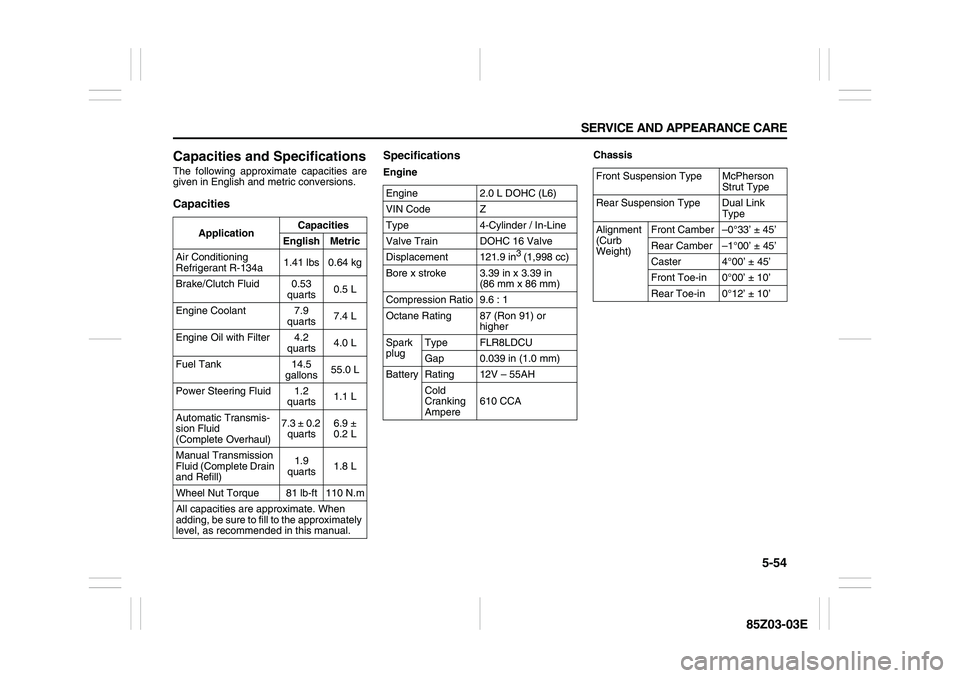
Capacities and SpecificationsThe following approximate capacities are
given in English and metric conversions. CapacitiesSpecifications
EngineChassis
ApplicationCapacities
English Metric
Air Conditioning
Refrigerant R-134a1.41 lbs 0.64 kg
Brake/Clutch Fluid 0.53
quarts0.5 L
Engine Coolant 7.9
quarts7.4 L
Engine Oil with Filter 4.2
quarts4.0 L
Fuel Tank 14.5
gallons55.0 L
Power Steering Fluid 1.2
quarts1.1 L
Automatic Transmis-
sion Fluid
(Complete Overhaul)7.3 ± 0.2
quarts6.9 ±
0.2 L
Manual Transmission
Fluid (Complete Drain
and Refill)1.9
quarts1.8 L
Wheel Nut Torque 81 lb-ft 110 N.m
All capacities are approximate. When
adding, be sure to fill to the approximately
level, as recommended in this manual. Engine 2.0 L DOHC (L6)
VIN Code Z
Type 4-Cylinder / In-Line
Valve Train DOHC 16 Valve
Displacement 121.9 in
3 (1,998 cc)
Bore x stroke 3.39 in x 3.39 in
(86 mm x 86 mm)
Compression Ratio 9.6 : 1
Octane Rating 87 (Ron 91) or
higher
Spark
plugType FLR8LDCU
Gap 0.039 in (1.0 mm)
Battery Rating 12V – 55AH
Cold
Cranking
Ampere610 CCA
Front Suspension Type McPherson
Strut Type
Rear Suspension Type Dual Link
Type
Alignment
(Curb
Weight)Front Camber –0°33’ ± 45’
Rear Camber –1°00’ ± 45’
Caster 4°00’ ± 45’
Front Toe-in 0°00’ ± 10’
Rear Toe-in 0°12’ ± 10’
Page 202 of 225
6-2 MAINTENANCE SCHEDULE
85Z03-03E
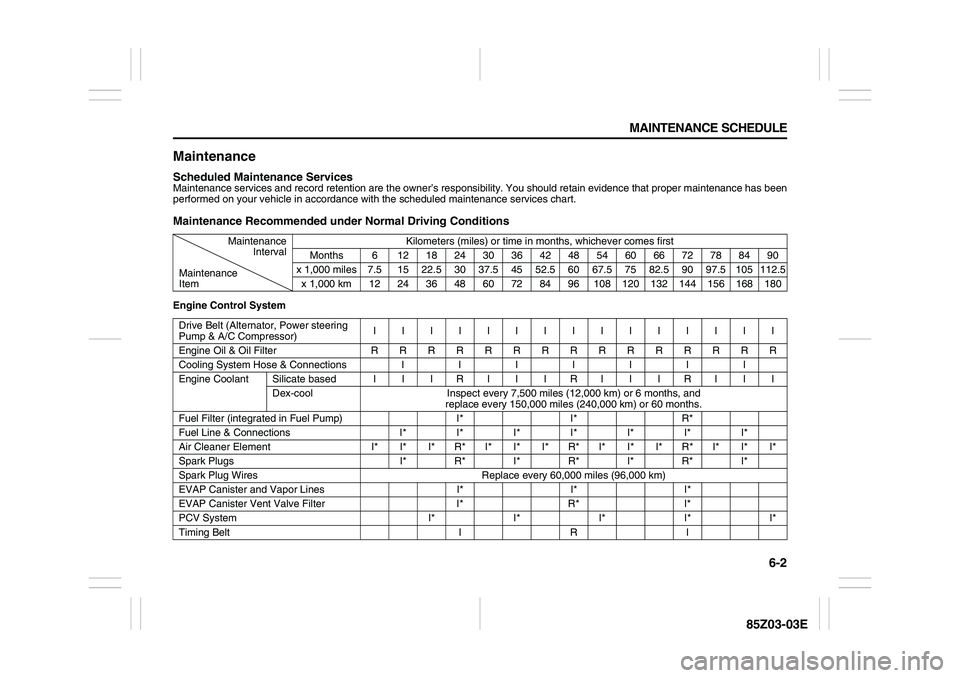
MaintenanceScheduled Maintenance ServicesMaintenance services and record retention are the owner’s responsibility. You should retain evidence that proper maintenance has been
performed on your vehicle in accordance with the scheduled maintenance services chart.Maintenance Recommended under Normal Driving ConditionsEngine Control SystemMaintenance
IntervalKilometers (miles) or time in months, whichever comes first
Months 6 1218243036424854606672788490
Maintenance
Itemx 1,000 miles 7.5 15 22.5 30 37.5 45 52.5 60 67.5 75 82.5 90 97.5 105 112.5
x 1,000 km 12 24 36 48 60 72 84 96 108 120 132 144 156 168 180
Drive Belt (Alternator, Power steering
Pump & A/C Compressor)IIIIIIIIIIIIIII
Engine Oil & Oil Filter RRRRRRRRRRRRRRR
Cooling System Hose & Connections I I I I I I I
Engine Coolant Silicate based I I I R I I I R I I I R I I I
Dex-cool Inspect every 7,500 miles (12,000 km) or 6 months, and
replace every 150,000 miles (240,000 km) or 60 months.
Fuel Filter (integrated in Fuel Pump) I* I* R*
Fuel Line & Connections I* I* I* I* I* I* I*
Air Cleaner Element I* I* I* R* I* I* I* R* I* I* I* R* I* I* I*
Spark Plugs I* R* I* R* I* R* I*
Spark Plug Wires Replace every 60,000 miles (96,000 km)
EVAP Canister and Vapor Lines I* I* I*
EVAP Canister Vent Valve Filter I* R* I*
PCV System I* I* I* I* I*
Timing Belt I R I
Page 203 of 225
6-3 MAINTENANCE SCHEDULE
85Z03-03E
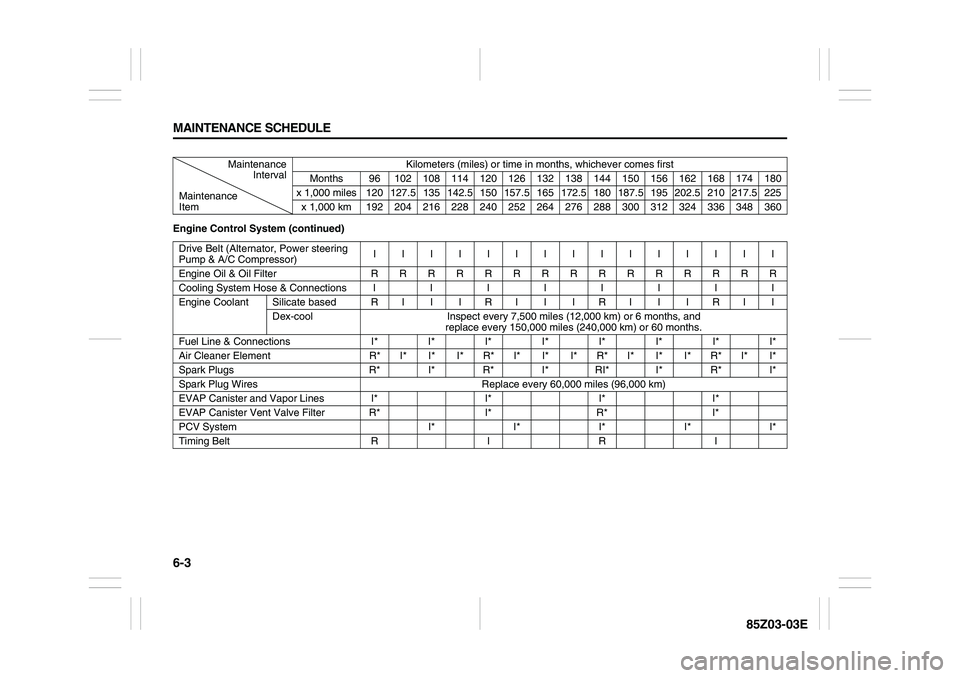
Engine Control System (continued)Maintenance
IntervalKilometers (miles) or time in months, whichever comes first
Months 96 102 108 114 120 126 132 138 144 150 156 162 168 174 180
Maintenance
Itemx 1,000 miles 120 127.5 135 142.5 150 157.5 165 172.5 180 187.5 195 202.5 210 217.5 225
x 1,000 km 192 204 216 228 240 252 264 276 288 300 312 324 336 348 360
Drive Belt (Alternator, Power steering
Pump & A/C Compressor)IIIIIIIIIIIIIII
Engine Oil & Oil Filter RRRRRRRRRRRRRRR
Cooling System Hose & Connections I I I I I I I I
Engine Coolant Silicate based R I I I R I I I R I I I R I I
Dex-cool Inspect every 7,500 miles (12,000 km) or 6 months, and
replace every 150,000 miles (240,000 km) or 60 months.
Fuel Line & Connections I* I* I* I* I* I* I* I*
Air Cleaner Element R* I* I* I* R* I* I* I* R* I* I* I* R* I* I*
Spark Plugs R* I* R* I* RI* I* R* I*
Spark Plug Wires Replace every 60,000 miles (96,000 km)
EVAP Canister and Vapor Lines I* I* I* I*
EVAP Canister Vent Valve Filter R* I* R* I*
PCV System I* I* I* I* I*
Timing Belt RIRI
Page 206 of 225
6-6 MAINTENANCE SCHEDULE
85Z03-03E
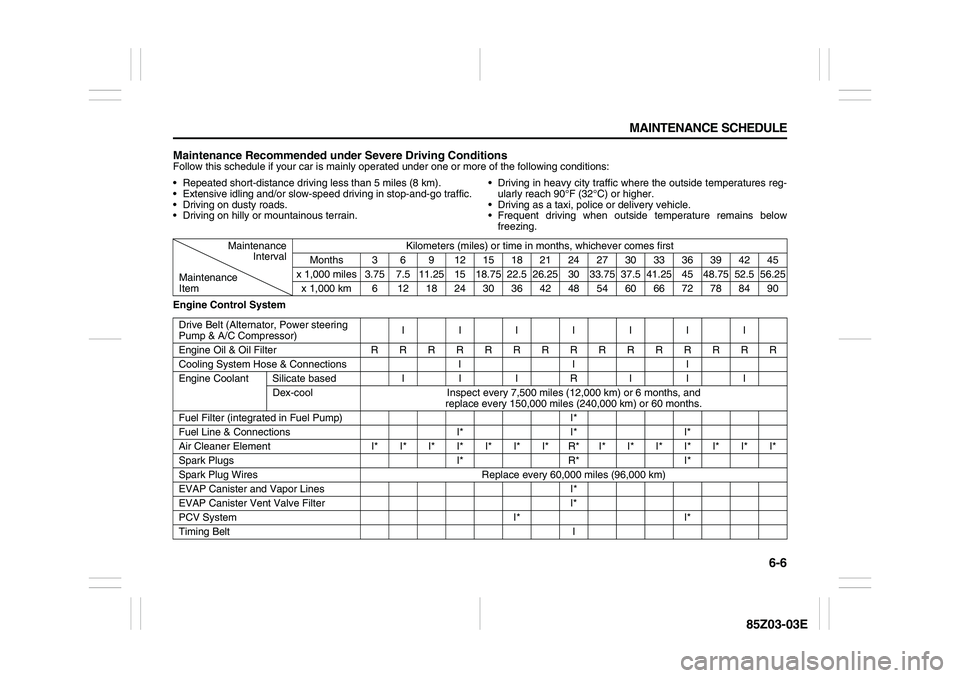
Maintenance Recommended under Severe Driving ConditionsFollow this schedule if your car is mainly operated under one or more of the following conditions:
Engine Control System Repeated short-distance driving less than 5 miles (8 km).
Extensive idling and/or slow-speed driving in stop-and-go traffic.
Driving on dusty roads.
Driving on hilly or mountainous terrain. Driving in heavy city traffic where the outside temperatures reg-
ularly reach 90°F (32°C) or higher.
Driving as a taxi, police or delivery vehicle.
Frequent driving when outside temperature remains below
freezing.
Maintenance
IntervalKilometers (miles) or time in months, whichever comes first
Months 3 6 9 121518212427303336394245
Maintenance
Itemx 1,000 miles 3.75 7.5 11.25 15 18.75 22.526.25 30 33.75 37.5 41.25 45 48.75 52.5 56.25
x 1,000 km 6 1218243036424854606672788490Drive Belt (Alternator, Power steering
Pump & A/C Compressor)IIIIIII
Engine Oil & Oil Filter RRRRRRRRRRRRRRR
Cooling System Hose & Connections I I I
Engine Coolant Silicate based I I I R I I I
Dex-cool Inspect every 7,500 miles (12,000 km) or 6 months, and
replace every 150,000 miles (240,000 km) or 60 months.
Fuel Filter (integrated in Fuel Pump) I*
Fuel Line & Connections I* I* I*
Air Cleaner Element I* I* I* I* I* I* I* R* I* I* I* I* I* I* I*
Spark Plugs I* R* I*
Spark Plug Wires Replace every 60,000 miles (96,000 km)
EVAP Canister and Vapor Lines I*
EVAP Canister Vent Valve Filter I*
PCV System I* I*
Timing BeltI
Page 207 of 225
6-7 MAINTENANCE SCHEDULE
85Z03-03E
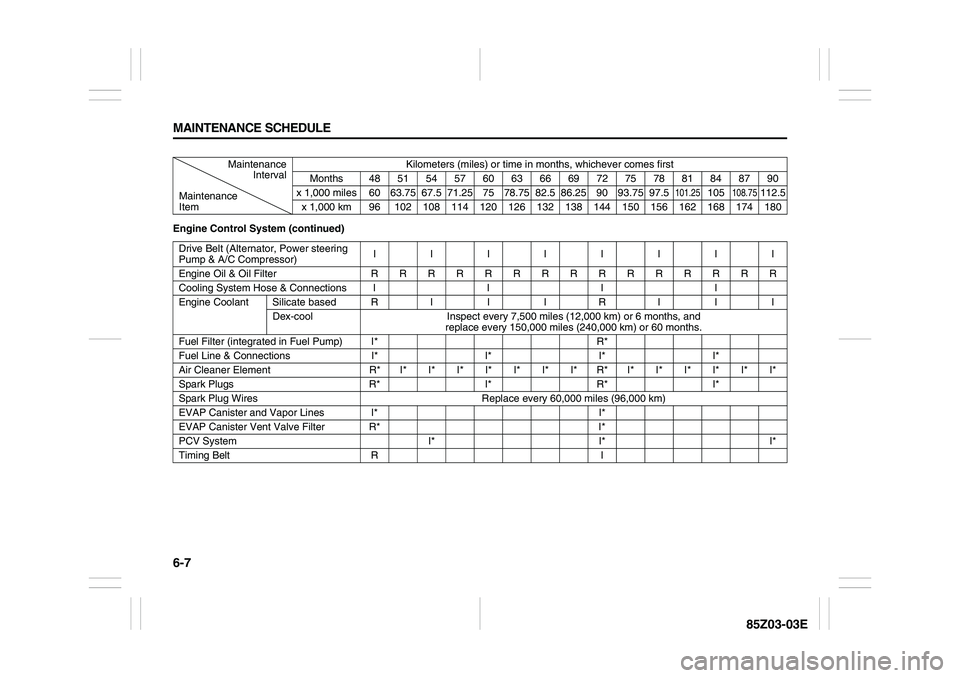
Engine Control System (continued)Maintenance
IntervalKilometers (miles) or time in months, whichever comes first
Months 48 51 54 57 60 63 66 69 72 75 78 81 84 87 90
Maintenance
Itemx 1,000 miles 60 63.75 67.5 71.25 75 78.75 82.5 86.25 90 93.75 97.5
101.25
105
108.75
112.5
x 1,000 km 96 102 108 114 120 126 132 138 144 150 156 162 168 174 180
Drive Belt (Alternator, Power steering
Pump & A/C Compressor)IIIIIIII
Engine Oil & Oil Filter RRRRRRRRRRRRRRR
Cooling System Hose & Connections I I I I
Engine Coolant Silicate based R I I I R I I I
Dex-cool Inspect every 7,500 miles (12,000 km) or 6 months, and
replace every 150,000 miles (240,000 km) or 60 months.
Fuel Filter (integrated in Fuel Pump) I* R*
Fuel Line & Connections I* I* I* I*
Air Cleaner Element R* I* I* I* I* I* I* I* R* I* I* I* I* I* I*
Spark Plugs R* I* R* I*
Spark Plug Wires Replace every 60,000 miles (96,000 km)
EVAP Canister and Vapor Lines I* I*
EVAP Canister Vent Valve Filter R* I*
PCV System I* I* I*
Timing Belt R I
Page 210 of 225
6-10 MAINTENANCE SCHEDULE
85Z03-03E
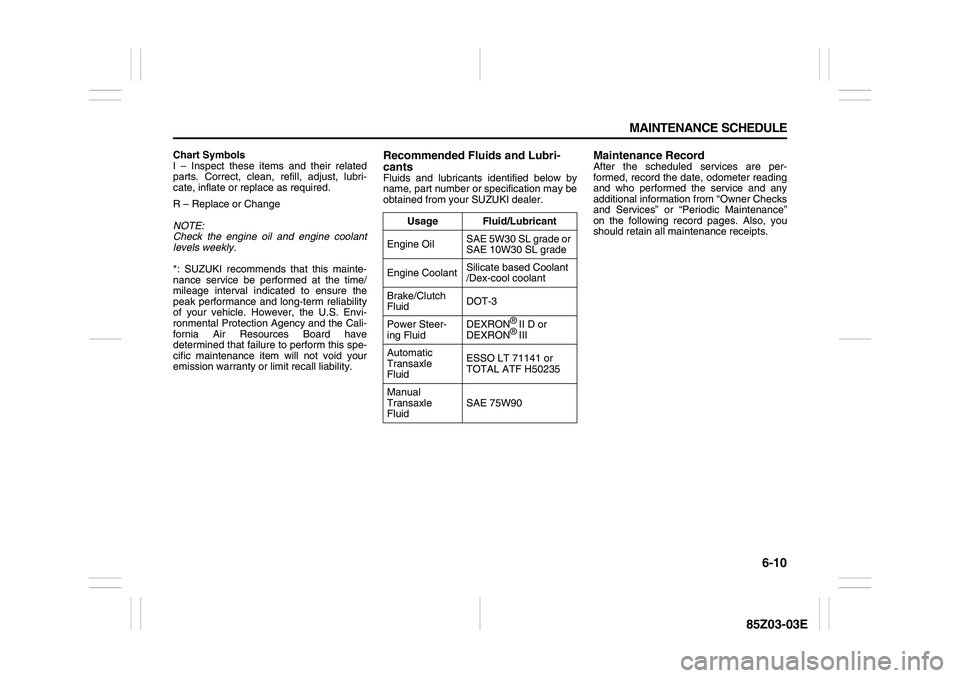
Chart Symbols
I – Inspect these items and their related
parts. Correct, clean, refill, adjust, lubri-
cate, inflate or replace as required.
R – Replace or Change
NOTE:
Check the engine oil and engine coolant
levels weekly.
*: SUZUKI recommends that this mainte-
nance service be performed at the time/
mileage interval indicated to ensure the
peak performance and long-term reliability
of your vehicle. However, the U.S. Envi-
ronmental Protection Agency and the Cali-
fornia Air Resources Board have
determined that failure to perform this spe-
cific maintenance item will not void your
emission warranty or limit recall liability.
Recommended Fluids and Lubri-
cantsFluids and lubricants identified below by
name, part number or specification may be
obtained from your SUZUKI dealer.
Maintenance RecordAfter the scheduled services are per-
formed, record the date, odometer reading
and who performed the service and any
additional information from “Owner Checks
and Services” or “Periodic Maintenance”
on the following record pages. Also, you
should retain all maintenance receipts. Usage Fluid/Lubricant
Engine OilSAE 5W30 SL grade or
SAE 10W30 SL grade
Engine CoolantSilicate based Coolant
/Dex-cool coolant
Brake/Clutch
FluidDOT-3
Power Steer-
ing FluidDEXRON
® II D or
DEXRON® III
Automatic
Transaxle
FluidESSO LT 71141 or
TOTAL ATF H50235
Manual
Transaxle
FluidSAE 75W90