battery SUZUKI FORENZA 2008 1.G User Guide
[x] Cancel search | Manufacturer: SUZUKI, Model Year: 2008, Model line: FORENZA, Model: SUZUKI FORENZA 2008 1.GPages: 226, PDF Size: 5.25 MB
Page 100 of 226
3-24
INSTRUMENT PANEL
85Z04-03E
If you experience one or more of these
conditions, change the fuel brand you use.
It will require at least one full tank of the
proper fuel to turn the light off.
If none of the above steps have made the
light turn off, your SUZUKI dealer can
check the vehicle. Your SUZUKI dealer has
the proper test equipment and diagnostic
tools to fix any mechanical or electrical
problems that may have developed.
Emissions Inspection and Maintenance
Programs
Some state/provincial and local govern-
ments have or may begin programs to
inspect the emission control equipment on
your vehicle. Failure to pass this inspection
could prevent you from getting a vehicle
registration.
Here are some things you need to know to
help your vehicle pass an inspection:
Your vehicle will not pass this inspection if
the Check Engine light is on or is not work-
ing properly.
Your vehicle will not pass this inspection if
the OBD (on-board diagnostic) system
determines that critical emission control
systems have not been completely diag-
nosed by the system. The vehicle would be
considered not ready for inspection. This
can happen if you have recently replaced
your battery or if your battery has run
down. The diagnostic system is designed
to evaluate critical emission control sys-tems during normal driving. This may take
several days of routine driving. If you have
done this and your vehicle still does not
pass the inspection for lack of OBD system
readiness, your SUZUKI dealer can pre-
pare the vehicle for inspection.
Oil Pressure LightIf you have a low engine oil pressure prob-
lem, this light will stay on after you start
your engine, or come on when you are
driving. This indicates that your engine is
not receiving enough oil.
The engine could be low on oil, or could
have some other oil problem. Have it fixed
immediately.
The oil light could also come on in three
other situations:
When the ignition is on but the engine is
not running, the light will come on as a
check to show you it is working. The light
will go out after you start the engine. If it
doesn’t come on with the ignition on, you
may have a problem with the fuse or
bulb. Have it fixed right away. If you’re idling at a stop sign, the light
may blink on and then off.
If you make a hard stop, the light may
come on for a moment. This is normal.
Fog Lamp LightIf your vehicle has this feature, the fog
lamps indicator light will come on when the
fog lamps are in use.
The light will go out when the fog lamps
are turned off.
WARNING
Don’t keep driving if the oil pressure
is low. If you do, your engine can
become so hot that it catches fire.
You or others could be burned. Check
your oil as soon as possible and have
your vehicle serviced.
CAUTION
Operating your engine with the low
oil pressure light on can result in
severe engine damage which is not
covered by your warranty.
Warning Lights, Gauges and Indicators:
Page 139 of 226
4-15DRIVING YOUR VEHICLE
85Z04-03E
Run your engine only as long as you must.
This saves fuel. When you run the engine,
make it go a little faster than just idle. That
is, push the accelerator slightly. This uses
less fuel for the heat that you get and it
keeps the battery charged. You will need a
well-charged battery to restart the vehicle,
and possibly for signaling later on with your
headlamps. Let the heater run for a while.
Then, shut the engine off and close the
window almost all the way to preserve the
heat. Start the engine again and repeat
this only when you feel really uncomfort-
able from the cold. But do it as little as pos-
sible. Preserve the fuel as long as you can.
To help keep warm, you can get out of the
vehicle and do some fairly vigorous exer-
cises every half hour or so until help
comes.
If You Are Stuck: In Sand, Mud, Ice or
Snow
In order to free your vehicle when it is
stuck, you will need to spin the wheels, but
you don’t want to spin your wheels too fast.
The method known as “rocking” can help
you get out when you’re stuck, but you
must use caution.For information about using tire chains on
your vehicle, see “Tire Chains” in section 5.Rocking Your Vehicle To Get It Out
First, turn your steering wheel left and
right. That will clear the area around your
front wheels. Then shift back and forth
between REVERSE (R) and a forward
gear (or with a manual transmission,
between FIRST (1) or SECOND (2) and
REVERSE (R)), spinning the wheels as lit-
tle as possible. Release the accelerator
pedal while you shift, and press lightly on
the accelerator pedal when the transmis-
sion is in gear. By slowly spinning your
wheels in the forward and reverse direc-
tions, you will cause a rocking motion that
may free your vehicle. If that doesn’t get
you out after a few tries, you may need to
be towed out. If you do need to be towed
out, see “Towing Your Vehicle” in the fol-
lowing section.
WARNING
If you let your tires spin at high
speed, they can explode, and you or
others could be injured. And, the
transmission or other parts of the
vehicle can overheat. That could
cause an engine compartment fire or
other damage. When you’re stuck,
spin the wheels as little as possible.
Don’t spin the wheels above 35 mph
(55 km/h) as shown on the speedom-
eter.
CAUTION
Spinning your wheels can destroy
parts of your vehicle as well as the
tires. If you spin the wheels too fast
while shifting your transmission back
and forth, you can destroy your trans-
mission. See “Rocking Your Vehicle
To Get It Out.”
Your Driving, the Road, and Your Vehicle:
Page 164 of 226
5-20
SERVICE AND APPEARANCE CARE
85Z04-03E
Brake Pedal Travel
See your SUZUKI dealer if the brake pedal
does not return to normal height, or if there
is a rapid increase in pedal travel. This
could be a sign of brake trouble.
Brake Adjustment
Every time you make a moderate brake
stop, your disc brakes adjust for wear. If
you rarely make a moderate or heavier
stop, then your brakes might not adjust
correctly. If you drive in that way, then –
very carefully – make a few moderate
brake stops about every 1,000 miles
(1,600 km), so your brakes will adjust prop-
erly.
Replacing Brake System Parts
The braking system on a vehicle is com-
plex. Its many parts have to be of top qual-
ity and work well together if the vehicle is
to have really good braking. When you
replace parts of your braking system – for
example, when your brake linings wear
down and you need new ones put in – be
sure you get new approved SUZUKI
replacement parts. If you don’t, your
brakes may no longer work properly. For
example, if someone puts in brake linings
that are wrong for your vehicle, the balance
between your front and rear brakes can
change – for the worse. The braking per-
formance you’ve come to expect can
change in many other ways if someone
puts in the wrong replacement brake parts.
BatteryYour new vehicle comes with a mainte-
nance free battery. When it’s time for a new
battery, get one that has the replacement
number shown on the original battery’s
label. See “Engine Compartment Over-
view” in this section for battery location.
Vehicle Stor ag e
If you’re not going to drive your vehicle for
25 days or more, remove the black, nega-
tive (–) cable from the battery. This will
help keep your battery from running down.
Contact your SUZUKI dealer to learn how
to prepare your vehicle for longer storage
periods.
Jump StartingIf your battery has run down, you may want
to use another vehicle and some jumper
cables to start your vehicle. Be sure to fol-
low the steps below to do it safely.
1) Check the other vehicle. It must have a
12-volt battery with a negative ground
system.
WARNING
Battery posts, terminals and related
accessories contain lead and lead
compounds, chemicals known to the
State of California to cause cancer
and reproductive harm. Wash hands
after handling.
WARNING
Batteries have acid that can burn you
and gas that can explode. You can be
badly hurt if you aren’t careful. See
the next section, “Jump Starting”, for
tips on working around a battery
without getting hurt.
WARNING
Batteries can hurt you. They can be
dangerous because:
They contain acid that can burn
you.
They contain gas that can explode
or ignite.
They contain enough electricity to
burn you.
If you don’t follow these steps
exactly, some or all of these things
can hurt you.
CAUTION
Ignoring the following steps could
result in costly damage to your vehi-
cle that wouldn’t be covered by your
warranty.
Trying to start your vehicle by push-
ing or pulling it won’t work, and it
could damage your vehicle.
Checking Things Under the Hood:
Page 165 of 226
5-21SERVICE AND APPEARANCE CARE
85Z04-03E
2) Get the vehicles close enough so the
jumper cables can reach, but be sure
the vehicles aren’t touching each other.
If they are, it could cause a ground con-
nection you don’t want. You wouldn’t be
able to start your vehicle, and the bad
grounding could damage the electrical
systems.
To avoid the possibility of the vehicles
rolling, set the parking brake firmly on
both vehicles involved in the jump start
procedure. Put an automatic transmis-
sion in PARK (P) or a manual transmis-
sion in NEUTRAL before setting the
parking brake.3) Turn off the ignition on both vehicles.
Unplug unnecessary accessories
plugged into the cigarette lighter or in
the accessory power outlet. Turn off the
radio and all lamps that aren’t needed.
This will avoid sparks and help save
both batteries. And it could save your
radio!
4) Open the hoods and locate the batter-
ies. Find the positive (+) and negative
(–) terminal locations on each vehicle.
Your vehicle’s positive (+) terminal is
located under a red tethered cap on the
battery. The negative (–) terminal is
located under a black tethered cap on
the battery. See “Engine Compartment
Overview” in this section for more infor-
mation on location. Flip the caps up to
access the positive (+) and negative (–)
terminals.
5) Check that the jumper cables don’t
have loose or missing insulation. If they
do, you could get a shock. The vehicles
could be damaged, too.
Before you connect the cables, here are
some basic things you should know.
Positive (+) will go to positive (+) or to a
remote positive (+) terminal if the vehi-
cle has one. Negative (–) will go to a
heavy, unpainted metal engine part or
to a remote negative (–) terminal if the
vehicle with the dead battery has one.
Don’t connect positive (+) to negative
(–) or you’ll get a short that would dam-
CAUTION
If the other system isn’t a 12-volt sys-
tem with a negative ground, both
vehicles can be damaged. Only use
vehicles with 12-volt systems with
negative grounds to jump start your
vehicle.
CAUTION
If you leave your radio or other acces-
sories on during the jump starting
procedure, they could be damaged.
The repairs wouldn’t be covered by
your warranty. Always turn off your
radio and other accessories when
jump starting your vehicle.
WARNING
An electric fan under the hood can
start up and injure you even when the
engine is not running. Keep hands,
clothing and tools away from any
underhood electric fan.
WARNING
Using a match near a battery can
cause battery gas to explode. People
have been hurt doing this, and some
have been blinded. Use a flashlight if
you need more light.
Be sure the battery has enough
water. You don’t need to add water to
the battery installed in your new vehi-
cle. But if a battery has filler caps, be
sure the right amount of fluid is
there. If it is low, add water to take
care of that first. If you don’t, explo-
sive gas could be present.
Battery fluid contains acid that can
burn you. Don’t get it on you. If you
accidentally get it in your eyes or on
your skin, flush the place with water
and get medical help immediately.
Checking Things Under the Hood:
Page 166 of 226
5-22
SERVICE AND APPEARANCE CARE
85Z04-03E
age the battery and maybe other parts,
too. And don’t connect the negative (–)
cable to the negative (–) terminal on the
dead battery because this can cause
sparks.
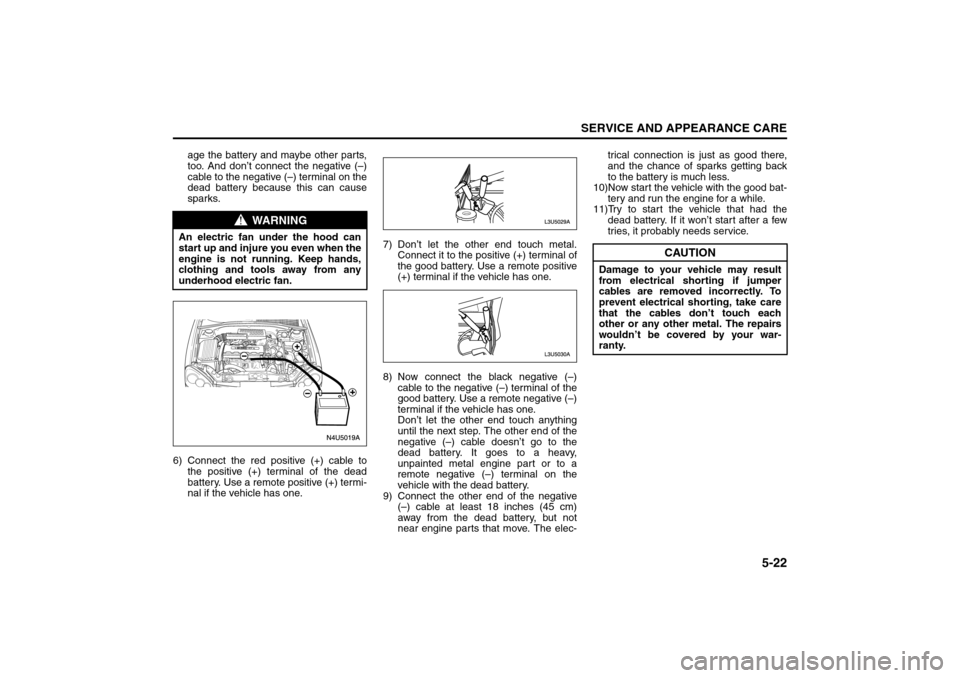
6) Connect the red positive (+) cable to
the positive (+) terminal of the dead
battery. Use a remote positive (+) termi-
nal if the vehicle has one.7) Don’t let the other end touch metal.
Connect it to the positive (+) terminal of
the good battery. Use a remote positive
(+) terminal if the vehicle has one.
8) Now connect the black negative (–)
cable to the negative (–) terminal of the
good battery. Use a remote negative (–)
terminal if the vehicle has one.
Don’t let the other end touch anything
until the next step. The other end of the
negative (–) cable doesn’t go to the
dead battery. It goes to a heavy,
unpainted metal engine part or to a
remote negative (–) terminal on the
vehicle with the dead battery.
9) Connect the other end of the negative
(–) cable at least 18 inches (45 cm)
away from the dead battery, but not
near engine parts that move. The elec-trical connection is just as good there,
and the chance of sparks getting back
to the battery is much less.
10)Now start the vehicle with the good bat-
tery and run the engine for a while.
11)Try to start the vehicle that had the
dead battery. If it won’t start after a few
tries, it probably needs service.
WARNING
An electric fan under the hood can
start up and injure you even when the
engine is not running. Keep hands,
clothing and tools away from any
underhood electric fan.
CAUTION
Damage to your vehicle may result
from electrical shorting if jumper
cables are removed incorrectly. To
prevent electrical shorting, take care
that the cables don’t touch each
other or any other metal. The repairs
wouldn’t be covered by your war-
ranty.
Checking Things Under the Hood:
Page 167 of 226
5-23SERVICE AND APPEARANCE CARE
85Z04-03E
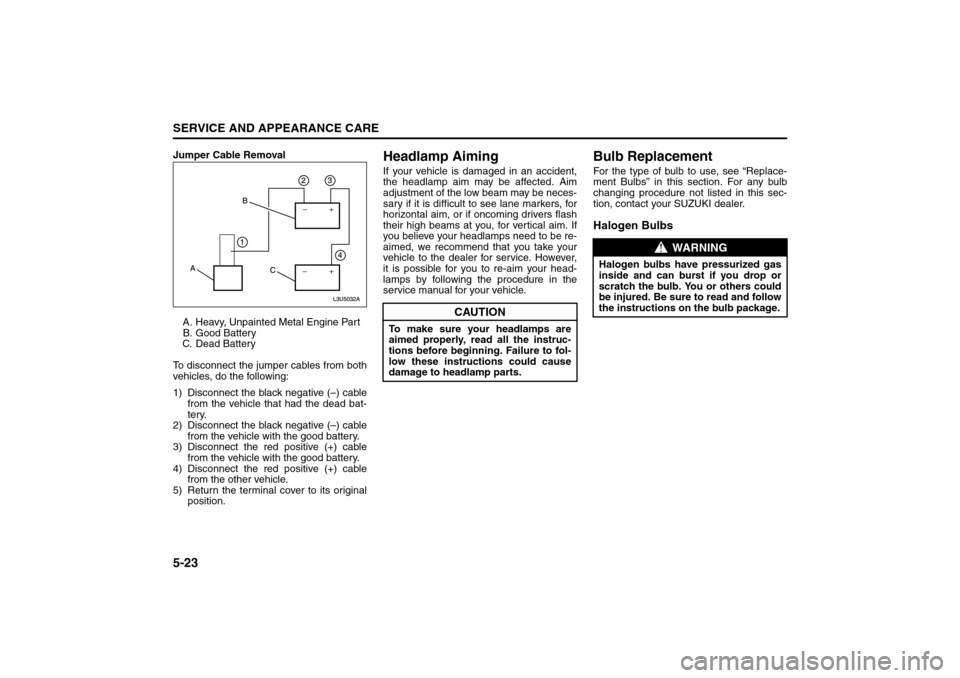
Jumper Cable Removal
A. Heavy, Unpainted Metal Engine Part
B. Good Battery
C. Dead Battery
To disconnect the jumper cables from both
vehicles, do the following:
1) Disconnect the black negative (–) cable
from the vehicle that had the dead bat-
tery.
2) Disconnect the black negative (–) cable
from the vehicle with the good battery.
3) Disconnect the red positive (+) cable
from the vehicle with the good battery.
4) Disconnect the red positive (+) cable
from the other vehicle.
5) Return the terminal cover to its original
position.
Headlamp AimingIf your vehicle is damaged in an accident,
the headlamp aim may be affected. Aim
adjustment of the low beam may be neces-
sary if it is difficult to see lane markers, for
horizontal aim, or if oncoming drivers flash
their high beams at you, for vertical aim. If
you believe your headlamps need to be re-
aimed, we recommend that you take your
vehicle to the dealer for service. However,
it is possible for you to re-aim your head-
lamps by following the procedure in the
service manual for your vehicle.
Bulb ReplacementFor the type of bulb to use, see “Replace-
ment Bulbs” in this section. For any bulb
changing procedure not listed in this sec-
tion, contact your SUZUKI dealer.Halogen Bulbs
CAUTION
To make sure your headlamps are
aimed properly, read all the instruc-
tions before beginning. Failure to fol-
low these instructions could cause
damage to headlamp parts.
WARNING
Halogen bulbs have pressurized gas
inside and can burst if you drop or
scratch the bulb. You or others could
be injured. Be sure to read and follow
the instructions on the bulb package.
Headlamp Aiming:
Bulb Replacement:
Page 176 of 226
5-32
SERVICE AND APPEARANCE CARE
85Z04-03E
mounted on a vehicle. The side of the tire
that contains a whitewall, bears white let-
tering or bears manufacturer, brand and or
model name molding that is higher or
deeper than the same moldings on the
other sidewall of the tire.
Passenger (P-Metric) Tire:
A tire used on passenger cars and some
light duty trucks and multipurpose vehicles.
Production Options Weight:
The combined weight of those installed
regular production options weighing over
2.3 kilograms in excess of those standard
items which they replace, not previously
considered in curb weight or accessory
weight, including heavy duty brakes, ride
levelers, roof rack, heavy duty battery, and
special trim.
Recommended Inflation Pressure:
Vehicle manufacturer’s recommended tire
inflation pressure shown on the tire plac-
ard.
Radial Ply Tire:
A pneumatic tire in which the ply cords that
extend to the beads are laid at 90 degrees
to the centerline of the tread.
Rim:
A metal support for a tire and upon which
the tire beads are seated.
Sidewall:
The portion of a tire between the tread and
the bead.Speed Rating:
An alphanumeric code assigned to a tire
indicating the maximum speed at which a
tire can operate.
Tr a c t i o n :
The friction between the tire and the road
surface. The amount of grip provided.
Tr e a d :
The portion of a tire that comes into con-
tact with the road.
Tread wear Indicators:
Narrow bands, sometimes called “wear
bars,” that show across the tread of a tire
when only 2/32 inch of tread remains.
UTQGS:
Uniform Tire Quality Grading Standards, a
tire information system that provides con-
sumers with ratings for a tire’s traction,
temperature and tread wear. Ratings are
determined by tire manufacturers using
government testing procedures. The rat-
ings are molded into the sidewall of the
tire.
Vehicle Capacity Weight:
The number of designated seating posi-
tions multiplied by 150 lbs (68 kg) plus the
rated cargo load.
Vehicle Maximum Load on the Tire:
The load on an individual tire that is deter-
mined by distributing to each axle its share
of the maximum loaded vehicle weight and
dividing by two.Vehicle Normal Load on the Tire:
The load on an individual tire that is deter-
mined by distributing to each axle its share
of the curb weight, accessory weight, and
normal occupant weight (distributed in
accordance with Table 1 shown below) and
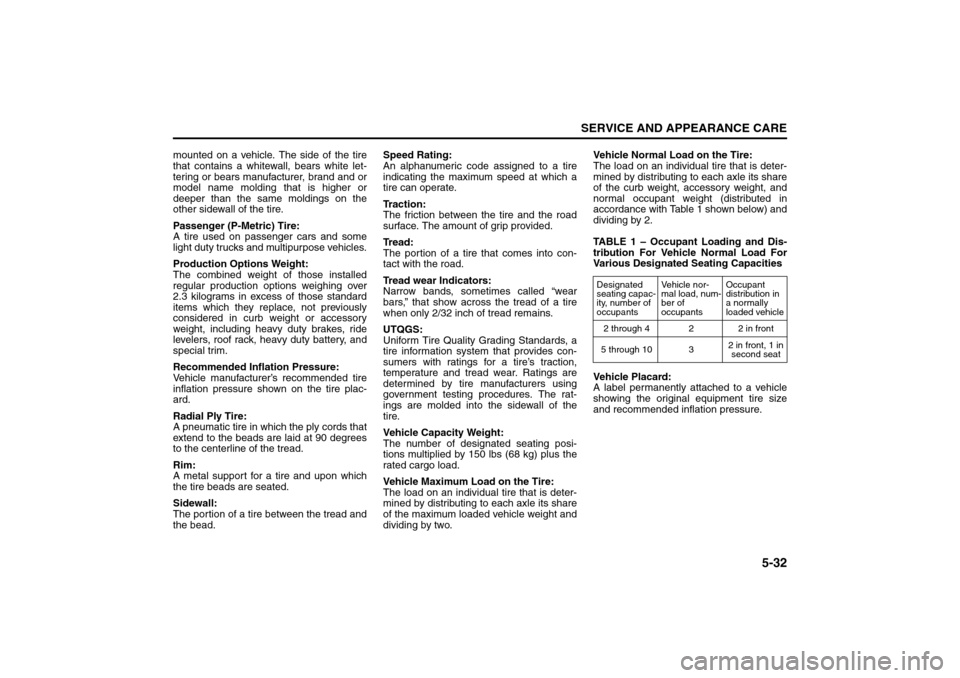
dividing by 2.
TABLE 1 – Occupant Loading and Dis-
tribution For Vehicle Normal Load For
Various Designated Seating Capacities
Vehicle Placard:
A label permanently attached to a vehicle
showing the original equipment tire size
and recommended inflation pressure.
Designated
seating capac-
ity, number of
occupantsVehicle nor-
mal load, num-
ber of
occupantsOccupant
distribution in
a normally
loaded vehicle
2 through 4 2 2 in front
5 through 10 32 in front, 1 in
second seat
Tires:
Page 195 of 226
5-51SERVICE AND APPEARANCE CARE
85Z04-03E
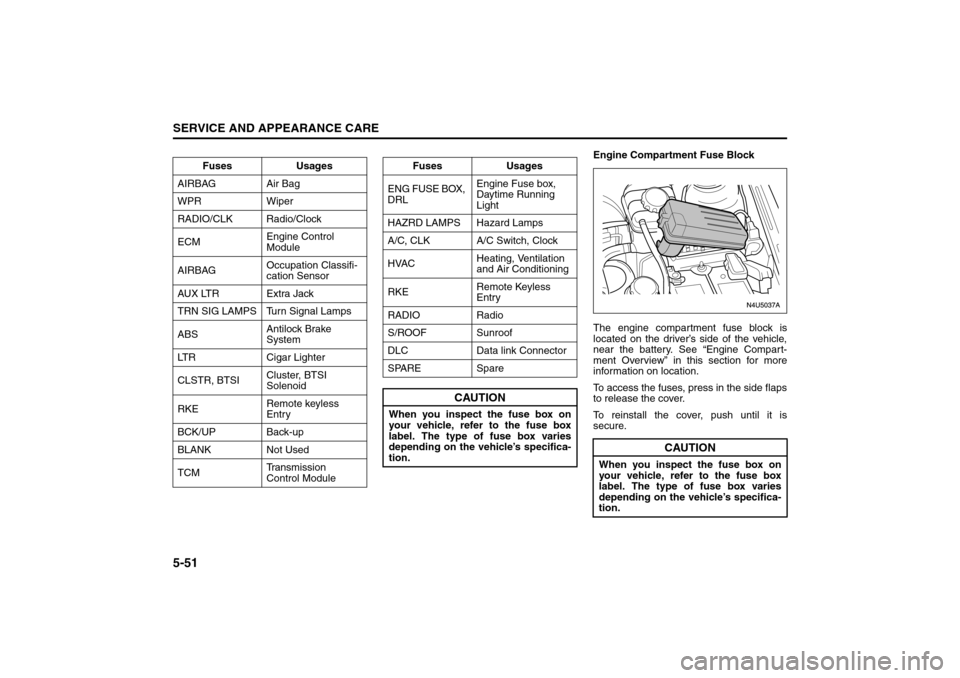
Engine Compartment Fuse Block
The engine compartment fuse block is
located on the driver’s side of the vehicle,
near the battery. See “Engine Compart-
ment Overview” in this section for more
information on location.
To access the fuses, press in the side flaps
to release the cover.
To reinstall the cover, push until it is
secure. Fuses Usages
AIRBAG Air Bag
WPR Wiper
RADIO/CLK Radio/Clock
ECMEngine Control
Module
AIRBAGOccupation Classifi-
cation Sensor
AUX LTR Extra Jack
TRN SIG LAMPS Turn Signal Lamps
ABSAntilock Brake
System
LTR Cigar Lighter
CLSTR, BTSICluster, BTSI
Solenoid
RKERemote keyless
Entry
BCK/UP Back-up
BLANK Not Used
TCMTransmission
Control Module
Fuses Usages
ENG FUSE BOX,
DRLEngine Fuse box,
Daytime Running
Light
HAZRD LAMPS Hazard Lamps
A/C, CLK A/C Switch, Clock
HVACHeating, Ventilation
and Air Conditioning
RKERemote Keyless
Entry
RADIO Radio
S/ROOF Sunroof
DLC Data link Connector
SPARE Spare
CAUTION
When you inspect the fuse box on
your vehicle, refer to the fuse box
label. The type of fuse box varies
depending on the vehicle’s specifica-
tion.
CAUTION
When you inspect the fuse box on
your vehicle, refer to the fuse box
label. The type of fuse box varies
depending on the vehicle’s specifica-
tion.
Electrical System:
Page 197 of 226
5-53SERVICE AND APPEARANCE CARE
85Z04-03E
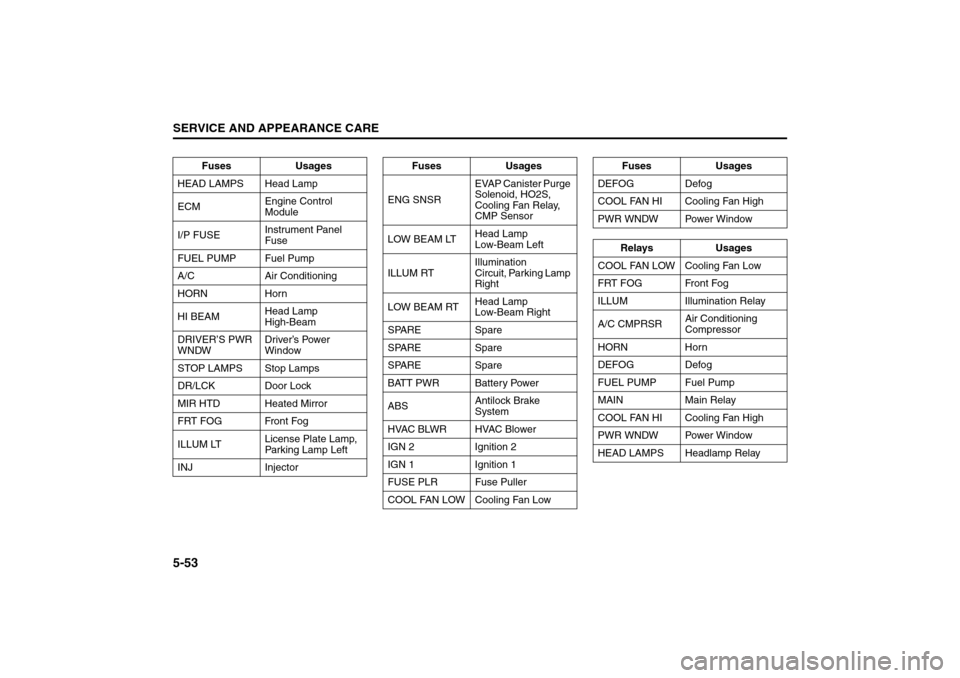
Fuses Usages
HEAD LAMPS Head Lamp
ECMEngine Control
Module
I/P FUSEInstrument Panel
Fuse
FUEL PUMP Fuel Pump
A/C Air Conditioning
HORN Horn
HI BEAMHead Lamp
High-Beam
DRIVER’S PWR
WNDWDriver’s Power
Window
STOP LAMPS Stop Lamps
DR/LCK Door Lock
MIR HTD Heated Mirror
FRT FOG Front Fog
ILLUM LTLicense Plate Lamp,
Parking Lamp Left
INJ Injector
Fuses Usages
ENG SNSREVAP Canister Purge
Solenoid, HO2S,
Cooling Fan Relay,
CMP Sensor
LOW BEAM LTHead Lamp
Low-Beam Left
ILLUM RTIllumination
Circuit, Parking Lamp
Right
LOW BEAM RTHead Lamp
Low-Beam Right
SPARE Spare
SPARE Spare
SPARE Spare
BATT PWR Battery Power
ABSAntilock Brake
System
HVAC BLWR HVAC Blower
IGN 2 Ignition 2
IGN 1 Ignition 1
FUSE PLR Fuse Puller
COOL FAN LOW Cooling Fan Low
Fuses Usages
DEFOG Defog
COOL FAN HI Cooling Fan High
PWR WNDW Power Window
Relays Usages
COOL FAN LOW Cooling Fan Low
FRT FOG Front Fog
ILLUM Illumination Relay
A/C CMPRSRAir Conditioning
Compressor
HORN Horn
DEFOG Defog
FUEL PUMP Fuel Pump
MAIN Main Relay
COOL FAN HI Cooling Fan High
PWR WNDW Power Window
HEAD LAMPS Headlamp Relay
Capacities and Specifications:
Page 198 of 226
5-54
SERVICE AND APPEARANCE CARE
85Z04-03E
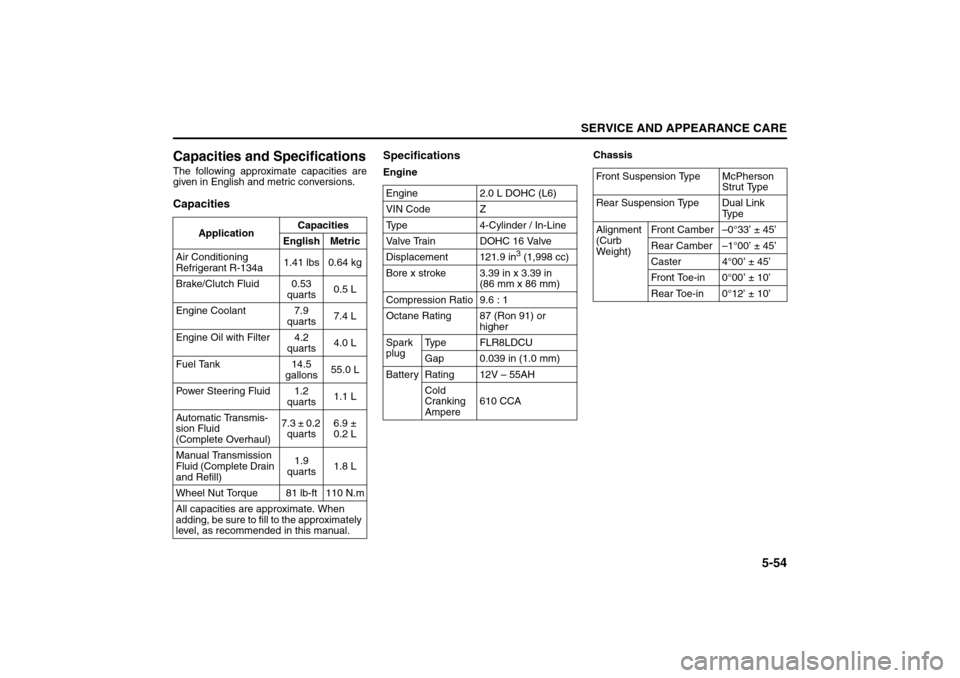
Capacities and SpecificationsThe following approximate capacities are
given in English and metric conversions. CapacitiesSpecifications
EngineChassis
ApplicationCapacities
English Metric
Air Conditioning
Refrigerant R-134a1.41 lbs 0.64 kg
Brake/Clutch Fluid 0.53
quarts0.5 L
Engine Coolant 7.9
quarts7.4 L
Engine Oil with Filter 4.2
quarts4.0 L
Fuel Tank 14.5
gallons55.0 L
Power Steering Fluid 1.2
quarts1.1 L
Automatic Transmis-
sion Fluid
(Complete Overhaul)7.3 ± 0.2
quarts6.9 ±
0.2 L
Manual Transmission
Fluid (Complete Drain
and Refill)1.9
quarts1.8 L
Wheel Nut Torque 81 lb-ft 110 N.m
All capacities are approximate. When
adding, be sure to fill to the approximately
level, as recommended in this manual. Engine 2.0 L DOHC (L6)
VIN Code Z
Type 4-Cylinder / In-Line
Valve Train DOHC 16 Valve
Displacement 121.9 in
3 (1,998 cc)
Bore x stroke 3.39 in x 3.39 in
(86 mm x 86 mm)
Compression Ratio 9.6 : 1
Octane Rating 87 (Ron 91) or
higher
Spark
plugType FLR8LDCU
Gap 0.039 in (1.0 mm)
Battery Rating 12V – 55AH
Cold
Cranking
Ampere610 CCA
Front Suspension Type McPherson
Strut Type
Rear Suspension Type Dual Link
Ty p e
Alignment
(Curb
Weight)Front Camber –0°33’ ± 45’
Rear Camber –1°00’ ± 45’
Caster 4°00’ ± 45’
Front Toe-in 0°00’ ± 10’
Rear Toe-in 0°12’ ± 10’