brake SUZUKI FORENZA 2008 1.G User Guide
[x] Cancel search | Manufacturer: SUZUKI, Model Year: 2008, Model line: FORENZA, Model: SUZUKI FORENZA 2008 1.GPages: 226, PDF Size: 5.25 MB
Page 67 of 226
2-19FEATURES AND CONTROLS
85Z04-03E
2) Turn the key to LOCK and remove the
key from the ignition switch.
3) Remove the hole cover from the shift
lock slot with a screwdriver
4) Insert the key into the shift lock slot and
press and hold it.
5) Shift to NEUTRAL (N).
6) Remove the key from the slot, insert it
into the ignition switch and start the
engine.
7) Apply and hold the regular brake fully
and release the parking brake.
8) Shift to the drive gear you want.
9) Have your vehicle fixed as soon as you
can.
Parking Your Vehicle
(Manual Transmission)Before leaving your vehicle, do the follow-
ing:
1) Hold the brake pedal down and firmly
apply the parking brake.
2) Fully press in the clutch pedal and
place the shift lever into the appropriate
position as stated below:
– When parking on level ground, place
the shift lever into FIRST (1) or
REVERSE (R).
– When parking downhill, place the shift
lever in REVERSE (R).
– When parking uphill, place the shift
lever in FIRST (1).
3) After shifting to the appropriate posi-
tion, turn the ignition key to LOCK,
remove the key and release the clutch.
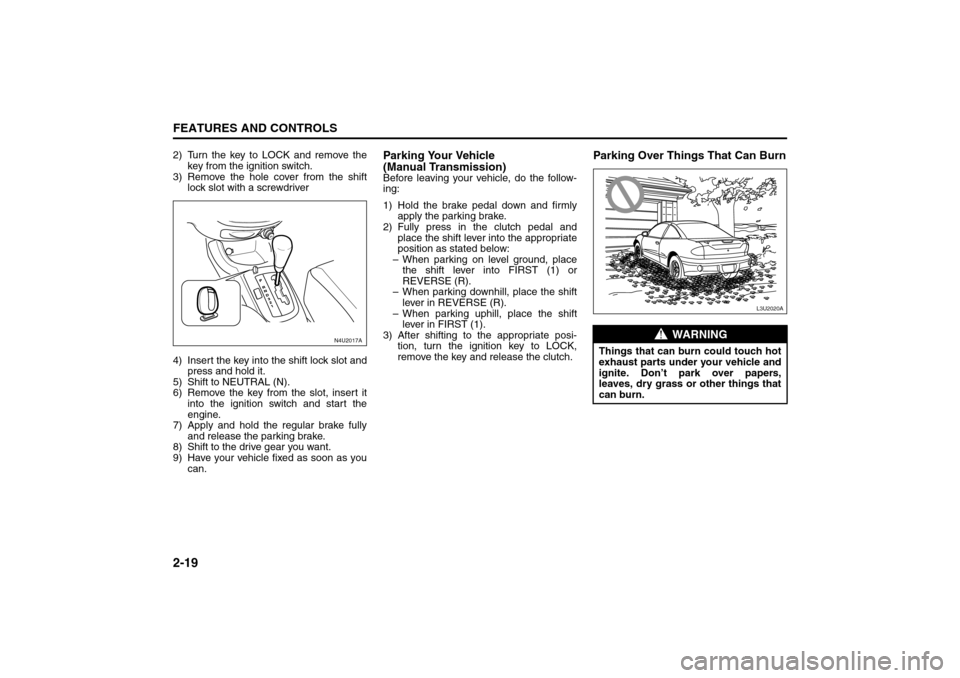
Parking Over Things That Can Burn
N4U2017A
WARNING
Things that can burn could touch hot
exhaust parts under your vehicle and
ignite. Don’t park over papers,
leaves, dry grass or other things that
can burn.
L3U2020A
Starting and Operating Your Vehicle:
Page 68 of 226
2-20
FEATURES AND CONTROLS
85Z04-03E
Engine Exhaust Running Your Engine While You Are
Parked
It’s better not to park with the engine run-
ning. But if you ever have to, here are
some things to know.
Follow the proper steps to be sure your
vehicle won’t move. See “Shifting Into Park
(P)” or “Parking Your Vehicle (Manual
Transmission)” in this section.
WARNING
Engine exhaust can kill. It contains
the gas carbon monoxide (CO), which
you can’t see or smell. It can cause
unconsciousness and death.
You might have exhaust coming in if:
Your exhaust system sounds
strange or different.
Your vehicle gets rusty underneath.
Your vehicle was damaged in a col-
lision.
Your vehicle was damaged when
driving over high points on the
road or over road debris.
Repairs weren’t done correctly.
Your vehicle or exhaust system had
been modified improperly.
If you ever suspect exhaust is com-
ing into your vehicle:
Drive it only with all the windows
down to blow out any CO; and
Have your vehicle fixed immedi-
ately.
WARNING
Idling the engine with the climate
control system off could allow dan-
gerous exhaust into your vehicle. See
the earlier Warning under “Engine
Exhaust.”
Also, idling in a closed-in place can
let deadly carbon monoxide (CO) into
your vehicle even if the climate con-
trol fan is at the highest setting. One
place this can happen is a garage.
Exhaust – with CO – can come in eas-
ily. NEVER park in a garage with the
engine running.
Another closed-in place can be a bliz-
zard. See “Winter Driving” in the
Index.
WARNING
It is dangerous to get out of your
vehicle if the shift lever is not fully in
PARK (P) or the appropriate position
with the parking brake firmly set.
Your vehicle can roll. To determine
the appropriate position, see “Park-
ing Your Vehicle”. Don’t leave your
vehicle when the engine is running
unless you have to. If you’ve left the
engine running, the vehicle can move
suddenly. You or others could be
injured. To be sure your vehicle won’t
move, even when you’re on fairly
level ground, always set your parking
brake and move the shift lever to
PARK (P) or the appropriate position
as described under “Parking Your
Ve h i cl e ” .
Starting and Operating Your Vehicle:
Mirrors:
Page 83 of 226
3-7INSTRUMENT PANEL
85Z04-03E
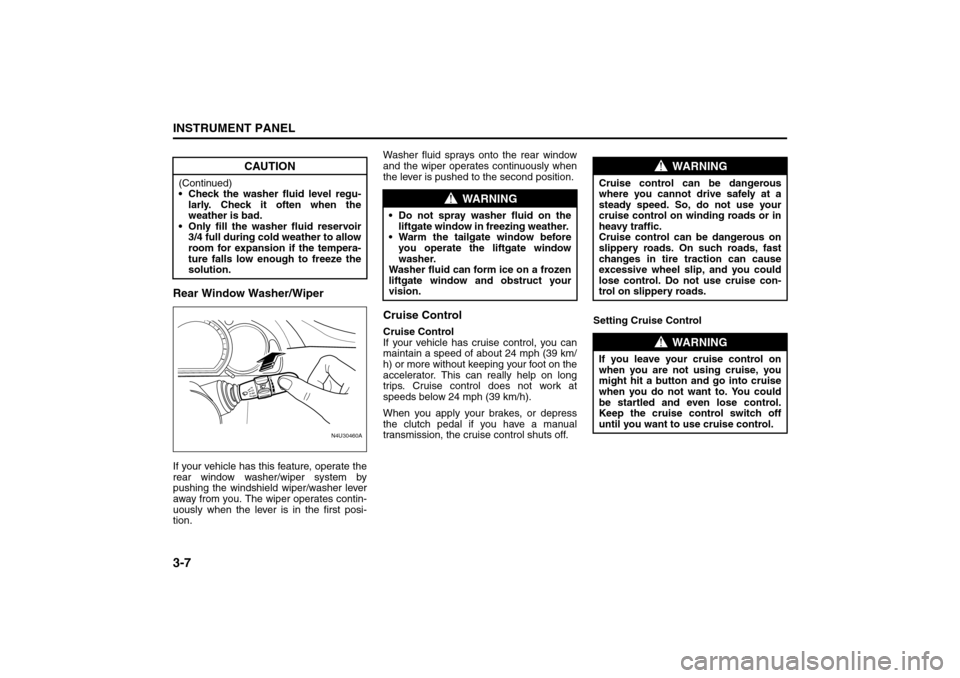
Rear Window Washer/WiperIf your vehicle has this feature, operate the
rear window washer/wiper system by
pushing the windshield wiper/washer lever
away from you. The wiper operates contin-
uously when the lever is in the first posi-
tion.Washer fluid sprays onto the rear window
and the wiper operates continuously when
the lever is pushed to the second position.
Cruise ControlCruise Control
If your vehicle has cruise control, you can
maintain a speed of about 24 mph (39 km/
h) or more without keeping your foot on the
accelerator. This can really help on long
trips. Cruise control does not work at
speeds below 24 mph (39 km/h).
When you apply your brakes, or depress
the clutch pedal if you have a manual
transmission, the cruise control shuts off.Setting Cruise Control
CAUTION
(Continued)
Check the washer fluid level regu-
larly. Check it often when the
weather is bad.
Only fill the washer fluid reservoir
3/4 full during cold weather to allow
room for expansion if the tempera-
ture falls low enough to freeze the
solution.
N4U30460A
FASTSLOW
WARNING
Do not spray washer fluid on the
liftgate window in freezing weather.
Warm the tailgate window before
you operate the liftgate window
washer.
Washer fluid can form ice on a frozen
liftgate window and obstruct your
vision.
WARNING
Cruise control can be dangerous
where you cannot drive safely at a
steady speed. So, do not use your
cruise control on winding roads or in
heavy traffic.
Cruise control can be dangerous on
slippery roads. On such roads, fast
changes in tire traction can cause
excessive wheel slip, and you could
lose control. Do not use cruise con-
trol on slippery roads.
WARNING
If you leave your cruise control on
when you are not using cruise, you
might hit a button and go into cruise
when you do not want to. You could
be startled and even lose control.
Keep the cruise control switch off
until you want to use cruise control.
Instrument Panel Overview:
Page 84 of 226
3-8
INSTRUMENT PANEL
85Z04-03E
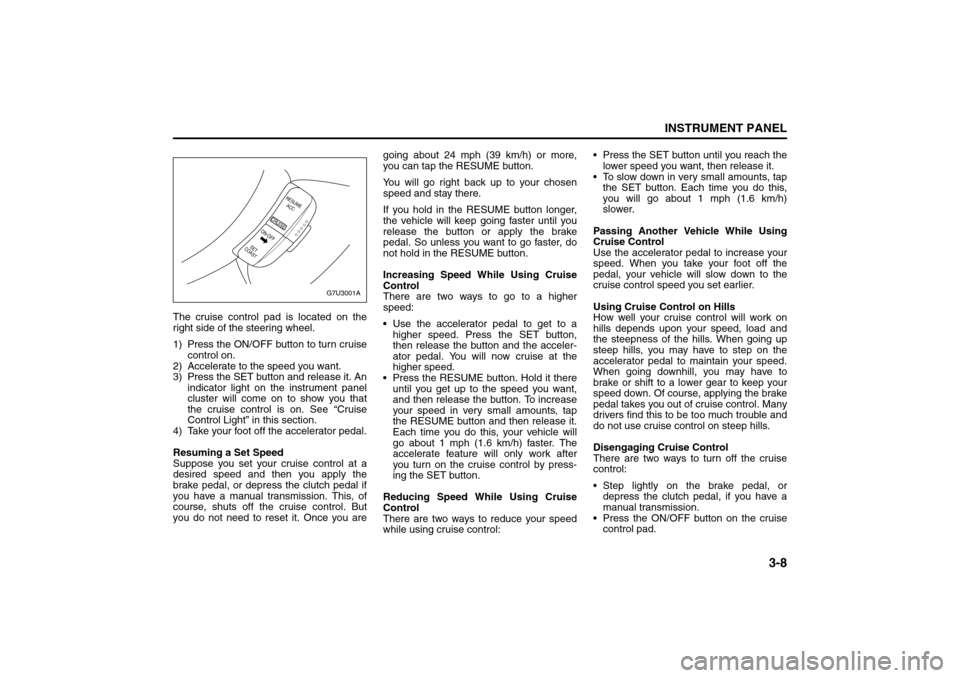
The cruise control pad is located on the
right side of the steering wheel.
1) Press the ON/OFF button to turn cruise
control on.
2) Accelerate to the speed you want.
3) Press the SET button and release it. An
indicator light on the instrument panel
cluster will come on to show you that
the cruise control is on. See “Cruise
Control Light” in this section.
4) Take your foot off the accelerator pedal.
Resuming a Set Speed
Suppose you set your cruise control at a
desired speed and then you apply the
brake pedal, or depress the clutch pedal if
you have a manual transmission. This, of
course, shuts off the cruise control. But
you do not need to reset it. Once you aregoing about 24 mph (39 km/h) or more,
you can tap the RESUME button.
You will go right back up to your chosen
speed and stay there.
If you hold in the RESUME button longer,
the vehicle will keep going faster until you
release the button or apply the brake
pedal. So unless you want to go faster, do
not hold in the RESUME button.
Increasing Speed While Using Cruise
Control
There are two ways to go to a higher
speed:
Use the accelerator pedal to get to a
higher speed. Press the SET button,
then release the button and the acceler-
ator pedal. You will now cruise at the
higher speed.
Press the RESUME button. Hold it there
until you get up to the speed you want,
and then release the button. To increase
your speed in very small amounts, tap
the RESUME button and then release it.
Each time you do this, your vehicle will
go about 1 mph (1.6 km/h) faster. The
accelerate feature will only work after
you turn on the cruise control by press-
ing the SET button.
Reducing Speed While Using Cruise
Control
There are two ways to reduce your speed
while using cruise control: Press the SET button until you reach the
lower speed you want, then release it.
To slow down in very small amounts, tap
the SET button. Each time you do this,
you will go about 1 mph (1.6 km/h)
slower.
Passing Another Vehicle While Using
Cruise Control
Use the accelerator pedal to increase your
speed. When you take your foot off the
pedal, your vehicle will slow down to the
cruise control speed you set earlier.
Using Cruise Control on Hills
How well your cruise control will work on
hills depends upon your speed, load and
the steepness of the hills. When going up
steep hills, you may have to step on the
accelerator pedal to maintain your speed.
When going downhill, you may have to
brake or shift to a lower gear to keep your
speed down. Of course, applying the brake
pedal takes you out of cruise control. Many
drivers find this to be too much trouble and
do not use cruise control on steep hills.
Disengaging Cruise Control
There are two ways to turn off the cruise
control:
Step lightly on the brake pedal, or
depress the clutch pedal, if you have a
manual transmission.
Press the ON/OFF button on the cruise
control pad.
G7U3001A
RESUME
ACC
CRUISE
SET
COASTON-OFF
Instrument Panel Overview:
Page 85 of 226
3-9INSTRUMENT PANEL
85Z04-03E
Erasing Speed Memory
When you turn off the cruise control or the
ignition, your cruise control set speed
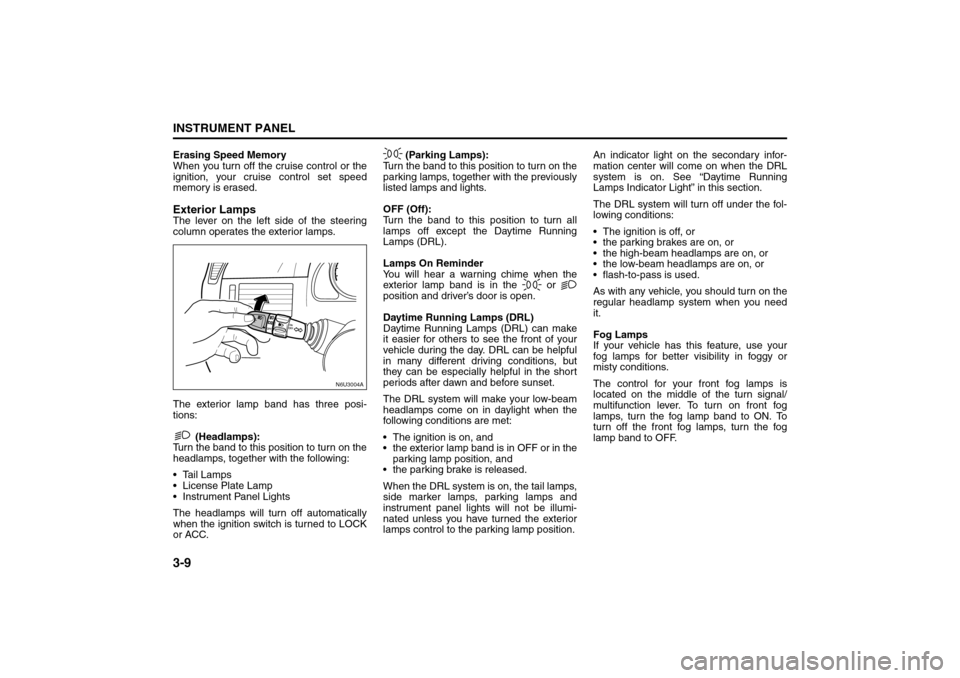
memory is erased.Exterior LampsThe lever on the left side of the steering
column operates the exterior lamps.
The exterior lamp band has three posi-
tions:
(Headlamps):
Turn the band to this position to turn on the
headlamps, together with the following:
Tail Lamps
License Plate Lamp
Instrument Panel Lights
The headlamps will turn off automatically
when the ignition switch is turned to LOCK
or ACC. (Parking Lamps):
Turn the band to this position to turn on the
parking lamps, together with the previously
listed lamps and lights.
OFF (Off):
Turn the band to this position to turn all
lamps off except the Daytime Running
Lamps (DRL).
Lamps On Reminder
You will hear a warning chime when the
exterior lamp band is in the or
position and driver’s door is open.
Daytime Running Lamps (DRL)
Daytime Running Lamps (DRL) can make
it easier for others to see the front of your
vehicle during the day. DRL can be helpful
in many different driving conditions, but
they can be especially helpful in the short
periods after dawn and before sunset.
The DRL system will make your low-beam
headlamps come on in daylight when the
following conditions are met:
The ignition is on, and
the exterior lamp band is in OFF or in the
parking lamp position, and
the parking brake is released.
When the DRL system is on, the tail lamps,
side marker lamps, parking lamps and
instrument panel lights will not be illumi-
nated unless you have turned the exterior
lamps control to the parking lamp position.An indicator light on the secondary infor-
mation center will come on when the DRL
system is on. See “Daytime Running
Lamps Indicator Light” in this section.
The DRL system will turn off under the fol-
lowing conditions:
The ignition is off, or
the parking brakes are on, or
the high-beam headlamps are on, or
the low-beam headlamps are on, or
flash-to-pass is used.
As with any vehicle, you should turn on the
regular headlamp system when you need
it.
Fog Lamps
If your vehicle has this feature, use your
fog lamps for better visibility in foggy or
misty conditions.
The control for your front fog lamps is
located on the middle of the turn signal/
multifunction lever. To turn on front fog
lamps, turn the fog lamp band to ON. To
turn off the front fog lamps, turn the fog
lamp band to OFF.
N6U3004A
Instrument Panel Overview:
Page 97 of 226
3-21INSTRUMENT PANEL
85Z04-03E
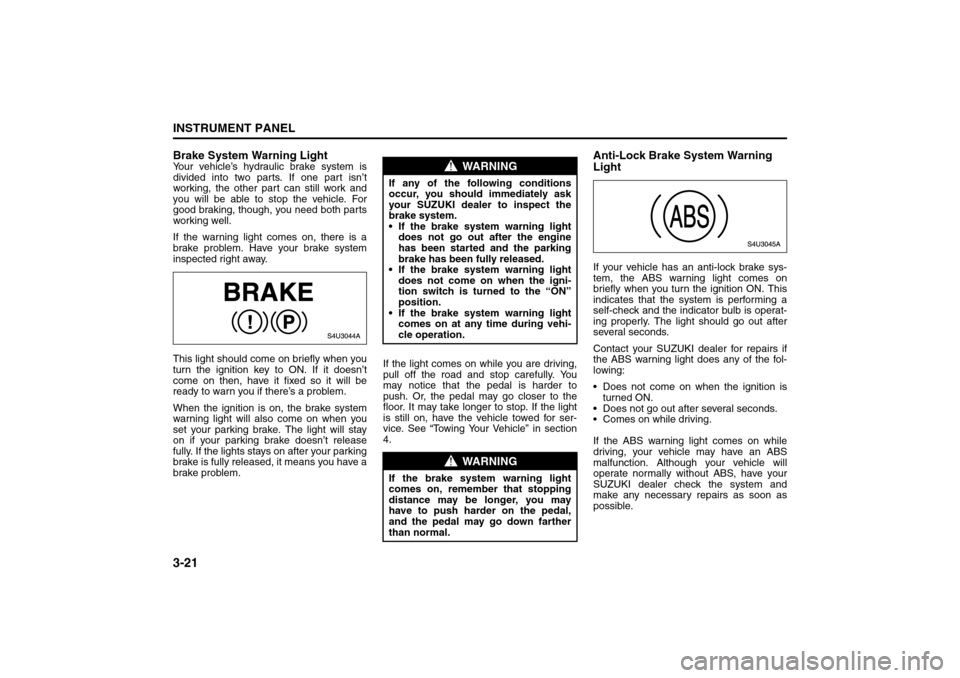
Brake System Warning LightYour vehicle’s hydraulic brake system is
divided into two parts. If one part isn’t
working, the other part can still work and
you will be able to stop the vehicle. For
good braking, though, you need both parts
working well.
If the warning light comes on, there is a
brake problem. Have your brake system
inspected right away.
This light should come on briefly when you
turn the ignition key to ON. If it doesn’t
come on then, have it fixed so it will be
ready to warn you if there’s a problem.
When the ignition is on, the brake system
warning light will also come on when you
set your parking brake. The light will stay
on if your parking brake doesn’t release
fully. If the lights stays on after your parking
brake is fully released, it means you have a
brake problem.If the light comes on while you are driving,
pull off the road and stop carefully. You
may notice that the pedal is harder to
push. Or, the pedal may go closer to the
floor. It may take longer to stop. If the light
is still on, have the vehicle towed for ser-
vice. See “Towing Your Vehicle” in section
4.
Anti-Lock Brake System Warning
LightIf your vehicle has an anti-lock brake sys-
tem, the ABS warning light comes on
briefly when you turn the ignition ON. This
indicates that the system is performing a
self-check and the indicator bulb is operat-
ing properly. The light should go out after
several seconds.
Contact your SUZUKI dealer for repairs if
the ABS warning light does any of the fol-
lowing:
Does not come on when the ignition is
turned ON.
Does not go out after several seconds.
Comes on while driving.
If the ABS warning light comes on while
driving, your vehicle may have an ABS
malfunction. Although your vehicle will
operate normally without ABS, have your
SUZUKI dealer check the system and
make any necessary repairs as soon as
possible.
WARNING
If any of the following conditions
occur, you should immediately ask
your SUZUKI dealer to inspect the
brake system.
If the brake system warning light
does not go out after the engine
has been started and the parking
brake has been fully released.
If the brake system warning light
does not come on when the igni-
tion switch is turned to the “ON”
position.
If the brake system warning light
comes on at any time during vehi-
cle operation.
WARNING
If the brake system warning light
comes on, remember that stopping
distance may be longer, you may
have to push harder on the pedal,
and the pedal may go down farther
than normal.
Warning Lights, Gauges and Indicators:
Page 104 of 226
3-28
INSTRUMENT PANEL
85Z04-03E
See “Tire pressure Monitoring System” in
Section 5 for more information.
Audio SystemPrecautions When the inside of the car is very cold
and the player is used soon after switch-
ing on the heater, moisture may form on
the disc or the optical parts of the player
and proper playback may not be possi-
ble. If moisture forms on the disc, wipe it
off with a soft cloth. If moisture forms on
the optical parts of the player, do not use
the player for about one hour, this will
allow the condensation to disappear nor-
mally.
Driving on extremely bumpy roads which
cause severe vibrations may cause
sound to skip.
This unit uses a precision mechanism.
Even in the event that trouble arises,
never open the case, disassemble the
unit, or lubricate the rotating parts.
Please bring the unit to an authorized
SUZUKI dealer.
WARNING
If the tire pressure warning light does
not come on when the ignition is
turned to the “ON” position, or
comes on and blinks for approxi-
mately one minute and then illumi-
nate continuously, while driving there
may be a problem with the tire pres-
sure monitoring system. Have your
vehicle inspected by an authorized
dealer.
WARNING
If the tire pressure warning light
comes on and stays on, reduce your
speed and avoid abrupt steering and
braking. Stop in a safe place as soon
as possible and check your tires.
If you have a flat tire, replace it with
a spare tire. Refer to “Changing a
Flat Tire” in section 5.
If one or more of your tires is
under-inflated, adjust the inflation
pressure in all of your tires to the
recommended inflation pressure as
soon as possible.
Be aware that driving on a signifi-
cantly under-inflated tire can cause
the tire to overheat and can lead to
tire failure, and may affect steering
control and brake effectiveness. This
could lead to an accident, resulting in
severe injury or death.
Audio System:
Page 125 of 226
4-1DRIVING YOUR VEHICLE
85Z04-03E
Your Driving, the Road, and
Your VehicleDefensive DrivingThe best advice anyone can give about
driving is: Drive defensively.
Please start by using a very important
safety device in your vehicle: Your safety
belt. Buckle up. See “Safety Belts: They
Are for Everyone” in section 1.
Defensive driving really means “be ready
for anything.” On city streets, rural roads or
freeways, it means “always expect the
unexpected.”
Assume that pedestrians or other drivers
are going to be careless and make mis-
takes. Anticipate what they might do. Be
ready for their mistakes.
Rear-end collisions are about the most
preventable of accidents. Yet they are com-
mon. Allow enough following distance. It’s
the best defensive driving maneuver, in
both city and rural driving. You never know
when the vehicle in front of you is going to
brake or turn suddenly.
Defensive driving requires that a driver
concentrate on the driving task. Anything
that distracts from the driving task – such
as concentrating on a cellular telephone
call, reading, or reaching for something on
the floor – makes proper defensive driving
more difficult and can even cause a colli-
sion, with resulting injury. Ask a passengerto help do things like this, or pull off the
road in a safe place to do them yourself.
These simple defensive driving tech-
niques could save your life.
Drunken DrivingDeath and injury associated with drinking
and driving is a national tragedy. It’s the
number one contributor to the highway
death toll, claiming thousands of victims
every year.
Alcohol affects four things that everyone
needs to drive a vehicle:
Judgment
Muscular Coordination
Vision
Attentiveness.
Police records show that almost half of all
motor vehicle-related deaths involve alco-
hol. In most cases, these deaths are the
result of someone who was drinking and
driving. In recent years, more than 16,000
annual motor vehicle-related deaths have
been associated with the use of alcohol,
with more than 300,000 people injured.
Many adults – by some estimates, nearly
half the adult population – choose never to
drink alcohol, so they never drive after
drinking. For persons under 21, it is
against the law in every U.S. state to drink
alcohol. There are good medical, psycho-
logical and developmental reasons for
these laws.The obvious way to eliminate the leading
highway safety problem is for people never
to drink alcohol and then drive. But what if
people do? How much is “too much” if
someone plans to drive? It’s a lot less than
many might think. Although it depends on
each person and situation, here is some
general information on the problem.
The Blood Alcohol Concentration (BAC) of
someone who is drinking depends upon
four things:
The amount of alcohol consumed
The drinker’s body weight
The amount of food that is consumed
before and during drinking
The length of time it has taken the
drinker to consume the alcohol.
According to the American Medical Associ-
ation, a 180 lb (82 kg) person who drinks
three 12 ounce (355 ml) bottles of beer in
an hour will end up with a BAC of about
0.06 percent. The person would reach the
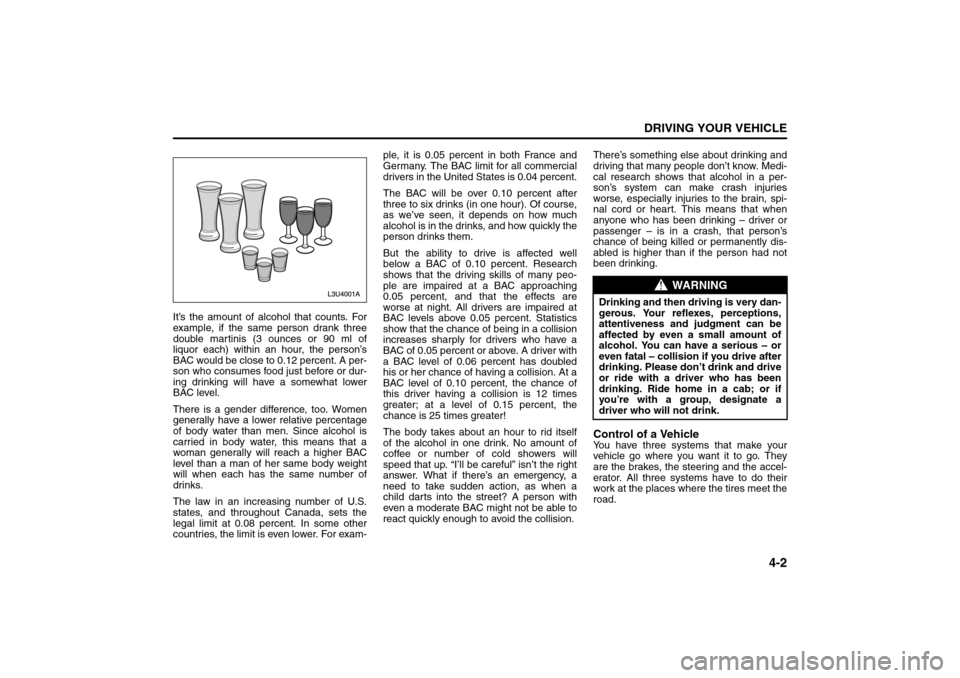
same BAC by drinking three 4 ounce (120
ml) glasses of wine or three mixed drinks if
each had 1-1/2 ounces (45 ml) of liquors
like whiskey, gin or vodka.
Your Driving, the Road, and Your Vehicle:
Page 126 of 226
4-2
DRIVING YOUR VEHICLE
85Z04-03E
It’s the amount of alcohol that counts. For
example, if the same person drank three
double martinis (3 ounces or 90 ml of
liquor each) within an hour, the person’s
BAC would be close to 0.12 percent. A per-
son who consumes food just before or dur-
ing drinking will have a somewhat lower
BAC level.
There is a gender difference, too. Women
generally have a lower relative percentage
of body water than men. Since alcohol is
carried in body water, this means that a
woman generally will reach a higher BAC
level than a man of her same body weight
will when each has the same number of
drinks.
The law in an increasing number of U.S.
states, and throughout Canada, sets the
legal limit at 0.08 percent. In some other
countries, the limit is even lower. For exam-ple, it is 0.05 percent in both France and
Germany. The BAC limit for all commercial
drivers in the United States is 0.04 percent.
The BAC will be over 0.10 percent after
three to six drinks (in one hour). Of course,
as we’ve seen, it depends on how much
alcohol is in the drinks, and how quickly the
person drinks them.
But the ability to drive is affected well
below a BAC of 0.10 percent. Research
shows that the driving skills of many peo-
ple are impaired at a BAC approaching
0.05 percent, and that the effects are
worse at night. All drivers are impaired at
BAC levels above 0.05 percent. Statistics
show that the chance of being in a collision
increases sharply for drivers who have a
BAC of 0.05 percent or above. A driver with
a BAC level of 0.06 percent has doubled
his or her chance of having a collision. At a
BAC level of 0.10 percent, the chance of
this driver having a collision is 12 times
greater; at a level of 0.15 percent, the
chance is 25 times greater!
The body takes about an hour to rid itself
of the alcohol in one drink. No amount of
coffee or number of cold showers will
speed that up. “I’ll be careful” isn’t the right
answer. What if there’s an emergency, a
need to take sudden action, as when a
child darts into the street? A person with
even a moderate BAC might not be able to
react quickly enough to avoid the collision.There’s something else about drinking and
driving that many people don’t know. Medi-
cal research shows that alcohol in a per-
son’s system can make crash injuries
worse, especially injuries to the brain, spi-
nal cord or heart. This means that when
anyone who has been drinking – driver or
passenger – is in a crash, that person’s
chance of being killed or permanently dis-
abled is higher than if the person had not
been drinking.
Control of a VehicleYou have three systems that make your
vehicle go where you want it to go. They
are the brakes, the steering and the accel-
erator. All three systems have to do their
work at the places where the tires meet the
road.
WARNING
Drinking and then driving is very dan-
gerous. Your reflexes, perceptions,
attentiveness and judgment can be
affected by even a small amount of
alcohol. You can have a serious – or
even fatal – collision if you drive after
drinking. Please don’t drink and drive
or ride with a driver who has been
drinking. Ride home in a cab; or if
you’re with a group, designate a
driver who will not drink.
Your Driving, the Road, and Your Vehicle:
Page 127 of 226
4-3DRIVING YOUR VEHICLE
85Z04-03E
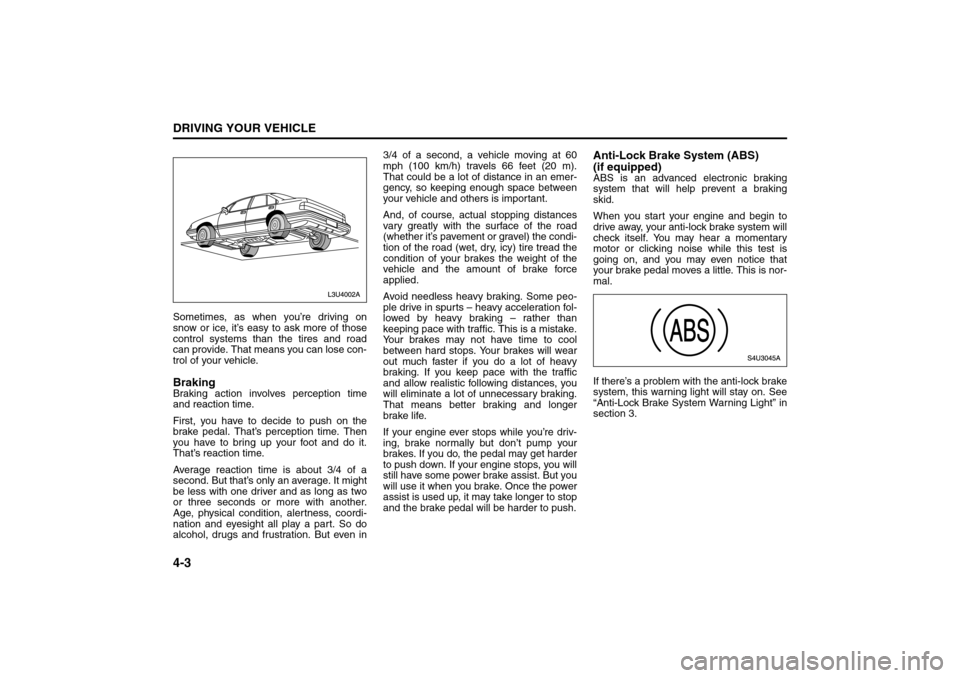
Sometimes, as when you’re driving on
snow or ice, it’s easy to ask more of those
control systems than the tires and road
can provide. That means you can lose con-
trol of your vehicle.BrakingBraking action involves perception time
and reaction time.
First, you have to decide to push on the
brake pedal. That’s perception time. Then
you have to bring up your foot and do it.
That’s reaction time.
Average reaction time is about 3/4 of a
second. But that’s only an average. It might
be less with one driver and as long as two
or three seconds or more with another.
Age, physical condition, alertness, coordi-
nation and eyesight all play a part. So do
alcohol, drugs and frustration. But even in3/4 of a second, a vehicle moving at 60
mph (100 km/h) travels 66 feet (20 m).
That could be a lot of distance in an emer-
gency, so keeping enough space between
your vehicle and others is important.
And, of course, actual stopping distances
vary greatly with the surface of the road
(whether it’s pavement or gravel) the condi-
tion of the road (wet, dry, icy) tire tread the
condition of your brakes the weight of the
vehicle and the amount of brake force
applied.
Avoid needless heavy braking. Some peo-
ple drive in spurts – heavy acceleration fol-
lowed by heavy braking – rather than
keeping pace with traffic. This is a mistake.
Your brakes may not have time to cool
between hard stops. Your brakes will wear
out much faster if you do a lot of heavy
braking. If you keep pace with the traffic
and allow realistic following distances, you
will eliminate a lot of unnecessary braking.
That means better braking and longer
brake life.
If your engine ever stops while you’re driv-
ing, brake normally but don’t pump your
brakes. If you do, the pedal may get harder
to push down. If your engine stops, you will
still have some power brake assist. But you
will use it when you brake. Once the power
assist is used up, it may take longer to stop
and the brake pedal will be harder to push.
Anti-Lock Brake System (ABS)
(if equipped)ABS is an advanced electronic braking
system that will help prevent a braking
skid.
When you start your engine and begin to
drive away, your anti-lock brake system will
check itself. You may hear a momentary
motor or clicking noise while this test is
going on, and you may even notice that
your brake pedal moves a little. This is nor-
mal.
If there’s a problem with the anti-lock brake
system, this warning light will stay on. See
“Anti-Lock Brake System Warning Light” in
section 3.
Your Driving, the Road, and Your Vehicle: