fuel SUZUKI FORENZA 2008 1.G User Guide
[x] Cancel search | Manufacturer: SUZUKI, Model Year: 2008, Model line: FORENZA, Model: SUZUKI FORENZA 2008 1.GPages: 226, PDF Size: 5.25 MB
Page 101 of 226
3-25INSTRUMENT PANEL
85Z04-03E
See “Fog Lamps” under Exterior Lamps in
this section for more information.Cruise Control LightIf your vehicle has this feature, this light will
come on briefly when the ignition is turned
on.
The CRUISE light comes on whenever the
cruise control is set. See “Cruise Control”
in this section. The light will turn off when
the cruise control is turned off.High beam On LightThis light comes on whenever the high-
beam headlamps are on.
See “Headlamp High/Low-Beam Changer”
under “Turn Signal/Multifunction Lever” in
this section for additional information.
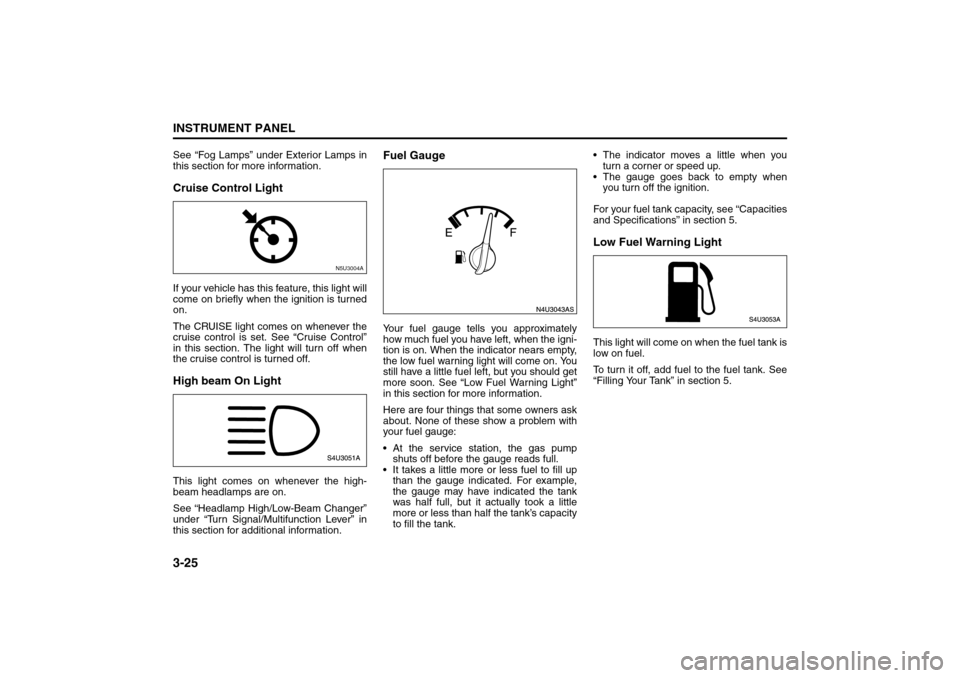
Fuel GaugeYour fuel gauge tells you approximately
how much fuel you have left, when the igni-
tion is on. When the indicator nears empty,
the low fuel warning light will come on. You
still have a little fuel left, but you should get
more soon. See “Low Fuel Warning Light”
in this section for more information.
Here are four things that some owners ask
about. None of these show a problem with
your fuel gauge:
At the service station, the gas pump
shuts off before the gauge reads full.
It takes a little more or less fuel to fill up
than the gauge indicated. For example,
the gauge may have indicated the tank
was half full, but it actually took a little
more or less than half the tank’s capacity
to fill the tank. The indicator moves a little when you
turn a corner or speed up.
The gauge goes back to empty when
you turn off the ignition.
For your fuel tank capacity, see “Capacities
and Specifications” in section 5.
Low Fuel Warning LightThis light will come on when the fuel tank is
low on fuel.
To turn it off, add fuel to the fuel tank. See
“Filling Your Tank” in section 5.
N5U3004A
Warning Lights, Gauges and Indicators:
Page 103 of 226
3-27INSTRUMENT PANEL
85Z04-03E
tire pressure monitoring system is func-
tioning properly.
Your vehicle has also been equipped with
a TPMS malfunction indictor to indicate
when the system is not operating properly.
The TPMS malfunction indicator is com-
bined with the low tire pressure telltale.
When the system detects a malfunction,
the telltale will flash for approximately one
minute and then remain continuously illu-
minated. This sequence will continue upon
subsequent vehicle start-ups as long as
the malfunction exists.In this situation, please have the system
inspected by an authorized service facility.
If you replace one or more tires and the
TPMS warning light goes off during driv-
ing, there is no problem. However, if the
warning light does not go off, or if it flashes
again when the vehicle is driven, have the
vehicle inspected by an authorized service
facility.
WARNING
Each tire, including the spare (if pro-
vided), should be checked monthly
when cold and inflated to the inflation
pressure recommended by the vehi-
cle manufacturer on the vehicle plac-
ard or tire inflation pressure label and
this manual. (If your vehicle has tires
of a different size than the size indi-
cated on the vehicle label or tire infla-
tion pressure label, you should
determine the proper tire inflation
pressure for those tires.)
As an added safety feature, your
vehicle has been equipped with a tire
pressure monitoring system (TPMS)
that illuminates a low tire pressure
telltale when one or more of your
tires is significantly under-inflated.
Accordingly, when the low tire pres-
sure telltale illuminates, you should
stop and check your tires as soon as
possible and inflate them to the
proper pressure. Driving on a signifi-
cantly under-inflated tire causes the
tire to overheat and can lead to tire
failure.
Under-inflation also reduces fuel effi-
ciency and tire tread life and may
affect the vehicle’s handling and
stopping ability.
(Continued)
WARNING
(Continued)
Please note that the TPMS is not a
substitute for proper tire mainte-
nance, and it is the driver’s responsi-
bility to maintain correct tire
pressure, even if under-inflation has
not reached the level to trigger illumi-
nation of the TPMS low tire pressure
telltale.
WARNING
If the tire pressure monitoring system
warning light does not illuminate
when the ignition key is turned to the
“ON” position, have the system
inspected by an authorized service
facility. If the warning light flashes
while driving, check to see whether
the warning light goes off after a few
minutes of driving.
WARNING
When the malfunction indicator is
illuminated, the system may not be
able to detect or signal low tire pres-
sure as intended. TPMS malfunctions
may occur for a variety of reasons,
including the installation of replace-
ment or alternate tires or wheels on
the vehicle that prevent the TPMS
from functioning properly. Always
check the TPMS malfunction telltale
after replacing one or more tires or
wheels on your vehicle to ensure that
the replacement or alternate tires and
wheels allow the TPMS to continue to
function properly.
Audio System:
Page 135 of 226
4-11DRIVING YOUR VEHICLE
85Z04-03E
time and energy. See the next part,
“Freeway Driving.”
Treat a green light as a warning signal. A
traffic light is there because the corner is
busy enough to need it. When a light
turns green, and just before you start to
move, check both ways for vehicles that
have not cleared the intersection or may
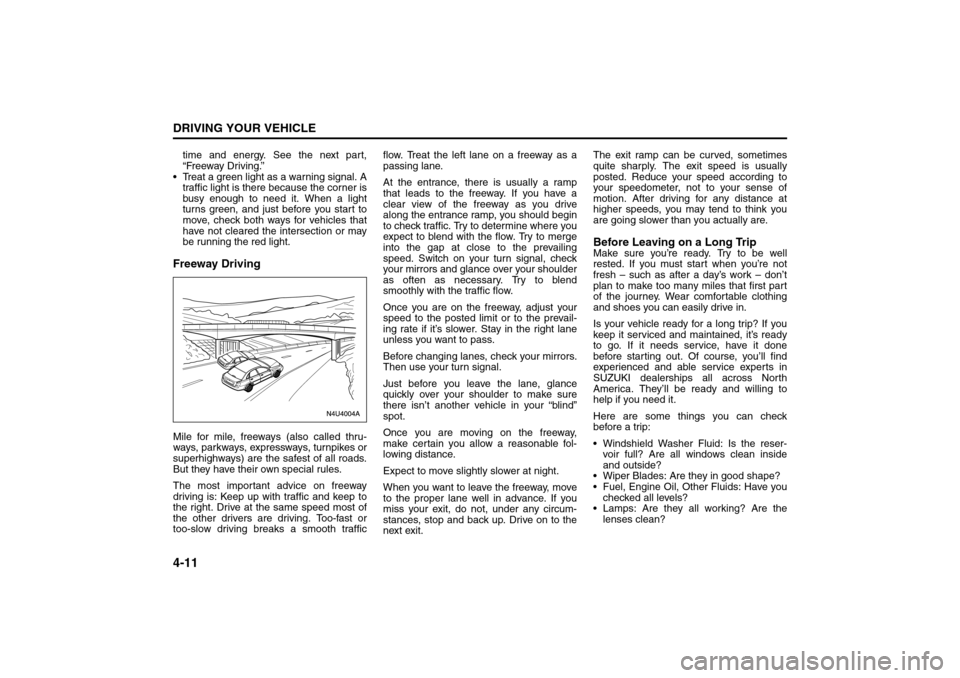
be running the red light.Freeway DrivingMile for mile, freeways (also called thru-
ways, parkways, expressways, turnpikes or
superhighways) are the safest of all roads.
But they have their own special rules.
The most important advice on freeway
driving is: Keep up with traffic and keep to
the right. Drive at the same speed most of
the other drivers are driving. Too-fast or
too-slow driving breaks a smooth trafficflow. Treat the left lane on a freeway as a
passing lane.
At the entrance, there is usually a ramp
that leads to the freeway. If you have a
clear view of the freeway as you drive
along the entrance ramp, you should begin
to check traffic. Try to determine where you
expect to blend with the flow. Try to merge
into the gap at close to the prevailing
speed. Switch on your turn signal, check
your mirrors and glance over your shoulder
as often as necessary. Try to blend
smoothly with the traffic flow.
Once you are on the freeway, adjust your
speed to the posted limit or to the prevail-
ing rate if it’s slower. Stay in the right lane
unless you want to pass.
Before changing lanes, check your mirrors.
Then use your turn signal.
Just before you leave the lane, glance
quickly over your shoulder to make sure
there isn’t another vehicle in your “blind”
spot.
Once you are moving on the freeway,
make certain you allow a reasonable fol-
lowing distance.
Expect to move slightly slower at night.
When you want to leave the freeway, move
to the proper lane well in advance. If you
miss your exit, do not, under any circum-
stances, stop and back up. Drive on to the
next exit.The exit ramp can be curved, sometimes
quite sharply. The exit speed is usually
posted. Reduce your speed according to
your speedometer, not to your sense of
motion. After driving for any distance at
higher speeds, you may tend to think you
are going slower than you actually are.
Before Leaving on a Long TripMake sure you’re ready. Try to be well
rested. If you must start when you’re not
fresh – such as after a day’s work – don’t
plan to make too many miles that first part
of the journey. Wear comfortable clothing
and shoes you can easily drive in.
Is your vehicle ready for a long trip? If you
keep it serviced and maintained, it’s ready
to go. If it needs service, have it done
before starting out. Of course, you’ll find
experienced and able service experts in
SUZUKI dealerships all across North
America. They’ll be ready and willing to
help if you need it.
Here are some things you can check
before a trip:
Windshield Washer Fluid: Is the reser-
voir full? Are all windows clean inside
and outside?
Wiper Blades: Are they in good shape?
Fuel, Engine Oil, Other Fluids: Have you
checked all levels?
Lamps: Are they all working? Are the
lenses clean?
Your Driving, the Road, and Your Vehicle:
Page 139 of 226
4-15DRIVING YOUR VEHICLE
85Z04-03E
Run your engine only as long as you must.
This saves fuel. When you run the engine,
make it go a little faster than just idle. That
is, push the accelerator slightly. This uses
less fuel for the heat that you get and it
keeps the battery charged. You will need a
well-charged battery to restart the vehicle,
and possibly for signaling later on with your
headlamps. Let the heater run for a while.
Then, shut the engine off and close the
window almost all the way to preserve the
heat. Start the engine again and repeat
this only when you feel really uncomfort-
able from the cold. But do it as little as pos-
sible. Preserve the fuel as long as you can.
To help keep warm, you can get out of the
vehicle and do some fairly vigorous exer-
cises every half hour or so until help
comes.
If You Are Stuck: In Sand, Mud, Ice or
Snow
In order to free your vehicle when it is
stuck, you will need to spin the wheels, but
you don’t want to spin your wheels too fast.
The method known as “rocking” can help
you get out when you’re stuck, but you
must use caution.For information about using tire chains on
your vehicle, see “Tire Chains” in section 5.Rocking Your Vehicle To Get It Out
First, turn your steering wheel left and
right. That will clear the area around your
front wheels. Then shift back and forth
between REVERSE (R) and a forward
gear (or with a manual transmission,
between FIRST (1) or SECOND (2) and
REVERSE (R)), spinning the wheels as lit-
tle as possible. Release the accelerator
pedal while you shift, and press lightly on
the accelerator pedal when the transmis-
sion is in gear. By slowly spinning your
wheels in the forward and reverse direc-
tions, you will cause a rocking motion that
may free your vehicle. If that doesn’t get
you out after a few tries, you may need to
be towed out. If you do need to be towed
out, see “Towing Your Vehicle” in the fol-
lowing section.
WARNING
If you let your tires spin at high
speed, they can explode, and you or
others could be injured. And, the
transmission or other parts of the
vehicle can overheat. That could
cause an engine compartment fire or
other damage. When you’re stuck,
spin the wheels as little as possible.
Don’t spin the wheels above 35 mph
(55 km/h) as shown on the speedom-
eter.
CAUTION
Spinning your wheels can destroy
parts of your vehicle as well as the
tires. If you spin the wheels too fast
while shifting your transmission back
and forth, you can destroy your trans-
mission. See “Rocking Your Vehicle
To Get It Out.”
Your Driving, the Road, and Your Vehicle:
Page 143 of 226
4-19DRIVING YOUR VEHICLE
85Z04-03E
Determining Compatibility of Tire and
Vehicle Load Limits
The tires on your vehicle, when they are
inflated to the recommended tire inflation
pressure, have a load-carrying capacity
that is greater than the load that will be onthe tires when the vehicle is at its GVWR
or GAWR limit. Never use replacement
tires that have a load-carrying capacity
less than the original tires on your vehicle.
Tire load-carrying capacity information is
molded into the tire sidewall typically
shown as “Max. Load”. Use of replacement
tires with a lower load-carrying capacity
than the original tires, or failure to keep the
tires inflated to recommended tire pres-
sure, may reduce the GVWR or GAWR
limit of your vehicle.
NOTE:
Use of replacement tires with a higher
load-carrying capacity than the original
tires, or using a tire inflation pressure
higher than the recommended tire inflation
pressure, will not increase the GVWR or
GAWR limit of your vehicle.
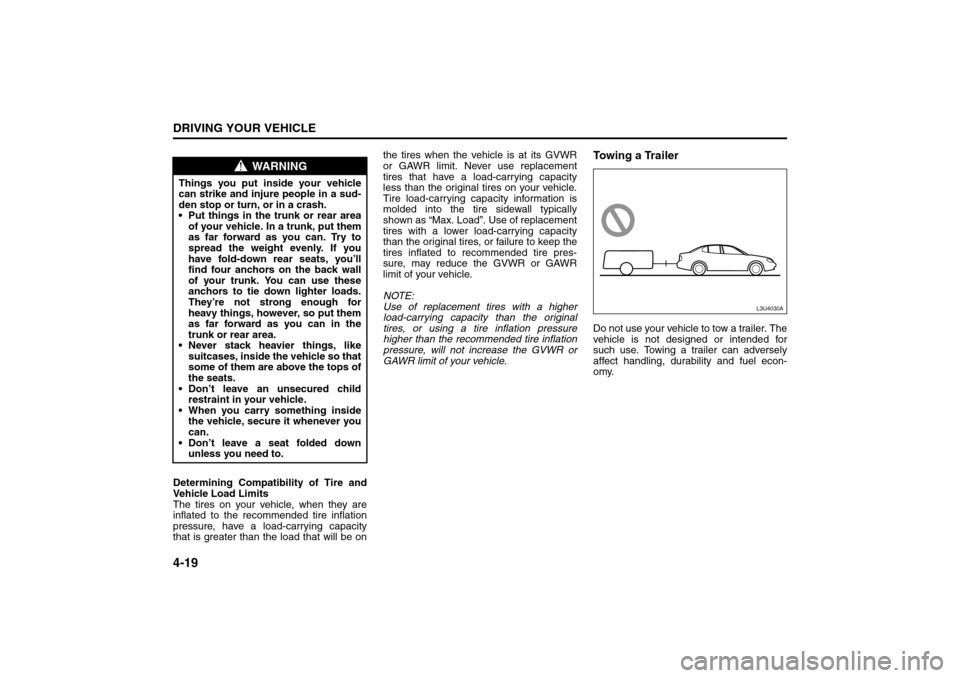
Towing a TrailerDo not use your vehicle to tow a trailer. The
vehicle is not designed or intended for
such use. Towing a trailer can adversely
affect handling, durability and fuel econ-
omy.
WARNING
Things you put inside your vehicle
can strike and injure people in a sud-
den stop or turn, or in a crash.
Put things in the trunk or rear area
of your vehicle. In a trunk, put them
as far forward as you can. Try to
spread the weight evenly. If you
have fold-down rear seats, you’ll
find four anchors on the back wall
of your trunk. You can use these
anchors to tie down lighter loads.
They’re not strong enough for
heavy things, however, so put them
as far forward as you can in the
trunk or rear area.
Never stack heavier things, like
suitcases, inside the vehicle so that
some of them are above the tops of
the seats.
Don’t leave an unsecured child
restraint in your vehicle.
When you carry something inside
the vehicle, secure it whenever you
can.
Don’t leave a seat folded down
unless you need to.
L3U4030A
Towing:
Page 144 of 226
SERVICE AND APPEARANCE CARE
5
85Z04-03E
SERVICE AND APPEARANCE CAREService ................................................................................. 5-1
Fuel ....................................................................................... 5-1
Checking Things Under the Hood ..................................... 5-4
Headlamp Aiming ................................................................ 5-23
Bulb Replacement ............................................................... 5-23
Windshield Wiper Blade Replacement .............................. 5-28
Tires ...................................................................................... 5-28
Tire Pressure Monitoring System ...................................... 5-33
Appearance Care ................................................................. 5-45
Vehicle Identification .......................................................... 5-49
Electrical System ................................................................ 5-49
Capacities and Specifications ........................................... 5-54
Page 145 of 226
5-1SERVICE AND APPEARANCE CARE
85Z04-03E
ServiceYour SUZUKI dealer knows your vehicle
best and wants you to be happy with it. We
hope you’ll go to your SUZUKI dealer for
all your service needs. You’ll get genuine
SUZUKI parts and SUZUKI trained and
supported service people.
We hope you’ll want to keep your SUZUKI
vehicle all SUZUKI. Doing Your Own Service WorkYour vehicle has an air bag system. Before
attempting to do your own service work,
see “Servicing Your Air Bag-Equipped
Vehicle” in section 1.
You should keep a record with all parts
receipts and list the mileage and the date
of any service work you perform. See
“Maintenance Record” in section 6.
Adding Equipment to the Outside of
Yo u r Ve h i c l eThings you might add to the outside of your
vehicle can affect the airflow around it. This
may cause wind noise and affect wind-
shield washer performance. Check with
your SUZUKI dealer before adding equip-
ment to the outside of your vehicle.
FuelUse of the recommended fuel is an impor-
tant part of the proper maintenance of your
vehicle.Gasoline OctaneUse only unleaded gasoline with a posted
octane rating of 87 or higher. In an emer-
gency, you may be able to use a lower
octane rating – as low as 85 – if heavy
knocking does not occur. Refill your tank
with proper fuel as soon as possible. Oth-
erwise, you might damage your engine. If
you are using 87 or higher-octane rating
fuel and you hear heavy knocking, your
engine needs service.California FuelIf your vehicle is certified to meet California
Emission Standards (see the underhood
emission control label), it is designed to
operate on fuels that meet California spec-
ifications. If this fuel is not available in
states adopting California emissions stan-
dards, your vehicle will operate satisfacto-
rily on fuels meeting federal specifications,
but emission control system performance
may be affected. The malfunction indicator
lamp may turn on (see Malfunction Indica-
tor Lamp in section 3) and your vehicle
may fail a smog-check test. If this occurs,
return to your SUZUKI dealer for diagno-
sis.
WARNING
You can be injured and your vehicle
could be damaged if you try to do
service work on a vehicle without
knowing enough about it.
Be sure you have sufficient knowl-
edge, experience, the proper
replacement parts and tools before
you attempt any vehicle mainte-
nance task.
Be sure to use the proper nuts,
bolts and other fasteners.
“English” and “metric” fasteners
can be easily confused. If you use
the wrong fasteners, parts can later
break or fall off. You could be hurt.
Service:
Fuel:
Page 146 of 226
5-2
SERVICE AND APPEARANCE CARE
85Z04-03E
AdditivesTo provide cleaner air, all gasolines in the
United States are now required to contain
additives that will help prevent engine and
fuel system deposits from forming, allow-
ing your emission control system to work
properly. You should not have to add any-
thing to your fuel. However, some gaso-
lines contain only the minimum amount of
additive required to meet U.S. Environ-
mental Protection Agency regulations.
SUZUKI recommends that you buy gaso-
lines that are advertised to help keep fuel
injectors and intake valves clean. If your
vehicle experiences problems due to dirty
injectors or valves, try a different brand of
gasoline.
Gasoline containing oxygenates, such as
ethers and ethanol, and reformulated gas-
olines may be available in your area to
contribute to clean air. SUZUKI recom-
mends that you use these gasolines.
Some gasolines that are not reformulated
for low emissions may contain an octane-
enhancing additive called methylcyclopen-tadienyl manganese tricarbonyl (MMT);
ask the attendant where you buy gasoline
whether the fuel contains MMT. SUZUKI
does not recommend the use of such gas-
olines. Fuels containing MMT can reduce
the life of spark plugs and the performance
of the emission control system may be
affected. The malfunction indicator lamp
may turn on. If this occurs, return to your
SUZUKI dealer for service.
Fuels in Foreign CountriesIf you plan on driving in another country
outside the United States or Canada, the
proper fuel may be hard to find. Never use
leaded gasoline or any other fuel not rec-
ommended in the previous text on fuel.
Costly repairs caused by use of improper
fuel wouldn’t be covered by your warranty.
To check the fuel availability, ask an auto
club, or contact a major oil company that
does business in the country where you’ll
be driving.
Filling Your Tank
CAUTION
Your vehicle was not designed for
fuel that contains methanol. Don’t
use fuel containing methanol. It can
corrode metal parts in your fuel sys-
tem and also damage the plastic and
rubber parts. That damage wouldn’t
be covered under your warranty.
WARNING
Fuel vapor burns violently and a fuel
fire can cause severe injuries. To help
avoid injuries to you and others, read
and follow all the instructions on the
pump island. Turn off your engine
when you are refueling. Don’t smoke
if you’re near fuel or are refueling
your vehicle. Keep sparks, flames
and smoking materials away from
fuel. Don’t leave the fuel pump unat-
tended when refueling your vehicle –
this is against the law in some
places. Keep children away from the
fuel pump; never let children pump
fuel.
Fuel:
Page 147 of 226
5-3SERVICE AND APPEARANCE CARE
85Z04-03E
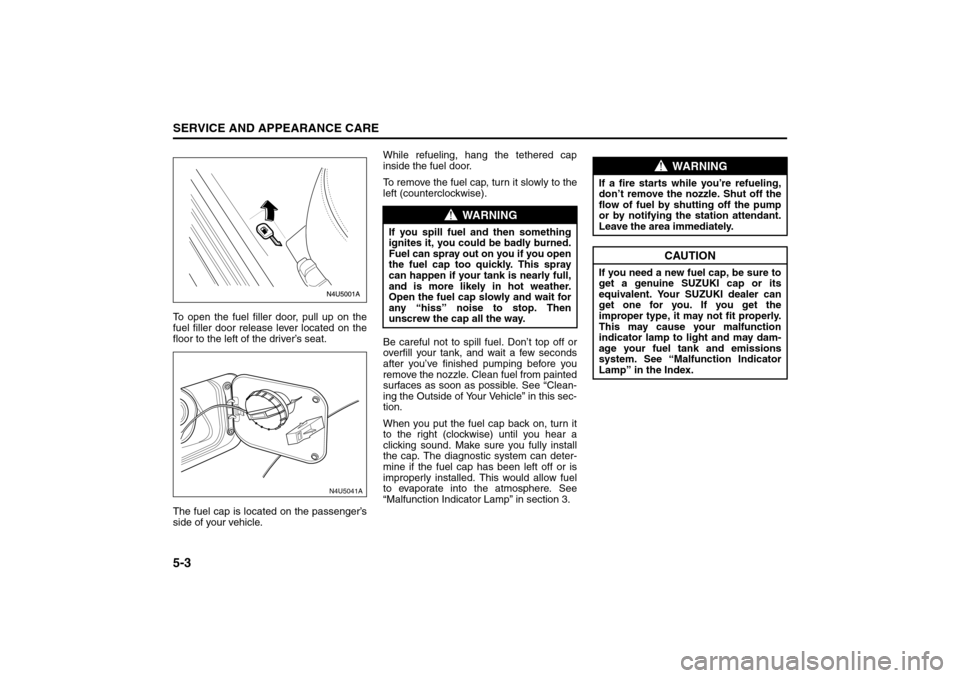
To open the fuel filler door, pull up on the
fuel filler door release lever located on the
floor to the left of the driver’s seat.
The fuel cap is located on the passenger’s
side of your vehicle.While refueling, hang the tethered cap
inside the fuel door.
To remove the fuel cap, turn it slowly to the
left (counterclockwise).
Be careful not to spill fuel. Don’t top off or
overfill your tank, and wait a few seconds
after you’ve finished pumping before you
remove the nozzle. Clean fuel from painted
surfaces as soon as possible. See “Clean-
ing the Outside of Your Vehicle” in this sec-
tion.
When you put the fuel cap back on, turn it
to the right (clockwise) until you hear a
clicking sound. Make sure you fully install
the cap. The diagnostic system can deter-
mine if the fuel cap has been left off or is
improperly installed. This would allow fuel
to evaporate into the atmosphere. See
“Malfunction Indicator Lamp” in section 3.
N4U5041A
WARNING
If you spill fuel and then something
ignites it, you could be badly burned.
Fuel can spray out on you if you open
the fuel cap too quickly. This spray
can happen if your tank is nearly full,
and is more likely in hot weather.
Open the fuel cap slowly and wait for
any “hiss” noise to stop. Then
unscrew the cap all the way.
WARNING
If a fire starts while you’re refueling,
don’t remove the nozzle. Shut off the
flow of fuel by shutting off the pump
or by notifying the station attendant.
Leave the area immediately.
CAUTION
If you need a new fuel cap, be sure to
get a genuine SUZUKI cap or its
equivalent. Your SUZUKI dealer can
get one for you. If you get the
improper type, it may not fit properly.
This may cause your malfunction
indicator lamp to light and may dam-
age your fuel tank and emissions
system. See “Malfunction Indicator
Lamp” in the Index.
Fuel:
Page 148 of 226
5-4
SERVICE AND APPEARANCE CARE
85Z04-03E
Filling a Portable Fuel Container
Checking Things Under the
Hood
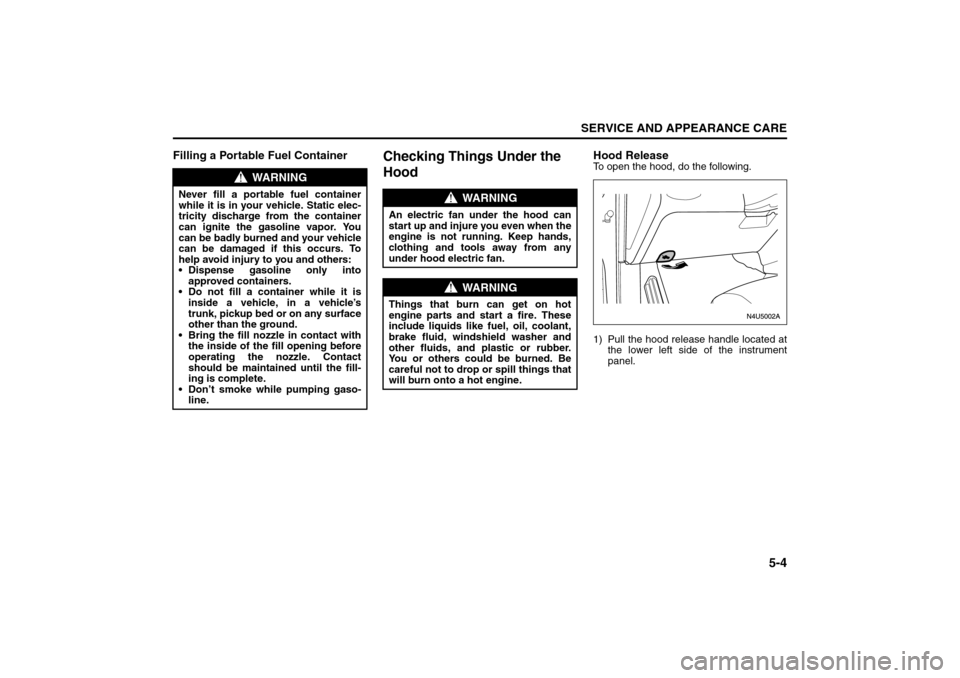
Hood ReleaseTo open the hood, do the following.
1) Pull the hood release handle located at
the lower left side of the instrument
panel.
WARNING
Never fill a portable fuel container
while it is in your vehicle. Static elec-
tricity discharge from the container
can ignite the gasoline vapor. You
can be badly burned and your vehicle
can be damaged if this occurs. To
help avoid injury to you and others:
Dispense gasoline only into
approved containers.
Do not fill a container while it is
inside a vehicle, in a vehicle’s
trunk, pickup bed or on any surface
other than the ground.
Bring the fill nozzle in contact with
the inside of the fill opening before
operating the nozzle. Contact
should be maintained until the fill-
ing is complete.
Don’t smoke while pumping gaso-
line.
WARNING
An electric fan under the hood can
start up and injure you even when the
engine is not running. Keep hands,
clothing and tools away from any
under hood electric fan.
WARNING
Things that burn can get on hot
engine parts and start a fire. These
include liquids like fuel, oil, coolant,
brake fluid, windshield washer and
other fluids, and plastic or rubber.
You or others could be burned. Be
careful not to drop or spill things that
will burn onto a hot engine.
Fuel:
Checking Things Under the Hood: