tires SUZUKI FORENZA 2008 1.G User Guide
[x] Cancel search | Manufacturer: SUZUKI, Model Year: 2008, Model line: FORENZA, Model: SUZUKI FORENZA 2008 1.GPages: 226, PDF Size: 5.25 MB
Page 133 of 226
4-9DRIVING YOUR VEHICLE
85Z04-03E
Remember that your headlamps light up
far less of a roadway when you are in a
turn or curve. Keep your eyes moving; that
way, it’s easier to pick out dimly lighted
objects. Just as your headlamps should be
checked regularly for proper aim, so
should your eyes be examined regularly.
Some drivers suffer from night blindness –
the inability to see in dim light – and aren’t
even aware of it.Driving in Rain and on Wet RoadsRain and wet roads can mean driving trou-
ble. On a wet road, you can’t stop, acceler-
ate or turn as well because your tire-to-
road traction isn’t as good as on dry roads.
And, if your tires don’t have much tread
left, you’ll get even less traction. It’s always
wise to go slower and be cautious if rain
starts to fall while you are driving. The sur-
face may get wet suddenly when yourreflexes are tuned for driving on dry pave-
ment.
The heavier the rain, the harder it is to see.
Even if your windshield wiper blades are in
good shape, a heavy rain can make it
harder to see road signs and traffic signals,
pavement markings, the edge of the road
and even people walking.
It’s wise to keep your windshield wiping
equipment in good shape and keep your
windshield washer tank filled with washer
fluid. Replace your windshield wiper
inserts when they show signs of streaking
or missing areas on the windshield, or
when strips of rubber start to separate
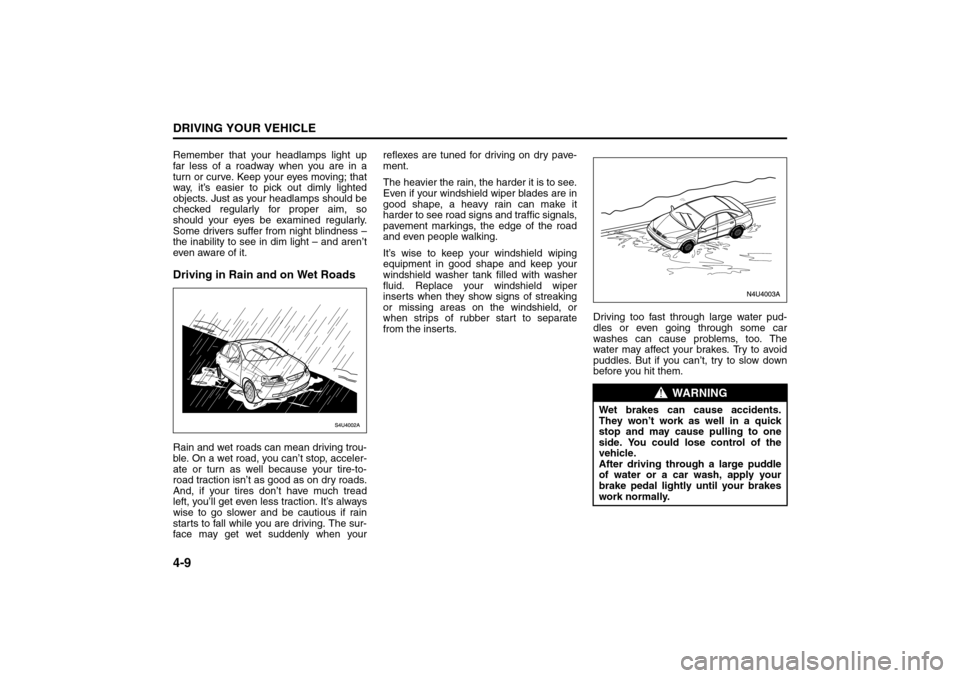
from the inserts.Driving too fast through large water pud-
dles or even going through some car
washes can cause problems, too. The
water may affect your brakes. Try to avoid
puddles. But if you can’t, try to slow down
before you hit them.
WARNING
Wet brakes can cause accidents.
They won’t work as well in a quick
stop and may cause pulling to one
side. You could lose control of the
vehicle.
After driving through a large puddle
of water or a car wash, apply your
brake pedal lightly until your brakes
work normally.
Your Driving, the Road, and Your Vehicle:
Page 134 of 226
4-10
DRIVING YOUR VEHICLE
85Z04-03E
Hydroplaning
Hydroplaning is dangerous. So much
water can build up under your tires that
they can actually ride on the water. This
can happen if the road is wet enough and
you’re going fast enough. When your vehi-
cle is hydroplaning, it has little or no con-
tact with the road.
Hydroplaning doesn’t happen often. But it
can if your tires do not have much tread or
if the pressure in one or more is low. It can
happen if a lot of water is standing on the
road. If you can see reflections from trees,
telephone poles or other vehicles, and
raindrops “dimple” the water’s surface,
there could be the possibility of hydroplan-
ing.
Hydroplaning usually happens at higher
speeds. There just isn’t a hard and fast rule
about hydroplaning. The best advice is to
slow down when it is raining.Driving Through Deep Standing Water
Driving Trough Flowing Water
Some Other Rainy Weather Tips
Besides slowing down, allow some extra
following distance. And be especially
careful when you pass another vehicle.Allow yourself more clear room ahead,
and be prepared to have your view
restricted by road spray.
Have good tires with proper tread depth.
See “Tires” in section 5.
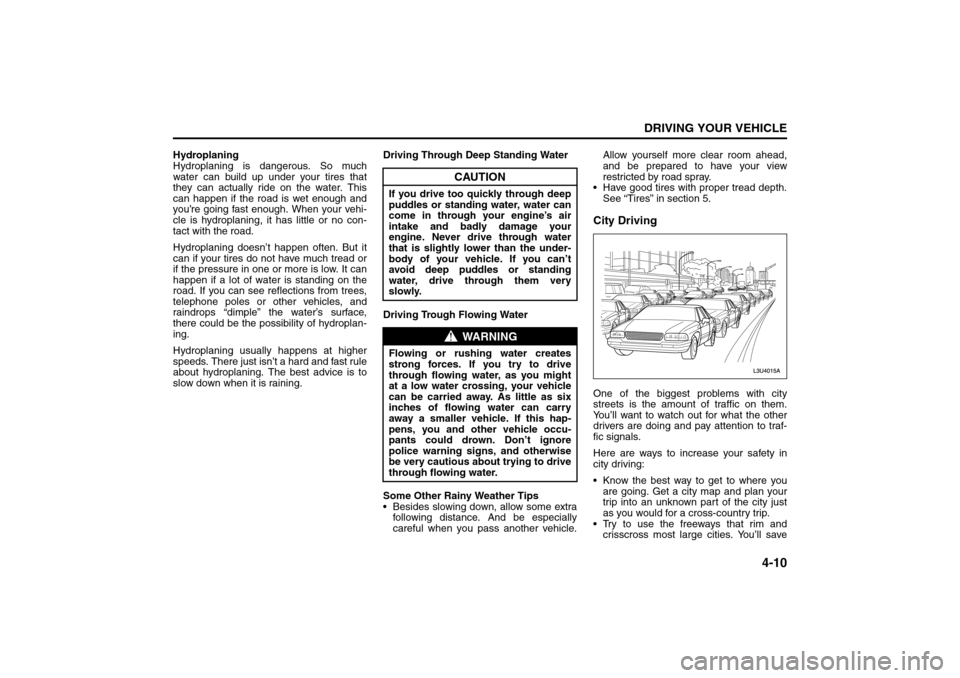
City DrivingOne of the biggest problems with city
streets is the amount of traffic on them.
You’ll want to watch out for what the other
drivers are doing and pay attention to traf-
fic signals.
Here are ways to increase your safety in
city driving:
Know the best way to get to where you
are going. Get a city map and plan your
trip into an unknown part of the city just
as you would for a cross-country trip.
Try to use the freeways that rim and
crisscross most large cities. You’ll save
CAUTION
If you drive too quickly through deep
puddles or standing water, water can
come in through your engine’s air
intake and badly damage your
engine. Never drive through water
that is slightly lower than the under-
body of your vehicle. If you can’t
avoid deep puddles or standing
water, drive through them very
slowly.
WARNING
Flowing or rushing water creates
strong forces. If you try to drive
through flowing water, as you might
at a low water crossing, your vehicle
can be carried away. As little as six
inches of flowing water can carry
away a smaller vehicle. If this hap-
pens, you and other vehicle occu-
pants could drown. Don’t ignore
police warning signs, and otherwise
be very cautious about trying to drive
through flowing water.
Your Driving, the Road, and Your Vehicle:
Page 136 of 226
4-12
DRIVING YOUR VEHICLE
85Z04-03E
Tires: They are vitally important to a
safe, trouble-free trip. Is the tread good
enough for long-distance driving? Are
the tires all inflated to the recommended
pressure?
Weather Forecasts: What’s the weather
outlook along your route? Should you
delay your trip a short time to avoid a
major storm system?
Maps: Do you have up-to-date maps?Highway HypnosisIs there actually such a condition as “high-
way hypnosis”? Or is it just plain falling
asleep at the wheel? Call it highway hyp-
nosis, lack of awareness, or whatever.
There is something about an easy stretch
of road with the same scenery, along with
the hum of the tires on the road, the drone
of the engine, and the rush of the wind
against the vehicle that can make you
sleepy. Don’t let it happen to you! If it does,
your vehicle can leave the road in less than
a second, and you could crash and be
injured.
What can you do about highway hypnosis?
First, be aware that it can happen.
Then here are some tips:
Make sure your vehicle is well ventilated,
with a comfortably cool interior.
Keep your eyes moving. Scan the road
ahead and to the sides. Check your rear-
view mirrors and your instruments fre-
quently. If you get sleepy, pull off the road into a
rest, service or parking area and take a
nap, get some exercise, or both. For
safety, treat drowsiness on the highway
as an emergency.
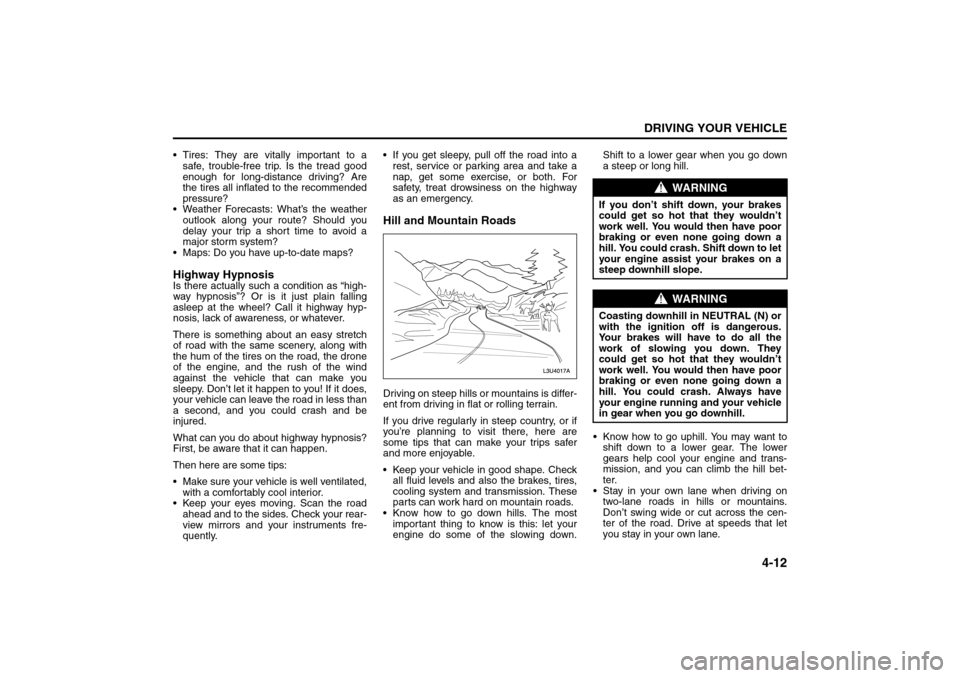
Hill and Mountain RoadsDriving on steep hills or mountains is differ-
ent from driving in flat or rolling terrain.
If you drive regularly in steep country, or if
you’re planning to visit there, here are
some tips that can make your trips safer
and more enjoyable.
Keep your vehicle in good shape. Check
all fluid levels and also the brakes, tires,
cooling system and transmission. These
parts can work hard on mountain roads.
Know how to go down hills. The most
important thing to know is this: let your
engine do some of the slowing down.Shift to a lower gear when you go down
a steep or long hill.
Know how to go uphill. You may want to
shift down to a lower gear. The lower
gears help cool your engine and trans-
mission, and you can climb the hill bet-
ter.
Stay in your own lane when driving on
two-lane roads in hills or mountains.
Don’t swing wide or cut across the cen-
ter of the road. Drive at speeds that let
you stay in your own lane.
WARNING
If you don’t shift down, your brakes
could get so hot that they wouldn’t
work well. You would then have poor
braking or even none going down a
hill. You could crash. Shift down to let
your engine assist your brakes on a
steep downhill slope.
WARNING
Coasting downhill in NEUTRAL (N) or
with the ignition off is dangerous.
Your brakes will have to do all the
work of slowing you down. They
could get so hot that they wouldn’t
work well. You would then have poor
braking or even none going down a
hill. You could crash. Always have
your engine running and your vehicle
in gear when you go downhill.
Your Driving, the Road, and Your Vehicle:
Page 137 of 226
4-13DRIVING YOUR VEHICLE
85Z04-03E
As you go over the top of a hill, be alert.
There could be something in your lane,
like a stalled car or an accident.
You may see highway signs on moun-
tains that warn of special problems.
Examples are long grades, passing or
no-passing zones, a falling rocks area or
winding roads. Be alert to these and take
appropriate action.Winter DrivingHere are some tips for winter driving:
Have your vehicle in good shape for win-
ter.
You may want to put winter emergency
supplies in your trunk.Include an ice scraper, a small brush or
broom, a supply of windshield washer fluid,
a rag, some winter outer clothing, a small
shovel, a flashlight, a red cloth and a cou-
ple of reflective warning triangles. And, if
you will be driving under severe conditions,
include a small bag of sand, a piece of old
carpet or a couple of burlap bags to help
provide traction. Be sure you properly
secure these items in your vehicle.
Driving on Snow or Ice
Most of the time, those places where your
tires meet the road probably have good
traction.
However, if there is snow or ice between
your tires and the road, you can have a
very slippery situation. You’ll have a lot
less traction or “grip” and will need to be
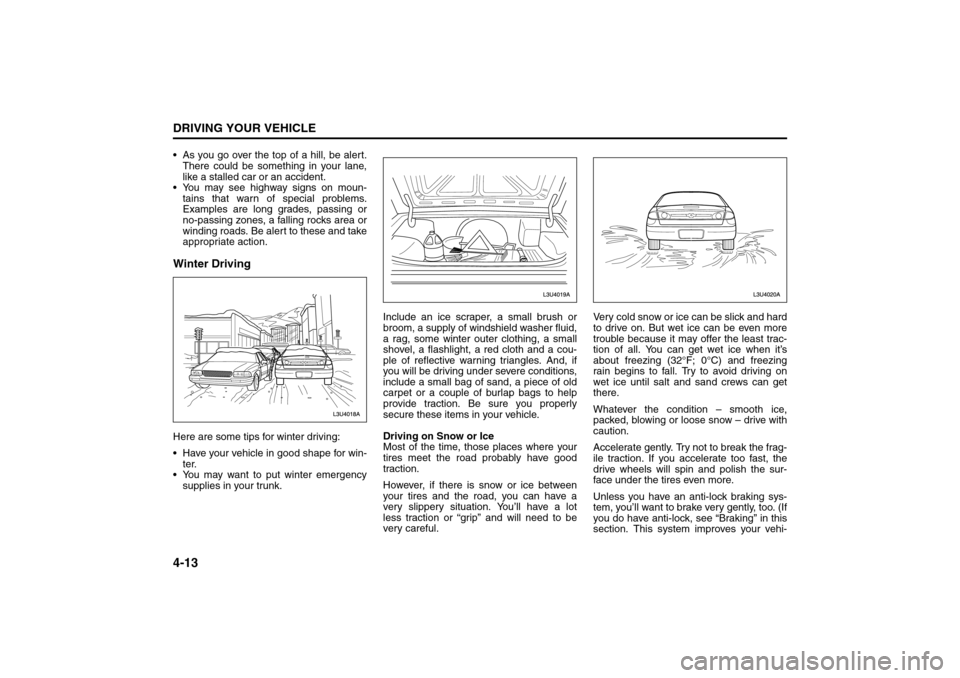
very careful.Very cold snow or ice can be slick and hard
to drive on. But wet ice can be even more
trouble because it may offer the least trac-
tion of all. You can get wet ice when it’s
about freezing (32°F; 0°C) and freezing
rain begins to fall. Try to avoid driving on
wet ice until salt and sand crews can get
there.
Whatever the condition – smooth ice,
packed, blowing or loose snow – drive with
caution.
Accelerate gently. Try not to break the frag-
ile traction. If you accelerate too fast, the
drive wheels will spin and polish the sur-
face under the tires even more.
Unless you have an anti-lock braking sys-
tem, you’ll want to brake very gently, too. (If
you do have anti-lock, see “Braking” in this
section. This system improves your vehi-
Your Driving, the Road, and Your Vehicle:
Page 139 of 226
4-15DRIVING YOUR VEHICLE
85Z04-03E
Run your engine only as long as you must.
This saves fuel. When you run the engine,
make it go a little faster than just idle. That
is, push the accelerator slightly. This uses
less fuel for the heat that you get and it
keeps the battery charged. You will need a
well-charged battery to restart the vehicle,
and possibly for signaling later on with your
headlamps. Let the heater run for a while.
Then, shut the engine off and close the
window almost all the way to preserve the
heat. Start the engine again and repeat
this only when you feel really uncomfort-
able from the cold. But do it as little as pos-
sible. Preserve the fuel as long as you can.
To help keep warm, you can get out of the
vehicle and do some fairly vigorous exer-
cises every half hour or so until help
comes.
If You Are Stuck: In Sand, Mud, Ice or
Snow
In order to free your vehicle when it is
stuck, you will need to spin the wheels, but
you don’t want to spin your wheels too fast.
The method known as “rocking” can help
you get out when you’re stuck, but you
must use caution.For information about using tire chains on
your vehicle, see “Tire Chains” in section 5.Rocking Your Vehicle To Get It Out
First, turn your steering wheel left and
right. That will clear the area around your
front wheels. Then shift back and forth
between REVERSE (R) and a forward
gear (or with a manual transmission,
between FIRST (1) or SECOND (2) and
REVERSE (R)), spinning the wheels as lit-
tle as possible. Release the accelerator
pedal while you shift, and press lightly on
the accelerator pedal when the transmis-
sion is in gear. By slowly spinning your
wheels in the forward and reverse direc-
tions, you will cause a rocking motion that
may free your vehicle. If that doesn’t get
you out after a few tries, you may need to
be towed out. If you do need to be towed
out, see “Towing Your Vehicle” in the fol-
lowing section.
WARNING
If you let your tires spin at high
speed, they can explode, and you or
others could be injured. And, the
transmission or other parts of the
vehicle can overheat. That could
cause an engine compartment fire or
other damage. When you’re stuck,
spin the wheels as little as possible.
Don’t spin the wheels above 35 mph
(55 km/h) as shown on the speedom-
eter.
CAUTION
Spinning your wheels can destroy
parts of your vehicle as well as the
tires. If you spin the wheels too fast
while shifting your transmission back
and forth, you can destroy your trans-
mission. See “Rocking Your Vehicle
To Get It Out.”
Your Driving, the Road, and Your Vehicle:
Page 141 of 226
4-17DRIVING YOUR VEHICLE
85Z04-03E
and shift to NEUTRAL (N). See “Shift-
ing Out of Park (P)” in Section 2.
5) Clamp the steering wheel in a straight-
ahead position with a clamping device
designed for towing.
6) Release the parking brake.
Loading Your VehicleIt is very important to know how much
weight your vehicle can carry. The load
capacities of your vehicle are indicated by
the Gross Vehicle Weight Rating (GVWR),
the Gross Axle Weight Rating (GAWR,
front and rear), the total load capacity, the
seating capacity, and the cargo load
capacity. The GVWR and GAWR (front and
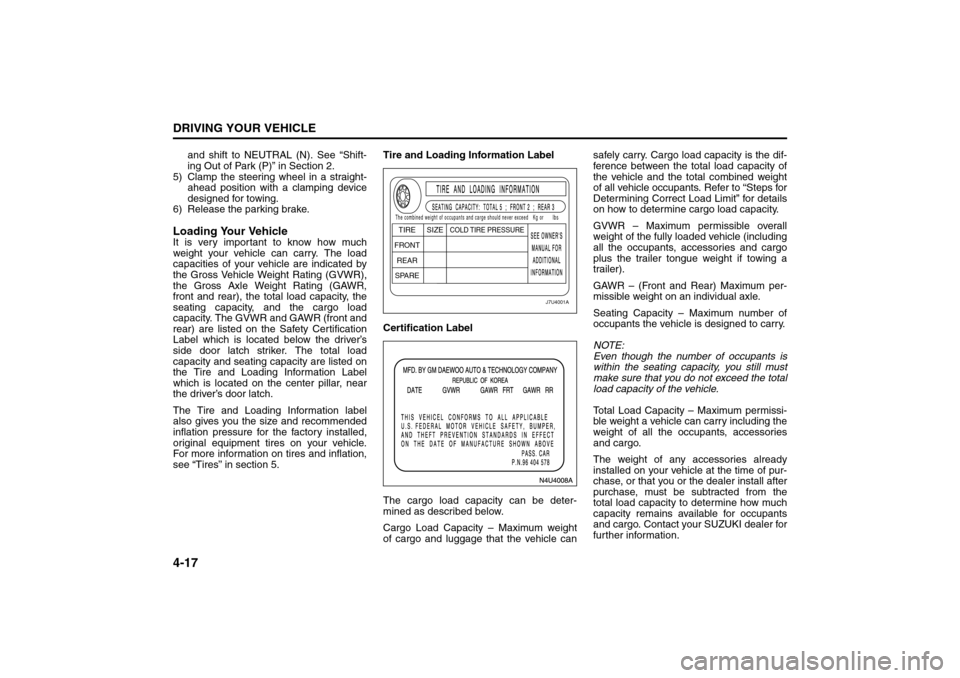
rear) are listed on the Safety Certification
Label which is located below the driver’s
side door latch striker. The total load
capacity and seating capacity are listed on
the Tire and Loading Information Label
which is located on the center pillar, near
the driver’s door latch.
The Tire and Loading Information label
also gives you the size and recommended
inflation pressure for the factory installed,
original equipment tires on your vehicle.
For more information on tires and inflation,
see “Tires” in section 5.Tire and Loading Information Label
Certification Label
The cargo load capacity can be deter-
mined as described below.
Cargo Load Capacity – Maximum weight
of cargo and luggage that the vehicle cansafely carry. Cargo load capacity is the dif-
ference between the total load capacity of
the vehicle and the total combined weight
of all vehicle occupants. Refer to “Steps for
Determining Correct Load Limit” for details
on how to determine cargo load capacity.
GVWR – Maximum permissible overall
weight of the fully loaded vehicle (including
all the occupants, accessories and cargo
plus the trailer tongue weight if towing a
trailer).
GAWR – (Front and Rear) Maximum per-
missible weight on an individual axle.
Seating Capacity – Maximum number of
occupants the vehicle is designed to carry.
NOTE:
Even though the number of occupants is
within the seating capacity, you still must
make sure that you do not exceed the total
load capacity of the vehicle.
Total Load Capacity – Maximum permissi-
ble weight a vehicle can carry including the
weight of all the occupants, accessories
and cargo.
The weight of any accessories already
installed on your vehicle at the time of pur-
chase, or that you or the dealer install after
purchase, must be subtracted from the
total load capacity to determine how much
capacity remains available for occupants
and cargo. Contact your SUZUKI dealer for
further information.
J7U4001A
TIRE
SIZE
COLD TIRE PRESSURE
FRONT
REAR
SPAREThe combined weight of occupants and carge should never exceedKg or lbs
Towing:
Page 142 of 226
4-18
DRIVING YOUR VEHICLE
85Z04-03E
Actual weight of the loaded vehicle and
actual loads at the front and rear axles can
only be determined by weighing the vehicle
using a vehicle scale. To measure the
weight and load, try taking your vehicle to
a highway weighing station, shipping com-
pany or inspection station for trucks, etc.
Compare these weights to the GVWR and
GAWR (front and rear) listed on the Safety
Certification Label. If the gross vehicle
weight or the load on either axle exceeds
these ratings, you must remove enough
weight to bring the load down to the rated
capacity.
Steps for Determining Correct Load
Limit
1) Locate the statement “The combined
weight of occupants and cargo should
never exceed XXX pounds” on your
vehicle placard.
2) Determine the combined weight of the
driver and passengers that will be riding
in your vehicle.
3) Subtract the combined weight of the
driver and passengers from XXX kilo-
grams or XXX pounds.
4) The resulting figure equals the available
amount of cargo and luggage load
capacity. For example, if the “XXX”
amounts equals 1,400 lbs and there will
be five 150 lb passengers in your vehi-
cle, the amount of available cargo and
luggage load capacity is 650 lbs (1,400
– 750 (5 x 150) = 650 lbs).5) Determine the combined weight of lug-
gage and cargo being loaded on the
vehicle. That weight may not safely
exceed the available cargo and luggage
load capacity calculated in Step 4.
Vehicle Loading Example
As an example, suppose that the Tire and
Loading Information label on your vehicle
indicates that your vehicle’s total load
capacity is 950 lbs. If you were to drive
your vehicle with one passenger, and the
total combined weight of you and your pas-
senger was 350 lbs, then the cargo and
luggage capacity of your vehicle would be
600 lbs (950 – 350 = 600 lbs).
If you later added 2 more passengers, hav-
ing a combined weight of 325 lbs, the
cargo and luggage capacity of your vehicle
would be reduced from 600 lbs to 275 lbs
(600 – 325 = 275 lbs). As you can see, as
the number and combined weight of vehi-
cle occupants increase, the vehicle’s cargo
and luggage capacity decreases. Do not
carry more than 123 lbs (56 kg) in your
trunk.If you put things inside your vehicle – like
suitcases, tools, packages, or anything
else – they will go as fast as the vehicle
goes. If you have to stop or turn quickly, or
if there is a crash, they’ll keep going.
WARNING
Never overload your vehicle. Over-
loading your vehicle can cause dam-
age to your tires and lead to poor
steering and braking which can result
in an accident. The gross vehicle
weight (sum of the weights of the
loaded vehicle, driver and passen-
gers) must never exceed the Gross
Vehicle Weight Rating (GVWR) listed
on the Safety Certification Label. In
addition, never distribute a load so
that the weight on either the front or
rear axle exceeds the Gross Axle
Weight Rating (GAWR) listed on the
Safety Certification Label.
Towing:
Page 143 of 226
4-19DRIVING YOUR VEHICLE
85Z04-03E
Determining Compatibility of Tire and
Vehicle Load Limits
The tires on your vehicle, when they are
inflated to the recommended tire inflation
pressure, have a load-carrying capacity
that is greater than the load that will be onthe tires when the vehicle is at its GVWR
or GAWR limit. Never use replacement
tires that have a load-carrying capacity
less than the original tires on your vehicle.
Tire load-carrying capacity information is
molded into the tire sidewall typically
shown as “Max. Load”. Use of replacement
tires with a lower load-carrying capacity
than the original tires, or failure to keep the
tires inflated to recommended tire pres-
sure, may reduce the GVWR or GAWR
limit of your vehicle.
NOTE:
Use of replacement tires with a higher
load-carrying capacity than the original
tires, or using a tire inflation pressure
higher than the recommended tire inflation
pressure, will not increase the GVWR or
GAWR limit of your vehicle.
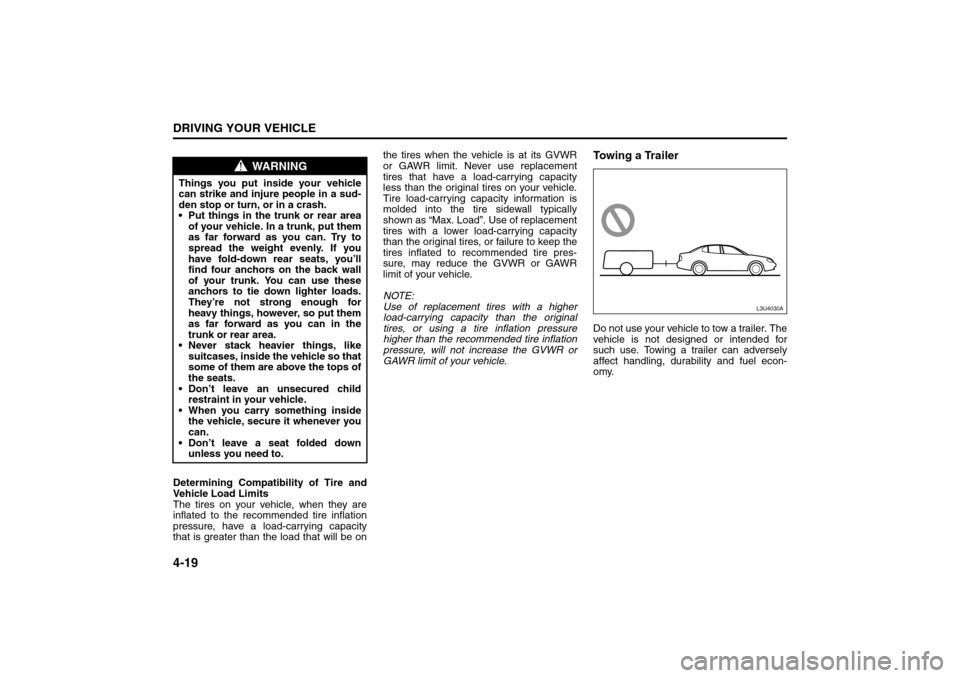
Towing a TrailerDo not use your vehicle to tow a trailer. The
vehicle is not designed or intended for
such use. Towing a trailer can adversely
affect handling, durability and fuel econ-
omy.
WARNING
Things you put inside your vehicle
can strike and injure people in a sud-
den stop or turn, or in a crash.
Put things in the trunk or rear area
of your vehicle. In a trunk, put them
as far forward as you can. Try to
spread the weight evenly. If you
have fold-down rear seats, you’ll
find four anchors on the back wall
of your trunk. You can use these
anchors to tie down lighter loads.
They’re not strong enough for
heavy things, however, so put them
as far forward as you can in the
trunk or rear area.
Never stack heavier things, like
suitcases, inside the vehicle so that
some of them are above the tops of
the seats.
Don’t leave an unsecured child
restraint in your vehicle.
When you carry something inside
the vehicle, secure it whenever you
can.
Don’t leave a seat folded down
unless you need to.
L3U4030A
Towing:
Page 144 of 226
SERVICE AND APPEARANCE CARE
5
85Z04-03E
SERVICE AND APPEARANCE CAREService ................................................................................. 5-1
Fuel ....................................................................................... 5-1
Checking Things Under the Hood ..................................... 5-4
Headlamp Aiming ................................................................ 5-23
Bulb Replacement ............................................................... 5-23
Windshield Wiper Blade Replacement .............................. 5-28
Tires ...................................................................................... 5-28
Tire Pressure Monitoring System ...................................... 5-33
Appearance Care ................................................................. 5-45
Vehicle Identification .......................................................... 5-49
Electrical System ................................................................ 5-49
Capacities and Specifications ........................................... 5-54
Page 163 of 226
5-19SERVICE AND APPEARANCE CARE
85Z04-03E
When your brake fluid falls to a low level,
your brake warning light will come on. See
“Brake System Warning Light” in section 3.
What to Add
When you do need brake fluid, use only
DOT-3 brake fluid. Use new brake fluid
from a sealed container only. See “Recom-
mended Fluids and Lubricants” in section
6.
Always clean the brake fluid reservoir cap
and the area around the cap before remov-
ing it. This will help keep dirt from entering
the reservoir.Brake Wear
Your vehicle has front and rear disc brakes.
Disc brake pads have built-in wear indica-
tors that make a high-pitched warning
sound when the brake pads are worn and
new pads are needed. The sound may
come and go or be heard all the time your
vehicle is moving (except when you are
pushing on the brake pedal firmly).Some driving conditions or climates may
cause a brake squeal when the brakes are
first applied or lightly applied. This does
not mean something is wrong with your
brakes.
Properly torqued wheel nuts are necessary
to help prevent brake pulsation. When tires
are rotated, inspect brake pads for wear
and evenly tighten wheel nuts in the proper
sequence to SUZUKI torque specifica-
tions.
Brake linings should always be replaced as
complete axle sets.
See “Brake System Inspection” in section
6.
WARNING
If you have too much brake fluid, it
can spill on the engine. The fluid will
burn if the engine is hot enough. You
or others could be burned, and your
vehicle could be damaged.
WARNING
With the wrong kind of fluid in your
brake system, your brakes may not
work well, or they may not even work
at all. This could cause a crash.
Always use the proper brake fluid.
CAUTION
Using the wrong fluid can badly
damage brake system parts. For
example, just a few drops of min-
eral-based oil, such as engine oil,
in your brake system can damage
brake system parts so badly that
they’ll have to be replaced. Don’t let
someone put in the wrong kind of
fluid.
If you spill brake fluid on your vehi-
cle’s painted surfaces, the paint fin-
ish can be damaged. Be careful not
to spill brake fluid on your vehicle.
If you do, wash it off immediately.
See “Appearance Care” in the
Index.
WARNING
The brake wear warning sound
means that soon your brakes won’t
work well. That could lead to an acci-
dent. When you hear the brake wear
warning sound, have your vehicle
serviced.
CAUTION
Continuing to drive with worn-out
brake pads could result in costly
brake repair.
Checking Things Under the Hood: