belt SUZUKI FORENZA 2008 1.G Owner's Manual
[x] Cancel search | Manufacturer: SUZUKI, Model Year: 2008, Model line: FORENZA, Model: SUZUKI FORENZA 2008 1.GPages: 226, PDF Size: 5.25 MB
Page 32 of 226
1-20
SEATS AND RESTRAINT SYSTEMS
85Z04-03E
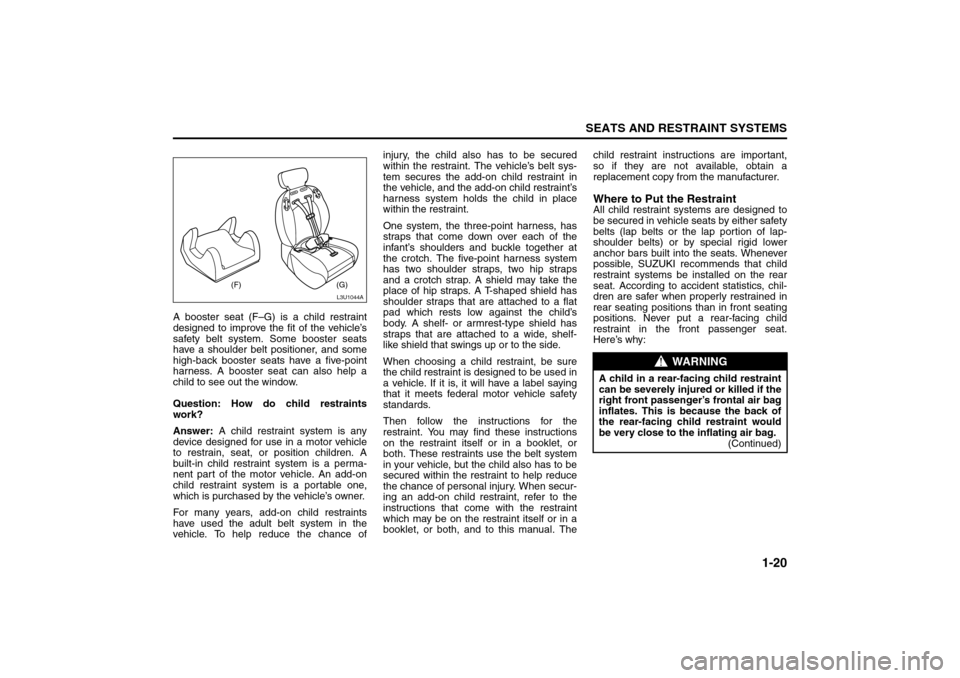
A booster seat (F–G) is a child restraint
designed to improve the fit of the vehicle’s
safety belt system. Some booster seats
have a shoulder belt positioner, and some
high-back booster seats have a five-point
harness. A booster seat can also help a
child to see out the window.
Question: How do child restraints
work?
Answer: A child restraint system is any
device designed for use in a motor vehicle
to restrain, seat, or position children. A
built-in child restraint system is a perma-
nent part of the motor vehicle. An add-on
child restraint system is a portable one,
which is purchased by the vehicle’s owner.
For many years, add-on child restraints
have used the adult belt system in the
vehicle. To help reduce the chance ofinjury, the child also has to be secured
within the restraint. The vehicle’s belt sys-
tem secures the add-on child restraint in
the vehicle, and the add-on child restraint’s
harness system holds the child in place
within the restraint.
One system, the three-point harness, has
straps that come down over each of the
infant’s shoulders and buckle together at
the crotch. The five-point harness system
has two shoulder straps, two hip straps
and a crotch strap. A shield may take the
place of hip straps. A T-shaped shield has
shoulder straps that are attached to a flat
pad which rests low against the child’s
body. A shelf- or armrest-type shield has
straps that are attached to a wide, shelf-
like shield that swings up or to the side.
When choosing a child restraint, be sure
the child restraint is designed to be used in
a vehicle. If it is, it will have a label saying
that it meets federal motor vehicle safety
standards.
Then follow the instructions for the
restraint. You may find these instructions
on the restraint itself or in a booklet, or
both. These restraints use the belt system
in your vehicle, but the child also has to be
secured within the restraint to help reduce
the chance of personal injury. When secur-
ing an add-on child restraint, refer to the
instructions that come with the restraint
which may be on the restraint itself or in a
booklet, or both, and to this manual. Thechild restraint instructions are important,
so if they are not available, obtain a
replacement copy from the manufacturer.
Where to Put the RestraintAll child restraint systems are designed to
be secured in vehicle seats by either safety
belts (lap belts or the lap portion of lap-
shoulder belts) or by special rigid lower
anchor bars built into the seats. Whenever
possible, SUZUKI recommends that child
restraint systems be installed on the rear
seat. According to accident statistics, chil-
dren are safer when properly restrained in
rear seating positions than in front seating
positions. Never put a rear-facing child
restraint in the front passenger seat.
Here’s why:
(F) (G)
L3U1044A
WARNING
A child in a rear-facing child restraint
can be severely injured or killed if the
right front passenger’s frontal air bag
inflates. This is because the back of
the rear-facing child restraint would
be very close to the inflating air bag.
(Continued)
Child Restraints:
Page 36 of 226
1-24
SEATS AND RESTRAINT SYSTEMS
85Z04-03E
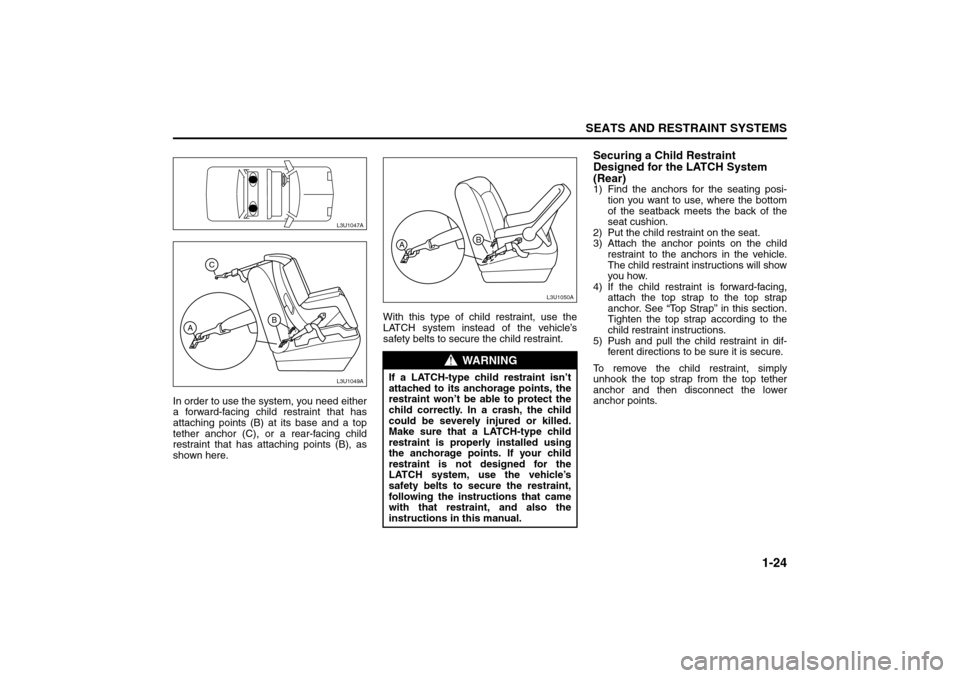
In order to use the system, you need either
a forward-facing child restraint that has
attaching points (B) at its base and a top
tether anchor (C), or a rear-facing child
restraint that has attaching points (B), as
shown here.With this type of child restraint, use the
LATCH system instead of the vehicle’s
safety belts to secure the child restraint.
Securing a Child Restraint
Designed for the LATCH System
(Rear)1) Find the anchors for the seating posi-
tion you want to use, where the bottom
of the seatback meets the back of the
seat cushion.
2) Put the child restraint on the seat.
3) Attach the anchor points on the child
restraint to the anchors in the vehicle.
The child restraint instructions will show
you how.
4) If the child restraint is forward-facing,
attach the top strap to the top strap
anchor. See “Top Strap” in this section.
Tighten the top strap according to the
child restraint instructions.
5) Push and pull the child restraint in dif-
ferent directions to be sure it is secure.
To remove the child restraint, simply
unhook the top strap from the top tether
anchor and then disconnect the lower
anchor points.
L3U1047A
AB C
L3U1049A
WARNING
If a LATCH-type child restraint isn’t
attached to its anchorage points, the
restraint won’t be able to protect the
child correctly. In a crash, the child
could be severely injured or killed.
Make sure that a LATCH-type child
restraint is properly installed using
the anchorage points. If your child
restraint is not designed for the
LATCH system, use the vehicle’s
safety belts to secure the restraint,
following the instructions that came
with that restraint, and also the
instructions in this manual.AB
L3U1050A
Child Restraints:
Page 37 of 226
1-25SEATS AND RESTRAINT SYSTEMS
85Z04-03E
Securing a Child Restraint in a Rear
Seat PositionIf your child restraint is equipped with the
LATCH system, see “Lower Anchorages
and Top Tethers for Children (LATCH Sys-
tem)” in this section. See “Top Strap” in this
section if the child restraint has one.
If your child restraint does not have the
LATCH system, you will be using the lap-
shoulder belt to secure the child restraint in
this position. Be sure to follow the instruc-
tions that came with the child restraint.
Secure the child in the child restraint when
and as the instructions say.
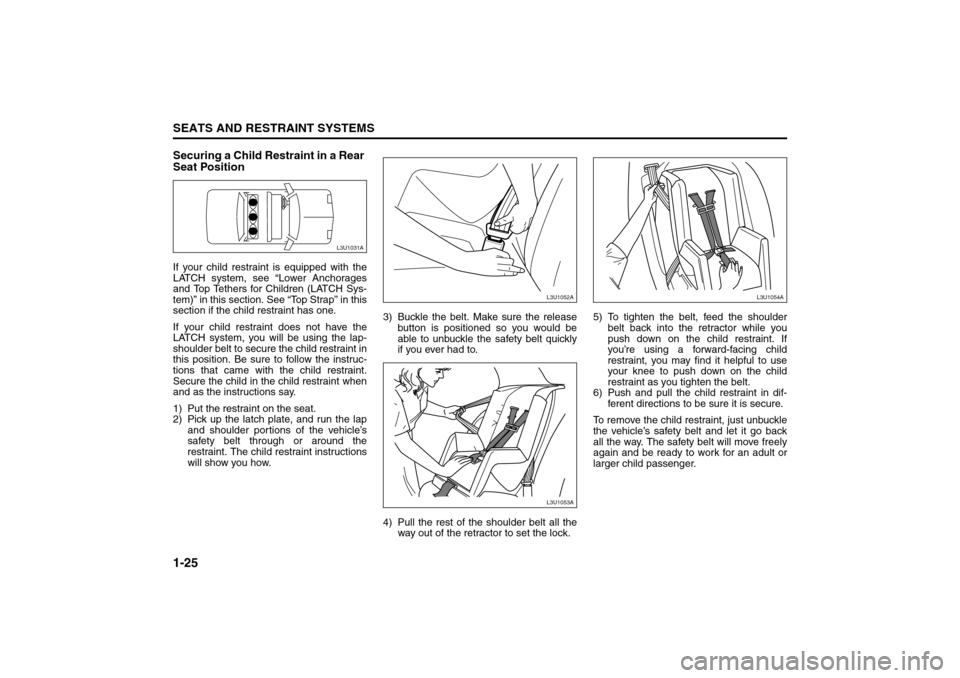
1) Put the restraint on the seat.
2) Pick up the latch plate, and run the lap
and shoulder portions of the vehicle’s
safety belt through or around the
restraint. The child restraint instructions
will show you how. 3) Buckle the belt. Make sure the release
button is positioned so you would be
able to unbuckle the safety belt quickly
if you ever had to.
4) Pull the rest of the shoulder belt all the
way out of the retractor to set the lock.5) To tighten the belt, feed the shoulder
belt back into the retractor while you
push down on the child restraint. If
you’re using a forward-facing child
restraint, you may find it helpful to use
your knee to push down on the child
restraint as you tighten the belt.
6) Push and pull the child restraint in dif-
ferent directions to be sure it is secure.
To remove the child restraint, just unbuckle
the vehicle’s safety belt and let it go back
all the way. The safety belt will move freely
again and be ready to work for an adult or
larger child passenger.
L3U1031A
L3U1052AL3U1053A
L3U1054A
Child Restraints:
Page 38 of 226
1-26
SEATS AND RESTRAINT SYSTEMS
85Z04-03E
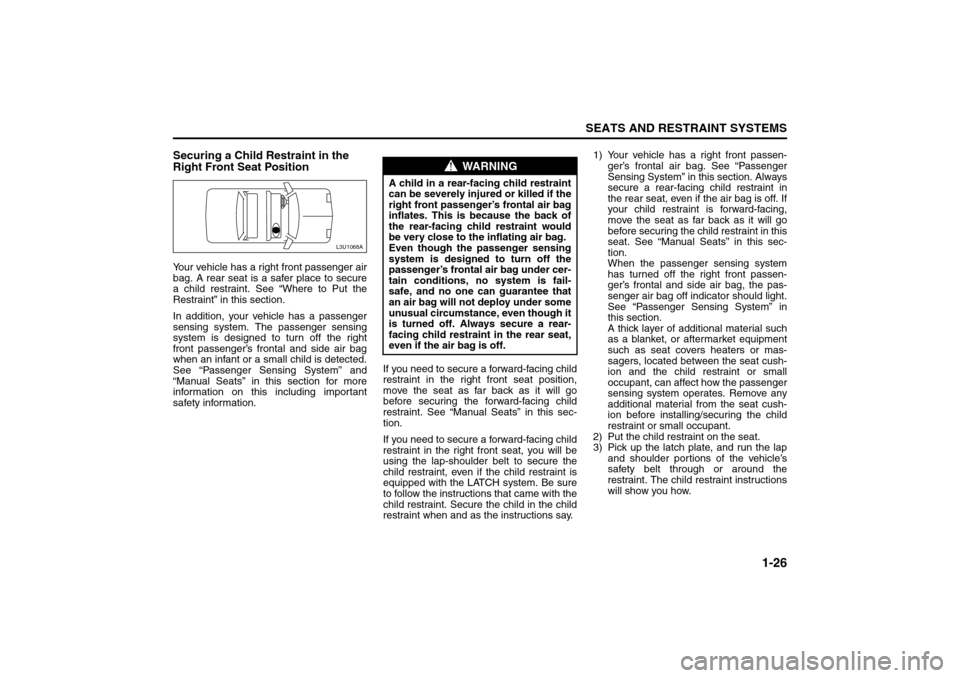
Securing a Child Restraint in the
Right Front Seat PositionYour vehicle has a right front passenger air
bag. A rear seat is a safer place to secure
a child restraint. See “Where to Put the
Restraint” in this section.
In addition, your vehicle has a passenger
sensing system. The passenger sensing
system is designed to turn off the right
front passenger’s frontal and side air bag
when an infant or a small child is detected.
See “Passenger Sensing System” and
“Manual Seats” in this section for more
information on this including important
safety information.If you need to secure a forward-facing child
restraint in the right front seat position,
move the seat as far back as it will go
before securing the forward-facing child
restraint. See “Manual Seats” in this sec-
tion.
If you need to secure a forward-facing child
restraint in the right front seat, you will be
using the lap-shoulder belt to secure the
child restraint, even if the child restraint is
equipped with the LATCH system. Be sure
to follow the instructions that came with the
child restraint. Secure the child in the child
restraint when and as the instructions say.1) Your vehicle has a right front passen-
ger’s frontal air bag. See “Passenger
Sensing System” in this section. Always
secure a rear-facing child restraint in
the rear seat, even if the air bag is off. If
your child restraint is forward-facing,
move the seat as far back as it will go
before securing the child restraint in this
seat. See “Manual Seats” in this sec-
tion.
When the passenger sensing system
has turned off the right front passen-
ger’s frontal and side air bag, the pas-
senger air bag off indicator should light.
See “Passenger Sensing System” in
this section.
A thick layer of additional material such
as a blanket, or aftermarket equipment
such as seat covers heaters or mas-
sagers, located between the seat cush-
ion and the child restraint or small
occupant, can affect how the passenger
sensing system operates. Remove any
additional material from the seat cush-
ion before installing/securing the child
restraint or small occupant.
2) Put the child restraint on the seat.
3) Pick up the latch plate, and run the lap
and shoulder portions of the vehicle’s
safety belt through or around the
restraint. The child restraint instructions
will show you how.
L3U1068A
WARNING
A child in a rear-facing child restraint
can be severely injured or killed if the
right front passenger’s frontal air bag
inflates. This is because the back of
the rear-facing child restraint would
be very close to the inflating air bag.
Even though the passenger sensing
system is designed to turn off the
passenger’s frontal air bag under cer-
tain conditions, no system is fail-
safe, and no one can guarantee that
an air bag will not deploy under some
unusual circumstance, even though it
is turned off. Always secure a rear-
facing child restraint in the rear seat,
even if the air bag is off.
Child Restraints:
Page 39 of 226
1-27SEATS AND RESTRAINT SYSTEMS
85Z04-03E
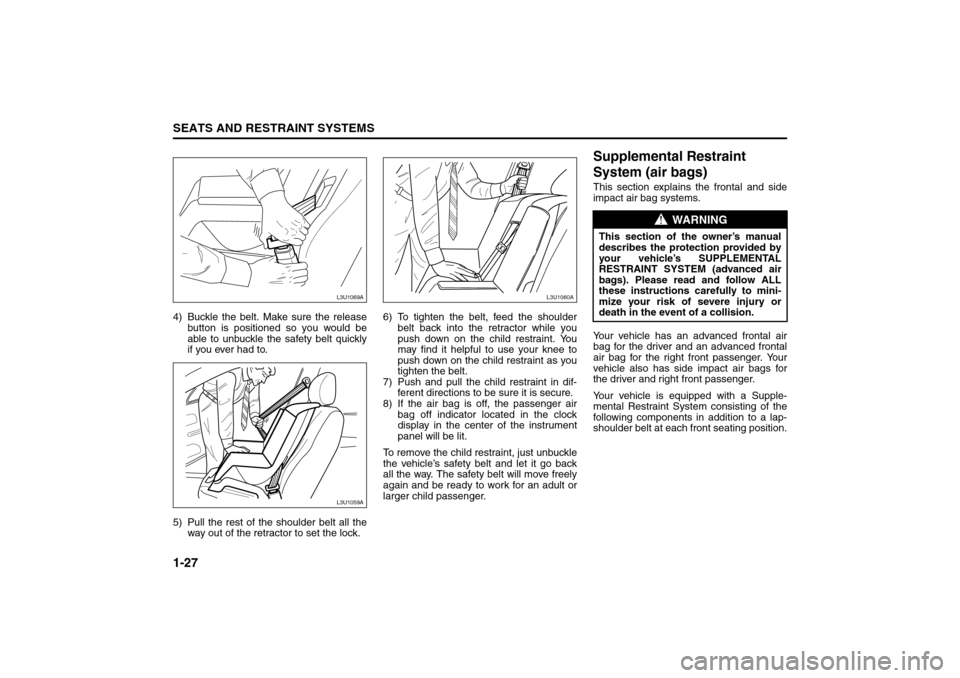
4) Buckle the belt. Make sure the release
button is positioned so you would be
able to unbuckle the safety belt quickly
if you ever had to.
5) Pull the rest of the shoulder belt all the
way out of the retractor to set the lock.6) To tighten the belt, feed the shoulder
belt back into the retractor while you
push down on the child restraint. You
may find it helpful to use your knee to
push down on the child restraint as you
tighten the belt.
7) Push and pull the child restraint in dif-
ferent directions to be sure it is secure.
8) If the air bag is off, the passenger air
bag off indicator located in the clock
display in the center of the instrument
panel will be lit.
To remove the child restraint, just unbuckle
the vehicle’s safety belt and let it go back
all the way. The safety belt will move freely
again and be ready to work for an adult or
larger child passenger.
Supplemental Restraint
System (air bags)This section explains the frontal and side
impact air bag systems.
Your vehicle has an advanced frontal air
bag for the driver and an advanced frontal
air bag for the right front passenger. Your
vehicle also has side impact air bags for
the driver and right front passenger.
Your vehicle is equipped with a Supple-
mental Restraint System consisting of the
following components in addition to a lap-
shoulder belt at each front seating position.
L3U1069AL3U1059A
L3U1061AL3U1060A
WARNING
This section of the owner’s manual
describes the protection provided by
your vehicle’s SUPPLEMENTAL
RESTRAINT SYSTEM (advanced air
bags). Please read and follow ALL
these instructions carefully to mini-
mize your risk of severe injury or
death in the event of a collision.
Child Restraints:
Supplemental Restraint System:
Page 40 of 226
1-28
SEATS AND RESTRAINT SYSTEMS
85Z04-03E
85Z008
8
6
1010 2 1
7
9
5
4
3
3
9
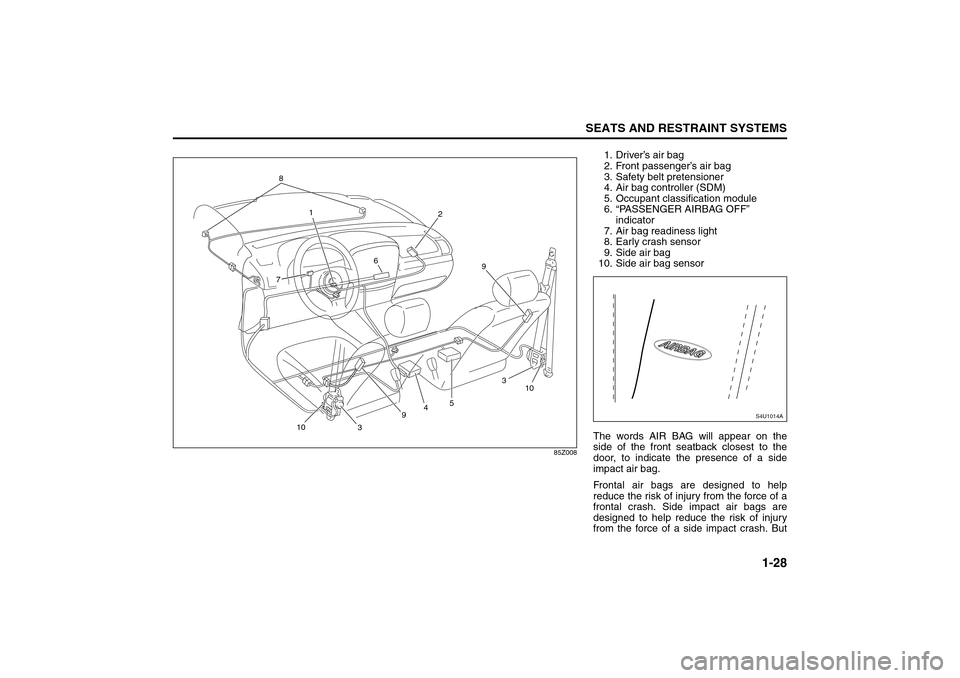
1. Driver’s air bag
2. Front passenger’s air bag
3. Safety belt pretensioner
4. Air bag controller (SDM)
5. Occupant classification module
6. “PASSENGER AIRBAG OFF”
indicator
7. Air bag readiness light
8. Early crash sensor
9. Side air bag
10. Side air bag sensor
The words AIR BAG will appear on the
side of the front seatback closest to the
door, to indicate the presence of a side
impact air bag.
Frontal air bags are designed to help
reduce the risk of injury from the force of a
frontal crash. Side impact air bags are
designed to help reduce the risk of injury
from the force of a side impact crash. But
S4U1014A
Supplemental Restraint System:
Page 41 of 226
1-29SEATS AND RESTRAINT SYSTEMS
85Z04-03E
these air bags must inflate very quickly to
do their job. Here are the most important
things to know about the air bag systems.
WARNING
You can be severely injured or killed
in a crash if you aren’t wearing your
safety belt – even if you have air
bags. Wearing your safety belt during
a crash helps reduce your chance of
hitting things inside the vehicle or
being ejected from it. Air bags are
designed to work with safety belts
but don’t replace them.
Frontal air bags for the driver and
right front passenger are designed to
deploy only in moderate to severe
frontal and near frontal crashes. They
aren’t designed to inflate at all in roll-
over, rear or low-speed frontal
crashes, or in many side crashes.
And, for some unrestrained occu-
pants, frontal air bags may provide
less protection in frontal crashes
than more forceful air bags have pro-
vided in the past.
(Continued)
WARNING
(Continued)
The side impact air bags are
designed to inflate only in moderate
to severe crashes where something
hits the side of your vehicle. They
aren’t designed to inflate in frontal, in
rollover or in rear crashes.
Everyone in your vehicle should wear
a safety belt properly – whether or
not there’s an air bag for that person.
WARNING
Air bags inflate with great force,
faster than the blink of an eye. If
you’re too close to an inflating air
bag, as you would be if you were
leaning forward, it could severely
injure you. Safety belts help keep you
in position for air bag inflation before
and during a crash. Always wear your
safety belt, even with frontal air bags.
The driver should sit as far back as
possible while still maintaining con-
trol of the vehicle. Front occupants
should not lean on or sleep against
the door.
WARNING
Do not attach any objects to, or place
any objects over, the steering wheel
or dashboard. Do not place any
objects between the air bag and the
driver or front passenger. These
objects may interfere with air bag
operation or may be propelled by the
air bag in the event of a crash. Either
of these conditions may cause
severe injury.
WARNING
Anyone who is up against, or very
close to, any air bag when it inflates
can be severely injured or killed. Air
bags plus lap-shoulder belts offer the
best protection for adults, but not for
young children and infants. Neither
the vehicle’s safety belt system nor
its air bag system is designed for
them. Young children and infants
need the protection that a child
restraint system can provide. Always
secure children properly in your vehi-
cle. To read how, see the part of this
manual called “Older Children” or
“Infants and Young Children.”
Supplemental Restraint System:
Page 43 of 226
1-31SEATS AND RESTRAINT SYSTEMS
85Z04-03E
Passenger Sensing SystemYour vehicle has a passenger sensing sys-
tem for the right front passenger position.
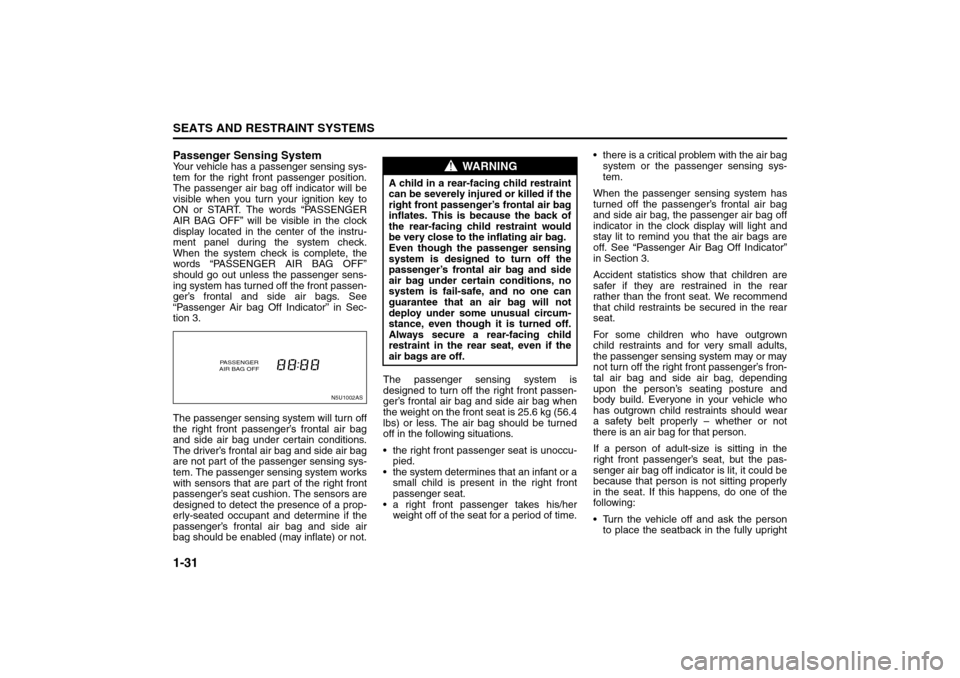
The passenger air bag off indicator will be
visible when you turn your ignition key to
ON or START. The words “PASSENGER
AIR BAG OFF” will be visible in the clock
display located in the center of the instru-
ment panel during the system check.
When the system check is complete, the
words “PASSENGER AIR BAG OFF”
should go out unless the passenger sens-
ing system has turned off the front passen-
ger’s frontal and side air bags. See
“Passenger Air bag Off Indicator” in Sec-
tion 3.
The passenger sensing system will turn off
the right front passenger’s frontal air bag
and side air bag under certain conditions.
The driver’s frontal air bag and side air bag
are not part of the passenger sensing sys-
tem. The passenger sensing system works
with sensors that are part of the right front
passenger’s seat cushion. The sensors are
designed to detect the presence of a prop-
erly-seated occupant and determine if the
passenger’s frontal air bag and side air
bag should be enabled (may inflate) or not.The passenger sensing system is
designed to turn off the right front passen-
ger’s frontal air bag and side air bag when
the weight on the front seat is 25.6 kg (56.4
lbs) or less. The air bag should be turned
off in the following situations.
the right front passenger seat is unoccu-
pied.
the system determines that an infant or a
small child is present in the right front
passenger seat.
a right front passenger takes his/her
weight off of the seat for a period of time. there is a critical problem with the air bag
system or the passenger sensing sys-
tem.
When the passenger sensing system has
turned off the passenger’s frontal air bag
and side air bag, the passenger air bag off
indicator in the clock display will light and
stay lit to remind you that the air bags are
off. See “Passenger Air Bag Off Indicator”
in Section 3.
Accident statistics show that children are
safer if they are restrained in the rear
rather than the front seat. We recommend
that child restraints be secured in the rear
seat.
For some children who have outgrown
child restraints and for very small adults,
the passenger sensing system may or may
not turn off the right front passenger’s fron-
tal air bag and side air bag, depending
upon the person’s seating posture and
body build. Everyone in your vehicle who
has outgrown child restraints should wear
a safety belt properly – whether or not
there is an air bag for that person.
If a person of adult-size is sitting in the
right front passenger’s seat, but the pas-
senger air bag off indicator is lit, it could be
because that person is not sitting properly
in the seat. If this happens, do one of the
following:
Turn the vehicle off and ask the person
to place the seatback in the fully upright
N5U1002AS
PASSENGER
AIR BAG OFF
WARNING
A child in a rear-facing child restraint
can be severely injured or killed if the
right front passenger’s frontal air bag
inflates. This is because the back of
the rear-facing child restraint would
be very close to the inflating air bag.
Even though the passenger sensing
system is designed to turn off the
passenger’s frontal air bag and side
air bag under certain conditions, no
system is fail-safe, and no one can
guarantee that an air bag will not
deploy under some unusual circum-
stance, even though it is turned off.
Always secure a rear-facing child
restraint in the rear seat, even if the
air bags are off.
Supplemental Restraint System:
Page 44 of 226
1-32
SEATS AND RESTRAINT SYSTEMS
85Z04-03E
position, then sit upright in the seat, cen-
tered on the seat cushion, with the per-
son’s legs comfortably extended. Restart
the vehicle and have the person remain
in this position for about three minutes.
This will allow the system to detect that
person and then enable the passenger’s
air bag.
With the vehicle parked, ask the right
front passenger to get out of the seat for
more than three seconds, place the
seatback in the fully upright position, and
then sit upright in the seat, centered on
the seat cushion, with the person’s legs
comfortably extended. Have the person
remain in this position for about three
minutes. This will allow the system to
detect that person and then enable the
passenger’s air bag.
Adding Equipment to Your Air Bag-
Equipped VehicleQuestion: Because I have a disability, I
have to get my vehicle modified. How
can I find out whether this will affect my
advanced air bag system?
Answer: Changing or moving any parts of
the front seats, safety belts, the air bag
sensing and diagnostic module can affect
the operation of the advanced air bag sys-
tem. If it is necessary to modify the
advanced air bag system to accommodate
a person with disabilities, owners in the
continental United States can call Ameri-
can Suzuki toll-free at 1-800-934-0934, or
write to:
American Suzuki Motor Corporation
Automotive Customer Relations
3251 East Imperial Highway
Brea, CA 92821-6795
When Should an Air Bag Inflate?The driver’s and right front passenger’s
frontal air bags are designed to inflate in
moderate to severe frontal or near-frontal
crashes. But they are designed to inflate
only if the impact speed is above the sys-
tem’s designed “threshold level.”
If the front of your vehicle goes straight into
a wall that doesn’t move or deform, the
threshold level is about 9 to 14 mph (14.5
to 23 km/h). The threshold level can vary,
however, with specific vehicle design, so
that it can be somewhat above or below
this range.
If your vehicle strikes something that will
move or deform, such as a parked car, the
threshold level will be higher. The driver’s
and right front passenger’s frontal air bags
are not designed to inflate in rollovers, rear
impacts, or in many side impacts because
inflation would not help the occupant.
A side impact air bag is designed to inflate
in moderate to severe side crashes involv-
ing the front door. A side impact air bag will
inflate if the crash severity is above the
system’s designed “threshold level”. The
threshold level can vary with specific vehi-
cle design. A side impact air bag is not
designed to inflate in frontal or near-frontal
impacts, rollovers or rear impacts, because
inflation would not help the occupant.
In any particular crash, no one can say
whether an air bag should have inflated
simply because of the damage to a vehicle
WARNING
If the air bag readiness light in the
instrument panel cluster ever comes
on and stays on, it means that some-
thing may be wrong with the air bag
system. If this ever happens, have the
vehicle serviced promptly, because
an adult-size person sitting in the
right front passenger’s seat may not
have the protection of the air bags.
See “Air Bag Readiness Light” in
Section 3 for more on this, including
important safety information.
WARNING
A thick layer of additional material
such as a blanket, or aftermarket
equipment such as seat covers, seat
heaters and seat massagers can
affect how well the passenger sens-
ing system operates. Remove any
additional material from the seat
cushion before allowing a passenger
to use the front passenger’s seat, and
do not use aftermarket equipment
such as seat covers.
Supplemental Restraint System:
Page 45 of 226
1-33SEATS AND RESTRAINT SYSTEMS
85Z04-03E
or because of what the repair costs were.
For frontal air bags, inflation is determined
by the angle of the impact and how quickly
the vehicle slows down in frontal and near-
frontal impacts. For side impact air bags,
inflation is determined by the location and
severity of the impact.What Makes an Air Bag Inflate?In an impact of sufficient severity, the air
bag sensing system detects that the vehi-
cle is in a crash. For both frontal and side
impact air bags, the sensing system trig-
gers a release of gas from the inflator,
which inflates the air bag. The inflator, the
air bag and related hardware are all part of
the air bag modules. Frontal air bag mod-
ules are located inside the steering wheel
and instrument panel. Side impact air bag
modules are located in the side of the seat-
back closest to the door.How Does an Air Bag Restrain?In moderate to severe frontal or near fron-
tal collisions, even belted occupants can
contact the steering wheel or the instru-
ment panel. In moderate to severe side
collisions, even belted occupants can con-
tact the inside of the vehicle.
The air bag supplements the protection
provided by safety belts. Air bags distribute
the force of the impact more evenly over
the occupant’s upper body, stopping the
occupant more gradually. But the frontal air
bags would not help you in many types ofcollisions, including rollovers, rear impacts,
and many side impacts, primarily because
an occupant’s motion is not toward the air
bag. Side impact air bags would not help
you in many types of collisions, including
frontal or near frontal collisions, rollovers,
and rear impacts, primarily because an
occupant’s motion is not toward those air
bags. Air bags should never be regarded
as anything more than a supplement to
safety belts, and then only in moderate to
severe frontal or near-frontal collisions for
the driver’s and right front passenger’s
frontal air bags, and only in moderate to
severe side collisions for vehicles with side
impact air bags.
What Will You See After an Air Bag
Inflates?After the air bag inflates, it quickly deflates,
so quickly that some people may not even
realize the air bag inflated. Some compo-
nents of the air bag module will be hot for a
short time. These components include the
steering wheel hub for the driver’s frontal
air bag, the instrument panel for the right
front passenger’s frontal bag and the side
of the seatback closest to the front door for
the side impact air bag. The parts of the
bag that come into contact with you may
be warm, but not too hot to touch. There
will be some smoke and dust coming from
the vents in the deflated air bags. Air bag
inflation doesn’t prevent the driver from
seeing or being able to steer the vehicle,nor does it stop people from leaving the
vehicle.
In many crashes severe enough to inflate
an air bag, windshields are broken by vehi-
cle deformation. Additional windshield
breakage may also occur from the right
front passenger air bag.
Air bags are designed to inflate only
once. After an air bag inflates, you’ll
need some new parts for your air bag
system. If you don’t get them, the air bag
system won’t be there to help protect
you in another crash. A new system will
include air bag modules and possibly
other parts. The service manual for your
vehicle covers the need to replace other
parts.
WARNING
When an air bag inflates, there is dust
in the air. This dust could cause
breathing problems for people with a
history of asthma or other breathing
trouble. To avoid this, everyone in the
vehicle should get out as soon as it is
safe to do so. If you have breathing
problems but can’t get out of the
vehicle after an air bag inflates, then
get fresh air by opening a window or
a door. If you experience breathing
problems following an air bag deploy-
ment, you should seek medical atten-
tion.
Supplemental Restraint System: