steering wheel SUZUKI FORENZA 2008 1.G Owner's Manual
[x] Cancel search | Manufacturer: SUZUKI, Model Year: 2008, Model line: FORENZA, Model: SUZUKI FORENZA 2008 1.GPages: 226, PDF Size: 5.25 MB
Page 141 of 226
4-17DRIVING YOUR VEHICLE
85Z04-03E
and shift to NEUTRAL (N). See “Shift-
ing Out of Park (P)” in Section 2.
5) Clamp the steering wheel in a straight-
ahead position with a clamping device
designed for towing.
6) Release the parking brake.
Loading Your VehicleIt is very important to know how much
weight your vehicle can carry. The load
capacities of your vehicle are indicated by
the Gross Vehicle Weight Rating (GVWR),
the Gross Axle Weight Rating (GAWR,
front and rear), the total load capacity, the
seating capacity, and the cargo load
capacity. The GVWR and GAWR (front and
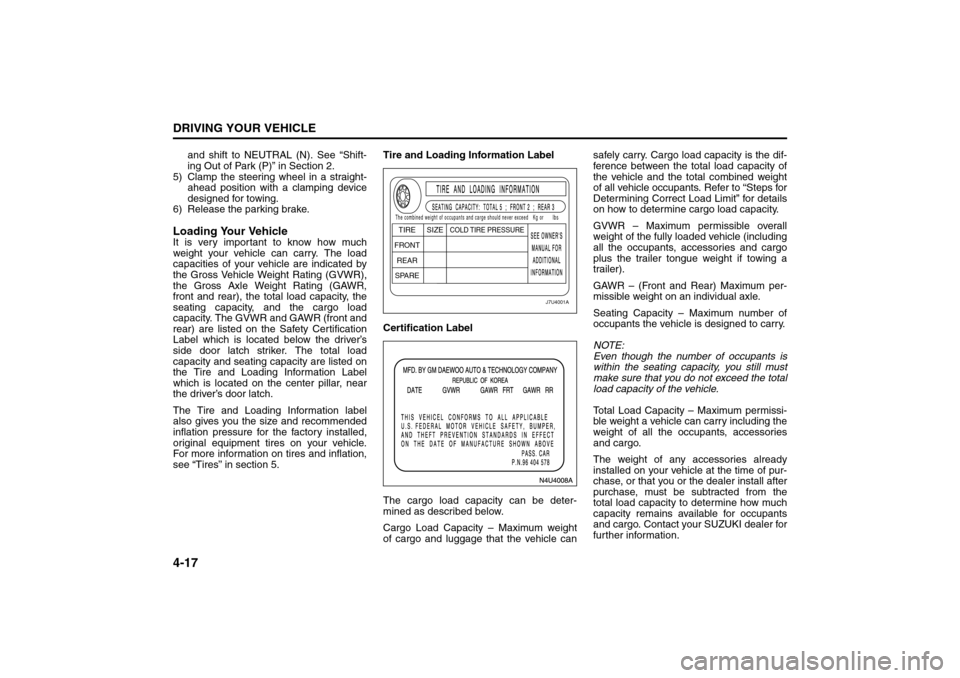
rear) are listed on the Safety Certification
Label which is located below the driver’s
side door latch striker. The total load
capacity and seating capacity are listed on
the Tire and Loading Information Label
which is located on the center pillar, near
the driver’s door latch.
The Tire and Loading Information label
also gives you the size and recommended
inflation pressure for the factory installed,
original equipment tires on your vehicle.
For more information on tires and inflation,
see “Tires” in section 5.Tire and Loading Information Label
Certification Label
The cargo load capacity can be deter-
mined as described below.
Cargo Load Capacity – Maximum weight
of cargo and luggage that the vehicle cansafely carry. Cargo load capacity is the dif-
ference between the total load capacity of
the vehicle and the total combined weight
of all vehicle occupants. Refer to “Steps for
Determining Correct Load Limit” for details
on how to determine cargo load capacity.
GVWR – Maximum permissible overall
weight of the fully loaded vehicle (including
all the occupants, accessories and cargo
plus the trailer tongue weight if towing a
trailer).
GAWR – (Front and Rear) Maximum per-
missible weight on an individual axle.
Seating Capacity – Maximum number of
occupants the vehicle is designed to carry.
NOTE:
Even though the number of occupants is
within the seating capacity, you still must
make sure that you do not exceed the total
load capacity of the vehicle.
Total Load Capacity – Maximum permissi-
ble weight a vehicle can carry including the
weight of all the occupants, accessories
and cargo.
The weight of any accessories already
installed on your vehicle at the time of pur-
chase, or that you or the dealer install after
purchase, must be subtracted from the
total load capacity to determine how much
capacity remains available for occupants
and cargo. Contact your SUZUKI dealer for
further information.
J7U4001A
TIRE
SIZE
COLD TIRE PRESSURE
FRONT
REAR
SPAREThe combined weight of occupants and carge should never exceedKg or lbs
Towing:
Page 174 of 226
5-30
SERVICE AND APPEARANCE CARE
85Z04-03E
and the maximum pressure needed to
support that load. See “Compact
Spare Tire” in this section and “Load-
ing Your Vehicle” in section 4.
E. Tire Inflation Pressure
The temporary use tire or compact
spare tire should be inflated to 60 psi
(420 kPa). For more information on
tire pressure and inflation, see “Tire
Inflation Pressure” in this section.
F. T i r e S i z e
A combination of letters and numbers
defining a tire’s width, height, aspect
ratio, construction type and service
description. The letter “T” as the first
character in the tire size means the
tire is for temporary use only.
Tire Size
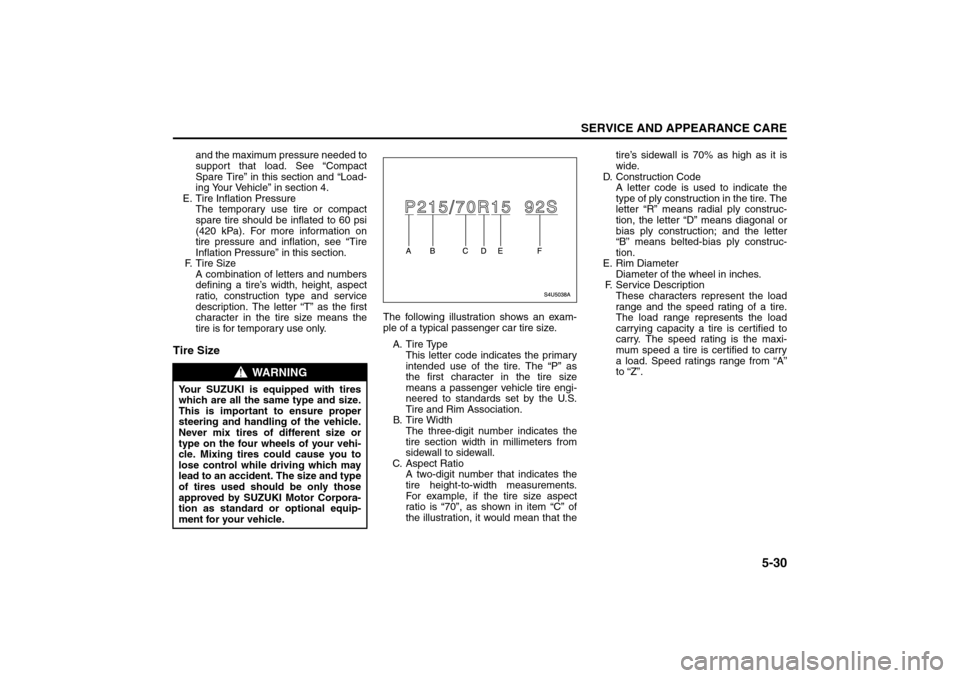
The following illustration shows an exam-
ple of a typical passenger car tire size.
A. Tire Type
This letter code indicates the primary
intended use of the tire. The “P” as
the first character in the tire size
means a passenger vehicle tire engi-
neered to standards set by the U.S.
Tire and Rim Association.
B. Tire Width
The three-digit number indicates the
tire section width in millimeters from
sidewall to sidewall.
C. Aspect Ratio
A two-digit number that indicates the
tire height-to-width measurements.
For example, if the tire size aspect
ratio is “70”, as shown in item “C” of
the illustration, it would mean that thetire’s sidewall is 70% as high as it is
wide.
D. Construction Code
A letter code is used to indicate the
type of ply construction in the tire. The
letter “R” means radial ply construc-
tion, the letter “D” means diagonal or
bias ply construction; and the letter
“B” means belted-bias ply construc-
tion.
E. Rim Diameter
Diameter of the wheel in inches.
F. Service Description
These characters represent the load
range and the speed rating of a tire.
The load range represents the load
carrying capacity a tire is certified to
carry. The speed rating is the maxi-
mum speed a tire is certified to carry
a load. Speed ratings range from “A”
to “Z”.
WARNING
Your SUZUKI is equipped with tires
which are all the same type and size.
This is important to ensure proper
steering and handling of the vehicle.
Never mix tires of different size or
type on the four wheels of your vehi-
cle. Mixing tires could cause you to
lose control while driving which may
lead to an accident. The size and type
of tires used should be only those
approved by SUZUKI Motor Corpora-
tion as standard or optional equip-
ment for your vehicle.
Tires:
Page 177 of 226
5-33SERVICE AND APPEARANCE CARE
85Z04-03E
Tire Pressure Monitoring
SystemIf your vehicle is equipped with a tire pres-
sure monitoring system, it uses pressure
sensors containing a unique identification
code to monitor the inflation pressure of
the tires. When the inflation pressure of
one or more tires indicates significant
under-inflation, the tire pressure warning
light comes on. If the warning light blinks,
for approximately one minute and then illu-
minates continuously, the monitoring sys-
tem may not be working. For more
information, see “Tire Pressure Monitoring
System Warning Light” in section 3.
The tire pressure monitoring system does
not replace normal tire maintenance. See
“Inflation – Tire Pressure & Correcting the
Tire Pressure” in this section for more
information.
The tire pressure warning light can come
on due to normal causes such as natural
air leaks and pressure changes caused by
changes in temperature or atmospheric
pressure. Adjusting the air pressure in the
tires to the pressure shown on the tire and
loading information label should cause the
tire pressure warning light to turn off.
If you use new wheels with new tire infla-
tion pressure sensors, their ID codes must
be programmed into the tire pressure mon-
WARNING
If the tire pressure warning light does
not come on when the ignition is
turned to the “ON” position, or
comes on and blinks while driving
there may be a problem with the tire
pressure monitoring system. Have
your vehicle inspected by an autho-
rized dealer.
WARNING
If the tire pressure warning light
comes on and stays on, reduce your
speed and avoid abrupt steering and
braking. Stop in a safe place as soon
as possible and check your tires.
If you have a flat tire, replace it with
a spare tire. Refer to “Changing a
Flat Tire” in section 5.
If one or more of your tires is
under-inflated, adjust the inflation
pressure in all of your tires to the
recommended inflation pressure as
soon as possible.
Be aware that driving on a signifi-
cantly under-inflated tire can cause
the tire to overheat and can lead to
tire failure, and may affect steering
control and brake effectiveness. This
could lead to an accident, resulting in
severe injury or death.
CAUTION
Do not use liquid sealants for a flat
tire as air pressure sensors can be
damaged.
In case of tire a bursting or sudden
pressure drops, the tire pressure
monitoring system warning light
may not come on immediately.
The inflation pressures vary with
the ambient temperature. If the
vehicle is subjected to large varia-
tions in ambient temperature, the
tire
inflation pressure may be
under-inflated when the ambient
temperature is relatively low. If the
warning light comes on, adjust the
tire inflation pressure.
The tire pressure sensors can be
damaged by the installation or
removal of tires. When tires must
be repaired or replaced, we highly
recommend that you have them
repaired or replaced by your
SUZUKI dealer.
If the tire pressure warning light
comes on or blinks frequently,
there may be something wrong
with one of the tires or with the
monitoring system. Have your vehi-
cle inspected by your SUZUKI
dealer.
Tires:
Page 181 of 226
5-37SERVICE AND APPEARANCE CARE
85Z04-03E
The tread or sidewall is cracked, cut or
snagged deep enough to show cord or
fabric.
The tire has a bump, bulge or split.
The tire has a puncture, cut or other
damage that can’t be repaired well
because of the size or location of the
damage.Buying New TiresTo find out what kind and size of tires you
need, look at the Tire and Loading Infor-
mation label.
Make sure the replacements are the same
size, load range, speed rating and con-
struction type (bias, bias-belted or radial)
as your original tires.
Uniform Tire Quality GradingQuality grades can be found where appli-
cable on the tire sidewall between the
tread shoulder and the maximum section
width. For example:
Tread wear 200 Traction AA Tempera-
ture A
The following information relates to the
system developed by the United States
National Highway Traffic Safety Adminis-
tration, which grades tires by tread wear,
traction and temperature performance.
(This applies only to vehicles sold in the
United States.) The grades are molded on
the sidewalls of most passenger car tires.
The Uniform Tire Quality Grading system
does not apply to deep tread, winter-type
snow tires, space-saver or temporary use
spare tires, tires with nominal rim diame-
ters of 10 to 12 inches (25 to 30 cm), or to
some limited-production tires.
While the tires available on SUZUKI vehi-
cles may vary with respect to these grades,
they all conform to federal safety require-
ments.
Tread wear
The tread wear grade is a comparative rat-
ing based on the wear rate of the tire when
tested under controlled conditions on a
specified government test course. For
example, a tire graded 150 would wear one
and a half (1.5) times as well on the gov-
ernment course as a tire graded 100. The
WARNING
Your SUZUKI is equipped with tires
which are all the same type and size.
This is important to ensure proper
steering and handling of the vehicle.
Never mix tires of different size or
type on the four wheels of your vehi-
cle. The size and type of tires used
should be only those approved by
SUZUKI Motor Corporation as stan-
dard or optional equipment for your
vehicle.
WARNING
Replacing the wheels and tires
equipped on your vehicle with certain
combinations of aftermarket wheels
and tires can significantly change the
steering and handling characteris-
tics of your vehicle. Oversized tires
may also rub against the fender over
bumps, causing vehicle damage or
tire failure. Therefore, use only those
wheel and tire combinations
approved by SUZUKI Motor Corpora-
tion as standard or optional equip-
ment for your vehicle. For
information regarding the specified
tires, refer to the Tire Information
Label located on the driver’s side
door pillar or “Tire Inflation Pres-
sure” in this section.
CAUTION
Replacing the original tires with tires
of a different size may result in false
speedometer or odometer readings.
Check with your SUZUKI dealer
before purchasing replacement tires
that differ in size from the original
tires.
Tires:
Page 183 of 226
5-39SERVICE AND APPEARANCE CARE
85Z04-03E
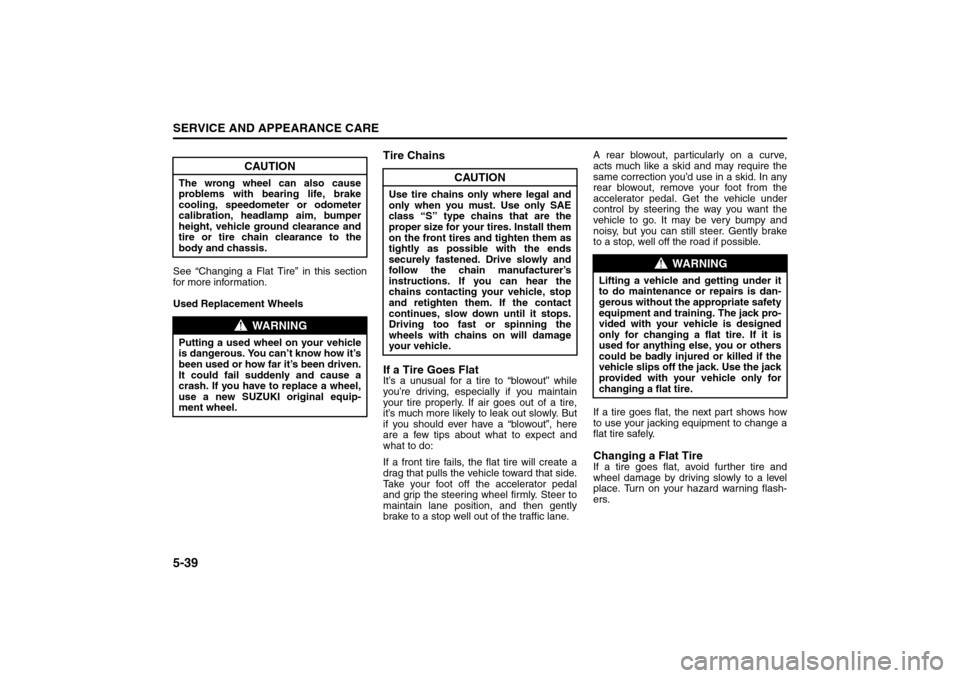
See “Changing a Flat Tire” in this section
for more information.
Used Replacement Wheels
Tire Chains
If a Tire Goes FlatIt’s a unusual for a tire to “blowout” while
you’re driving, especially if you maintain
your tire properly. If air goes out of a tire,
it’s much more likely to leak out slowly. But
if you should ever have a “blowout”, here
are a few tips about what to expect and
what to do:
If a front tire fails, the flat tire will create a
drag that pulls the vehicle toward that side.
Take your foot off the accelerator pedal
and grip the steering wheel firmly. Steer to
maintain lane position, and then gently
brake to a stop well out of the traffic lane.A rear blowout, particularly on a curve,
acts much like a skid and may require the
same correction you’d use in a skid. In any
rear blowout, remove your foot from the
accelerator pedal. Get the vehicle under
control by steering the way you want the
vehicle to go. It may be very bumpy and
noisy, but you can still steer. Gently brake
to a stop, well off the road if possible.
If a tire goes flat, the next part shows how
to use your jacking equipment to change a
flat tire safely.
Changing a Flat TireIf a tire goes flat, avoid further tire and
wheel damage by driving slowly to a level
place. Turn on your hazard warning flash-
ers.
CAUTION
The wrong wheel can also cause
problems with bearing life, brake
cooling, speedometer or odometer
calibration, headlamp aim, bumper
height, vehicle ground clearance and
tire or tire chain clearance to the
body and chassis.
WARNING
Putting a used wheel on your vehicle
is dangerous. You can’t know how it’s
been used or how far it’s been driven.
It could fail suddenly and cause a
crash. If you have to replace a wheel,
use a new SUZUKI original equip-
ment wheel.
CAUTION
Use tire chains only where legal and
only when you must. Use only SAE
class “S” type chains that are the
proper size for your tires. Install them
on the front tires and tighten them as
tightly as possible with the ends
securely fastened. Drive slowly and
follow the chain manufacturer’s
instructions. If you can hear the
chains contacting your vehicle, stop
and retighten them. If the contact
continues, slow down until it stops.
Driving too fast or spinning the
wheels with chains on will damage
your vehicle.
WARNING
Lifting a vehicle and getting under it
to do maintenance or repairs is dan-
gerous without the appropriate safety
equipment and training. The jack pro-
vided with your vehicle is designed
only for changing a flat tire. If it is
used for anything else, you or others
could be badly injured or killed if the
vehicle slips off the jack. Use the jack
provided with your vehicle only for
changing a flat tire.
Tires:
Page 198 of 226
5-54
SERVICE AND APPEARANCE CARE
85Z04-03E
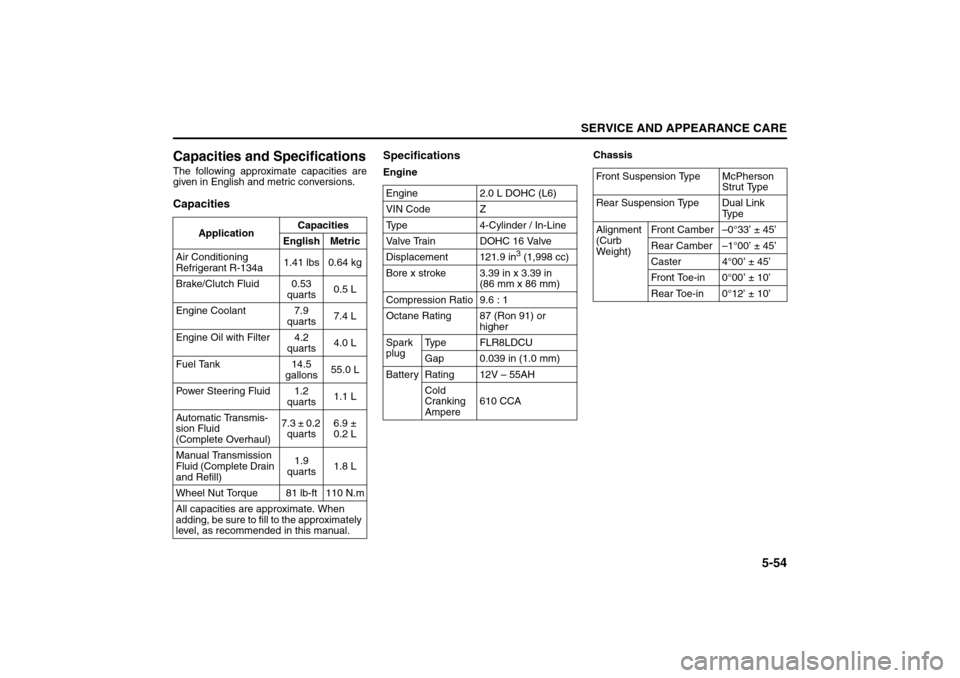
Capacities and SpecificationsThe following approximate capacities are
given in English and metric conversions. CapacitiesSpecifications
EngineChassis
ApplicationCapacities
English Metric
Air Conditioning
Refrigerant R-134a1.41 lbs 0.64 kg
Brake/Clutch Fluid 0.53
quarts0.5 L
Engine Coolant 7.9
quarts7.4 L
Engine Oil with Filter 4.2
quarts4.0 L
Fuel Tank 14.5
gallons55.0 L
Power Steering Fluid 1.2
quarts1.1 L
Automatic Transmis-
sion Fluid
(Complete Overhaul)7.3 ± 0.2
quarts6.9 ±
0.2 L
Manual Transmission
Fluid (Complete Drain
and Refill)1.9
quarts1.8 L
Wheel Nut Torque 81 lb-ft 110 N.m
All capacities are approximate. When
adding, be sure to fill to the approximately
level, as recommended in this manual. Engine 2.0 L DOHC (L6)
VIN Code Z
Type 4-Cylinder / In-Line
Valve Train DOHC 16 Valve
Displacement 121.9 in
3 (1,998 cc)
Bore x stroke 3.39 in x 3.39 in
(86 mm x 86 mm)
Compression Ratio 9.6 : 1
Octane Rating 87 (Ron 91) or
higher
Spark
plugType FLR8LDCU
Gap 0.039 in (1.0 mm)
Battery Rating 12V – 55AH
Cold
Cranking
Ampere610 CCA
Front Suspension Type McPherson
Strut Type
Rear Suspension Type Dual Link
Ty p e
Alignment
(Curb
Weight)Front Camber –0°33’ ± 45’
Rear Camber –1°00’ ± 45’
Caster 4°00’ ± 45’
Front Toe-in 0°00’ ± 10’
Rear Toe-in 0°12’ ± 10’
Page 204 of 226
6-4
MAINTENANCE SCHEDULE
85Z04-03E
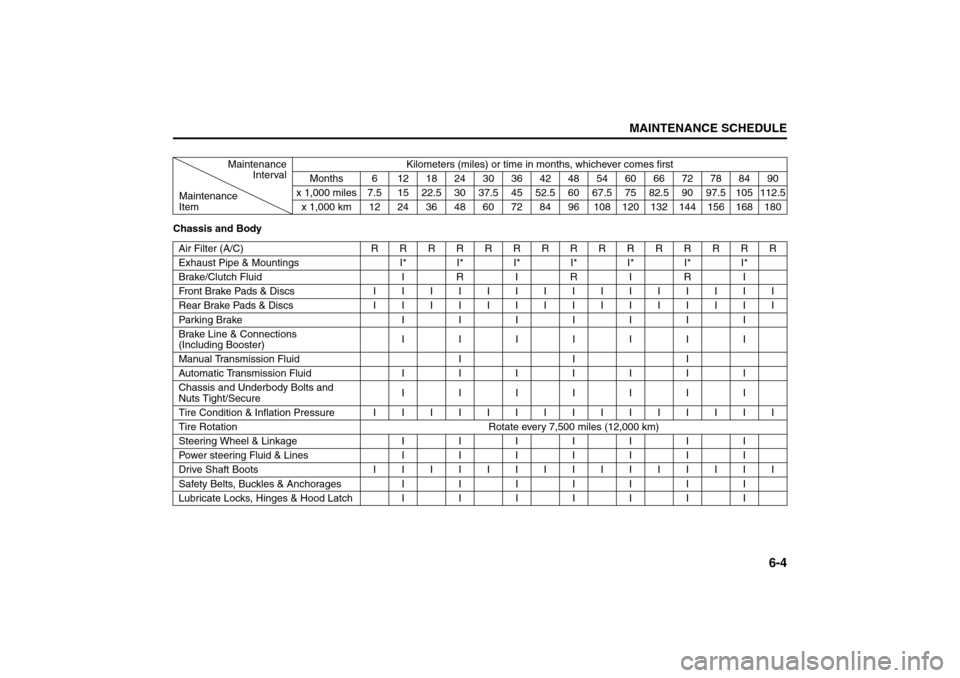
Chassis and BodyMaintenance
IntervalKilometers (miles) or time in months, whichever comes first
Months 6 1218243036424854606672788490
Maintenance
Itemx 1,000 miles 7.5 15 22.5 30 37.5 45 52.5 60 67.5 75 82.5 90 97.5 105 112.5
x 1,000 km 12 24 36 48 60 72 84 96 108 120 132 144 156 168 180
Air Filter (A/C) RRRRRRRRRRRRRRR
Exhaust Pipe & Mountings I* I* I* I* I* I* I*
Brake/Clutch Fluid I R I R I R I
Front Brake Pads & Discs IIIIIIIIIIIIIII
Rear Brake Pads & Discs IIIIIIIIIIIIIII
Parking Brake IIIIIII
Brake Line & Connections
(Including Booster)IIIIIII
Manual Transmission Fluid I I I
Automatic Transmission Fluid IIIIIII
Chassis and Underbody Bolts and
Nuts Tight/SecureIIIIIII
Tire Condition & Inflation Pressure IIIIIIIIIIIIIII
Tire Rotation Rotate every 7,500 miles (12,000 km)
Steering Wheel & Linkage I I I I I I I
Power steering Fluid & Lines I I I I I I I
Drive Shaft Boots IIIIIIIIIIIIIII
Safety Belts, Buckles & Anchorages I I I I I I I
Lubricate Locks, Hinges & Hood Latch I I I I I I I
Page 205 of 226
6-5MAINTENANCE SCHEDULE
85Z04-03E
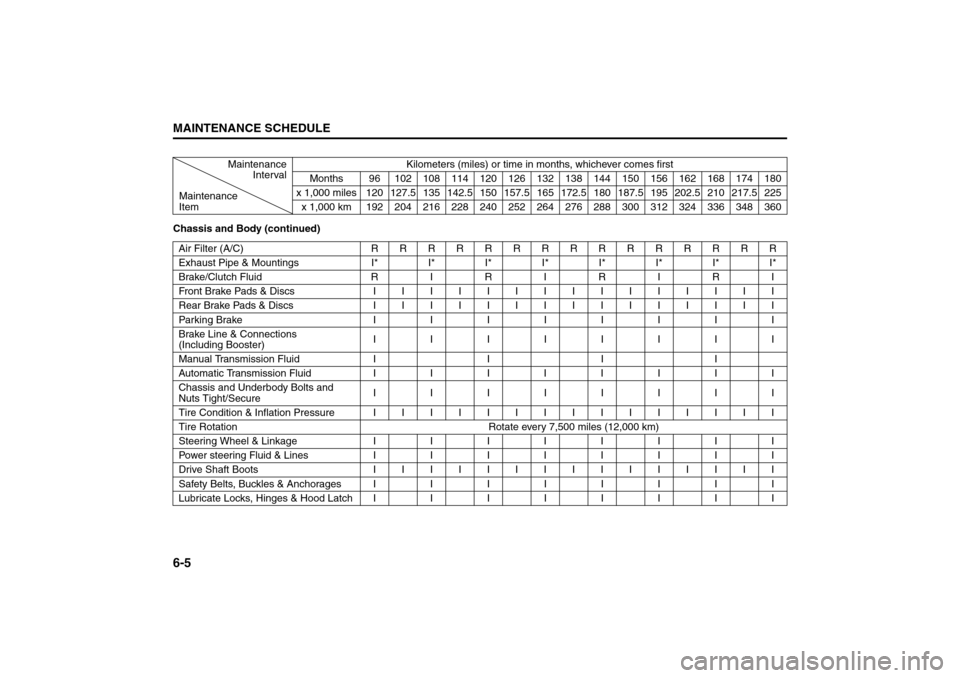
Chassis and Body (continued)Maintenance
IntervalKilometers (miles) or time in months, whichever comes first
Months 96 102 108 114 120 126 132 138 144 150 156 162 168 174 180
Maintenance
Itemx 1,000 miles 120 127.5 135 142.5 150 157.5 165 172.5 180 187.5 195 202.5 210 217.5 225
x 1,000 km 192 204 216 228 240 252 264 276 288 300 312 324 336 348 360
Air Filter (A/C) RRRRRRRRRRRRRRR
Exhaust Pipe & Mountings I* I* I* I* I* I* I* I*
Brake/Clutch Fluid R I R I R I R I
Front Brake Pads & Discs IIIIIIIIIIIIIII
Rear Brake Pads & Discs IIIIIIIIIIIIIII
Parking Brake IIIIIIII
Brake Line & Connections
(Including Booster)IIIIIIII
Manual Transmission Fluid I I I I
Automatic Transmission Fluid IIIIIIII
Chassis and Underbody Bolts and
Nuts Tight/SecureIIIIIIII
Tire Condition & Inflation Pressure IIIIIIIIIIIIIII
Tire Rotation Rotate every 7,500 miles (12,000 km)
Steering Wheel & Linkage I I I I I I I I
Power steering Fluid & Lines I I I I I I I I
Drive Shaft Boots IIIIIIIIIIIIIII
Safety Belts, Buckles & Anchorages I I I I I I I I
Lubricate Locks, Hinges & Hood Latch I I I I I I I I
Page 208 of 226
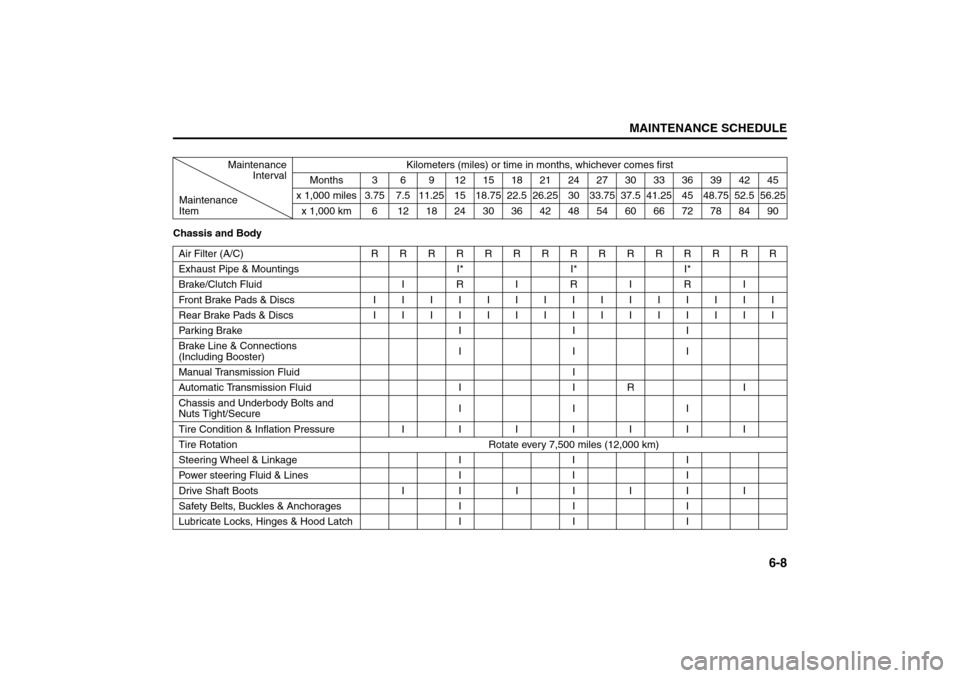
6-8
MAINTENANCE SCHEDULE
85Z04-03E
Chassis and BodyMaintenance
IntervalKilometers (miles) or time in months, whichever comes first
Months 3 6 9 121518212427303336394245
Maintenance
Itemx 1,000 miles 3.75 7.5 11.25 15 18.75 22.526.25 30 33.75 37.5 41.25 45 48.75 52.5 56.25
x 1,000 km 6 1218243036424854606672788490
Air Filter (A/C) RRRRRRRRRRRRRRR
Exhaust Pipe & Mountings I* I* I*
Brake/Clutch Fluid I R I R I R I
Front Brake Pads & Discs IIIIIIIIIIIIIII
Rear Brake Pads & Discs IIIIIIIIIIIIIII
Parking Brake I I I
Brake Line & Connections
(Including Booster)III
Manual Transmission Fluid I
Automatic Transmission Fluid I I R I
Chassis and Underbody Bolts and
Nuts Tight/SecureIII
Tire Condition & Inflation Pressure I I I I I I I
Tire Rotation Rotate every 7,500 miles (12,000 km)
Steering Wheel & Linkage I I I
Power steering Fluid & Lines I I I
Drive Shaft Boots IIIIIII
Safety Belts, Buckles & Anchorages I I I
Lubricate Locks, Hinges & Hood Latch I I I
Page 209 of 226
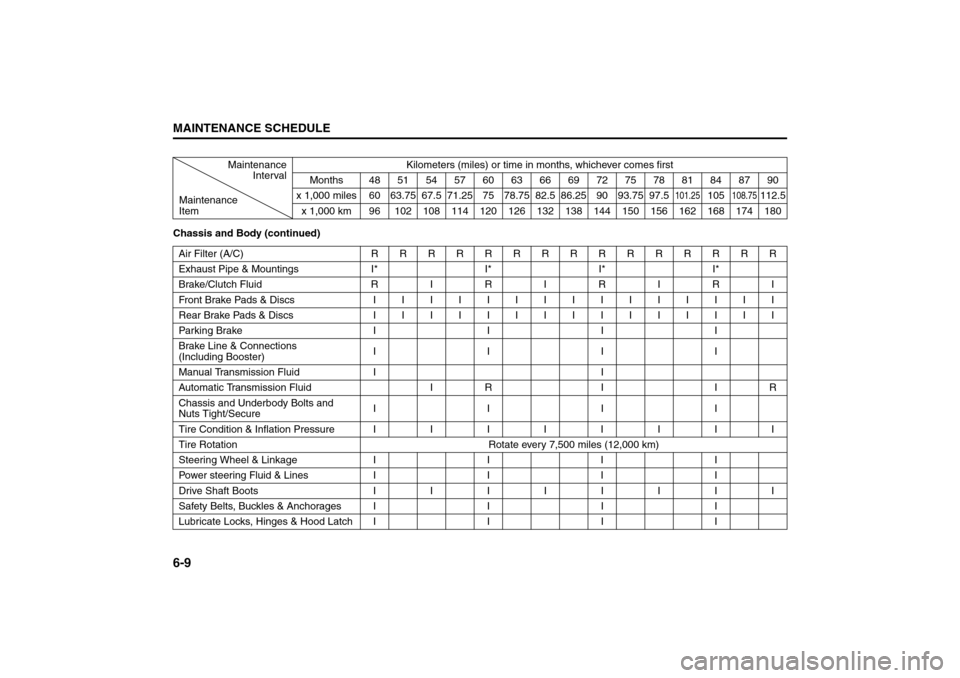
6-9MAINTENANCE SCHEDULE
85Z04-03E
Chassis and Body (continued)Maintenance
IntervalKilometers (miles) or time in months, whichever comes first
Months 48 51 54 57 60 63 66 69 72 75 78 81 84 87 90
Maintenance
Itemx 1,000 miles 60 63.75 67.5 71.25 75 78.75 82.5 86.25 90 93.75 97.5
101.25
105
108.75
112.5
x 1,000 km 96 102 108 114 120 126 132 138 144 150 156 162 168 174 180
Air Filter (A/C) RRRRRRRRRRRRRRR
Exhaust Pipe & Mountings I* I* I* I*
Brake/Clutch Fluid R I R I R I R I
Front Brake Pads & Discs IIIIIIIIIIIIIII
Rear Brake Pads & Discs IIIIIIIIIIIIIII
Parking Brake I I I I
Brake Line & Connections
(Including Booster)IIII
Manual Transmission Fluid I I
Automatic Transmission Fluid I R I I R
Chassis and Underbody Bolts and
Nuts Tight/SecureIIII
Tire Condition & Inflation Pressure I I I I I I I I
Tire Rotation Rotate every 7,500 miles (12,000 km)
Steering Wheel & Linkage I I I I
Power steering Fluid & Lines I I I I
Drive Shaft Boots IIIIIIII
Safety Belts, Buckles & Anchorages I I I I
Lubricate Locks, Hinges & Hood Latch I I I I