Trans SUZUKI GRAND VITARA 1999 2.G Owners Manual
[x] Cancel search | Manufacturer: SUZUKI, Model Year: 1999, Model line: GRAND VITARA, Model: SUZUKI GRAND VITARA 1999 2.GPages: 656, PDF Size: 14.31 MB
Page 475 of 656
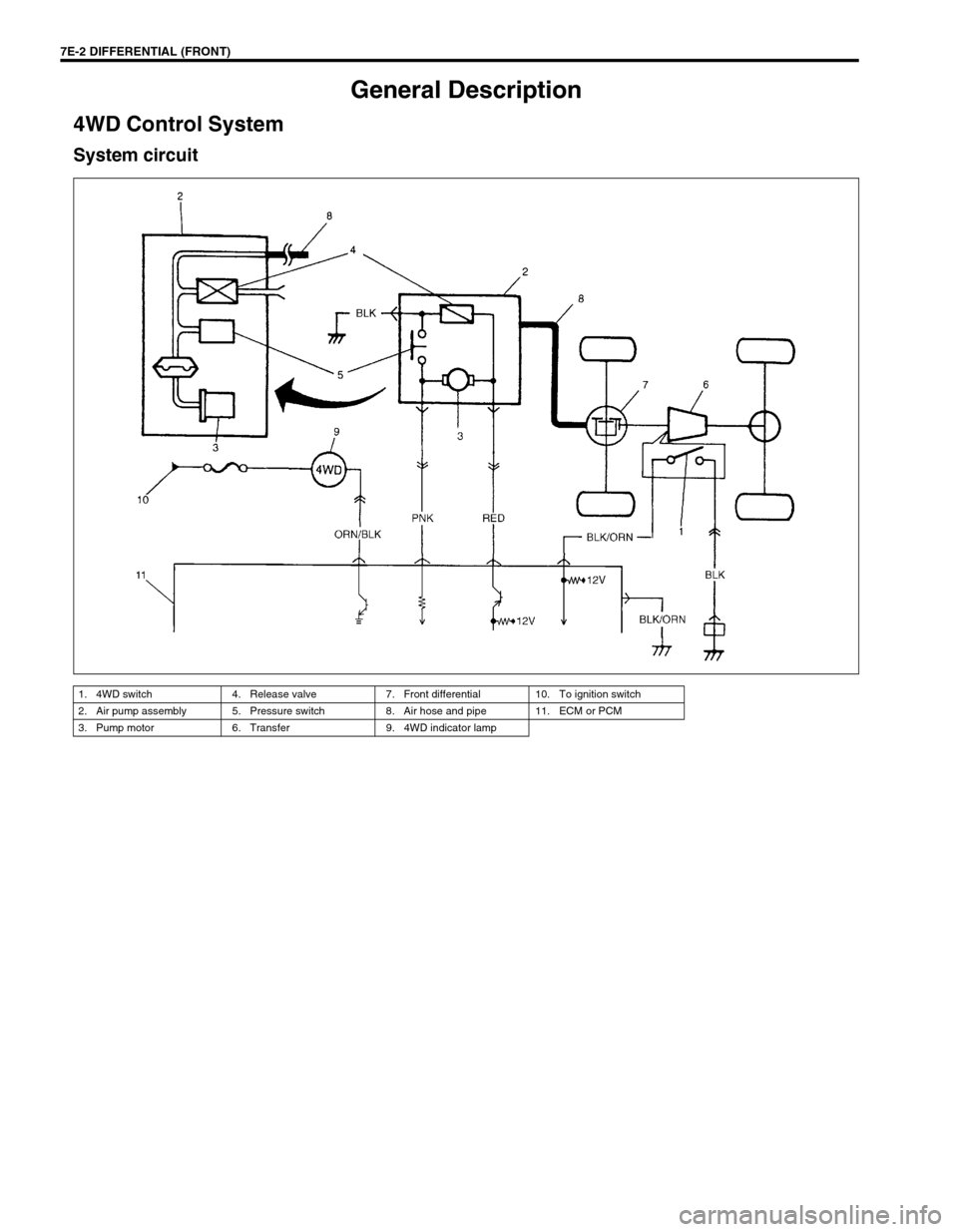
7E-2 DIFFERENTIAL (FRONT)
General Description
4WD Control System
System circuit
1. 4WD switch 4. Release valve 7. Front differential 10. To ignition switch
2. Air pump assembly 5. Pressure switch 8. Air hose and pipe 11. ECM or PCM
3. Pump motor 6. Transfer 9. 4WD indicator lamp
Page 476 of 656
DIFFERENTIAL (FRONT) 7E-3
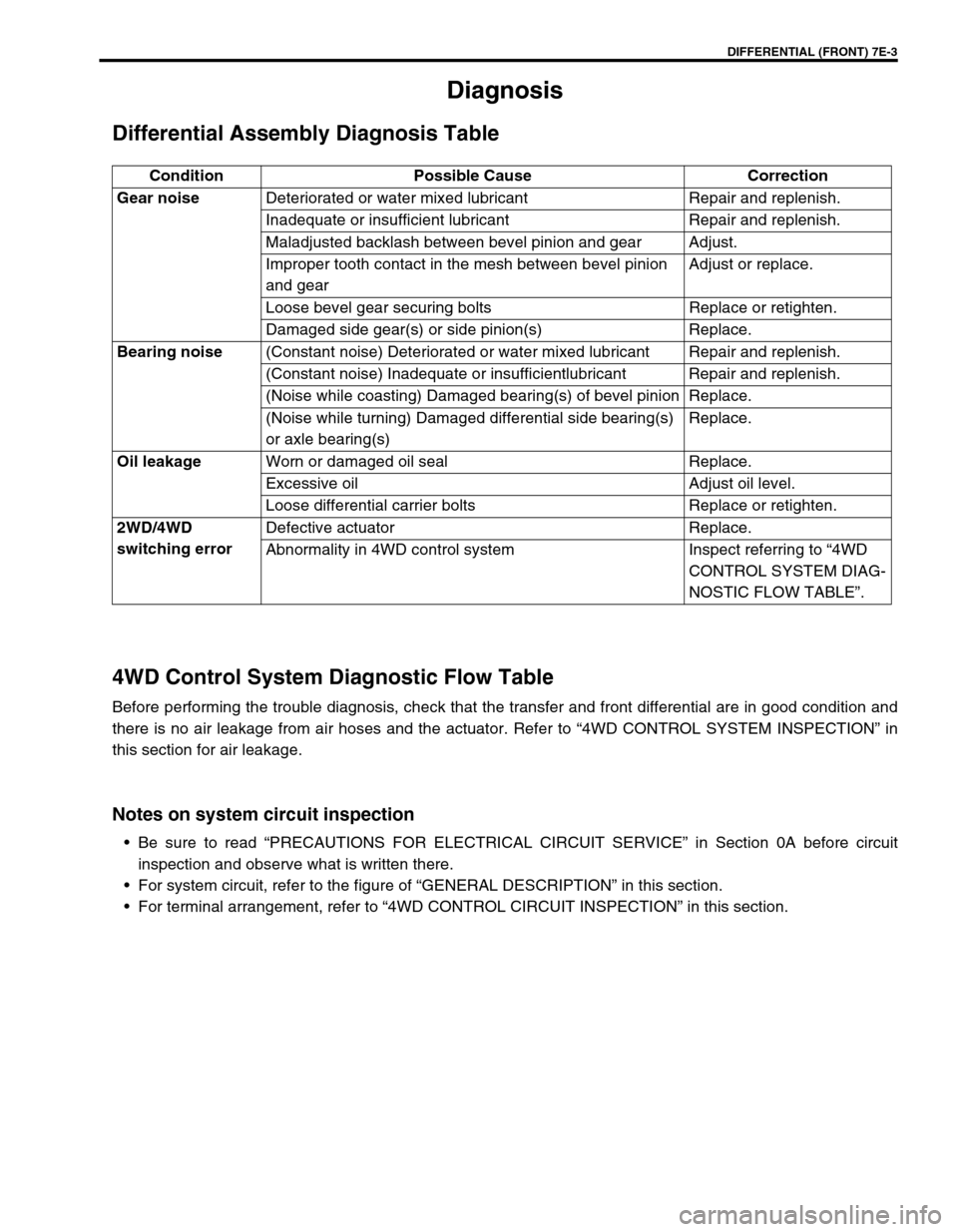
Diagnosis
Differential Assembly Diagnosis Table
4WD Control System Diagnostic Flow Table
Before performing the trouble diagnosis, check that the transfer and front differential are in good condition and
there is no air leakage from air hoses and the actuator. Refer to “4WD CONTROL SYSTEM INSPECTION” in
this section for air leakage.
Notes on system circuit inspection
•Be sure to read “PRECAUTIONS FOR ELECTRICAL CIRCUIT SERVICE” in Section 0A before circuit
inspection and observe what is written there.
•For system circuit, refer to the figure of “GENERAL DESCRIPTION” in this section.
•For terminal arrangement, refer to “4WD CONTROL CIRCUIT INSPECTION” in this section. Condition Possible Cause Correction
Gear noiseDeteriorated or water mixed lubricant Repair and replenish.
Inadequate or insufficient lubricant Repair and replenish.
Maladjusted backlash between bevel pinion and gear Adjust.
Improper tooth contact in the mesh between bevel pinion
and gearAdjust or replace.
Loose bevel gear securing bolts Replace or retighten.
Damaged side gear(s) or side pinion(s) Replace.
Bearing noise(Constant noise) Deteriorated or water mixed lubricant Repair and replenish.
(Constant noise) Inadequate or insufficientlubricant Repair and replenish.
(Noise while coasting) Damaged bearing(s) of bevel pinion Replace.
(Noise while turning) Damaged differential side bearing(s)
or axle bearing(s)Replace.
Oil leakageWorn or damaged oil seal Replace.
Excessive oil Adjust oil level.
Loose differential carrier bolts Replace or retighten.
2WD/4WD
switching errorDefective actuator Replace.
Abnormality in 4WD control system Inspect referring to “4WD
CONTROL SYSTEM DIAG-
NOSTIC FLOW TABLE”.
Page 477 of 656
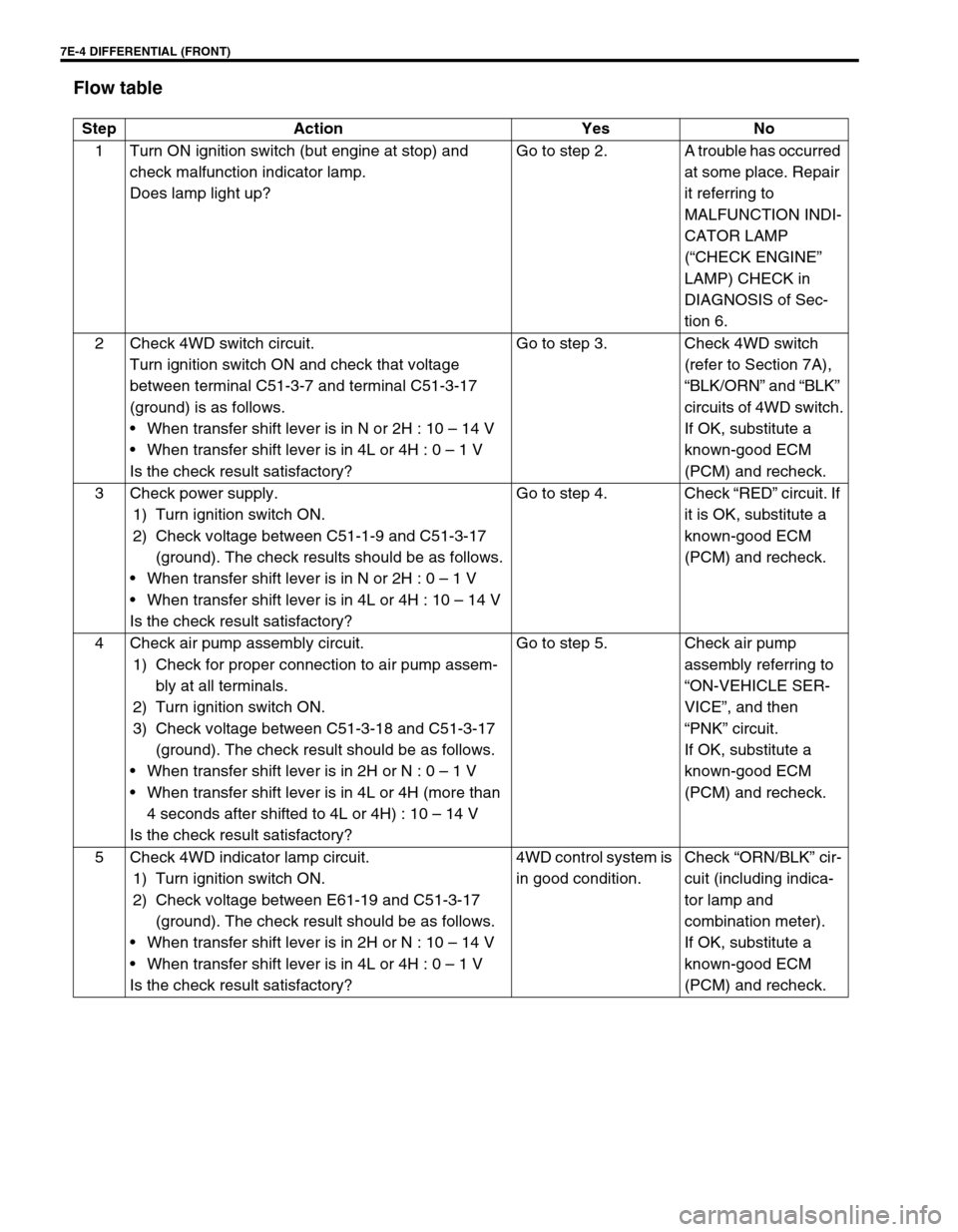
7E-4 DIFFERENTIAL (FRONT)
Flow table
Step Action Yes No
1 Turn ON ignition switch (but engine at stop) and
check malfunction indicator lamp.
Does lamp light up?Go to step 2. A trouble has occurred
at some place. Repair
it referring to
MALFUNCTION INDI-
CATOR LAMP
(“CHECK ENGINE”
LAMP) CHECK in
DIAGNOSIS of Sec-
tion 6.
2 Check 4WD switch circuit.
Turn ignition switch ON and check that voltage
between terminal C51-3-7 and terminal C51-3-17
(ground) is as follows.
When transfer shift lever is in N or 2H : 10 – 14 V
When transfer shift lever is in 4L or 4H : 0 – 1 V
Is the check result satisfactory?Go to step 3. Check 4WD switch
(refer to Section 7A),
“BLK/ORN” and “BLK”
circuits of 4WD switch.
If OK, substitute a
known-good ECM
(PCM) and recheck.
3 Check power supply.
1) Turn ignition switch ON.
2) Check voltage between C51-1-9 and C51-3-17
(ground). The check results should be as follows.
When transfer shift lever is in N or 2H : 0 – 1 V
When transfer shift lever is in 4L or 4H : 10 – 14 V
Is the check result satisfactory?Go to step 4. Check “RED” circuit. If
it is OK, substitute a
known-good ECM
(PCM) and recheck.
4 Check air pump assembly circuit.
1) Check for proper connection to air pump assem-
bly at all terminals.
2) Turn ignition switch ON.
3) Check voltage between C51-3-18 and C51-3-17
(ground). The check result should be as follows.
When transfer shift lever is in 2H or N : 0 – 1 V
When transfer shift lever is in 4L or 4H (more than
4 seconds after shifted to 4L or 4H) : 10 – 14 V
Is the check result satisfactory?Go to step 5. Check air pump
assembly referring to
“ON-VEHICLE SER-
VICE”, and then
“PNK” circuit.
If OK, substitute a
known-good ECM
(PCM) and recheck.
5 Check 4WD indicator lamp circuit.
1) Turn ignition switch ON.
2) Check voltage between E61-19 and C51-3-17
(ground). The check result should be as follows.
When transfer shift lever is in 2H or N : 10 – 14 V
When transfer shift lever is in 4L or 4H : 0 – 1 V
Is the check result satisfactory?4WD control system is
in good condition.Check “ORN/BLK” cir-
cuit (including indica-
tor lamp and
combination meter).
If OK, substitute a
known-good ECM
(PCM) and recheck.
Page 478 of 656
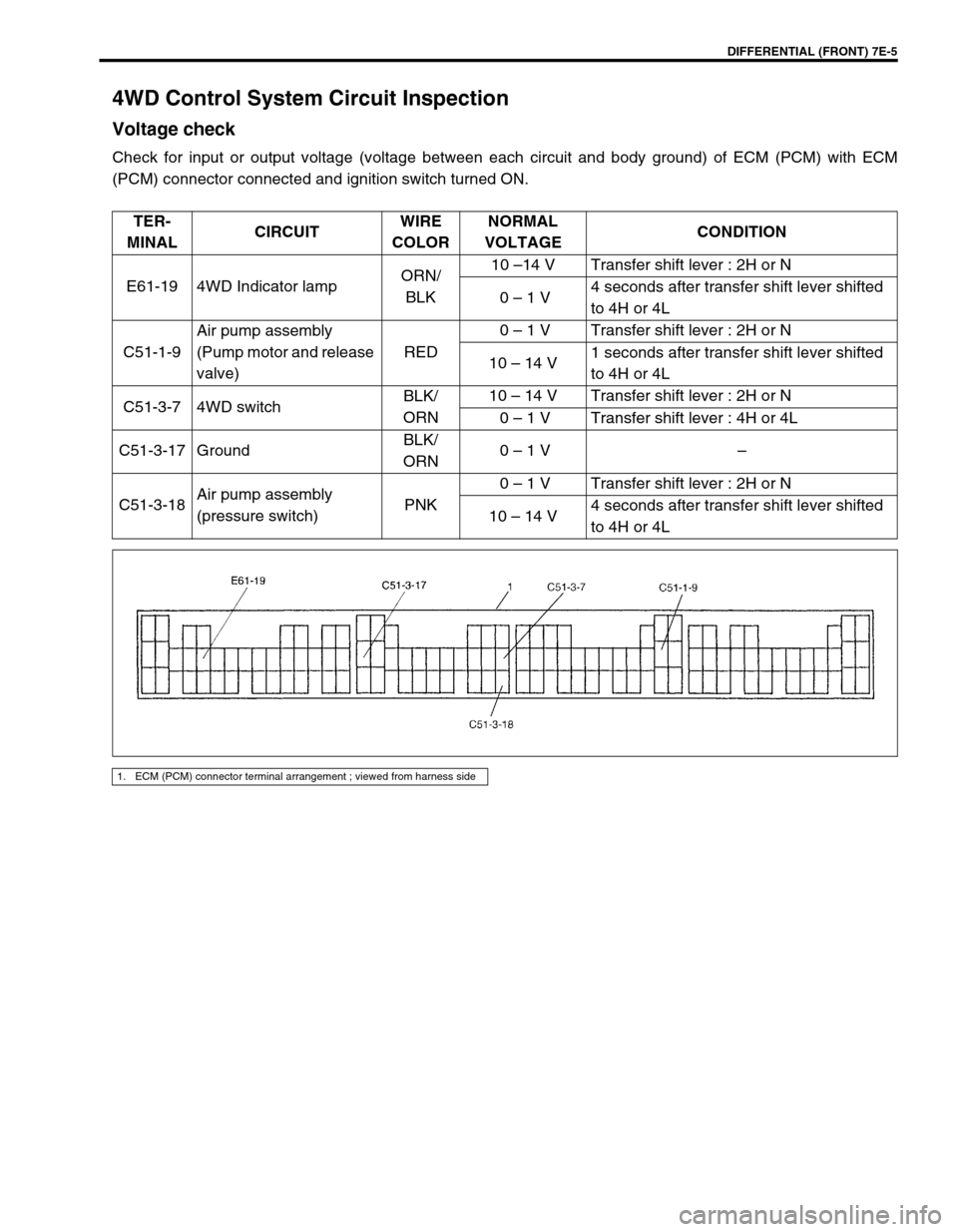
DIFFERENTIAL (FRONT) 7E-5
4WD Control System Circuit Inspection
Voltage check
Check for input or output voltage (voltage between each circuit and body ground) of ECM (PCM) with ECM
(PCM) connector connected and ignition switch turned ON.
TER-
MINALCIRCUITWIRE
COLORNORMAL
VOLTAGECONDITION
E61-19 4WD Indicator lampORN/
BLK10 –14 V Transfer shift lever : 2H or N
0 – 1 V4 seconds after transfer shift lever shifted
to 4H or 4L
C51-1-9Air pump assembly
(Pump motor and release
valve)RED 0 – 1 V Transfer shift lever : 2H or N
10 – 14 V1 seconds after transfer shift lever shifted
to 4H or 4L
C51-3-7 4WD switchBLK/
ORN10 – 14 V Transfer shift lever : 2H or N
0 – 1 V Transfer shift lever : 4H or 4L
C51-3-17 GroundBLK/
ORN 0 – 1 V –
C51-3-18Air pump assembly
(pressure switch)PNK 0 – 1 V Transfer shift lever : 2H or N
10 – 14 V4 seconds after transfer shift lever shifted
to 4H or 4L
1. ECM (PCM) connector terminal arrangement ; viewed from harness side
Page 479 of 656
7E-6 DIFFERENTIAL (FRONT)
4WD Control System Inspection
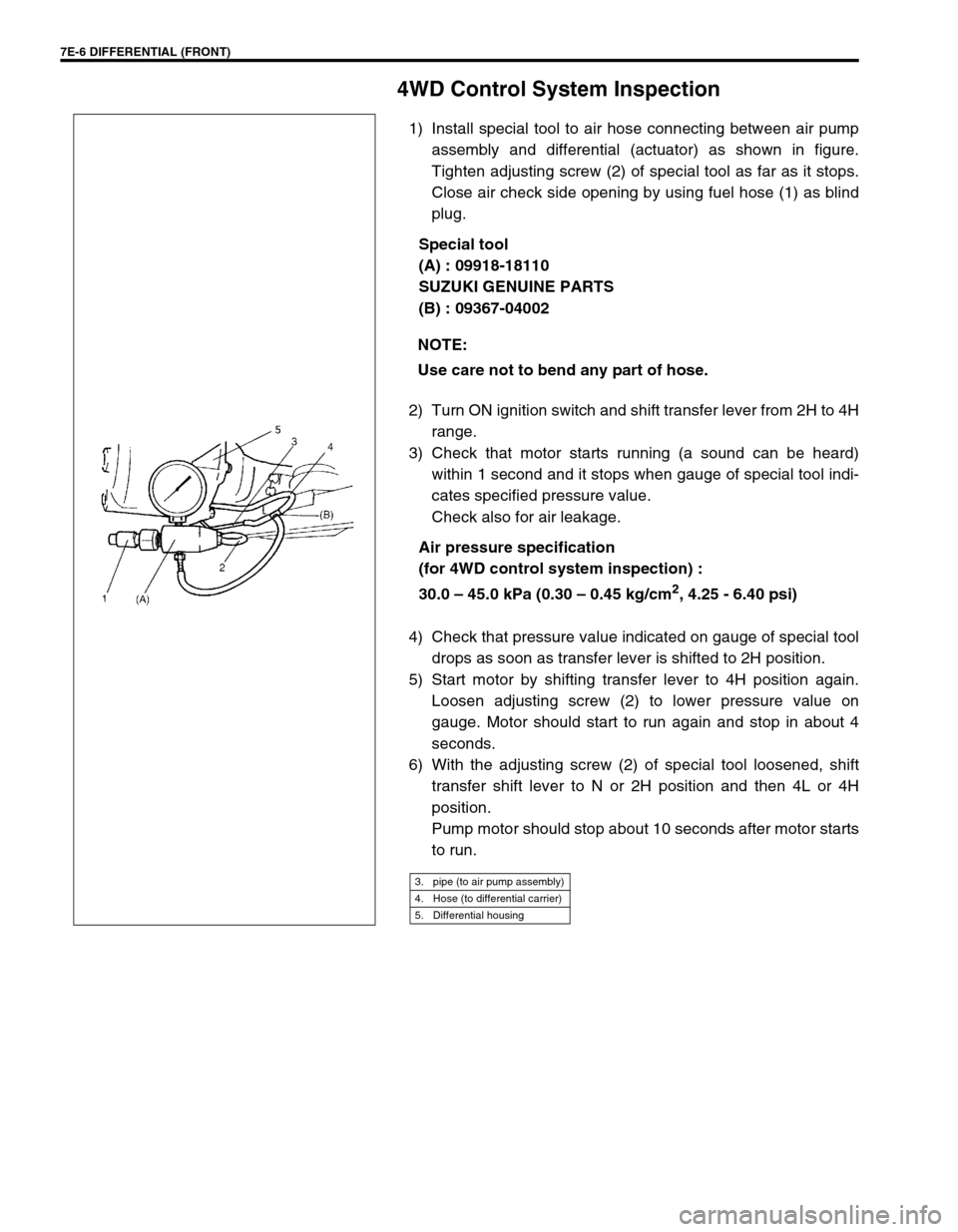
1) Install special tool to air hose connecting between air pump
assembly and differential (actuator) as shown in figure.
Tighten adjusting screw (2) of special tool as far as it stops.
Close air check side opening by using fuel hose (1) as blind
plug.
Special tool
(A) : 09918-18110
SUZUKI GENUINE PARTS
(B) : 09367-04002
2) Turn ON ignition switch and shift transfer lever from 2H to 4H
range.
3) Check that motor starts running (a sound can be heard)
within 1 second and it stops when gauge of special tool indi-
cates specified pressure value.
Check also for air leakage.
Air pressure specification
(for 4WD control system inspection) :
30.0 – 45.0 kPa (0.30 – 0.45 kg/cm
2, 4.25 - 6.40 psi)
4) Check that pressure value indicated on gauge of special tool
drops as soon as transfer lever is shifted to 2H position.
5) Start motor by shifting transfer lever to 4H position again.
Loosen adjusting screw (2) to lower pressure value on
gauge. Motor should start to run again and stop in about 4
seconds.
6) With the adjusting screw (2) of special tool loosened, shift
transfer shift lever to N or 2H position and then 4L or 4H
position.
Pump motor should stop about 10 seconds after motor starts
to run. NOTE:
Use care not to bend any part of hose.
3. pipe (to air pump assembly)
4. Hose (to differential carrier)
5. Differential housing
Page 482 of 656
DIFFERENTIAL (FRONT) 7E-9
Front Differential Assembly
DISMOUNTING
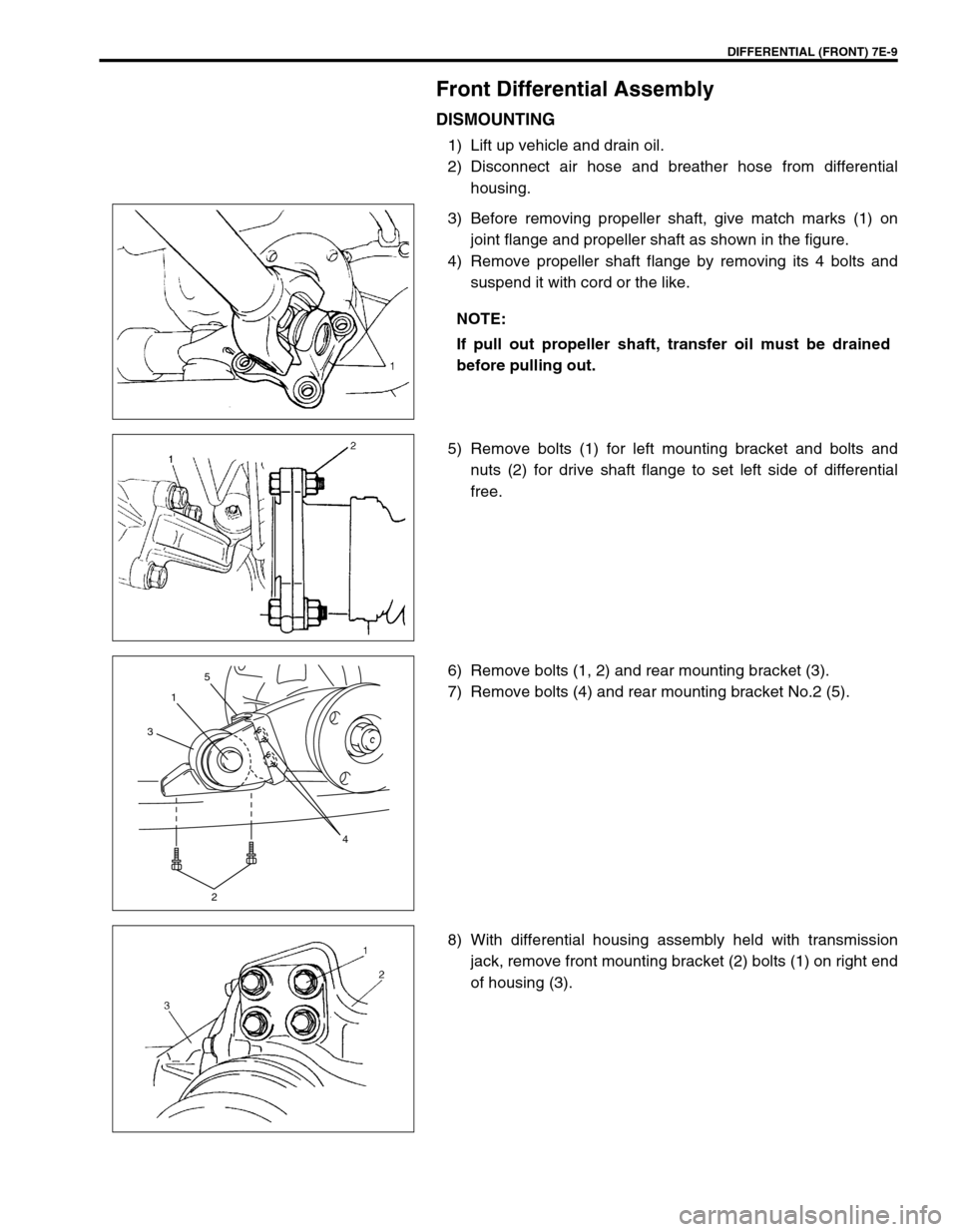
1) Lift up vehicle and drain oil.
2) Disconnect air hose and breather hose from differential
housing.
3) Before removing propeller shaft, give match marks (1) on
joint flange and propeller shaft as shown in the figure.
4) Remove propeller shaft flange by removing its 4 bolts and
suspend it with cord or the like.
5) Remove bolts (1) for left mounting bracket and bolts and
nuts (2) for drive shaft flange to set left side of differential
free.
6) Remove bolts (1, 2) and rear mounting bracket (3).
7) Remove bolts (4) and rear mounting bracket No.2 (5).
8) With differential housing assembly held with transmission
jack, remove front mounting bracket (2) bolts (1) on right end
of housing (3). NOTE:
If pull out propeller shaft, transfer oil must be drained
before pulling out.
4 1
2
5
3
Page 514 of 656
![SUZUKI GRAND VITARA 1999 2.G Owners Manual INSTRUMENTATION/DRIVER INFORMATION 8C-3
COMBINATION METER INTERNAL CIRCUITS
COMBINATION METER COUPLERS
[A] : Coupler A [B] : Coupler B [C] : Coupler C
1. To Cruise control module (if equipped) GRY/YE](/img/20/7583/w960_7583-513.png "SUZUKI GRAND VITARA 1999 2.G Owners Manual INSTRUMENTATION/DRIVER INFORMATION 8C-3
COMBINATION METER INTERNAL CIRCUITS
COMBINATION METER COUPLERS
[A] : Coupler A [B] : Coupler B [C] : Coupler C
1. To Cruise control module (if equipped) GRY/YE")
INSTRUMENTATION/DRIVER INFORMATION 8C-3
COMBINATION METER INTERNAL CIRCUITS
COMBINATION METER COUPLERS
[A] : Coupler A [B] : Coupler B [C] : Coupler C
1. To Cruise control module (if equipped) GRY/YEL 1. To door switch (drive side) BLK/BLU 1. To ground BLK
2. Blank–2. To transmission range switch
(A/T vehicle only, if equipped) LGRN/BLU 2. To ECM (PCM for A/T vehicle) BRN
3. To ignition switch BLK/WHT 3. To transmission range switch
(A/T vehicle only, if equipped) 2GRN/ORN 3. To ignition switch PPL/RED
4. Blank–4. To transmission range switch
(A/T vehicle only, if equipped) DYEL/GRN 4. To brake fluid level switch RED/BLK
5. To ABS control module (if equipped) BLU/ORN 5. To transmission range switch
(A/T vehicle only, if equipped) NORN/BLU 5. To parking brake switch PPL
6. To PCM (A/T vehicle only) GRY/BLU 6. To transmission range switch
(A/T vehicle only, if equipped) PORN/GRN 6. To seat belt switch GRY/RED
7. To ABS control module (if equipped) BRN 7. To transmission range switch
(A/T vehicle only, if equipped) RRED 7. To generator WHT/RED
8. To VSS BLU/YEL 8. To illumination control module RED/GRN 8. To engine oil pressure switch YEL/BLK
9. To combination switch GRN/RED 9. To PCM (A/T vehicle only) WHT/BLK 9. To combination switch RED/YEL
10. To air bag SDM BLU 10. To ECT sensor YEL/WHT 10. To ignition switch BLU/RED
11. To main fuse WHT/BLU 11. To fuel level gauge BLU/WHT
12. To fuse box WHT 12. To ground BLU/YEL
13. To combination switch RED 13. To combination switch GRN/YEL
14. To immobilizer control module
(if equipped)PPL
15. To ECM (PCM for A/T vehicle) PPL/YEL
16. To ECM (PCM for A/T vehicle) ORN/BLK
P R N D 2 LCRUISEPOWER4WDSPEED
METERTACHO
METERFUEL
METERTEMP.
METER
A-11
A-13 A-8 B-12 B-11 C-8 A-15 A-6 A-1 B-9 A-16 A-14 C-7 C-1 A-10 C-3 C-4 C-5 A-7 A-5 B-8 B-1B-10 C-2 A-12 A-3B-13 B-2 B-3 B-4 B-5 B- B-6 C-9 C-10 A-9ABS circuit EBD circuit Air bag circuit
or ABS or BRAKE
if equipped
or CHECK
ENGINE
NOTE:
Terminal arrangement of coupler viewed from harness side.
Page 522 of 656
CRUISE CONTROL SYSTEM 8E-1
6F1
6F2
6G
6H
6K
7A
7A1
7B1
7C1
7D
7E
8E
8A
8B
8C
8D
8B
9
10
10A
10B
SECTION 8E
CRUISE CONTROL SYSTEM
CONTENTS
General Description ....................................... 8E-2
Cautions in Servicing ................................... 8E-2
Symbols and Marks ...................................... 8E-2
Abbreviations ............................................... 8E-2
Wiring Color Symbols ................................... 8E-2
Joint Connector ............................................ 8E-2
Fuse Box and Relay ..................................... 8E-2
Power Supply Diagram ................................ 8E-2
Cruise Control System ................................. 8E-3
Cruise control system circuit .................... 8E-3
Components and functions....................... 8E-4
Cancel Conditions .................................... 8E-5
Diagnosis ........................................................ 8E-5
Diagnosis Table ........................................... 8E-5
Note on System Circuit Inspection ............... 8E-7
Cruise Main Switch Indicator Lamp
Circuit Check ................................................ 8E-8
“Cruise” Indicator Lamp Circuit Check ......... 8E-9
Cruise Main Switch, Coast/Set,
Resume/Accel and Cancel Switches
Circuits Check ............................................ 8E-10
VSS Circuit Check ...................................... 8E-11
Stop Lamp Switch (with Pedal Position
Switch) Circuits Check ............................... 8E-12Transmission Range Switch Circuit Check 8E-13
Clutch Pedal Position Switch Circuit Check 8E-14
Throttle Valve Opening Signal Circuit
Check ......................................................... 8E-15
Overdrive and TCC off Command Signal
Circuit Check.............................................. 8E-16
Cruise Control Module Power and Ground
Circuits Check ............................................ 8E-16
Cruise Control Module and Its Circuit
Inspection................................................... 8E-17
Cruise Cable Play Inspection and
Adjustment ................................................. 8E-19
On-Vehicle Service ...................................... 8E-19
Cruise Main Switch .................................... 8E-19
Coast/Set, Resume/Accel and Cancel
Switches..................................................... 8E-20
Vehicle Speed Sensor (VSS) ..................... 8E-20
Transmission Range Switch ...................... 8E-20
Clutch Pedal Position (CPP) Switch .......... 8E-21
Stop Lamp Switch (with Pedal Position
Switch) ....................................................... 8E-22
Cruise Control Actuator Assembly
(with Control Module) ................................. 8E-23
Cruise Cable .............................................. 8E-24
WARNING:
For vehicles equipped with Supplemental Restraint (Air Bag) System:
Service on and around the air bag system components or wiring must be performed only by an
authorized SUZUKI dealer. Refer to “Air Bag System Components and Wiring Location View” under
“General Description” in air bag system section in order to confirm whether you are performing ser-
vice on or near the air bag system components or wiring. Please observe all WARNINGS and “Ser-
vice Precautions” under “On-Vehicle Service” in air bag system section before performing service
on or around the air bag system components or wiring. Failure to follow WARNINGS could result in
unintentional activation of the system or could render the system inoperative. Either of these two
conditions may result in severe injury.
Technical service work must be started at least 90 seconds after the ignition switch is turned to the
“LOCK” position and the negative cable is disconnected from the battery. Otherwise, the system
may be activated by reserve energy in the Sensing and Diagnostic Module (SDM).
Page 524 of 656
CRUISE CONTROL SYSTEM 8E-3
Cruise Control System
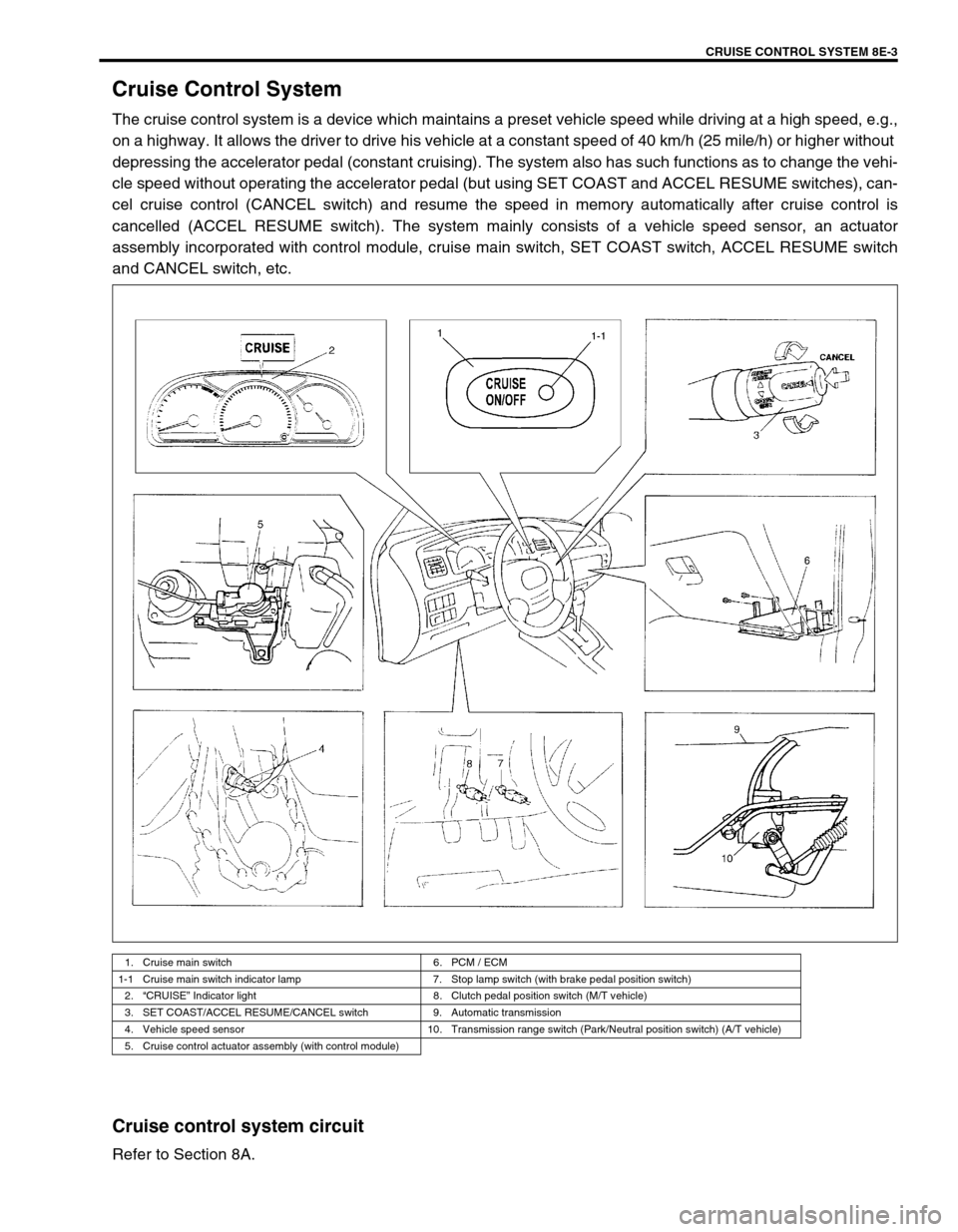
The cruise control system is a device which maintains a preset vehicle speed while driving at a high speed, e.g.,
on a highway. It allows the driver to drive his vehicle at a constant speed of 40 km/h (25 mile/h) or higher without
depressing the accelerator pedal (constant cruising). The system also has such functions as to change the vehi-
cle speed without operating the accelerator pedal (but using SET COAST and ACCEL RESUME switches), can-
cel cruise control (CANCEL switch) and resume the speed in memory automatically after cruise control is
cancelled (ACCEL RESUME switch). The system mainly consists of a vehicle speed sensor, an actuator
assembly incorporated with control module, cruise main switch, SET COAST switch, ACCEL RESUME switch
and CANCEL switch, etc.
Cruise control system circuit
Refer to Section 8A.
1. Cruise main switch 6. PCM / ECM
1-1 Cruise main switch indicator lamp 7. Stop lamp switch (with brake pedal position switch)
2.“CRUISE” Indicator light 8. Clutch pedal position switch (M/T vehicle)
3. SET COAST/ACCEL RESUME/CANCEL switch 9. Automatic transmission
4. Vehicle speed sensor 10. Transmission range switch (Park/Neutral position switch) (A/T vehicle)
5. Cruise control actuator assembly (with control module)
Page 525 of 656
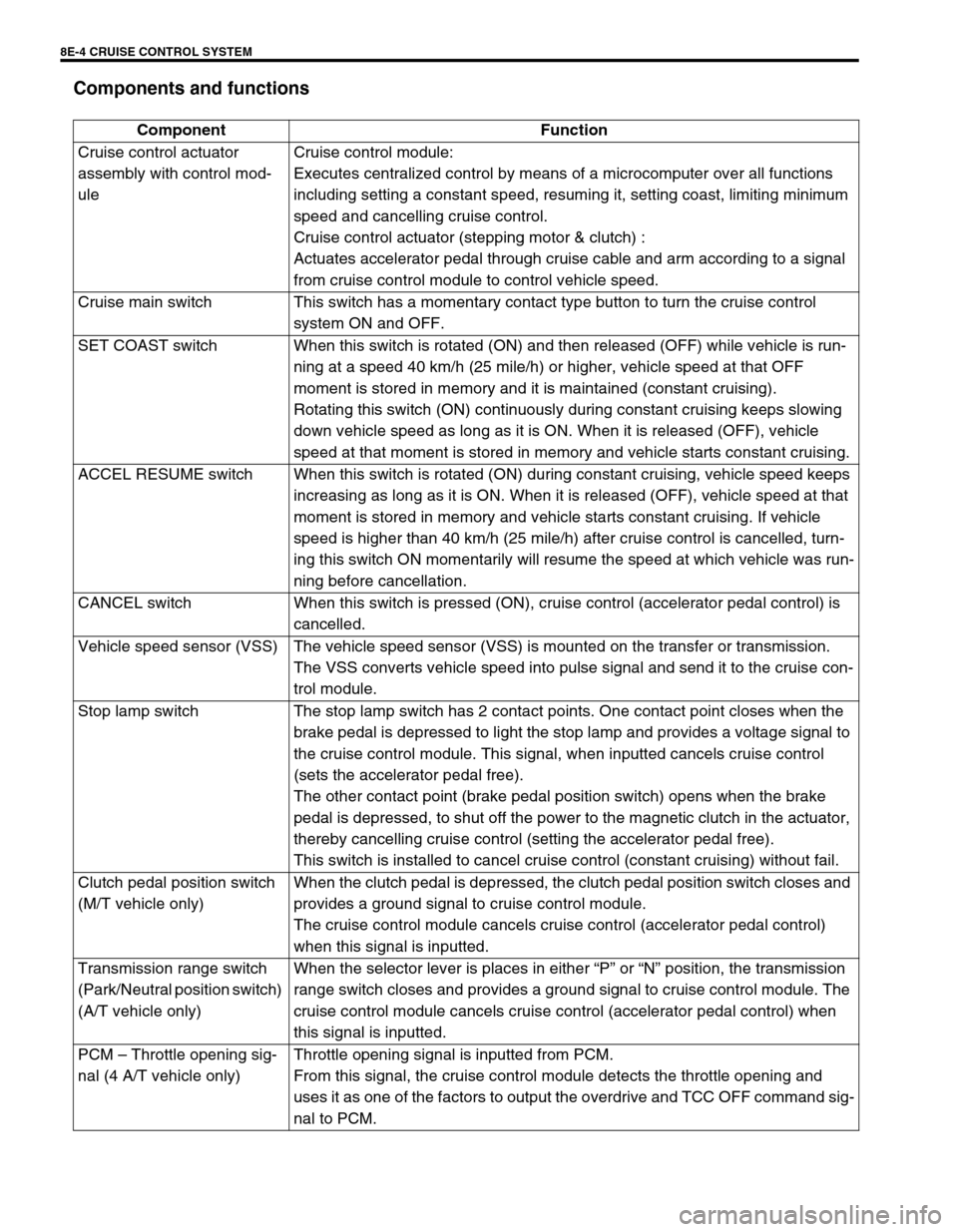
8E-4 CRUISE CONTROL SYSTEM
Components and functions
Component Function
Cruise control actuator
assembly with control mod-
uleCruise control module:
Executes centralized control by means of a microcomputer over all functions
including setting a constant speed, resuming it, setting coast, limiting minimum
speed and cancelling cruise control.
Cruise control actuator (stepping motor & clutch) :
Actuates accelerator pedal through cruise cable and arm according to a signal
from cruise control module to control vehicle speed.
Cruise main switch This switch has a momentary contact type button to turn the cruise control
system ON and OFF.
SET COAST switch When this switch is rotated (ON) and then released (OFF) while vehicle is run-
ning at a speed 40 km/h (25 mile/h) or higher, vehicle speed at that OFF
moment is stored in memory and it is maintained (constant cruising).
Rotating this switch (ON) continuously during constant cruising keeps slowing
down vehicle speed as long as it is ON. When it is released (OFF), vehicle
speed at that moment is stored in memory and vehicle starts constant cruising.
ACCEL RESUME switch When this switch is rotated (ON) during constant cruising, vehicle speed keeps
increasing as long as it is ON. When it is released (OFF), vehicle speed at that
moment is stored in memory and vehicle starts constant cruising. If vehicle
speed is higher than 40 km/h (25 mile/h) after cruise control is cancelled, turn-
ing this switch ON momentarily will resume the speed at which vehicle was run-
ning before cancellation.
CANCEL switch When this switch is pressed (ON), cruise control (accelerator pedal control) is
cancelled.
Vehicle speed sensor (VSS) The vehicle speed sensor (VSS) is mounted on the transfer or transmission.
The VSS converts vehicle speed into pulse signal and send it to the cruise con-
trol module.
Stop lamp switch The stop lamp switch has 2 contact points. One contact point closes when the
brake pedal is depressed to light the stop lamp and provides a voltage signal to
the cruise control module. This signal, when inputted cancels cruise control
(sets the accelerator pedal free).
The other contact point (brake pedal position switch) opens when the brake
pedal is depressed, to shut off the power to the magnetic clutch in the actuator,
thereby cancelling cruise control (setting the accelerator pedal free).
This switch is installed to cancel cruise control (constant cruising) without fail.
Clutch pedal position switch
(M/T vehicle only)When the clutch pedal is depressed, the clutch pedal position switch closes and
provides a ground signal to cruise control module.
The cruise control module cancels cruise control (accelerator pedal control)
when this signal is inputted.
Transmission range switch
(Park/Neutral position switch)
(A/T vehicle only)When the selector lever is places in either “P” or “N” position, the transmission
range switch closes and provides a ground signal to cruise control module. The
cruise control module cancels cruise control (accelerator pedal control) when
this signal is inputted.
PCM – Throttle opening sig-
nal (4 A/T vehicle only)Throttle opening signal is inputted from PCM.
From this signal, the cruise control module detects the throttle opening and
uses it as one of the factors to output the overdrive and TCC OFF command sig-
nal to PCM.