Transfer SUZUKI GRAND VITARA 1999 2.G User Guide
[x] Cancel search | Manufacturer: SUZUKI, Model Year: 1999, Model line: GRAND VITARA, Model: SUZUKI GRAND VITARA 1999 2.GPages: 656, PDF Size: 14.31 MB
Page 200 of 656
ENGINE GENERAL INFORMATION AND DIAGNOSIS (H27 ENGINE) 6-1-39
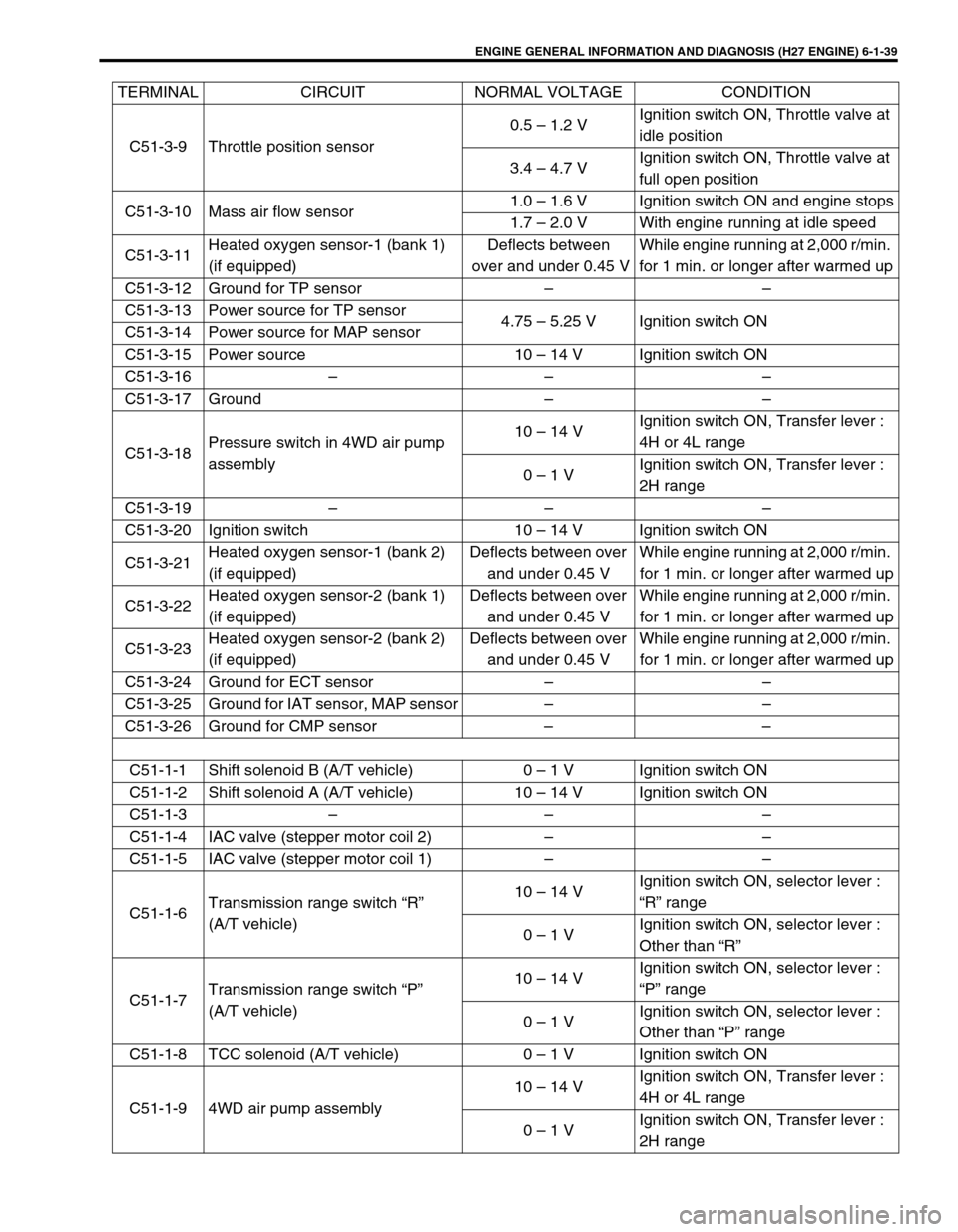
C51-3-9 Throttle position sensor0.5 – 1.2 VIgnition switch ON, Throttle valve at
idle position
3.4 – 4.7 VIgnition switch ON, Throttle valve at
full open position
C51-3-10 Mass air flow sensor1.0 – 1.6 V Ignition switch ON and engine stops
1.7 – 2.0 V With engine running at idle speed
C51-3-11Heated oxygen sensor-1 (bank 1)
(if equipped)Deflects between
over and under 0.45 VWhile engine running at 2,000 r/min.
for 1 min. or longer after warmed up
C51-3-12 Ground for TP sensor – –
C51-3-13 Power source for TP sensor
4.75 – 5.25 V Ignition switch ON
C51-3-14 Power source for MAP sensor
C51-3-15 Power source 10 – 14 V Ignition switch ON
C51-3-16 – – –
C51-3-17 Ground – –
C51-3-18Pressure switch in 4WD air pump
assembly10 – 14 VIgnition switch ON, Transfer lever :
4H or 4L range
0 – 1 VIgnition switch ON, Transfer lever :
2H range
C51-3-19 – – –
C51-3-20 Ignition switch 10 – 14 V Ignition switch ON
C51-3-21Heated oxygen sensor-1 (bank 2)
(if equipped)Deflects between over
and under 0.45 VWhile engine running at 2,000 r/min.
for 1 min. or longer after warmed up
C51-3-22Heated oxygen sensor-2 (bank 1)
(if equipped)Deflects between over
and under 0.45 VWhile engine running at 2,000 r/min.
for 1 min. or longer after warmed up
C51-3-23Heated oxygen sensor-2 (bank 2)
(if equipped)Deflects between over
and under 0.45 VWhile engine running at 2,000 r/min.
for 1 min. or longer after warmed up
C51-3-24 Ground for ECT sensor – –
C51-3-25 Ground for IAT sensor, MAP sensor – –
C51-3-26 Ground for CMP sensor – –
C51-1-1 Shift solenoid B (A/T vehicle) 0 – 1 V Ignition switch ON
C51-1-2 Shift solenoid A (A/T vehicle) 10 – 14 V Ignition switch ON
C51-1-3 – – –
C51-1-4 IAC valve (stepper motor coil 2) – –
C51-1-5 IAC valve (stepper motor coil 1) – –
C51-1-6Transmission range switch “R”
(A/T vehicle)10 – 14 VIgnition switch ON, selector lever :
“R” range
0 – 1 VIgnition switch ON, selector lever :
Other than “R”
C51-1-7Transmission range switch “P”
(A/T vehicle)10 – 14 VIgnition switch ON, selector lever :
“P” range
0 – 1 VIgnition switch ON, selector lever :
Other than “P” range
C51-1-8 TCC solenoid (A/T vehicle) 0 – 1 V Ignition switch ON
C51-1-9 4WD air pump assembly10 – 14 VIgnition switch ON, Transfer lever :
4H or 4L range
0 – 1 VIgnition switch ON, Transfer lever :
2H range TERMINAL CIRCUIT NORMAL VOLTAGE CONDITION
Page 201 of 656
6-1-40 ENGINE GENERAL INFORMATION AND DIAGNOSIS (H27 ENGINE)
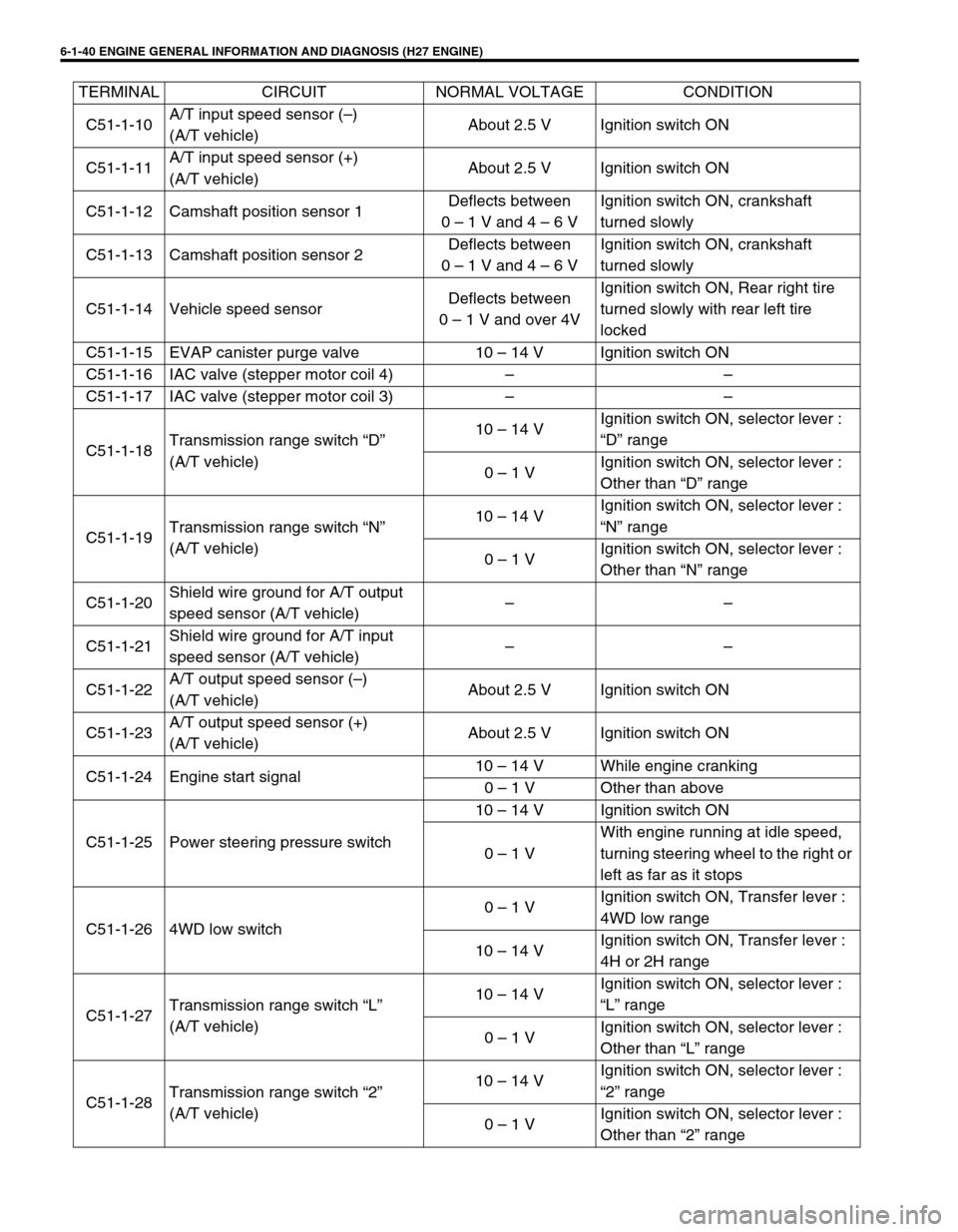
C51-1-10A/T input speed sensor (–)
(A/T vehicle)About 2.5 V Ignition switch ON
C51-1-11A/T input speed sensor (+)
(A/T vehicle)About 2.5 V Ignition switch ON
C51-1-12 Camshaft position sensor 1Deflects between
0 – 1 V and 4 – 6 VIgnition switch ON, crankshaft
turned slowly
C51-1-13 Camshaft position sensor 2Deflects between
0 – 1 V and 4 – 6 VIgnition switch ON, crankshaft
turned slowly
C51-1-14 Vehicle speed sensorDeflects between
0 – 1 V and over 4VIgnition switch ON, Rear right tire
turned slowly with rear left tire
locked
C51-1-15 EVAP canister purge valve 10 – 14 V Ignition switch ON
C51-1-16 IAC valve (stepper motor coil 4) – –
C51-1-17 IAC valve (stepper motor coil 3) – –
C51-1-18Transmission range switch “D”
(A/T vehicle)10 – 14 VIgnition switch ON, selector lever :
“D” range
0 – 1 VIgnition switch ON, selector lever :
Other than “D” range
C51-1-19Transmission range switch “N”
(A/T vehicle)10 – 14 VIgnition switch ON, selector lever :
“N” range
0 – 1 VIgnition switch ON, selector lever :
Other than “N” range
C51-1-20Shield wire ground for A/T output
speed sensor (A/T vehicle)––
C51-1-21Shield wire ground for A/T input
speed sensor (A/T vehicle)––
C51-1-22A/T output speed sensor (–)
(A/T vehicle)About 2.5 V Ignition switch ON
C51-1-23A/T output speed sensor (+)
(A/T vehicle)About 2.5 V Ignition switch ON
C51-1-24 Engine start signal10 – 14 V While engine cranking
0 – 1 V Other than above
C51-1-25 Power steering pressure switch10 – 14 V Ignition switch ON
0 – 1 VWith engine running at idle speed,
turning steering wheel to the right or
left as far as it stops
C51-1-26 4WD low switch0 – 1 VIgnition switch ON, Transfer lever :
4WD low range
10 – 14 VIgnition switch ON, Transfer lever :
4H or 2H range
C51-1-27Transmission range switch “L”
(A/T vehicle)10 – 14 VIgnition switch ON, selector lever :
“L” range
0 – 1 VIgnition switch ON, selector lever :
Other than “L” range
C51-1-28Transmission range switch “2”
(A/T vehicle)10 – 14 VIgnition switch ON, selector lever :
“2” range
0 – 1 VIgnition switch ON, selector lever :
Other than “2” range TERMINAL CIRCUIT NORMAL VOLTAGE CONDITION
Page 261 of 656
6-1-100 ENGINE GENERAL INFORMATION AND DIAGNOSIS (H27 ENGINE)
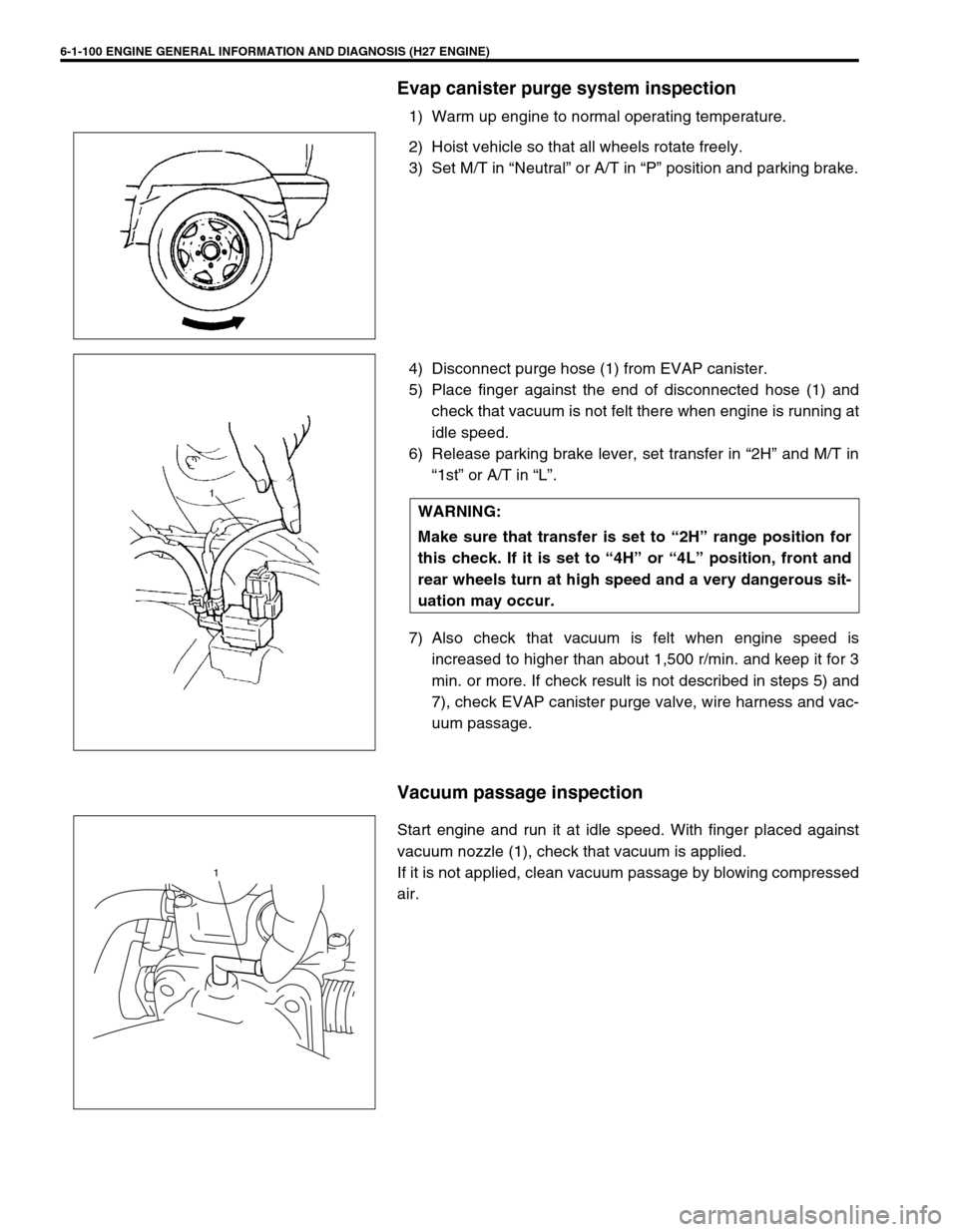
Evap canister purge system inspection
1) Warm up engine to normal operating temperature.
2) Hoist vehicle so that all wheels rotate freely.
3) Set M/T in “Neutral” or A/T in “P” position and parking brake.
4) Disconnect purge hose (1) from EVAP canister.
5) Place finger against the end of disconnected hose (1) and
check that vacuum is not felt there when engine is running at
idle speed.
6) Release parking brake lever, set transfer in “2H” and M/T in
“1st” or A/T in “L”.
7) Also check that vacuum is felt when engine speed is
increased to higher than about 1,500 r/min. and keep it for 3
min. or more. If check result is not described in steps 5) and
7), check EVAP canister purge valve, wire harness and vac-
uum passage.
Vacuum passage inspection
Start engine and run it at idle speed. With finger placed against
vacuum nozzle (1), check that vacuum is applied.
If it is not applied, clean vacuum passage by blowing compressed
air.
WARNING:
Make sure that transfer is set to “2H” range position for
this check. If it is set to “4H” or “4L” position, front and
rear wheels turn at high speed and a very dangerous sit-
uation may occur.
1
Page 268 of 656
![SUZUKI GRAND VITARA 1999 2.G User Guide ENGINE GENERAL INFORMATION AND DIAGNOSIS (H27 ENGINE) 6-1-107
[A] Fig. for Step 3 / [B] Fig. for Step 4, 6, 7
Fig. for Step 55 VSS visual inspection:
1) Remove VSS referring to “TRANSFER”
section](/img/20/7583/w960_7583-267.png "SUZUKI GRAND VITARA 1999 2.G User Guide ENGINE GENERAL INFORMATION AND DIAGNOSIS (H27 ENGINE) 6-1-107
[A] Fig. for Step 3 / [B] Fig. for Step 4, 6, 7
Fig. for Step 55 VSS visual inspection:
1) Remove VSS referring to “TRANSFER”
section")
ENGINE GENERAL INFORMATION AND DIAGNOSIS (H27 ENGINE) 6-1-107
[A] Fig. for Step 3 / [B] Fig. for Step 4, 6, 7
Fig. for Step 55 VSS visual inspection:
1) Remove VSS referring to “TRANSFER”
section.
2) Check VSS drive and driven gears for
damage and excessive wear.
Are they in good condition?Poor VSS connection or VSS
malfunction.
If connection is OK, substi-
tute a known-good VSS and
recheck.Replace VSS.
6 Speedometer circuit check:
1) With ignition switch OFF, disconnect
G11 coupler from combination meter.
2) With ignition switch ON leaving engine
OFF, check voltage between C20-1 and
C20-2 terminal of VSS coupler.
Is voltage 4 V or more?Substitute a known-good
combination meter and
recheck.Go to Step 7.
7 Cruise control module circuit check (if
equipped):
1) With ignition switch OFF, disconnect
E132 coupler from cruise control mod-
ule.
2) With ignition switch ON leaving engine
OFF, check voltage between C20-1 and
C20-2 terminal of VSS coupler.
Is voltage 4 V or more?Substitute a known-good
cruise control module and
recheck.“BLU/YEL” wire open/
short or faulty ECM
(PCM).
If wire and connection are
OK, substitute a known-
good ECM (PCM) and
recheck.
1. VSS coupler
2.“BLU/YEL” (C20-1) terminal
3.“BLK/YEL” (C20-2) terminal
4.“BLU/BLK” (C20-3) terminal
Step Action Yes No
1. VSS coupler
2. VSS driven gear
3. VSS drive gear
Page 372 of 656
ENGINE AND EMISSION CONTROL SYSTEM (SEQUENTIAL MULTIPORT FUEL INJECTION FOR H27 ENGINE) 6E2-39
HEATER INSPECTION
Refer to “HEATED OXYGEN SENSOR (SENSOR 1) HEATER
INSPECTION”
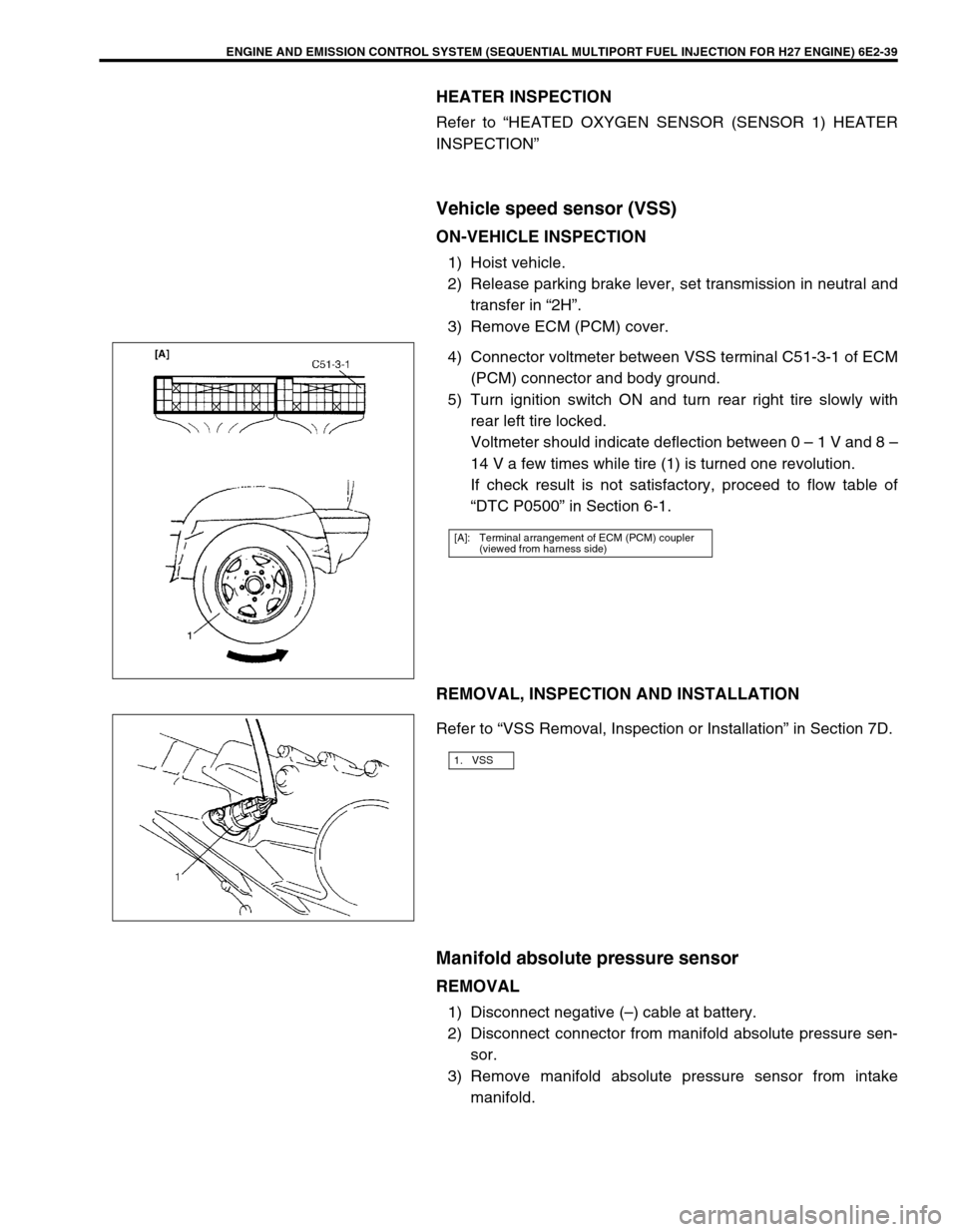
Vehicle speed sensor (VSS)
ON-VEHICLE INSPECTION
1) Hoist vehicle.
2) Release parking brake lever, set transmission in neutral and
transfer in “2H”.
3) Remove ECM (PCM) cover.
4) Connector voltmeter between VSS terminal C51-3-1 of ECM
(PCM) connector and body ground.
5) Turn ignition switch ON and turn rear right tire slowly with
rear left tire locked.
Voltmeter should indicate deflection between 0 – 1 V and 8 –
14 V a few times while tire (1) is turned one revolution.
If check result is not satisfactory, proceed to flow table of
“DTC P0500” in Section 6-1.
REMOVAL, INSPECTION AND INSTALLATION
Refer to “VSS Removal, Inspection or Installation” in Section 7D.
Manifold absolute pressure sensor
REMOVAL
1) Disconnect negative (–) cable at battery.
2) Disconnect connector from manifold absolute pressure sen-
sor.
3) Remove manifold absolute pressure sensor from intake
manifold.
[A]: Terminal arrangement of ECM (PCM) coupler
(viewed from harness side)
1. VSS
Page 412 of 656
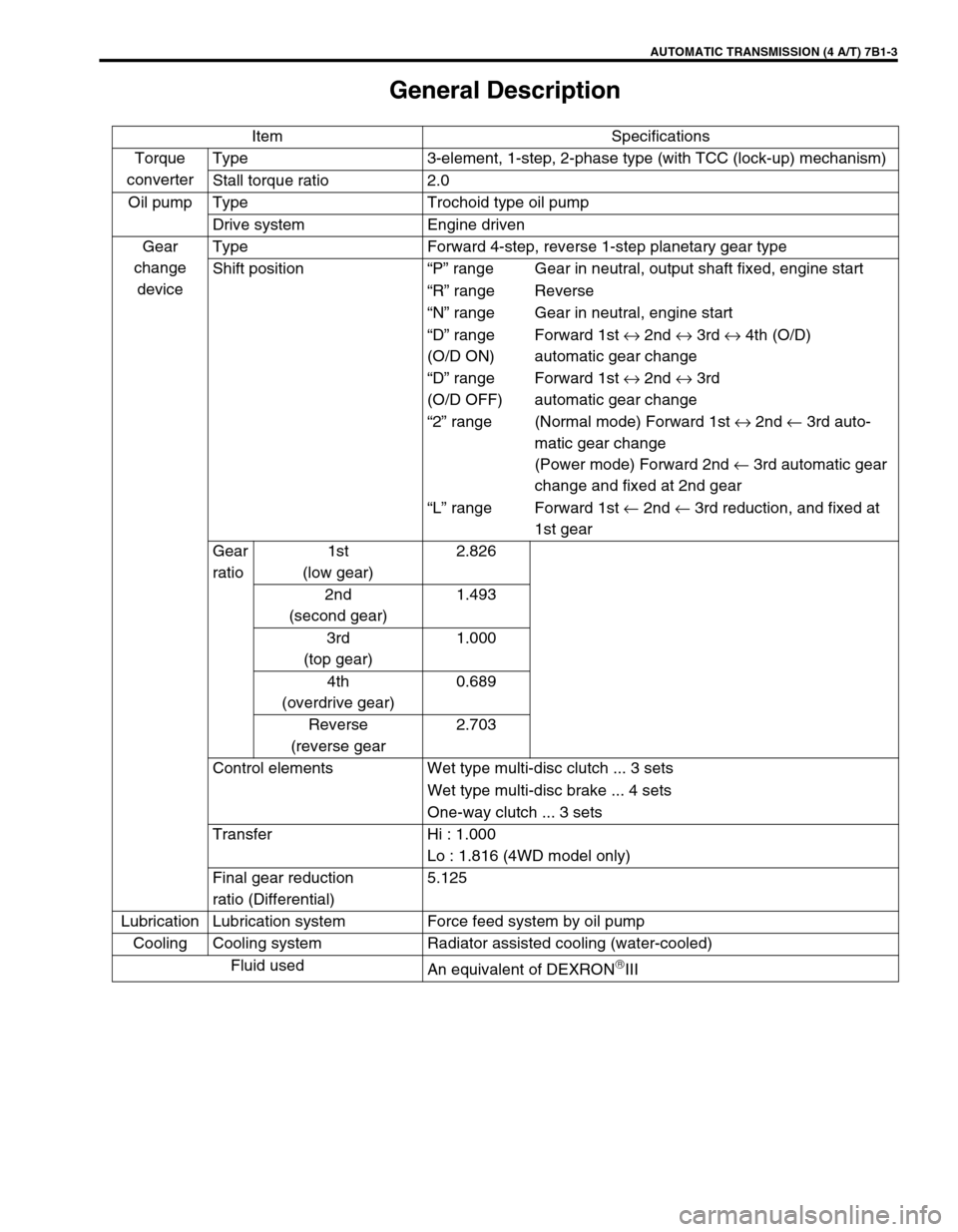
AUTOMATIC TRANSMISSION (4 A/T) 7B1-3
General Description
Item Specifications
Torque
converterType 3-element, 1-step, 2-phase type (with TCC (lock-up) mechanism)
Stall torque ratio 2.0
Oil pump Type Trochoid type oil pump
Drive system Engine driven
Gear
change
deviceType Forward 4-step, reverse 1-step planetary gear type
Shift position“P” range Gear in neutral, output shaft fixed, engine start
“R” range Reverse
“N” range Gear in neutral, engine start
“D” range
(O/D ON)Forward 1st ↔ 2nd ↔ 3rd ↔ 4th (O/D)
automatic gear change
“D” range
(O/D OFF)Forward 1st ↔ 2nd ↔ 3rd
automatic gear change
“2” range (Normal mode) Forward 1st ↔ 2nd ← 3rd auto-
matic gear change
(Power mode) Forward 2nd ← 3rd automatic gear
change and fixed at 2nd gear
“L” range Forward 1st ← 2nd ← 3rd reduction, and fixed at
1st gear
Gear
ratio1st
(low gear)2.826
2nd
(second gear)1.493
3rd
(top gear)1.000
4th
(overdrive gear)0.689
Reverse
(reverse gear2.703
Control elements Wet type multi-disc clutch ... 3 sets
Wet type multi-disc brake ... 4 sets
One-way clutch ... 3 sets
Transfer Hi : 1.000
Lo : 1.816 (4WD model only)
Final gear reduction
ratio (Differential)5.125
Lubrication Lubrication system Force feed system by oil pump
Cooling Cooling system Radiator assisted cooling (water-cooled)
Fluid used
An equivalent of DEXRON
III
Page 427 of 656
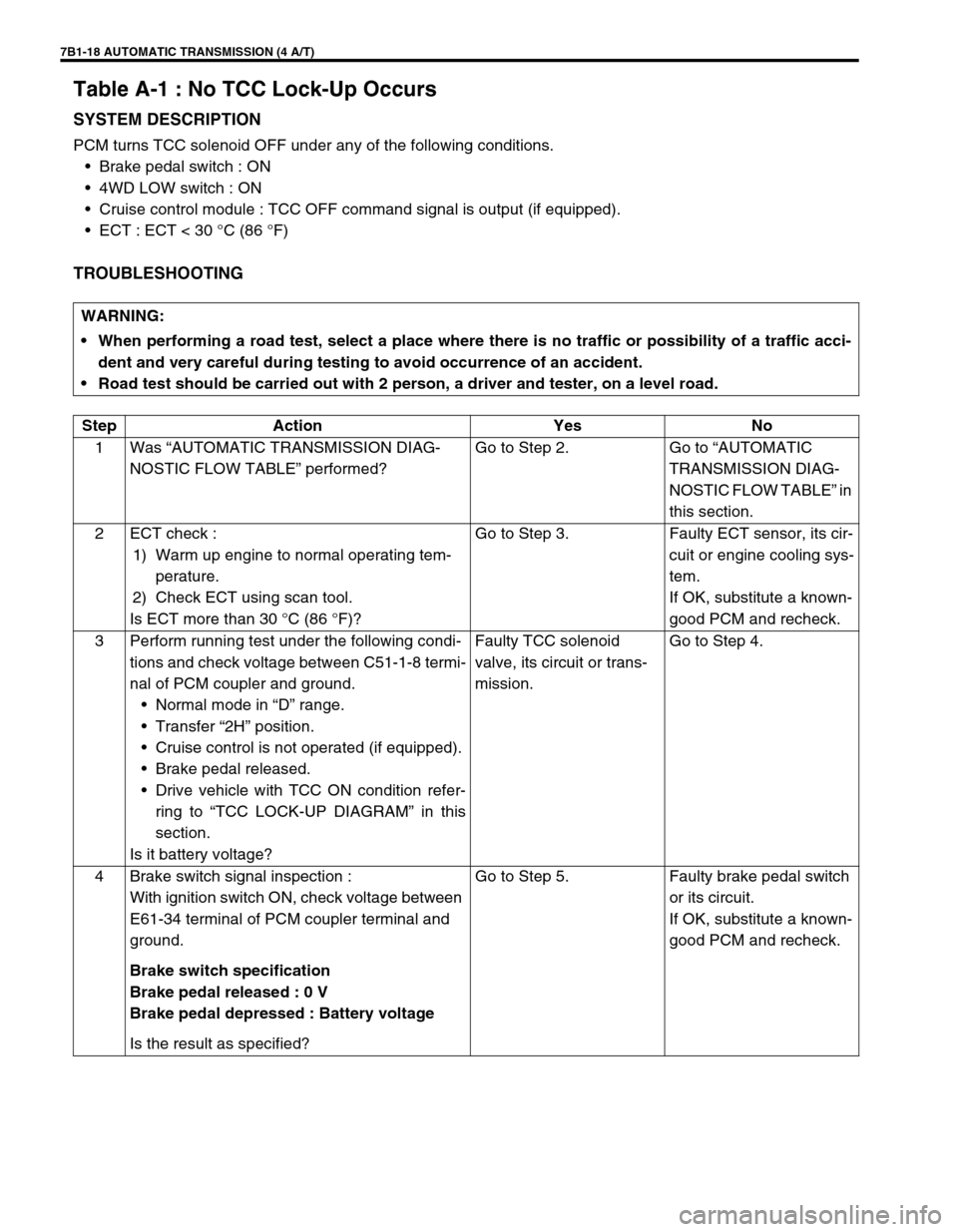
7B1-18 AUTOMATIC TRANSMISSION (4 A/T)
Table A-1 : No TCC Lock-Up Occurs
SYSTEM DESCRIPTION
PCM turns TCC solenoid OFF under any of the following conditions.
•Brake pedal switch : ON
•4WD LOW switch : ON
•Cruise control module : TCC OFF command signal is output (if equipped).
•ECT : ECT < 30 °C (86 °F)
TROUBLESHOOTING
WARNING:
When performing a road test, select a place where there is no traffic or possibility of a traffic acci-
dent and very careful during testing to avoid occurrence of an accident.
Road test should be carried out with 2 person, a driver and tester, on a level road.
Step Action Yes No
1Was “AUTOMATIC TRANSMISSION DIAG-
NOSTIC FLOW TABLE” performed?Go to Step 2. Go to “AUTOMATIC
TRANSMISSION DIAG-
NOSTIC FLOW TABLE” in
this section.
2 ECT check :
1) Warm up engine to normal operating tem-
perature.
2) Check ECT using scan tool.
Is ECT more than 30 °C (86 °F)?Go to Step 3. Faulty ECT sensor, its cir-
cuit or engine cooling sys-
tem.
If OK, substitute a known-
good PCM and recheck.
3 Perform running test under the following condi-
tions and check voltage between C51-1-8 termi-
nal of PCM coupler and ground.
•Normal mode in “D” range.
•Transfer “2H” position.
•Cruise control is not operated (if equipped).
•Brake pedal released.
•Drive vehicle with TCC ON condition refer-
ring to “TCC LOCK-UP DIAGRAM” in this
section.
Is it battery voltage?Faulty TCC solenoid
valve, its circuit or trans-
mission.Go to Step 4.
4 Brake switch signal inspection :
With ignition switch ON, check voltage between
E61-34 terminal of PCM coupler terminal and
ground.
Brake switch specification
Brake pedal released : 0 V
Brake pedal depressed : Battery voltage
Is the result as specified?Go to Step 5. Faulty brake pedal switch
or its circuit.
If OK, substitute a known-
good PCM and recheck.
Page 428 of 656
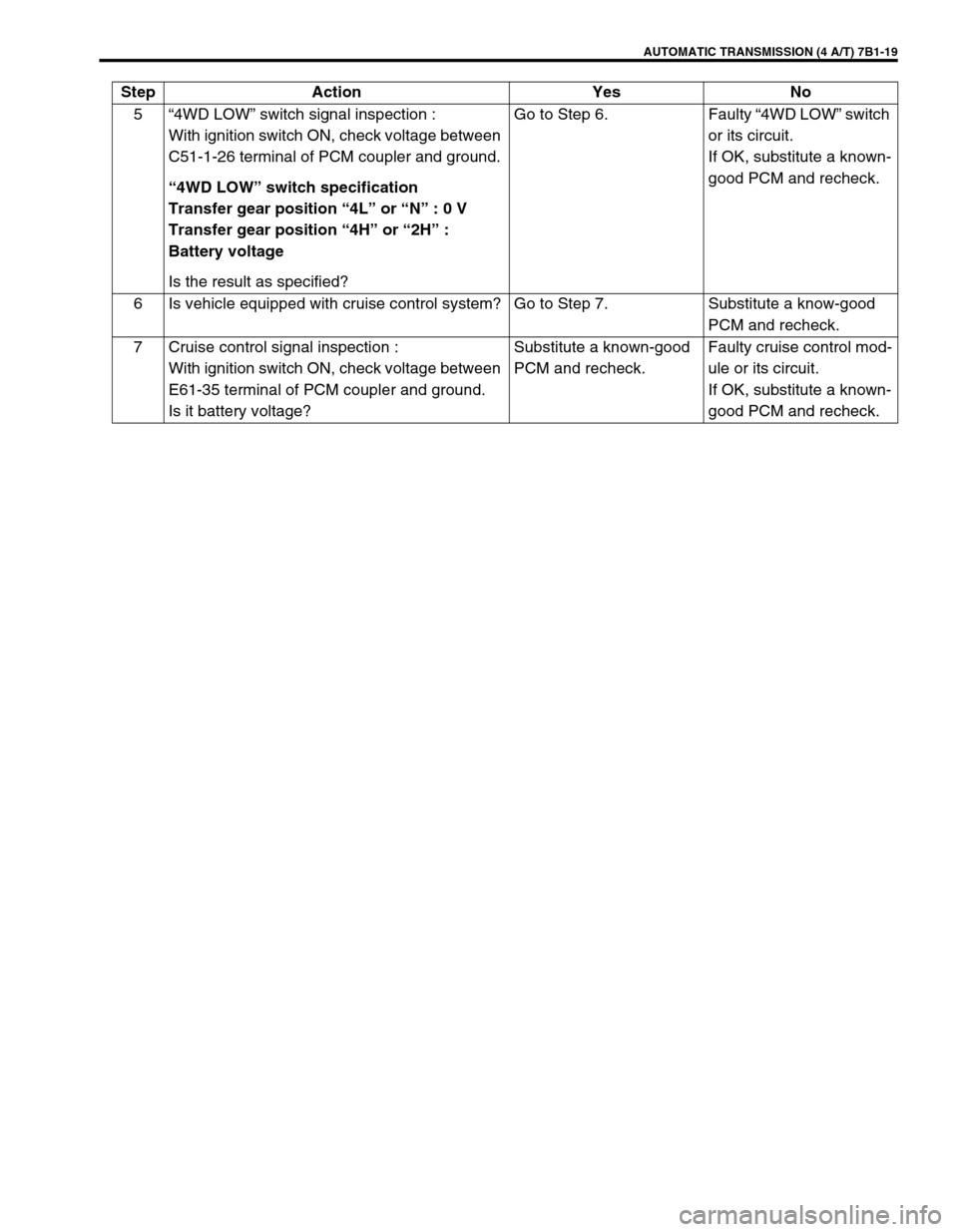
AUTOMATIC TRANSMISSION (4 A/T) 7B1-19
5“4WD LOW” switch signal inspection :
With ignition switch ON, check voltage between
C51-1-26 terminal of PCM coupler and ground.
“4WD LOW” switch specification
Transfer gear position “4L” or “N” : 0 V
Transfer gear position “4H” or “2H” :
Battery voltage
Is the result as specified?Go to Step 6. Faulty “4WD LOW” switch
or its circuit.
If OK, substitute a known-
good PCM and recheck.
6 Is vehicle equipped with cruise control system? Go to Step 7. Substitute a know-good
PCM and recheck.
7 Cruise control signal inspection :
With ignition switch ON, check voltage between
E61-35 terminal of PCM coupler and ground.
Is it battery voltage?Substitute a known-good
PCM and recheck.Faulty cruise control mod-
ule or its circuit.
If OK, substitute a known-
good PCM and recheck. Step Action Yes No
Page 429 of 656
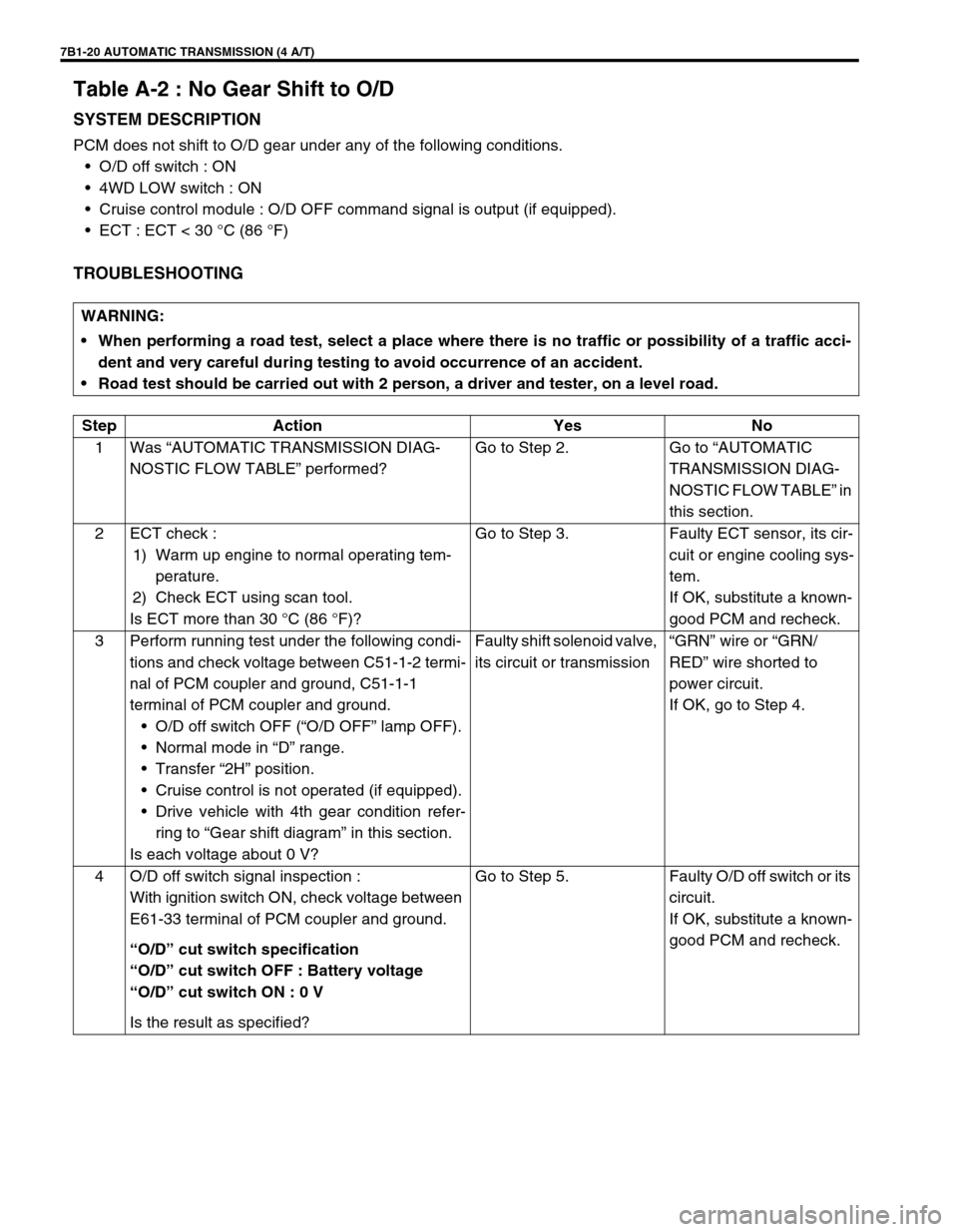
7B1-20 AUTOMATIC TRANSMISSION (4 A/T)
Table A-2 : No Gear Shift to O/D
SYSTEM DESCRIPTION
PCM does not shift to O/D gear under any of the following conditions.
•O/D off switch : ON
•4WD LOW switch : ON
•Cruise control module : O/D OFF command signal is output (if equipped).
•ECT : ECT < 30 °C (86 °F)
TROUBLESHOOTING
WARNING:
When performing a road test, select a place where there is no traffic or possibility of a traffic acci-
dent and very careful during testing to avoid occurrence of an accident.
Road test should be carried out with 2 person, a driver and tester, on a level road.
Step Action Yes No
1Was “AUTOMATIC TRANSMISSION DIAG-
NOSTIC FLOW TABLE” performed?Go to Step 2. Go to “AUTOMATIC
TRANSMISSION DIAG-
NOSTIC FLOW TABLE” in
this section.
2 ECT check :
1) Warm up engine to normal operating tem-
perature.
2) Check ECT using scan tool.
Is ECT more than 30 °C (86 °F)?Go to Step 3. Faulty ECT sensor, its cir-
cuit or engine cooling sys-
tem.
If OK, substitute a known-
good PCM and recheck.
3 Perform running test under the following condi-
tions and check voltage between C51-1-2 termi-
nal of PCM coupler and ground, C51-1-1
terminal of PCM coupler and ground.
•O/D off switch OFF (“O/D OFF” lamp OFF).
•Normal mode in “D” range.
•Transfer “2H” position.
•Cruise control is not operated (if equipped).
•Drive vehicle with 4th gear condition refer-
ring to “Gear shift diagram” in this section.
Is each voltage about 0 V?Faulty shift solenoid valve,
its circuit or transmission“GRN” wire or “GRN/
RED” wire shorted to
power circuit.
If OK, go to Step 4.
4 O/D off switch signal inspection :
With ignition switch ON, check voltage between
E61-33 terminal of PCM coupler and ground.
“O/D” cut switch specification
“O/D” cut switch OFF : Battery voltage
“O/D” cut switch ON : 0 V
Is the result as specified?Go to Step 5. Faulty O/D off switch or its
circuit.
If OK, substitute a known-
good PCM and recheck.
Page 430 of 656
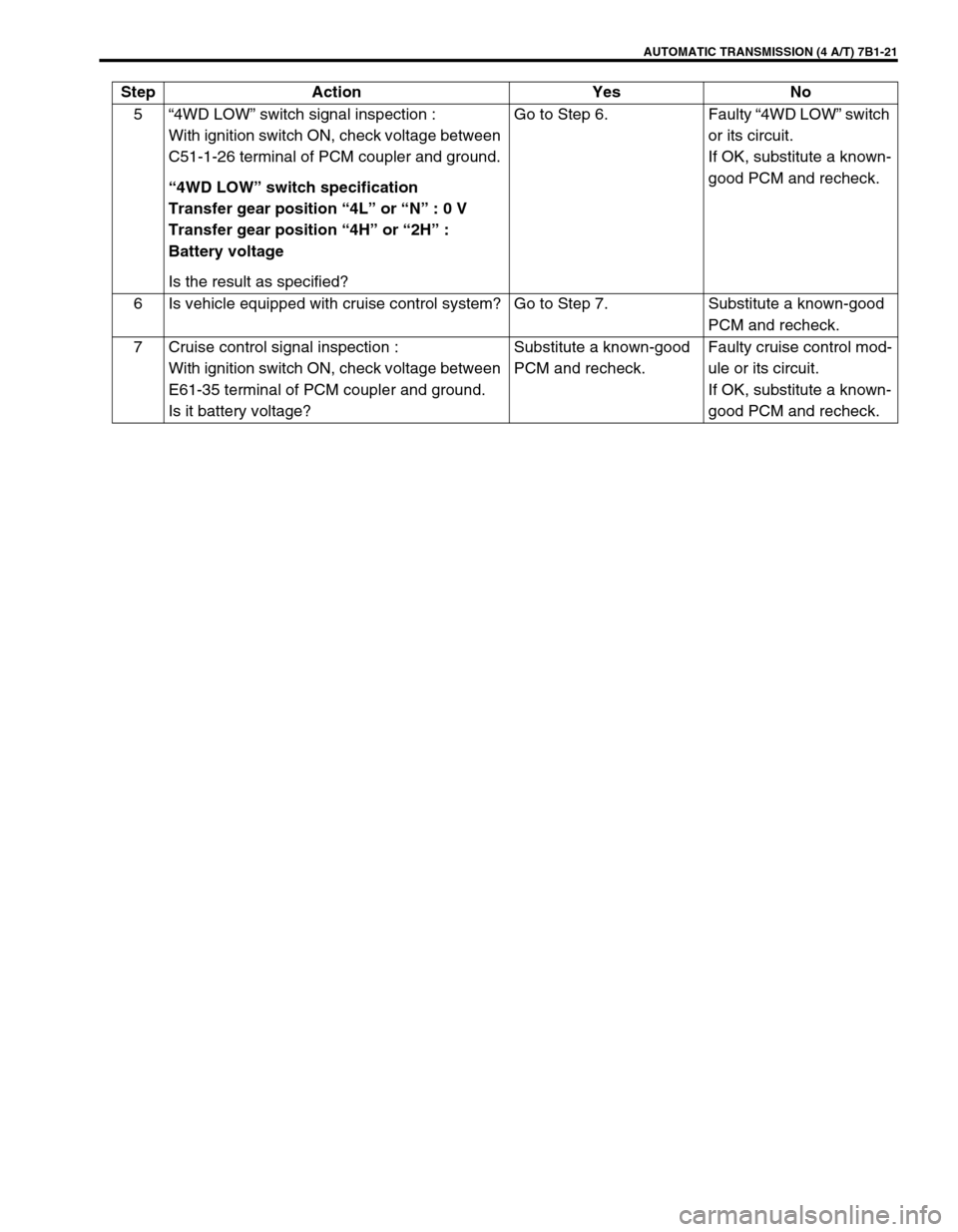
AUTOMATIC TRANSMISSION (4 A/T) 7B1-21
5“4WD LOW” switch signal inspection :
With ignition switch ON, check voltage between
C51-1-26 terminal of PCM coupler and ground.
“4WD LOW” switch specification
Transfer gear position “4L” or “N” : 0 V
Transfer gear position “4H” or “2H” :
Battery voltage
Is the result as specified?Go to Step 6. Faulty “4WD LOW” switch
or its circuit.
If OK, substitute a known-
good PCM and recheck.
6 Is vehicle equipped with cruise control system? Go to Step 7. Substitute a known-good
PCM and recheck.
7 Cruise control signal inspection :
With ignition switch ON, check voltage between
E61-35 terminal of PCM coupler and ground.
Is it battery voltage?Substitute a known-good
PCM and recheck.Faulty cruise control mod-
ule or its circuit.
If OK, substitute a known-
good PCM and recheck. Step Action Yes No