switch SUZUKI GRAND VITARA 1999 2.G Owners Manual
[x] Cancel search | Manufacturer: SUZUKI, Model Year: 1999, Model line: GRAND VITARA, Model: SUZUKI GRAND VITARA 1999 2.GPages: 656, PDF Size: 14.31 MB
Page 633 of 656
10B-56 AIR BAG SYSTEM
Repairs and Inspections Required after an Accident
Accident with deployment/activation - component replacement
Certain air bag system components must be replaced. Those components are:
•Driver and passenger air bag (inflator) modules
–Replace with new one.
•Driver and Passenger seat belt pretensioners
–Replace with new one.
•SDM after detecting such collision as to meet deployment conditions
–Replace with new one.
•Forward sensors
–Replace with new one. CAUTION:
All air bag system components, including the electrical harness (component mounting points),
must be inspected after an accident. If any components are damaged or bent, they must be replaced
even if air bag system activation did not occur.
Never use air bag system parts from another vehicle.
Do not attempt to service the parts below. Service of these parts is by replacement only.
–Driver/Passenger air bag (inflator) modules, Driver/Passenger seat belt pretensioners
–Forward sensors
–SDM
–Contact coil and combination switch assembly
–Air bag wire harness
Proper operation of the sensors and air bag system requires that any repairs to the vehicle struc-
ture return it to its original production configuration.
CAUTION:
After detecting one time of such collision as to meet deployment conditions, the SDM must not be
used.
Refer to “AIR BAG DIAGNOSTIC SYSTEM CHECK” when checking the SDM.
Page 634 of 656
AIR BAG SYSTEM 10B-57
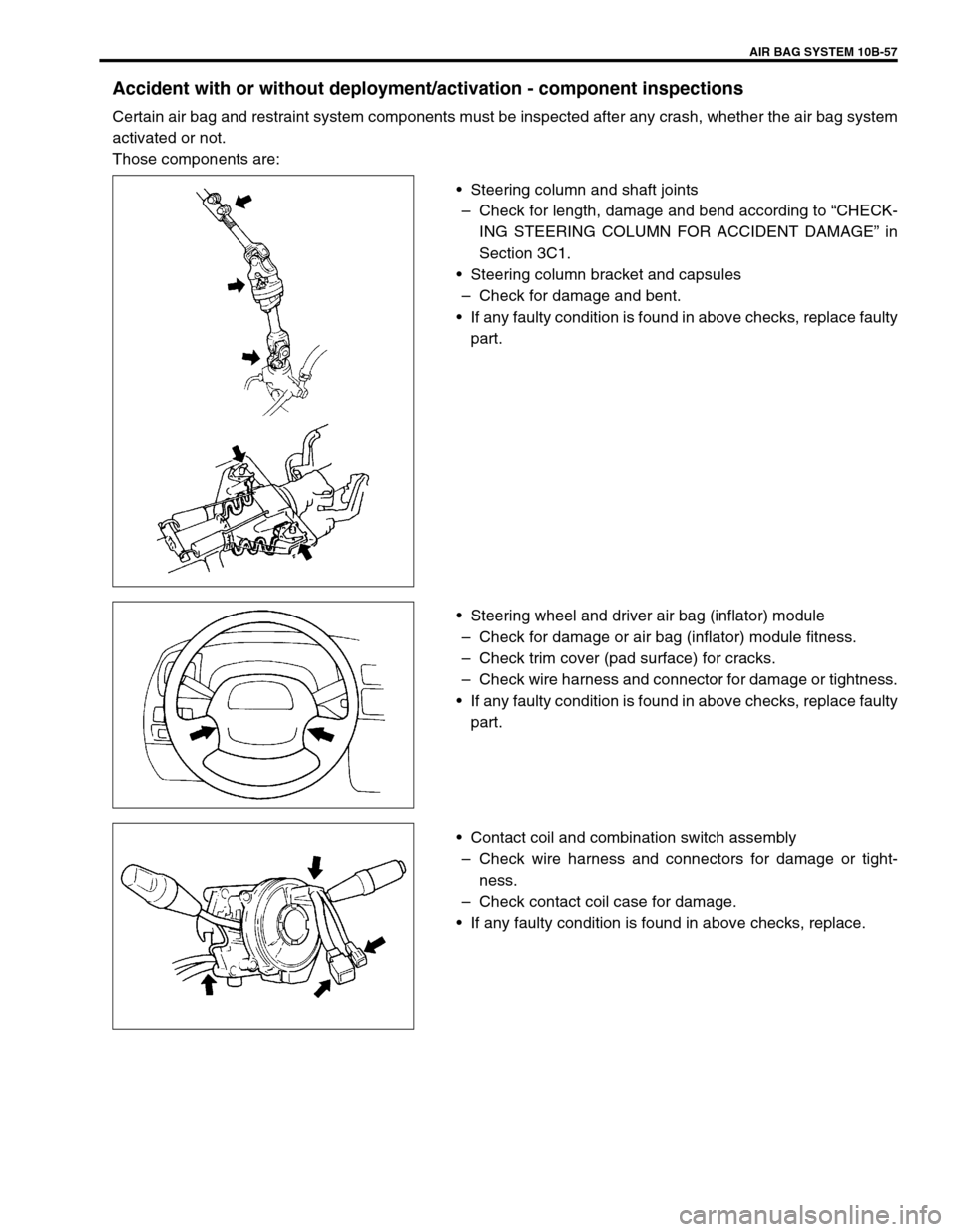
Accident with or without deployment/activation - component inspections
Certain air bag and restraint system components must be inspected after any crash, whether the air bag system
activated or not.
Those components are:
•Steering column and shaft joints
–Check for length, damage and bend according to “CHECK-
ING STEERING COLUMN FOR ACCIDENT DAMAGE” in
Section 3C1.
•Steering column bracket and capsules
–Check for damage and bent.
•If any faulty condition is found in above checks, replace faulty
part.
•Steering wheel and driver air bag (inflator) module
–Check for damage or air bag (inflator) module fitness.
–Check trim cover (pad surface) for cracks.
–Check wire harness and connector for damage or tightness.
•If any faulty condition is found in above checks, replace faulty
part.
•Contact coil and combination switch assembly
–Check wire harness and connectors for damage or tight-
ness.
–Check contact coil case for damage.
•If any faulty condition is found in above checks, replace.
Page 643 of 656
10B-66 AIR BAG SYSTEM
Deployment/Activation Outside Vehicle
Use this procedure when the vehicle itself is used again (only the
air bag (inflator) module(s) and seat belt pretensioner(s) are dis-
posed).
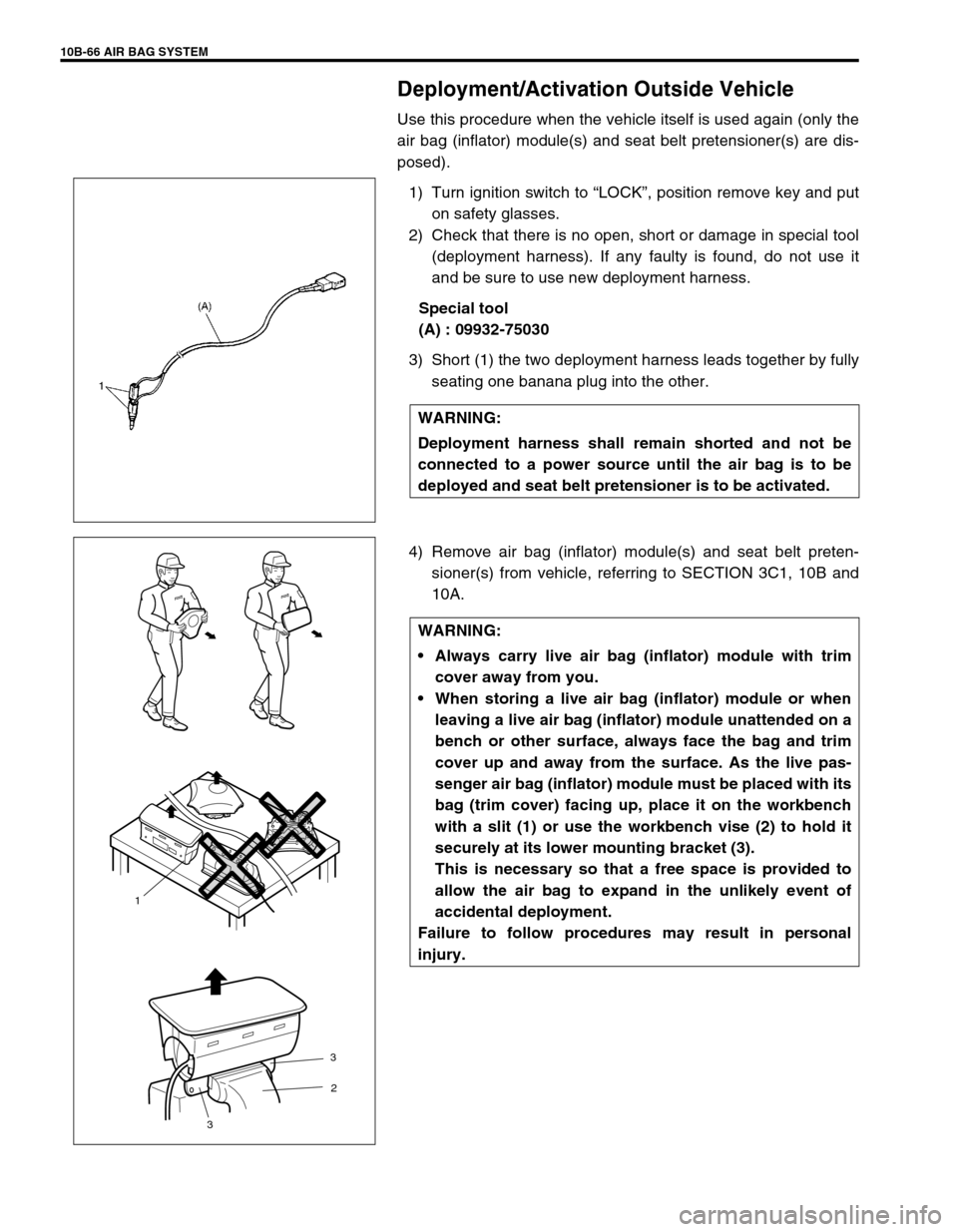
1) Turn ignition switch to “LOCK”, position remove key and put
on safety glasses.
2) Check that there is no open, short or damage in special tool
(deployment harness). If any faulty is found, do not use it
and be sure to use new deployment harness.
Special tool
(A) : 09932-75030
3) Short (1) the two deployment harness leads together by fully
seating one banana plug into the other.
4) Remove air bag (inflator) module(s) and seat belt preten-
sioner(s) from vehicle, referring to SECTION 3C1, 10B and
10A. WARNING:
Deployment harness shall remain shorted and not be
connected to a power source until the air bag is to be
deployed and seat belt pretensioner is to be activated.
WARNING:
Always carry live air bag (inflator) module with trim
cover away from you.
When storing a live air bag (inflator) module or when
leaving a live air bag (inflator) module unattended on a
bench or other surface, always face the bag and trim
cover up and away from the surface. As the live pas-
senger air bag (inflator) module must be placed with its
bag (trim cover) facing up, place it on the workbench
with a slit (1) or use the workbench vise (2) to hold it
securely at its lower mounting bracket (3).
This is necessary so that a free space is provided to
allow the air bag to expand in the unlikely event of
accidental deployment.
Failure to follow procedures may result in personal
injury.
1
3
32
Page 649 of 656
10B-72 AIR BAG SYSTEM
Deployment/Activation Inside Vehicle
Use this procedure when scrapping the entire vehicle including
the air bag (inflator) modules and seat belt pretensioners.
1) Turn ignition switch to “LOCK” position, remove key and put
on safety glasses.
2) Remove all loose objects from front seats and instrument
panel.
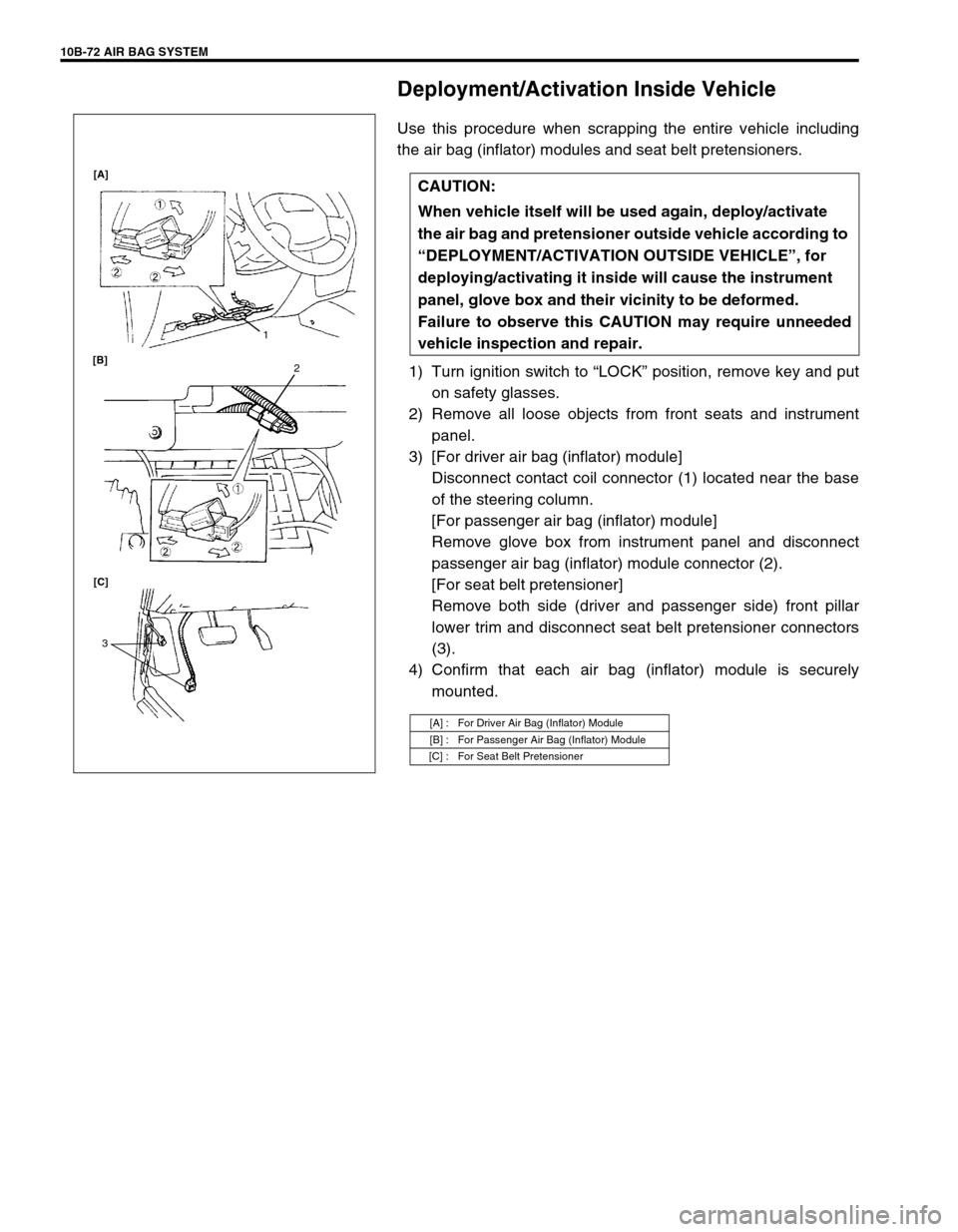
3) [For driver air bag (inflator) module]
Disconnect contact coil connector (1) located near the base
of the steering column.
[For passenger air bag (inflator) module]
Remove glove box from instrument panel and disconnect
passenger air bag (inflator) module connector (2).
[For seat belt pretensioner]
Remove both side (driver and passenger side) front pillar
lower trim and disconnect seat belt pretensioner connectors
(3).
4) Confirm that each air bag (inflator) module is securely
mounted. CAUTION:
When vehicle itself will be used again, deploy/activate
the air bag and pretensioner outside vehicle according to
“DEPLOYMENT/ACTIVATION OUTSIDE VEHICLE”, for
deploying/activating it inside will cause the instrument
panel, glove box and their vicinity to be deformed.
Failure to observe this CAUTION may require unneeded
vehicle inspection and repair.
[A] : For Driver Air Bag (Inflator) Module
[B] : For Passenger Air Bag (Inflator) Module
[C] : For Seat Belt Pretensioner
[A]
[B]
[C]
1
2
3