Switch light SUZUKI GRAND VITARA 1999 2.G Owner's Manual
[x] Cancel search | Manufacturer: SUZUKI, Model Year: 1999, Model line: GRAND VITARA, Model: SUZUKI GRAND VITARA 1999 2.GPages: 656, PDF Size: 14.31 MB
Page 410 of 656
AUTOMATIC TRANSMISSION (4 A/T) 7B1-1
7B1
SECTION 7B1
AUTOMATIC TRANSMISSION (4 A/T)
CONTENTS
General Description ......................................7B1-3
Electronic Shift Control System ................... 7B1-4
Automatic gear shift diagram................... 7B1-5
Diagnosis .......................................................7B1-7
On-Board Diagnostic System
(Vehicle without monitor connector) ............ 7B1-7
On-Board Diagnostic System
(Vehicle with monitor connector) ................. 7B1-8
Precaution in Diagnosing Trouble ............... 7B1-9
Automatic Transmission Diagnostic Flow
Table ......................................................... 7B1-10
Malfunction Indicator Lamp (MIL) Check... 7B1-13
“O/D OFF” Lamp Check ............................ 7B1-13
“POWER” Lamp Check ............................. 7B1-13
Diagnostic Trouble Code (DTC) Check ..... 7B1-13
Diagnostic Trouble Code Clearance ......... 7B1-13
Diagnostic Trouble Code Table ................. 7B1-14
Fail Safe Table .......................................... 7B1-14
Visual Inspection ....................................... 7B1-14
A/T Basic Check ........................................ 7B1-14
Trouble Diagnosis Table 1 ........................ 7B1-15
Trouble Diagnosis Table 2 ........................ 7B1-15
Trouble Diagnosis Table 3 ........................ 7B1-16
Scan Tool Data ......................................... 7B1-17
Inspection of PCM and Its Circuit .............. 7B1-17Wire Harness and Connectors .................. 7B1-17
Table A-1 : No TCC Lock-Up Occurs ........ 7B1-18
Table A-2 : No Gear Shift to O/D .............. 7B1-20
Table B-1 : “O/D OFF” Light Circuit Check
(“O/D OFF” Light Doesn’t Light at Ignition
Switch ON But Engine Starts Up) ............. 7B1-22
Table B-2 : “O/D OFF” Light Circuit Check
(“O/D OFF” Light Comes ON Steadily) ..... 7B1-23
Table B-3 : “POWER” Light Circuit Check
(“POWER” Light Doesn’t Light at Ignition
Switch ON But Engine Starts Up) ............. 7B1-24
Table B-4 : “POWER” Light Circuit Check
(“POWER” Light Comes ON Steadily) ...... 7B1-25
DTC P0705 (DTC NO.72) - Transmission
Range Sensor (Switch) Circuit Malfunction7B1-26
DTC P0715 (DTC NO.76) - Input/Turbine
Speed Sensor Circuit Malfunction............. 7B1-29
DTC P0720 (DTC NO.75) Output Speed
Sensor Circuit Malfunction ........................ 7B1-32
DTC P0743 (DTC NO.65/66) -
TCC (Lock-Up) Solenoid Electrical ........... 7B1-34
DTC P0753 (DTC NO.61/62)
Shift Solenoid-A (#1) Electrical
DTC P0758 (DTC NO.63/64)
Shift Solenoid-B (#2) Electrical ................. 7B1-36 WARNING:
For vehicles equipped with Supplemental Restraint (Air Bag) System:
Service on and around the air bag system components or wiring must be performed only by an
authorized SUZUKI dealer. Refer to “Air Bag System Components and Wiring Location View” under
“General Description” in air bag system section in order to confirm whether you are performing ser-
vice on or near the air bag system components or wiring. Please observe all WARNINGS and “Ser-
vice Precautions” under “On-Vehicle Service” in air bag system section before performing service
on or around the air bag system components or wiring. Failure to follow WARNINGS could result in
unintentional activation of the system or could render the system inoperative. Either of these two
conditions may result in severe injury.
Technical service work must be started at least 90 seconds after the ignition switch is turned to the
“LOCK” position and the negative cable is disconnected from the battery. Otherwise, the system
may be activated by reserve energy in the Sensing and Diagnostic Module (SDM).
NOTE:
For the descriptions (items) not found in this section, refer to the same section of the Service Manual
mentioned in FOREWORD of this manual.
Page 422 of 656
AUTOMATIC TRANSMISSION (4 A/T) 7B1-13
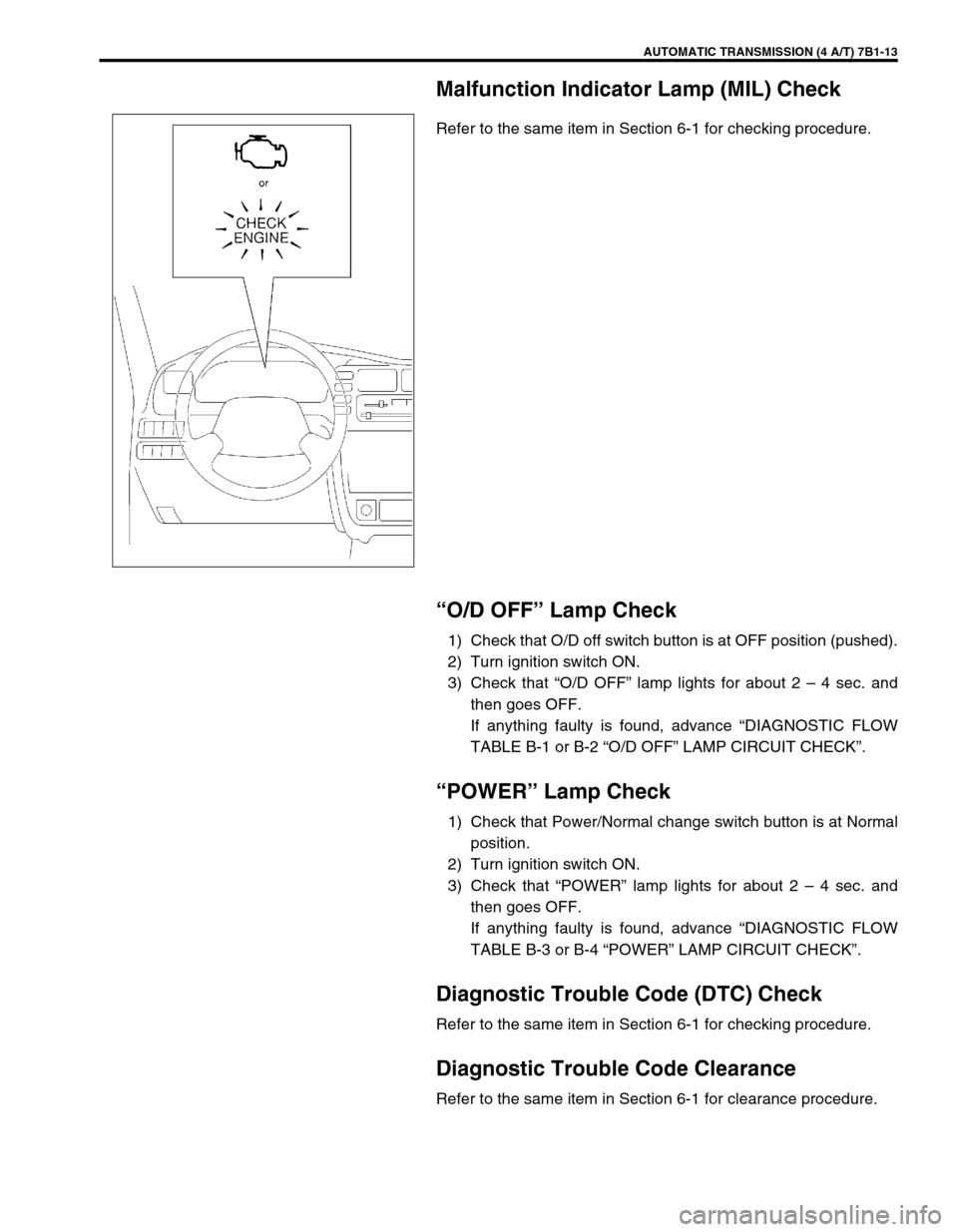
Malfunction Indicator Lamp (MIL) Check
Refer to the same item in Section 6-1 for checking procedure.
“O/D OFF” Lamp Check
1) Check that O/D off switch button is at OFF position (pushed).
2) Turn ignition switch ON.
3) Check that “O/D OFF” lamp lights for about 2 – 4 sec. and
then goes OFF.
If anything faulty is found, advance “DIAGNOSTIC FLOW
TABLE B-1 or B-2 “O/D OFF” LAMP CIRCUIT CHECK”.
“POWER” Lamp Check
1) Check that Power/Normal change switch button is at Normal
position.
2) Turn ignition switch ON.
3) Check that “POWER” lamp lights for about 2 – 4 sec. and
then goes OFF.
If anything faulty is found, advance “DIAGNOSTIC FLOW
TABLE B-3 or B-4 “POWER” LAMP CIRCUIT CHECK”.
Diagnostic Trouble Code (DTC) Check
Refer to the same item in Section 6-1 for checking procedure.
Diagnostic Trouble Code Clearance
Refer to the same item in Section 6-1 for clearance procedure.
Page 431 of 656
7B1-22 AUTOMATIC TRANSMISSION (4 A/T)
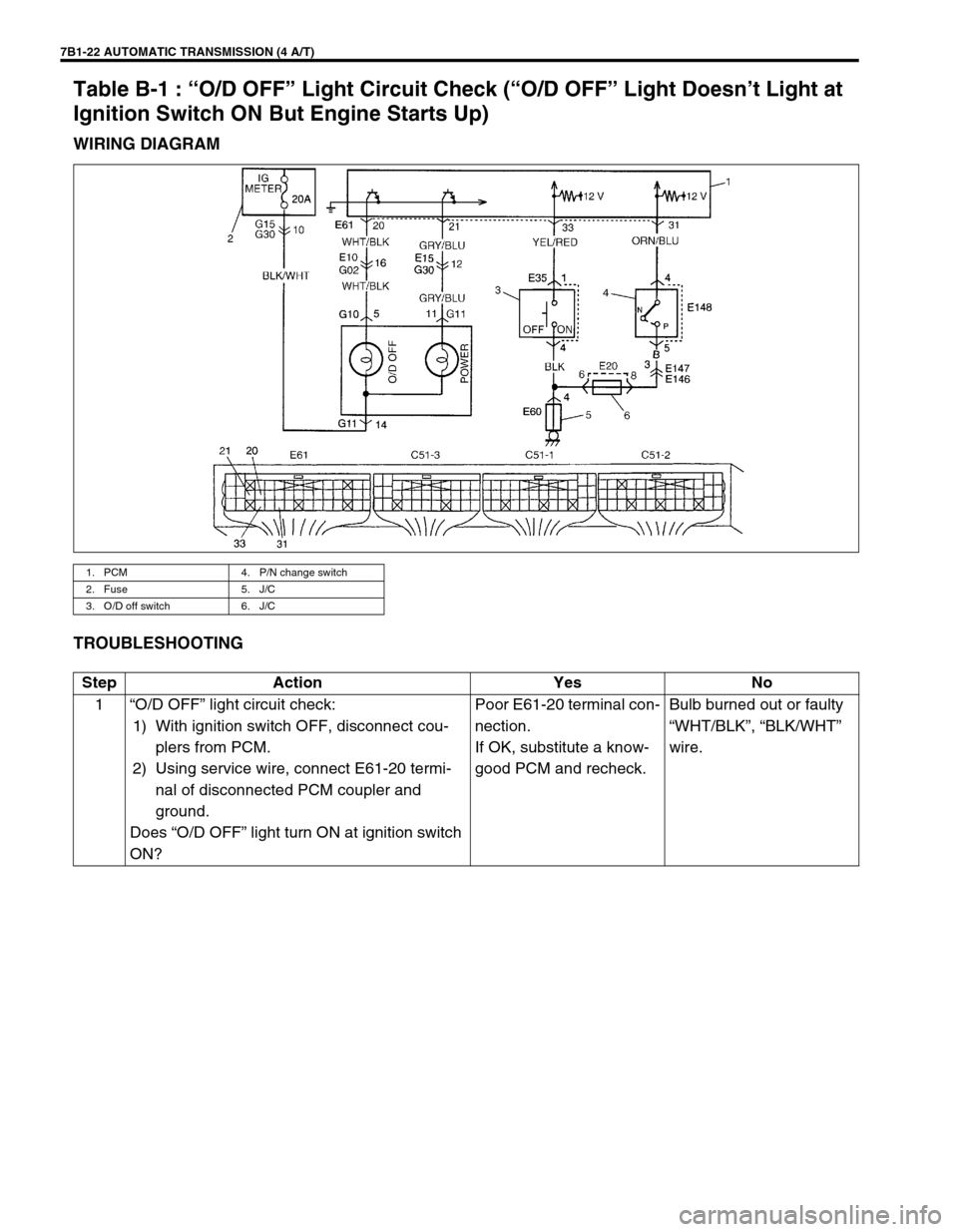
Table B-1 : “O/D OFF” Light Circuit Check (“O/D OFF” Light Doesn’t Light at
Ignition Switch ON But Engine Starts Up)
WIRING DIAGRAM
TROUBLESHOOTING
1. PCM 4. P/N change switch
2. Fuse 5. J/C
3. O/D off switch 6. J/C
Step Action Yes No
1“O/D OFF” light circuit check:
1) With ignition switch OFF, disconnect cou-
plers from PCM.
2) Using service wire, connect E61-20 termi-
nal of disconnected PCM coupler and
ground.
Does “O/D OFF” light turn ON at ignition switch
ON?Poor E61-20 terminal con-
nection.
If OK, substitute a know-
good PCM and recheck.Bulb burned out or faulty
“WHT/BLK”, “BLK/WHT”
wire.
Page 432 of 656

AUTOMATIC TRANSMISSION (4 A/T) 7B1-23
Table B-2 : “O/D OFF” Light Circuit Check (“O/D OFF” Light Comes ON
Steadily)
WIRING DIAGRAM
Refer to “TABLE B-1” in this section.
TROUBLESHOOTING
[A] for Step 1/[B] for Step 4Step Action Yes No
1 Check O/D off switch status.
Press O/D off switch button (1).
Does “O/D OFF” lamp come ON steadily?Go to Step 2. System is OK.
2 Check lamp circuit for short.
1) Turn ignition switch OFF and disconnect
PCM connectors.
2) Turn ignition switch ON.
Does “O/D OFF” lamp come ON steadily?“WHT/BLK” circuit
shorted to ground.Go to Step 3.
3 Check O/D off switch circuit.
1) Check resistance between terminal E61-33
of disconnected PCM connector and body
ground with O/D off switch button (1)
released.
Is continuity indicated?Go to Step 4. Check PCM ground circuit
for open.
If ground circuit is OK,
substitute a known-good
PCM and recheck.
4 Check O/D off switch for operation.
1) Remove console box.
2) Disconnect O/D off switch connector.
3) Check continuity between switch terminals
under each condition below.
O/D switch operation
With O/D off switch button (1) released :
No continuity
With O/D off switch button (1) pressed :
Continuity
Is check result satisfactory?“YEL/RED” circuit shorted
to ground.Replace O/D off switch.
Page 433 of 656
7B1-24 AUTOMATIC TRANSMISSION (4 A/T)
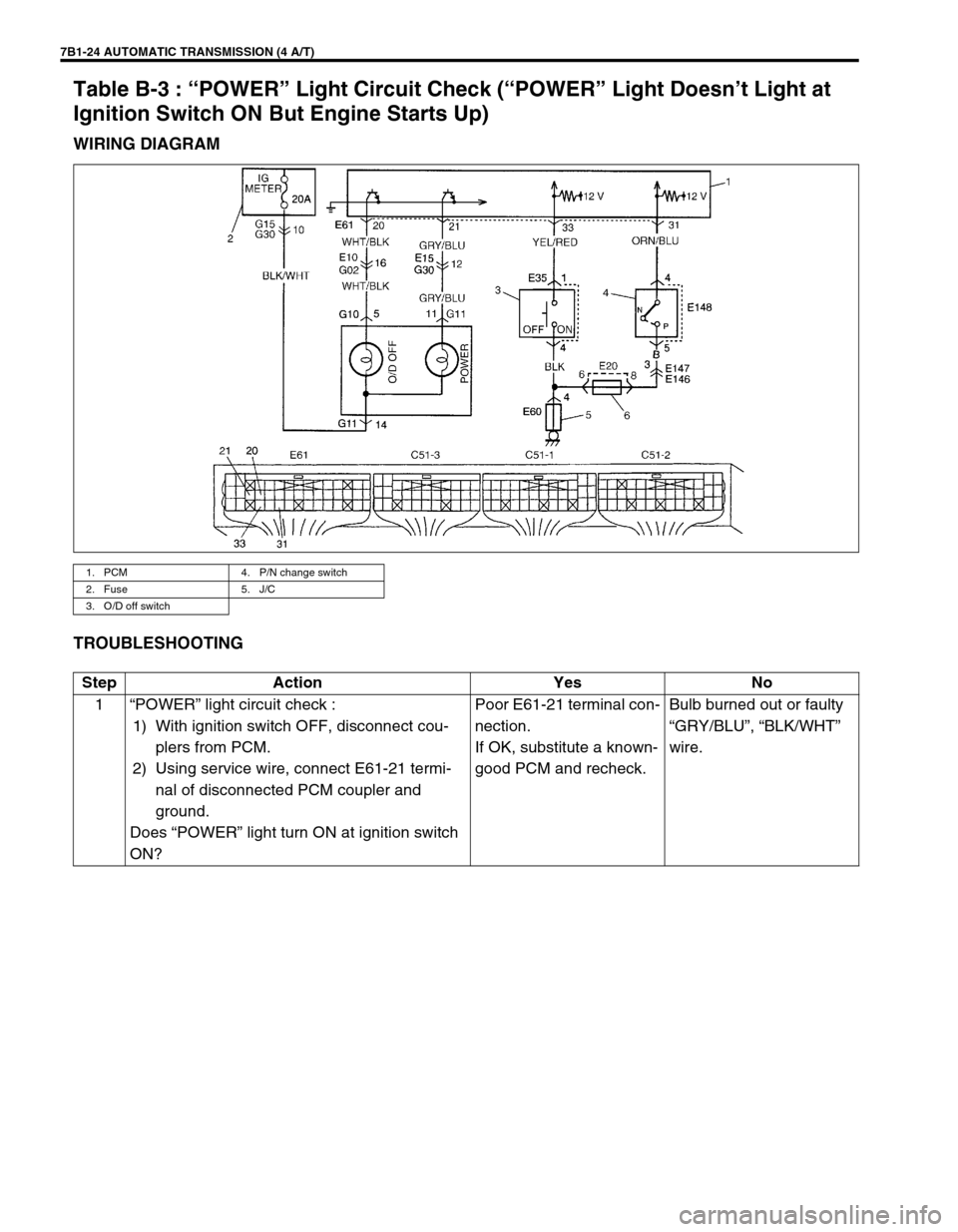
Table B-3 : “POWER” Light Circuit Check (“POWER” Light Doesn’t Light at
Ignition Switch ON But Engine Starts Up)
WIRING DIAGRAM
TROUBLESHOOTING
1. PCM 4. P/N change switch
2. Fuse 5. J/C
3. O/D off switch
Step Action Yes No
1“POWER” light circuit check :
1) With ignition switch OFF, disconnect cou-
plers from PCM.
2) Using service wire, connect E61-21 termi-
nal of disconnected PCM coupler and
ground.
Does “POWER” light turn ON at ignition switch
ON?Poor E61-21 terminal con-
nection.
If OK, substitute a known-
good PCM and recheck.Bulb burned out or faulty
“GRY/BLU”, “BLK/WHT”
wire.
Page 434 of 656
![SUZUKI GRAND VITARA 1999 2.G Owners Manual AUTOMATIC TRANSMISSION (4 A/T) 7B1-25
Table B-4 : “POWER” Light Circuit Check (“POWER” Light Comes ON
Steadily)
WIRING DIAGRAM
Refer to “TABLE B-3” in this section.
TROUBLESHOOTING
[A] fo](/img/20/7583/w960_7583-433.png "SUZUKI GRAND VITARA 1999 2.G Owners Manual AUTOMATIC TRANSMISSION (4 A/T) 7B1-25
Table B-4 : “POWER” Light Circuit Check (“POWER” Light Comes ON
Steadily)
WIRING DIAGRAM
Refer to “TABLE B-3” in this section.
TROUBLESHOOTING
[A] fo")
AUTOMATIC TRANSMISSION (4 A/T) 7B1-25
Table B-4 : “POWER” Light Circuit Check (“POWER” Light Comes ON
Steadily)
WIRING DIAGRAM
Refer to “TABLE B-3” in this section.
TROUBLESHOOTING
[A] for Step 1/[B] for Step 4Step Action Yes No
1 Check Power/Normal change switch position.
Is switch button at Normal position?Go to Step 2. Set Power/Normal
change switch at Nor-
mal position.
2 Check lamp circuit for short.
1) Turn ignition switch OFF and disconnect PCM
connectors.
2) Turn ignition switch ON.
Does “POWER” lamp come ON steadily?“GRY/BLU” circuit
shorted to ground.Go to Step 3.
3 Check Power/Normal change switch circuit.
1) Check resistance between terminal E61-31 of dis-
connected PCM connector and body ground with
P/N change switch OFF.
Is continuity indicated?Go to Step 4. Check PCM ground
circuit for open.
If ground circuit is OK,
substitute a known-
good PCM and
recheck.
4 Check Power/Normal change switch for operation.
1) Remove Power/Normal change switch.
2) Check continuity between switch terminals “4” and
“5” under each condition below.
Normal position: No continuity
Power position: Continuity.
Is check result satisfactory?“ORN/BLU” circuit
shorted to ground.Replace Power/Normal
change switch.
Page 477 of 656
7E-4 DIFFERENTIAL (FRONT)
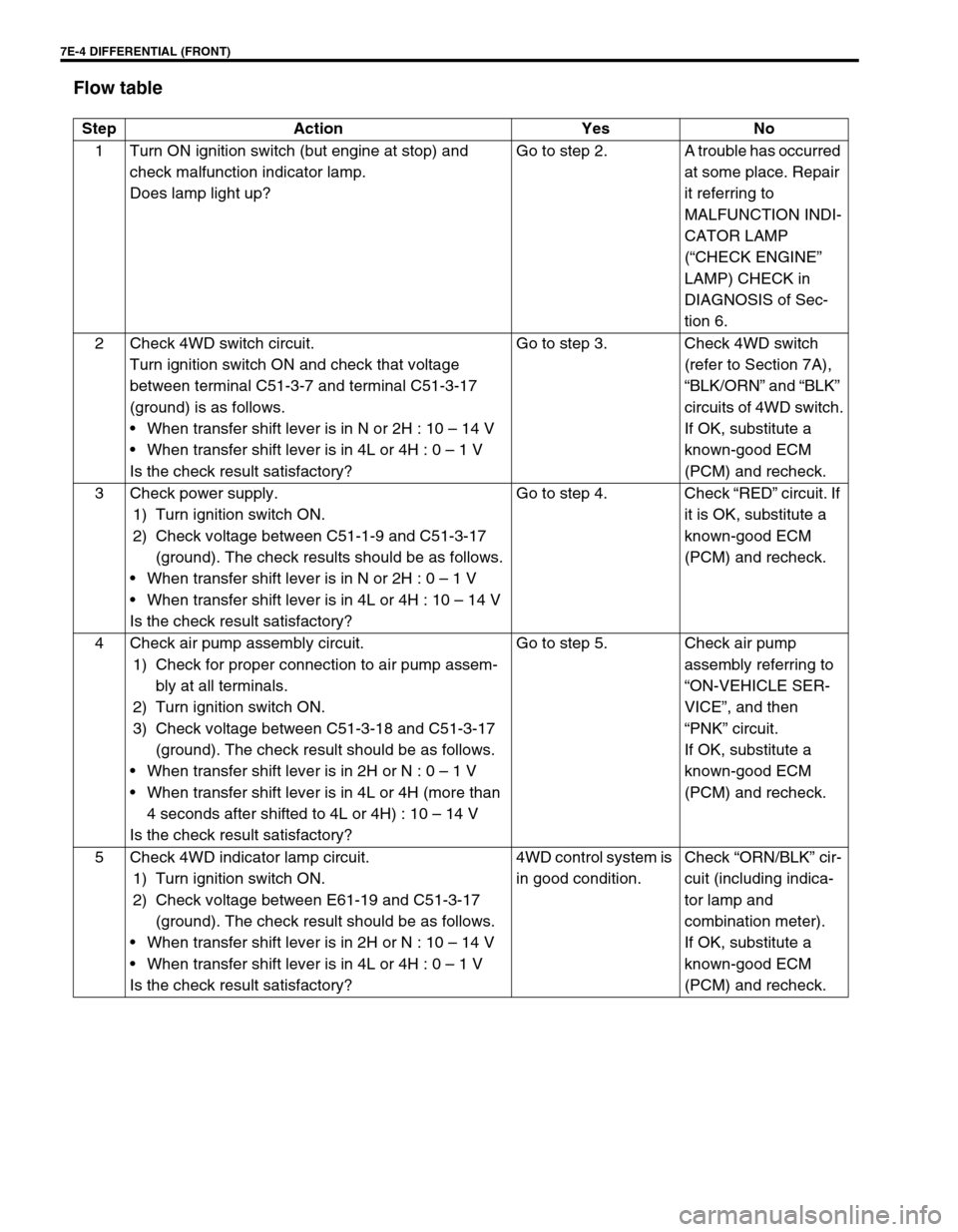
Flow table
Step Action Yes No
1 Turn ON ignition switch (but engine at stop) and
check malfunction indicator lamp.
Does lamp light up?Go to step 2. A trouble has occurred
at some place. Repair
it referring to
MALFUNCTION INDI-
CATOR LAMP
(“CHECK ENGINE”
LAMP) CHECK in
DIAGNOSIS of Sec-
tion 6.
2 Check 4WD switch circuit.
Turn ignition switch ON and check that voltage
between terminal C51-3-7 and terminal C51-3-17
(ground) is as follows.
When transfer shift lever is in N or 2H : 10 – 14 V
When transfer shift lever is in 4L or 4H : 0 – 1 V
Is the check result satisfactory?Go to step 3. Check 4WD switch
(refer to Section 7A),
“BLK/ORN” and “BLK”
circuits of 4WD switch.
If OK, substitute a
known-good ECM
(PCM) and recheck.
3 Check power supply.
1) Turn ignition switch ON.
2) Check voltage between C51-1-9 and C51-3-17
(ground). The check results should be as follows.
When transfer shift lever is in N or 2H : 0 – 1 V
When transfer shift lever is in 4L or 4H : 10 – 14 V
Is the check result satisfactory?Go to step 4. Check “RED” circuit. If
it is OK, substitute a
known-good ECM
(PCM) and recheck.
4 Check air pump assembly circuit.
1) Check for proper connection to air pump assem-
bly at all terminals.
2) Turn ignition switch ON.
3) Check voltage between C51-3-18 and C51-3-17
(ground). The check result should be as follows.
When transfer shift lever is in 2H or N : 0 – 1 V
When transfer shift lever is in 4L or 4H (more than
4 seconds after shifted to 4L or 4H) : 10 – 14 V
Is the check result satisfactory?Go to step 5. Check air pump
assembly referring to
“ON-VEHICLE SER-
VICE”, and then
“PNK” circuit.
If OK, substitute a
known-good ECM
(PCM) and recheck.
5 Check 4WD indicator lamp circuit.
1) Turn ignition switch ON.
2) Check voltage between E61-19 and C51-3-17
(ground). The check result should be as follows.
When transfer shift lever is in 2H or N : 10 – 14 V
When transfer shift lever is in 4L or 4H : 0 – 1 V
Is the check result satisfactory?4WD control system is
in good condition.Check “ORN/BLK” cir-
cuit (including indica-
tor lamp and
combination meter).
If OK, substitute a
known-good ECM
(PCM) and recheck.
Page 510 of 656
BODY ELECTRICAL SYSTEM 8-1
6F1
6F2
6G
6H
6K
7A
8
6K
7C1
7D
7E
7F
8A
8D
8E
9
10
10A
10B
SECTION 8
BODY ELECTRICAL SYSTEM
Wiring System
(Harnesses, Connectors, Fuses, Relay, Switches, Grounds, System Circuit Diagram) .......... Section 8A
Lighting System .............................................................................................................................. Section 8B
Instrumententation and Driver Information .................................................................................. Section 8C
Windows, Mirrors, Security and Locks ......................................................................................... Section 8D
Immobilizer Control System............................................................................................................Section 8F
CONTENTS
General Description .......................................... 8-3
WARNING:
For vehicles equipped with Supplemental Restraint (Air Bag) System:
Service on and around the air bag system components or wiring must be performed only by an
authorized SUZUKI dealer. Refer to “Air Bag System Components and Wiring Location View” under
“General Description” in air bag system section in order to confirm whether you are performing ser-
vice on or near the air bag system components or wiring. Please observe all WARNINGS and “Ser-
vice Precautions” under “On-Vehicle Service” in air bag system section before performing service
on or around the air bag system components or wiring. Failure to follow WARNINGS could result in
unintentional activation of the system or could render the system inoperative. Either of these two
conditions may result in severe injury.
Technical service work must be started at least 90 seconds after the ignition switch is turned to the
“LOCK” position and the negative cable is disconnected from the battery. Otherwise, the system
may be activated by reserve energy in the Sensing and Diagnostic Module (SDM).
NOTE:
For the descriptions (items) not found in this section, refer to the same section of the Service Manual
mentioned in FOREWORD of this manual.
Page 512 of 656
INSTRUMENTATION/DRIVER INFORMATION 8C-1
8C
SECTION 8C
INSTRUMENTATION/DRIVER INFORMATION
CONTENTS
General Description ........................................8C-2
Combination Meter ........................................8C-2
On-vehicle Service ..........................................8C-4
Fuel Meter/Fuel Gauge Unit ..........................8C-4
Fuel level sensor (sender gauge) ..............8C-4
Engine Coolant Temperature (ECT) Meter
and Sensor ....................................................8C-5Engine coolant temperature sensor .......... 8C-5
Oil Pressure Light ......................................... 8C-5
Oil pressure switch .................................... 8C-5
Brake Warning Light ..................................... 8C-5
Brake fluid level switch .............................. 8C-5
WARNING:
For vehicles equipped with Supplemental Restraint (Air Bag) System:
Service on and around the air bag system components or wiring must be performed only by an
authorized SUZUKI dealer. Refer to “Air Bag System Components and Wiring Location View” under
“General Description” in air bag system section in order to confirm whether you are performing ser-
vice on or near the air bag system components or wiring. Please observe all WARNINGS and “Ser-
vice Precautions” under “On-Vehicle Service” in air bag system section before performing service
on or around the air bag system components or wiring. Failure to follow WARNINGS could result in
unintentional activation of the system or could render the system inoperative. Either of these two
conditions may result in severe injury.
Technical service work must be started at least 90 seconds after the ignition switch is turned to the
“LOCK” position and the negative cable is disconnected from the battery. Otherwise, the system
may be activated by reserve energy in the Sensing and Diagnostic Module (SDM).
NOTE:
For the descriptions (items) not found in this section, refer to the same section of the Service Manual
mentioned in the FOREWORD of this manual.
Page 516 of 656
INSTRUMENTATION/DRIVER INFORMATION 8C-5
Engine Coolant Temperature (ECT) Meter and
Sensor
Engine coolant temperature sensor
REMOVAL AND INSTALLATION
Refer to “ECT SENSOR” in Section 6E2.
Oil Pressure Light
Oil pressure switch
REMOVAL AND INSTALLATION
Refer to “OIL PRESSURE CHECK” in Section 6A2.
Brake Warning Light
Brake fluid level switch
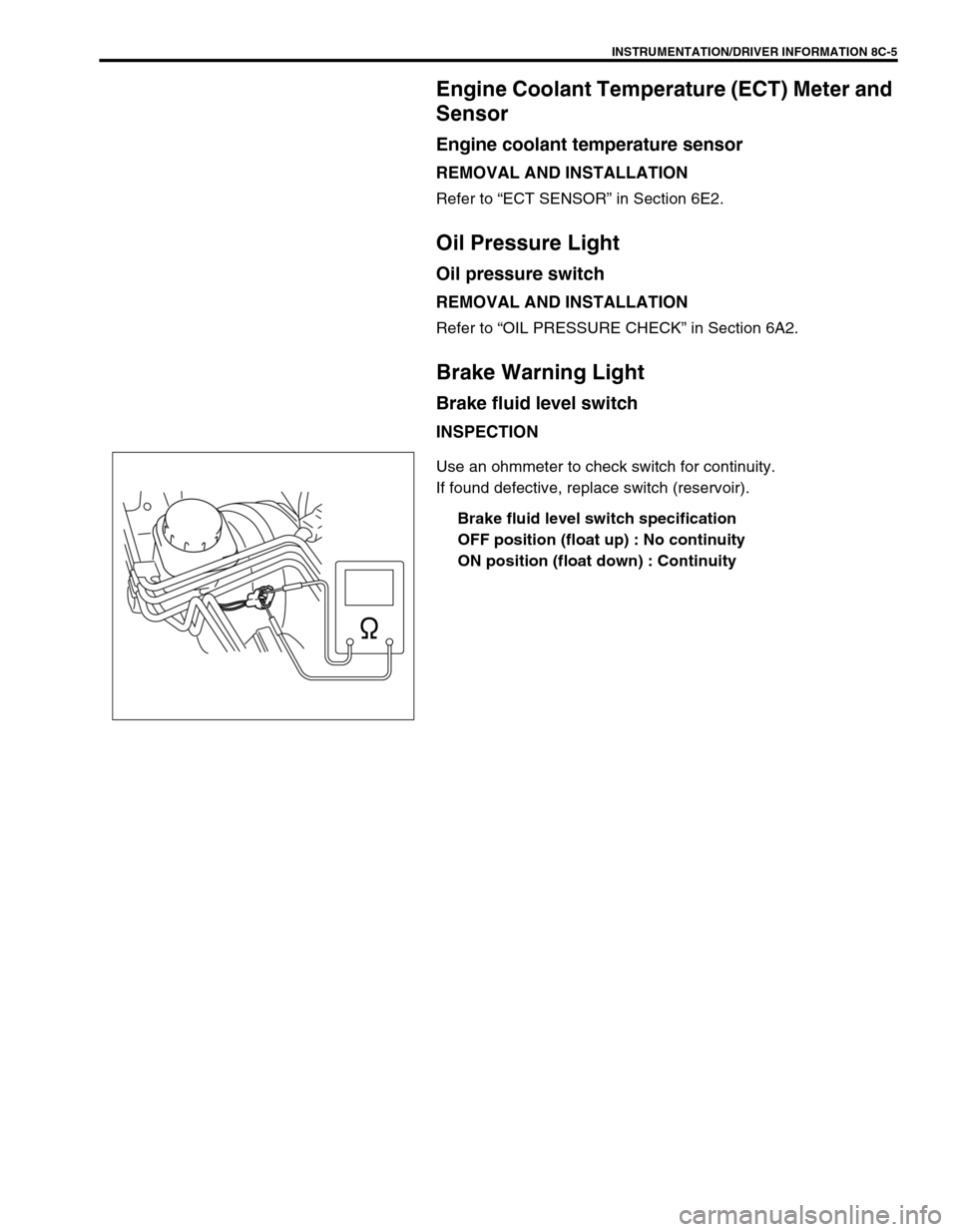
INSPECTION
Use an ohmmeter to check switch for continuity.
If found defective, replace switch (reservoir).
Brake fluid level switch specification
OFF position (float up) : No continuity
ON position (float down) : Continuity