check oil SUZUKI GRAND VITARA 1999 2.G Owner's Manual
[x] Cancel search | Manufacturer: SUZUKI, Model Year: 1999, Model line: GRAND VITARA, Model: SUZUKI GRAND VITARA 1999 2.GPages: 656, PDF Size: 14.31 MB
Page 242 of 656
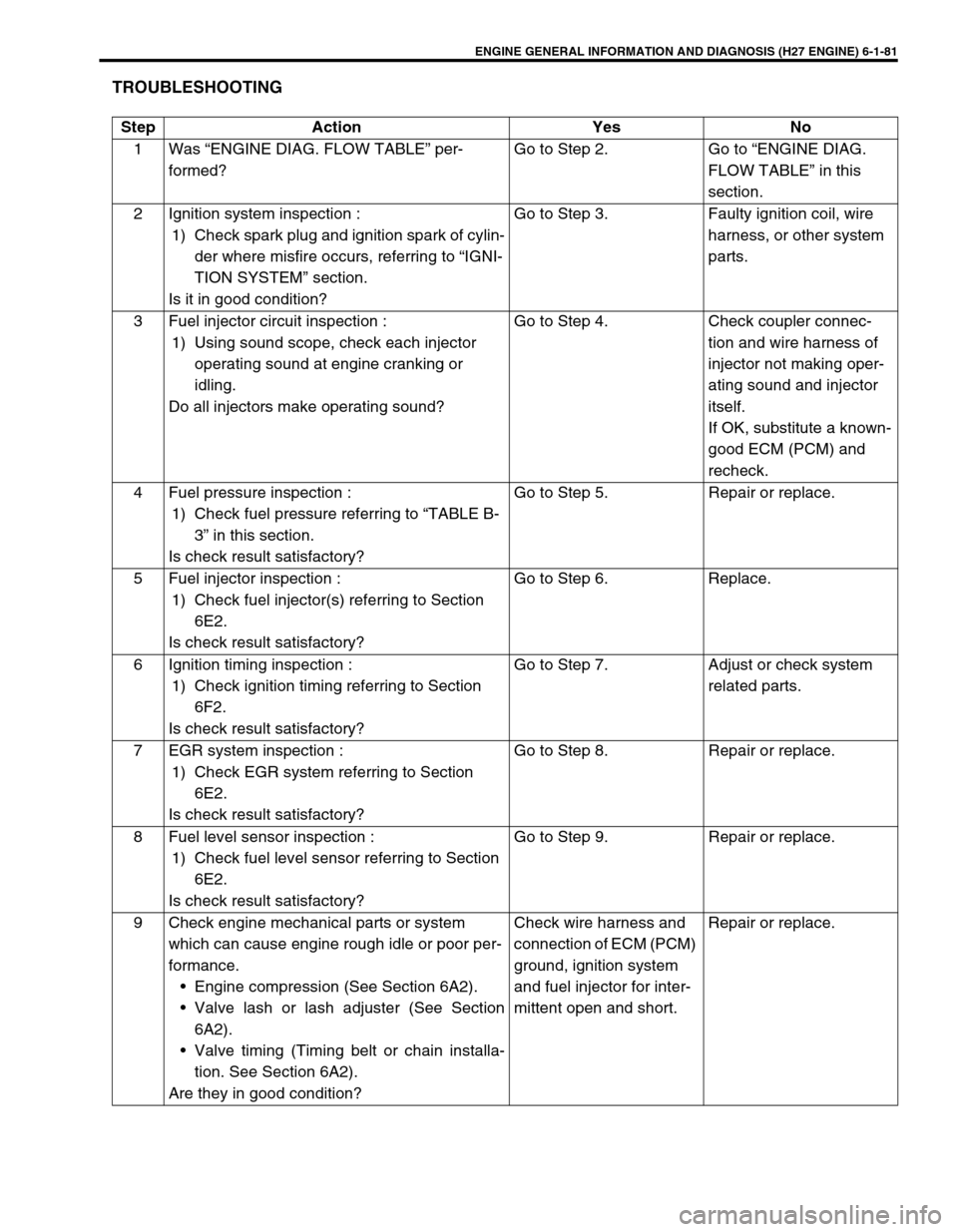
ENGINE GENERAL INFORMATION AND DIAGNOSIS (H27 ENGINE) 6-1-81
TROUBLESHOOTING
Step Action Yes No
1 Was “ENGINE DIAG. FLOW TABLE” per-
formed?Go to Step 2. Go to “ENGINE DIAG.
FLOW TABLE” in this
section.
2 Ignition system inspection :
1) Check spark plug and ignition spark of cylin-
der where misfire occurs, referring to “IGNI-
TION SYSTEM” section.
Is it in good condition?Go to Step 3. Faulty ignition coil, wire
harness, or other system
parts.
3 Fuel injector circuit inspection :
1) Using sound scope, check each injector
operating sound at engine cranking or
idling.
Do all injectors make operating sound?Go to Step 4. Check coupler connec-
tion and wire harness of
injector not making oper-
ating sound and injector
itself.
If OK, substitute a known-
good ECM (PCM) and
recheck.
4 Fuel pressure inspection :
1) Check fuel pressure referring to “TABLE B-
3” in this section.
Is check result satisfactory?Go to Step 5. Repair or replace.
5 Fuel injector inspection :
1) Check fuel injector(s) referring to Section
6E2.
Is check result satisfactory?Go to Step 6. Replace.
6 Ignition timing inspection :
1) Check ignition timing referring to Section
6F2.
Is check result satisfactory?Go to Step 7. Adjust or check system
related parts.
7 EGR system inspection :
1) Check EGR system referring to Section
6E2.
Is check result satisfactory?Go to Step 8. Repair or replace.
8 Fuel level sensor inspection :
1) Check fuel level sensor referring to Section
6E2.
Is check result satisfactory?Go to Step 9. Repair or replace.
9 Check engine mechanical parts or system
which can cause engine rough idle or poor per-
formance.
• Engine compression (See Section 6A2).
• Valve lash or lash adjuster (See Section
6A2).
• Valve timing (Timing belt or chain installa-
tion. See Section 6A2).
Are they in good condition?Check wire harness and
connection of ECM (PCM)
ground, ignition system
and fuel injector for inter-
mittent open and short.Repair or replace.
Page 249 of 656
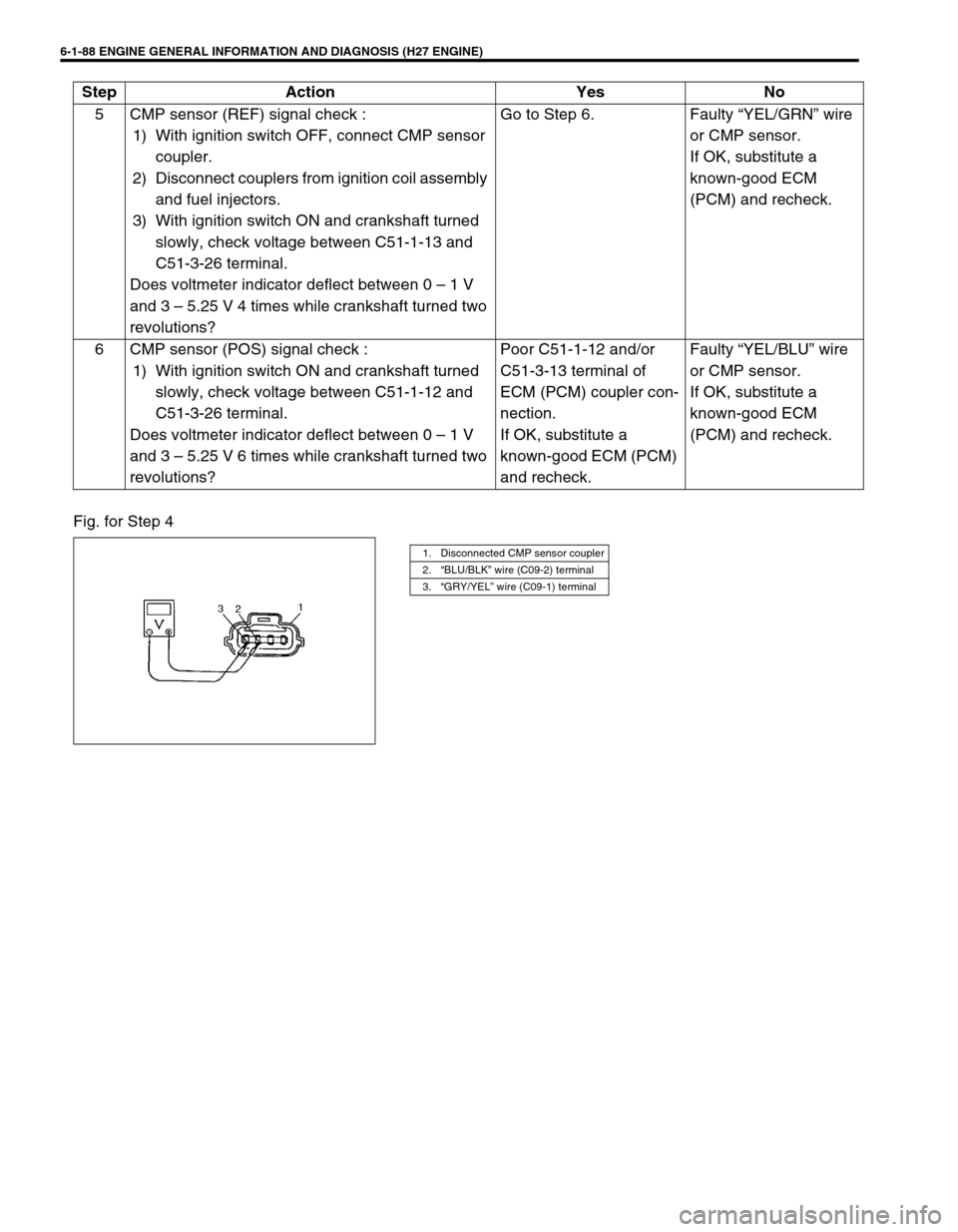
6-1-88 ENGINE GENERAL INFORMATION AND DIAGNOSIS (H27 ENGINE)
Fig. for Step 45 CMP sensor (REF) signal check :
1) With ignition switch OFF, connect CMP sensor
coupler.
2) Disconnect couplers from ignition coil assembly
and fuel injectors.
3) With ignition switch ON and crankshaft turned
slowly, check voltage between C51-1-13 and
C51-3-26 terminal.
Does voltmeter indicator deflect between 0 – 1 V
and 3 – 5.25 V 4 times while crankshaft turned two
revolutions?Go to Step 6. Faulty “YEL/GRN” wire
or CMP sensor.
If OK, substitute a
known-good ECM
(PCM) and recheck.
6 CMP sensor (POS) signal check :
1) With ignition switch ON and crankshaft turned
slowly, check voltage between C51-1-12 and
C51-3-26 terminal.
Does voltmeter indicator deflect between 0 – 1 V
and 3 – 5.25 V 6 times while crankshaft turned two
revolutions?Poor C51-1-12 and/or
C51-3-13 terminal of
ECM (PCM) coupler con-
nection.
If OK, substitute a
known-good ECM (PCM)
and recheck.Faulty “YEL/BLU” wire
or CMP sensor.
If OK, substitute a
known-good ECM
(PCM) and recheck. Step Action Yes No
1. Disconnected CMP sensor coupler
2. “BLU/BLK” wire (C09-2) terminal
3. “GRY/YEL” wire (C09-1) terminal
Page 252 of 656
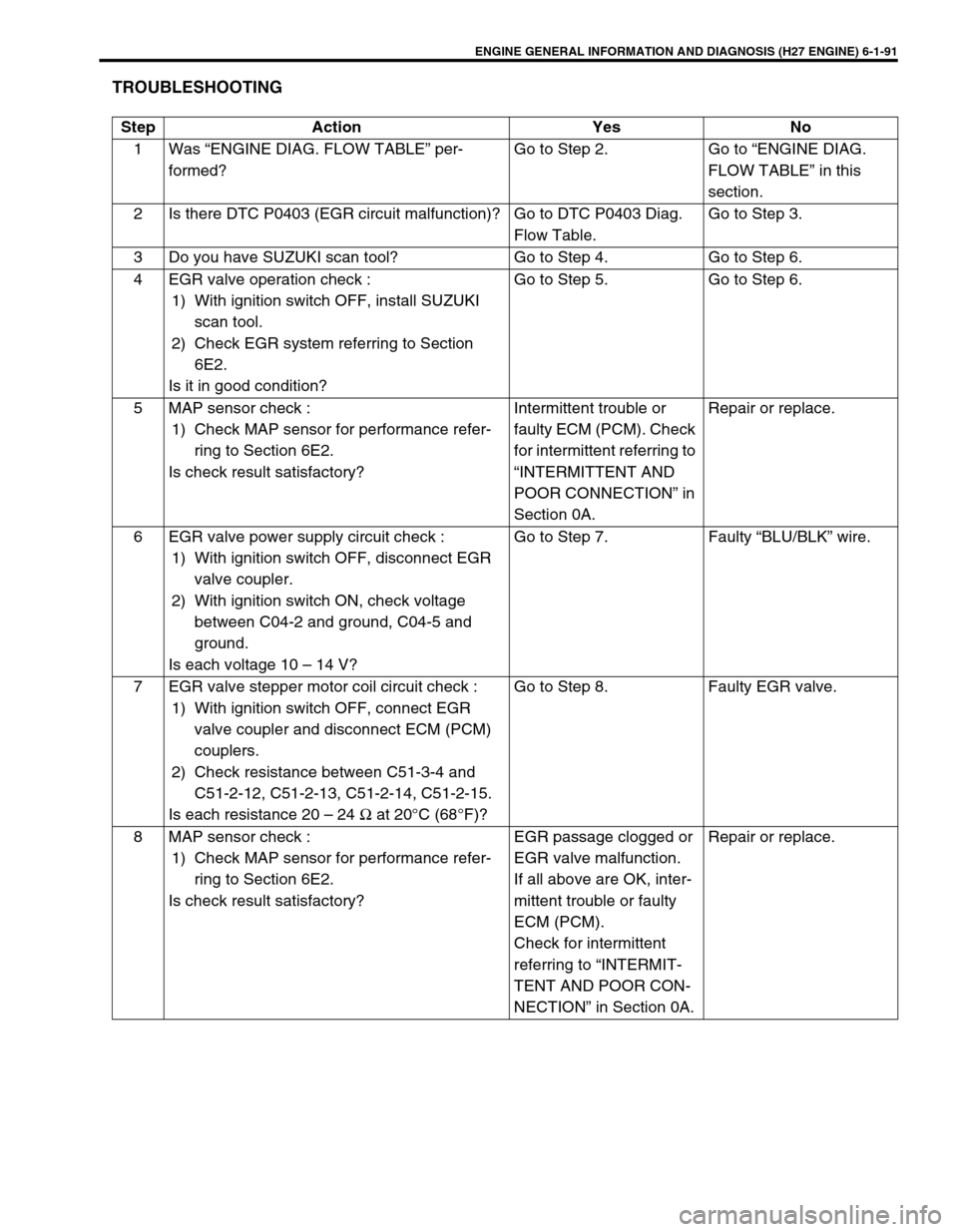
ENGINE GENERAL INFORMATION AND DIAGNOSIS (H27 ENGINE) 6-1-91
TROUBLESHOOTING
Step Action Yes No
1 Was “ENGINE DIAG. FLOW TABLE” per-
formed?Go to Step 2. Go to “ENGINE DIAG.
FLOW TABLE” in this
section.
2 Is there DTC P0403 (EGR circuit malfunction)? Go to DTC P0403 Diag.
Flow Table.Go to Step 3.
3 Do you have SUZUKI scan tool? Go to Step 4. Go to Step 6.
4 EGR valve operation check :
1) With ignition switch OFF, install SUZUKI
scan tool.
2) Check EGR system referring to Section
6E2.
Is it in good condition?Go to Step 5. Go to Step 6.
5 MAP sensor check :
1) Check MAP sensor for performance refer-
ring to Section 6E2.
Is check result satisfactory?Intermittent trouble or
faulty ECM (PCM). Check
for intermittent referring to
“INTERMITTENT AND
POOR CONNECTION” in
Section 0A.Repair or replace.
6 EGR valve power supply circuit check :
1) With ignition switch OFF, disconnect EGR
valve coupler.
2) With ignition switch ON, check voltage
between C04-2 and ground, C04-5 and
ground.
Is each voltage 10 – 14 V?Go to Step 7. Faulty “BLU/BLK” wire.
7 EGR valve stepper motor coil circuit check :
1) With ignition switch OFF, connect EGR
valve coupler and disconnect ECM (PCM)
couplers.
2) Check resistance between C51-3-4 and
C51-2-12, C51-2-13, C51-2-14, C51-2-15.
Is each resistance 20 – 24 Ω at 20°C (68°F)?Go to Step 8. Faulty EGR valve.
8 MAP sensor check :
1) Check MAP sensor for performance refer-
ring to Section 6E2.
Is check result satisfactory?EGR passage clogged or
EGR valve malfunction.
If all above are OK, inter-
mittent trouble or faulty
ECM (PCM).
Check for intermittent
referring to “INTERMIT-
TENT AND POOR CON-
NECTION” in Section 0A.Repair or replace.
Page 299 of 656
6A2-12 ENGINE MECHANICAL (H27 ENGINE)
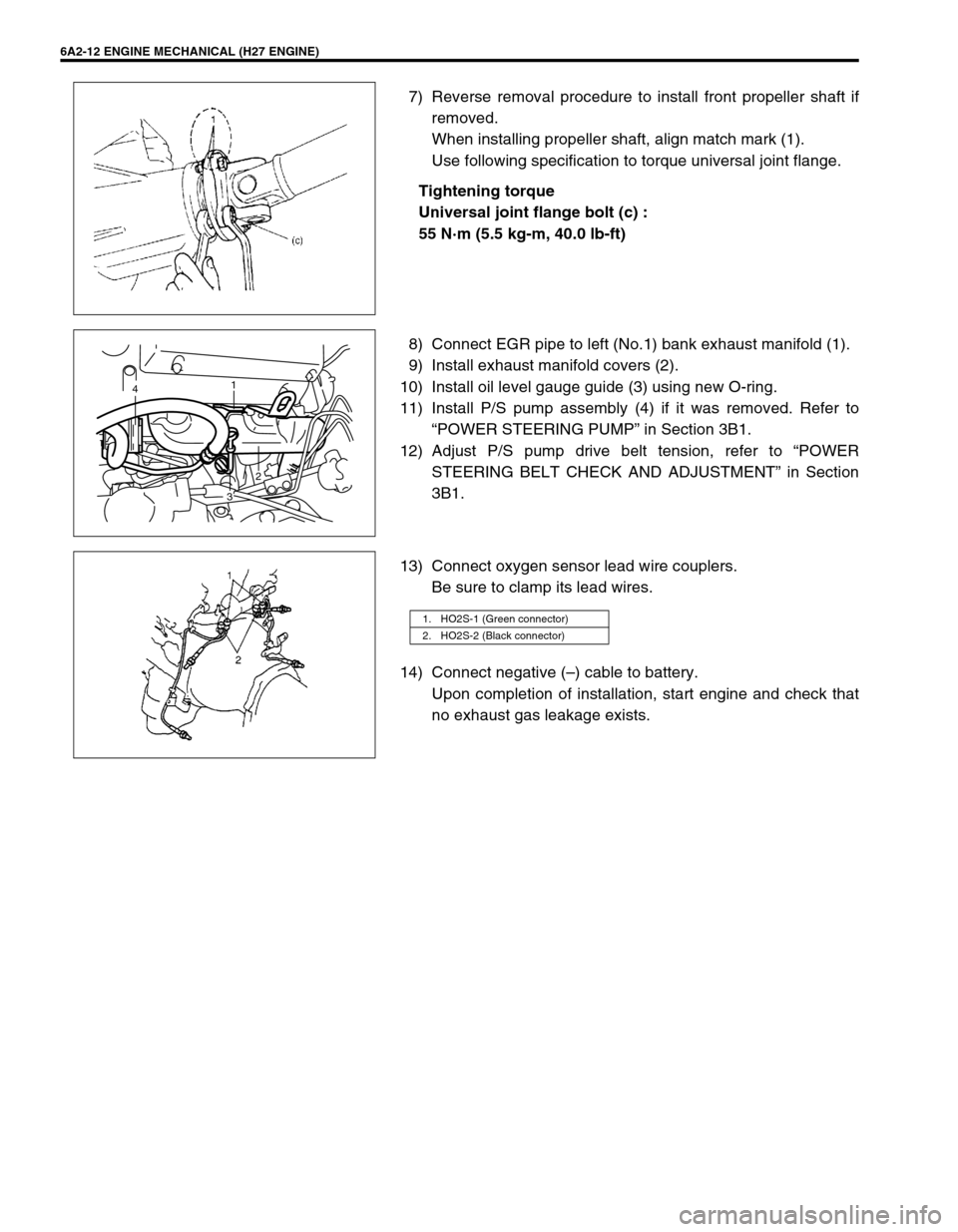
7) Reverse removal procedure to install front propeller shaft if
removed.
When installing propeller shaft, align match mark (1).
Use following specification to torque universal joint flange.
Tightening torque
Universal joint flange bolt (c) :
55 N·m (5.5 kg-m, 40.0 lb-ft)
8) Connect EGR pipe to left (No.1) bank exhaust manifold (1).
9) Install exhaust manifold covers (2).
10) Install oil level gauge guide (3) using new O-ring.
11) Install P/S pump assembly (4) if it was removed. Refer to
“POWER STEERING PUMP” in Section 3B1.
12) Adjust P/S pump drive belt tension, refer to “POWER
STEERING BELT CHECK AND ADJUSTMENT” in Section
3B1.
13) Connect oxygen sensor lead wire couplers.
Be sure to clamp its lead wires.
14) Connect negative (–) cable to battery.
Upon completion of installation, start engine and check that
no exhaust gas leakage exists.
1
4
32
1. HO2S-1 (Green connector)
2. HO2S-2 (Black connector)
Page 305 of 656
6A2-18 ENGINE MECHANICAL (H27 ENGINE)
INSPECTION
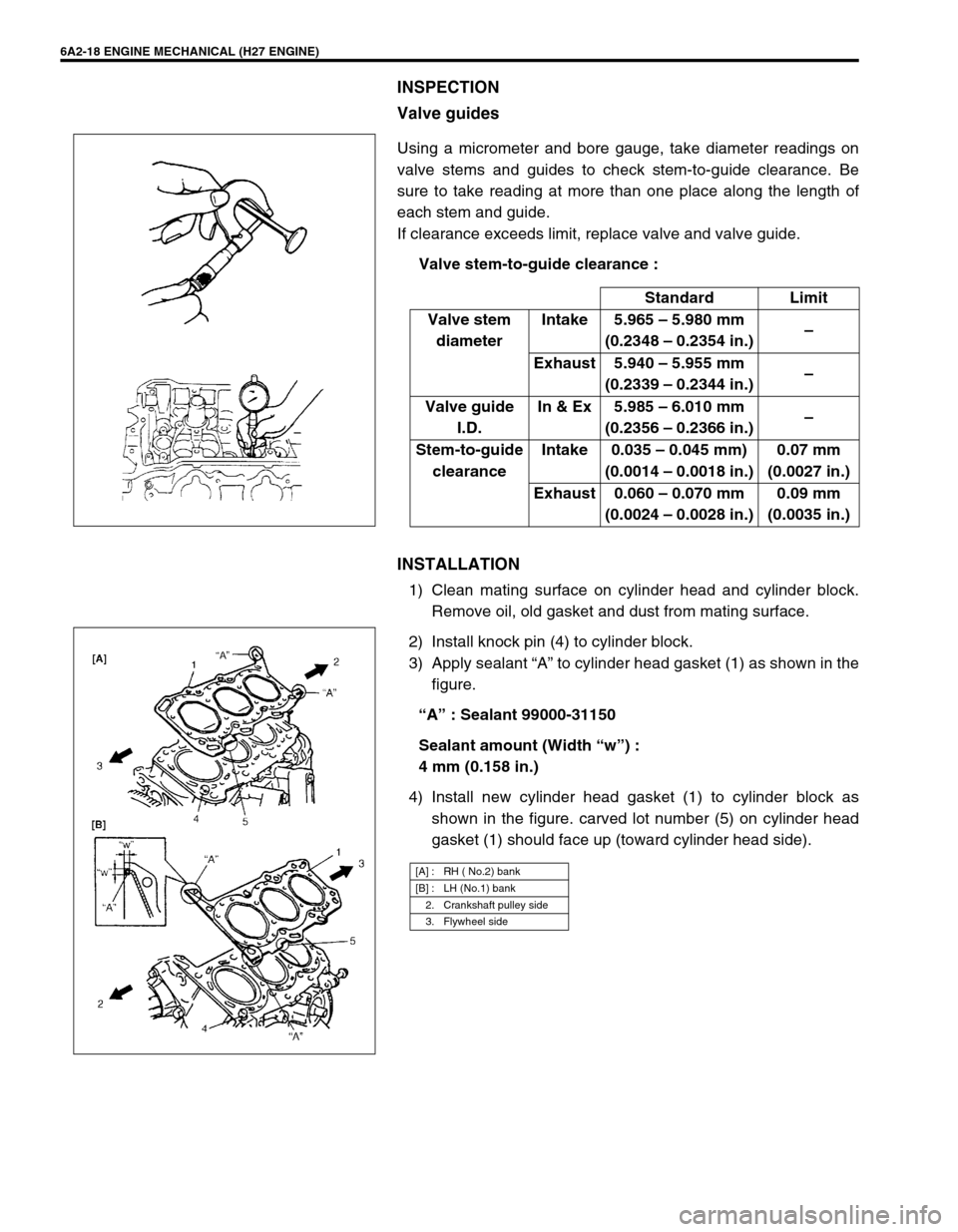
Valve guides
Using a micrometer and bore gauge, take diameter readings on
valve stems and guides to check stem-to-guide clearance. Be
sure to take reading at more than one place along the length of
each stem and guide.
If clearance exceeds limit, replace valve and valve guide.
Valve stem-to-guide clearance :
INSTALLATION
1) Clean mating surface on cylinder head and cylinder block.
Remove oil, old gasket and dust from mating surface.
2) Install knock pin (4) to cylinder block.
3) Apply sealant “A” to cylinder head gasket (1) as shown in the
figure.
“A” : Sealant 99000-31150
Sealant amount (Width “w”) :
4 mm (0.158 in.)
4) Install new cylinder head gasket (1) to cylinder block as
shown in the figure. carved lot number (5) on cylinder head
gasket (1) should face up (toward cylinder head side).Standard Limit
Valve stem
diameterIntake 5.965 – 5.980 mm
(0.2348 – 0.2354 in.)–
Exhaust 5.940 – 5.955 mm
(0.2339 – 0.2344 in.)–
Valve guide
I.D.In & Ex 5.985 – 6.010 mm
(0.2356 – 0.2366 in.)–
Stem-to-guide
clearanceIntake 0.035 – 0.045 mm)
(0.0014 – 0.0018 in.)0.07 mm
(0.0027 in.)
Exhaust 0.060 – 0.070 mm
(0.0024 – 0.0028 in.)0.09 mm
(0.0035 in.)
[A] : RH ( No.2) bank
[B] : LH (No.1) bank
2. Crankshaft pulley side
3. Flywheel side
Page 306 of 656
ENGINE MECHANICAL (H27 ENGINE) 6A2-19
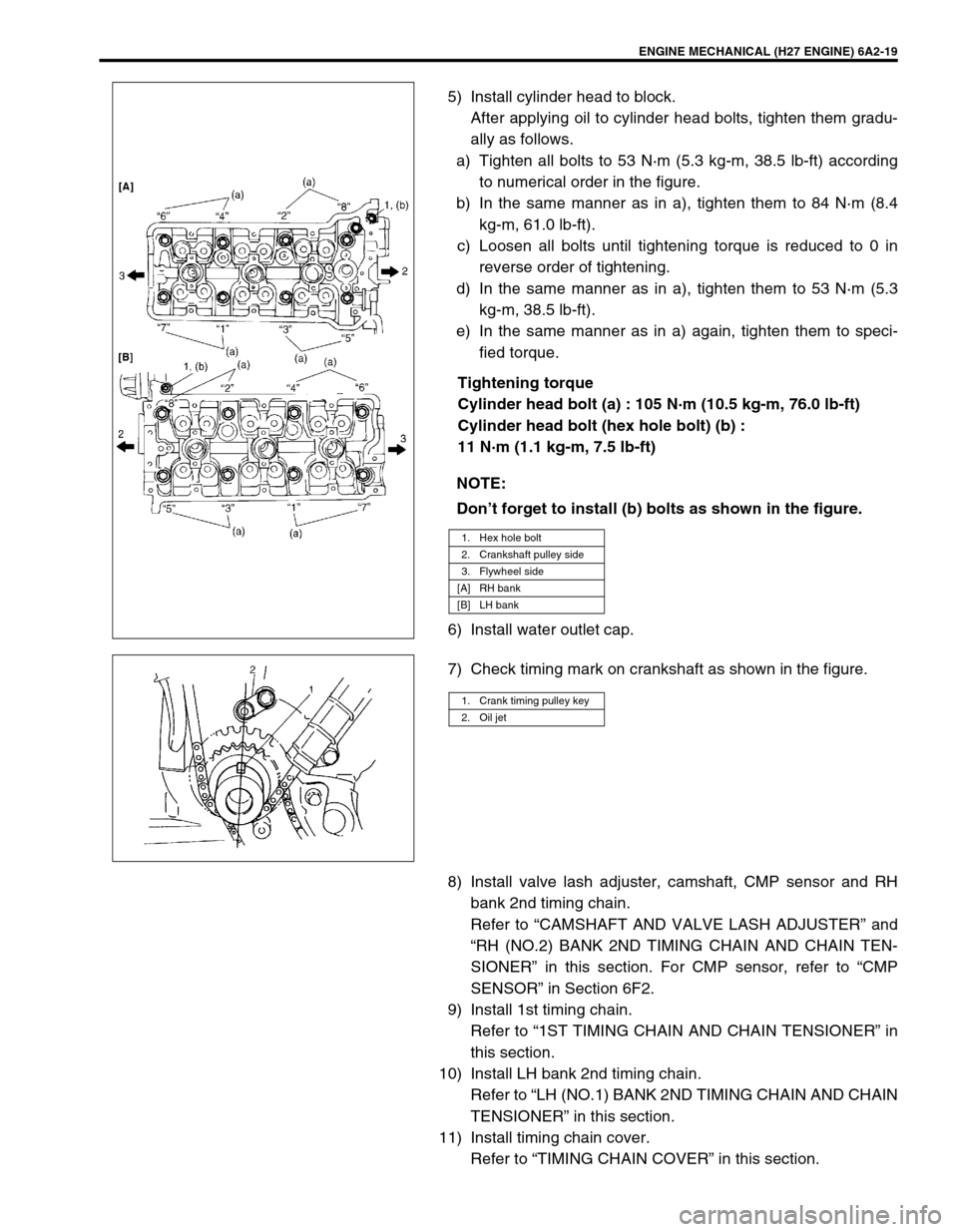
5) Install cylinder head to block.
After applying oil to cylinder head bolts, tighten them gradu-
ally as follows.
a) Tighten all bolts to 53 N·m (5.3 kg-m, 38.5 lb-ft) according
to numerical order in the figure.
b) In the same manner as in a), tighten them to 84 N·m (8.4
kg-m, 61.0 lb-ft).
c) Loosen all bolts until tightening torque is reduced to 0 in
reverse order of tightening.
d) In the same manner as in a), tighten them to 53 N·m (5.3
kg-m, 38.5 lb-ft).
e) In the same manner as in a) again, tighten them to speci-
fied torque.
Tightening torque
Cylinder head bolt (a) : 105 N·m (10.5 kg-m, 76.0 lb-ft)
Cylinder head bolt (hex hole bolt) (b) :
11 N·m (1.1 kg-m, 7.5 lb-ft)
6) Install water outlet cap.
7) Check timing mark on crankshaft as shown in the figure.
8) Install valve lash adjuster, camshaft, CMP sensor and RH
bank 2nd timing chain.
Refer to “CAMSHAFT AND VALVE LASH ADJUSTER” and
“RH (NO.2) BANK 2ND TIMING CHAIN AND CHAIN TEN-
SIONER” in this section. For CMP sensor, refer to “CMP
SENSOR” in Section 6F2.
9) Install 1st timing chain.
Refer to “1ST TIMING CHAIN AND CHAIN TENSIONER” in
this section.
10) Install LH bank 2nd timing chain.
Refer to “LH (NO.1) BANK 2ND TIMING CHAIN AND CHAIN
TENSIONER” in this section.
11) Install timing chain cover.
Refer to “TIMING CHAIN COVER” in this section. NOTE:
Don’t forget to install (b) bolts as shown in the figure.
1. Hex hole bolt
2. Crankshaft pulley side
3. Flywheel side
[A] RH bank
[B] LH bank
1. Crank timing pulley key
2. Oil jet
Page 307 of 656
6A2-20 ENGINE MECHANICAL (H27 ENGINE)
12) Install oil pan and oil pump strainer.
Refer to “OIL PAN AND OIL PUMP STRAINER” in this sec-
tion.
13) Install cylinder head cover.
Refer to “CYLINDER HEAD COVER” in this section.
14) Install exhaust manifold.
Refer to “EXHAUST MANIFOLD” in this section.
15) Install radiator outlet pipe, radiator, cooling fan and water
hose.
Refer to “COOLING WATER PIPES OR HOSES”, “RADIA-
TOR” and “COOLING FAN AND FAN CLUTCH” in Section
6B.
16) Install throttle body and intake manifold.
Refer to “THROTTLE BODY AND INTAKE MANIFOLD” in
this section.
17) Adjust water pump drive belt tension.
Refer to “COOLING FAN BELT TENSION CHECK AND
ADJUSTMENT” in Section 6B.
18) Adjust power steering pump drive belt tension.
Refer to “POWER STEERING PUMP DRIVE BELT” in Sec-
tion 3B1.
19) Adjust accelerator cable play and A/T throttle cable play.
Refer to “ACCELERATOR CABLE ADJUSTMENT” and “A/T
THROTTLE CABLE ADJUSTMENT (A/T VEHICLE)” in Sec-
tion 6E2.
20) Check to ensure that all removed parts are back in place.
Reinstall any necessary parts which have not been rein-
stalled.
21) Refill engine with engine oil, referring to “ENGINE OIL
CHANGE” in Section 0B.
22) Refill cooling system referring to “COOLING SYSTEM
FLUSH AND REFILL” in Section 6B.
23) Refill front differential housing with gear oil if drained, refer-
ring to “MAINTENANCE SERVICE” in Section 7E.
24) Connect negative cable at battery.
25) Check ignition timing and adjust as necessary, referring to
“IGNITION TIMING CHECK AND ADJUSTMENT” in Section
6F2.
26) Verify that there is no fuel leakage, water leakage, oil leak-
age and exhaust gas leakage at each connection.
27) Check wheel alignment, referring to “STEERING ANGLE” in
Section 3A.
Page 315 of 656
6A2-28 ENGINE MECHANICAL (H27 ENGINE)
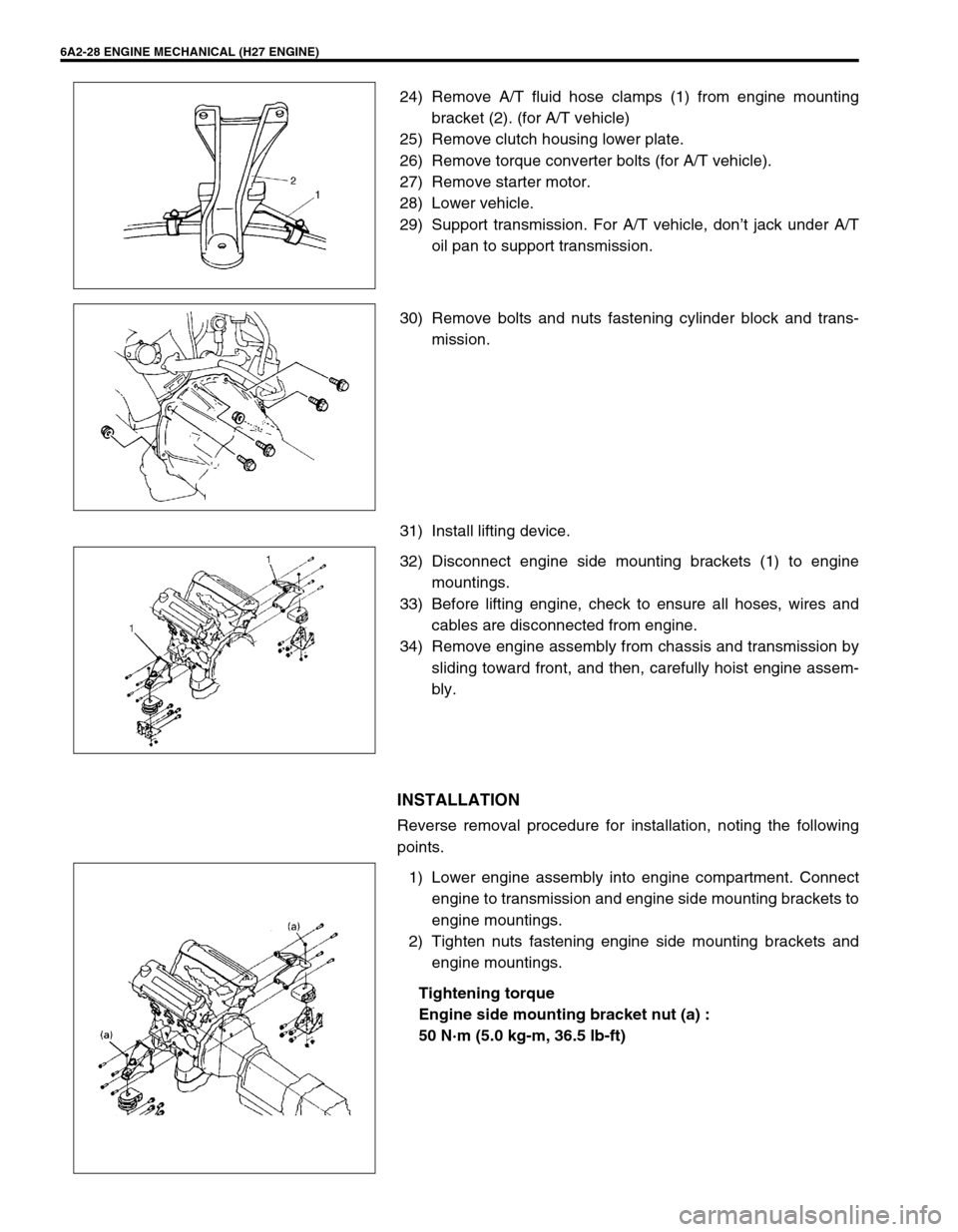
24) Remove A/T fluid hose clamps (1) from engine mounting
bracket (2). (for A/T vehicle)
25) Remove clutch housing lower plate.
26) Remove torque converter bolts (for A/T vehicle).
27) Remove starter motor.
28) Lower vehicle.
29) Support transmission. For A/T vehicle, don’t jack under A/T
oil pan to support transmission.
30) Remove bolts and nuts fastening cylinder block and trans-
mission.
31) Install lifting device.
32) Disconnect engine side mounting brackets (1) to engine
mountings.
33) Before lifting engine, check to ensure all hoses, wires and
cables are disconnected from engine.
34) Remove engine assembly from chassis and transmission by
sliding toward front, and then, carefully hoist engine assem-
bly.
INSTALLATION
Reverse removal procedure for installation, noting the following
points.
1) Lower engine assembly into engine compartment. Connect
engine to transmission and engine side mounting brackets to
engine mountings.
2) Tighten nuts fastening engine side mounting brackets and
engine mountings.
Tightening torque
Engine side mounting bracket nut (a) :
50 N·m (5.0 kg-m, 36.5 lb-ft)
Page 316 of 656
ENGINE MECHANICAL (H27 ENGINE) 6A2-29
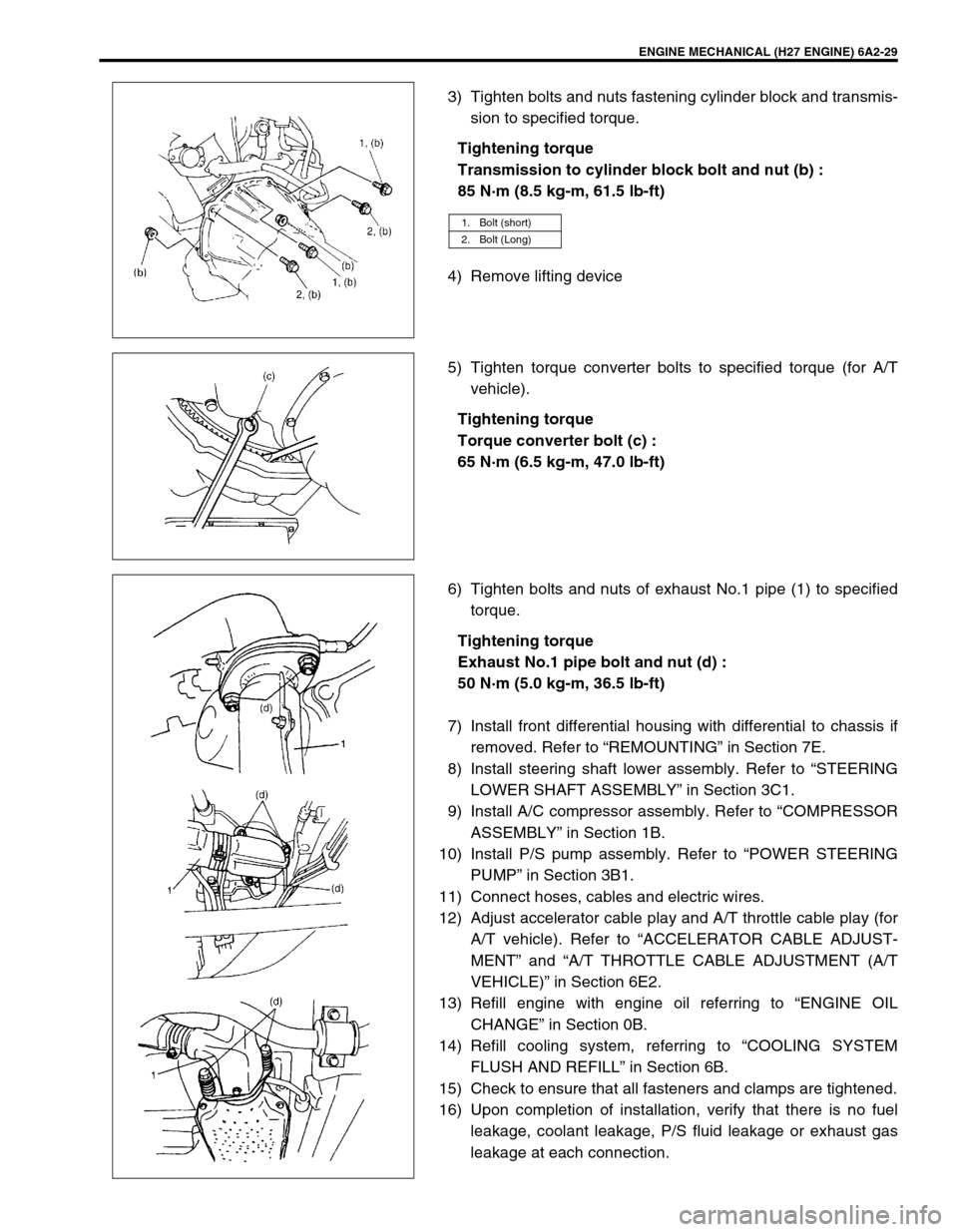
3) Tighten bolts and nuts fastening cylinder block and transmis-
sion to specified torque.
Tightening torque
Transmission to cylinder block bolt and nut (b) :
85 N·m (8.5 kg-m, 61.5 lb-ft)
4) Remove lifting device
5) Tighten torque converter bolts to specified torque (for A/T
vehicle).
Tightening torque
Torque converter bolt (c) :
65 N·m (6.5 kg-m, 47.0 lb-ft)
6) Tighten bolts and nuts of exhaust No.1 pipe (1) to specified
torque.
Tightening torque
Exhaust No.1 pipe bolt and nut (d) :
50 N·m (5.0 kg-m, 36.5 lb-ft)
7) Install front differential housing with differential to chassis if
removed. Refer to “REMOUNTING” in Section 7E.
8) Install steering shaft lower assembly. Refer to “STEERING
LOWER SHAFT ASSEMBLY” in Section 3C1.
9) Install A/C compressor assembly. Refer to “COMPRESSOR
ASSEMBLY” in Section 1B.
10) Install P/S pump assembly. Refer to “POWER STEERING
PUMP” in Section 3B1.
11) Connect hoses, cables and electric wires.
12) Adjust accelerator cable play and A/T throttle cable play (for
A/T vehicle). Refer to “ACCELERATOR CABLE ADJUST-
MENT” and “A/T THROTTLE CABLE ADJUSTMENT (A/T
VEHICLE)” in Section 6E2.
13) Refill engine with engine oil referring to “ENGINE OIL
CHANGE” in Section 0B.
14) Refill cooling system, referring to “COOLING SYSTEM
FLUSH AND REFILL” in Section 6B.
15) Check to ensure that all fasteners and clamps are tightened.
16) Upon completion of installation, verify that there is no fuel
leakage, coolant leakage, P/S fluid leakage or exhaust gas
leakage at each connection.
1. Bolt (short)
2. Bolt (Long)
Page 318 of 656
ENGINE MECHANICAL (H27 ENGINE) 6A2-31
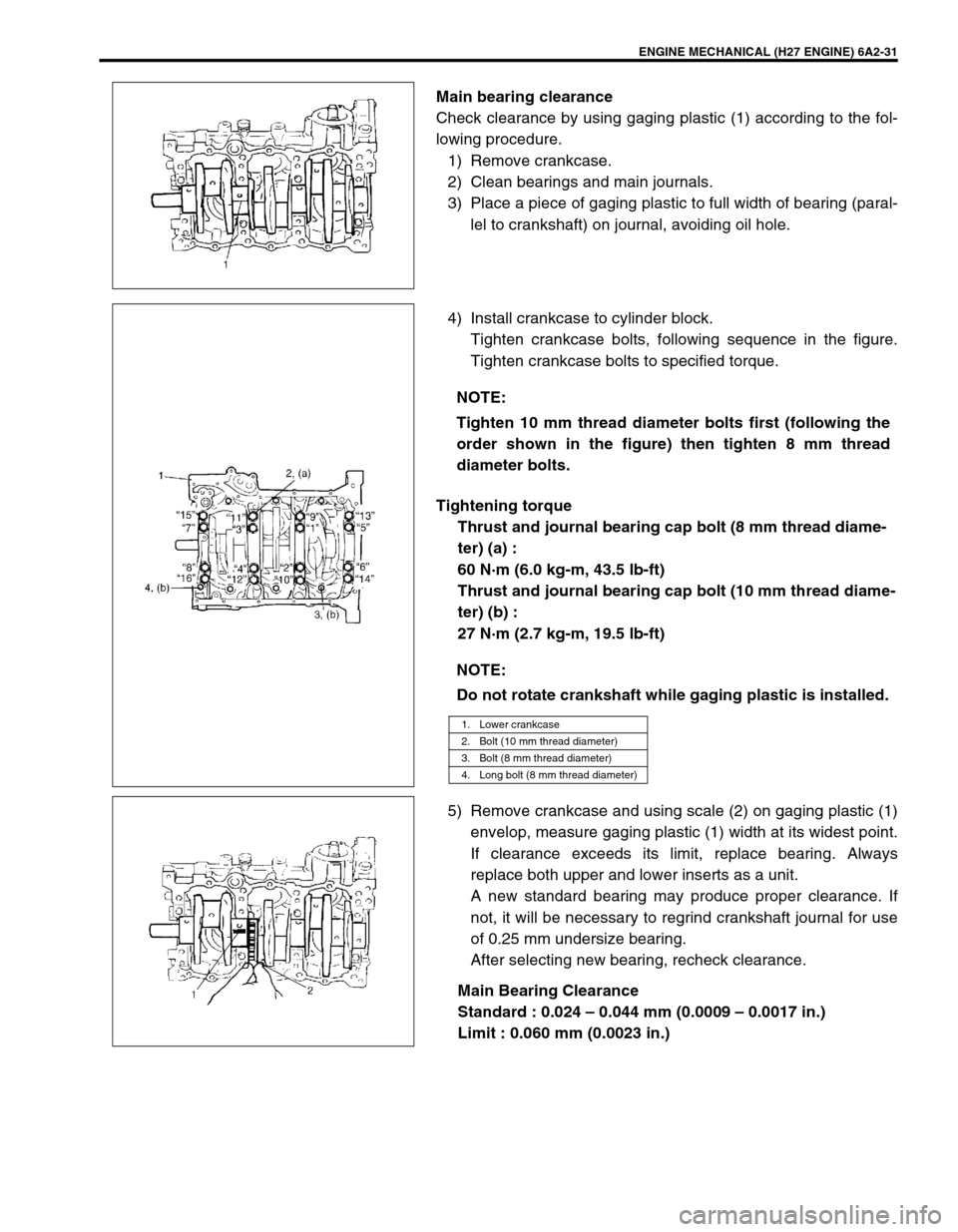
Main bearing clearance
Check clearance by using gaging plastic (1) according to the fol-
lowing procedure.
1) Remove crankcase.
2) Clean bearings and main journals.
3) Place a piece of gaging plastic to full width of bearing (paral-
lel to crankshaft) on journal, avoiding oil hole.
4) Install crankcase to cylinder block.
Tighten crankcase bolts, following sequence in the figure.
Tighten crankcase bolts to specified torque.
Tightening torque
Thrust and journal bearing cap bolt (8 mm thread diame-
ter) (a) :
60 N·m (6.0 kg-m, 43.5 lb-ft)
Thrust and journal bearing cap bolt (10 mm thread diame-
ter) (b) :
27 N·m (2.7 kg-m, 19.5 lb-ft)
5) Remove crankcase and using scale (2) on gaging plastic (1)
envelop, measure gaging plastic (1) width at its widest point.
If clearance exceeds its limit, replace bearing. Always
replace both upper and lower inserts as a unit.
A new standard bearing may produce proper clearance. If
not, it will be necessary to regrind crankshaft journal for use
of 0.25 mm undersize bearing.
After selecting new bearing, recheck clearance.
Main Bearing Clearance
Standard : 0.024 – 0.044 mm (0.0009 – 0.0017 in.)
Limit : 0.060 mm (0.0023 in.)
NOTE:
Tighten 10 mm thread diameter bolts first (following the
order shown in the figure) then tighten 8 mm thread
diameter bolts.
NOTE:
Do not rotate crankshaft while gaging plastic is installed.
1. Lower crankcase
2. Bolt (10 mm thread diameter)
3. Bolt (8 mm thread diameter)
4. Long bolt (8 mm thread diameter)