wiring SUZUKI GRAND VITARA 1999 2.G Owner's Manual
[x] Cancel search | Manufacturer: SUZUKI, Model Year: 1999, Model line: GRAND VITARA, Model: SUZUKI GRAND VITARA 1999 2.GPages: 656, PDF Size: 14.31 MB
Page 205 of 656
6-1-44 ENGINE GENERAL INFORMATION AND DIAGNOSIS (H27 ENGINE)
Table A-2 Malfunction Indicator Lamp Circuit Check – Lamp Remains “ON”
after Engine Starts
WIRING DIAGRAM/CIRCUIT DESCRIPTION
Refer to TABLE A-1.
INSPECTION
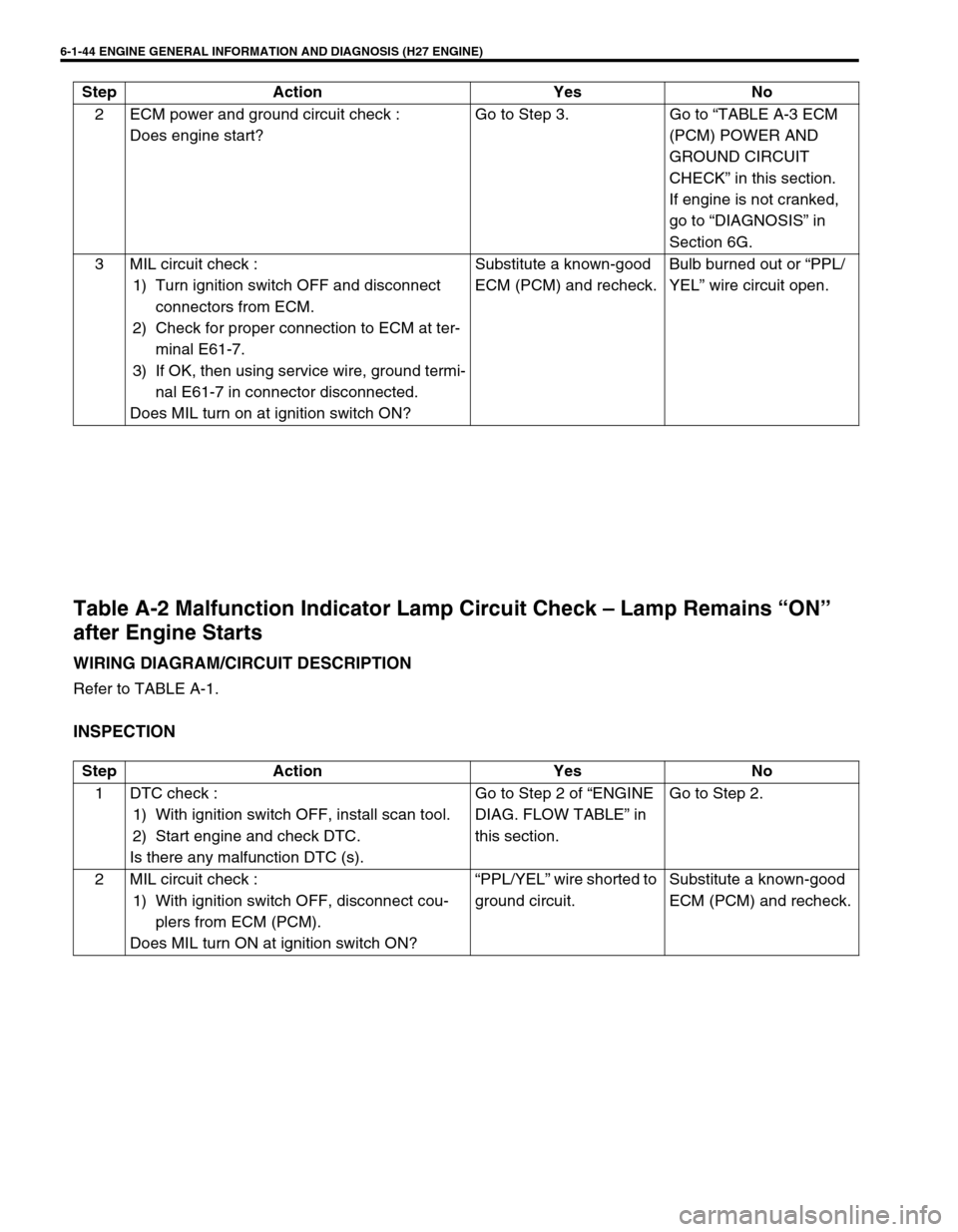
2 ECM power and ground circuit check :
Does engine start?Go to Step 3. Go to “TABLE A-3 ECM
(PCM) POWER AND
GROUND CIRCUIT
CHECK” in this section.
If engine is not cranked,
go to “DIAGNOSIS” in
Section 6G.
3 MIL circuit check :
1) Turn ignition switch OFF and disconnect
connectors from ECM.
2) Check for proper connection to ECM at ter-
minal E61-7.
3) If OK, then using service wire, ground termi-
nal E61-7 in connector disconnected.
Does MIL turn on at ignition switch ON?Substitute a known-good
ECM (PCM) and recheck.Bulb burned out or “PPL/
YEL” wire circuit open. Step Action Yes No
Step Action Yes No
1 DTC check :
1) With ignition switch OFF, install scan tool.
2) Start engine and check DTC.
Is there any malfunction DTC (s).Go to Step 2 of “ENGINE
DIAG. FLOW TABLE” in
this section.Go to Step 2.
2 MIL circuit check :
1) With ignition switch OFF, disconnect cou-
plers from ECM (PCM).
Does MIL turn ON at ignition switch ON?“PPL/YEL” wire shorted to
ground circuit.Substitute a known-good
ECM (PCM) and recheck.
Page 206 of 656
ENGINE GENERAL INFORMATION AND DIAGNOSIS (H27 ENGINE) 6-1-45
Table A-3 Malfunction Indicator Lamp Check – MIL Flashes at Ignition Switch
ON (Vehicle with Monitor Connector)
WIRING DIAGRAM/CIRCUIT DESCRIPTION
Refer to TABLE A-1.
TROUBLESHOOTING
Table A-4 Malfunction Indicator Lamp Check – MIL Does Not Flash or Just
Remains ON Even with Grounding Diagnosis Switch Terminal (Vehicle with
Monitor Connector)
WIRING DIAGRAM/CIRCUIT DESCRIPTION
Refer to TABLE A-1.
TROUBLESHOOTING
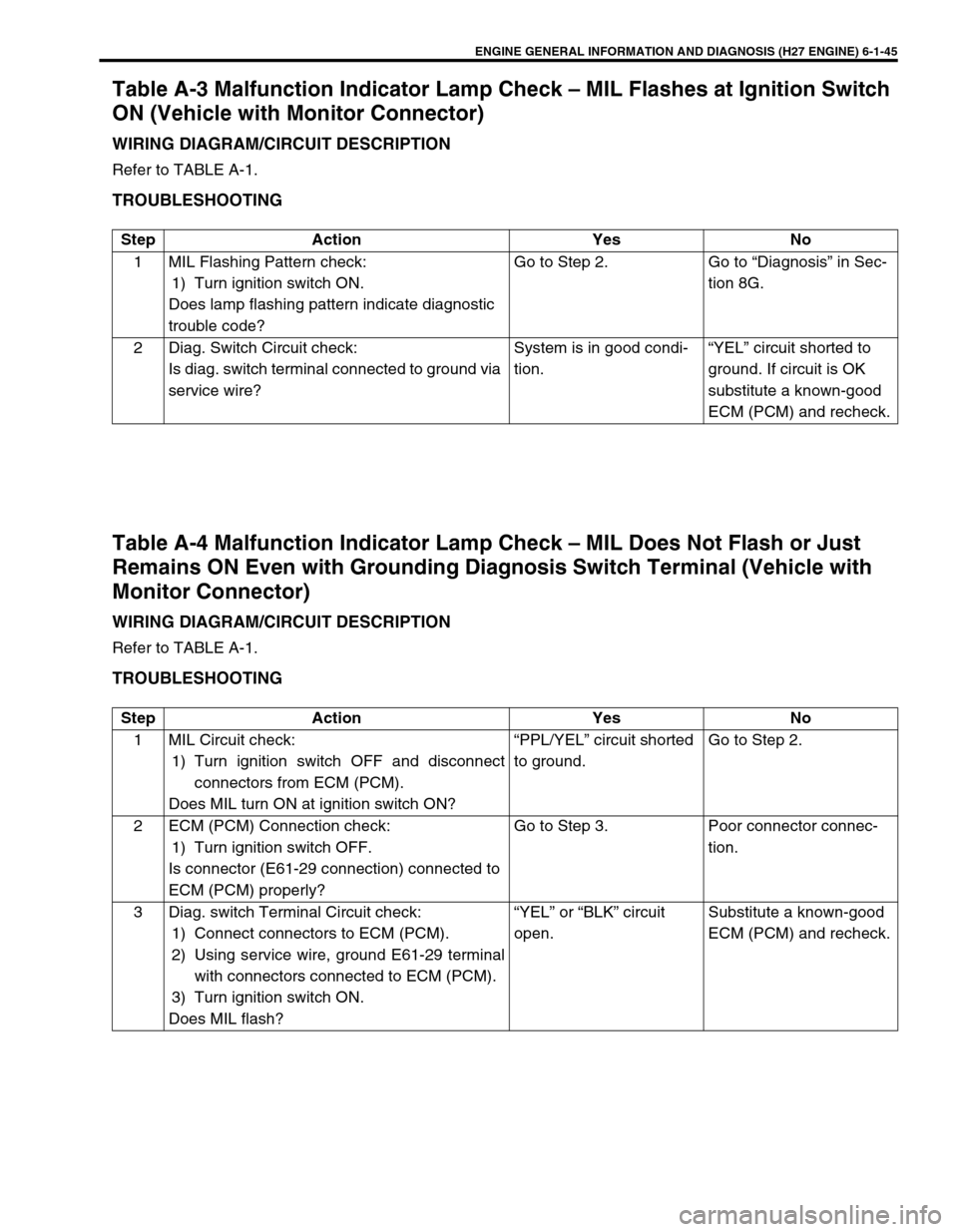
Step Action Yes No
1 MIL Flashing Pattern check:
1) Turn ignition switch ON.
Does lamp flashing pattern indicate diagnostic
trouble code?Go to Step 2. Go to “Diagnosis” in Sec-
tion 8G.
2 Diag. Switch Circuit check:
Is diag. switch terminal connected to ground via
service wire?System is in good condi-
tion.“YEL” circuit shorted to
ground. If circuit is OK
substitute a known-good
ECM (PCM) and recheck.
Step Action Yes No
1 MIL Circuit check:
1) Turn ignition switch OFF and disconnect
connectors from ECM (PCM).
Does MIL turn ON at ignition switch ON?“PPL/YEL” circuit shorted
to ground.Go to Step 2.
2 ECM (PCM) Connection check:
1) Turn ignition switch OFF.
Is connector (E61-29 connection) connected to
ECM (PCM) properly?Go to Step 3. Poor connector connec-
tion.
3 Diag. switch Terminal Circuit check:
1) Connect connectors to ECM (PCM).
2) Using service wire, ground E61-29 terminal
with connectors connected to ECM (PCM).
3) Turn ignition switch ON.
Does MIL flash?“YEL” or “BLK” circuit
open.Substitute a known-good
ECM (PCM) and recheck.
Page 207 of 656
6-1-46 ENGINE GENERAL INFORMATION AND DIAGNOSIS (H27 ENGINE)
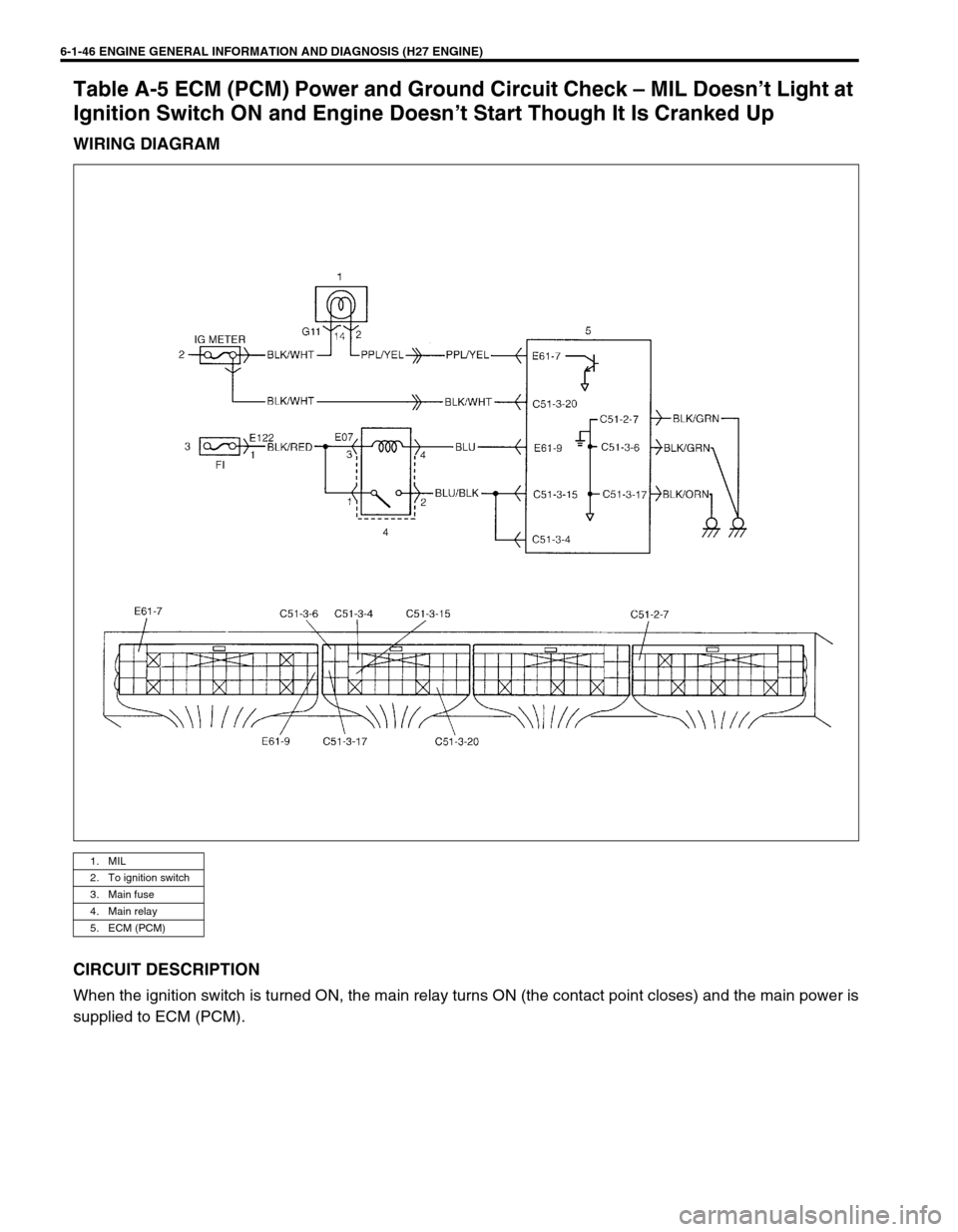
Table A-5 ECM (PCM) Power and Ground Circuit Check – MIL Doesn’t Light at
Ignition Switch ON and Engine Doesn’t Start Though It Is Cranked Up
WIRING DIAGRAM
CIRCUIT DESCRIPTION
When the ignition switch is turned ON, the main relay turns ON (the contact point closes) and the main power is
supplied to ECM (PCM).
1. MIL
2. To ignition switch
3. Main fuse
4. Main relay
5. ECM (PCM)
Page 209 of 656
6-1-48 ENGINE GENERAL INFORMATION AND DIAGNOSIS (H27 ENGINE)
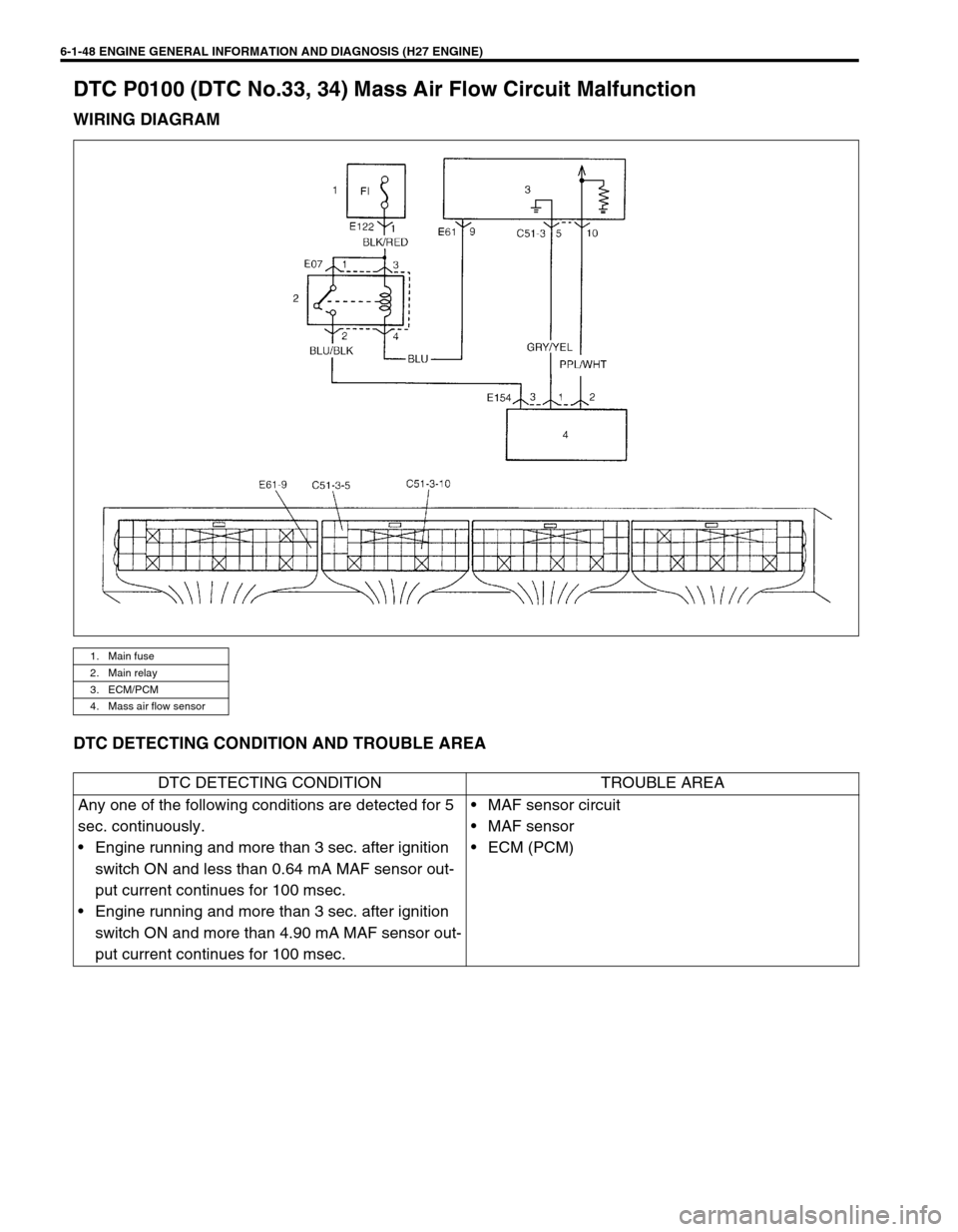
DTC P0100 (DTC No.33, 34) Mass Air Flow Circuit Malfunction
WIRING DIAGRAM
DTC DETECTING CONDITION AND TROUBLE AREA
1. Main fuse
2. Main relay
3. ECM/PCM
4. Mass air flow sensor
DTC DETECTING CONDITION TROUBLE AREA
Any one of the following conditions are detected for 5
sec. continuously.
• Engine running and more than 3 sec. after ignition
switch ON and less than 0.64 mA MAF sensor out-
put current continues for 100 msec.
• Engine running and more than 3 sec. after ignition
switch ON and more than 4.90 mA MAF sensor out-
put current continues for 100 msec.• MAF sensor circuit
• MAF sensor
• ECM (PCM)
Page 211 of 656
6-1-50 ENGINE GENERAL INFORMATION AND DIAGNOSIS (H27 ENGINE)
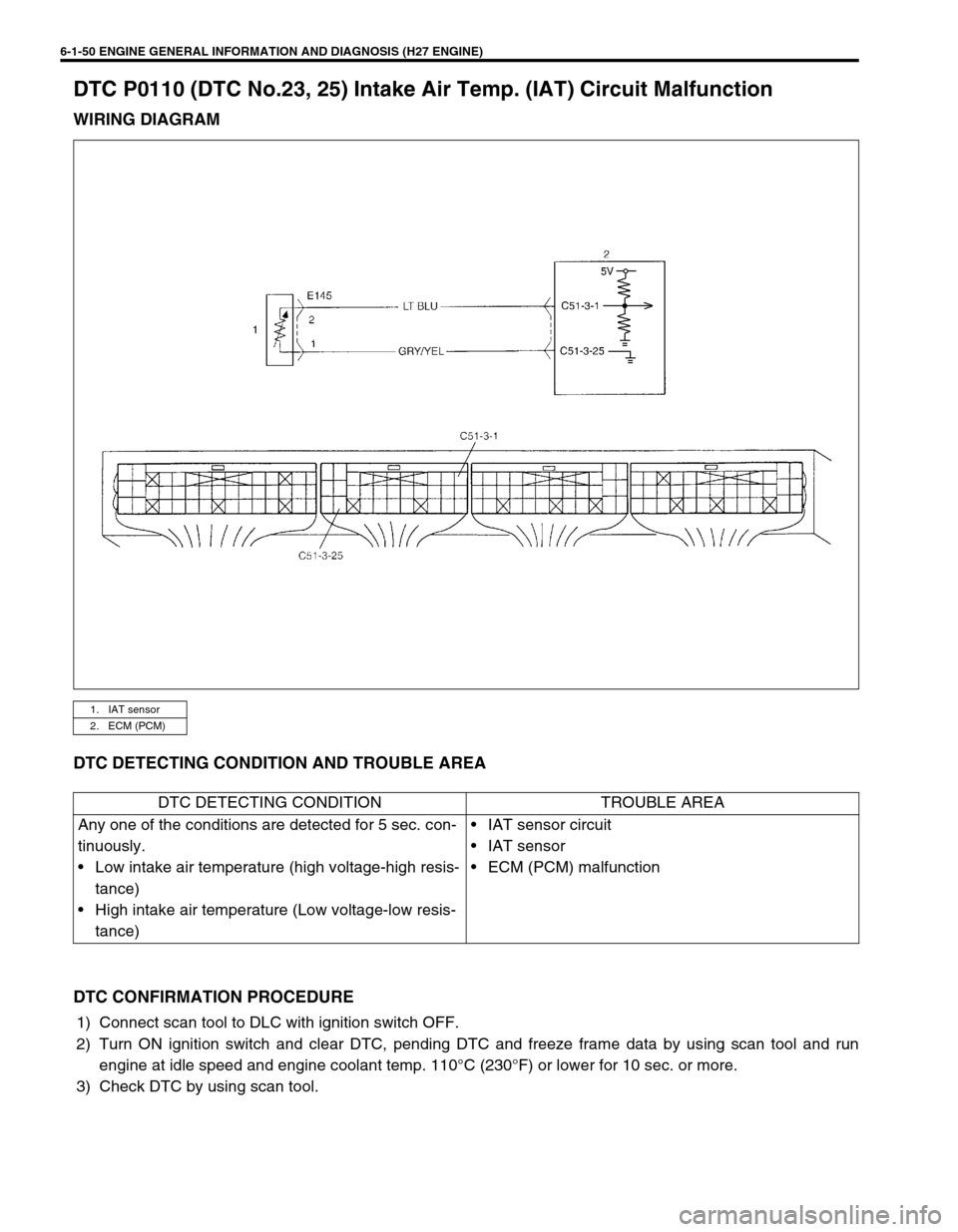
DTC P0110 (DTC No.23, 25) Intake Air Temp. (IAT) Circuit Malfunction
WIRING DIAGRAM
DTC DETECTING CONDITION AND TROUBLE AREA
DTC CONFIRMATION PROCEDURE
1) Connect scan tool to DLC with ignition switch OFF.
2) Turn ON ignition switch and clear DTC, pending DTC and freeze frame data by using scan tool and run
engine at idle speed and engine coolant temp. 110°C (230°F) or lower for 10 sec. or more.
3) Check DTC by using scan tool.
1. IAT sensor
2. ECM (PCM)
DTC DETECTING CONDITION TROUBLE AREA
Any one of the conditions are detected for 5 sec. con-
tinuously.
• Low intake air temperature (high voltage-high resis-
tance)
• High intake air temperature (Low voltage-low resis-
tance)• IAT sensor circuit
• IAT sensor
• ECM (PCM) malfunction
Page 213 of 656
6-1-52 ENGINE GENERAL INFORMATION AND DIAGNOSIS (H27 ENGINE)
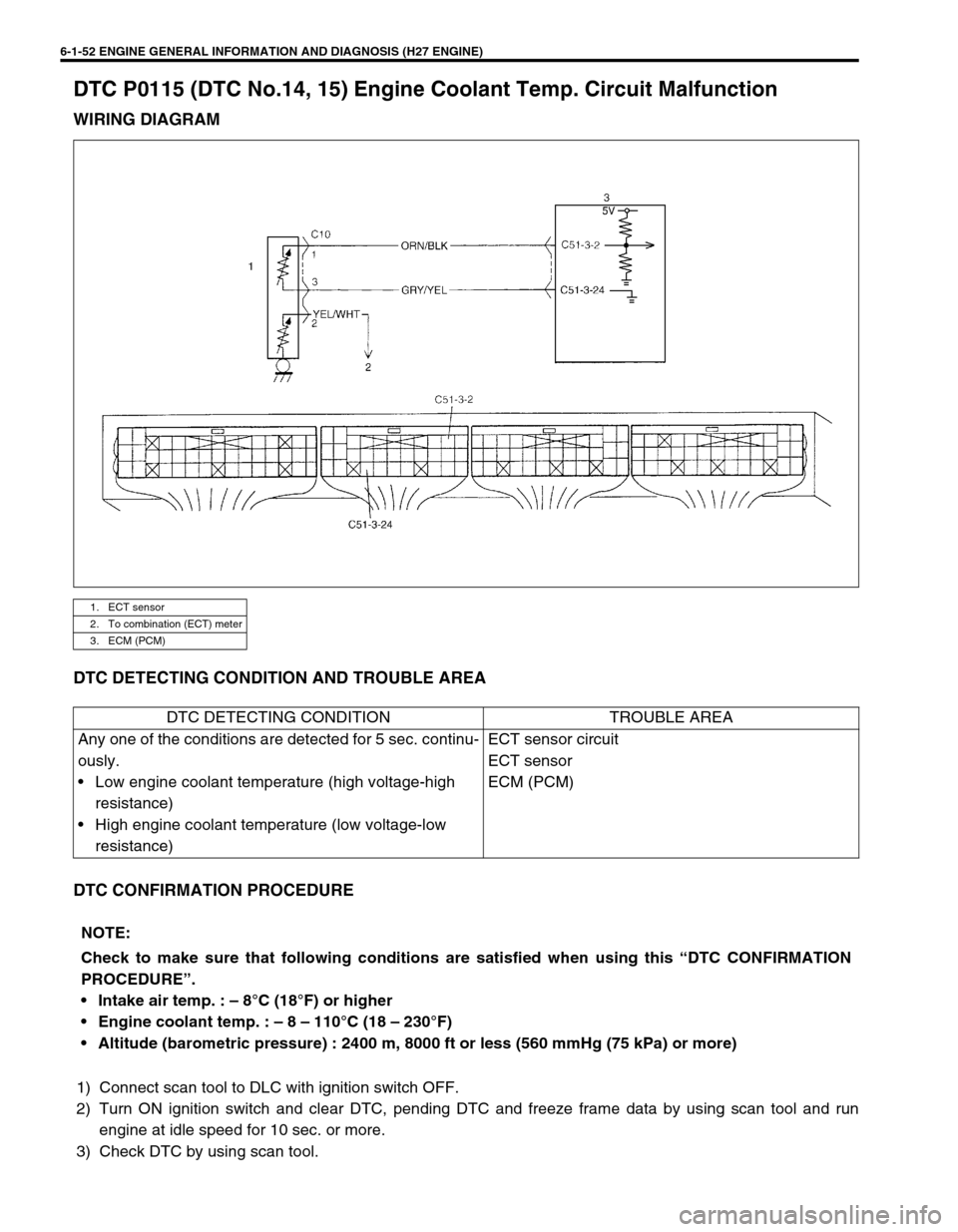
DTC P0115 (DTC No.14, 15) Engine Coolant Temp. Circuit Malfunction
WIRING DIAGRAM
DTC DETECTING CONDITION AND TROUBLE AREA
DTC CONFIRMATION PROCEDURE
1) Connect scan tool to DLC with ignition switch OFF.
2) Turn ON ignition switch and clear DTC, pending DTC and freeze frame data by using scan tool and run
engine at idle speed for 10 sec. or more.
3) Check DTC by using scan tool.
1. ECT sensor
2. To combination (ECT) meter
3. ECM (PCM)
DTC DETECTING CONDITION TROUBLE AREA
Any one of the conditions are detected for 5 sec. continu-
ously.
• Low engine coolant temperature (high voltage-high
resistance)
• High engine coolant temperature (low voltage-low
resistance)ECT sensor circuit
ECT sensor
ECM (PCM)
NOTE:
Check to make sure that following conditions are satisfied when using this “DTC CONFIRMATION
PROCEDURE”.
Intake air temp. : – 8°C (18°F) or higher
Engine coolant temp. : – 8 – 110°C (18 – 230°F)
Altitude (barometric pressure) : 2400 m, 8000 ft or less (560 mmHg (75 kPa) or more)
Page 215 of 656
6-1-54 ENGINE GENERAL INFORMATION AND DIAGNOSIS (H27 ENGINE)
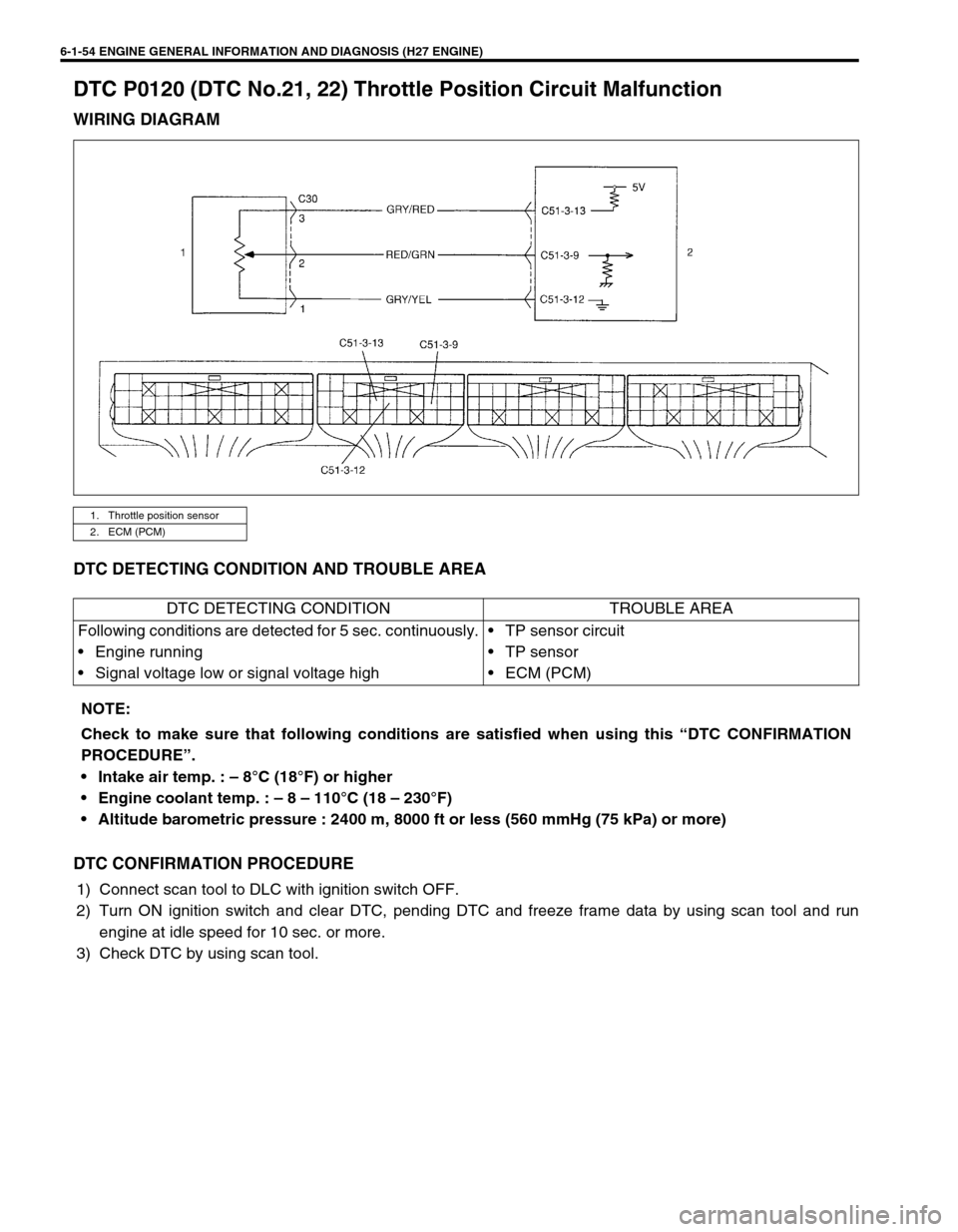
DTC P0120 (DTC No.21, 22) Throttle Position Circuit Malfunction
WIRING DIAGRAM
DTC DETECTING CONDITION AND TROUBLE AREA
DTC CONFIRMATION PROCEDURE
1) Connect scan tool to DLC with ignition switch OFF.
2) Turn ON ignition switch and clear DTC, pending DTC and freeze frame data by using scan tool and run
engine at idle speed for 10 sec. or more.
3) Check DTC by using scan tool.
1. Throttle position sensor
2. ECM (PCM)
DTC DETECTING CONDITION TROUBLE AREA
Following conditions are detected for 5 sec. continuously.
• Engine running
• Signal voltage low or signal voltage high• TP sensor circuit
•TP sensor
•ECM (PCM)
NOTE:
Check to make sure that following conditions are satisfied when using this “DTC CONFIRMATION
PROCEDURE”.
Intake air temp. : – 8°C (18°F) or higher
Engine coolant temp. : – 8 – 110°C (18 – 230°F)
Altitude barometric pressure : 2400 m, 8000 ft or less (560 mmHg (75 kPa) or more)
Page 217 of 656
6-1-56 ENGINE GENERAL INFORMATION AND DIAGNOSIS (H27 ENGINE)
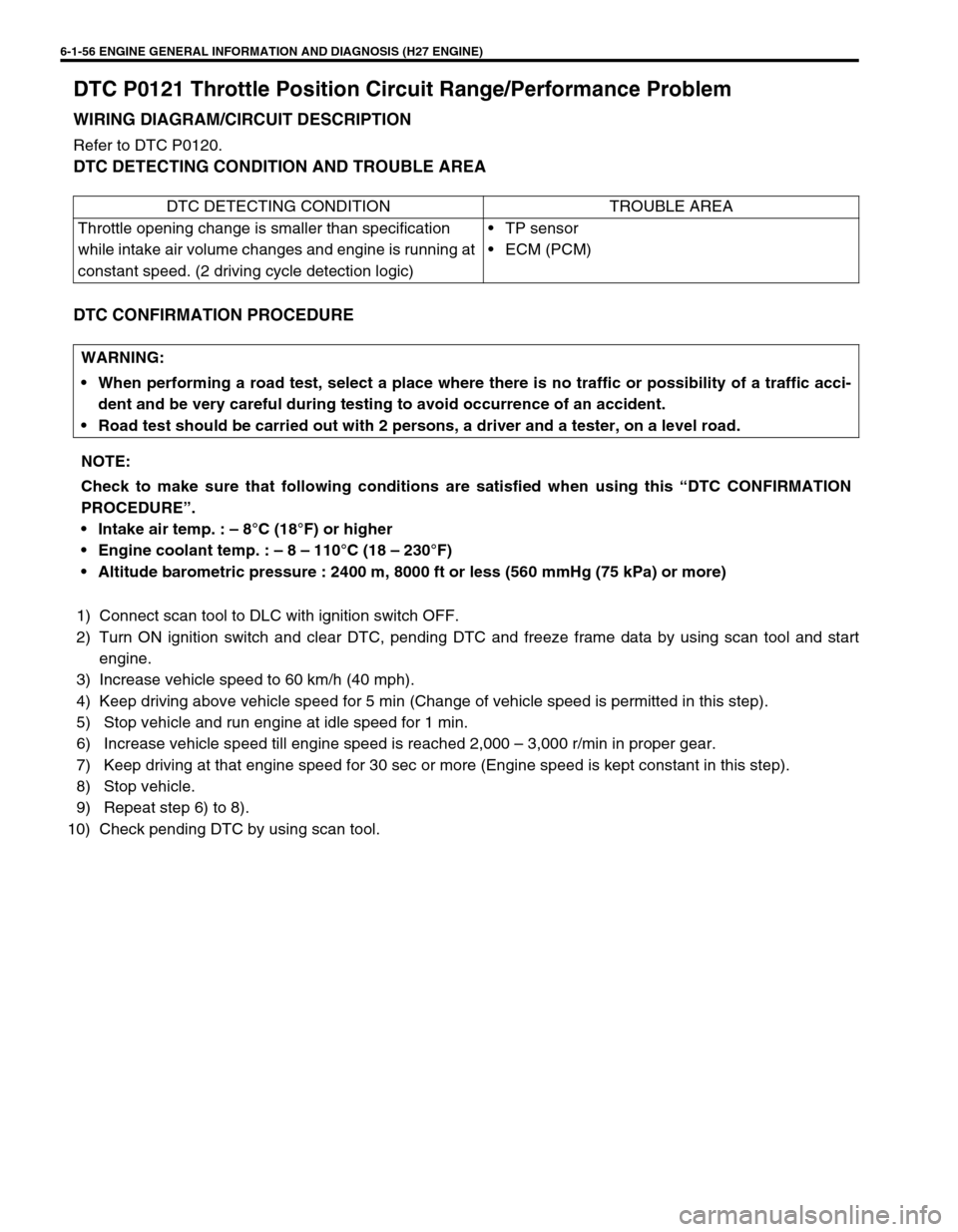
DTC P0121 Throttle Position Circuit Range/Performance Problem
WIRING DIAGRAM/CIRCUIT DESCRIPTION
Refer to DTC P0120.
DTC DETECTING CONDITION AND TROUBLE AREA
DTC CONFIRMATION PROCEDURE
1) Connect scan tool to DLC with ignition switch OFF.
2) Turn ON ignition switch and clear DTC, pending DTC and freeze frame data by using scan tool and start
engine.
3) Increase vehicle speed to 60 km/h (40 mph).
4) Keep driving above vehicle speed for 5 min (Change of vehicle speed is permitted in this step).
5) Stop vehicle and run engine at idle speed for 1 min.
6) Increase vehicle speed till engine speed is reached 2,000 – 3,000 r/min in proper gear.
7) Keep driving at that engine speed for 30 sec or more (Engine speed is kept constant in this step).
8) Stop vehicle.
9) Repeat step 6) to 8).
10) Check pending DTC by using scan tool.DTC DETECTING CONDITION TROUBLE AREA
Throttle opening change is smaller than specification
while intake air volume changes and engine is running at
constant speed. (2 driving cycle detection logic)•TP sensor
•ECM (PCM)
WARNING:
When performing a road test, select a place where there is no traffic or possibility of a traffic acci-
dent and be very careful during testing to avoid occurrence of an accident.
Road test should be carried out with 2 persons, a driver and a tester, on a level road.
NOTE:
Check to make sure that following conditions are satisfied when using this “DTC CONFIRMATION
PROCEDURE”.
Intake air temp. : – 8°C (18°F) or higher
Engine coolant temp. : – 8 – 110°C (18 – 230°F)
Altitude barometric pressure : 2400 m, 8000 ft or less (560 mmHg (75 kPa) or more)
Page 219 of 656
6-1-58 ENGINE GENERAL INFORMATION AND DIAGNOSIS (H27 ENGINE)
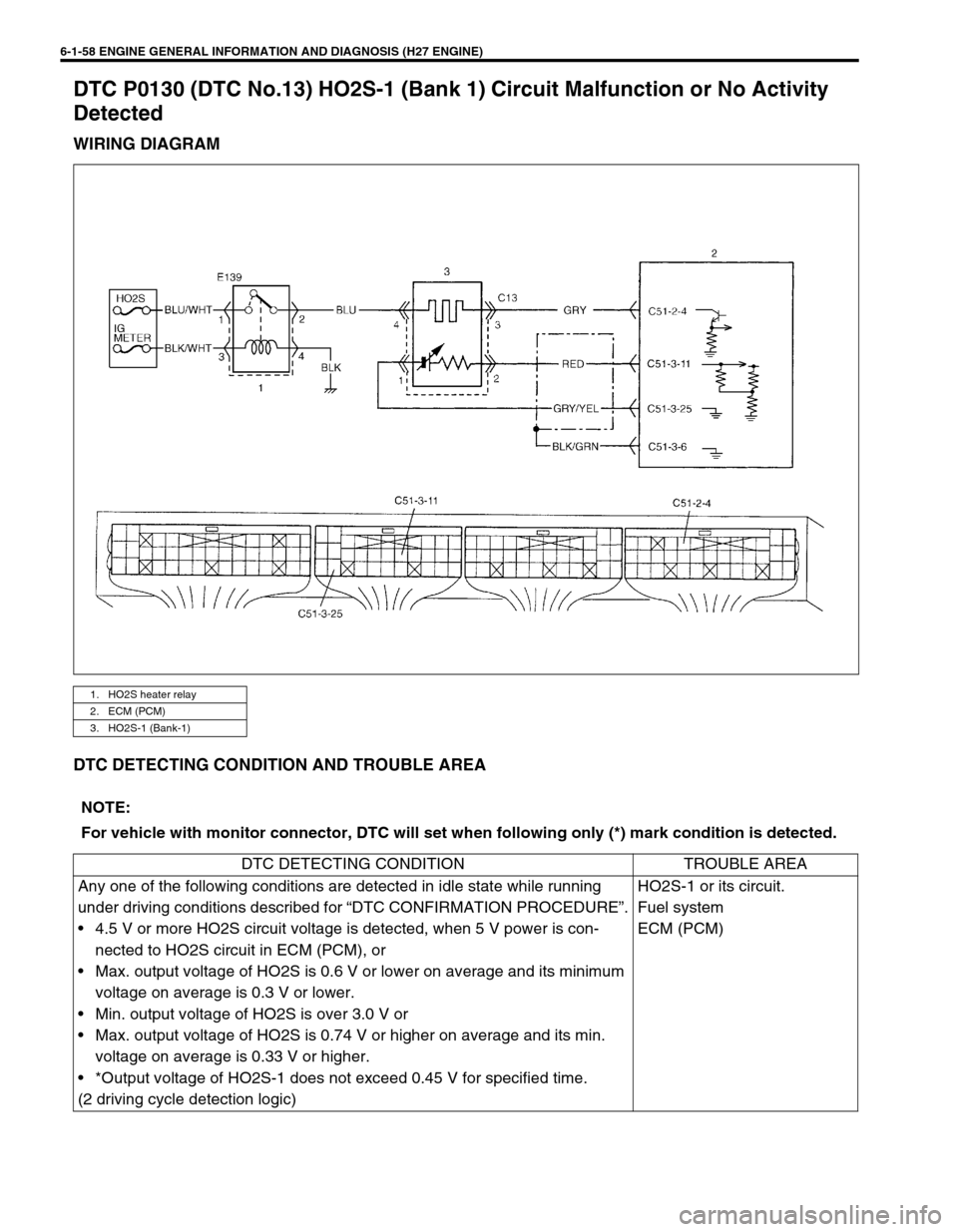
DTC P0130 (DTC No.13) HO2S-1 (Bank 1) Circuit Malfunction or No Activity
Detected
WIRING DIAGRAM
DTC DETECTING CONDITION AND TROUBLE AREA
1. HO2S heater relay
2. ECM (PCM)
3. HO2S-1 (Bank-1)
NOTE:
For vehicle with monitor connector, DTC will set when following only (*) mark condition is detected.
DTC DETECTING CONDITION TROUBLE AREA
Any one of the following conditions are detected in idle state while running
under driving conditions described for “DTC CONFIRMATION PROCEDURE”.
• 4.5 V or more HO2S circuit voltage is detected, when 5 V power is con-
nected to HO2S circuit in ECM (PCM), or
• Max. output voltage of HO2S is 0.6 V or lower on average and its minimum
voltage on average is 0.3 V or lower.
• Min. output voltage of HO2S is over 3.0 V or
• Max. output voltage of HO2S is 0.74 V or higher on average and its min.
voltage on average is 0.33 V or higher.
• *Output voltage of HO2S-1 does not exceed 0.45 V for specified time.
(2 driving cycle detection logic)HO2S-1 or its circuit.
Fuel system
ECM (PCM)
Page 221 of 656
6-1-60 ENGINE GENERAL INFORMATION AND DIAGNOSIS (H27 ENGINE)
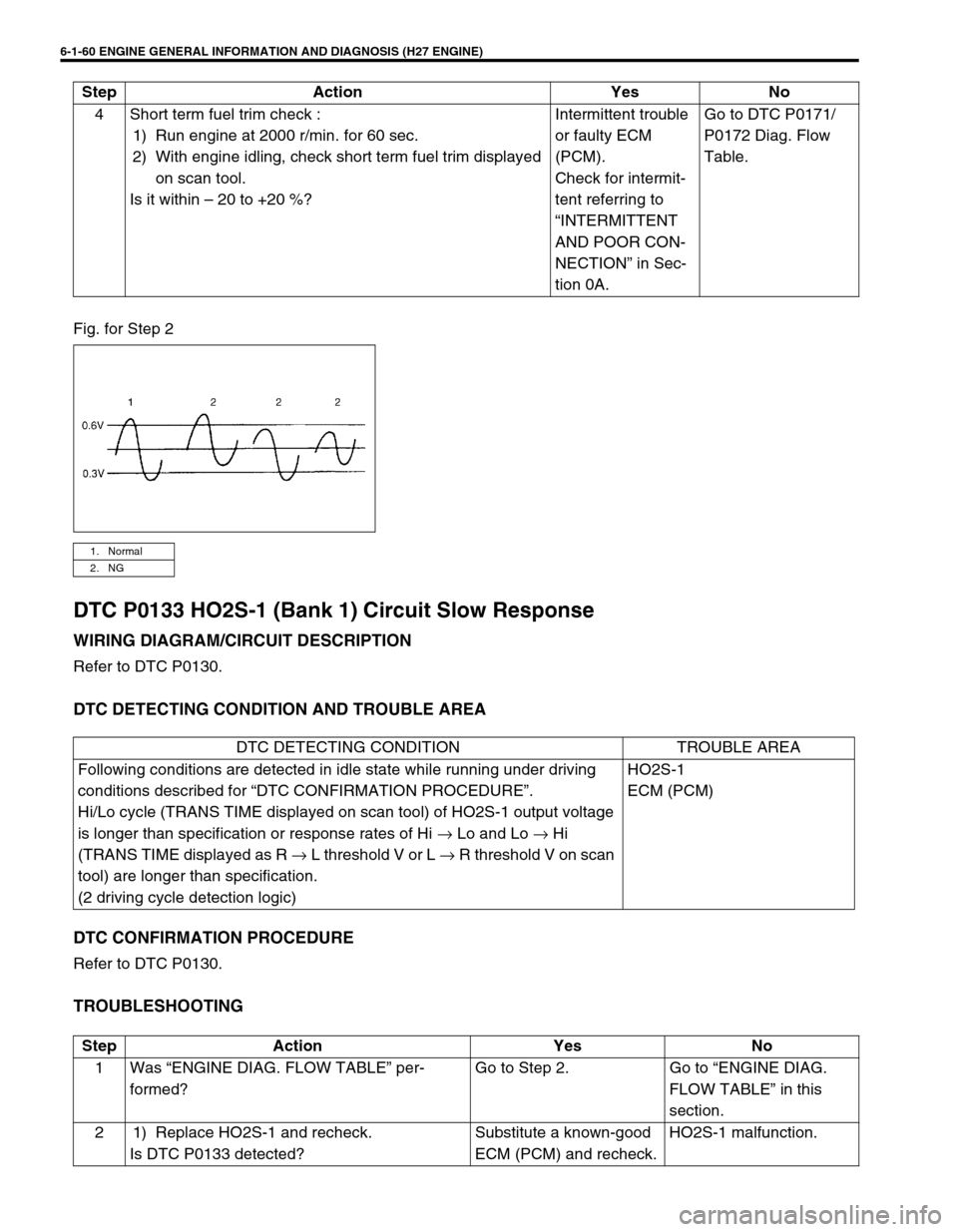
Fig. for Step 2
DTC P0133 HO2S-1 (Bank 1) Circuit Slow Response
WIRING DIAGRAM/CIRCUIT DESCRIPTION
Refer to DTC P0130.
DTC DETECTING CONDITION AND TROUBLE AREA
DTC CONFIRMATION PROCEDURE
Refer to DTC P0130.
TROUBLESHOOTING
4 Short term fuel trim check :
1) Run engine at 2000 r/min. for 60 sec.
2) With engine idling, check short term fuel trim displayed
on scan tool.
Is it within – 20 to +20 %?Intermittent trouble
or faulty ECM
(PCM).
Check for intermit-
tent referring to
“INTERMITTENT
AND POOR CON-
NECTION” in Sec-
tion 0A.Go to DTC P0171/
P0172 Diag. Flow
Table. Step Action Yes No
1. Normal
2. NG
DTC DETECTING CONDITION TROUBLE AREA
Following conditions are detected in idle state while running under driving
conditions described for “DTC CONFIRMATION PROCEDURE”.
Hi/Lo cycle (TRANS TIME displayed on scan tool) of HO2S-1 output voltage
is longer than specification or response rates of Hi → Lo and Lo → Hi
(TRANS TIME displayed as R → L threshold V or L → R threshold V on scan
tool) are longer than specification.
(2 driving cycle detection logic)HO2S-1
ECM (PCM)
Step Action Yes No
1 Was “ENGINE DIAG. FLOW TABLE” per-
formed?Go to Step 2. Go to “ENGINE DIAG.
FLOW TABLE” in this
section.
2 1) Replace HO2S-1 and recheck.
Is DTC P0133 detected?Substitute a known-good
ECM (PCM) and recheck.HO2S-1 malfunction.