troubleshooting SUZUKI GRAND VITARA 1999 2.G Workshop Manual
[x] Cancel search | Manufacturer: SUZUKI, Model Year: 1999, Model line: GRAND VITARA, Model: SUZUKI GRAND VITARA 1999 2.GPages: 656, PDF Size: 14.31 MB
Page 439 of 656
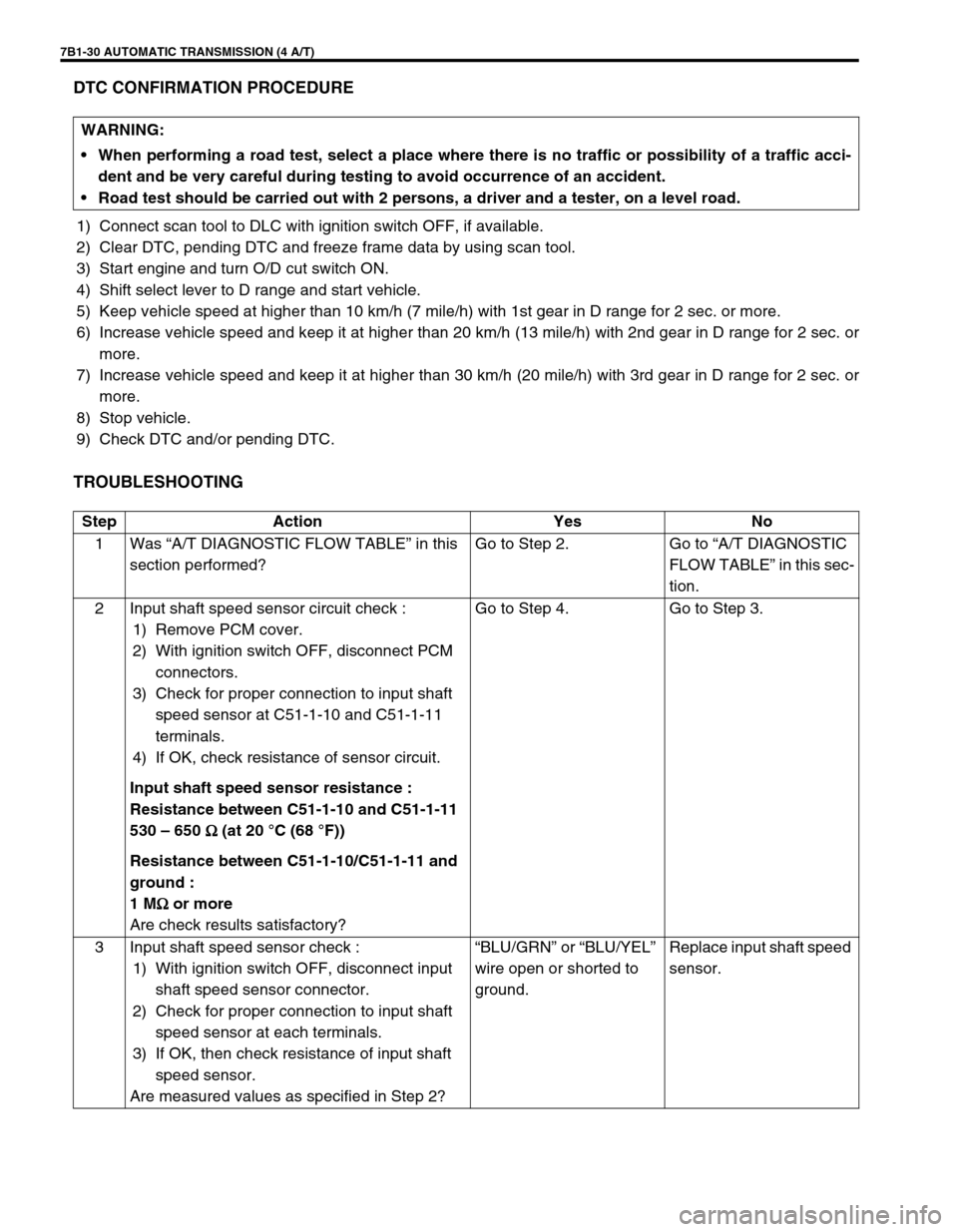
7B1-30 AUTOMATIC TRANSMISSION (4 A/T)
DTC CONFIRMATION PROCEDURE
1) Connect scan tool to DLC with ignition switch OFF, if available.
2) Clear DTC, pending DTC and freeze frame data by using scan tool.
3) Start engine and turn O/D cut switch ON.
4) Shift select lever to D range and start vehicle.
5) Keep vehicle speed at higher than 10 km/h (7 mile/h) with 1st gear in D range for 2 sec. or more.
6) Increase vehicle speed and keep it at higher than 20 km/h (13 mile/h) with 2nd gear in D range for 2 sec. or
more.
7) Increase vehicle speed and keep it at higher than 30 km/h (20 mile/h) with 3rd gear in D range for 2 sec. or
more.
8) Stop vehicle.
9) Check DTC and/or pending DTC.
TROUBLESHOOTING
WARNING:
When performing a road test, select a place where there is no traffic or possibility of a traffic acci-
dent and be very careful during testing to avoid occurrence of an accident.
Road test should be carried out with 2 persons, a driver and a tester, on a level road.
Step Action Yes No
1Was “A/T DIAGNOSTIC FLOW TABLE” in this
section performed?Go to Step 2. Go to “A/T DIAGNOSTIC
FLOW TABLE” in this sec-
tion.
2 Input shaft speed sensor circuit check :
1) Remove PCM cover.
2) With ignition switch OFF, disconnect PCM
connectors.
3) Check for proper connection to input shaft
speed sensor at C51-1-10 and C51-1-11
terminals.
4) If OK, check resistance of sensor circuit.
Input shaft speed sensor resistance :
Resistance between C51-1-10 and C51-1-11
530 – 650 Ω
ΩΩ Ω (at 20 °C (68 °F))
Resistance between C51-1-10/C51-1-11 and
ground :
1 MΩ
ΩΩ Ω or more
Are check results satisfactory?Go to Step 4. Go to Step 3.
3 Input shaft speed sensor check :
1) With ignition switch OFF, disconnect input
shaft speed sensor connector.
2) Check for proper connection to input shaft
speed sensor at each terminals.
3) If OK, then check resistance of input shaft
speed sensor.
Are measured values as specified in Step 2?“BLU/GRN” or “BLU/YEL”
wire open or shorted to
ground.Replace input shaft speed
sensor.
Page 442 of 656
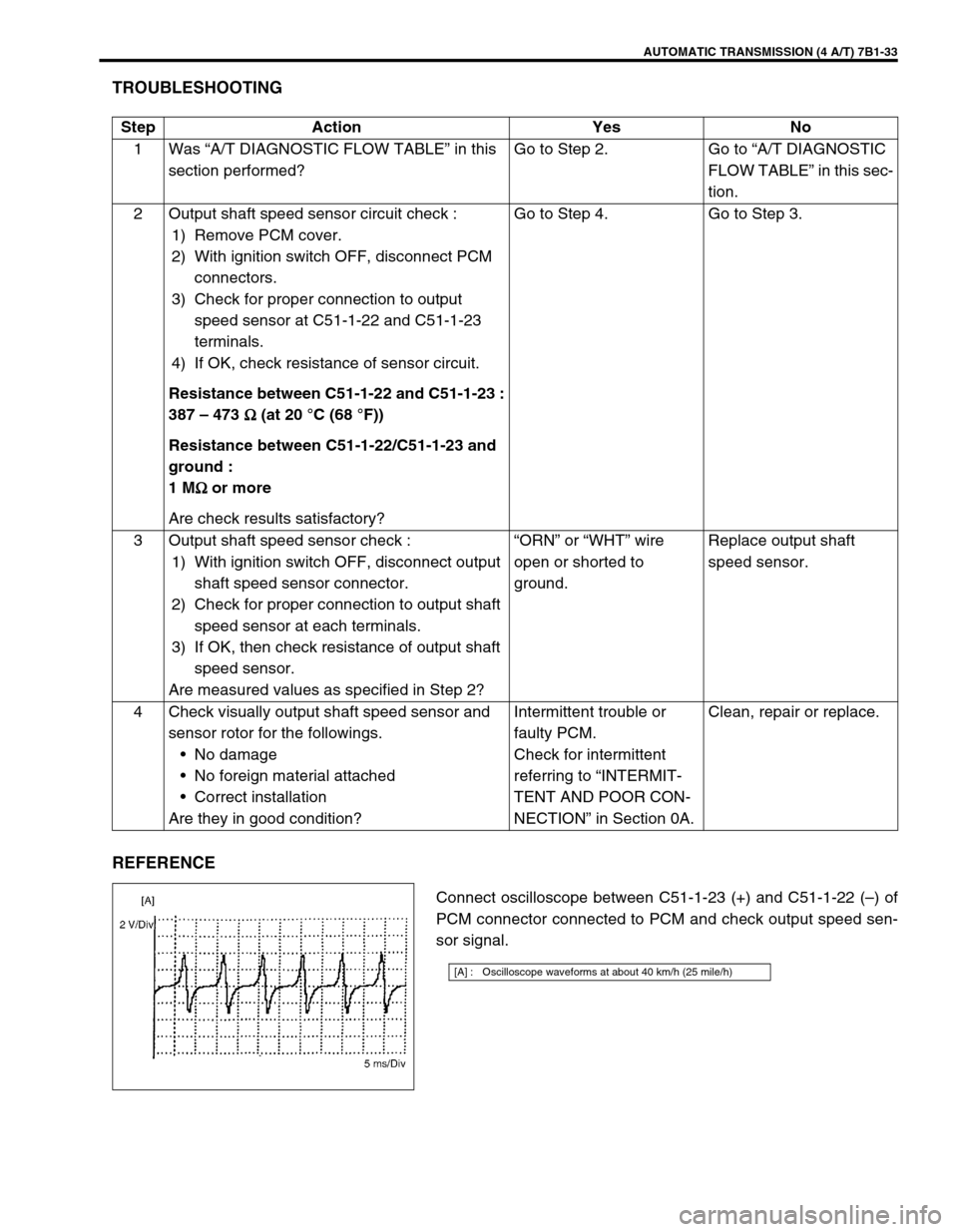
AUTOMATIC TRANSMISSION (4 A/T) 7B1-33
TROUBLESHOOTING
REFERENCE
Connect oscilloscope between C51-1-23 (+) and C51-1-22 (–) of
PCM connector connected to PCM and check output speed sen-
sor signal. Step Action Yes No
1Was “A/T DIAGNOSTIC FLOW TABLE” in this
section performed?Go to Step 2. Go to “A/T DIAGNOSTIC
FLOW TABLE” in this sec-
tion.
2 Output shaft speed sensor circuit check :
1) Remove PCM cover.
2) With ignition switch OFF, disconnect PCM
connectors.
3) Check for proper connection to output
speed sensor at C51-1-22 and C51-1-23
terminals.
4) If OK, check resistance of sensor circuit.
Resistance between C51-1-22 and C51-1-23 :
387 – 473 Ω
ΩΩ Ω (at 20 °C (68 °F))
Resistance between C51-1-22/C51-1-23 and
ground :
1 MΩ
ΩΩ Ω or more
Are check results satisfactory?Go to Step 4. Go to Step 3.
3 Output shaft speed sensor check :
1) With ignition switch OFF, disconnect output
shaft speed sensor connector.
2) Check for proper connection to output shaft
speed sensor at each terminals.
3) If OK, then check resistance of output shaft
speed sensor.
Are measured values as specified in Step 2?“ORN” or “WHT” wire
open or shorted to
ground.Replace output shaft
speed sensor.
4 Check visually output shaft speed sensor and
sensor rotor for the followings.
•No damage
•No foreign material attached
•Correct installation
Are they in good condition?Intermittent trouble or
faulty PCM.
Check for intermittent
referring to “INTERMIT-
TENT AND POOR CON-
NECTION” in Section 0A.Clean, repair or replace.
[A] : Oscilloscope waveforms at about 40 km/h (25 mile/h)
Page 444 of 656
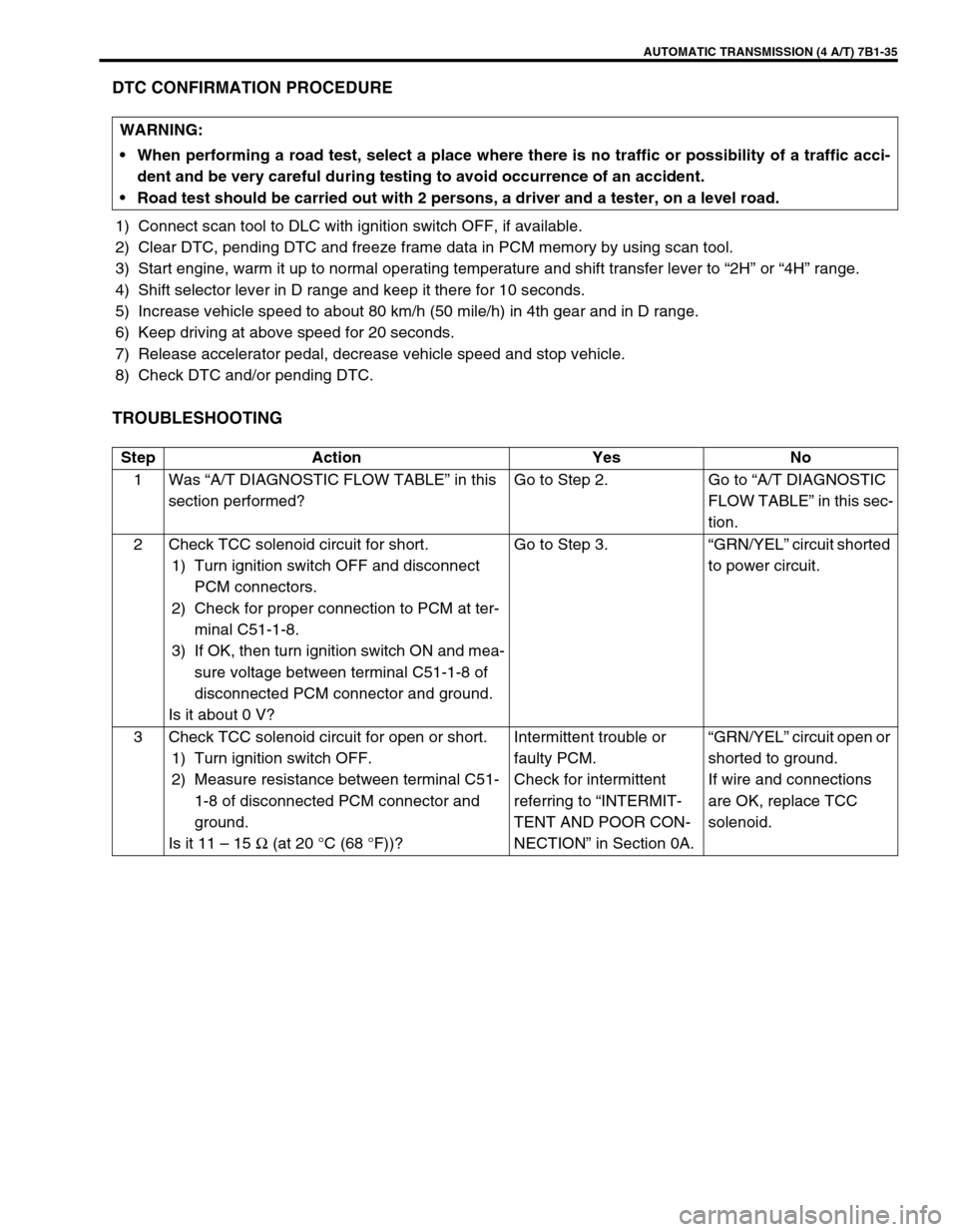
AUTOMATIC TRANSMISSION (4 A/T) 7B1-35
DTC CONFIRMATION PROCEDURE
1) Connect scan tool to DLC with ignition switch OFF, if available.
2) Clear DTC, pending DTC and freeze frame data in PCM memory by using scan tool.
3) Start engine, warm it up to normal operating temperature and shift transfer lever to “2H” or “4H” range.
4) Shift selector lever in D range and keep it there for 10 seconds.
5) Increase vehicle speed to about 80 km/h (50 mile/h) in 4th gear and in D range.
6) Keep driving at above speed for 20 seconds.
7) Release accelerator pedal, decrease vehicle speed and stop vehicle.
8) Check DTC and/or pending DTC.
TROUBLESHOOTING
WARNING:
When performing a road test, select a place where there is no traffic or possibility of a traffic acci-
dent and be very careful during testing to avoid occurrence of an accident.
Road test should be carried out with 2 persons, a driver and a tester, on a level road.
Step Action Yes No
1Was “A/T DIAGNOSTIC FLOW TABLE” in this
section performed?Go to Step 2. Go to “A/T DIAGNOSTIC
FLOW TABLE” in this sec-
tion.
2 Check TCC solenoid circuit for short.
1) Turn ignition switch OFF and disconnect
PCM connectors.
2) Check for proper connection to PCM at ter-
minal C51-1-8.
3) If OK, then turn ignition switch ON and mea-
sure voltage between terminal C51-1-8 of
disconnected PCM connector and ground.
Is it about 0 V?Go to Step 3.“GRN/YEL” circuit shorted
to power circuit.
3 Check TCC solenoid circuit for open or short.
1) Turn ignition switch OFF.
2) Measure resistance between terminal C51-
1-8 of disconnected PCM connector and
ground.
Is it 11 – 15 Ω (at 20 °C (68 °F))?Intermittent trouble or
faulty PCM.
Check for intermittent
referring to “INTERMIT-
TENT AND POOR CON-
NECTION” in Section 0A.“GRN/YEL” circuit open or
shorted to ground.
If wire and connections
are OK, replace TCC
solenoid.
Page 446 of 656
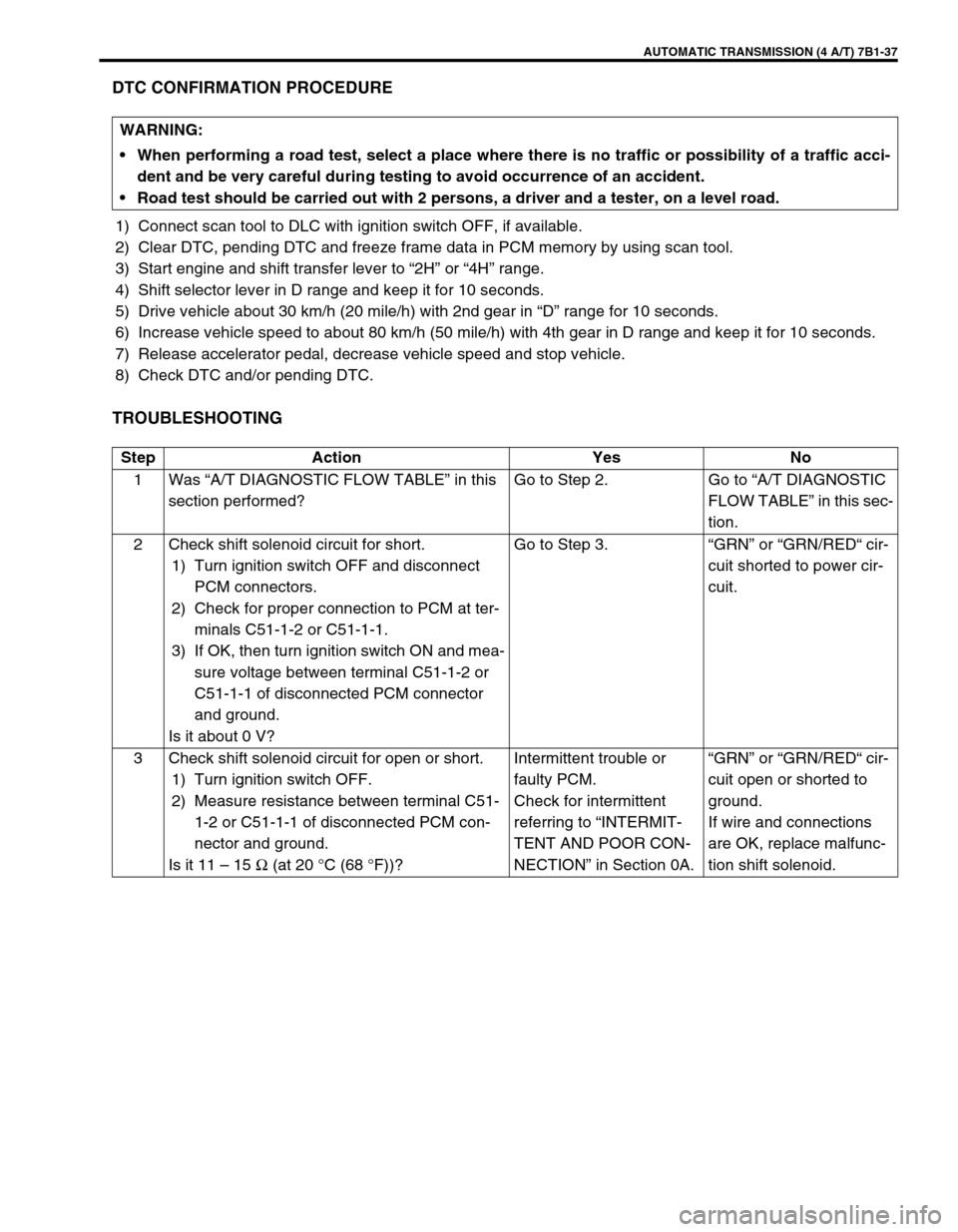
AUTOMATIC TRANSMISSION (4 A/T) 7B1-37
DTC CONFIRMATION PROCEDURE
1) Connect scan tool to DLC with ignition switch OFF, if available.
2) Clear DTC, pending DTC and freeze frame data in PCM memory by using scan tool.
3) Start engine and shift transfer lever to “2H” or “4H” range.
4) Shift selector lever in D range and keep it for 10 seconds.
5) Drive vehicle about 30 km/h (20 mile/h) with 2nd gear in “D” range for 10 seconds.
6) Increase vehicle speed to about 80 km/h (50 mile/h) with 4th gear in D range and keep it for 10 seconds.
7) Release accelerator pedal, decrease vehicle speed and stop vehicle.
8) Check DTC and/or pending DTC.
TROUBLESHOOTING
WARNING:
When performing a road test, select a place where there is no traffic or possibility of a traffic acci-
dent and be very careful during testing to avoid occurrence of an accident.
Road test should be carried out with 2 persons, a driver and a tester, on a level road.
Step Action Yes No
1Was “A/T DIAGNOSTIC FLOW TABLE” in this
section performed?Go to Step 2. Go to “A/T DIAGNOSTIC
FLOW TABLE” in this sec-
tion.
2 Check shift solenoid circuit for short.
1) Turn ignition switch OFF and disconnect
PCM connectors.
2) Check for proper connection to PCM at ter-
minals C51-1-2 or C51-1-1.
3) If OK, then turn ignition switch ON and mea-
sure voltage between terminal C51-1-2 or
C51-1-1 of disconnected PCM connector
and ground.
Is it about 0 V?Go to Step 3.“GRN” or “GRN/RED“ cir-
cuit shorted to power cir-
cuit.
3 Check shift solenoid circuit for open or short.
1) Turn ignition switch OFF.
2) Measure resistance between terminal C51-
1-2 or C51-1-1 of disconnected PCM con-
nector and ground.
Is it 11 – 15 Ω (at 20 °C (68 °F))?Intermittent trouble or
faulty PCM.
Check for intermittent
referring to “INTERMIT-
TENT AND POOR CON-
NECTION” in Section 0A.“GRN” or “GRN/RED“ cir-
cuit open or shorted to
ground.
If wire and connections
are OK, replace malfunc-
tion shift solenoid.
Page 447 of 656
7B1-38 AUTOMATIC TRANSMISSION (4 A/T)
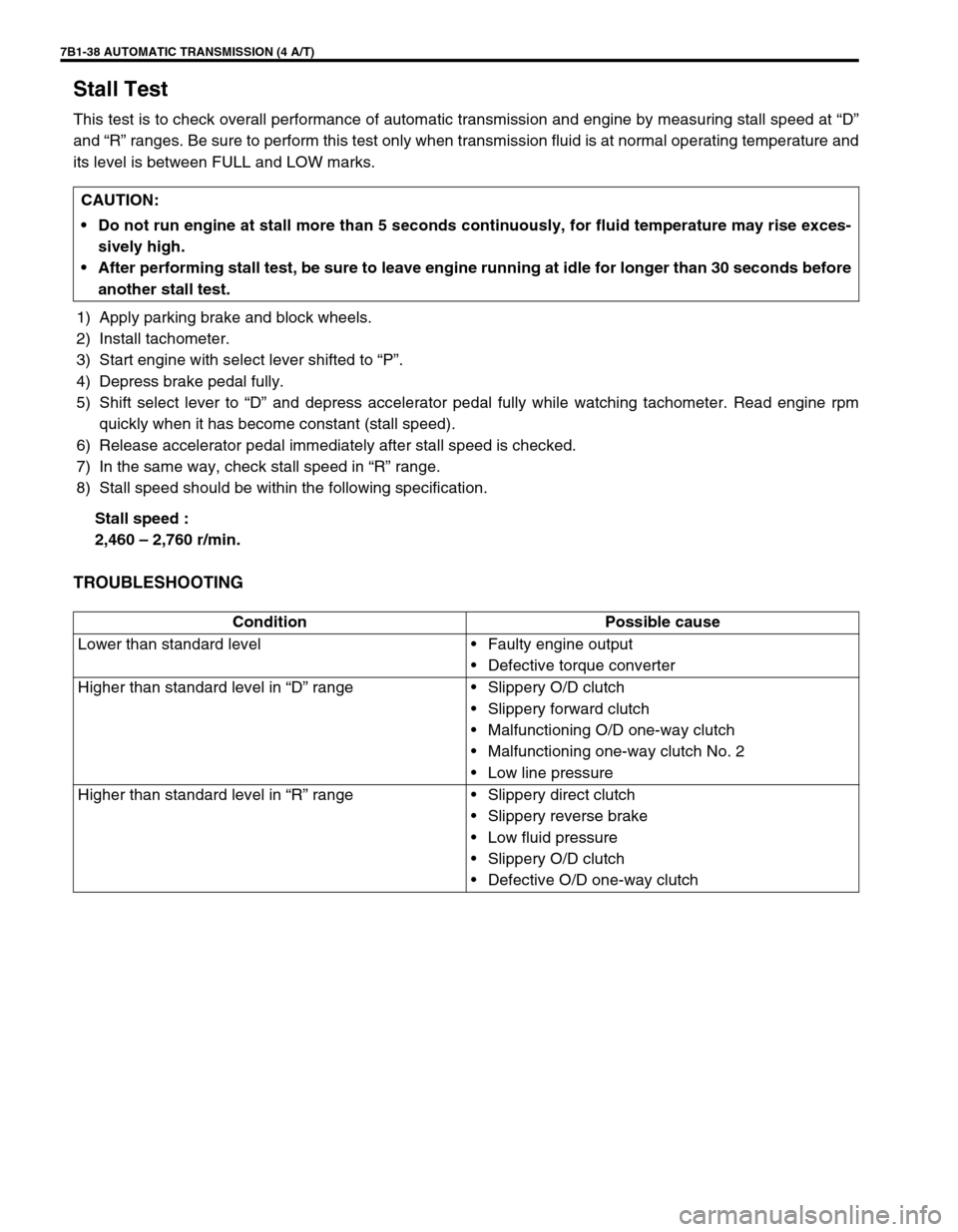
Stall Test
This test is to check overall performance of automatic transmission and engine by measuring stall speed at “D”
and “R” ranges. Be sure to perform this test only when transmission fluid is at normal operating temperature and
its level is between FULL and LOW marks.
1) Apply parking brake and block wheels.
2) Install tachometer.
3) Start engine with select lever shifted to “P”.
4) Depress brake pedal fully.
5) Shift select lever to “D” and depress accelerator pedal fully while watching tachometer. Read engine rpm
quickly when it has become constant (stall speed).
6) Release accelerator pedal immediately after stall speed is checked.
7) In the same way, check stall speed in “R” range.
8) Stall speed should be within the following specification.
Stall speed :
2,460 – 2,760 r/min.
TROUBLESHOOTING
CAUTION:
Do not run engine at stall more than 5 seconds continuously, for fluid temperature may rise exces-
sively high.
After performing stall test, be sure to leave engine running at idle for longer than 30 seconds before
another stall test.
Condition Possible cause
Lower than standard level•Faulty engine output
•Defective torque converter
Higher than standard level in “D” range•Slippery O/D clutch
•Slippery forward clutch
•Malfunctioning O/D one-way clutch
•Malfunctioning one-way clutch No. 2
•Low line pressure
Higher than standard level in “R” range•Slippery direct clutch
•Slippery reverse brake
•Low fluid pressure
•Slippery O/D clutch
•Defective O/D one-way clutch
Page 449 of 656
7B1-40 AUTOMATIC TRANSMISSION (4 A/T)
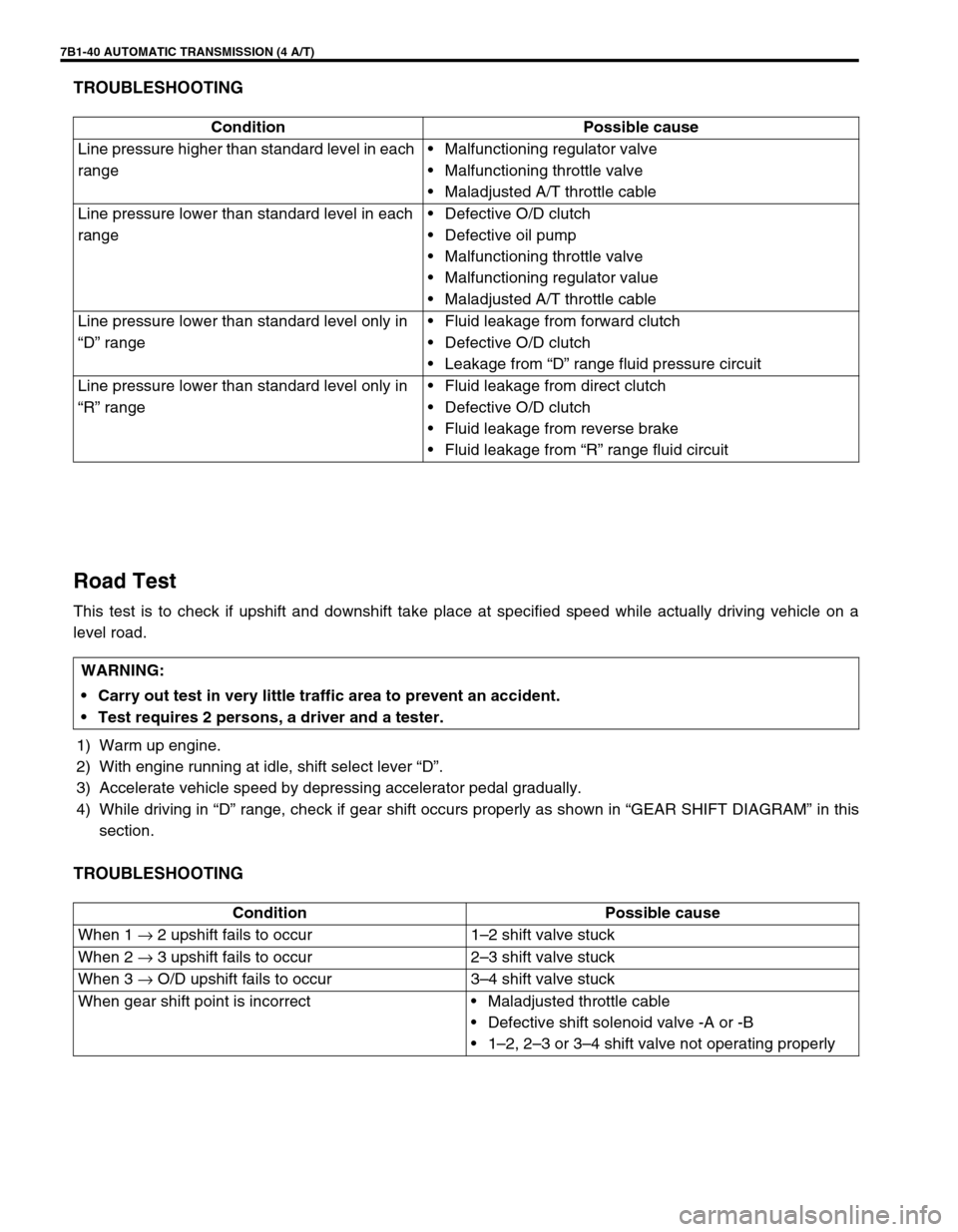
TROUBLESHOOTING
Road Test
This test is to check if upshift and downshift take place at specified speed while actually driving vehicle on a
level road.
1) Warm up engine.
2) With engine running at idle, shift select lever “D”.
3) Accelerate vehicle speed by depressing accelerator pedal gradually.
4) While driving in “D” range, check if gear shift occurs properly as shown in “GEAR SHIFT DIAGRAM” in this
section.
TROUBLESHOOTING
Condition Possible cause
Line pressure higher than standard level in each
range•Malfunctioning regulator valve
•Malfunctioning throttle valve
•Maladjusted A/T throttle cable
Line pressure lower than standard level in each
range•Defective O/D clutch
•Defective oil pump
•Malfunctioning throttle valve
•Malfunctioning regulator value
•Maladjusted A/T throttle cable
Line pressure lower than standard level only in
“D” range•Fluid leakage from forward clutch
•Defective O/D clutch
•Leakage from “D” range fluid pressure circuit
Line pressure lower than standard level only in
“R” range•Fluid leakage from direct clutch
•Defective O/D clutch
•Fluid leakage from reverse brake
•Fluid leakage from “R” range fluid circuit
WARNING:
Carry out test in very little traffic area to prevent an accident.
Test requires 2 persons, a driver and a tester.
Condition Possible cause
When 1 → 2 upshift fails to occur 1–2 shift valve stuck
When 2 → 3 upshift fails to occur 2–3 shift valve stuck
When 3 → O/D upshift fails to occur 3–4 shift valve stuck
When gear shift point is incorrect•Maladjusted throttle cable
•Defective shift solenoid valve -A or -B
•1–2, 2–3 or 3–4 shift valve not operating properly
Page 451 of 656
7B1-42 AUTOMATIC TRANSMISSION (4 A/T)
TROUBLESHOOTING
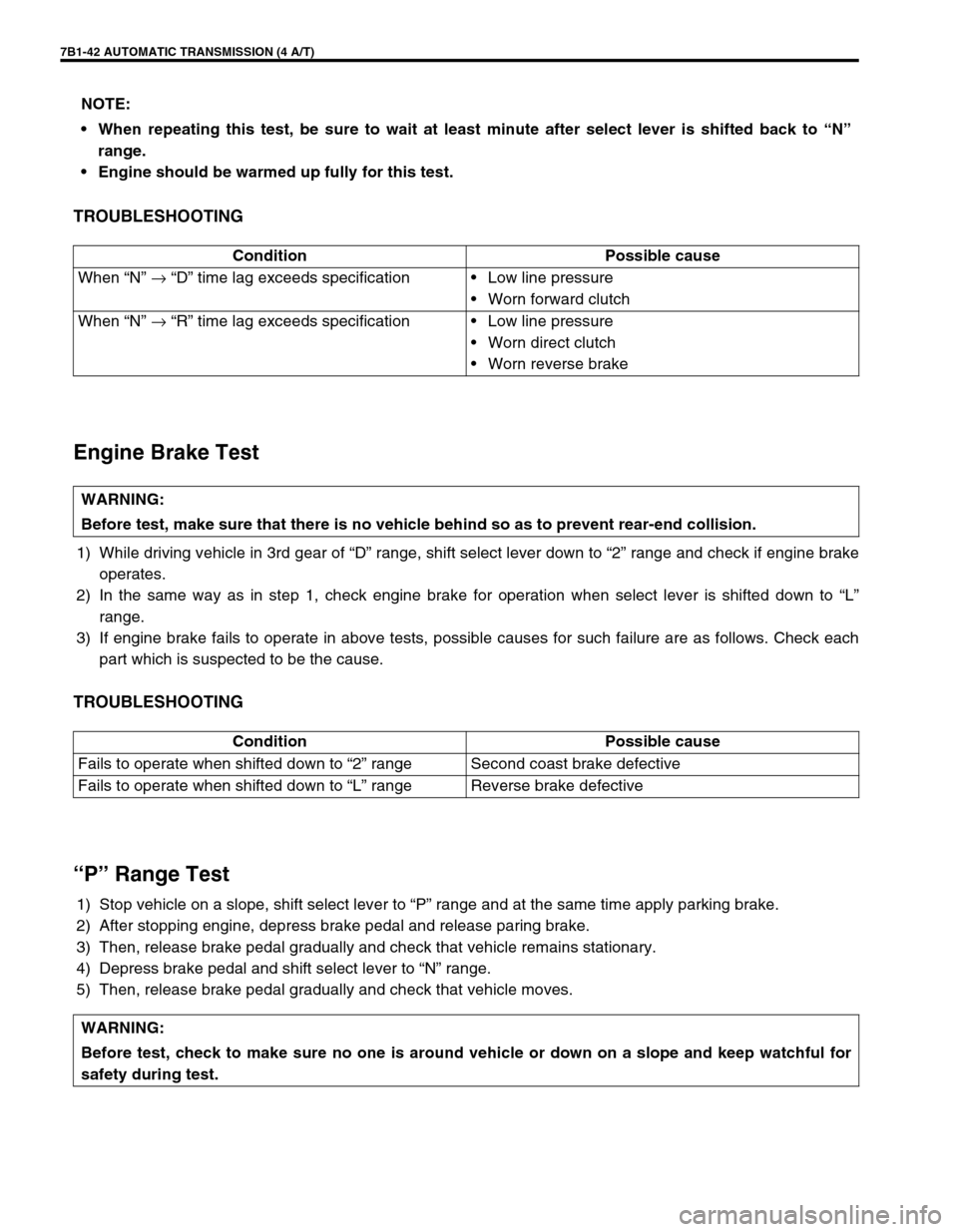
Engine Brake Test
1) While driving vehicle in 3rd gear of “D” range, shift select lever down to “2” range and check if engine brake
operates.
2) In the same way as in step 1, check engine brake for operation when select lever is shifted down to “L”
range.
3) If engine brake fails to operate in above tests, possible causes for such failure are as follows. Check each
part which is suspected to be the cause.
TROUBLESHOOTING
“P” Range Test
1) Stop vehicle on a slope, shift select lever to “P” range and at the same time apply parking brake.
2) After stopping engine, depress brake pedal and release paring brake.
3) Then, release brake pedal gradually and check that vehicle remains stationary.
4) Depress brake pedal and shift select lever to “N” range.
5) Then, release brake pedal gradually and check that vehicle moves.NOTE:
When repeating this test, be sure to wait at least minute after select lever is shifted back to “N”
range.
Engine should be warmed up fully for this test.
Condition Possible cause
When “N” → “D” time lag exceeds specification•Low line pressure
•Worn forward clutch
When “N” → “R” time lag exceeds specification•Low line pressure
•Worn direct clutch
•Worn reverse brake
WARNING:
Before test, make sure that there is no vehicle behind so as to prevent rear-end collision.
Condition Possible cause
Fails to operate when shifted down to “2” range Second coast brake defective
Fails to operate when shifted down to “L” range Reverse brake defective
WARNING:
Before test, check to make sure no one is around vehicle or down on a slope and keep watchful for
safety during test.
Page 583 of 656
10B-6 AIR BAG SYSTEM
Diagnosis
Diagnostic Trouble Code (DTC)
The AIR BAG DIAGNOSTIC SYSTEM CHECK must always be the starting point of any air bag system diagno-
sis. The AIR BAG DIAGNOSTIC SYSTEM CHECK checks for proper “AIR BAG” warning lamp operation and
checks for air bag diagnostic trouble codes (DTCs) using on-board diagnosis function or SUZUKI scan tool.
Use of Special Tool
You should be familiar with the tools listed in this section under the heading SPECIAL TOOLS. You should be
able to measure voltage and resistance. You should be familiar with proper use of a scan tool such as Air Bag
Driver/Passenger Load Tool, Connector Test Adapter Kit and the Digital Multimeter.
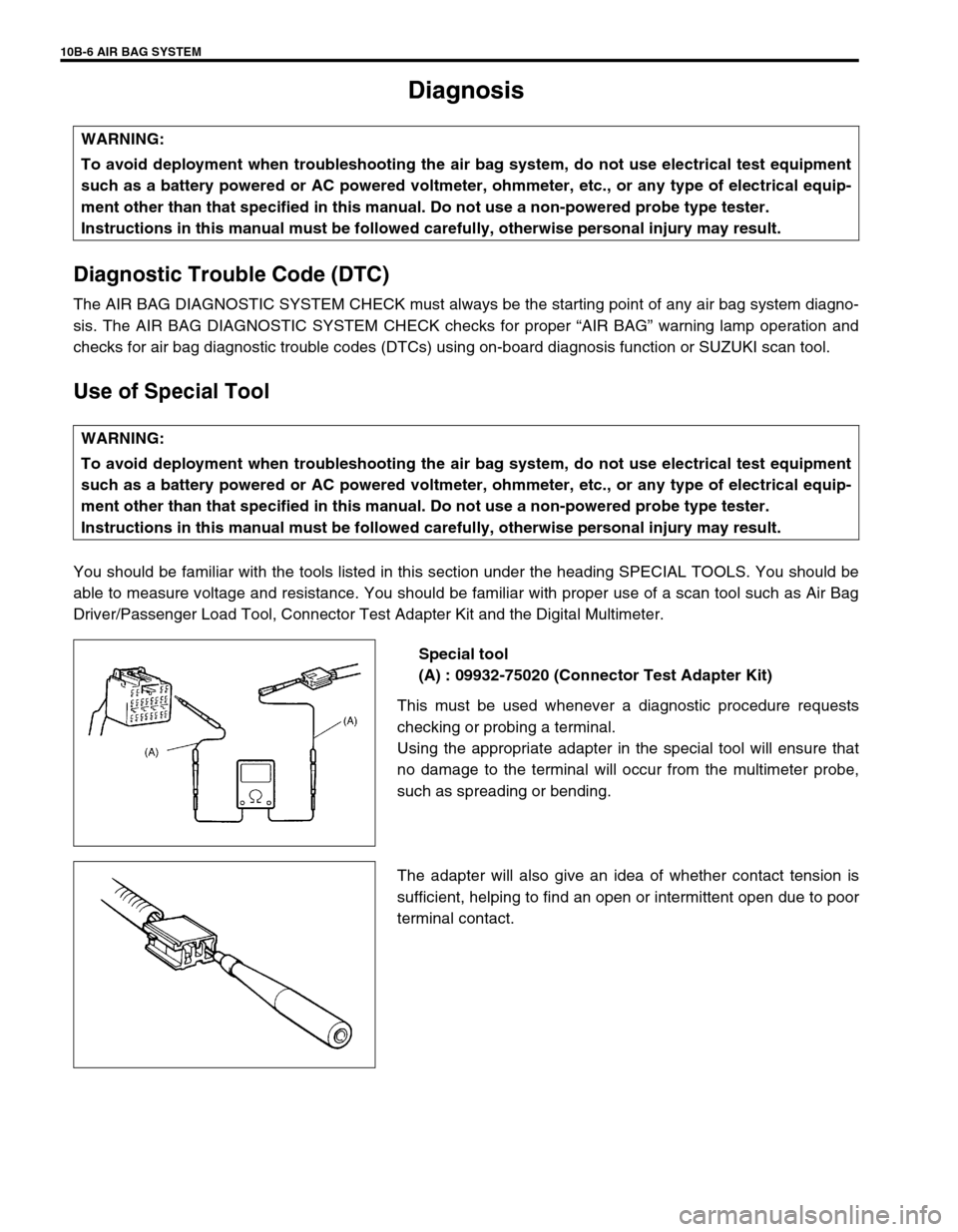
Special tool
(A) : 09932-75020 (Connector Test Adapter Kit)
This must be used whenever a diagnostic procedure requests
checking or probing a terminal.
Using the appropriate adapter in the special tool will ensure that
no damage to the terminal will occur from the multimeter probe,
such as spreading or bending.
The adapter will also give an idea of whether contact tension is
sufficient, helping to find an open or intermittent open due to poor
terminal contact. WARNING:
To avoid deployment when troubleshooting the air bag system, do not use electrical test equipment
such as a battery powered or AC powered voltmeter, ohmmeter, etc., or any type of electrical equip-
ment other than that specified in this manual. Do not use a non-powered probe type tester.
Instructions in this manual must be followed carefully, otherwise personal injury may result.
WARNING:
To avoid deployment when troubleshooting the air bag system, do not use electrical test equipment
such as a battery powered or AC powered voltmeter, ohmmeter, etc., or any type of electrical equip-
ment other than that specified in this manual. Do not use a non-powered probe type tester.
Instructions in this manual must be followed carefully, otherwise personal injury may result.
Page 586 of 656
AIR BAG SYSTEM 10B-9
Air Bag Diagnostic System Check
The diagnostic procedures used in this section are designed to find and repair air bag system malfunctions.
To get the best results, it is important to use the diagnostic flow tables and follow the sequence listed below.
1) Perform the AIR BAG DIAGNOSTIC SYSTEM CHECK FLOW TABLE.
(The AIR BAG DIAGNOSTIC SYSTEM CHECK FLOW TABLE must be the starting point of any air bag sys-
tem diagnosis.
The AIR BAG DIAGNOSTIC SYSTEM CHECK FLOW TABLE checks for proper “AIR BAG” warning lamp
operation through “AIR BAG” warning lamp and whether air bag diagnostic trouble codes exist.)
2) Refer to the proper diagnostic table as directed by the AIR BAG DIAGNOSTIC SYSTEM CHECK FLOW
TABLE.
(The AIR BAG DIAGNOSTIC SYSTEM CHECK FLOW TABLE will lead you to the correct table to diagnose
any air bag system malfunctions. Bypassing these procedures may result in extended diagnostic time, incor-
rect diagnosis and incorrect parts replacement.)
3) Repeat the AIR BAG DIAGNOSTIC SYSTEM CHECK FLOW TABLE after any repair or diagnostic proce-
dures have been performed.
(Performing the AIR BAG DIAGNOSTIC SYSTEM CHECK FLOW TABLE after all repair or diagnostic pro-
cedures will ensure that the repair has been made correctly and that no other malfunctions exist.)
FLOW TABLE TEST DESCRIPTION
STEP 1 : Check that “AIR BAG” warning lamp lights.
STEP 2 : Check that “AIR BAG” warning lamp lights.
STEP 3 : Check diagnosis switch circuit.
STEP 4 : Check that “AIR BAG” warning lamp flashes 6 times after ignition switch is turned ON.
STEP 6 : Check that history codes are in SDM memory. (using SUZUKI scan tool)
STEP 7 : Check that history codes are in SDM memory. (using monitor coupler)
STEP 9 : Check that current code is in SDM memory. (using SUZUKI scan tool)
STEP 10 : Check that current code is in SDM memory. (using monitor coupler)WARNING:
To avoid deployment when troubleshooting the air bag system, do not use electrical test equipment
such as a battery powered or AC powered voltmeter, ohmmeter, etc., or any type of electrical equip-
ment other than that specified in this manual. Do not use a non-powered probe type tester.
Instructions in this manual must be followed carefully, otherwise personal injury may result.
CAUTION:
The order in which diagnostic trouble codes are diagnosed is very important. Failure to diagnose the
diagnostic trouble codes in the order specified may result in extended diagnostic time, incorrect diag-
nosis and incorrect parts replacement.