engine coolant SUZUKI GRAND VITARA 2001 2.G User Guide
[x] Cancel search | Manufacturer: SUZUKI, Model Year: 2001, Model line: GRAND VITARA, Model: SUZUKI GRAND VITARA 2001 2.GPages: 656, PDF Size: 14.31 MB
Page 199 of 656
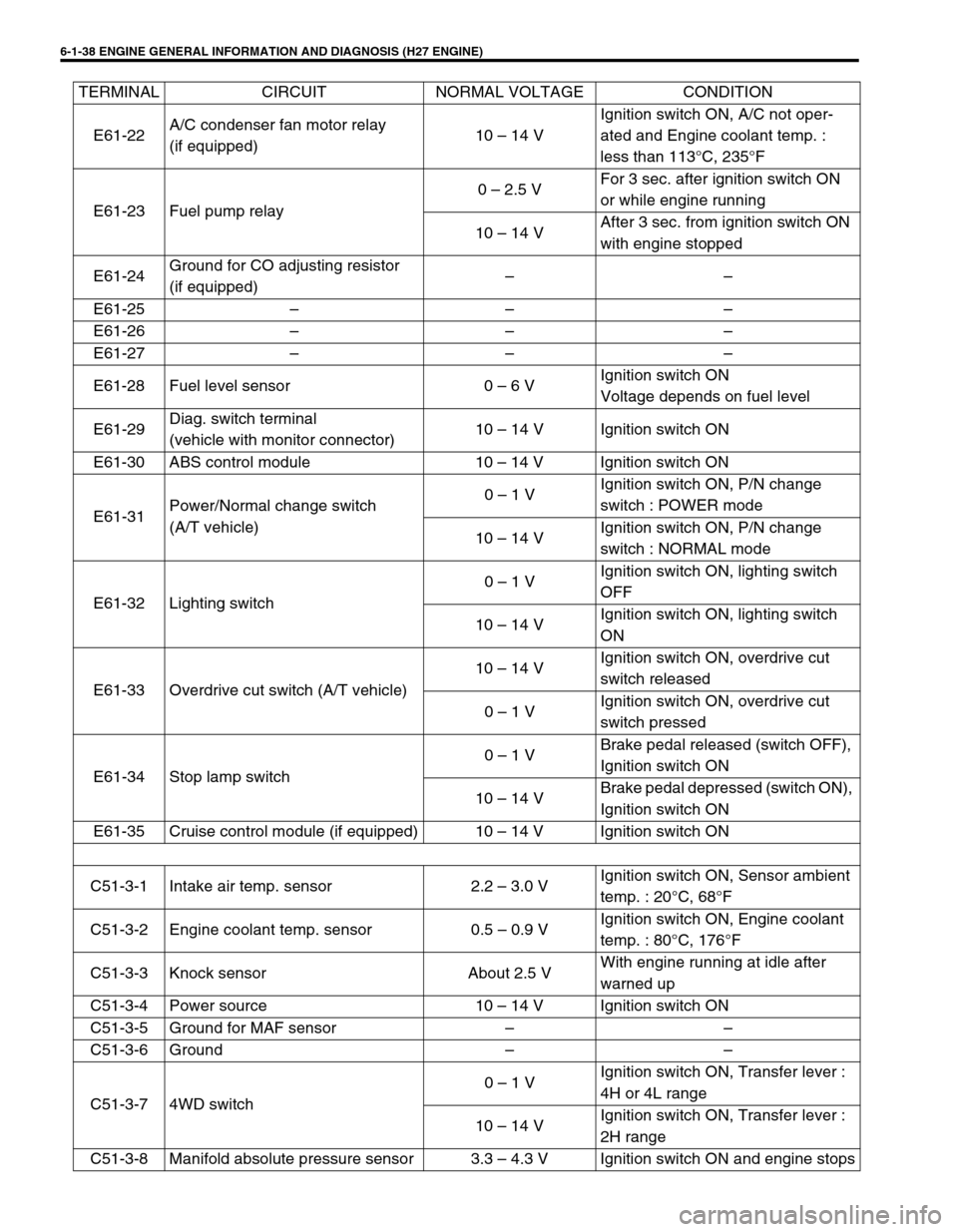
6-1-38 ENGINE GENERAL INFORMATION AND DIAGNOSIS (H27 ENGINE)
E61-22A/C condenser fan motor relay
(if equipped)10 – 14 VIgnition switch ON, A/C not oper-
ated and Engine coolant temp. :
less than 113°C, 235°F
E61-23 Fuel pump relay0 – 2.5 VFor 3 sec. after ignition switch ON
or while engine running
10 – 14 VAfter 3 sec. from ignition switch ON
with engine stopped
E61-24Ground for CO adjusting resistor
(if equipped)––
E61-25 – – –
E61-26 – – –
E61-27 – – –
E61-28 Fuel level sensor 0 – 6 VIgnition switch ON
Voltage depends on fuel level
E61-29Diag. switch terminal
(vehicle with monitor connector)10 – 14 V Ignition switch ON
E61-30 ABS control module 10 – 14 V Ignition switch ON
E61-31Power/Normal change switch
(A/T vehicle)0 – 1 VIgnition switch ON, P/N change
switch : POWER mode
10 – 14 VIgnition switch ON, P/N change
switch : NORMAL mode
E61-32 Lighting switch0 – 1 VIgnition switch ON, lighting switch
OFF
10 – 14 VIgnition switch ON, lighting switch
ON
E61-33 Overdrive cut switch (A/T vehicle)10 – 14 VIgnition switch ON, overdrive cut
switch released
0 – 1 VIgnition switch ON, overdrive cut
switch pressed
E61-34 Stop lamp switch0 – 1 VBrake pedal released (switch OFF),
Ignition switch ON
10 – 14 VBrake pedal depressed (switch ON),
Ignition switch ON
E61-35 Cruise control module (if equipped) 10 – 14 V Ignition switch ON
C51-3-1 Intake air temp. sensor 2.2 – 3.0 VIgnition switch ON, Sensor ambient
temp. : 20°C, 68°F
C51-3-2 Engine coolant temp. sensor 0.5 – 0.9 VIgnition switch ON, Engine coolant
temp. : 80°C, 176°F
C51-3-3 Knock sensor About 2.5 VWith engine running at idle after
warned up
C51-3-4 Power source 10 – 14 V Ignition switch ON
C51-3-5 Ground for MAF sensor – –
C51-3-6 Ground – –
C51-3-7 4WD switch0 – 1 VIgnition switch ON, Transfer lever :
4H or 4L range
10 – 14 VIgnition switch ON, Transfer lever :
2H range
C51-3-8 Manifold absolute pressure sensor 3.3 – 4.3 V Ignition switch ON and engine stops TERMINAL CIRCUIT NORMAL VOLTAGE CONDITION
Page 210 of 656
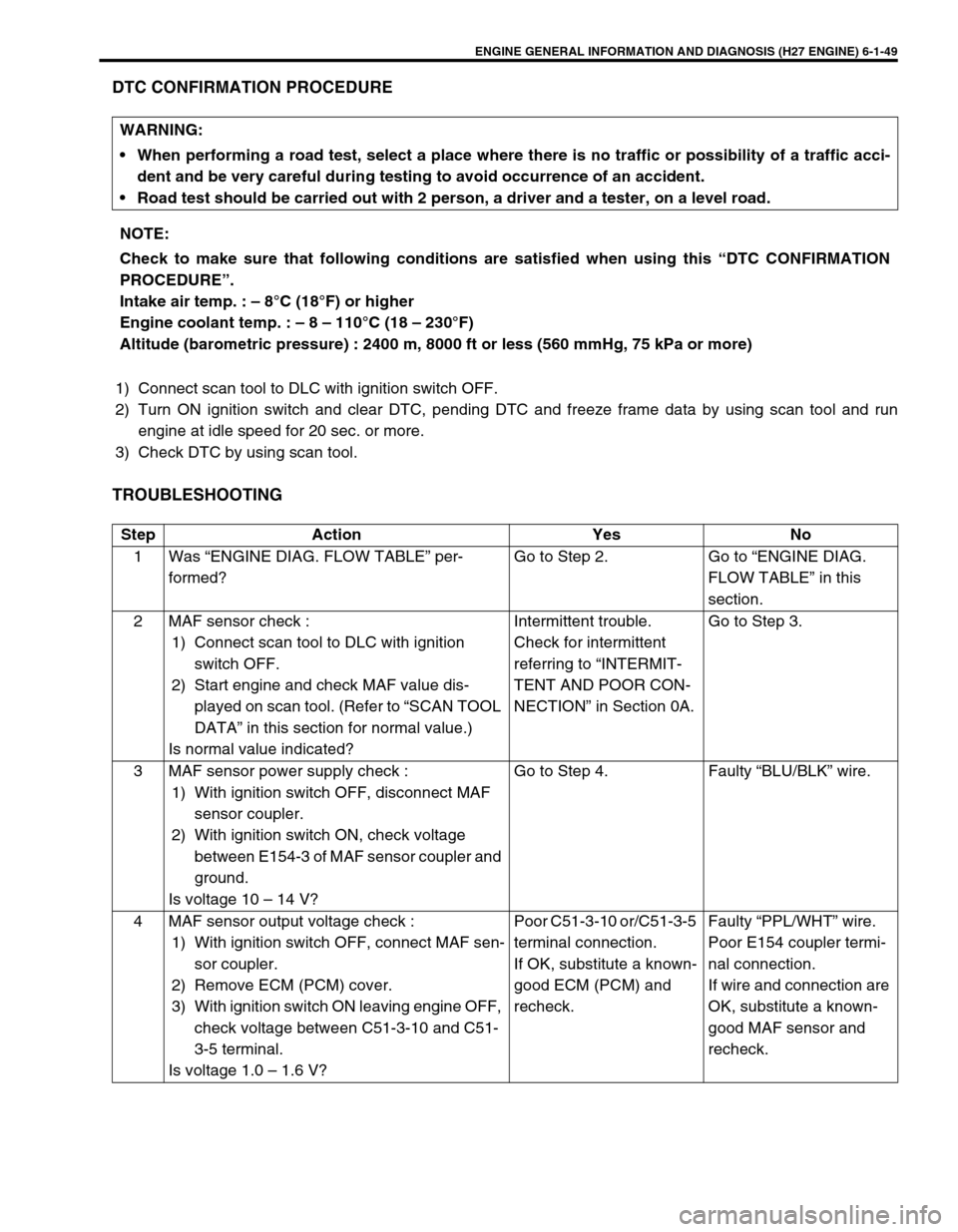
ENGINE GENERAL INFORMATION AND DIAGNOSIS (H27 ENGINE) 6-1-49
DTC CONFIRMATION PROCEDURE
1) Connect scan tool to DLC with ignition switch OFF.
2) Turn ON ignition switch and clear DTC, pending DTC and freeze frame data by using scan tool and run
engine at idle speed for 20 sec. or more.
3) Check DTC by using scan tool.
TROUBLESHOOTING
WARNING:
When performing a road test, select a place where there is no traffic or possibility of a traffic acci-
dent and be very careful during testing to avoid occurrence of an accident.
Road test should be carried out with 2 person, a driver and a tester, on a level road.
NOTE:
Check to make sure that following conditions are satisfied when using this “DTC CONFIRMATION
PROCEDURE”.
Intake air temp. : – 8°C (18°F) or higher
Engine coolant temp. : – 8 – 110°C (18 – 230°F)
Altitude (barometric pressure) : 2400 m, 8000 ft or less (560 mmHg, 75 kPa or more)
Step Action Yes No
1 Was “ENGINE DIAG. FLOW TABLE” per-
formed?Go to Step 2. Go to “ENGINE DIAG.
FLOW TABLE” in this
section.
2 MAF sensor check :
1) Connect scan tool to DLC with ignition
switch OFF.
2) Start engine and check MAF value dis-
played on scan tool. (Refer to “SCAN TOOL
DATA” in this section for normal value.)
Is normal value indicated?Intermittent trouble.
Check for intermittent
referring to “INTERMIT-
TENT AND POOR CON-
NECTION” in Section 0A.Go to Step 3.
3 MAF sensor power supply check :
1) With ignition switch OFF, disconnect MAF
sensor coupler.
2) With ignition switch ON, check voltage
between E154-3 of MAF sensor coupler and
ground.
Is voltage 10 – 14 V?Go to Step 4. Faulty “BLU/BLK” wire.
4 MAF sensor output voltage check :
1) With ignition switch OFF, connect MAF sen-
sor coupler.
2) Remove ECM (PCM) cover.
3) With ignition switch ON leaving engine OFF,
check voltage between C51-3-10 and C51-
3-5 terminal.
Is voltage 1.0 – 1.6 V?Poor C51-3-10 or/C51-3-5
terminal connection.
If OK, substitute a known-
good ECM (PCM) and
recheck.Faulty “PPL/WHT” wire.
Poor E154 coupler termi-
nal connection.
If wire and connection are
OK, substitute a known-
good MAF sensor and
recheck.
Page 211 of 656
6-1-50 ENGINE GENERAL INFORMATION AND DIAGNOSIS (H27 ENGINE)
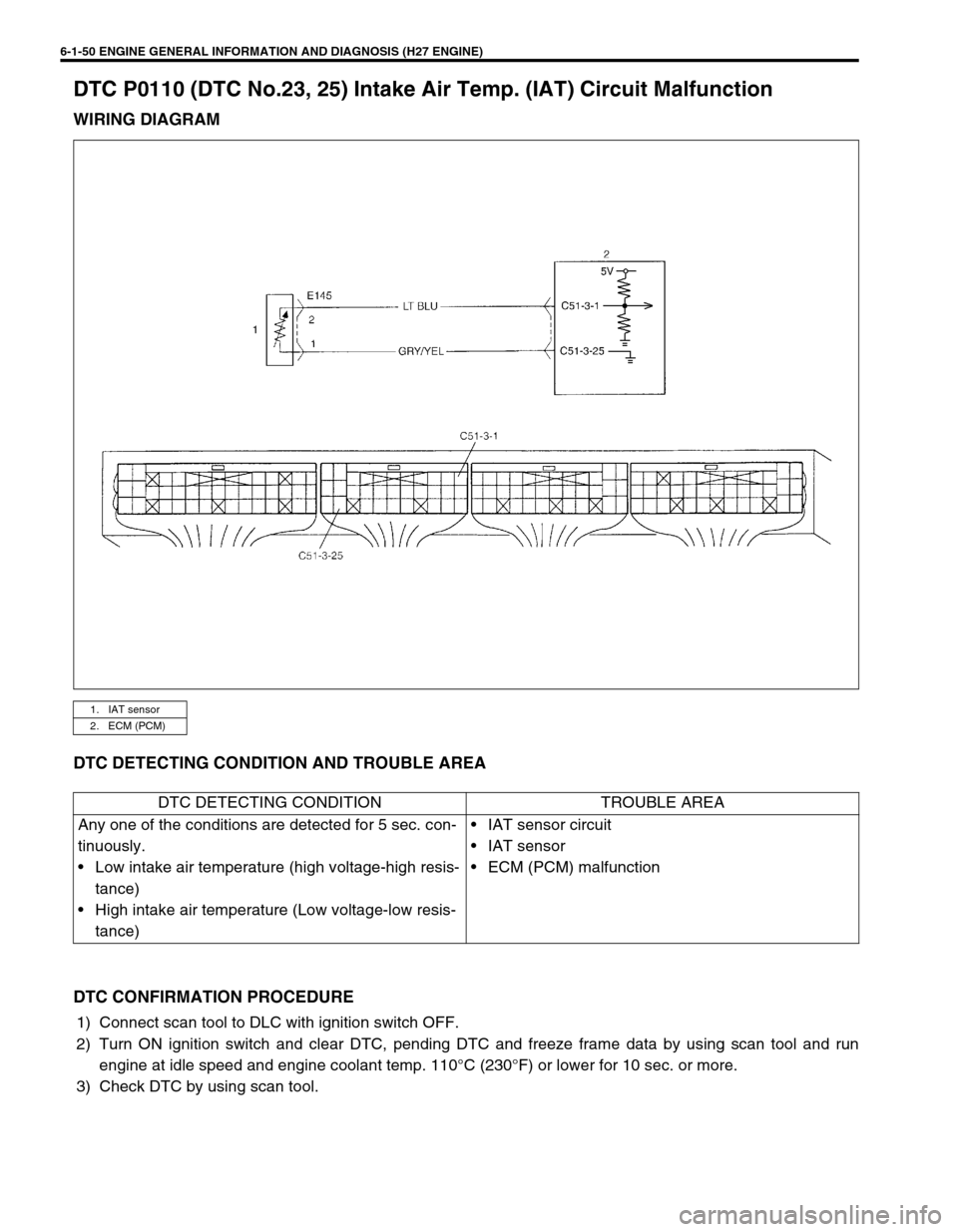
DTC P0110 (DTC No.23, 25) Intake Air Temp. (IAT) Circuit Malfunction
WIRING DIAGRAM
DTC DETECTING CONDITION AND TROUBLE AREA
DTC CONFIRMATION PROCEDURE
1) Connect scan tool to DLC with ignition switch OFF.
2) Turn ON ignition switch and clear DTC, pending DTC and freeze frame data by using scan tool and run
engine at idle speed and engine coolant temp. 110°C (230°F) or lower for 10 sec. or more.
3) Check DTC by using scan tool.
1. IAT sensor
2. ECM (PCM)
DTC DETECTING CONDITION TROUBLE AREA
Any one of the conditions are detected for 5 sec. con-
tinuously.
• Low intake air temperature (high voltage-high resis-
tance)
• High intake air temperature (Low voltage-low resis-
tance)• IAT sensor circuit
• IAT sensor
• ECM (PCM) malfunction
Page 213 of 656
6-1-52 ENGINE GENERAL INFORMATION AND DIAGNOSIS (H27 ENGINE)
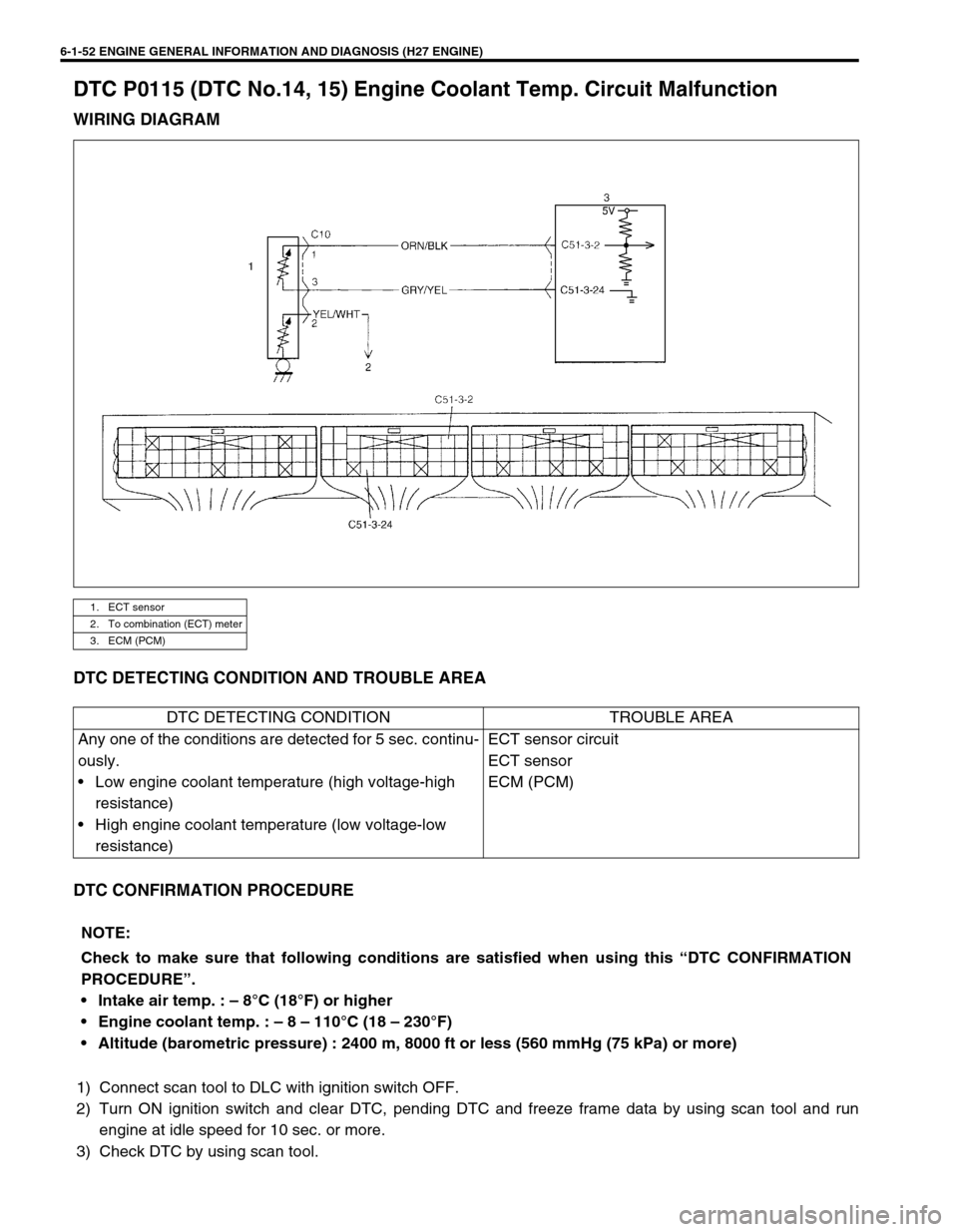
DTC P0115 (DTC No.14, 15) Engine Coolant Temp. Circuit Malfunction
WIRING DIAGRAM
DTC DETECTING CONDITION AND TROUBLE AREA
DTC CONFIRMATION PROCEDURE
1) Connect scan tool to DLC with ignition switch OFF.
2) Turn ON ignition switch and clear DTC, pending DTC and freeze frame data by using scan tool and run
engine at idle speed for 10 sec. or more.
3) Check DTC by using scan tool.
1. ECT sensor
2. To combination (ECT) meter
3. ECM (PCM)
DTC DETECTING CONDITION TROUBLE AREA
Any one of the conditions are detected for 5 sec. continu-
ously.
• Low engine coolant temperature (high voltage-high
resistance)
• High engine coolant temperature (low voltage-low
resistance)ECT sensor circuit
ECT sensor
ECM (PCM)
NOTE:
Check to make sure that following conditions are satisfied when using this “DTC CONFIRMATION
PROCEDURE”.
Intake air temp. : – 8°C (18°F) or higher
Engine coolant temp. : – 8 – 110°C (18 – 230°F)
Altitude (barometric pressure) : 2400 m, 8000 ft or less (560 mmHg (75 kPa) or more)
Page 214 of 656
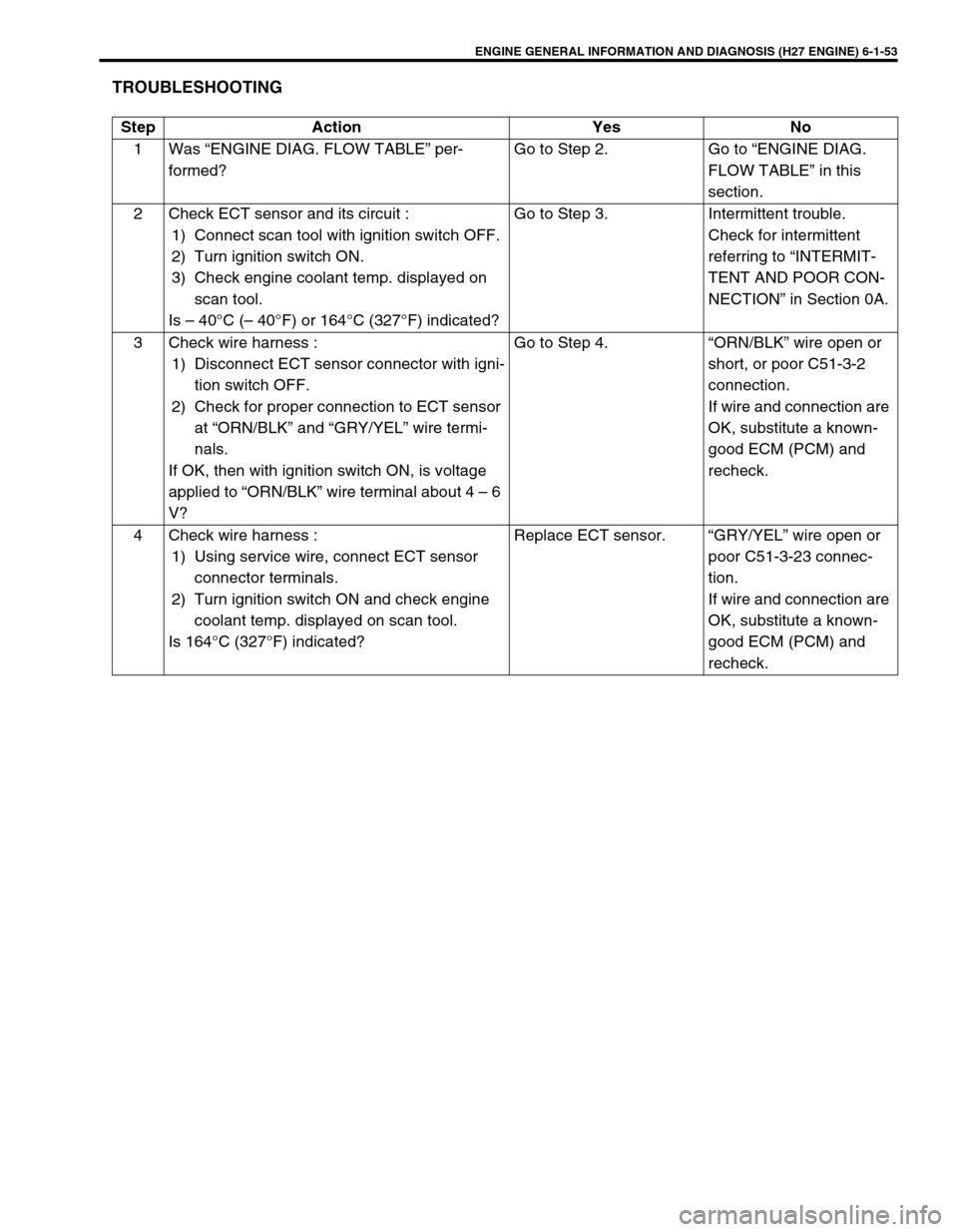
ENGINE GENERAL INFORMATION AND DIAGNOSIS (H27 ENGINE) 6-1-53
TROUBLESHOOTING
Step Action Yes No
1 Was “ENGINE DIAG. FLOW TABLE” per-
formed?Go to Step 2. Go to “ENGINE DIAG.
FLOW TABLE” in this
section.
2 Check ECT sensor and its circuit :
1) Connect scan tool with ignition switch OFF.
2) Turn ignition switch ON.
3) Check engine coolant temp. displayed on
scan tool.
Is – 40°C (– 40°F) or 164°C (327°F) indicated?Go to Step 3. Intermittent trouble.
Check for intermittent
referring to “INTERMIT-
TENT AND POOR CON-
NECTION” in Section 0A.
3 Check wire harness :
1) Disconnect ECT sensor connector with igni-
tion switch OFF.
2) Check for proper connection to ECT sensor
at “ORN/BLK” and “GRY/YEL” wire termi-
nals.
If OK, then with ignition switch ON, is voltage
applied to “ORN/BLK” wire terminal about 4 – 6
V?Go to Step 4. “ORN/BLK” wire open or
short, or poor C51-3-2
connection.
If wire and connection are
OK, substitute a known-
good ECM (PCM) and
recheck.
4 Check wire harness :
1) Using service wire, connect ECT sensor
connector terminals.
2) Turn ignition switch ON and check engine
coolant temp. displayed on scan tool.
Is 164°C (327°F) indicated?Replace ECT sensor. “GRY/YEL” wire open or
poor C51-3-23 connec-
tion.
If wire and connection are
OK, substitute a known-
good ECM (PCM) and
recheck.
Page 215 of 656
6-1-54 ENGINE GENERAL INFORMATION AND DIAGNOSIS (H27 ENGINE)
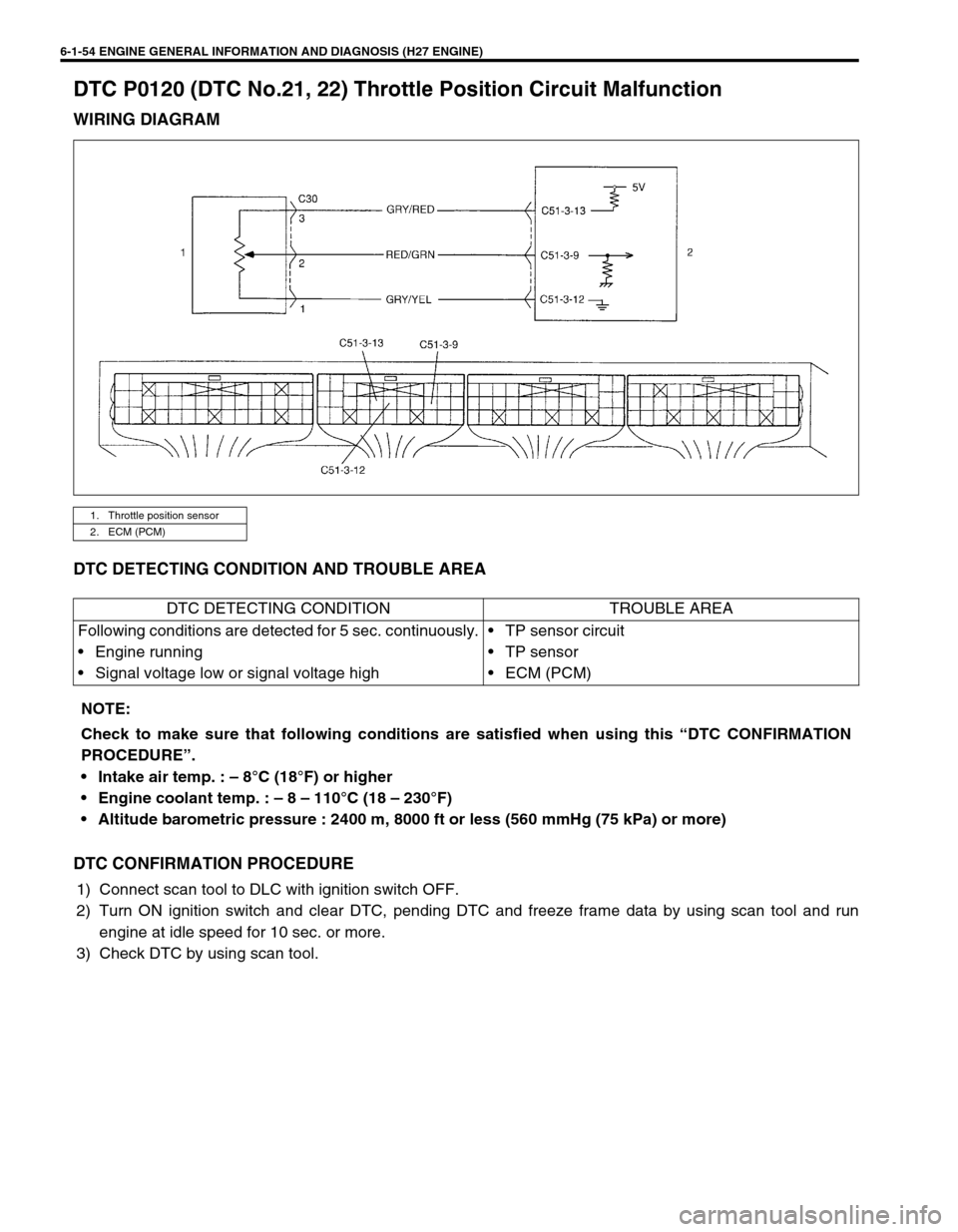
DTC P0120 (DTC No.21, 22) Throttle Position Circuit Malfunction
WIRING DIAGRAM
DTC DETECTING CONDITION AND TROUBLE AREA
DTC CONFIRMATION PROCEDURE
1) Connect scan tool to DLC with ignition switch OFF.
2) Turn ON ignition switch and clear DTC, pending DTC and freeze frame data by using scan tool and run
engine at idle speed for 10 sec. or more.
3) Check DTC by using scan tool.
1. Throttle position sensor
2. ECM (PCM)
DTC DETECTING CONDITION TROUBLE AREA
Following conditions are detected for 5 sec. continuously.
• Engine running
• Signal voltage low or signal voltage high• TP sensor circuit
•TP sensor
•ECM (PCM)
NOTE:
Check to make sure that following conditions are satisfied when using this “DTC CONFIRMATION
PROCEDURE”.
Intake air temp. : – 8°C (18°F) or higher
Engine coolant temp. : – 8 – 110°C (18 – 230°F)
Altitude barometric pressure : 2400 m, 8000 ft or less (560 mmHg (75 kPa) or more)
Page 217 of 656
6-1-56 ENGINE GENERAL INFORMATION AND DIAGNOSIS (H27 ENGINE)
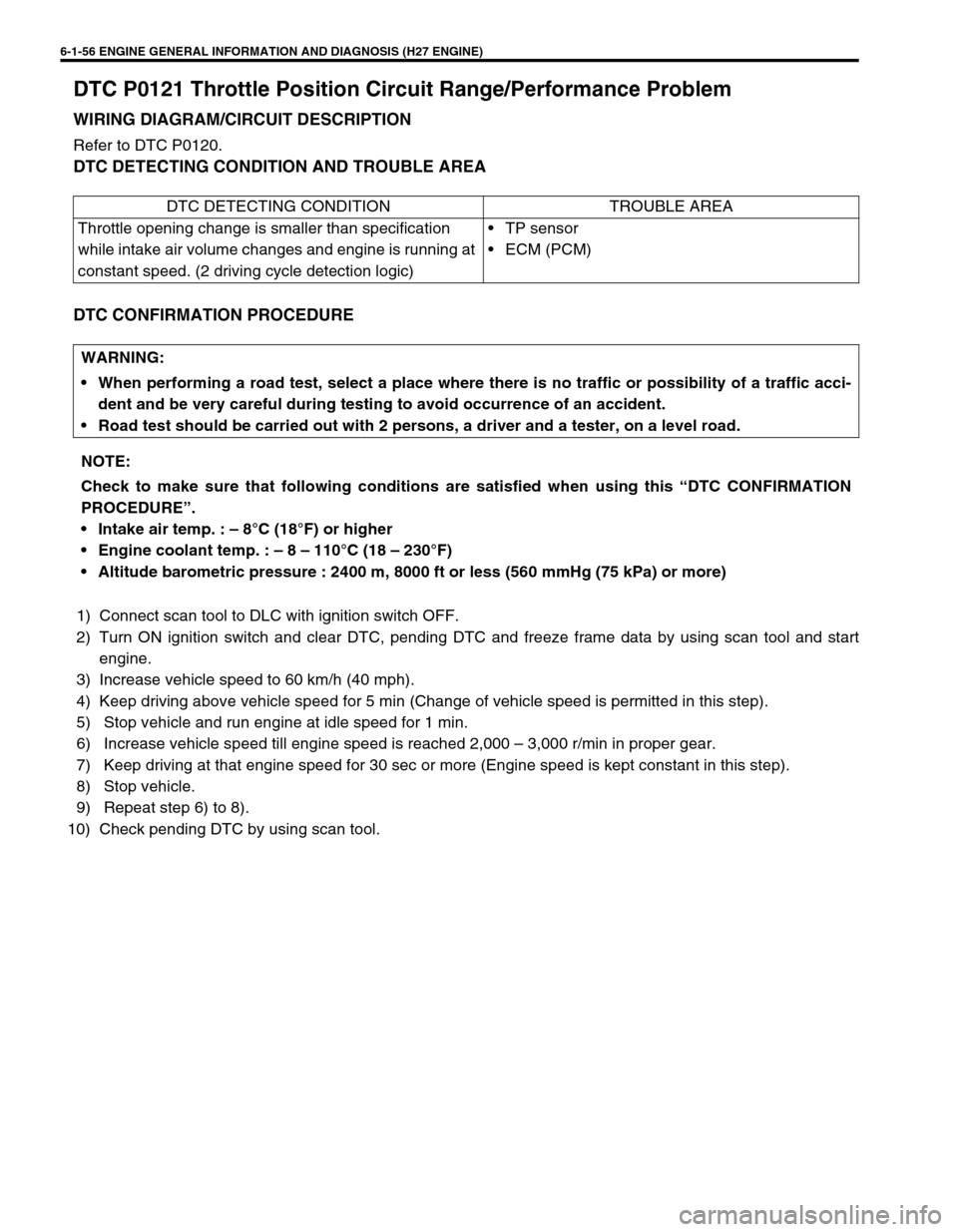
DTC P0121 Throttle Position Circuit Range/Performance Problem
WIRING DIAGRAM/CIRCUIT DESCRIPTION
Refer to DTC P0120.
DTC DETECTING CONDITION AND TROUBLE AREA
DTC CONFIRMATION PROCEDURE
1) Connect scan tool to DLC with ignition switch OFF.
2) Turn ON ignition switch and clear DTC, pending DTC and freeze frame data by using scan tool and start
engine.
3) Increase vehicle speed to 60 km/h (40 mph).
4) Keep driving above vehicle speed for 5 min (Change of vehicle speed is permitted in this step).
5) Stop vehicle and run engine at idle speed for 1 min.
6) Increase vehicle speed till engine speed is reached 2,000 – 3,000 r/min in proper gear.
7) Keep driving at that engine speed for 30 sec or more (Engine speed is kept constant in this step).
8) Stop vehicle.
9) Repeat step 6) to 8).
10) Check pending DTC by using scan tool.DTC DETECTING CONDITION TROUBLE AREA
Throttle opening change is smaller than specification
while intake air volume changes and engine is running at
constant speed. (2 driving cycle detection logic)•TP sensor
•ECM (PCM)
WARNING:
When performing a road test, select a place where there is no traffic or possibility of a traffic acci-
dent and be very careful during testing to avoid occurrence of an accident.
Road test should be carried out with 2 persons, a driver and a tester, on a level road.
NOTE:
Check to make sure that following conditions are satisfied when using this “DTC CONFIRMATION
PROCEDURE”.
Intake air temp. : – 8°C (18°F) or higher
Engine coolant temp. : – 8 – 110°C (18 – 230°F)
Altitude barometric pressure : 2400 m, 8000 ft or less (560 mmHg (75 kPa) or more)
Page 220 of 656
ENGINE GENERAL INFORMATION AND DIAGNOSIS (H27 ENGINE) 6-1-59
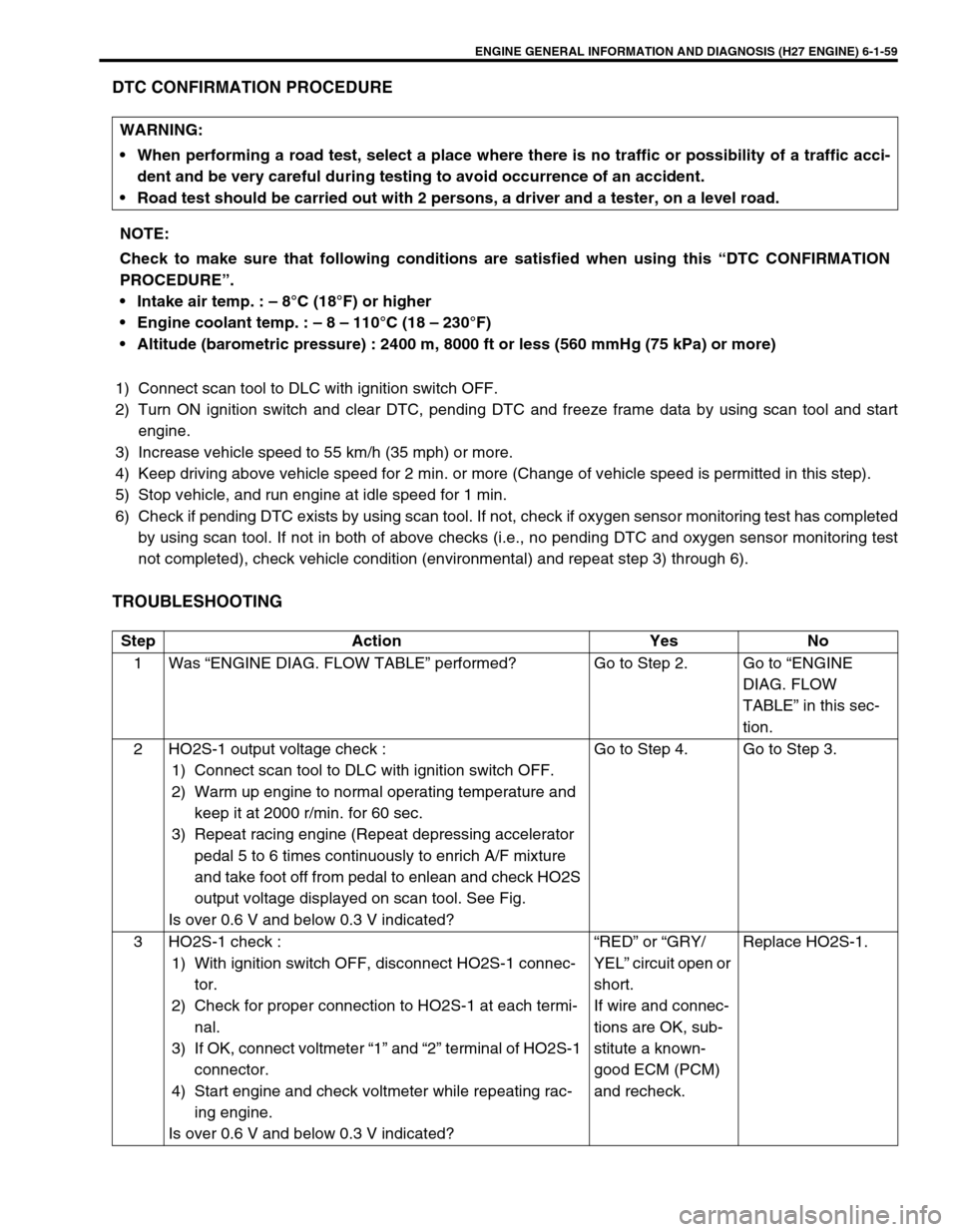
DTC CONFIRMATION PROCEDURE
1) Connect scan tool to DLC with ignition switch OFF.
2) Turn ON ignition switch and clear DTC, pending DTC and freeze frame data by using scan tool and start
engine.
3) Increase vehicle speed to 55 km/h (35 mph) or more.
4) Keep driving above vehicle speed for 2 min. or more (Change of vehicle speed is permitted in this step).
5) Stop vehicle, and run engine at idle speed for 1 min.
6) Check if pending DTC exists by using scan tool. If not, check if oxygen sensor monitoring test has completed
by using scan tool. If not in both of above checks (i.e., no pending DTC and oxygen sensor monitoring test
not completed), check vehicle condition (environmental) and repeat step 3) through 6).
TROUBLESHOOTING
WARNING:
When performing a road test, select a place where there is no traffic or possibility of a traffic acci-
dent and be very careful during testing to avoid occurrence of an accident.
Road test should be carried out with 2 persons, a driver and a tester, on a level road.
NOTE:
Check to make sure that following conditions are satisfied when using this “DTC CONFIRMATION
PROCEDURE”.
Intake air temp. : – 8°C (18°F) or higher
Engine coolant temp. : – 8 – 110°C (18 – 230°F)
Altitude (barometric pressure) : 2400 m, 8000 ft or less (560 mmHg (75 kPa) or more)
Step Action Yes No
1 Was “ENGINE DIAG. FLOW TABLE” performed? Go to Step 2. Go to “ENGINE
DIAG. FLOW
TABLE” in this sec-
tion.
2 HO2S-1 output voltage check :
1) Connect scan tool to DLC with ignition switch OFF.
2) Warm up engine to normal operating temperature and
keep it at 2000 r/min. for 60 sec.
3) Repeat racing engine (Repeat depressing accelerator
pedal 5 to 6 times continuously to enrich A/F mixture
and take foot off from pedal to enlean and check HO2S
output voltage displayed on scan tool. See Fig.
Is over 0.6 V and below 0.3 V indicated?Go to Step 4. Go to Step 3.
3 HO2S-1 check :
1) With ignition switch OFF, disconnect HO2S-1 connec-
tor.
2) Check for proper connection to HO2S-1 at each termi-
nal.
3) If OK, connect voltmeter “1” and “2” terminal of HO2S-1
connector.
4) Start engine and check voltmeter while repeating rac-
ing engine.
Is over 0.6 V and below 0.3 V indicated?“RED” or “GRY/
YEL” circuit open or
short.
If wire and connec-
tions are OK, sub-
stitute a known-
good ECM (PCM)
and recheck.Replace HO2S-1.
Page 222 of 656
ENGINE GENERAL INFORMATION AND DIAGNOSIS (H27 ENGINE) 6-1-61
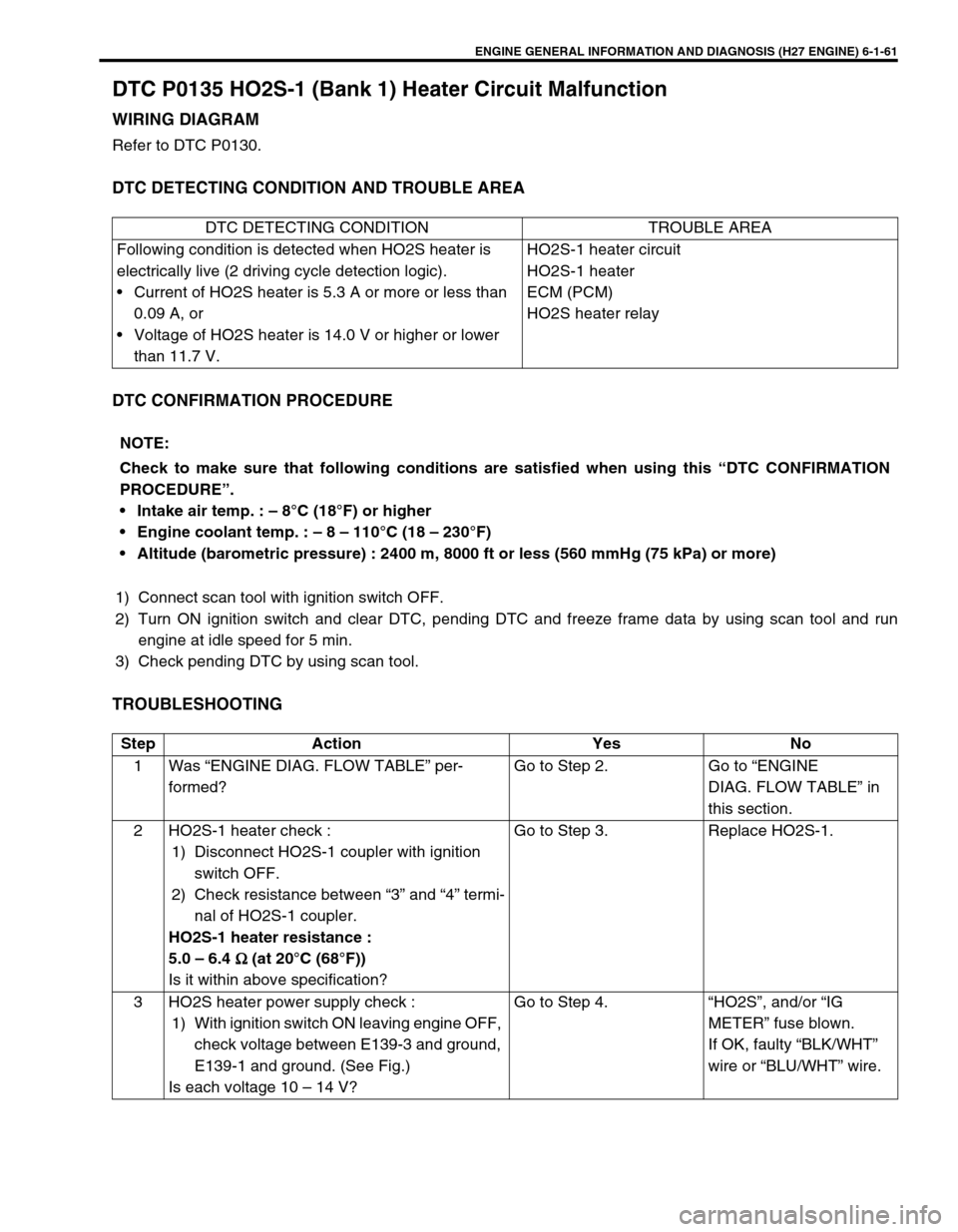
DTC P0135 HO2S-1 (Bank 1) Heater Circuit Malfunction
WIRING DIAGRAM
Refer to DTC P0130.
DTC DETECTING CONDITION AND TROUBLE AREA
DTC CONFIRMATION PROCEDURE
1) Connect scan tool with ignition switch OFF.
2) Turn ON ignition switch and clear DTC, pending DTC and freeze frame data by using scan tool and run
engine at idle speed for 5 min.
3) Check pending DTC by using scan tool.
TROUBLESHOOTING
DTC DETECTING CONDITION TROUBLE AREA
Following condition is detected when HO2S heater is
electrically live (2 driving cycle detection logic).
• Current of HO2S heater is 5.3 A or more or less than
0.09 A, or
• Voltage of HO2S heater is 14.0 V or higher or lower
than 11.7 V.HO2S-1 heater circuit
HO2S-1 heater
ECM (PCM)
HO2S heater relay
NOTE:
Check to make sure that following conditions are satisfied when using this “DTC CONFIRMATION
PROCEDURE”.
Intake air temp. : – 8°C (18°F) or higher
Engine coolant temp. : – 8 – 110°C (18 – 230°F)
Altitude (barometric pressure) : 2400 m, 8000 ft or less (560 mmHg (75 kPa) or more)
Step Action Yes No
1 Was “ENGINE DIAG. FLOW TABLE” per-
formed?Go to Step 2. Go to “ENGINE
DIAG. FLOW TABLE” in
this section.
2 HO2S-1 heater check :
1) Disconnect HO2S-1 coupler with ignition
switch OFF.
2) Check resistance between “3” and “4” termi-
nal of HO2S-1 coupler.
HO2S-1 heater resistance :
5.0 – 6.4
Ω
ΩΩ Ω (at 20°C (68°F))
Is it within above specification?Go to Step 3. Replace HO2S-1.
3 HO2S heater power supply check :
1) With ignition switch ON leaving engine OFF,
check voltage between E139-3 and ground,
E139-1 and ground. (See Fig.)
Is each voltage 10 – 14 V?Go to Step 4. “HO2S”, and/or “IG
METER” fuse blown.
If OK, faulty “BLK/WHT”
wire or “BLU/WHT” wire.
Page 225 of 656
6-1-64 ENGINE GENERAL INFORMATION AND DIAGNOSIS (H27 ENGINE)
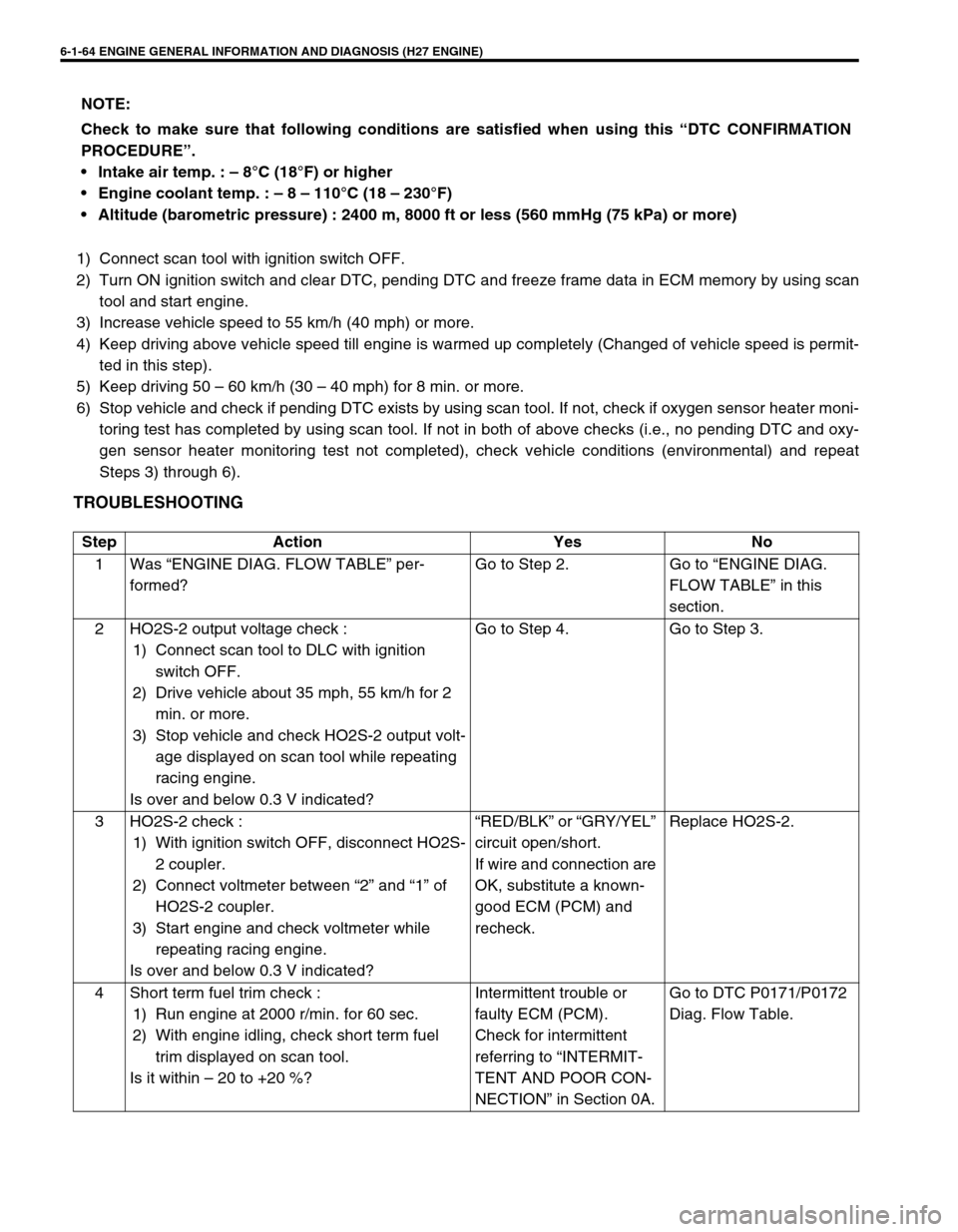
1) Connect scan tool with ignition switch OFF.
2) Turn ON ignition switch and clear DTC, pending DTC and freeze frame data in ECM memory by using scan
tool and start engine.
3) Increase vehicle speed to 55 km/h (40 mph) or more.
4) Keep driving above vehicle speed till engine is warmed up completely (Changed of vehicle speed is permit-
ted in this step).
5) Keep driving 50 – 60 km/h (30 – 40 mph) for 8 min. or more.
6) Stop vehicle and check if pending DTC exists by using scan tool. If not, check if oxygen sensor heater moni-
toring test has completed by using scan tool. If not in both of above checks (i.e., no pending DTC and oxy-
gen sensor heater monitoring test not completed), check vehicle conditions (environmental) and repeat
Steps 3) through 6).
TROUBLESHOOTING
NOTE:
Check to make sure that following conditions are satisfied when using this “DTC CONFIRMATION
PROCEDURE”.
Intake air temp. : – 8°C (18°F) or higher
Engine coolant temp. : – 8 – 110°C (18 – 230°F)
Altitude (barometric pressure) : 2400 m, 8000 ft or less (560 mmHg (75 kPa) or more)
Step Action Yes No
1 Was “ENGINE DIAG. FLOW TABLE” per-
formed?Go to Step 2. Go to “ENGINE DIAG.
FLOW TABLE” in this
section.
2 HO2S-2 output voltage check :
1) Connect scan tool to DLC with ignition
switch OFF.
2) Drive vehicle about 35 mph, 55 km/h for 2
min. or more.
3) Stop vehicle and check HO2S-2 output volt-
age displayed on scan tool while repeating
racing engine.
Is over and below 0.3 V indicated?Go to Step 4. Go to Step 3.
3 HO2S-2 check :
1) With ignition switch OFF, disconnect HO2S-
2 coupler.
2) Connect voltmeter between “2” and “1” of
HO2S-2 coupler.
3) Start engine and check voltmeter while
repeating racing engine.
Is over and below 0.3 V indicated?“RED/BLK” or “GRY/YEL”
circuit open/short.
If wire and connection are
OK, substitute a known-
good ECM (PCM) and
recheck.Replace HO2S-2.
4 Short term fuel trim check :
1) Run engine at 2000 r/min. for 60 sec.
2) With engine idling, check short term fuel
trim displayed on scan tool.
Is it within – 20 to +20 %?Intermittent trouble or
faulty ECM (PCM).
Check for intermittent
referring to “INTERMIT-
TENT AND POOR CON-
NECTION” in Section 0A.Go to DTC P0171/P0172
Diag. Flow Table.