Shift SUZUKI GRAND VITARA 2001 2.G Owner's Manual
[x] Cancel search | Manufacturer: SUZUKI, Model Year: 2001, Model line: GRAND VITARA, Model: SUZUKI GRAND VITARA 2001 2.GPages: 656, PDF Size: 14.31 MB
Page 413 of 656
7B1-4 AUTOMATIC TRANSMISSION (4 A/T)
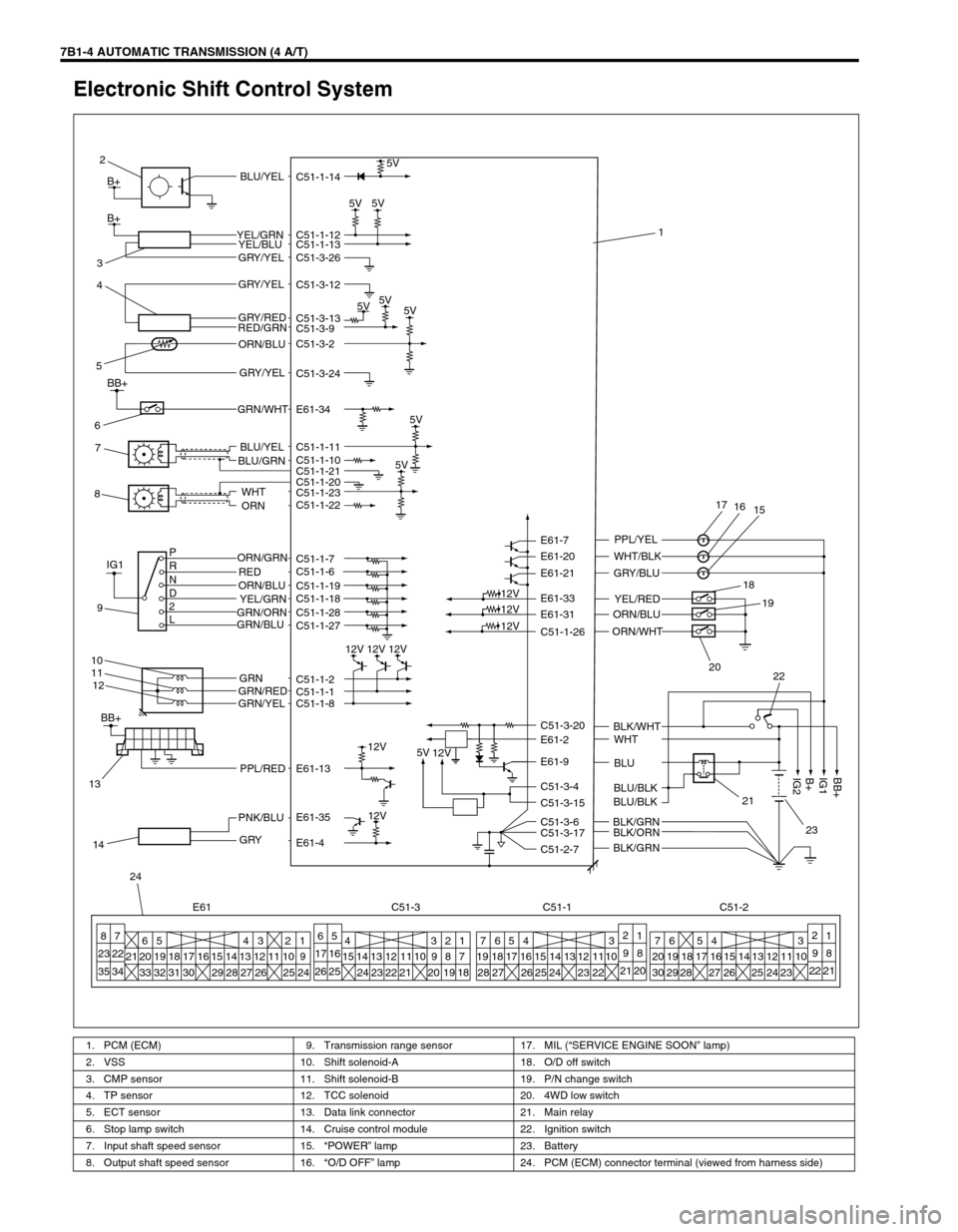
Electronic Shift Control System
1. PCM (ECM) 9. Transmission range sensor 17. MIL (“SERVICE ENGINE SOON” lamp)
2. VSS 10. Shift solenoid-A 18. O/D off switch
3. CMP sensor 11. Shift solenoid-B 19. P/N change switch
4. TP sensor 12. TCC solenoid 20. 4WD low switch
5. ECT sensor 13. Data link connector 21. Main relay
6. Stop lamp switch 14. Cruise control module 22. Ignition switch
7. Input shaft speed sensor 15.“POWER” lamp 23. Battery
8. Output shaft speed sensor 16.“O/D OFF” lamp 24. PCM (ECM) connector terminal (viewed from harness side)
5V
5V5V
5V5V
5V
5V 5V C51-1-14
C51-1-12
C51-1-13
C51-3-26
C51-3-12
C51-3-13
C51-3-9
C51-3-2
C51-3-24
C51-1-11
C51-1-10
C51-1-20 C51-1-21
C51-1-23
C51-1-22
C51-1-7
C51-1-6
C51-1-19
C51-1-18
C51-1-28
C51-1-27
C51-1-2
C51-1-1
C51-1-8
E61-13
E61-35
E61-4C51-1-26 E61-31 E61-33 E61-21 E61-20 E61-7
C51-3-20
E61-2
E61-9
C51-3-4
C51-3-15
C51-3-6
C51-3-17
C51-2-7
12V
12V 12V 12V
12V
12V
12V
12V
5V
12V
BLU/YEL
YEL/GRN
YEL/BLU
GRY/YEL
GRY/YEL
GRY/RED
RED/GRN
ORN/BLU
GRY/YEL
BLU/YEL
BLU/GRN
WHT
ORN
ORN/GRN
RED P
R
N
D
2
LORN/BLU
YEL/GRN
GRN/ORN
GRN/BLU
GRN
GRN/RED
GRN/YEL
PPL/RED
PNK/BLU
GRY
PPL/YEL
WHT/BLK
GRY/BLU
YEL/RED
ORN/BLU
WHT
BLU
BLU/BLK
BLU/BLK
BLK/GRN
BLK/ORN
BLK/GRNBLK/WHT ORN/WHT
8
7
23 22
35 346
20 21
335
19
3218
3117
3016 15
2914
284
13
273
12
26112
10
256
5
17 16
26 252
1
98
21 202
1
98
22 21 1
9
247
20
306
19
2918
27 17
2816 15
2614
25 5
13 4
12
24113
10
23 7
19
28654 3
18
2717 16
2615 14
2513
2412
2311
2210 4
15 14
2413
2312
2211 10 9 8 7
213
202
191
18
24
E61 C51-3 C51-1 C51-2 14
13
B+
B+
17
16
15
18
19
20
22
21
23
BB+
IG1
B+
IG2
1 2
3
4
5
7 6
8
IG1
9
10
11
12
BB+
E61-34 GRN/WHT
BB+
Page 414 of 656
AUTOMATIC TRANSMISSION (4 A/T) 7B1-5
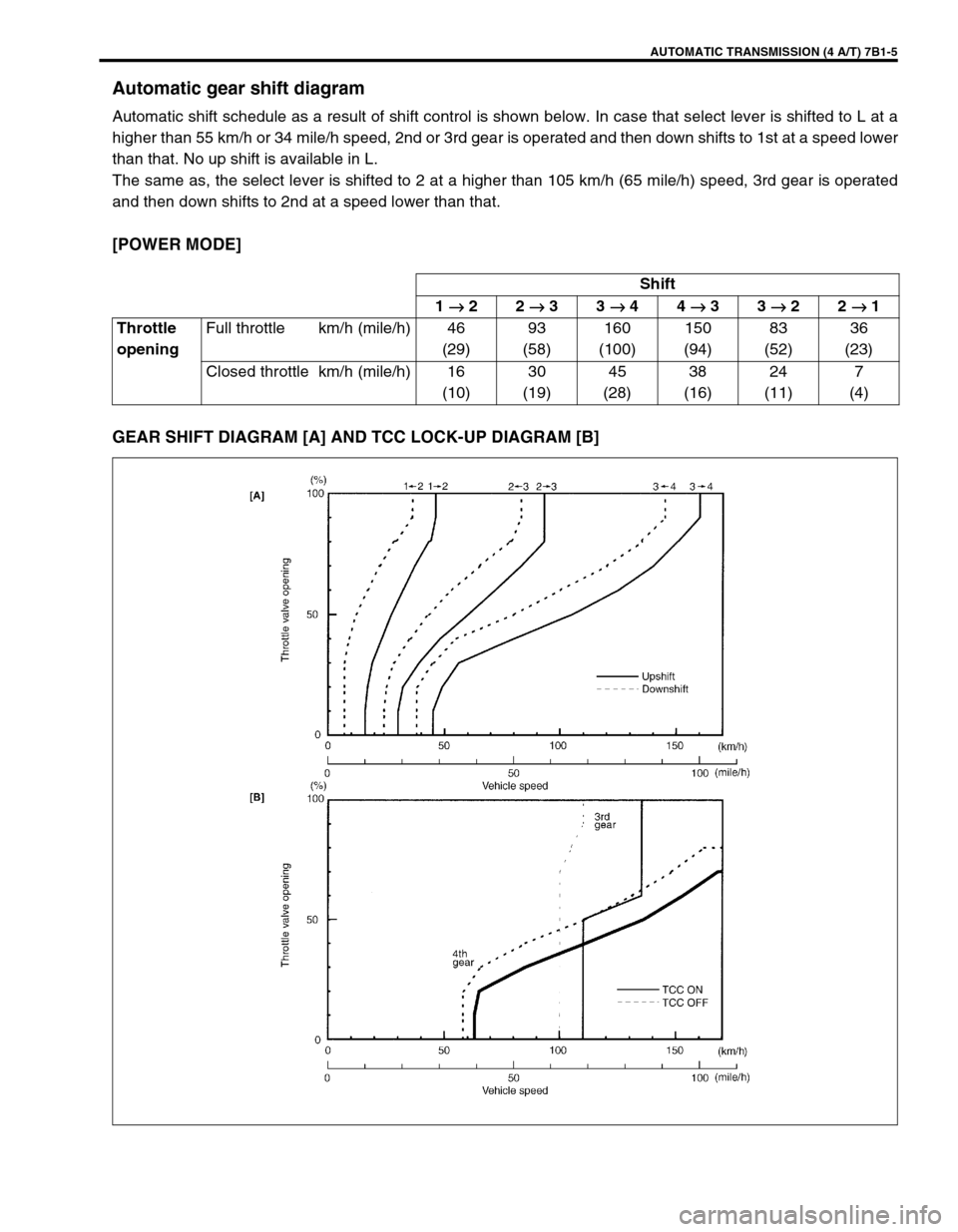
Automatic gear shift diagram
Automatic shift schedule as a result of shift control is shown below. In case that select lever is shifted to L at a
higher than 55 km/h or 34 mile/h speed, 2nd or 3rd gear is operated and then down shifts to 1st at a speed lower
than that. No up shift is available in L.
The same as, the select lever is shifted to 2 at a higher than 105 km/h (65 mile/h) speed, 3rd gear is operated
and then down shifts to 2nd at a speed lower than that.
[POWER MODE]
GEAR SHIFT DIAGRAM [A] AND TCC LOCK-UP DIAGRAM [B]
Shift
1 →
→→ → 22 →
→→ → 33 →
→→ → 44 →
→→ → 33 →
→→ → 22 →
→→ → 1
Throttle
openingFull throttle km/h (mile/h) 46
(29)93
(58)160
(100)150
(94)83
(52)36
(23)
Closed throttle km/h (mile/h) 16
(10)30
(19)45
(28)38
(16)24
(11)7
(4)
Page 415 of 656
![SUZUKI GRAND VITARA 2001 2.G Owners Manual 7B1-6 AUTOMATIC TRANSMISSION (4 A/T)
[NORMAL MODE]
GEAR SHIFT DIAGRAM [A] AND TCC LOCK-UP DIAGRAM [B]
Shift
1 →
→→ → 22 →
→→ → 33 →
→→ → 44 →
→→ → 33 →
→→ → 22](/img/20/7584/w960_7584-414.png "SUZUKI GRAND VITARA 2001 2.G Owners Manual 7B1-6 AUTOMATIC TRANSMISSION (4 A/T)
[NORMAL MODE]
GEAR SHIFT DIAGRAM [A] AND TCC LOCK-UP DIAGRAM [B]
Shift
1 →
→→ → 22 →
→→ → 33 →
→→ → 44 →
→→ → 33 →
→→ → 22")
7B1-6 AUTOMATIC TRANSMISSION (4 A/T)
[NORMAL MODE]
GEAR SHIFT DIAGRAM [A] AND TCC LOCK-UP DIAGRAM [B]
Shift
1 →
→→ → 22 →
→→ → 33 →
→→ → 44 →
→→ → 33 →
→→ → 22 →
→→ → 1
Throttle
openingFull throttle km/h (mile/h) 46
(29)93
(58)160
(100)150
(94)83
(52)36
(23)
Closed throttle km/h (mile/h) 11
(7)27
(17)40
(25)35
(22)21
(13)7
(4)
Page 416 of 656
AUTOMATIC TRANSMISSION (4 A/T) 7B1-7
Diagnosis
This vehicle is equipped with an electronic transmission control system, which control the automatic shift up and
shift down timing, TCC operation, etc. suitably to vehicle driving conditions.
PCM (ECM) has an On-Board Diagnosis system which detects a malfunction in this system and abnormality of
those parts that influence the engine exhaust emission.
When diagnosing a trouble in the transmission including this system, be sure to have full understanding of the
outline of “ON-BOARD DIAGNOSTIC SYSTEM” and each item in “PRECAUTION IN DIAGNOSING TROUBLE”
and execute diagnosis according to “AUTOMATIC TRANSMISSION DIAGNOSTIC FLOW TABLE” to obtain
correct result smoothly.
On-Board Diagnostic System (Vehicle without
monitor connector)
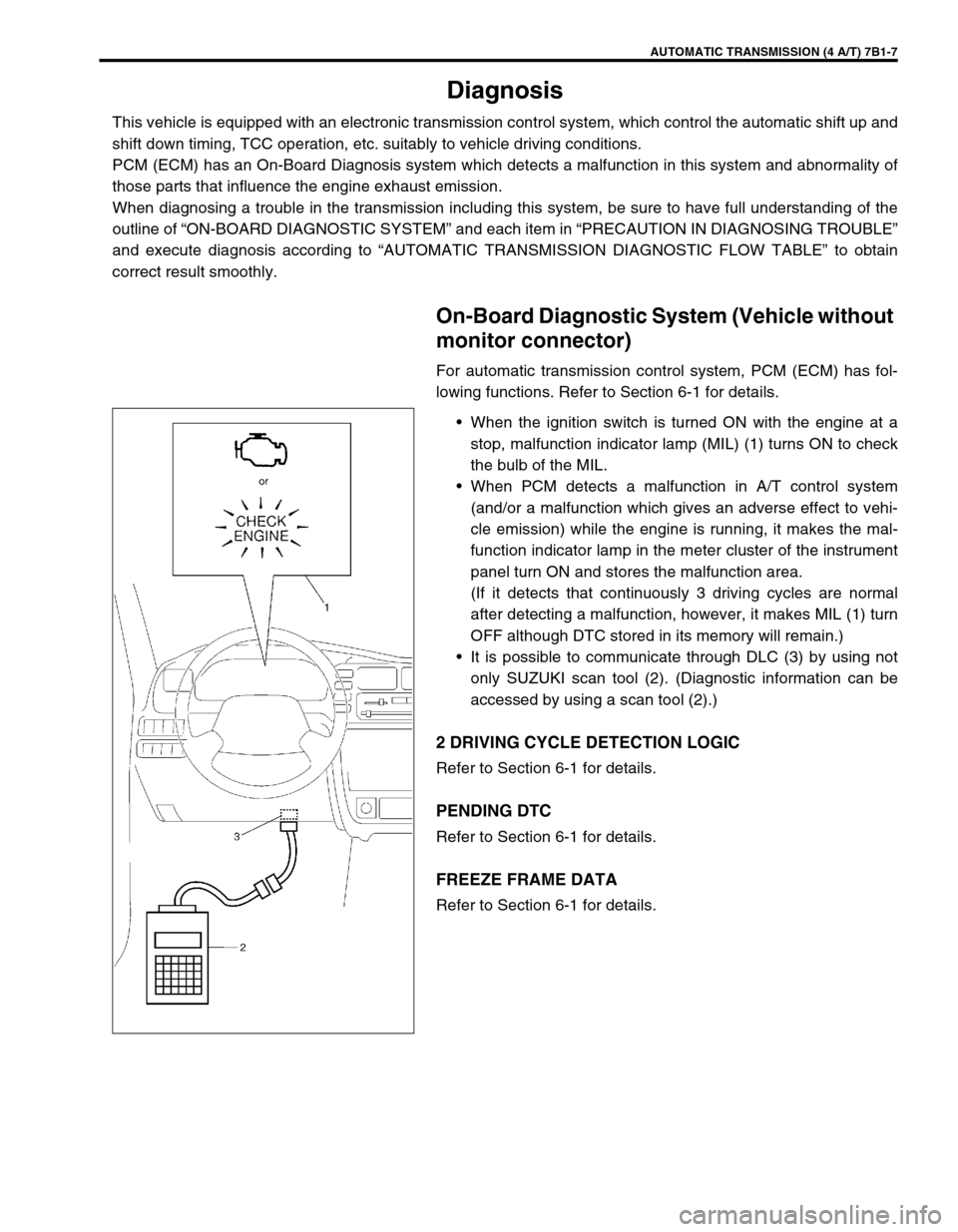
For automatic transmission control system, PCM (ECM) has fol-
lowing functions. Refer to Section 6-1 for details.
•When the ignition switch is turned ON with the engine at a
stop, malfunction indicator lamp (MIL) (1) turns ON to check
the bulb of the MIL.
•When PCM detects a malfunction in A/T control system
(and/or a malfunction which gives an adverse effect to vehi-
cle emission) while the engine is running, it makes the mal-
function indicator lamp in the meter cluster of the instrument
panel turn ON and stores the malfunction area.
(If it detects that continuously 3 driving cycles are normal
after detecting a malfunction, however, it makes MIL (1) turn
OFF although DTC stored in its memory will remain.)
•It is possible to communicate through DLC (3) by using not
only SUZUKI scan tool (2). (Diagnostic information can be
accessed by using a scan tool (2).)
2 DRIVING CYCLE DETECTION LOGIC
Refer to Section 6-1 for details.
PENDING DTC
Refer to Section 6-1 for details.
FREEZE FRAME DATA
Refer to Section 6-1 for details.
Page 417 of 656
7B1-8 AUTOMATIC TRANSMISSION (4 A/T)
On-Board Diagnostic System (Vehicle with
monitor connector)
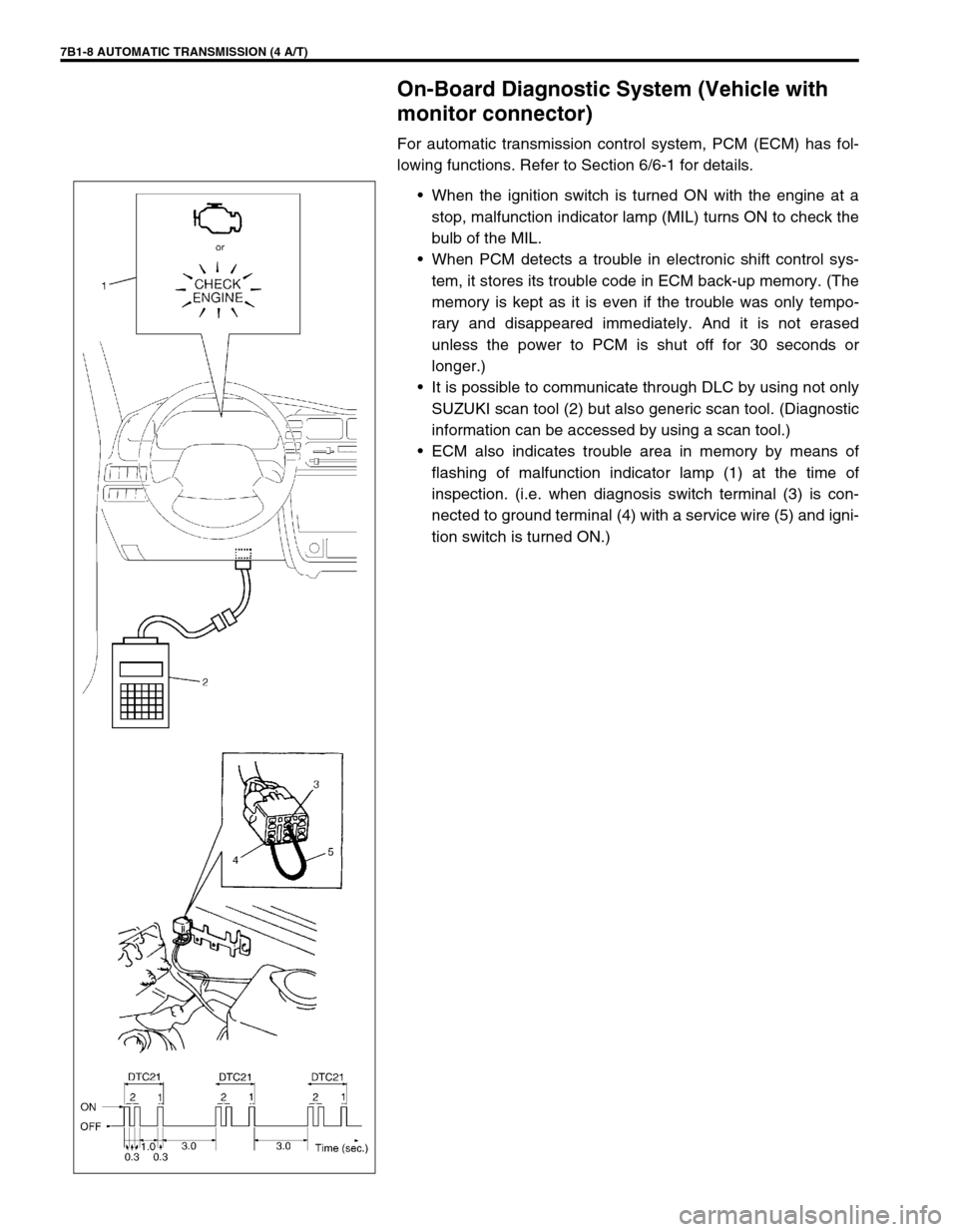
For automatic transmission control system, PCM (ECM) has fol-
lowing functions. Refer to Section 6/6-1 for details.
•When the ignition switch is turned ON with the engine at a
stop, malfunction indicator lamp (MIL) turns ON to check the
bulb of the MIL.
•When PCM detects a trouble in electronic shift control sys-
tem, it stores its trouble code in ECM back-up memory. (The
memory is kept as it is even if the trouble was only tempo-
rary and disappeared immediately. And it is not erased
unless the power to PCM is shut off for 30 seconds or
longer.)
•It is possible to communicate through DLC by using not only
SUZUKI scan tool (2) but also generic scan tool. (Diagnostic
information can be accessed by using a scan tool.)
•ECM also indicates trouble area in memory by means of
flashing of malfunction indicator lamp (1) at the time of
inspection. (i.e. when diagnosis switch terminal (3) is con-
nected to ground terminal (4) with a service wire (5) and igni-
tion switch is turned ON.)
Page 424 of 656
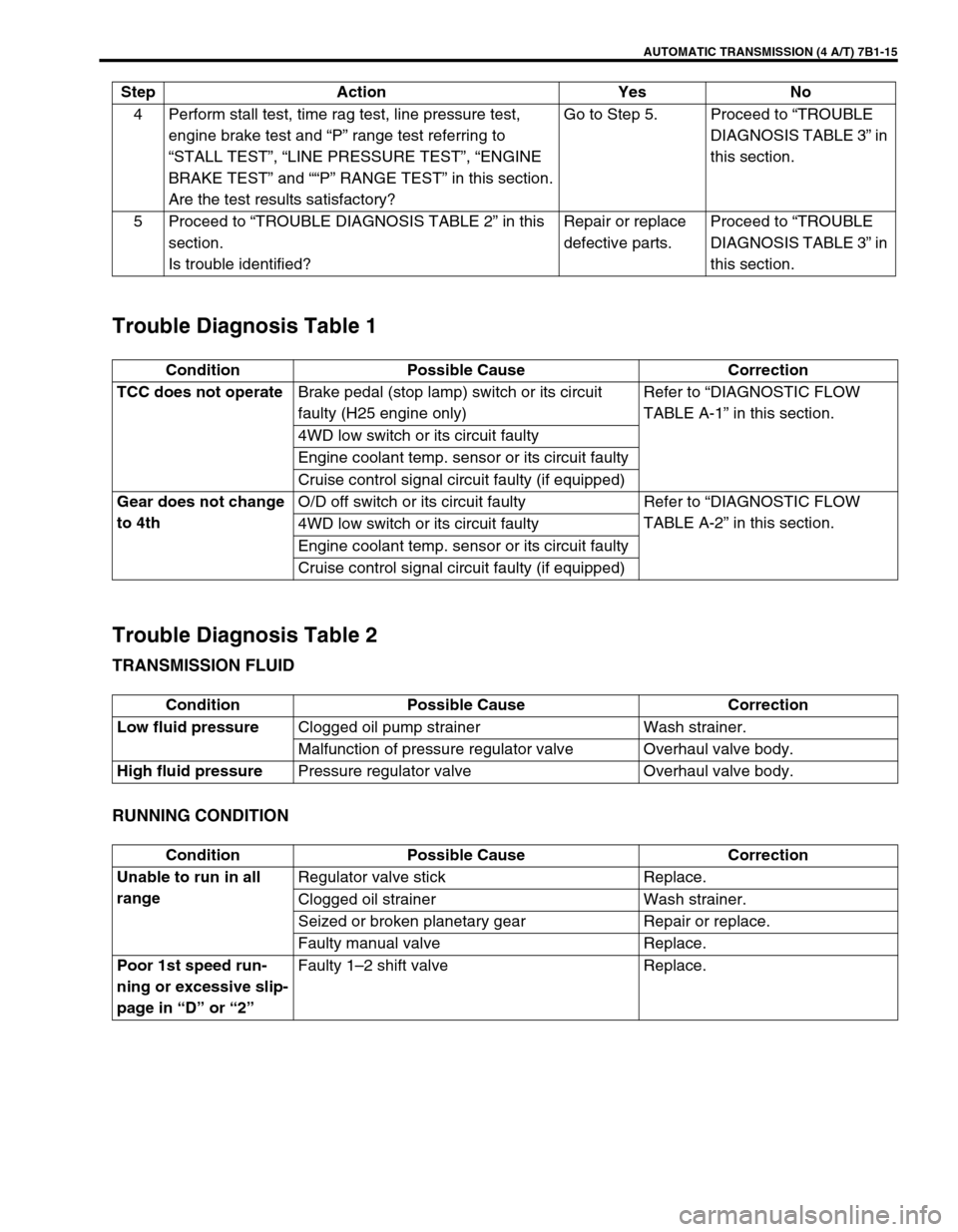
AUTOMATIC TRANSMISSION (4 A/T) 7B1-15
Trouble Diagnosis Table 1
Trouble Diagnosis Table 2
TRANSMISSION FLUID
RUNNING CONDITION
4 Perform stall test, time rag test, line pressure test,
engine brake test and “P” range test referring to
“STALL TEST”, “LINE PRESSURE TEST”, “ENGINE
BRAKE TEST” and ““P” RANGE TEST” in this section.
Are the test results satisfactory?Go to Step 5. Proceed to “TROUBLE
DIAGNOSIS TABLE 3” in
this section.
5 Proceed to “TROUBLE DIAGNOSIS TABLE 2” in this
section.
Is trouble identified?Repair or replace
defective parts.Proceed to “TROUBLE
DIAGNOSIS TABLE 3” in
this section. Step Action Yes No
Condition Possible Cause Correction
TCC does not operateBrake pedal (stop lamp) switch or its circuit
faulty (H25 engine only)Refer to “DIAGNOSTIC FLOW
TABLE A-1” in this section.
4WD low switch or its circuit faulty
Engine coolant temp. sensor or its circuit faulty
Cruise control signal circuit faulty (if equipped)
Gear does not change
to 4thO/D off switch or its circuit faulty Refer to “DIAGNOSTIC FLOW
TABLE A-2” in this section.
4WD low switch or its circuit faulty
Engine coolant temp. sensor or its circuit faulty
Cruise control signal circuit faulty (if equipped)
Condition Possible Cause Correction
Low fluid pressureClogged oil pump strainer Wash strainer.
Malfunction of pressure regulator valve Overhaul valve body.
High fluid pressurePressure regulator valve Overhaul valve body.
Condition Possible Cause Correction
Unable to run in all
rangeRegulator valve stick Replace.
Clogged oil strainer Wash strainer.
Seized or broken planetary gear Repair or replace.
Faulty manual valve Replace.
Poor 1st speed run-
ning or excessive slip-
page in “D” or “2”Faulty 1–2 shift valve Replace.
Page 425 of 656
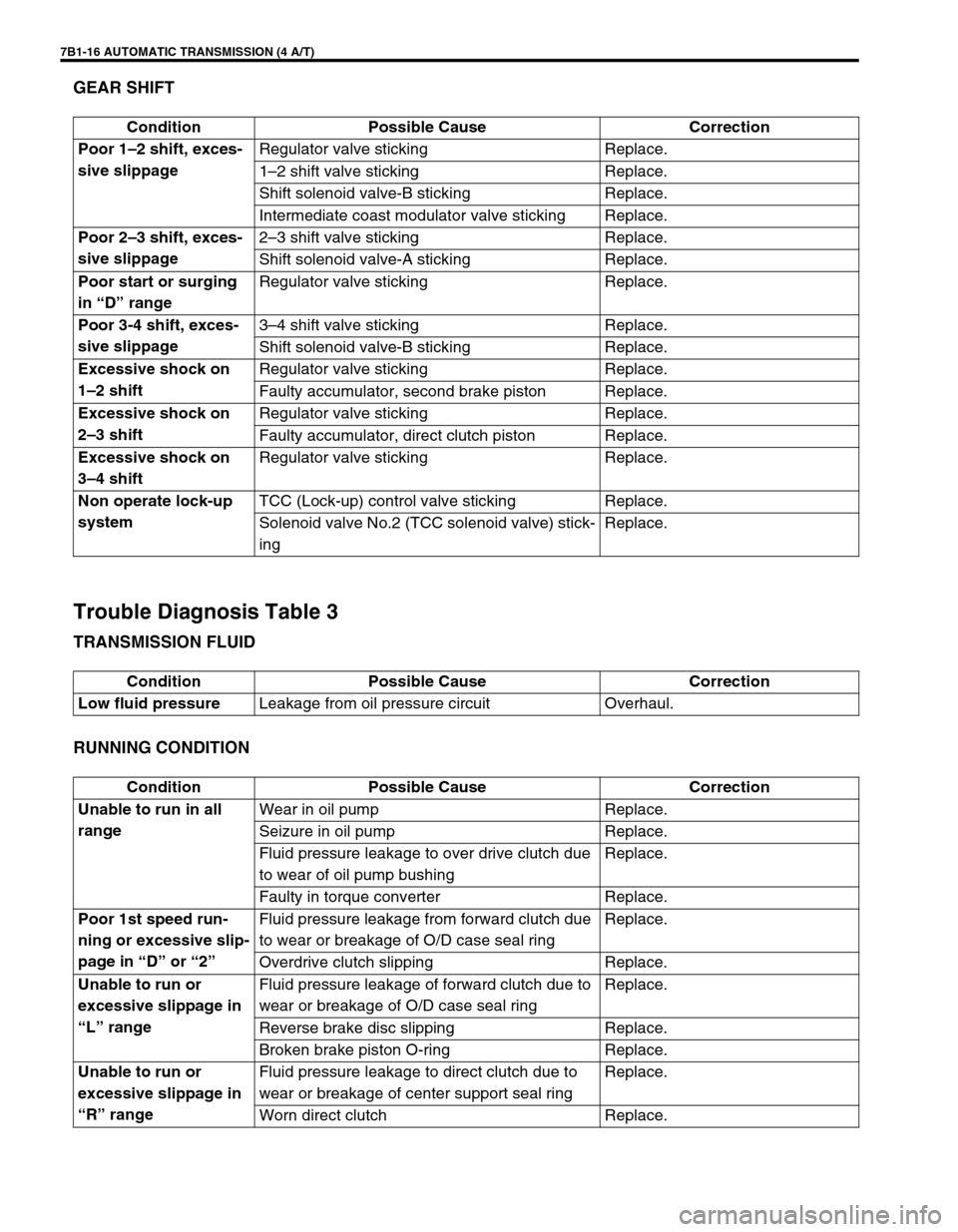
7B1-16 AUTOMATIC TRANSMISSION (4 A/T)
GEAR SHIFT
Trouble Diagnosis Table 3
TRANSMISSION FLUID
RUNNING CONDITION
Condition Possible Cause Correction
Poor 1–2 shift, exces-
sive slippageRegulator valve sticking Replace.
1–2 shift valve sticking Replace.
Shift solenoid valve-B sticking Replace.
Intermediate coast modulator valve sticking Replace.
Poor 2–3 shift, exces-
sive slippage2–3 shift valve sticking Replace.
Shift solenoid valve-A sticking Replace.
Poor start or surging
in “D” rangeRegulator valve sticking Replace.
Poor 3-4 shift, exces-
sive slippage3–4 shift valve sticking Replace.
Shift solenoid valve-B sticking Replace.
Excessive shock on
1–2 shiftRegulator valve sticking Replace.
Faulty accumulator, second brake piston Replace.
Excessive shock on
2–3 shiftRegulator valve sticking Replace.
Faulty accumulator, direct clutch piston Replace.
Excessive shock on
3–4 shiftRegulator valve sticking Replace.
Non operate lock-up
systemTCC (Lock-up) control valve sticking Replace.
Solenoid valve No.2 (TCC solenoid valve) stick-
ingReplace.
Condition Possible Cause Correction
Low fluid pressureLeakage from oil pressure circuit Overhaul.
Condition Possible Cause Correction
Unable to run in all
rangeWear in oil pump Replace.
Seizure in oil pump Replace.
Fluid pressure leakage to over drive clutch due
to wear of oil pump bushingReplace.
Faulty in torque converter Replace.
Poor 1st speed run-
ning or excessive slip-
page in “D” or “2”Fluid pressure leakage from forward clutch due
to wear or breakage of O/D case seal ringReplace.
Overdrive clutch slipping Replace.
Unable to run or
excessive slippage in
“L” rangeFluid pressure leakage of forward clutch due to
wear or breakage of O/D case seal ringReplace.
Reverse brake disc slipping Replace.
Broken brake piston O-ring Replace.
Unable to run or
excessive slippage in
“R” rangeFluid pressure leakage to direct clutch due to
wear or breakage of center support seal ringReplace.
Worn direct clutch Replace.
Page 426 of 656
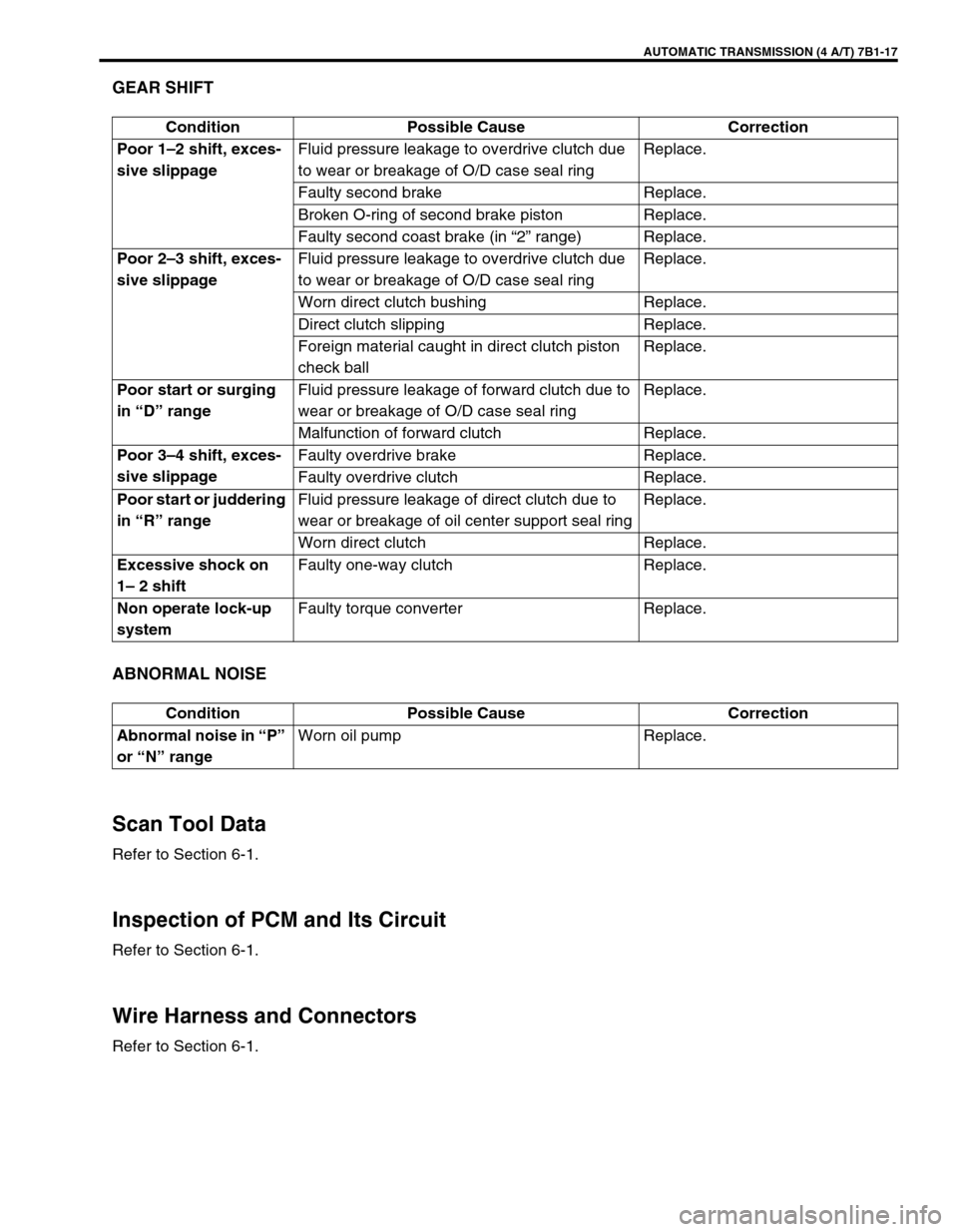
AUTOMATIC TRANSMISSION (4 A/T) 7B1-17
GEAR SHIFT
ABNORMAL NOISE
Scan Tool Data
Refer to Section 6-1.
Inspection of PCM and Its Circuit
Refer to Section 6-1.
Wire Harness and Connectors
Refer to Section 6-1.Condition Possible Cause Correction
Poor 1–2 shift, exces-
sive slippageFluid pressure leakage to overdrive clutch due
to wear or breakage of O/D case seal ringReplace.
Faulty second brake Replace.
Broken O-ring of second brake piston Replace.
Faulty second coast brake (in “2” range) Replace.
Poor 2–3 shift, exces-
sive slippageFluid pressure leakage to overdrive clutch due
to wear or breakage of O/D case seal ringReplace.
Worn direct clutch bushing Replace.
Direct clutch slipping Replace.
Foreign material caught in direct clutch piston
check ballReplace.
Poor start or surging
in “D” rangeFluid pressure leakage of forward clutch due to
wear or breakage of O/D case seal ringReplace.
Malfunction of forward clutch Replace.
Poor 3–4 shift, exces-
sive slippageFaulty overdrive brake Replace.
Faulty overdrive clutch Replace.
Poor start or juddering
in “R” rangeFluid pressure leakage of direct clutch due to
wear or breakage of oil center support seal ringReplace.
Worn direct clutch Replace.
Excessive shock on
1– 2 shiftFaulty one-way clutch Replace.
Non operate lock-up
systemFaulty torque converter Replace.
Condition Possible Cause Correction
Abnormal noise in “P”
or “N” rangeWorn oil pump Replace.
Page 429 of 656
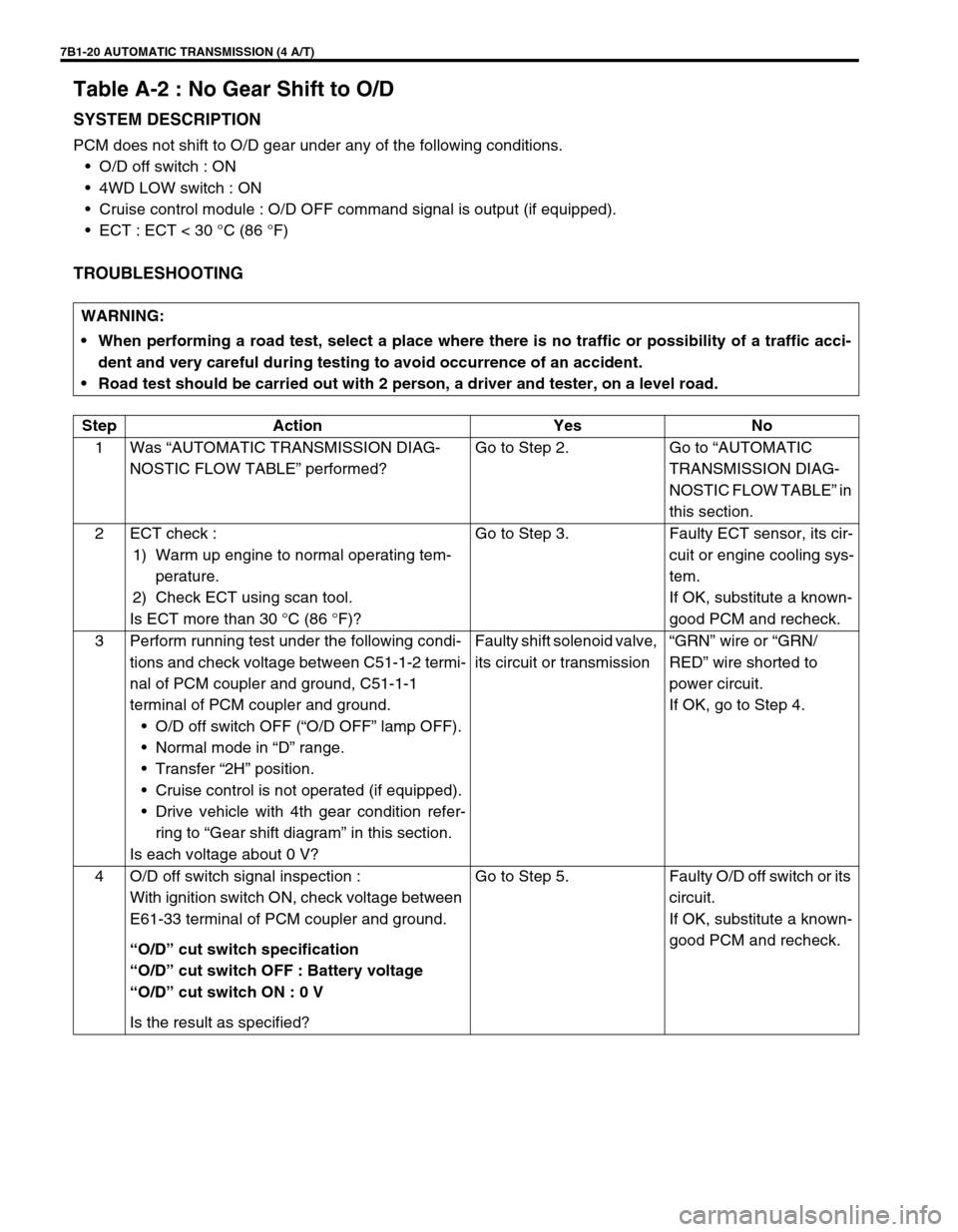
7B1-20 AUTOMATIC TRANSMISSION (4 A/T)
Table A-2 : No Gear Shift to O/D
SYSTEM DESCRIPTION
PCM does not shift to O/D gear under any of the following conditions.
•O/D off switch : ON
•4WD LOW switch : ON
•Cruise control module : O/D OFF command signal is output (if equipped).
•ECT : ECT < 30 °C (86 °F)
TROUBLESHOOTING
WARNING:
When performing a road test, select a place where there is no traffic or possibility of a traffic acci-
dent and very careful during testing to avoid occurrence of an accident.
Road test should be carried out with 2 person, a driver and tester, on a level road.
Step Action Yes No
1Was “AUTOMATIC TRANSMISSION DIAG-
NOSTIC FLOW TABLE” performed?Go to Step 2. Go to “AUTOMATIC
TRANSMISSION DIAG-
NOSTIC FLOW TABLE” in
this section.
2 ECT check :
1) Warm up engine to normal operating tem-
perature.
2) Check ECT using scan tool.
Is ECT more than 30 °C (86 °F)?Go to Step 3. Faulty ECT sensor, its cir-
cuit or engine cooling sys-
tem.
If OK, substitute a known-
good PCM and recheck.
3 Perform running test under the following condi-
tions and check voltage between C51-1-2 termi-
nal of PCM coupler and ground, C51-1-1
terminal of PCM coupler and ground.
•O/D off switch OFF (“O/D OFF” lamp OFF).
•Normal mode in “D” range.
•Transfer “2H” position.
•Cruise control is not operated (if equipped).
•Drive vehicle with 4th gear condition refer-
ring to “Gear shift diagram” in this section.
Is each voltage about 0 V?Faulty shift solenoid valve,
its circuit or transmission“GRN” wire or “GRN/
RED” wire shorted to
power circuit.
If OK, go to Step 4.
4 O/D off switch signal inspection :
With ignition switch ON, check voltage between
E61-33 terminal of PCM coupler and ground.
“O/D” cut switch specification
“O/D” cut switch OFF : Battery voltage
“O/D” cut switch ON : 0 V
Is the result as specified?Go to Step 5. Faulty O/D off switch or its
circuit.
If OK, substitute a known-
good PCM and recheck.
Page 436 of 656
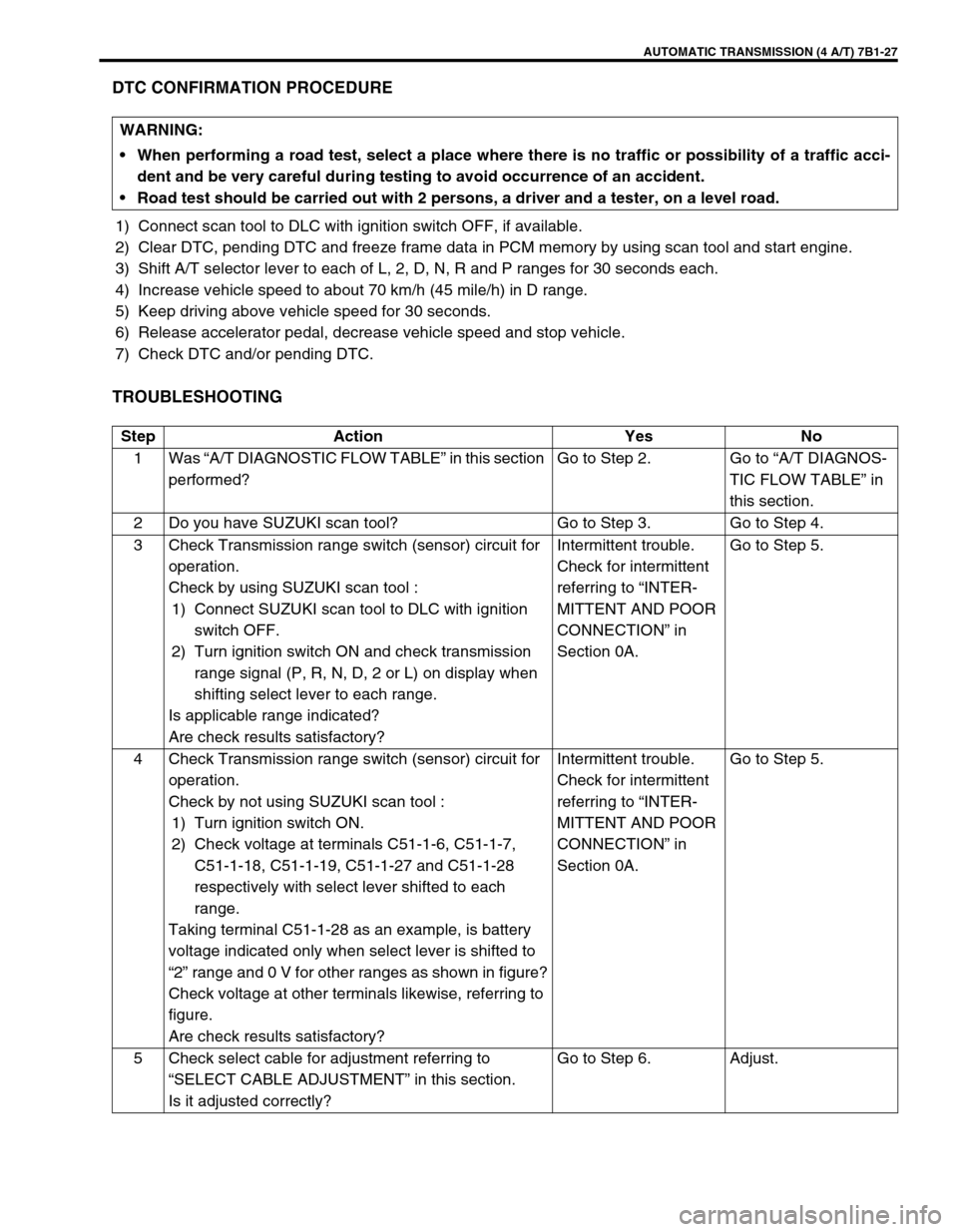
AUTOMATIC TRANSMISSION (4 A/T) 7B1-27
DTC CONFIRMATION PROCEDURE
1) Connect scan tool to DLC with ignition switch OFF, if available.
2) Clear DTC, pending DTC and freeze frame data in PCM memory by using scan tool and start engine.
3) Shift A/T selector lever to each of L, 2, D, N, R and P ranges for 30 seconds each.
4) Increase vehicle speed to about 70 km/h (45 mile/h) in D range.
5) Keep driving above vehicle speed for 30 seconds.
6) Release accelerator pedal, decrease vehicle speed and stop vehicle.
7) Check DTC and/or pending DTC.
TROUBLESHOOTING
WARNING:
When performing a road test, select a place where there is no traffic or possibility of a traffic acci-
dent and be very careful during testing to avoid occurrence of an accident.
Road test should be carried out with 2 persons, a driver and a tester, on a level road.
Step Action Yes No
1Was “A/T DIAGNOSTIC FLOW TABLE” in this section
performed?Go to Step 2. Go to “A/T DIAGNOS-
TIC FLOW TABLE” in
this section.
2 Do you have SUZUKI scan tool? Go to Step 3. Go to Step 4.
3 Check Transmission range switch (sensor) circuit for
operation.
Check by using SUZUKI scan tool :
1) Connect SUZUKI scan tool to DLC with ignition
switch OFF.
2) Turn ignition switch ON and check transmission
range signal (P, R, N, D, 2 or L) on display when
shifting select lever to each range.
Is applicable range indicated?
Are check results satisfactory?Intermittent trouble.
Check for intermittent
referring to “INTER-
MITTENT AND POOR
CONNECTION” in
Section 0A.Go to Step 5.
4 Check Transmission range switch (sensor) circuit for
operation.
Check by not using SUZUKI scan tool :
1) Turn ignition switch ON.
2) Check voltage at terminals C51-1-6, C51-1-7,
C51-1-18, C51-1-19, C51-1-27 and C51-1-28
respectively with select lever shifted to each
range.
Taking terminal C51-1-28 as an example, is battery
voltage indicated only when select lever is shifted to
“2” range and 0 V for other ranges as shown in figure?
Check voltage at other terminals likewise, referring to
figure.
Are check results satisfactory?Intermittent trouble.
Check for intermittent
referring to “INTER-
MITTENT AND POOR
CONNECTION” in
Section 0A.Go to Step 5.
5 Check select cable for adjustment referring to
“SELECT CABLE ADJUSTMENT” in this section.
Is it adjusted correctly?Go to Step 6. Adjust.