panel SUZUKI GRAND VITARA 2001 2.G Owner's Manual
[x] Cancel search | Manufacturer: SUZUKI, Model Year: 2001, Model line: GRAND VITARA, Model: SUZUKI GRAND VITARA 2001 2.GPages: 656, PDF Size: 14.31 MB
Page 564 of 656
BODY SERVICE 9-19
Exterior and Interior Trim
Floor Carpet
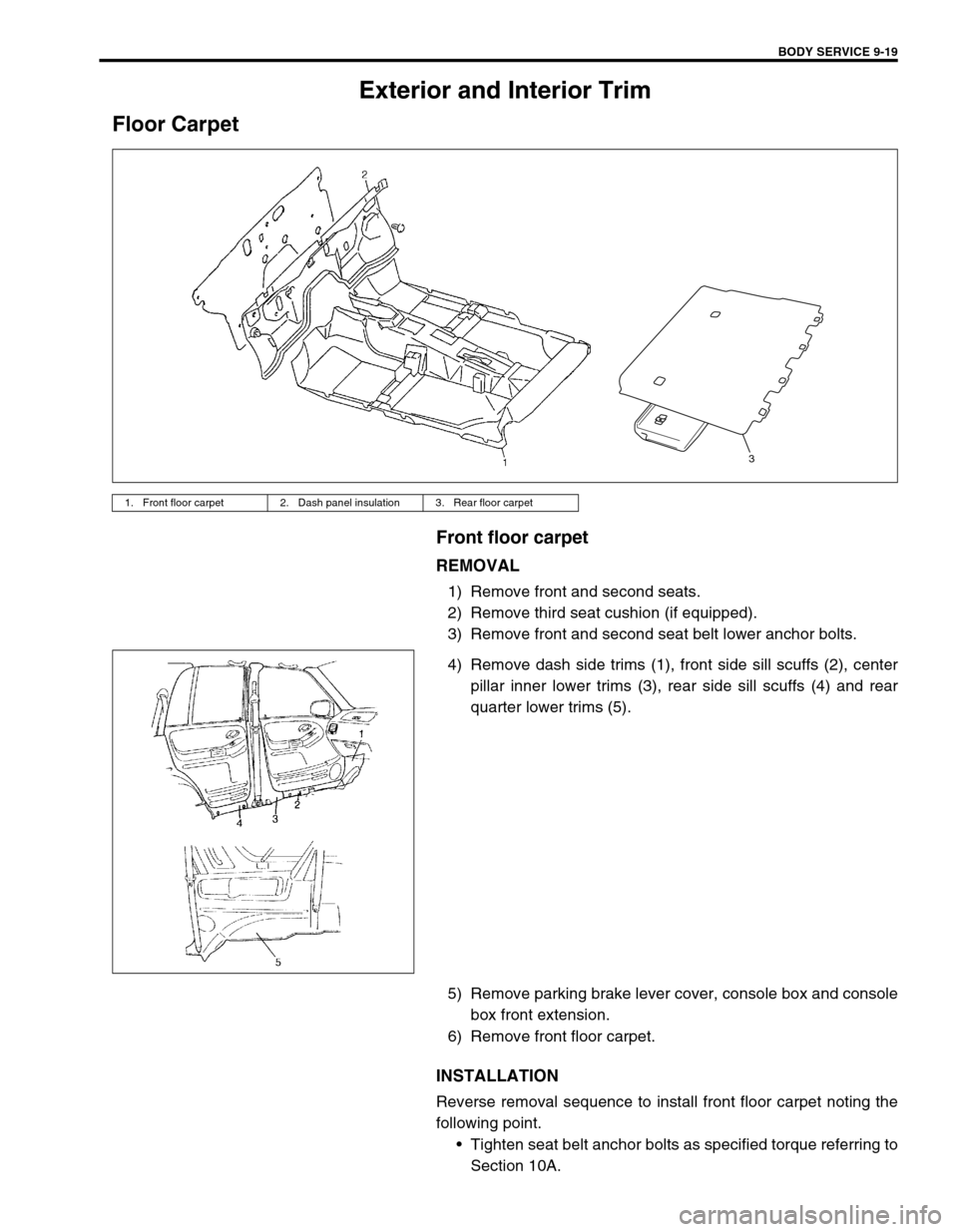
Front floor carpet
REMOVAL
1) Remove front and second seats.
2) Remove third seat cushion (if equipped).
3) Remove front and second seat belt lower anchor bolts.
4) Remove dash side trims (1), front side sill scuffs (2), center
pillar inner lower trims (3), rear side sill scuffs (4) and rear
quarter lower trims (5).
5) Remove parking brake lever cover, console box and console
box front extension.
6) Remove front floor carpet.
INSTALLATION
Reverse removal sequence to install front floor carpet noting the
following point.
•Tighten seat belt anchor bolts as specified torque referring to
Section 10A.
1. Front floor carpet 2. Dash panel insulation 3. Rear floor carpet
3
Page 569 of 656
10-2 RESTRAINT SYSTEM
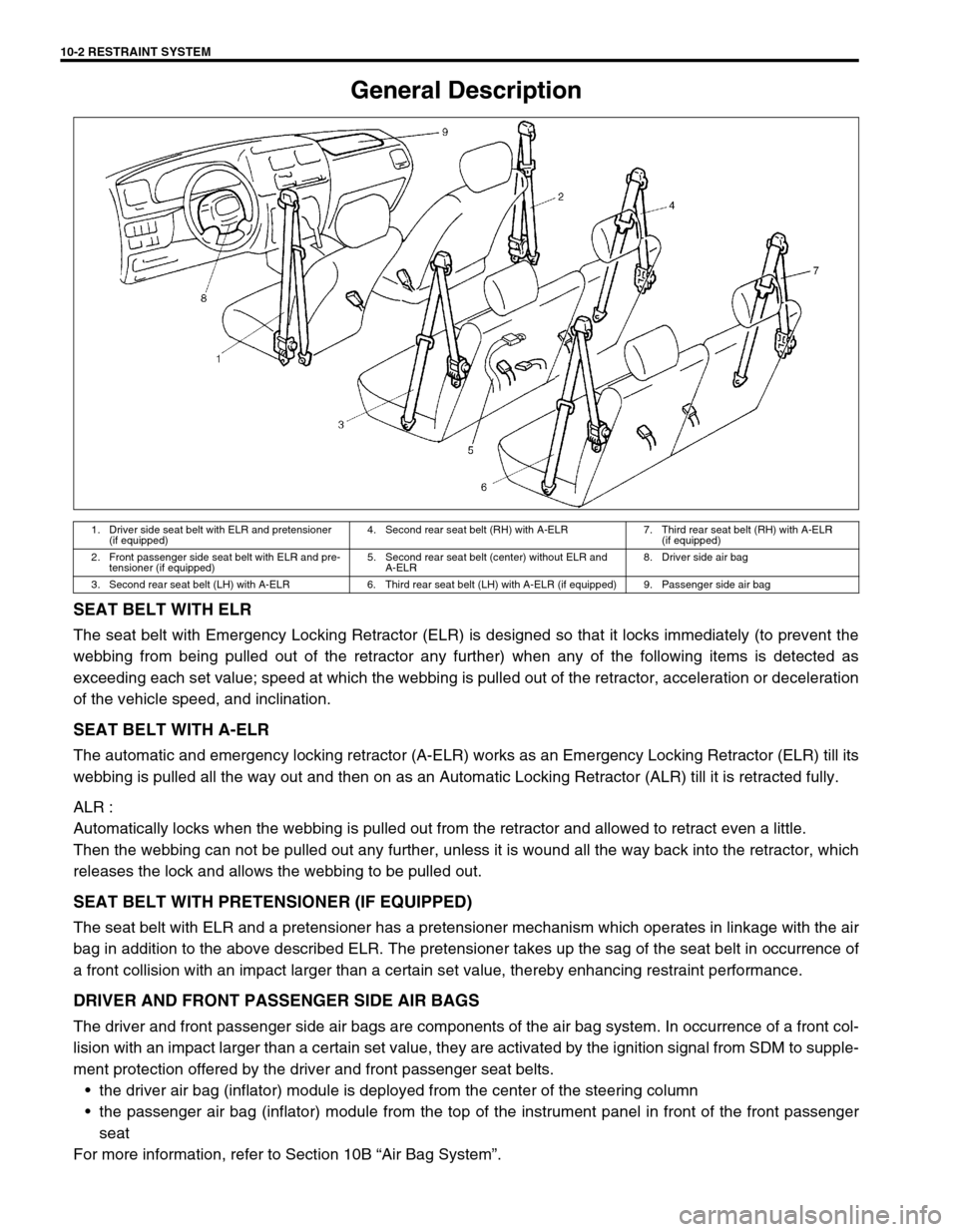
General Description
SEAT BELT WITH ELR
The seat belt with Emergency Locking Retractor (ELR) is designed so that it locks immediately (to prevent the
webbing from being pulled out of the retractor any further) when any of the following items is detected as
exceeding each set value; speed at which the webbing is pulled out of the retractor, acceleration or deceleration
of the vehicle speed, and inclination.
SEAT BELT WITH A-ELR
The automatic and emergency locking retractor (A-ELR) works as an Emergency Locking Retractor (ELR) till its
webbing is pulled all the way out and then on as an Automatic Locking Retractor (ALR) till it is retracted fully.
ALR :
Automatically locks when the webbing is pulled out from the retractor and allowed to retract even a little.
Then the webbing can not be pulled out any further, unless it is wound all the way back into the retractor, which
releases the lock and allows the webbing to be pulled out.
SEAT BELT WITH PRETENSIONER (IF EQUIPPED)
The seat belt with ELR and a pretensioner has a pretensioner mechanism which operates in linkage with the air
bag in addition to the above described ELR. The pretensioner takes up the sag of the seat belt in occurrence of
a front collision with an impact larger than a certain set value, thereby enhancing restraint performance.
DRIVER AND FRONT PASSENGER SIDE AIR BAGS
The driver and front passenger side air bags are components of the air bag system. In occurrence of a front col-
lision with an impact larger than a certain set value, they are activated by the ignition signal from SDM to supple-
ment protection offered by the driver and front passenger seat belts.
•the driver air bag (inflator) module is deployed from the center of the steering column
•the passenger air bag (inflator) module from the top of the instrument panel in front of the front passenger
seat
For more information, refer to Section 10B “Air Bag System”.
1. Driver side seat belt with ELR and pretensioner
(if equipped) 4. Second rear seat belt (RH) with A-ELR 7. Third rear seat belt (RH) with A-ELR
(if equipped)
2. Front passenger side seat belt with ELR and pre-
tensioner (if equipped) 5. Second rear seat belt (center) without ELR and
A-ELR8. Driver side air bag
3. Second rear seat belt (LH) with A-ELR 6. Third rear seat belt (LH) with A-ELR (if equipped) 9. Passenger side air bag
Page 571 of 656
10A-2 SEAT BELT
On-Vehicle Service
Service Precautions
Service and diagnosis
Before servicing or replacing seat belts, refer to following precautionary items.
•Seat belts should be normal relative to strap retractor and buckle portions.
•Keep sharp edges and damaging objects away from belts. Avoid bending or damaging any portion of belt
buckle, latch plate and ELR.
•Do not bleach or dye belt webbing. (Use only mild soap and lukewarm water to clean it.)
•When installing a seat belt anchor bolt, start bolt by hand to prevent cross-threading.
•Use only the correct seat belt anchor bolts and screws and tighten to the correct torque value.
•Do not attempt any repairs on retractor mechanisms or retractor covers. Replace defective assemblies with
new replacement parts.
•Keep belts dry and clean at all times.
•If there exist any parts in question, replace such parts.
•Replace belts whose webbing is cut or otherwise damaged.
•Do not put anything into trim panel opening which seat belt webbing passes through.
For Seat Belt with Pretensioner
Refer to “SERVICE AND DIAGNOSIS” of “SERVICE PRECAUTIONS” under “ON-VEHICLE SERVICE” in Sec-
tion 10B.
Disabling air bag system
Refer to “DISABLING AIR BAG SYSTEM” of “SERVICE PRECAUTIONS” under “ON-VEHICLE SERVICE” in
Section 10B.
Enabling air bag system
Refer to “ENABLING AIR BAG SYSTEM” of “SERVICE PRECAUTIONS” under “ON-VEHICLE SERVICE” in
Section 10B.
Handling and storage
Refer to “HANDLING AND STORAGE” of “SERVICE PRECAUTIONS” under “ON-VEHICLE SERVICE” in Sec-
tion 10B.
Disposal
Refer to “DISPOSAL” of “SERVICE PRECAUTIONS” under “ON-VEHICLE SERVICE” in Section 10B. WARNING:
If replacing seat belt is necessary, replace buckle and ELR (or webbing) together as a set. This is for
the reason of ensuring locking of tongue plate with buckle. If these parts are replaced individually,
such a locking condition may become unreliable. For this reason, SUZUKI will supply only the spare
buckle and ELR (or webbing) in a set part.
WARNING:
When performing service on or around air bag system components or air bag system wiring, disable
the air bag system. Refer to “DISABLING AIR BAG SYSTEM” of “SERVICE PRECAUTIONS” under
“ON-VEHICLE SERVICE” in Section 10B.
Failure to follow procedures could result in possible air bag activation, personal injury or unneeded
air bag system repairs.
Page 574 of 656
SEAT BELT 10A-5
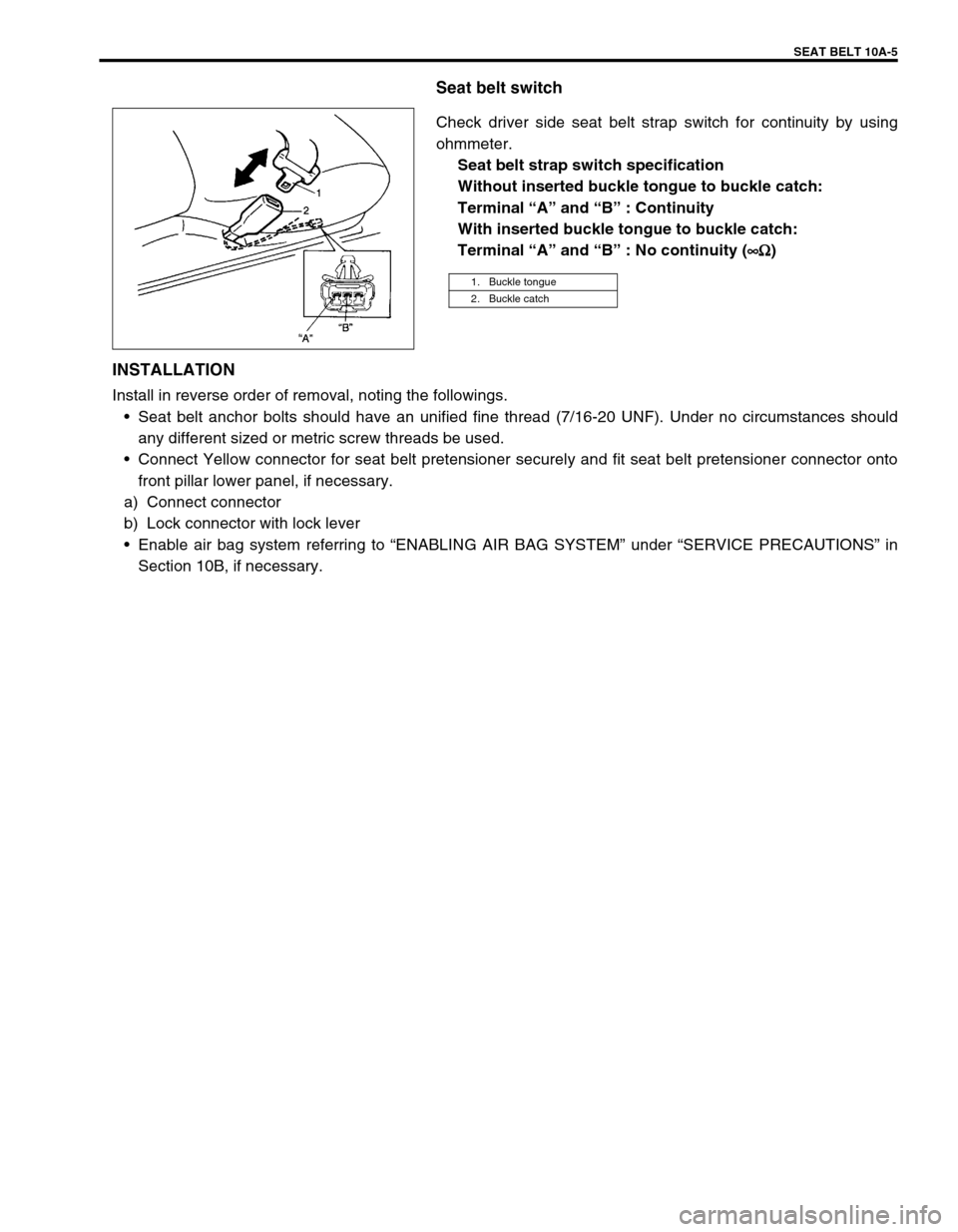
Seat belt switch
Check driver side seat belt strap switch for continuity by using
ohmmeter.
Seat belt strap switch specification
Without inserted buckle tongue to buckle catch:
Terminal “A” and “B” : Continuity
With inserted buckle tongue to buckle catch:
Terminal “A” and “B” : No continuity (∞Ω
∞Ω∞Ω ∞Ω)
INSTALLATION
Install in reverse order of removal, noting the followings.
•Seat belt anchor bolts should have an unified fine thread (7/16-20 UNF). Under no circumstances should
any different sized or metric screw threads be used.
•Connect Yellow connector for seat belt pretensioner securely and fit seat belt pretensioner connector onto
front pillar lower panel, if necessary.
a) Connect connector
b) Lock connector with lock lever
•Enable air bag system referring to “ENABLING AIR BAG SYSTEM” under “SERVICE PRECAUTIONS” in
Section 10B, if necessary.
1. Buckle tongue
2. Buckle catch
Page 580 of 656
AIR BAG SYSTEM 10B-3
General Description
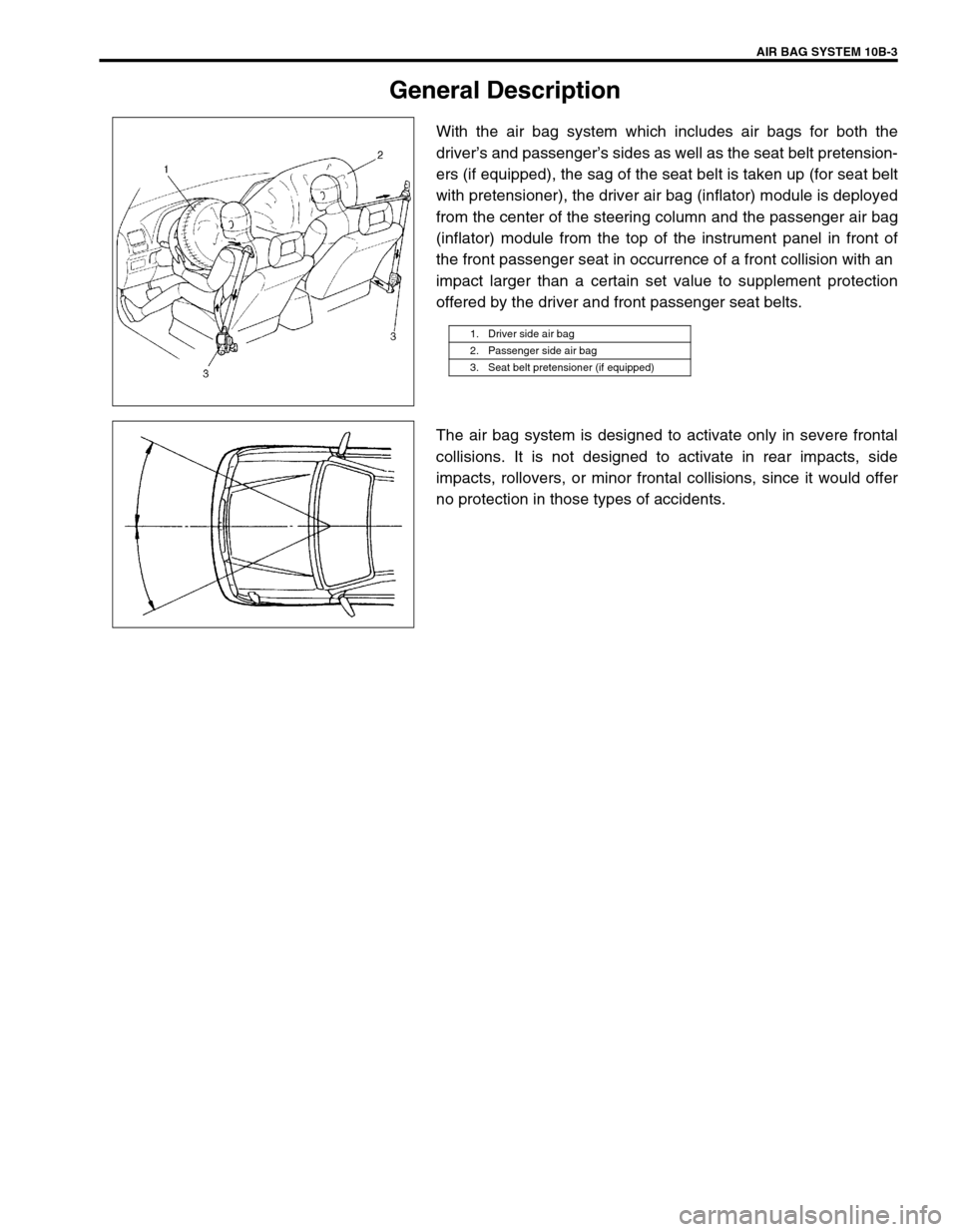
With the air bag system which includes air bags for both the
driver’s and passenger’s sides as well as the seat belt pretension-
ers (if equipped), the sag of the seat belt is taken up (for seat belt
with pretensioner), the driver air bag (inflator) module is deployed
from the center of the steering column and the passenger air bag
(inflator) module from the top of the instrument panel in front of
the front passenger seat in occurrence of a front collision with an
impact larger than a certain set value to supplement protection
offered by the driver and front passenger seat belts.
The air bag system is designed to activate only in severe frontal
collisions. It is not designed to activate in rear impacts, side
impacts, rollovers, or minor frontal collisions, since it would offer
no protection in those types of accidents.
1. Driver side air bag
2. Passenger side air bag
3. Seat belt pretensioner (if equipped)
Page 581 of 656
10B-4 AIR BAG SYSTEM
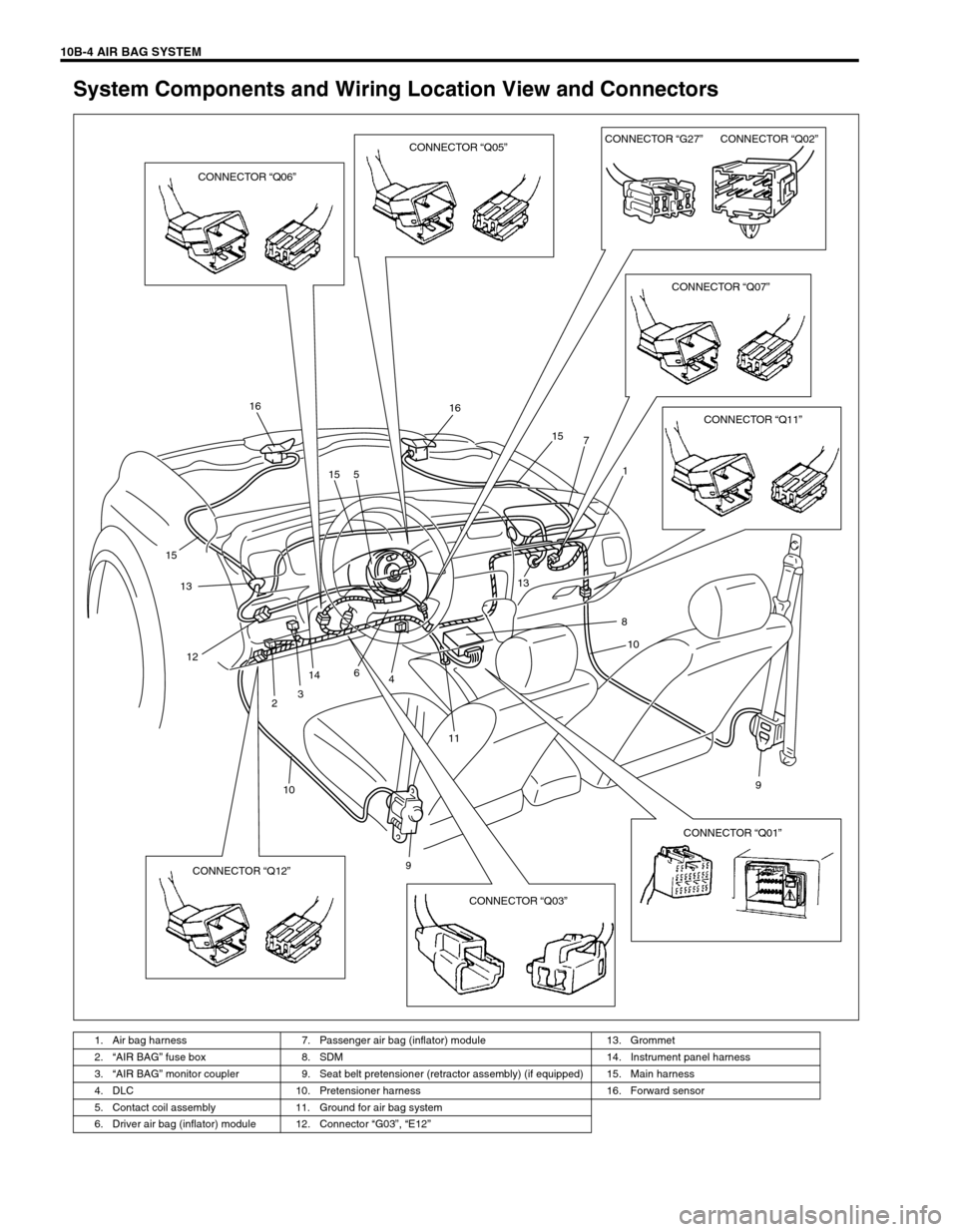
System Components and Wiring Location View and Connectors
1. Air bag harness 7. Passenger air bag (inflator) module 13. Grommet
2.“AIR BAG” fuse box 8. SDM 14. Instrument panel harness
3.“AIR BAG” monitor coupler 9. Seat belt pretensioner (retractor assembly) (if equipped) 15. Main harness
4. DLC 10. Pretensioner harness 16. Forward sensor
5. Contact coil assembly 11. Ground for air bag system
6. Driver air bag (inflator) module 12. Connector “G03”, “E12”
16 16
15
13
12
14
1113
10 15 5
6
3
248
9 1 7 15
9
10
CONNECTOR “Q06”CONNECTOR “Q05”CONNECTOR “G27”CONNECTOR “Q02”
CONNECTOR “Q07”
CONNECTOR “Q11”
CONNECTOR “Q03” CONNECTOR “Q12”CONNECTOR “Q01”
Page 588 of 656
AIR BAG SYSTEM 10B-11
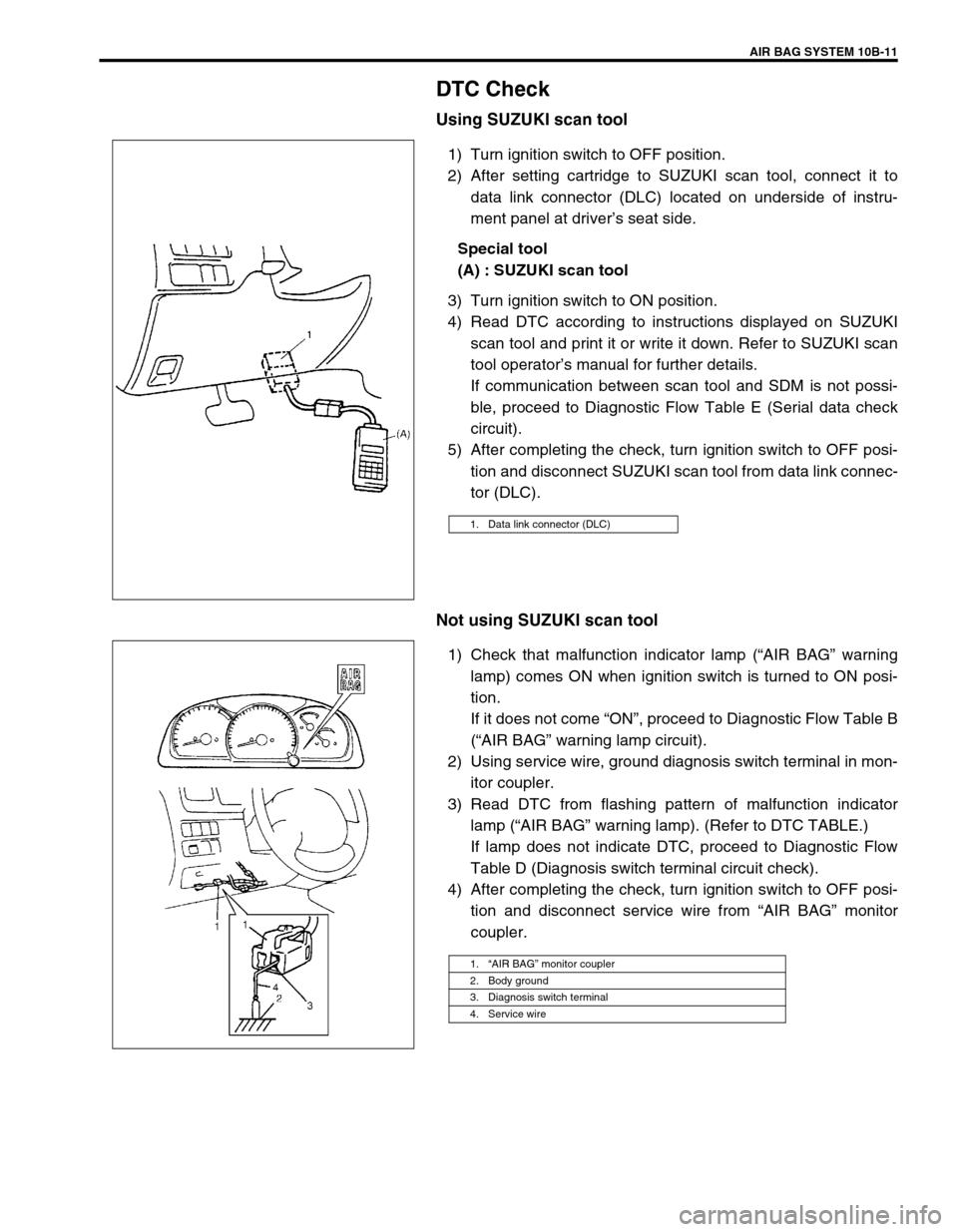
DTC Check
Using SUZUKI scan tool
1) Turn ignition switch to OFF position.
2) After setting cartridge to SUZUKI scan tool, connect it to
data link connector (DLC) located on underside of instru-
ment panel at driver’s seat side.
Special tool
(A) : SUZUKI scan tool
3) Turn ignition switch to ON position.
4) Read DTC according to instructions displayed on SUZUKI
scan tool and print it or write it down. Refer to SUZUKI scan
tool operator’s manual for further details.
If communication between scan tool and SDM is not possi-
ble, proceed to Diagnostic Flow Table E (Serial data check
circuit).
5) After completing the check, turn ignition switch to OFF posi-
tion and disconnect SUZUKI scan tool from data link connec-
tor (DLC).
Not using SUZUKI scan tool
1) Check that malfunction indicator lamp (“AIR BAG” warning
lamp) comes ON when ignition switch is turned to ON posi-
tion.
If it does not come “ON”, proceed to Diagnostic Flow Table B
(“AIR BAG” warning lamp circuit).
2) Using service wire, ground diagnosis switch terminal in mon-
itor coupler.
3) Read DTC from flashing pattern of malfunction indicator
lamp (“AIR BAG” warning lamp). (Refer to DTC TABLE.)
If lamp does not indicate DTC, proceed to Diagnostic Flow
Table D (Diagnosis switch terminal circuit check).
4) After completing the check, turn ignition switch to OFF posi-
tion and disconnect service wire from “AIR BAG” monitor
coupler.
1. Data link connector (DLC)
1.“AIR BAG” monitor coupler
2. Body ground
3. Diagnosis switch terminal
4. Service wire
Page 635 of 656
10B-58 AIR BAG SYSTEM
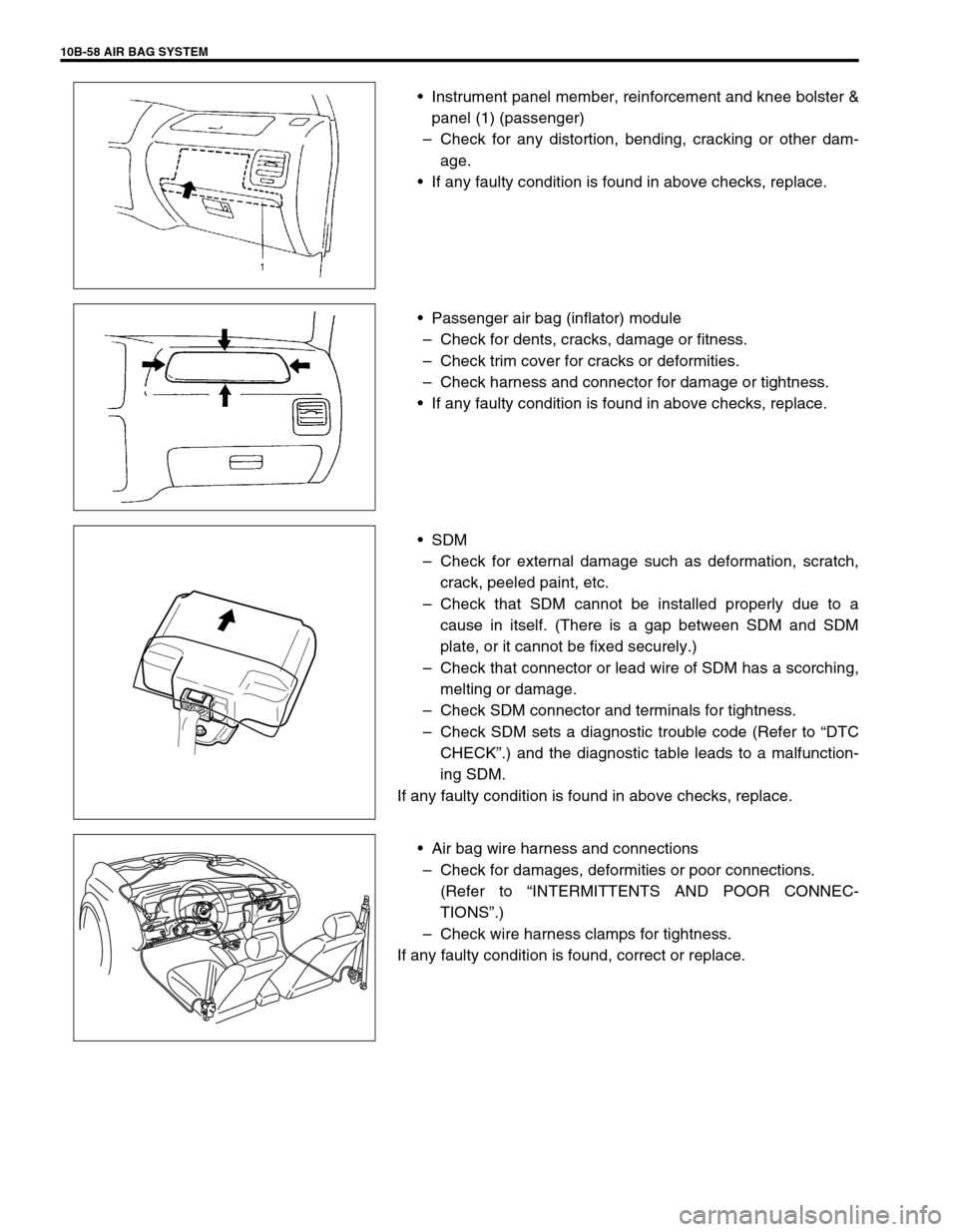
•Instrument panel member, reinforcement and knee bolster &
panel (1) (passenger)
–Check for any distortion, bending, cracking or other dam-
age.
•If any faulty condition is found in above checks, replace.
•Passenger air bag (inflator) module
–Check for dents, cracks, damage or fitness.
–Check trim cover for cracks or deformities.
–Check harness and connector for damage or tightness.
•If any faulty condition is found in above checks, replace.
•SDM
–Check for external damage such as deformation, scratch,
crack, peeled paint, etc.
–Check that SDM cannot be installed properly due to a
cause in itself. (There is a gap between SDM and SDM
plate, or it cannot be fixed securely.)
–Check that connector or lead wire of SDM has a scorching,
melting or damage.
–Check SDM connector and terminals for tightness.
–Check SDM sets a diagnostic trouble code (Refer to “DTC
CHECK”.) and the diagnostic table leads to a malfunction-
ing SDM.
If any faulty condition is found in above checks, replace.
•Air bag wire harness and connections
–Check for damages, deformities or poor connections.
(Refer to “INTERMITTENTS AND POOR CONNEC-
TIONS”.)
–Check wire harness clamps for tightness.
If any faulty condition is found, correct or replace.
15
Page 636 of 656
AIR BAG SYSTEM 10B-59
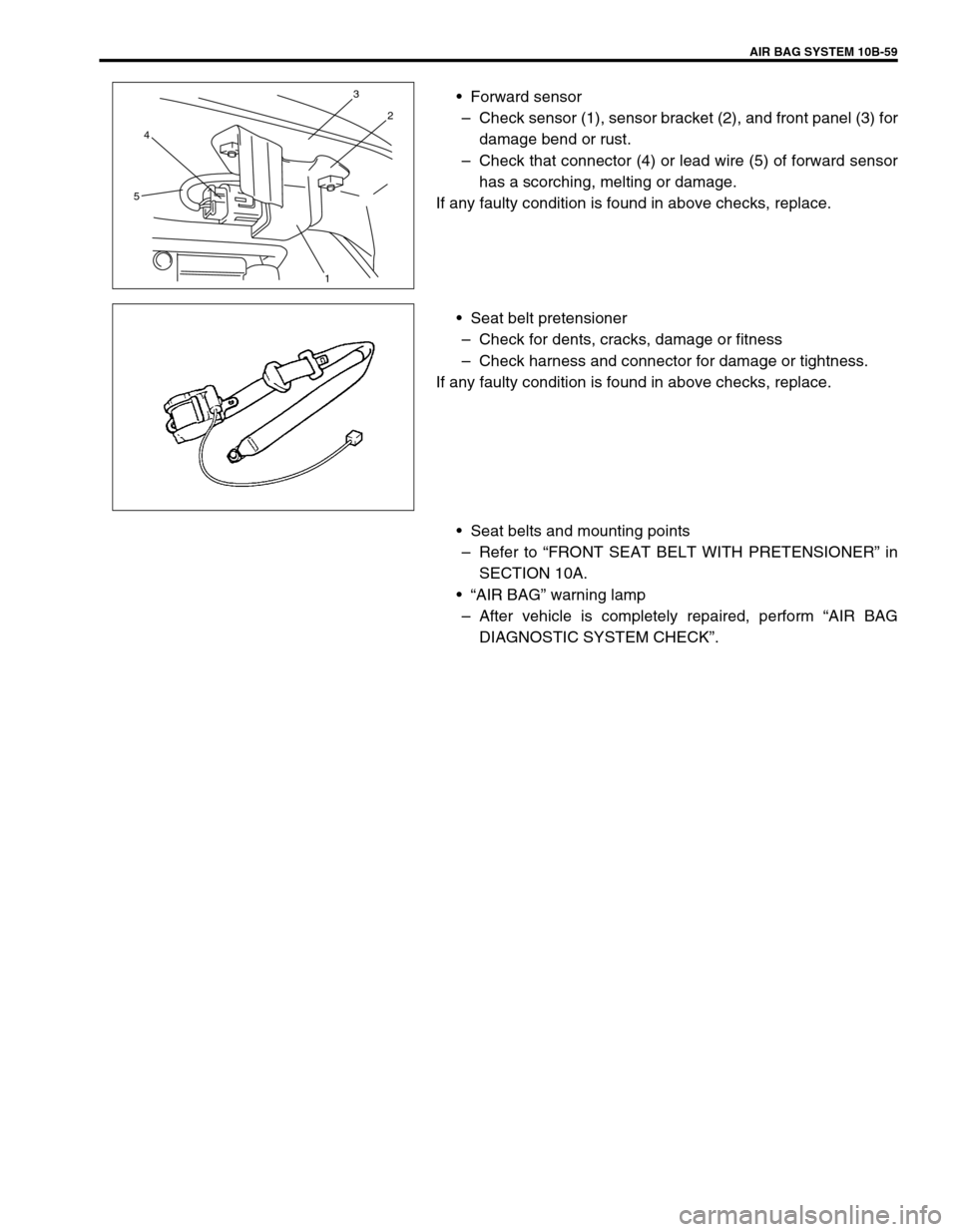
•Forward sensor
–Check sensor (1), sensor bracket (2), and front panel (3) for
damage bend or rust.
–Check that connector (4) or lead wire (5) of forward sensor
has a scorching, melting or damage.
If any faulty condition is found in above checks, replace.
•Seat belt pretensioner
–Check for dents, cracks, damage or fitness
–Check harness and connector for damage or tightness.
If any faulty condition is found in above checks, replace.
•Seat belts and mounting points
–Refer to “FRONT SEAT BELT WITH PRETENSIONER” in
SECTION 10A.
•“AIR BAG” warning lamp
–After vehicle is completely repaired, perform “AIR BAG
DIAGNOSTIC SYSTEM CHECK”.
543
2
1
Page 637 of 656
10B-60 AIR BAG SYSTEM
SDM
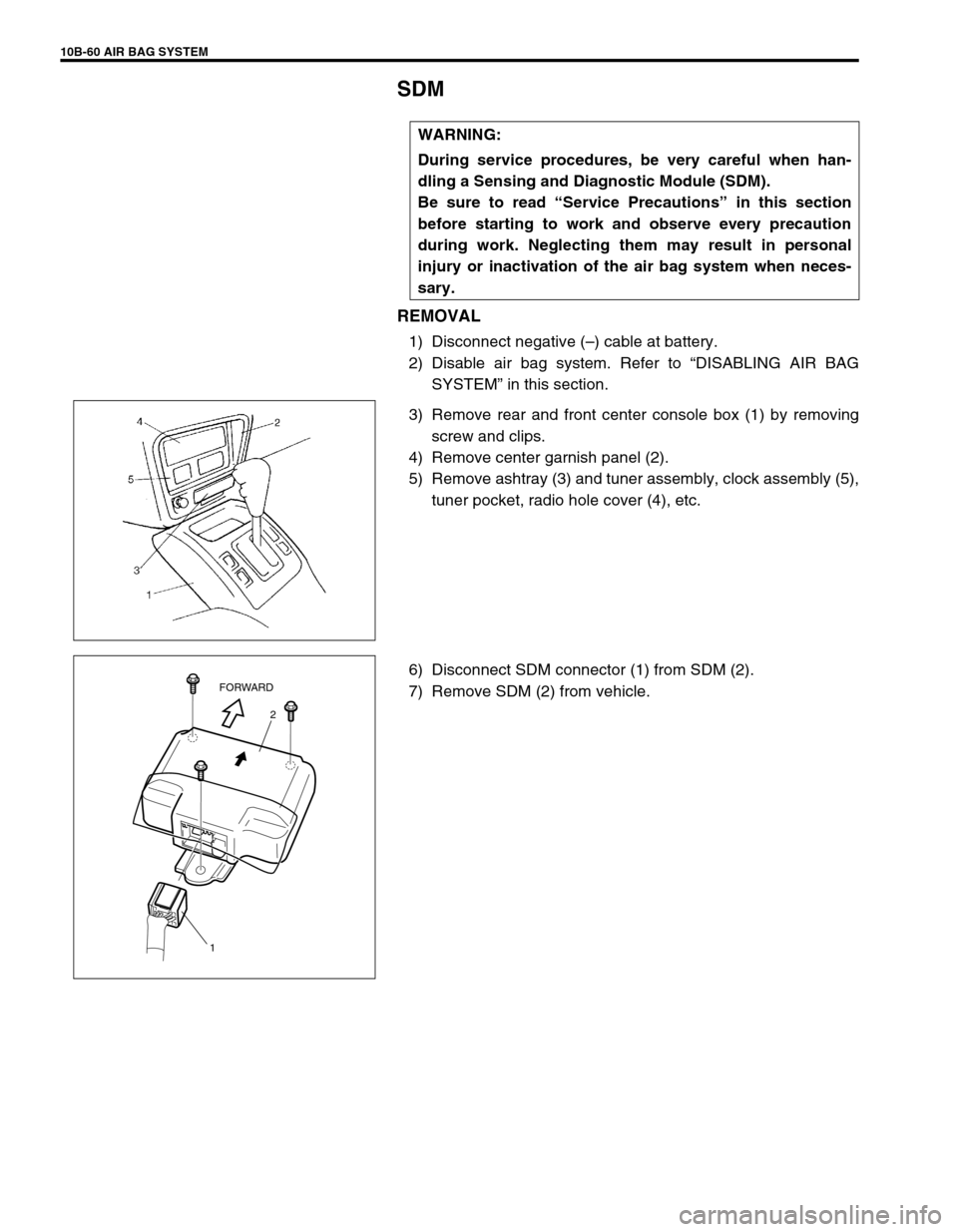
REMOVAL
1) Disconnect negative (–) cable at battery.
2) Disable air bag system. Refer to “DISABLING AIR BAG
SYSTEM” in this section.
3) Remove rear and front center console box (1) by removing
screw and clips.
4) Remove center garnish panel (2).
5) Remove ashtray (3) and tuner assembly, clock assembly (5),
tuner pocket, radio hole cover (4), etc.
6) Disconnect SDM connector (1) from SDM (2).
7) Remove SDM (2) from vehicle.WARNING:
During service procedures, be very careful when han-
dling a Sensing and Diagnostic Module (SDM).
Be sure to read “Service Precautions” in this section
before starting to work and observe every precaution
during work. Neglecting them may result in personal
injury or inactivation of the air bag system when neces-
sary.
2
1FORWARD