Light SUZUKI GRAND VITARA 2001 2.G Workshop Manual
[x] Cancel search | Manufacturer: SUZUKI, Model Year: 2001, Model line: GRAND VITARA, Model: SUZUKI GRAND VITARA 2001 2.GPages: 656, PDF Size: 14.31 MB
Page 526 of 656
CRUISE CONTROL SYSTEM 8E-5
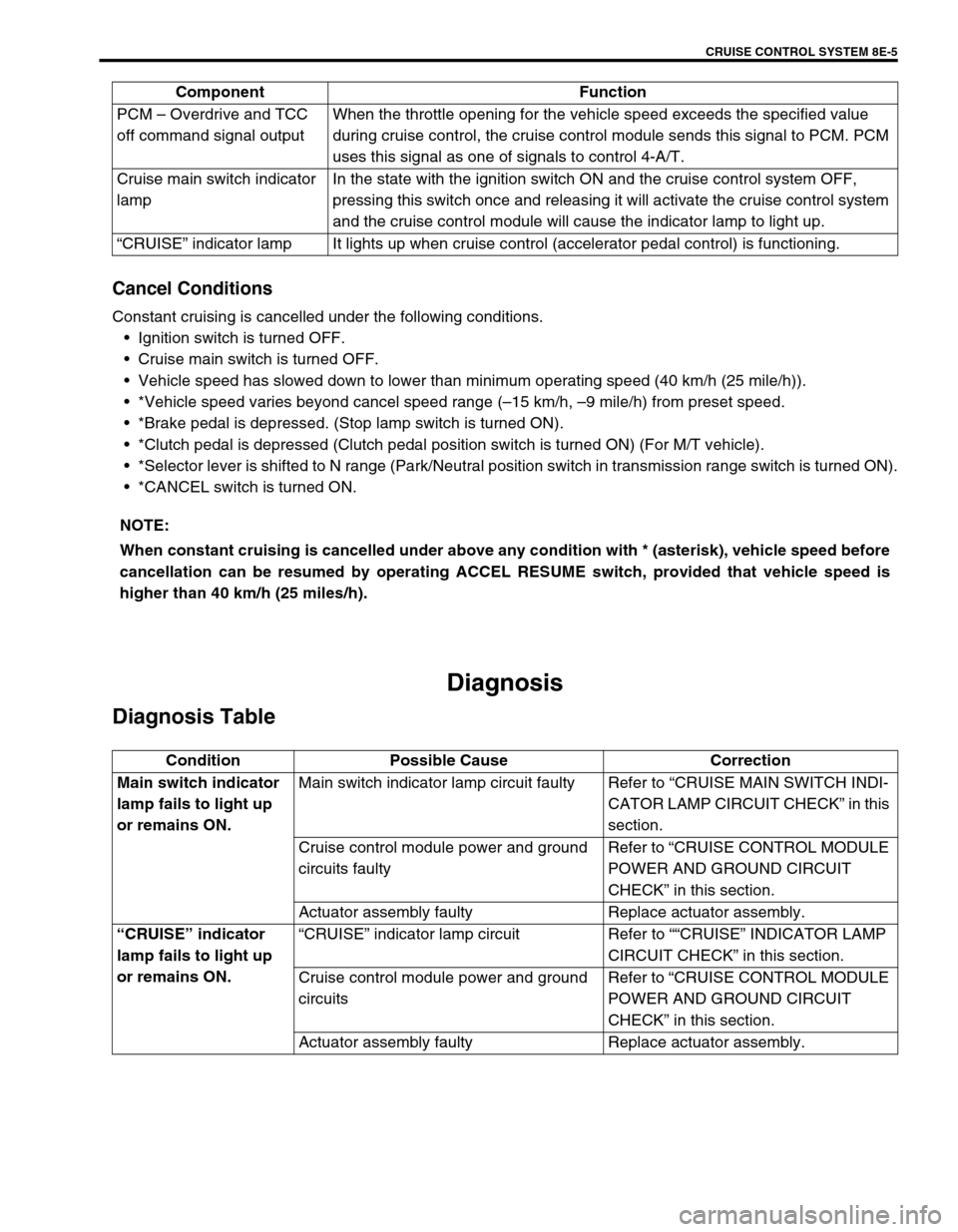
Cancel Conditions
Constant cruising is cancelled under the following conditions.
•Ignition switch is turned OFF.
•Cruise main switch is turned OFF.
•Vehicle speed has slowed down to lower than minimum operating speed (40 km/h (25 mile/h)).
•*Vehicle speed varies beyond cancel speed range (–15 km/h, –9 mile/h) from preset speed.
•*Brake pedal is depressed. (Stop lamp switch is turned ON).
•*Clutch pedal is depressed (Clutch pedal position switch is turned ON) (For M/T vehicle).
•*Selector lever is shifted to N range (Park/Neutral position switch in transmission range switch is turned ON).
•*CANCEL switch is turned ON.
Diagnosis
Diagnosis Table
PCM – Overdrive and TCC
off command signal outputWhen the throttle opening for the vehicle speed exceeds the specified value
during cruise control, the cruise control module sends this signal to PCM. PCM
uses this signal as one of signals to control 4-A/T.
Cruise main switch indicator
lampIn the state with the ignition switch ON and the cruise control system OFF,
pressing this switch once and releasing it will activate the cruise control system
and the cruise control module will cause the indicator lamp to light up.
“CRUISE” indicator lamp It lights up when cruise control (accelerator pedal control) is functioning. Component Function
NOTE:
When constant cruising is cancelled under above any condition with * (asterisk), vehicle speed before
cancellation can be resumed by operating ACCEL RESUME switch, provided that vehicle speed is
higher than 40 km/h (25 miles/h).
Condition Possible Cause Correction
Main switch indicator
lamp fails to light up
or remains ON.Main switch indicator lamp circuit faulty Refer to “CRUISE MAIN SWITCH INDI-
CATOR LAMP CIRCUIT CHECK” in this
section.
Cruise control module power and ground
circuits faultyRefer to “CRUISE CONTROL MODULE
POWER AND GROUND CIRCUIT
CHECK” in this section.
Actuator assembly faulty Replace actuator assembly.
“CRUISE” indicator
lamp fails to light up
or remains ON.“CRUISE” indicator lamp circuit Refer to ““CRUISE” INDICATOR LAMP
CIRCUIT CHECK” in this section.
Cruise control module power and ground
circuitsRefer to “CRUISE CONTROL MODULE
POWER AND GROUND CIRCUIT
CHECK” in this section.
Actuator assembly faulty Replace actuator assembly.
Page 538 of 656
CRUISE CONTROL SYSTEM 8E-17
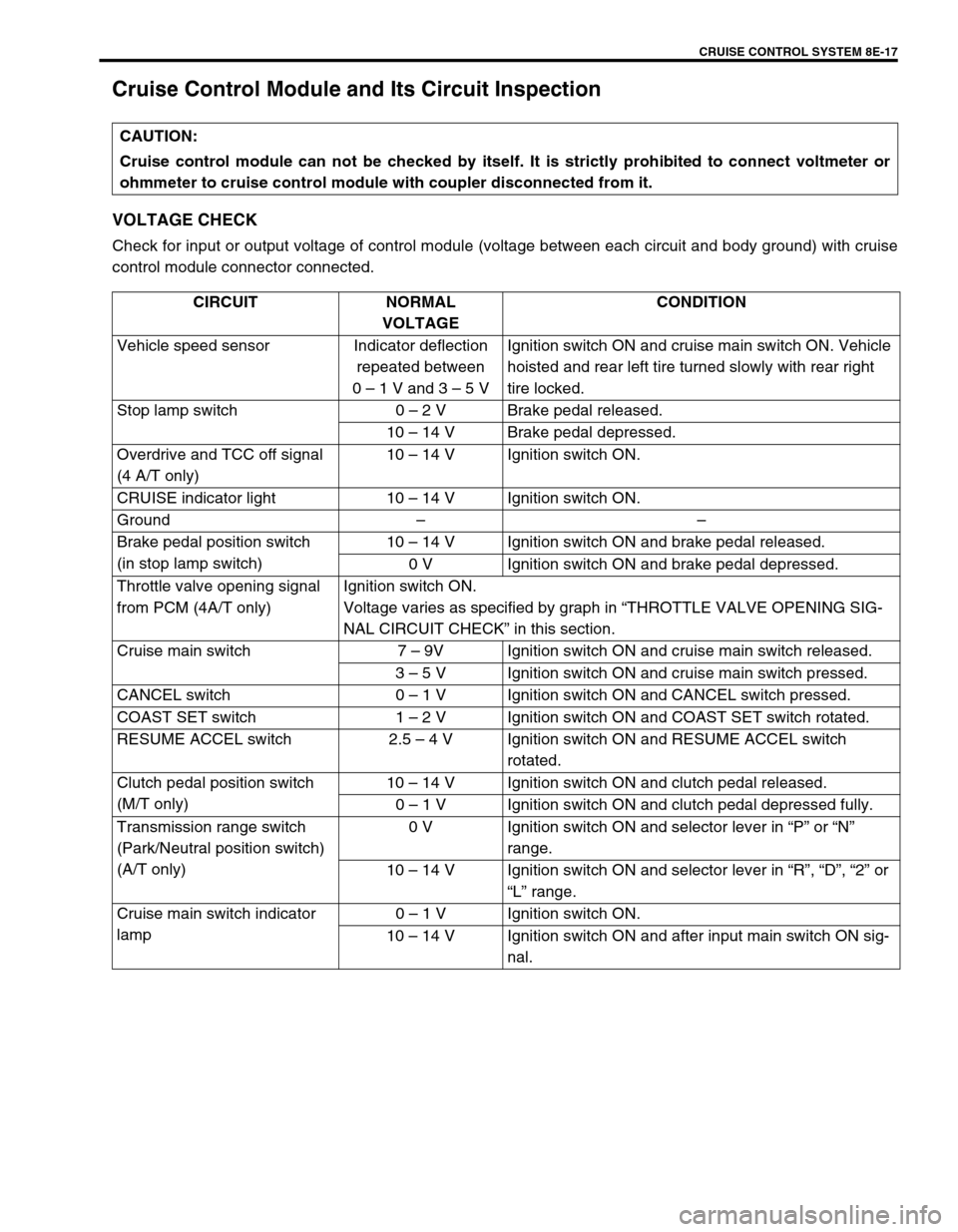
Cruise Control Module and Its Circuit Inspection
VOLTAGE CHECK
Check for input or output voltage of control module (voltage between each circuit and body ground) with cruise
control module connector connected.CAUTION:
Cruise control module can not be checked by itself. It is strictly prohibited to connect voltmeter or
ohmmeter to cruise control module with coupler disconnected from it.
CIRCUIT NORMAL
VOLTAGECONDITION
Vehicle speed sensor Indicator deflection
repeated between
0 – 1 V and 3 – 5 VIgnition switch ON and cruise main switch ON. Vehicle
hoisted and rear left tire turned slowly with rear right
tire locked.
Stop lamp switch 0 – 2 V Brake pedal released.
10 – 14 V Brake pedal depressed.
Overdrive and TCC off signal
(4 A/T only) 10 – 14 V Ignition switch ON.
CRUISE indicator light 10 – 14 V Ignition switch ON.
Ground––
Brake pedal position switch
(in stop lamp switch) 10 – 14 V Ignition switch ON and brake pedal released.
0 V Ignition switch ON and brake pedal depressed.
Throttle valve opening signal
from PCM (4A/T only)Ignition switch ON.
Voltage varies as specified by graph in “THROTTLE VALVE OPENING SIG-
NAL CIRCUIT CHECK” in this section.
Cruise main switch 7 – 9V Ignition switch ON and cruise main switch released.
3 – 5 V Ignition switch ON and cruise main switch pressed.
CANCEL switch 0 – 1 V Ignition switch ON and CANCEL switch pressed.
COAST SET switch 1 – 2 V Ignition switch ON and COAST SET switch rotated.
RESUME ACCEL switch 2.5 – 4 V Ignition switch ON and RESUME ACCEL switch
rotated.
Clutch pedal position switch
(M/T only)10 – 14 V Ignition switch ON and clutch pedal released.
0 – 1 V Ignition switch ON and clutch pedal depressed fully.
Transmission range switch
(Park/Neutral position switch)
(A/T only)0 V Ignition switch ON and selector lever in “P” or “N”
range.
10 – 14 V Ignition switch ON and selector lever in “R”, “D”, “2” or
“L” range.
Cruise main switch indicator
lamp0 – 1 V Ignition switch ON.
10 – 14 V Ignition switch ON and after input main switch ON sig-
nal.
Page 549 of 656
9-4 BODY SERVICE
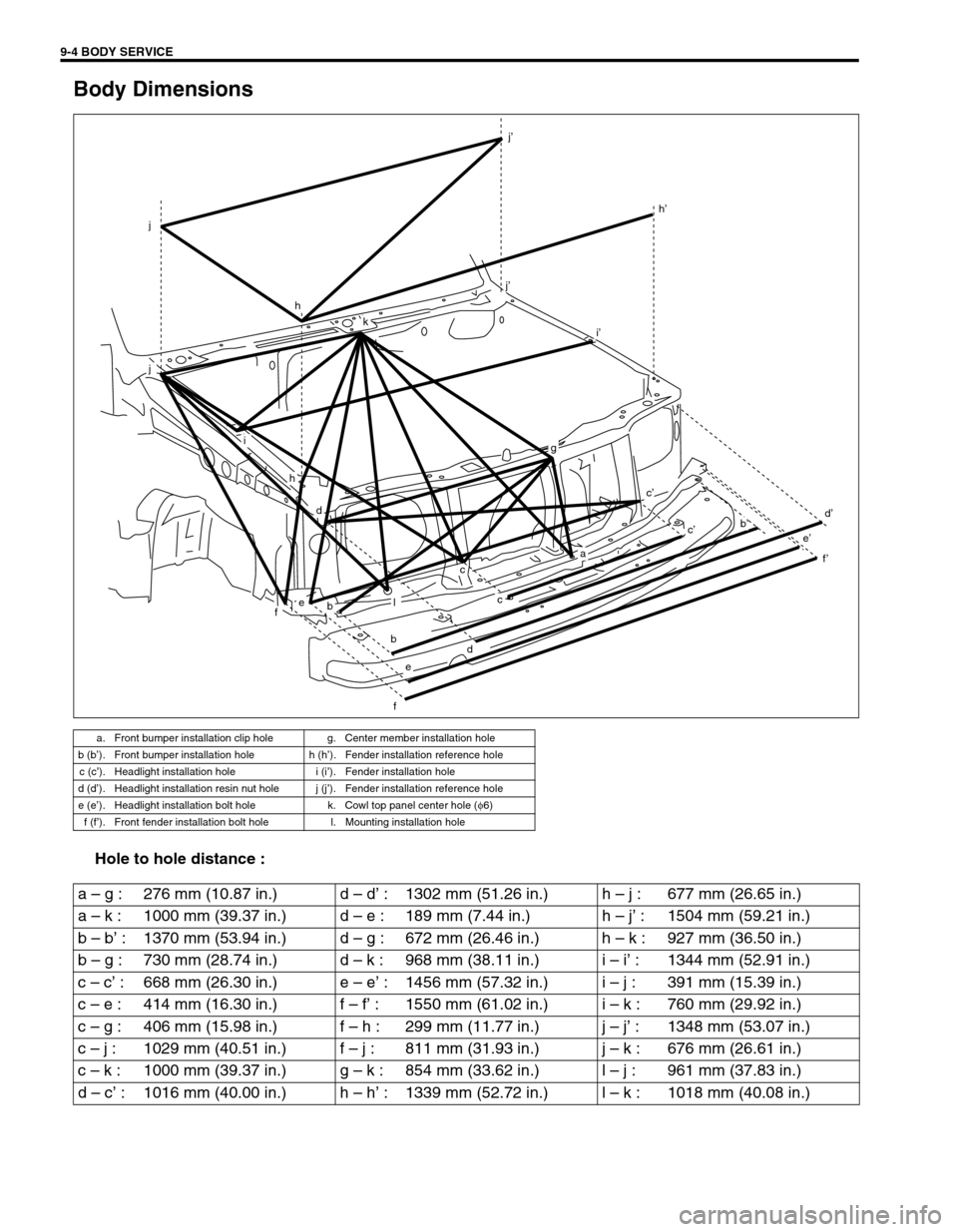
Body Dimensions
Hole to hole distance :
a. Front bumper installation clip hole g. Center member installation hole
b (b’). Front bumper installation hole h (h’). Fender installation reference hole
c (c’). Headlight installation hole i (i’). Fender installation hole
d (d’). Headlight installation resin nut hole j (j’). Fender installation reference hole
e (e’). Headlight installation bolt hole k. Cowl top panel center hole (φ
6)
f (f’). Front fender installation bolt hole l. Mounting installation hole
k
j’
j’
h’
j
j
i
h
h
febl
c
c
g
a
c’
i’
db’c’
d’
f’
e’
f
e
bd
a – g : 276 mm (10.87 in.) d – d’ : 1302 mm (51.26 in.) h – j : 677 mm (26.65 in.)
a – k : 1000 mm (39.37 in.) d – e : 189 mm (7.44 in.) h – j’ : 1504 mm (59.21 in.)
b – b’ : 1370 mm (53.94 in.) d – g : 672 mm (26.46 in.) h – k : 927 mm (36.50 in.)
b – g : 730 mm (28.74 in.) d – k : 968 mm (38.11 in.) i – i’ : 1344 mm (52.91 in.)
c – c’ : 668 mm (26.30 in.) e – e’ : 1456 mm (57.32 in.) i – j : 391 mm (15.39 in.)
c – e : 414 mm (16.30 in.) f – f’ : 1550 mm (61.02 in.) i – k : 760 mm (29.92 in.)
c – g : 406 mm (15.98 in.) f – h : 299 mm (11.77 in.) j – j’ : 1348 mm (53.07 in.)
c – j : 1029 mm (40.51 in.) f – j : 811 mm (31.93 in.) j – k : 676 mm (26.61 in.)
c – k : 1000 mm (39.37 in.) g – k : 854 mm (33.62 in.) l – j : 961 mm (37.83 in.)
d – c’ : 1016 mm (40.00 in.) h – h’ : 1339 mm (52.72 in.) l – k : 1018 mm (40.08 in.)
Page 585 of 656

10B-8 AIR BAG SYSTEM
Intermittents and Poor Connections
Most intermittents are caused by faulty electrical connections or
wiring. When a check for proper connection is requested in a
diagnostic flow table, perform careful check of suspect circuits for:
•Poor mating of connector halves, or terminals not fully
seated in the connector body (backed out).
•Dirt or corrosion on the terminals. The terminals must be
clean and free of any foreign material which could impede
proper terminal contact.
However, cleaning the terminal with a sand paper or the like
is prohibited.
•Damaged connector body, exposing the terminals to mois-
ture and dirt, as well as not maintaining proper terminal ori-
entation with the component or mating connector.
•Improperly formed or damaged terminals.
Check each connector terminal in problem circuits carefully
to ensure good contact tension by using the corresponding
mating terminal included in the connector test adapter kit
(special tool).
If contact tension is not enough, reform it to increase contact
tension or replace.
Special tool
(A) : 09932-75020 (Connector Test Adapter Kit)
•Poor terminal-to-wire connection.
Check each wire harness in problem circuits for poor con-
nection by shaking it by hand lightly. If any abnormal condi-
tion is found, change the wire harness assembly or
component parts with new ones.
•Wire insulation which is rubbed through, causing an intermit-
tent short as the bare area touches other wiring or parts of
the vehicle.
•Wire broken inside the insulation. This condition could cause
a continuity check to show a good circuit, but if only 1 or 2
strands of a multi-strand-type wire are intact, resistance
could be far too high.
If any abnormality is found, repair or replace as a wire harness
assembly.
Page 586 of 656
AIR BAG SYSTEM 10B-9
Air Bag Diagnostic System Check
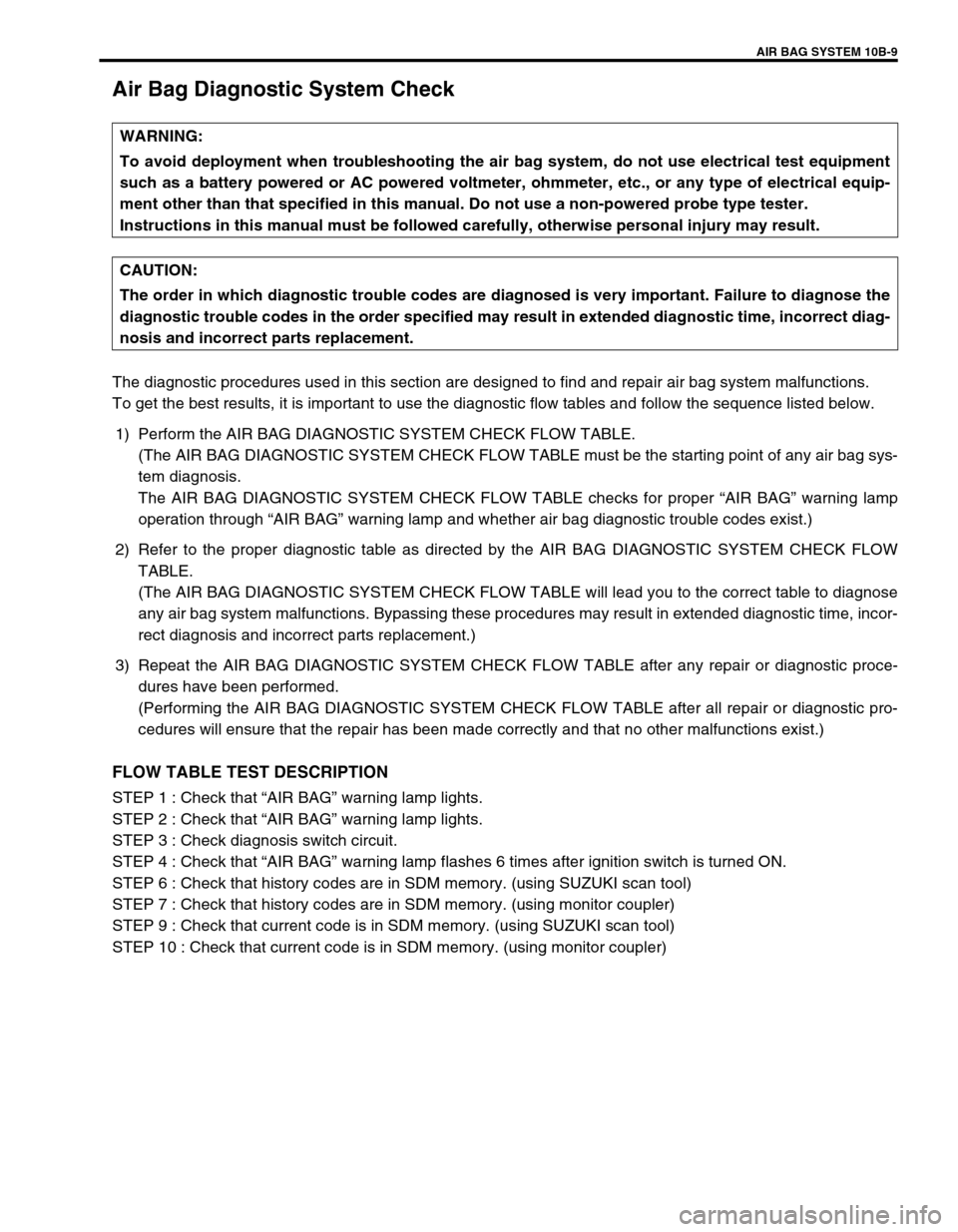
The diagnostic procedures used in this section are designed to find and repair air bag system malfunctions.
To get the best results, it is important to use the diagnostic flow tables and follow the sequence listed below.
1) Perform the AIR BAG DIAGNOSTIC SYSTEM CHECK FLOW TABLE.
(The AIR BAG DIAGNOSTIC SYSTEM CHECK FLOW TABLE must be the starting point of any air bag sys-
tem diagnosis.
The AIR BAG DIAGNOSTIC SYSTEM CHECK FLOW TABLE checks for proper “AIR BAG” warning lamp
operation through “AIR BAG” warning lamp and whether air bag diagnostic trouble codes exist.)
2) Refer to the proper diagnostic table as directed by the AIR BAG DIAGNOSTIC SYSTEM CHECK FLOW
TABLE.
(The AIR BAG DIAGNOSTIC SYSTEM CHECK FLOW TABLE will lead you to the correct table to diagnose
any air bag system malfunctions. Bypassing these procedures may result in extended diagnostic time, incor-
rect diagnosis and incorrect parts replacement.)
3) Repeat the AIR BAG DIAGNOSTIC SYSTEM CHECK FLOW TABLE after any repair or diagnostic proce-
dures have been performed.
(Performing the AIR BAG DIAGNOSTIC SYSTEM CHECK FLOW TABLE after all repair or diagnostic pro-
cedures will ensure that the repair has been made correctly and that no other malfunctions exist.)
FLOW TABLE TEST DESCRIPTION
STEP 1 : Check that “AIR BAG” warning lamp lights.
STEP 2 : Check that “AIR BAG” warning lamp lights.
STEP 3 : Check diagnosis switch circuit.
STEP 4 : Check that “AIR BAG” warning lamp flashes 6 times after ignition switch is turned ON.
STEP 6 : Check that history codes are in SDM memory. (using SUZUKI scan tool)
STEP 7 : Check that history codes are in SDM memory. (using monitor coupler)
STEP 9 : Check that current code is in SDM memory. (using SUZUKI scan tool)
STEP 10 : Check that current code is in SDM memory. (using monitor coupler)WARNING:
To avoid deployment when troubleshooting the air bag system, do not use electrical test equipment
such as a battery powered or AC powered voltmeter, ohmmeter, etc., or any type of electrical equip-
ment other than that specified in this manual. Do not use a non-powered probe type tester.
Instructions in this manual must be followed carefully, otherwise personal injury may result.
CAUTION:
The order in which diagnostic trouble codes are diagnosed is very important. Failure to diagnose the
diagnostic trouble codes in the order specified may result in extended diagnostic time, incorrect diag-
nosis and incorrect parts replacement.
Page 592 of 656
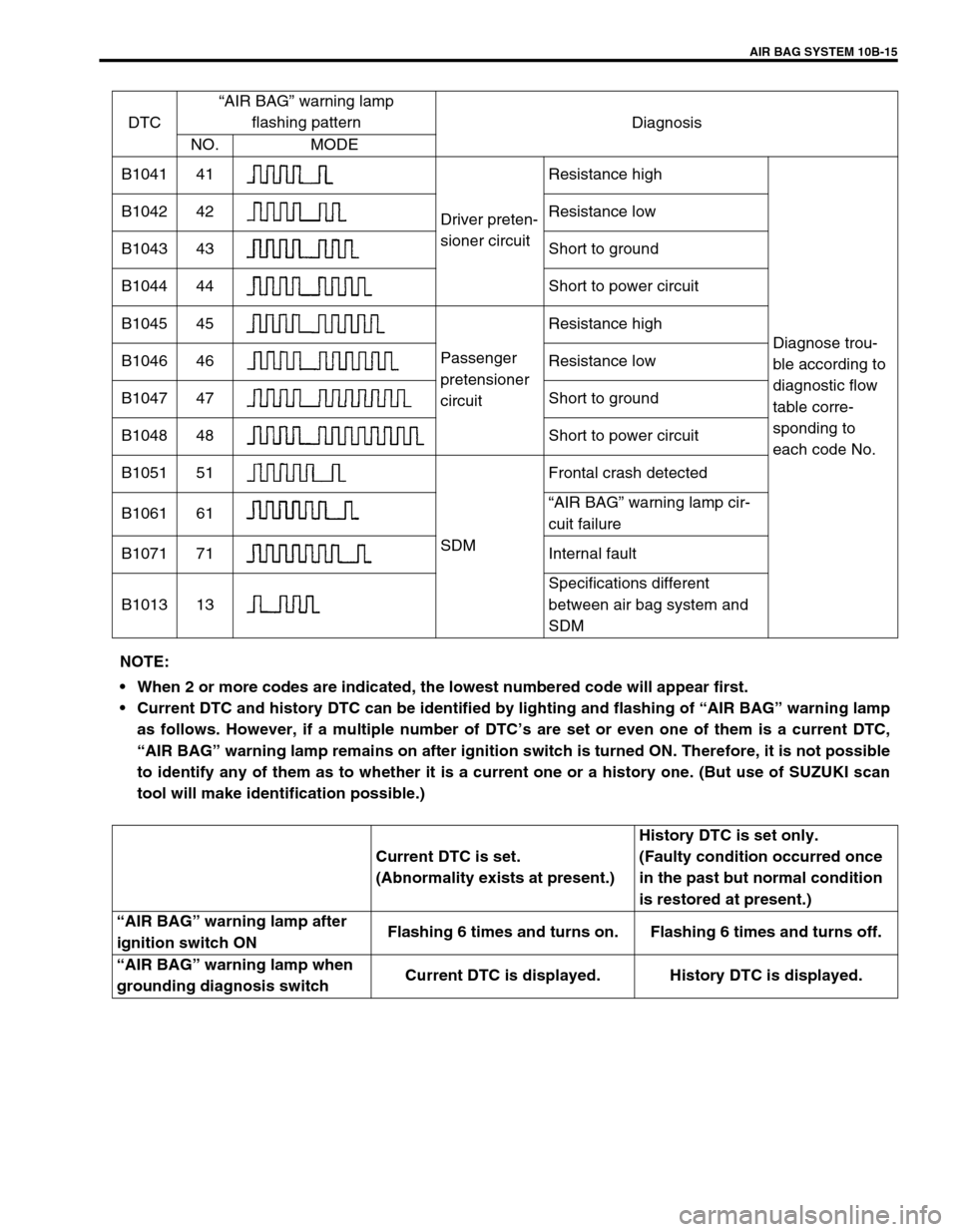
AIR BAG SYSTEM 10B-15
DTC“AIR BAG” warning lamp
flashing pattern
Diagnosis
NO. MODE
B1041 41
Driver preten-
sioner circuitResistance high
Diagnose trou-
ble according to
diagnostic flow
table corre-
sponding to
each code No. B1042 42 Resistance low
B1043 43 Short to ground
B1044 44 Short to power circuit
B1045 45
Passenger
pretensioner
circuitResistance high
B1046 46 Resistance low
B1047 47 Short to ground
B1048 48 Short to power circuit
B1051 51
SDMFrontal crash detected
B1061 61“AIR BAG” warning lamp cir-
cuit failure
B1071 71 Internal fault
B1013 13Specifications different
between air bag system and
SDM
NOTE:
When 2 or more codes are indicated, the lowest numbered code will appear first.
Current DTC and history DTC can be identified by lighting and flashing of “AIR BAG” warning lamp
as follows. However, if a multiple number of DTC’s are set or even one of them is a current DTC,
“AIR BAG” warning lamp remains on after ignition switch is turned ON. Therefore, it is not possible
to identify any of them as to whether it is a current one or a history one. (But use of SUZUKI scan
tool will make identification possible.)
Current DTC is set.
(Abnormality exists at present.)History DTC is set only.
(Faulty condition occurred once
in the past but normal condition
is restored at present.)
“AIR BAG” warning lamp after
ignition switch ONFlashing 6 times and turns on. Flashing 6 times and turns off.
“AIR BAG” warning lamp when
grounding diagnosis switchCurrent DTC is displayed. History DTC is displayed.