warning SUZUKI GRAND VITARA 2001 2.G Repair Manual
[x] Cancel search | Manufacturer: SUZUKI, Model Year: 2001, Model line: GRAND VITARA, Model: SUZUKI GRAND VITARA 2001 2.GPages: 656, PDF Size: 14.31 MB
Page 259 of 656
6-1-98 ENGINE GENERAL INFORMATION AND DIAGNOSIS (H27 ENGINE)
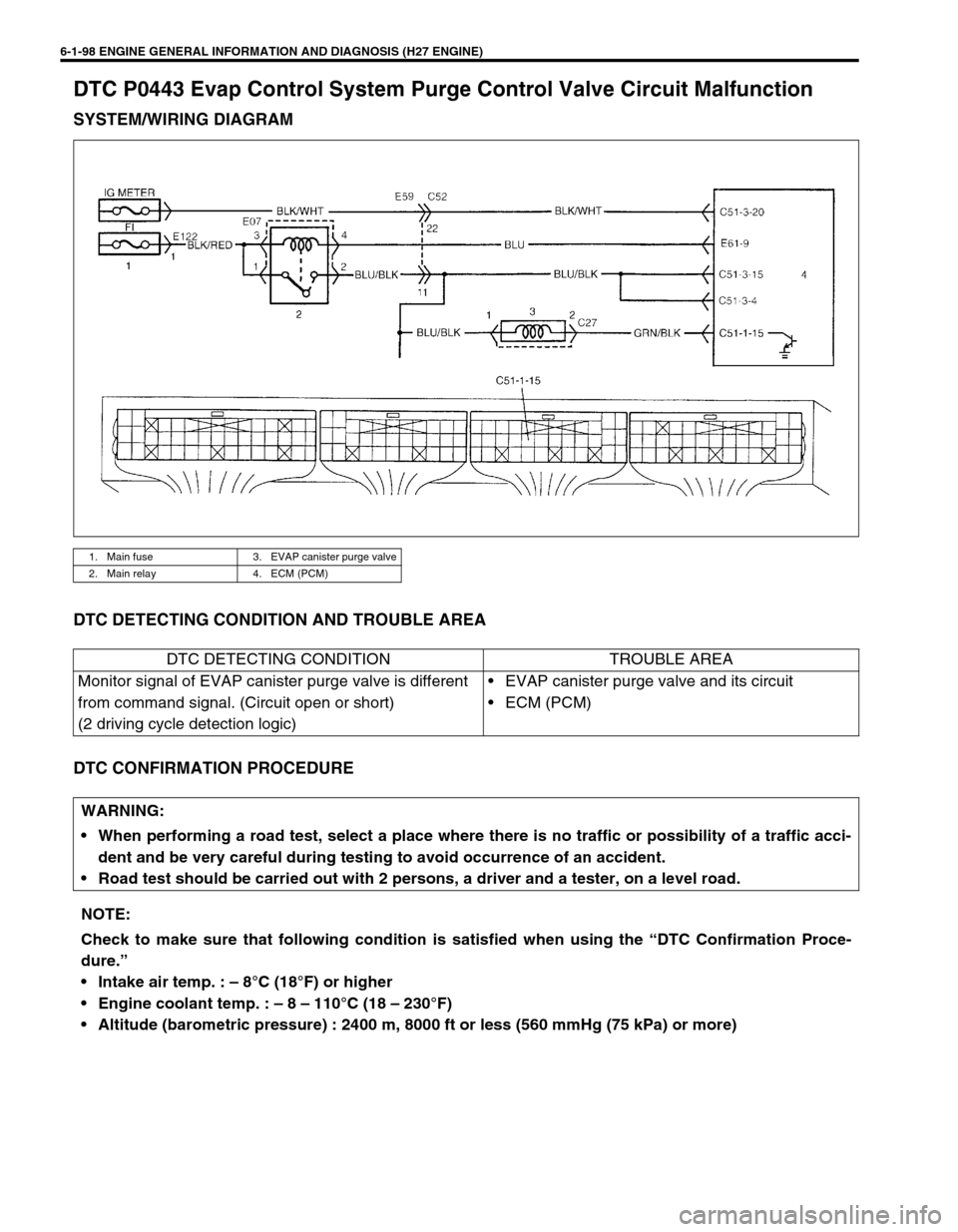
DTC P0443 Evap Control System Purge Control Valve Circuit Malfunction
SYSTEM/WIRING DIAGRAM
DTC DETECTING CONDITION AND TROUBLE AREA
DTC CONFIRMATION PROCEDURE
1. Main fuse 3. EVAP canister purge valve
2. Main relay 4. ECM (PCM)
DTC DETECTING CONDITION TROUBLE AREA
Monitor signal of EVAP canister purge valve is different
from command signal. (Circuit open or short)
(2 driving cycle detection logic)• EVAP canister purge valve and its circuit
•ECM (PCM)
WARNING:
When performing a road test, select a place where there is no traffic or possibility of a traffic acci-
dent and be very careful during testing to avoid occurrence of an accident.
Road test should be carried out with 2 persons, a driver and a tester, on a level road.
NOTE:
Check to make sure that following condition is satisfied when using the “DTC Confirmation Proce-
dure.”
Intake air temp. : – 8°C (18°F) or higher
Engine coolant temp. : – 8 – 110°C (18 – 230°F)
Altitude (barometric pressure) : 2400 m, 8000 ft or less (560 mmHg (75 kPa) or more)
Page 261 of 656
6-1-100 ENGINE GENERAL INFORMATION AND DIAGNOSIS (H27 ENGINE)
Evap canister purge system inspection
1) Warm up engine to normal operating temperature.
2) Hoist vehicle so that all wheels rotate freely.
3) Set M/T in “Neutral” or A/T in “P” position and parking brake.
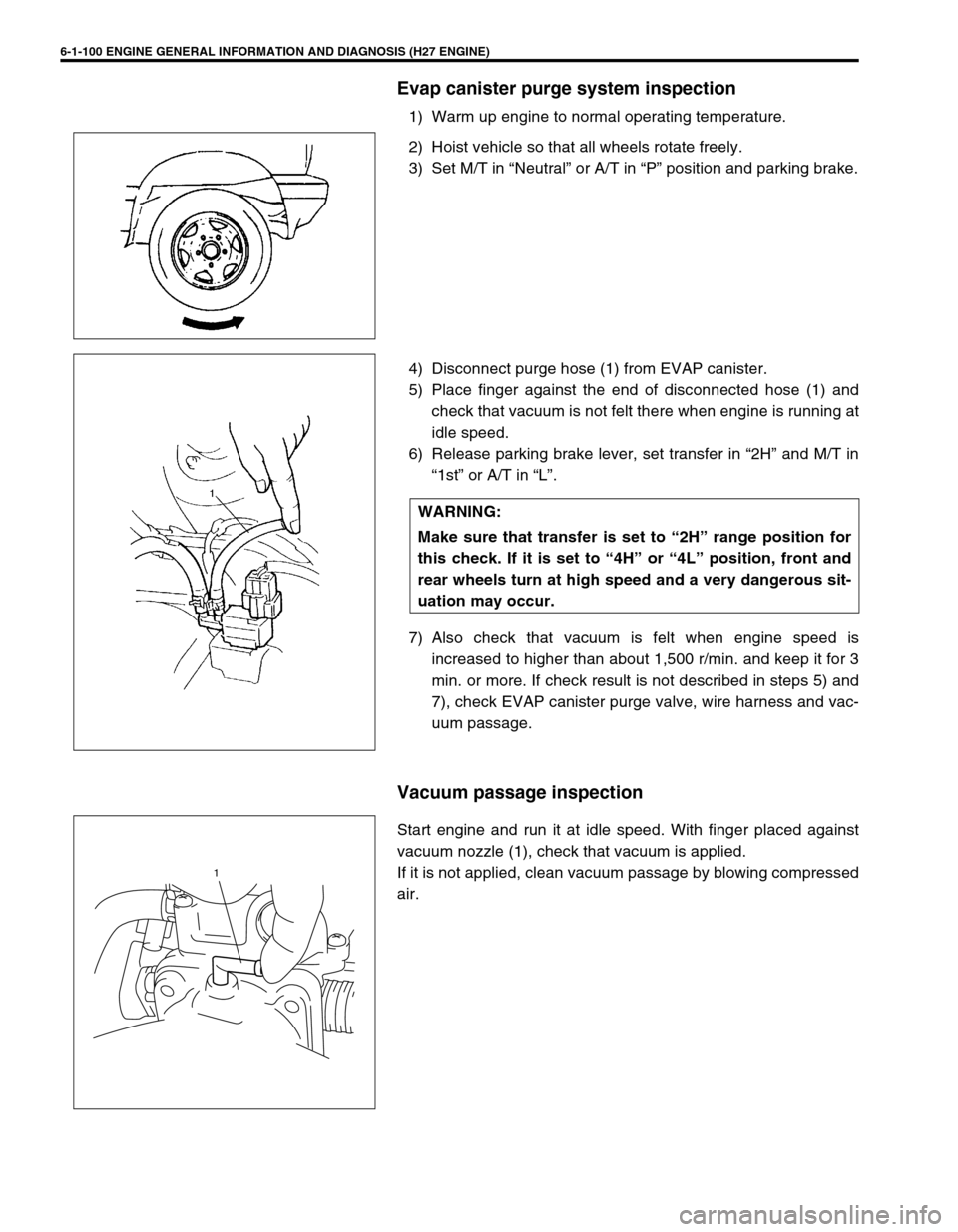
4) Disconnect purge hose (1) from EVAP canister.
5) Place finger against the end of disconnected hose (1) and
check that vacuum is not felt there when engine is running at
idle speed.
6) Release parking brake lever, set transfer in “2H” and M/T in
“1st” or A/T in “L”.
7) Also check that vacuum is felt when engine speed is
increased to higher than about 1,500 r/min. and keep it for 3
min. or more. If check result is not described in steps 5) and
7), check EVAP canister purge valve, wire harness and vac-
uum passage.
Vacuum passage inspection
Start engine and run it at idle speed. With finger placed against
vacuum nozzle (1), check that vacuum is applied.
If it is not applied, clean vacuum passage by blowing compressed
air.
WARNING:
Make sure that transfer is set to “2H” range position for
this check. If it is set to “4H” or “4L” position, front and
rear wheels turn at high speed and a very dangerous sit-
uation may occur.
1
Page 263 of 656
6-1-102 ENGINE GENERAL INFORMATION AND DIAGNOSIS (H27 ENGINE)
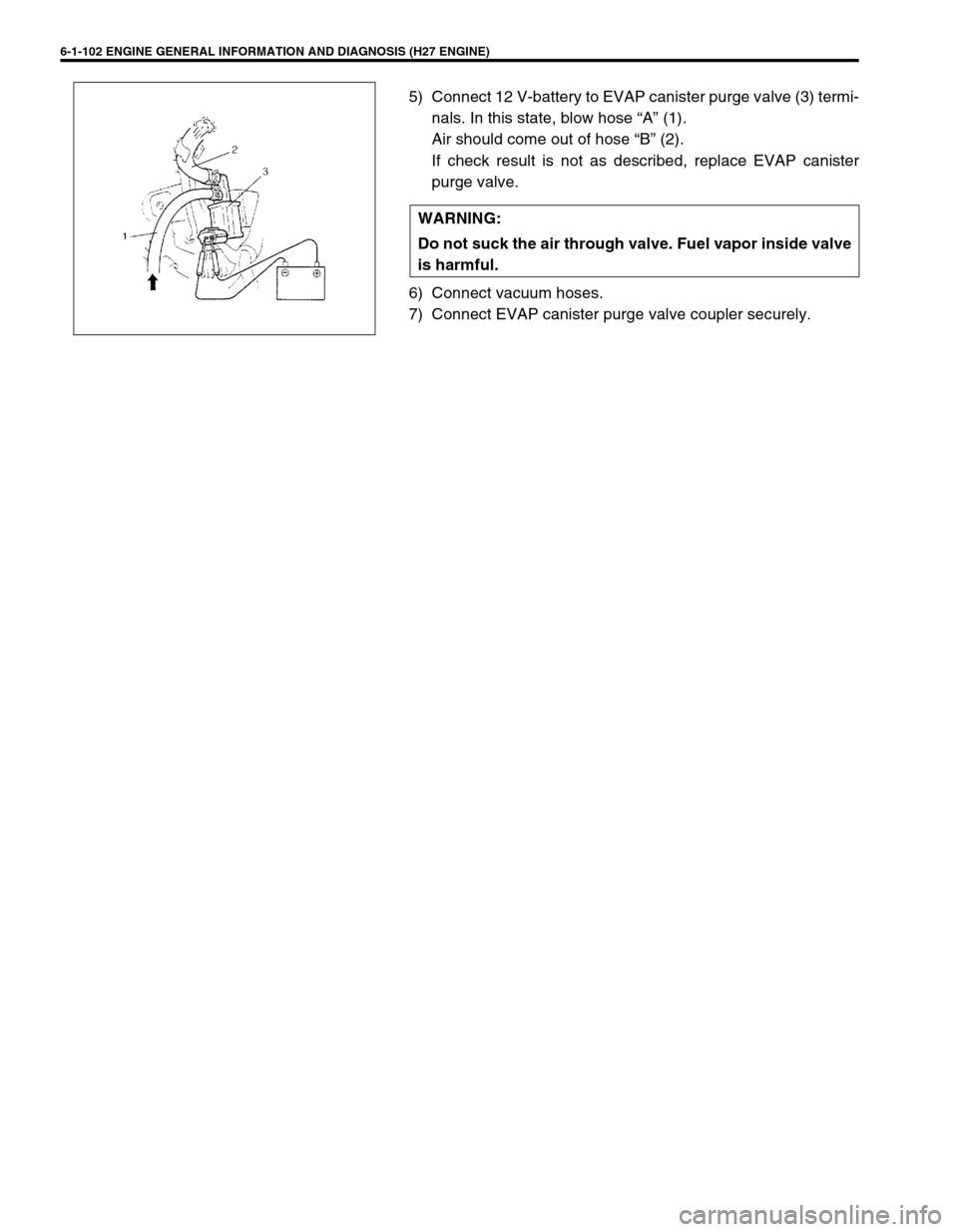
5) Connect 12 V-battery to EVAP canister purge valve (3) termi-
nals. In this state, blow hose “A” (1).
Air should come out of hose “B” (2).
If check result is not as described, replace EVAP canister
purge valve.
6) Connect vacuum hoses.
7) Connect EVAP canister purge valve coupler securely.WARNING:
Do not suck the air through valve. Fuel vapor inside valve
is harmful.
Page 267 of 656
6-1-106 ENGINE GENERAL INFORMATION AND DIAGNOSIS (H27 ENGINE)
DTC CONFIRMATION PROCEDURE
1) Connect scan tool to DLC with ignition switch OFF.
2) Turn ON ignition switch and clear DTC, pending DTC and freeze frame data by using scan tool and warm up
engine completely.
3) Increase vehicle speed to 100 – 110 km/h (60 – 70 mph).
4) Release accelerator pedal and with engine brake applied, keep vehicle coasting for 5 seconds or more and
then stop vehicle.
5) Check pending DTC by using scan tool.
TROUBLESHOOTING
WARNING:
When performing a road test, select a place where there is no traffic or possibility of a traffic acci-
dent and be very careful during testing to avoid occurrence of an accident.
Road test should be carried out with 2 persons, a driver and a tester, on a level road.
NOTE:
Check to make sure that following condition is satisfied when using this “DTC CONFIRMATION PRO-
CEDURE”.
Intake air temp. : – 8°C (18°F) or higher
Engine coolant temp. : – 8 – 110°C (18 – 230°F)
Altitude (barometric pressure) : 2400 m, 8000 ft or less (560 mmHg (75 kPa) or more)
Step Action Yes No
1Was “ENGINE DIAG. FLOW TABLE” per-
formed?Go to Step 2. Go to “ENGINE DIAG.
FLOW TABLE” in this
section.
2 Does speedometer indicate vehicle speed? Faulty “BLU/YEL” wire or
poor C51-1-14 connection.
If wire and connection are
OK, intermittent trouble or
faulty ECM (PCM).
Check for intermittent refer-
ring to “INTERMITTENT
AND POOR CONNECTION”
in Section 0A.Go to Step 3.
3 VSS power supply voltage check:
1) With ignition switch OFF, remove VSS
coupler.
2) With ignition switch ON leaving engine
OFF, check voltage between C20-3 and
C20-2 terminal of VSS coupler.
Is voltage 10 – 14 V?Go to Step 4.“BLK/BLU” or “BLK/YEL”
wire open/short.
4 VSS signal harness check:
1) With ignition switch ON leaving engine
OFF, check voltage between C20-1 and
C20-2 terminal of VSS coupler.
Is voltage 4 V or more?Go to Step 5. Go to Step 6.
Page 272 of 656
ENGINE GENERAL INFORMATION AND DIAGNOSIS (H27 ENGINE) 6-1-111
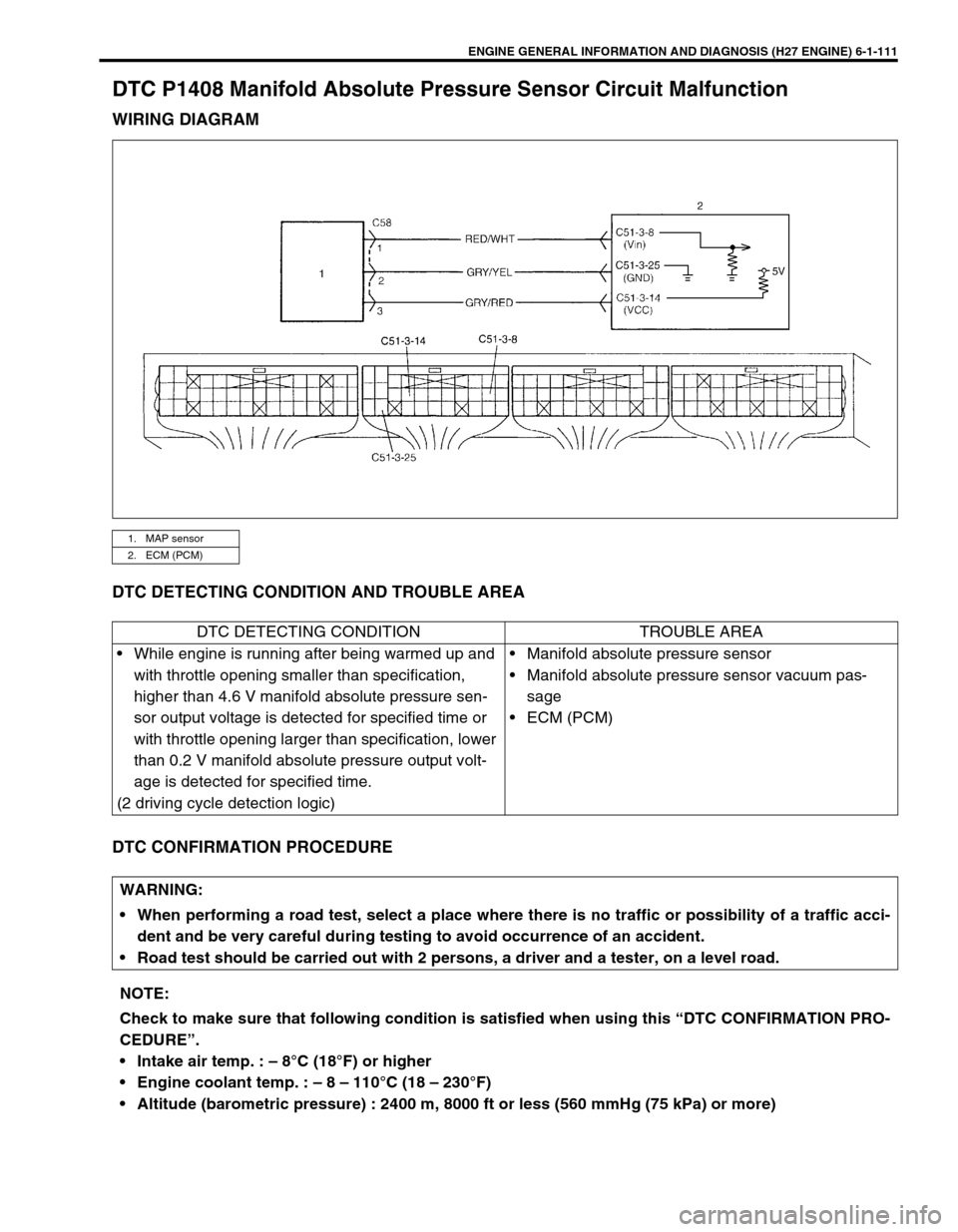
DTC P1408 Manifold Absolute Pressure Sensor Circuit Malfunction
WIRING DIAGRAM
DTC DETECTING CONDITION AND TROUBLE AREA
DTC CONFIRMATION PROCEDURE
1. MAP sensor
2. ECM (PCM)
DTC DETECTING CONDITION TROUBLE AREA
•While engine is running after being warmed up and
with throttle opening smaller than specification,
higher than 4.6 V manifold absolute pressure sen-
sor output voltage is detected for specified time or
with throttle opening larger than specification, lower
than 0.2 V manifold absolute pressure output volt-
age is detected for specified time.
(2 driving cycle detection logic)•Manifold absolute pressure sensor
•Manifold absolute pressure sensor vacuum pas-
sage
•ECM (PCM)
WARNING:
When performing a road test, select a place where there is no traffic or possibility of a traffic acci-
dent and be very careful during testing to avoid occurrence of an accident.
Road test should be carried out with 2 persons, a driver and a tester, on a level road.
NOTE:
Check to make sure that following condition is satisfied when using this “DTC CONFIRMATION PRO-
CEDURE”.
Intake air temp. : – 8°C (18°F) or higher
Engine coolant temp. : – 8 – 110°C (18 – 230°F)
Altitude (barometric pressure) : 2400 m, 8000 ft or less (560 mmHg (75 kPa) or more)
Page 274 of 656
ENGINE GENERAL INFORMATION AND DIAGNOSIS (H27 ENGINE) 6-1-113
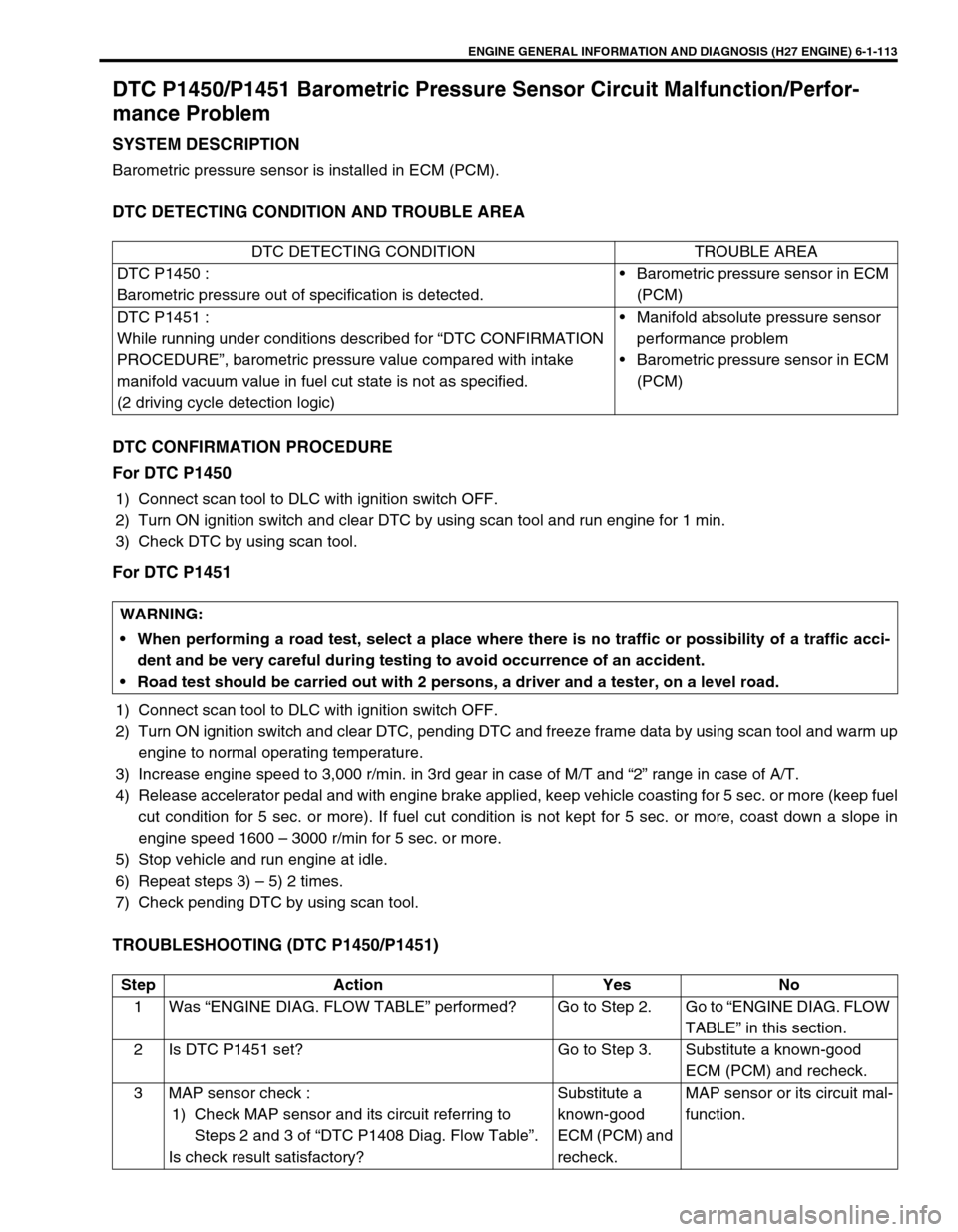
DTC P1450/P1451 Barometric Pressure Sensor Circuit Malfunction/Perfor-
mance Problem
SYSTEM DESCRIPTION
Barometric pressure sensor is installed in ECM (PCM).
DTC DETECTING CONDITION AND TROUBLE AREA
DTC CONFIRMATION PROCEDURE
For DTC P1450
1) Connect scan tool to DLC with ignition switch OFF.
2) Turn ON ignition switch and clear DTC by using scan tool and run engine for 1 min.
3) Check DTC by using scan tool.
For DTC P1451
1) Connect scan tool to DLC with ignition switch OFF.
2) Turn ON ignition switch and clear DTC, pending DTC and freeze frame data by using scan tool and warm up
engine to normal operating temperature.
3) Increase engine speed to 3,000 r/min. in 3rd gear in case of M/T and “2” range in case of A/T.
4) Release accelerator pedal and with engine brake applied, keep vehicle coasting for 5 sec. or more (keep fuel
cut condition for 5 sec. or more). If fuel cut condition is not kept for 5 sec. or more, coast down a slope in
engine speed 1600 – 3000 r/min for 5 sec. or more.
5) Stop vehicle and run engine at idle.
6) Repeat steps 3) – 5) 2 times.
7) Check pending DTC by using scan tool.
TROUBLESHOOTING (DTC P1450/P1451)
DTC DETECTING CONDITION TROUBLE AREA
DTC P1450 :
Barometric pressure out of specification is detected.•Barometric pressure sensor in ECM
(PCM)
DTC P1451 :
While running under conditions described for “DTC CONFIRMATION
PROCEDURE”, barometric pressure value compared with intake
manifold vacuum value in fuel cut state is not as specified.
(2 driving cycle detection logic)•Manifold absolute pressure sensor
performance problem
•Barometric pressure sensor in ECM
(PCM)
WARNING:
When performing a road test, select a place where there is no traffic or possibility of a traffic acci-
dent and be very careful during testing to avoid occurrence of an accident.
Road test should be carried out with 2 persons, a driver and a tester, on a level road.
Step Action Yes No
1Was “ENGINE DIAG. FLOW TABLE” performed? Go to Step 2. Go to “ENGINE DIAG. FLOW
TABLE” in this section.
2 Is DTC P1451 set? Go to Step 3. Substitute a known-good
ECM (PCM) and recheck.
3 MAP sensor check :
1) Check MAP sensor and its circuit referring to
Steps 2 and 3 of “DTC P1408 Diag. Flow Table”.
Is check result satisfactory?Substitute a
known-good
ECM (PCM) and
recheck.MAP sensor or its circuit mal-
function.
Page 285 of 656
6-1-124 ENGINE GENERAL INFORMATION AND DIAGNOSIS (H27 ENGINE)
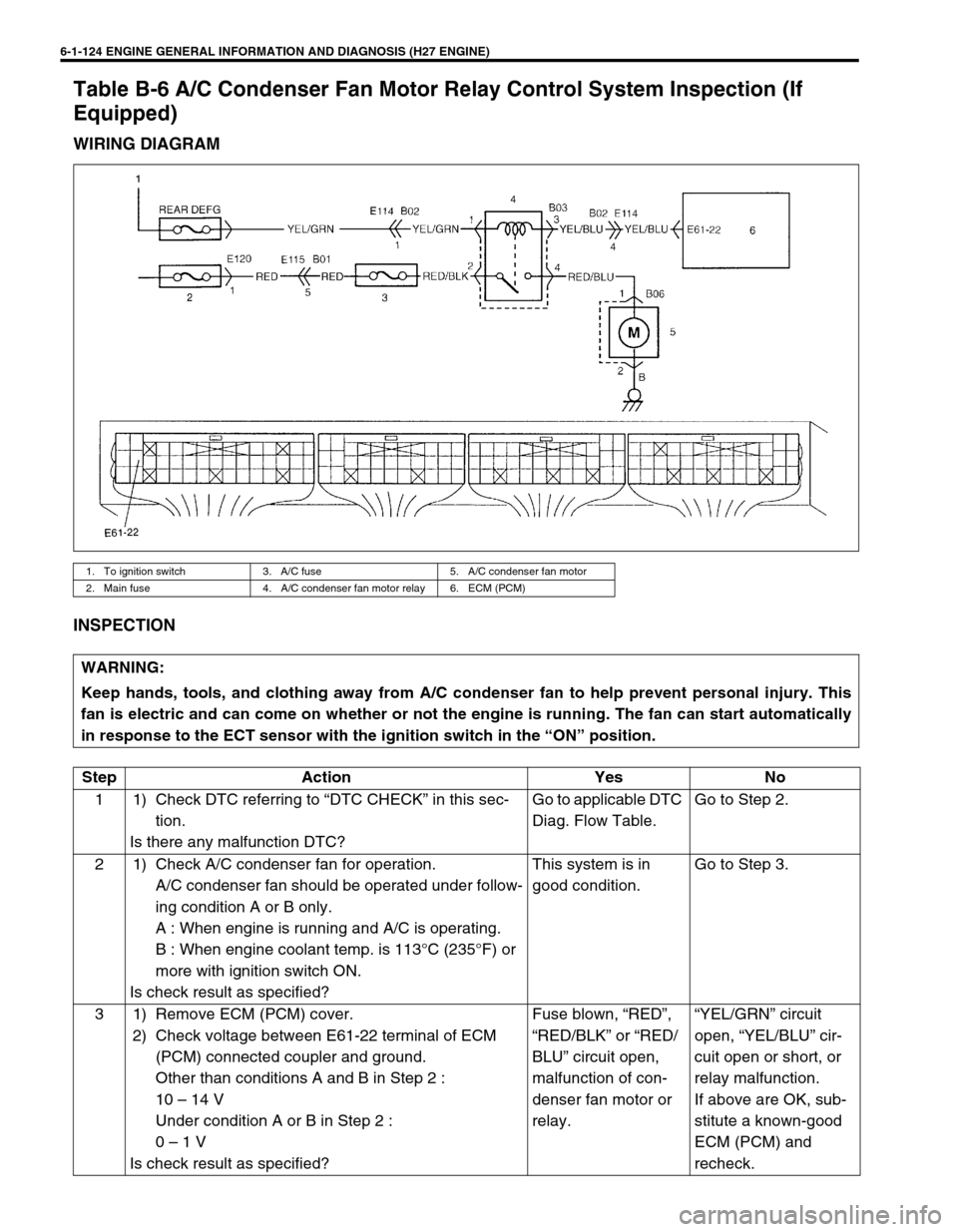
Table B-6 A/C Condenser Fan Motor Relay Control System Inspection (If
Equipped)
WIRING DIAGRAM
INSPECTION
1. To ignition switch 3. A/C fuse 5. A/C condenser fan motor
2. Main fuse 4. A/C condenser fan motor relay 6. ECM (PCM)
WARNING:
Keep hands, tools, and clothing away from A/C condenser fan to help prevent personal injury. This
fan is electric and can come on whether or not the engine is running. The fan can start automatically
in response to the ECT sensor with the ignition switch in the “ON” position.
Step Action Yes No
1 1) Check DTC referring to “DTC CHECK” in this sec-
tion.
Is there any malfunction DTC?Go to applicable DTC
Diag. Flow Table.Go to Step 2.
2 1) Check A/C condenser fan for operation.
A/C condenser fan should be operated under follow-
ing condition A or B only.
A : When engine is running and A/C is operating.
B : When engine coolant temp. is 113°C (235°F) or
more with ignition switch ON.
Is check result as specified?This system is in
good condition.Go to Step 3.
3 1) Remove ECM (PCM) cover.
2) Check voltage between E61-22 terminal of ECM
(PCM) connected coupler and ground.
Other than conditions A and B in Step 2 :
10 – 14 V
Under condition A or B in Step 2 :
0 – 1 V
Is check result as specified?Fuse blown, “RED”,
“RED/BLK” or “RED/
BLU” circuit open,
malfunction of con-
denser fan motor or
relay.“YEL/GRN” circuit
open, “YEL/BLU” cir-
cuit open or short, or
relay malfunction.
If above are OK, sub-
stitute a known-good
ECM (PCM) and
recheck.
Page 288 of 656
ENGINE MECHANICAL (H27 ENGINE) 6A2-1
6A2
SECTION 6A2
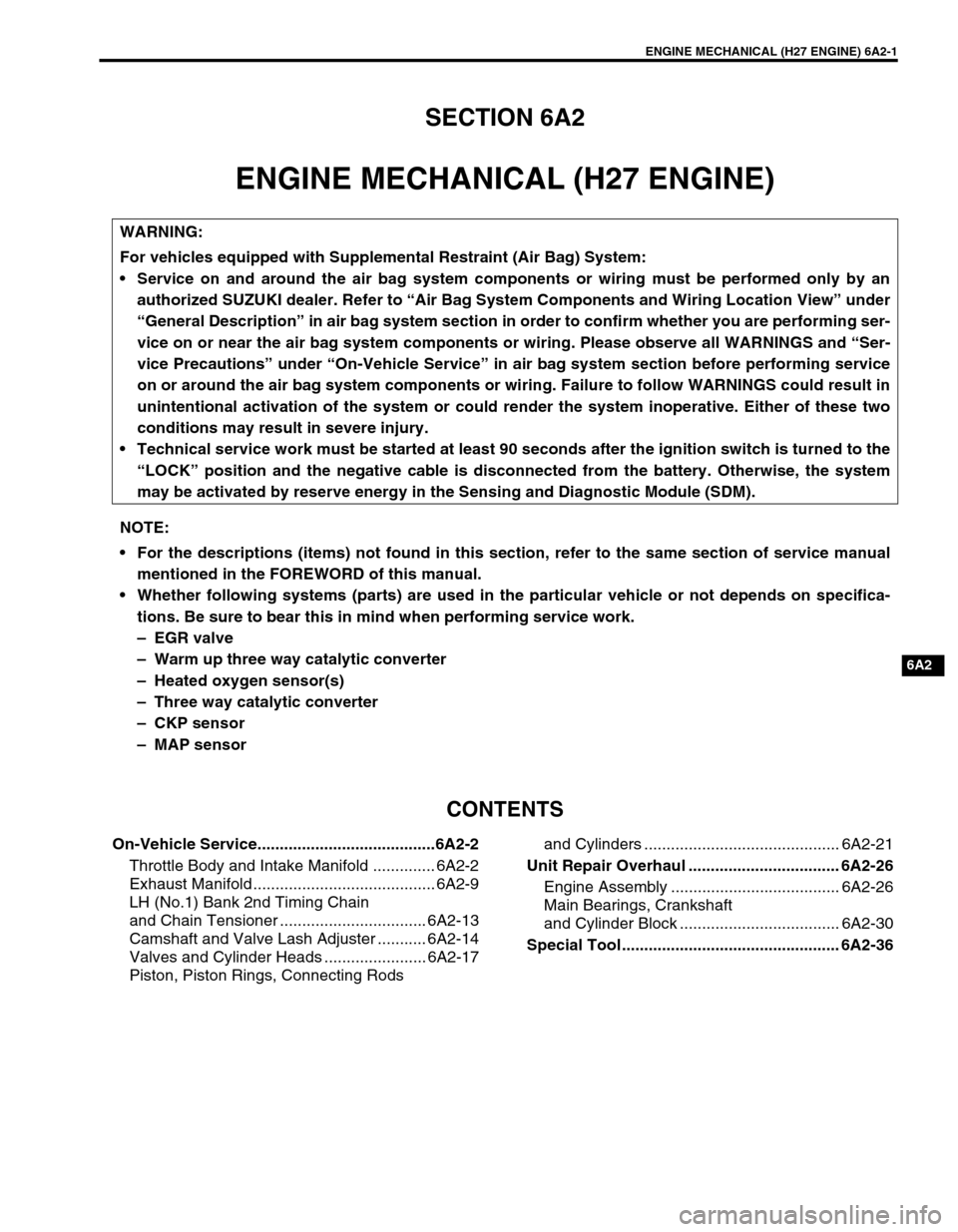
ENGINE MECHANICAL (H27 ENGINE)
CONTENTS
On-Vehicle Service........................................6A2-2
Throttle Body and Intake Manifold .............. 6A2-2
Exhaust Manifold ......................................... 6A2-9
LH (No.1) Bank 2nd Timing Chain
and Chain Tensioner ................................. 6A2-13
Camshaft and Valve Lash Adjuster ........... 6A2-14
Valves and Cylinder Heads ....................... 6A2-17
Piston, Piston Rings, Connecting Rodsand Cylinders ............................................ 6A2-21
Unit Repair Overhaul .................................. 6A2-26
Engine Assembly ...................................... 6A2-26
Main Bearings, Crankshaft
and Cylinder Block .................................... 6A2-30
Special Tool ................................................. 6A2-36
WARNING:
For vehicles equipped with Supplemental Restraint (Air Bag) System:
Service on and around the air bag system components or wiring must be performed only by an
authorized SUZUKI dealer. Refer to “Air Bag System Components and Wiring Location View” under
“General Description” in air bag system section in order to confirm whether you are performing ser-
vice on or near the air bag system components or wiring. Please observe all WARNINGS and “Ser-
vice Precautions” under “On-Vehicle Service” in air bag system section before performing service
on or around the air bag system components or wiring. Failure to follow WARNINGS could result in
unintentional activation of the system or could render the system inoperative. Either of these two
conditions may result in severe injury.
Technical service work must be started at least 90 seconds after the ignition switch is turned to the
“LOCK” position and the negative cable is disconnected from the battery. Otherwise, the system
may be activated by reserve energy in the Sensing and Diagnostic Module (SDM).
NOTE:
For the descriptions (items) not found in this section, refer to the same section of service manual
mentioned in the FOREWORD of this manual.
Whether following systems (parts) are used in the particular vehicle or not depends on specifica-
tions. Be sure to bear this in mind when performing service work.
–EGR valve
–Warm up three way catalytic converter
–Heated oxygen sensor(s)
–Three way catalytic converter
–CKP sensor
–MAP sensor
Page 290 of 656
ENGINE MECHANICAL (H27 ENGINE) 6A2-3
REMOVAL
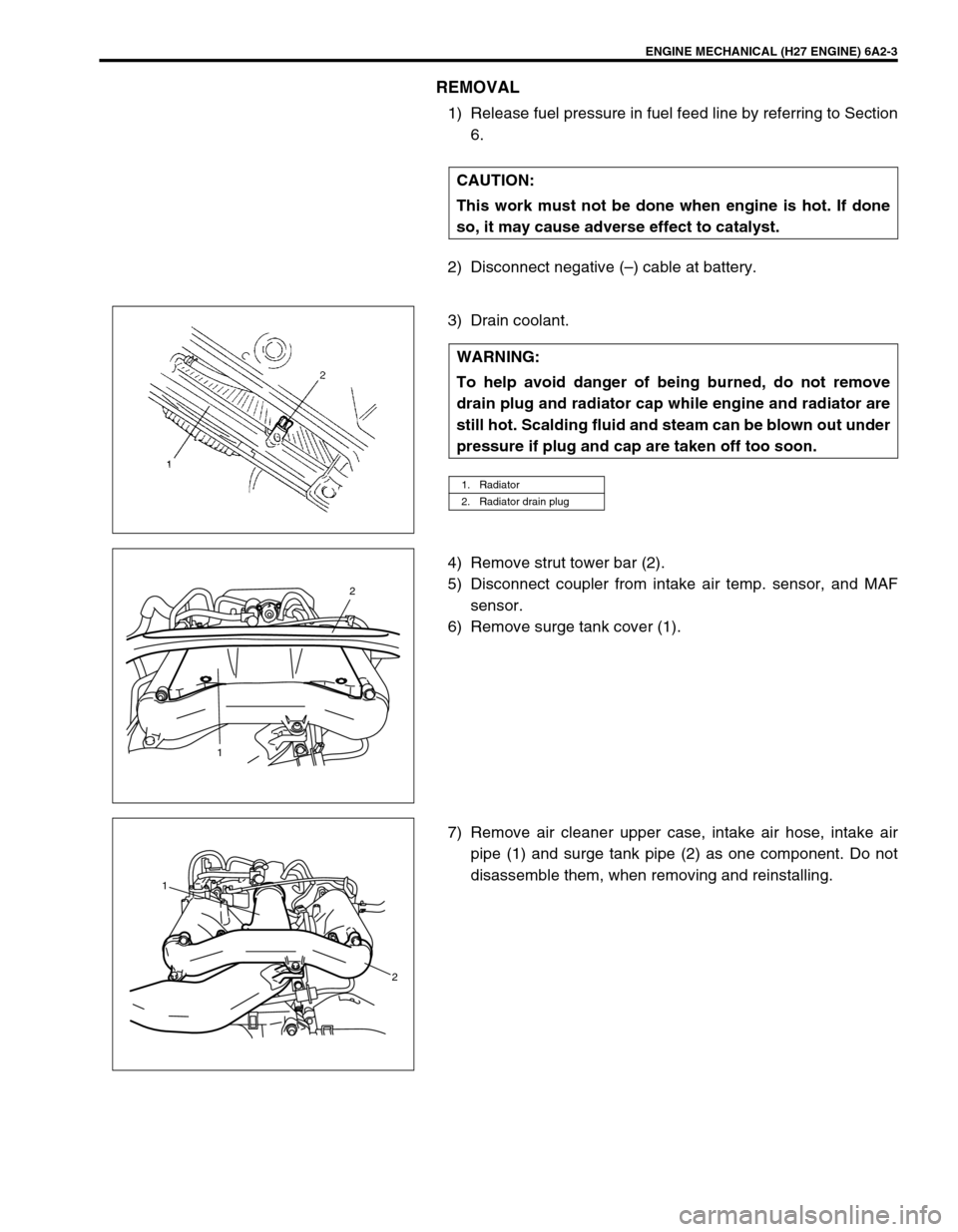
1) Release fuel pressure in fuel feed line by referring to Section
6.
2) Disconnect negative (–) cable at battery.
3) Drain coolant.
4) Remove strut tower bar (2).
5) Disconnect coupler from intake air temp. sensor, and MAF
sensor.
6) Remove surge tank cover (1).
7) Remove air cleaner upper case, intake air hose, intake air
pipe (1) and surge tank pipe (2) as one component. Do not
disassemble them, when removing and reinstalling. CAUTION:
This work must not be done when engine is hot. If done
so, it may cause adverse effect to catalyst.
WARNING:
To help avoid danger of being burned, do not remove
drain plug and radiator cap while engine and radiator are
still hot. Scalding fluid and steam can be blown out under
pressure if plug and cap are taken off too soon.
1. Radiator
2. Radiator drain plug
2
1
1
2
Page 296 of 656
ENGINE MECHANICAL (H27 ENGINE) 6A2-9
26) Upon completion of installation, verify that there is no fuel
leakage at each connection according to procedure
described in Section 6.
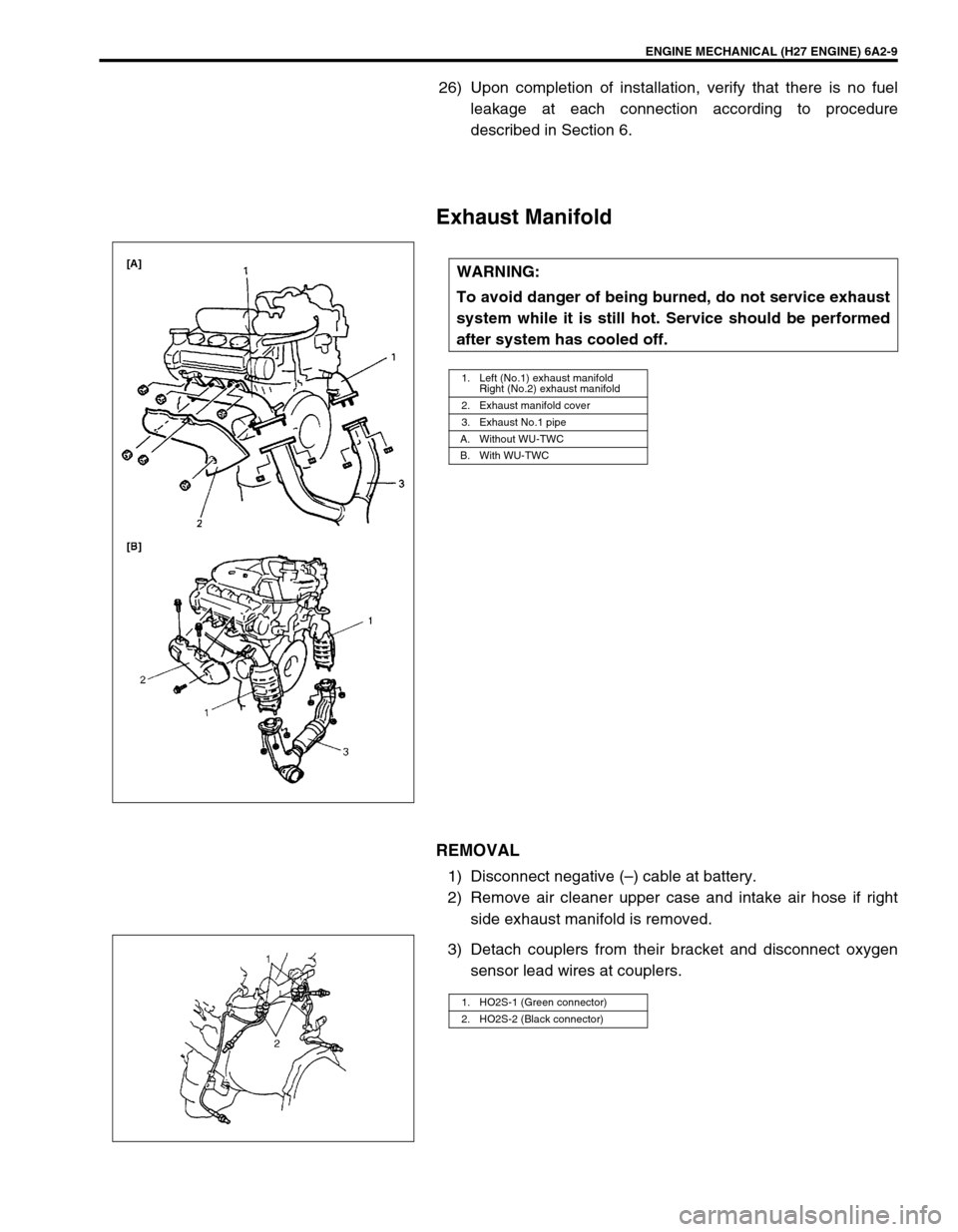
Exhaust Manifold
REMOVAL
1) Disconnect negative (–) cable at battery.
2) Remove air cleaner upper case and intake air hose if right
side exhaust manifold is removed.
3) Detach couplers from their bracket and disconnect oxygen
sensor lead wires at couplers. WARNING:
To avoid danger of being burned, do not service exhaust
system while it is still hot. Service should be performed
after system has cooled off.
1. Left (No.1) exhaust manifold
Right (No.2) exhaust manifold
2. Exhaust manifold cover
3. Exhaust No.1 pipe
A. Without WU-TWC
B. With WU-TWC
1. HO2S-1 (Green connector)
2. HO2S-2 (Black connector)