Jack SUZUKI GRAND VITARA 2001 2.G Owners Manual
[x] Cancel search | Manufacturer: SUZUKI, Model Year: 2001, Model line: GRAND VITARA, Model: SUZUKI GRAND VITARA 2001 2.GPages: 656, PDF Size: 14.31 MB
Page 13 of 656
0A-8 GENERAL INFORMATION
Warning, Caution and Information Labels
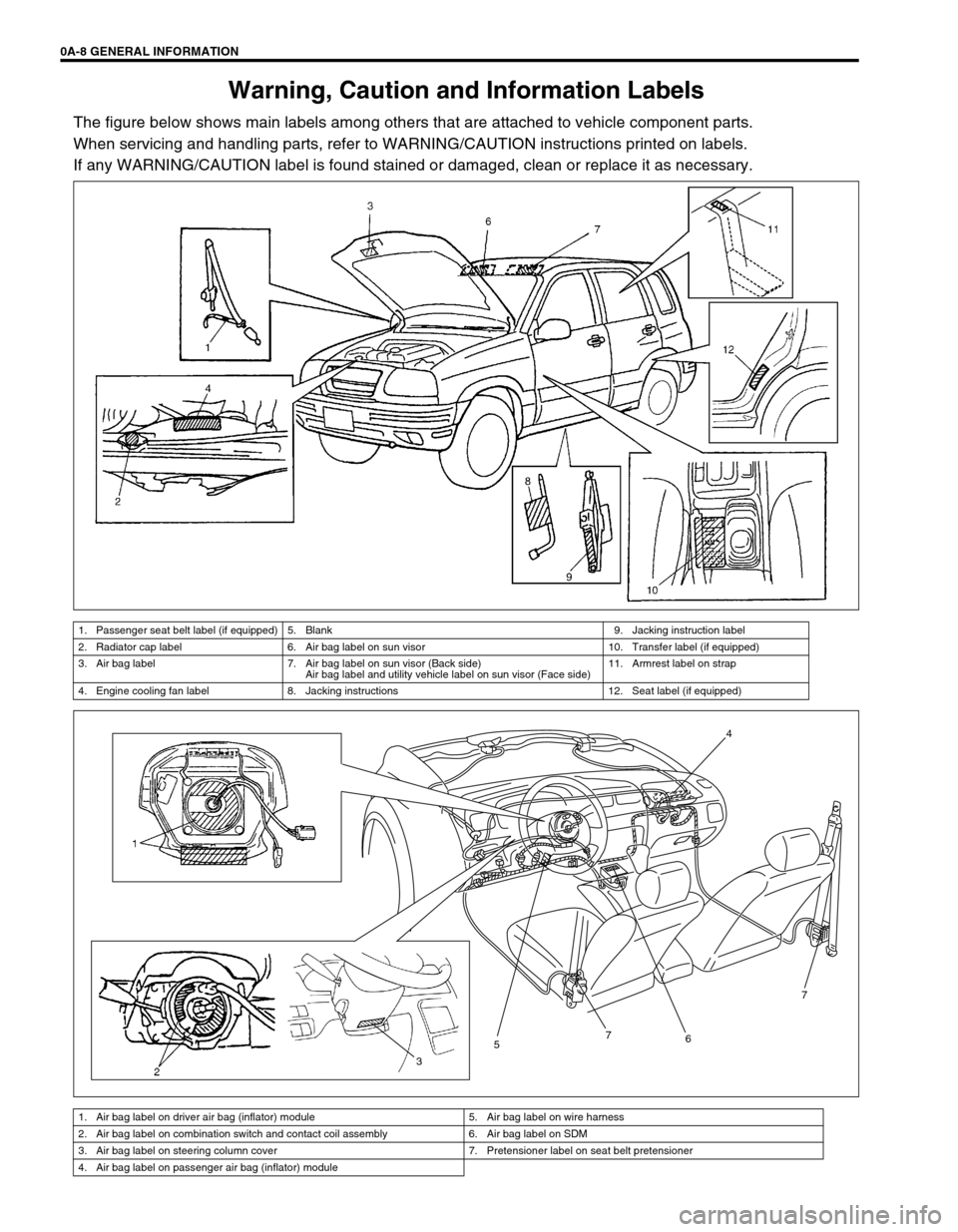
The figure below shows main labels among others that are attached to vehicle component parts.
When servicing and handling parts, refer to WARNING/CAUTION instructions printed on labels.
If any WARNING/CAUTION label is found stained or damaged, clean or replace it as necessary.
1. Passenger seat belt label (if equipped) 5. Blank 9. Jacking instruction label
2. Radiator cap label 6. Air bag label on sun visor 10. Transfer label (if equipped)
3. Air bag label 7. Air bag label on sun visor (Back side)
Air bag label and utility vehicle label on sun visor (Face side)11. Armrest label on strap
4. Engine cooling fan label 8. Jacking instructions 12. Seat label (if equipped)
1. Air bag label on driver air bag (inflator) module 5. Air bag label on wire harness
2. Air bag label on combination switch and contact coil assembly 6. Air bag label on SDM
3. Air bag label on steering column cover 7. Pretensioner label on seat belt pretensioner
4. Air bag label on passenger air bag (inflator) module
3
7
7
56
4
Page 130 of 656
ANTILOCK BRAKE SYSTEM (ABS) 5E2-5
Diagnosis
To ensure that the trouble diagnosis is done accurately and
smoothly, observe “PRECAUTIONS IN DIAGNOSING TROU-
BLES” and follow “ABS DIAGNOSTIC FLOW TABLE”.
Precautions in Diagnosing Troubles
If the vehicles was operated in any of the following ways,
ABS warning lamp may light momentarily but this does not
indicate anything abnormal in ABS.
–The vehicle was driven with parking brake pulled.
–The vehicle was driven with brake dragging.
–The vehicle was stuck in mud, sand, etc.
–Wheel spin occurred while driving.
–Wheel(s) was rotated while the vehicle was jacked up.
Be sure to read “PRECAUTIONS FOR ELECTRONIC CIR-
CUIT SERVICE” in Section 0A before inspection and
observe what is written there.
Be sure to use the trouble diagnosis procedure as described
in the flow table. Failure to follow the flow table may result in
incorrect diagnosis. (Some other diagnosis trouble code may
be stored by mistake in the memory of ABS control module
during inspection.)
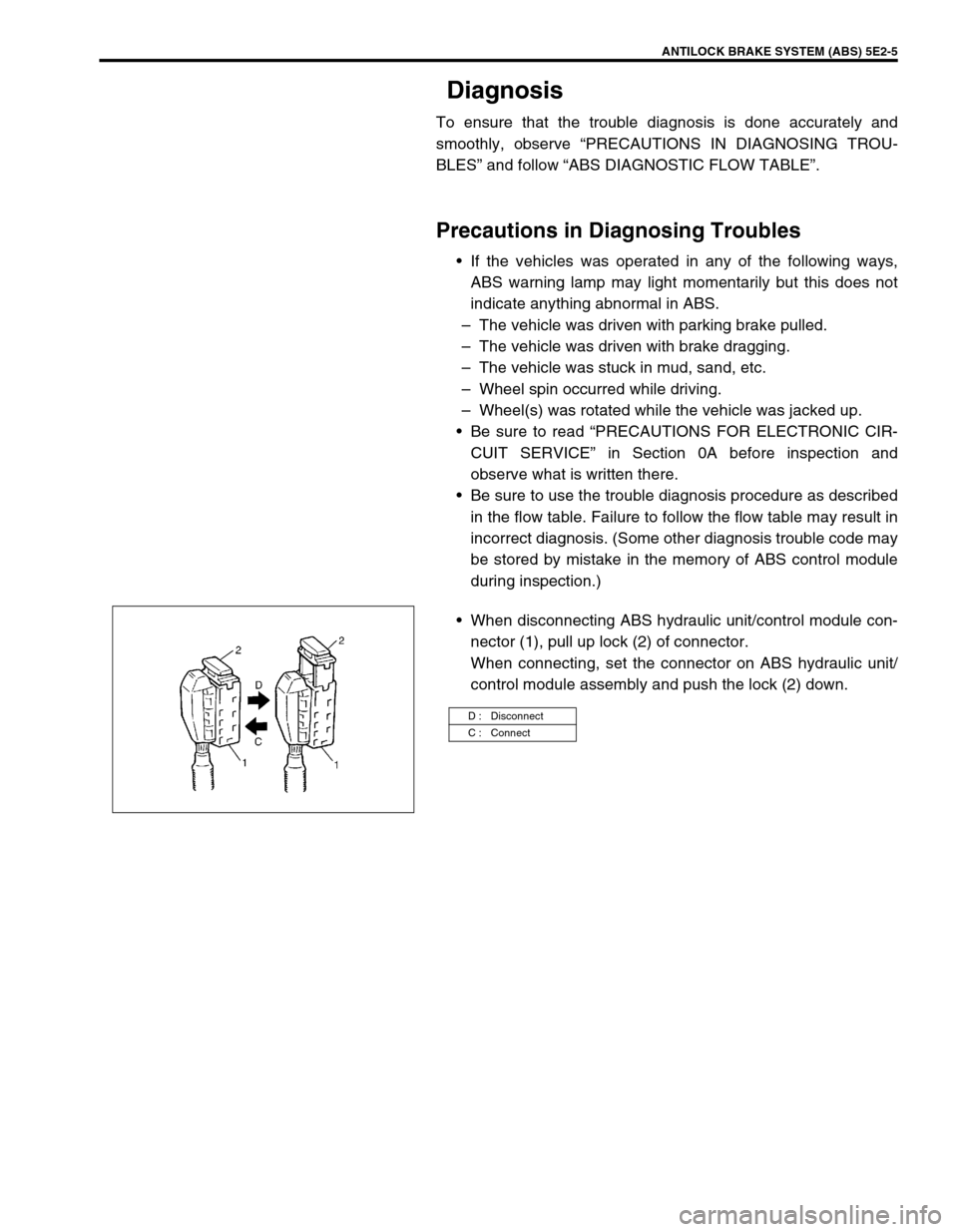
When disconnecting ABS hydraulic unit/control module con-
nector (1), pull up lock (2) of connector.
When connecting, set the connector on ABS hydraulic unit/
control module assembly and push the lock (2) down.
D : Disconnect
C : Connect
Page 147 of 656
5E2-22 ANTILOCK BRAKE SYSTEM (ABS)
DTC C1021 (DTC 21), DTC C1022 (DTC 22) – Right-Front Wheel Speed Sensor
Circuit or Sensor Ring
DTC C1025 (DTC 25), DTC C1026 (DTC 26) – Left-Front Wheel Speed Sensor
Circuit or Sensor Ring
DTC C1031 (DTC 31), DTC C1032 (DTC 32) – Right-Rear Wheel Speed Sensor
Circuit or Sensor Ring
DTC C1035 (DTC 35), DTC C1036 (DTC 36) – Left-Rear Wheel Speed Sensor
Circuit or Sensor Ring
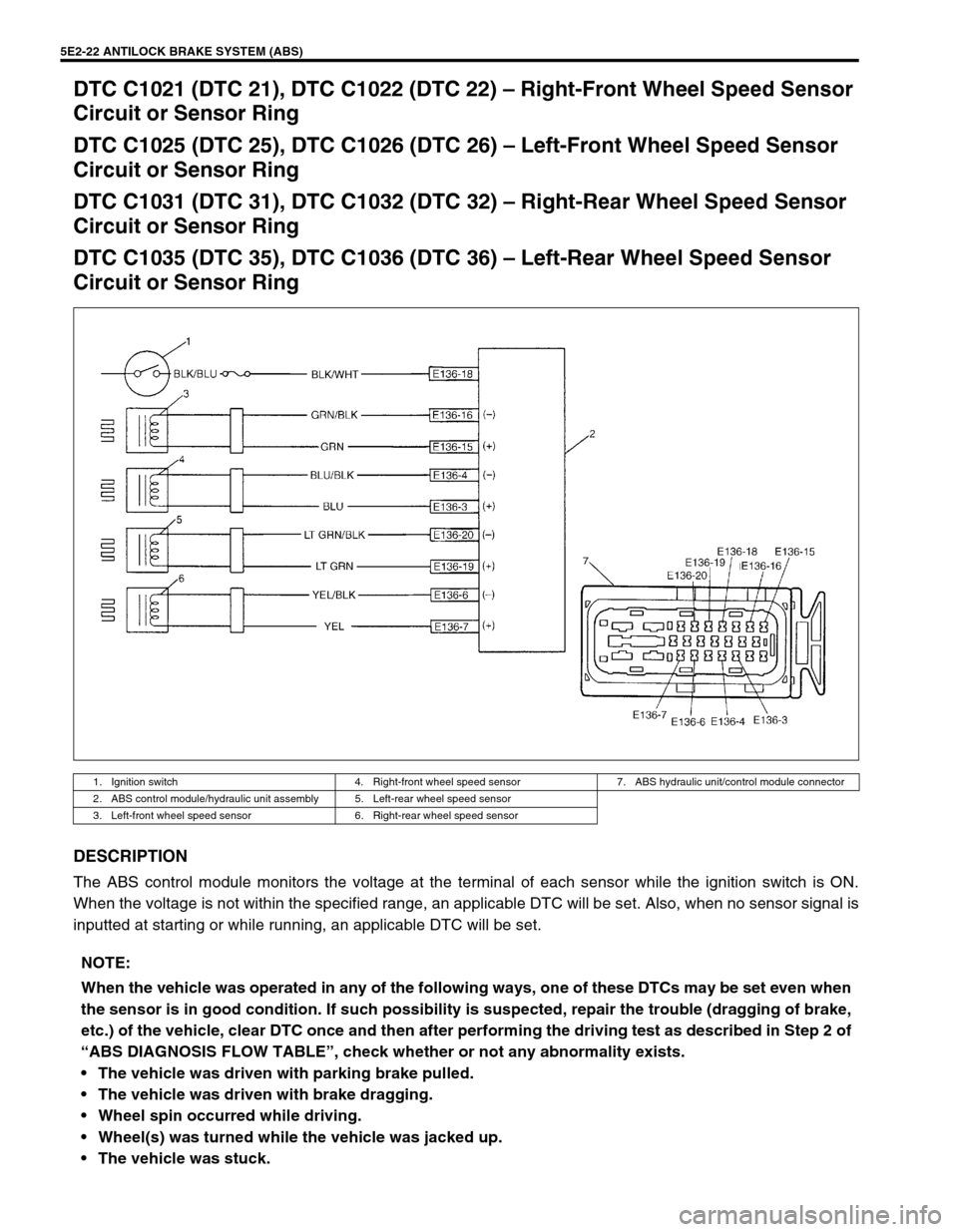
DESCRIPTION
The ABS control module monitors the voltage at the terminal of each sensor while the ignition switch is ON.
When the voltage is not within the specified range, an applicable DTC will be set. Also, when no sensor signal is
inputted at starting or while running, an applicable DTC will be set.
1. Ignition switch 4. Right-front wheel speed sensor 7. ABS hydraulic unit/control module connector
2. ABS control module/hydraulic unit assembly 5. Left-rear wheel speed sensor
3. Left-front wheel speed sensor 6. Right-rear wheel speed sensor
NOTE:
When the vehicle was operated in any of the following ways, one of these DTCs may be set even when
the sensor is in good condition. If such possibility is suspected, repair the trouble (dragging of brake,
etc.) of the vehicle, clear DTC once and then after performing the driving test as described in Step 2 of
“ABS DIAGNOSIS FLOW TABLE”, check whether or not any abnormality exists.
The vehicle was driven with parking brake pulled.
The vehicle was driven with brake dragging.
Wheel spin occurred while driving.
Wheel(s) was turned while the vehicle was jacked up.
The vehicle was stuck.
Page 164 of 656
ENGINE GENERAL INFORMATION AND DIAGNOSIS (H27 ENGINE) 6-1-3
General Information
Statement of Cleanliness and Care
An automobile engine is a combination of many machined, honed, polished and lapped surfaces with tolerances
that are measured in the thousands of an millimeter (ten thousands of inch). Accordingly, when any internal
engine parts are serviced, care and cleanliness are important. Throughout this section, it should be understood
that proper cleaning and protection of machined surfaces and friction areas is part of the repair procedure. This
is considered standard shop practice even if not specifically stated.
A liberal coating of engine oil should be applied to friction areas during assembly to protect and lubricate the
surface on initial operation.
Whenever valve train components, pistons, piston rings, connecting rods, rod bearings and crankshaft jour-
nal bearings are removed for service, they should be retained in order. At the time of installation, they should
be installed in the same locations and with the same mating surfaces as when removed.
Battery cables should be disconnected before any major work is performed on the engine. Failure to discon-
nect cables may result in damage to wire harness or other electrical parts.
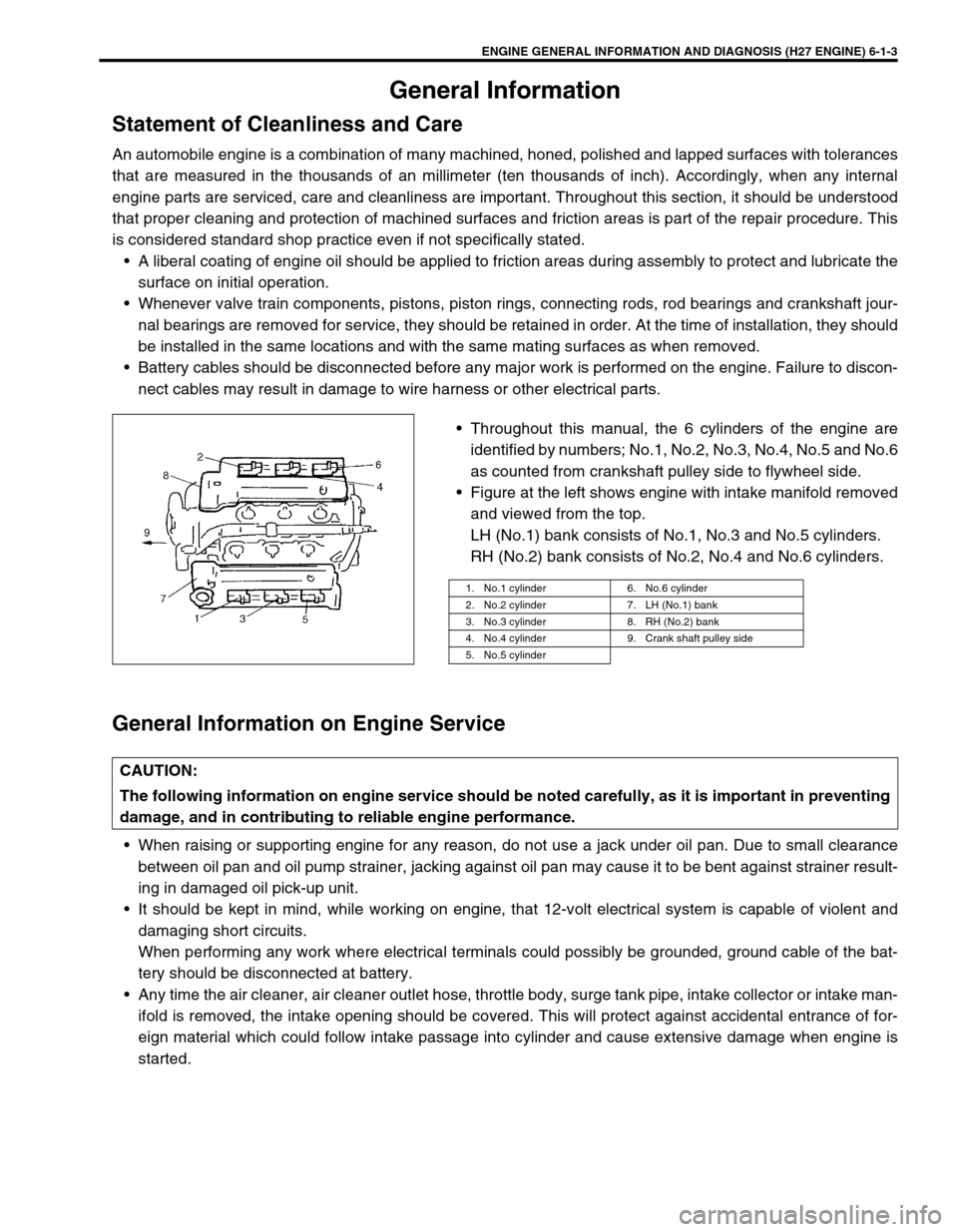
Throughout this manual, the 6 cylinders of the engine are
identified by numbers; No.1, No.2, No.3, No.4, No.5 and No.6
as counted from crankshaft pulley side to flywheel side.
Figure at the left shows engine with intake manifold removed
and viewed from the top.
LH (No.1) bank consists of No.1, No.3 and No.5 cylinders.
RH (No.2) bank consists of No.2, No.4 and No.6 cylinders.
General Information on Engine Service
When raising or supporting engine for any reason, do not use a jack under oil pan. Due to small clearance
between oil pan and oil pump strainer, jacking against oil pan may cause it to be bent against strainer result-
ing in damaged oil pick-up unit.
It should be kept in mind, while working on engine, that 12-volt electrical system is capable of violent and
damaging short circuits.
When performing any work where electrical terminals could possibly be grounded, ground cable of the bat-
tery should be disconnected at battery.
Any time the air cleaner, air cleaner outlet hose, throttle body, surge tank pipe, intake collector or intake man-
ifold is removed, the intake opening should be covered. This will protect against accidental entrance of for-
eign material which could follow intake passage into cylinder and cause extensive damage when engine is
started.
1. No.1 cylinder 6. No.6 cylinder
2. No.2 cylinder 7. LH (No.1) bank
3. No.3 cylinder 8. RH (No.2) bank
4. No.4 cylinder 9. Crank shaft pulley side
5. No.5 cylinder
CAUTION:
The following information on engine service should be noted carefully, as it is important in preventing
damage, and in contributing to reliable engine performance.
Page 315 of 656
6A2-28 ENGINE MECHANICAL (H27 ENGINE)
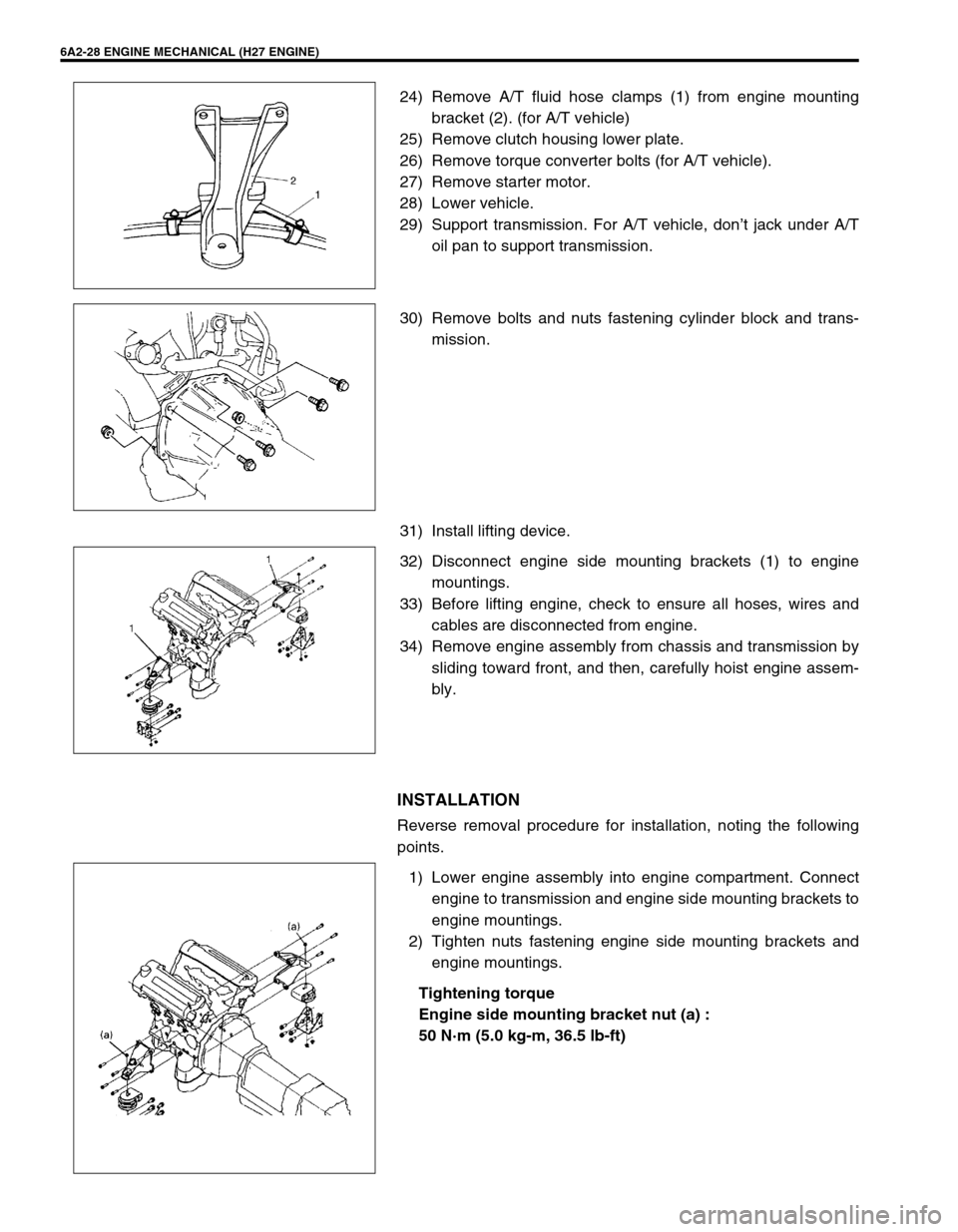
24) Remove A/T fluid hose clamps (1) from engine mounting
bracket (2). (for A/T vehicle)
25) Remove clutch housing lower plate.
26) Remove torque converter bolts (for A/T vehicle).
27) Remove starter motor.
28) Lower vehicle.
29) Support transmission. For A/T vehicle, don’t jack under A/T
oil pan to support transmission.
30) Remove bolts and nuts fastening cylinder block and trans-
mission.
31) Install lifting device.
32) Disconnect engine side mounting brackets (1) to engine
mountings.
33) Before lifting engine, check to ensure all hoses, wires and
cables are disconnected from engine.
34) Remove engine assembly from chassis and transmission by
sliding toward front, and then, carefully hoist engine assem-
bly.
INSTALLATION
Reverse removal procedure for installation, noting the following
points.
1) Lower engine assembly into engine compartment. Connect
engine to transmission and engine side mounting brackets to
engine mountings.
2) Tighten nuts fastening engine side mounting brackets and
engine mountings.
Tightening torque
Engine side mounting bracket nut (a) :
50 N·m (5.0 kg-m, 36.5 lb-ft)
Page 482 of 656
DIFFERENTIAL (FRONT) 7E-9
Front Differential Assembly
DISMOUNTING
1) Lift up vehicle and drain oil.
2) Disconnect air hose and breather hose from differential
housing.
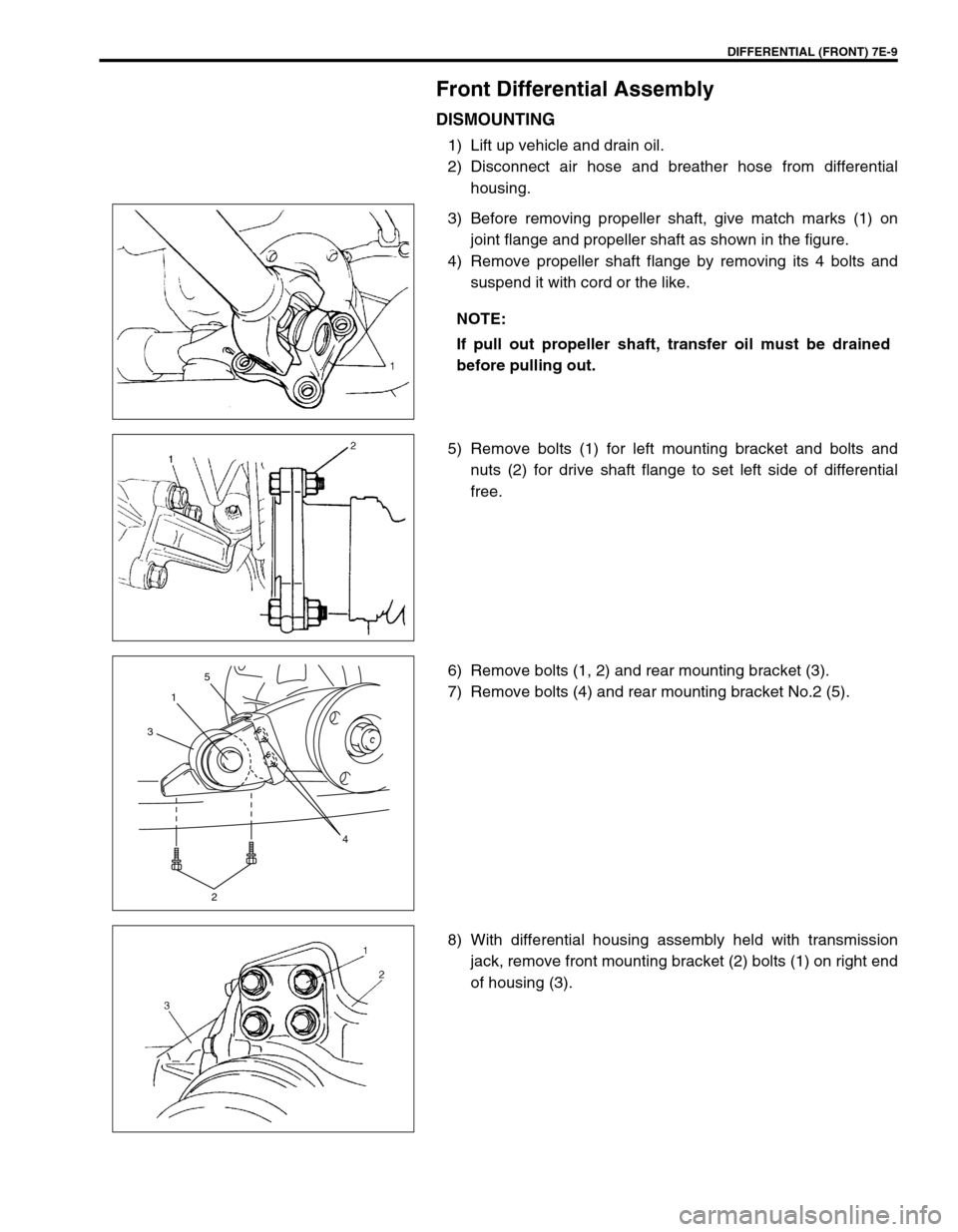
3) Before removing propeller shaft, give match marks (1) on
joint flange and propeller shaft as shown in the figure.
4) Remove propeller shaft flange by removing its 4 bolts and
suspend it with cord or the like.
5) Remove bolts (1) for left mounting bracket and bolts and
nuts (2) for drive shaft flange to set left side of differential
free.
6) Remove bolts (1, 2) and rear mounting bracket (3).
7) Remove bolts (4) and rear mounting bracket No.2 (5).
8) With differential housing assembly held with transmission
jack, remove front mounting bracket (2) bolts (1) on right end
of housing (3). NOTE:
If pull out propeller shaft, transfer oil must be drained
before pulling out.
4 1
2
5
3