transfer switch SUZUKI GRAND VITARA 2007 3.G User Guide
[x] Cancel search | Manufacturer: SUZUKI, Model Year: 2007, Model line: GRAND VITARA, Model: SUZUKI GRAND VITARA 2007 3.GPages: 211, PDF Size: 3.21 MB
Page 123 of 211

Downloaded from www.Manualslib.com manuals search engine 7-5 DRIVING TIPS
66J21-03E
Tire ChainsTire chains should only be used if they are
needed to increase traction or are required
by law. Make sure that the chains you use
are small-link chains or cable-type chains
and are the correct size for your vehicle’s
tires. Also make sure that there is enough
clearance between the fenders and the
chains as installed on the tires.
Install the chains on the rear tires tightly,
according to the chain manufacturer’s
instructions. Retighten the chains after
driving about 1.0 km (1/2 mile) if neces-
sary. With the chains installed, drive slowly.Do not drive through deep or rushing
water
Driving in deep or rushing water can be
hazardous. You could lose control of the
vehicle and the occupants could drown.
Also, your vehicle could be seriously dam-
aged. To avoid these risks, observe the fol-
lowing instructions and precautions.
Do not drive through deep or rushing
water. Deep or rushing water, such as
fast-moving streams or floodwaters,
could carry your vehicle away from your
intended path. The water is too deep if it
covers your wheel hubs, axles or
exhaust tailpipe. Know the depth of the
water before you attempt to drive
through it.
If water blocks the tailpipe, the engine
may not start or run. If the water is deep
enough to get drawn into the engine
intake system, the engine will be badly
damaged.
Submerged brakes will have poor brak-
ing performance. Drive slowly and care-
fully. Driving slowly will also help avoid
water splashing onto the ignition system,
which could cause the engine to stall.
Even when driving through shallow or
still waters, drive carefully since the
water may be hiding ground hazards
such as holes, ditches or bumps.
WARNING
Do not allow anyone to stand near
the vehicle when you are rocking it,
and do not spin the wheels faster
than an indicated 40 km/h (25 mph)
on the speedometer. Personal
injury and/or vehicle damage may
result from spinning the wheels too
fast.
Be sure to turn the transfer switch
from “4H” to “4H LOCK” or “4L
LOCK” when the tires slip in “4H”.
The continuing tires slip in “4H”
can cause the limited slip differen-
tial gear damage in the center dif-
ferential.
CAUTION
Release the accelerator pedal when
operating the gearshift lever. Operat-
ing the lever with the engine racing
can damage the gears.
CAUTION
Do not continue rocking the vehicle
for more than a few minutes. Pro-
longed rocking can cause engine
overheating, transmission or trans-
fer case damage or tire damage.
CAUTION
If you hear the chains hitting against
the vehicle body while driving, stop
and tighten them.
Off-Road Driving: NO
Page 132 of 211
Downloaded from www.Manualslib.com manuals search engine 8-6 VEHICLE LOADING AND TOWING
66J21-03E
60A186
WARNING
(Continued)
Avoid “riding” the brakes. “Riding”
the brakes could cause the brakes
to overheat, resulting in reduced
braking efficiency. Use engine
braking as much as possible.
Because of the added trailer
weight, your engine may overheat
on hot days when going up long or
steep hills. Pay attention to your
engine temperature gauge. If it indi-
cates overheating, pull off the road
and stop in a safe place. Refer to
the “If the Engine Overheats” in
“EMERGENCY SERVICE” section
for details on how to proceed.
WARNING
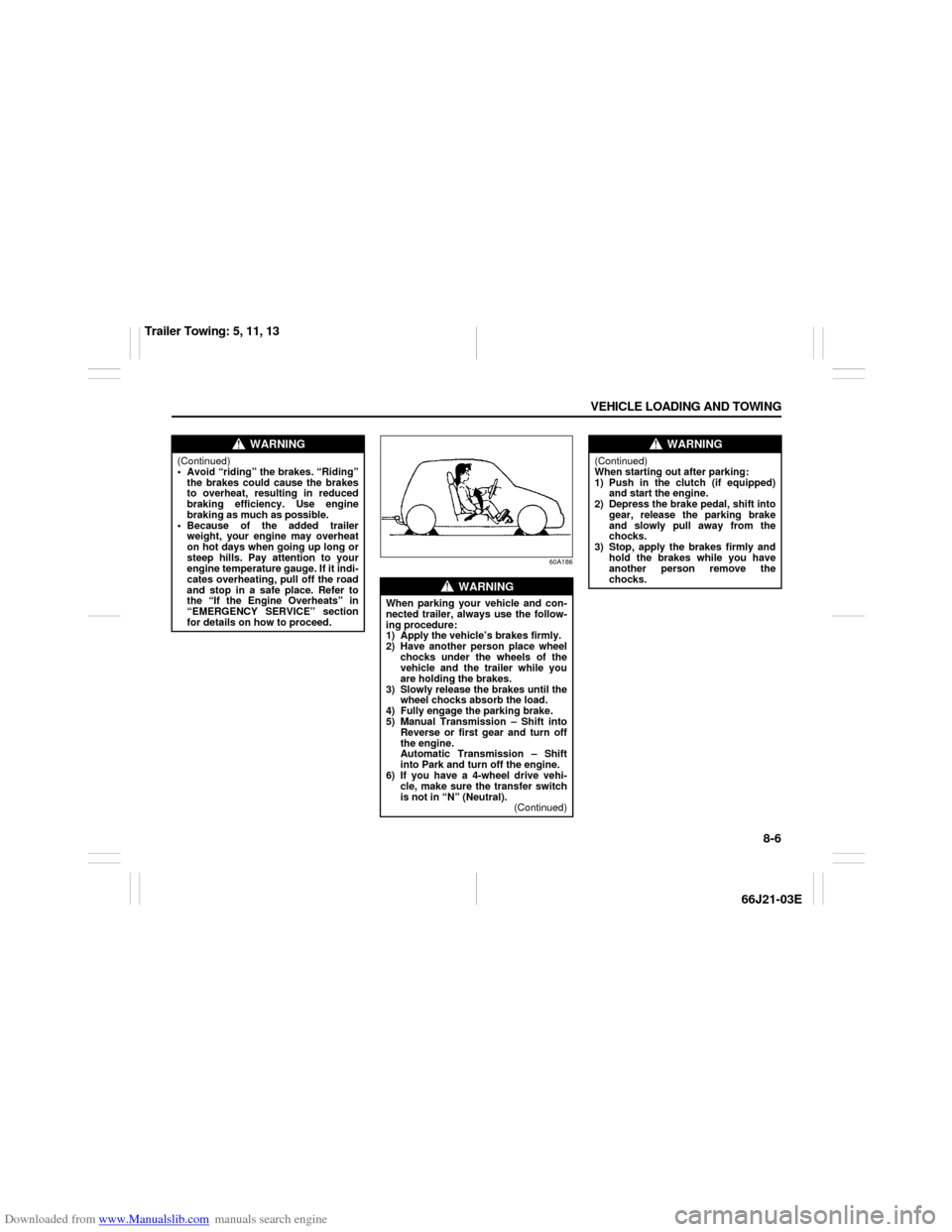
When parking your vehicle and con-
nected trailer, always use the follow-
ing procedure:
1) Apply the vehicle’s brakes firmly.
2) Have another person place wheel
chocks under the wheels of the
vehicle and the trailer while you
are holding the brakes.
3) Slowly release the brakes until the
wheel chocks absorb the load.
4) Fully engage the parking brake.
5) Manual Transmission – Shift into
Reverse or first gear and turn off
the engine.
Automatic Transmission – Shift
into Park and turn off the engine.
6) If you have a 4-wheel drive vehi-
cle, make sure the transfer switch
is not in “N” (Neutral).
(Continued)
WARNING
(Continued)
When starting out after parking:
1) Push in the clutch (if equipped)
and start the engine.
2) Depress the brake pedal, shift into
gear, release the parking brake
and slowly pull away from the
chocks.
3) Stop, apply the brakes firmly and
hold the brakes while you have
another person remove the
chocks.
Trailer Towing: 5, 11, 13
Page 133 of 211

Downloaded from www.Manualslib.com manuals search engine 8-7 VEHICLE LOADING AND TOWING
66J21-03E
Towing Your Vehicle
(recreational towing)Your vehicle may be towed behind another
vehicle (such as a motorhome), provided
you use the proper towing method speci-
fied for your vehicle. The towing method
you must use depends on the specifica-
tions of your vehicle: whether it is a 2-
wheel drive (2WD), 4-wheel drive (4WD)
with a transfer switch or 4-wheel drive
(4WD) without a transfer switch vehicle.
Use the towing instruction table to select
the proper towing method for your vehicle,
and carefully follow the corresponding
instructions. Be sure to use proper towing
equipment designed for recreational tow-
ing and make sure that towing speed does
not exceed 90 km/h (55 mph).TOWING INSTRUCTION TABLE
4WD Vehicle With a Transfer Switch
54G585
64J234
DRIVE TRAINTRANS-
MISSIONTOWING
METHOD
4WD
with a transfer
switchA/TA
M/TA
4WD
without a
transfer switchA/Tnone
M/Tnone
2WDA/TB
M/TB
CAUTION
Never tow your 4WD vehicle without
a transfer switch using recreational
towing methods. If you do, the trans-
mission will be permanently dam-
aged.
Towing Your Vehicle (recreational towing): 13
Page 134 of 211
Downloaded from www.Manualslib.com manuals search engine 8-8 VEHICLE LOADING AND TOWING
66J21-03E
Before towing
64J147
Vehicles equipped with a transfer switch
may be towed from the front with all four
wheels on the ground. Be sure to use
proper towing equipment designed for rec-
reational towing and make sure that towing
speed does not exceed 90 km/h (55 mph).To tow a vehicle equipped with a trans-
fer switch with all four wheels on the
ground:
1) Turn the ignition key to the “ON” posi-
tion.
2) Place the transmission in “N” (Neutral)
and depress the brake pedal and the
clutch pedal fully (if equipped).
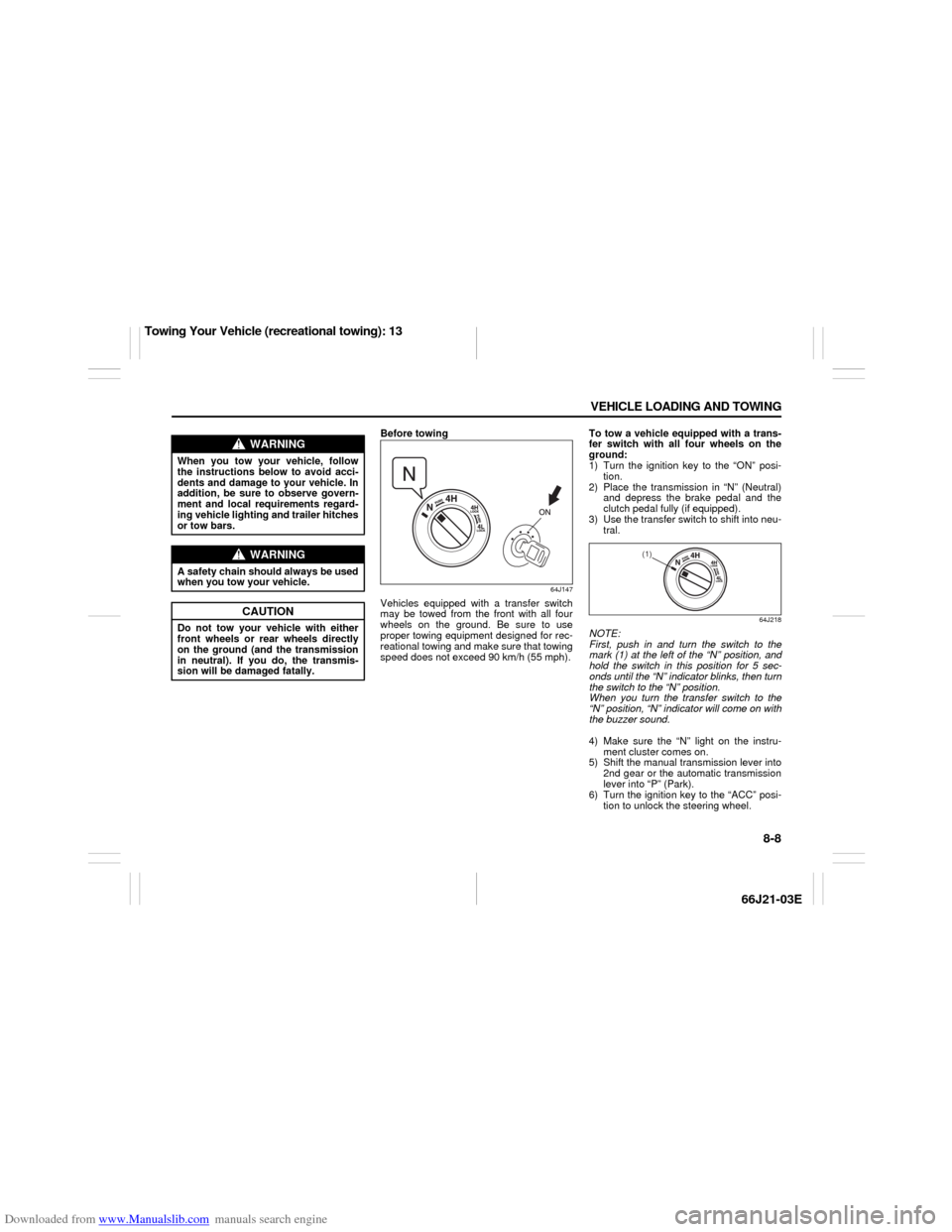
3) Use the transfer switch to shift into neu-
tral.
64J218
NOTE:
First, push in and turn the switch to the
mark (1) at the left of the “N” position, and
hold the switch in this position for 5 sec-
onds until the “N” indicator blinks, then turn
the switch to the “N” position.
When you turn the transfer switch to the
“N” position, “N” indicator will come on with
the buzzer sound.
4) Make sure the “N” light on the instru-
ment cluster comes on.
5) Shift the manual transmission lever into
2nd gear or the automatic transmission
lever into “P” (Park).
6) Turn the ignition key to the “ACC” posi-
tion to unlock the steering wheel.
WARNING
When you tow your vehicle, follow
the instructions below to avoid acci-
dents and damage to your vehicle. In
addition, be sure to observe govern-
ment and local requirements regard-
ing vehicle lighting and trailer hitches
or tow bars.
WARNING
A safety chain should always be used
when you tow your vehicle.
CAUTION
Do not tow your vehicle with either
front wheels or rear wheels directly
on the ground (and the transmission
in neutral). If you do, the transmis-
sion will be damaged fatally.
(1)
Towing Your Vehicle (recreational towing): 13
Page 135 of 211
Downloaded from www.Manualslib.com manuals search engine 8-9 VEHICLE LOADING AND TOWING
66J21-03E
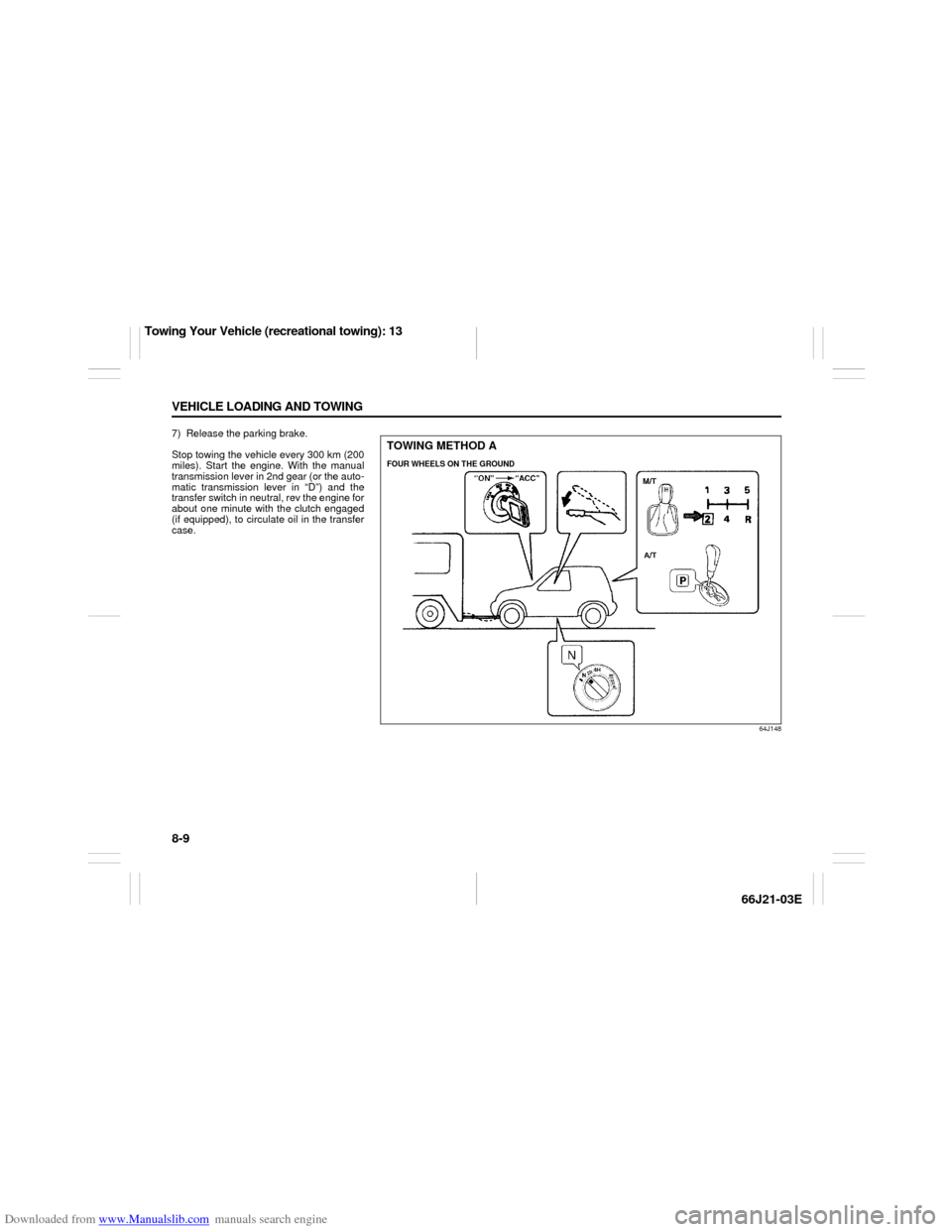
7) Release the parking brake.
Stop towing the vehicle every 300 km (200
miles). Start the engine. With the manual
transmission lever in 2nd gear (or the auto-
matic transmission lever in “D”) and the
transfer switch in neutral, rev the engine for
about one minute with the clutch engaged
(if equipped), to circulate oil in the transfer
case.
64J148
TOWING METHOD AFOUR WHEELS ON THE GROUND
Towing Your Vehicle (recreational towing): 13
Page 136 of 211
Downloaded from www.Manualslib.com manuals search engine 8-10 VEHICLE LOADING AND TOWING
66J21-03E
4WD Vehicle Without a Transfer
Switch
54G586
54G58564J234
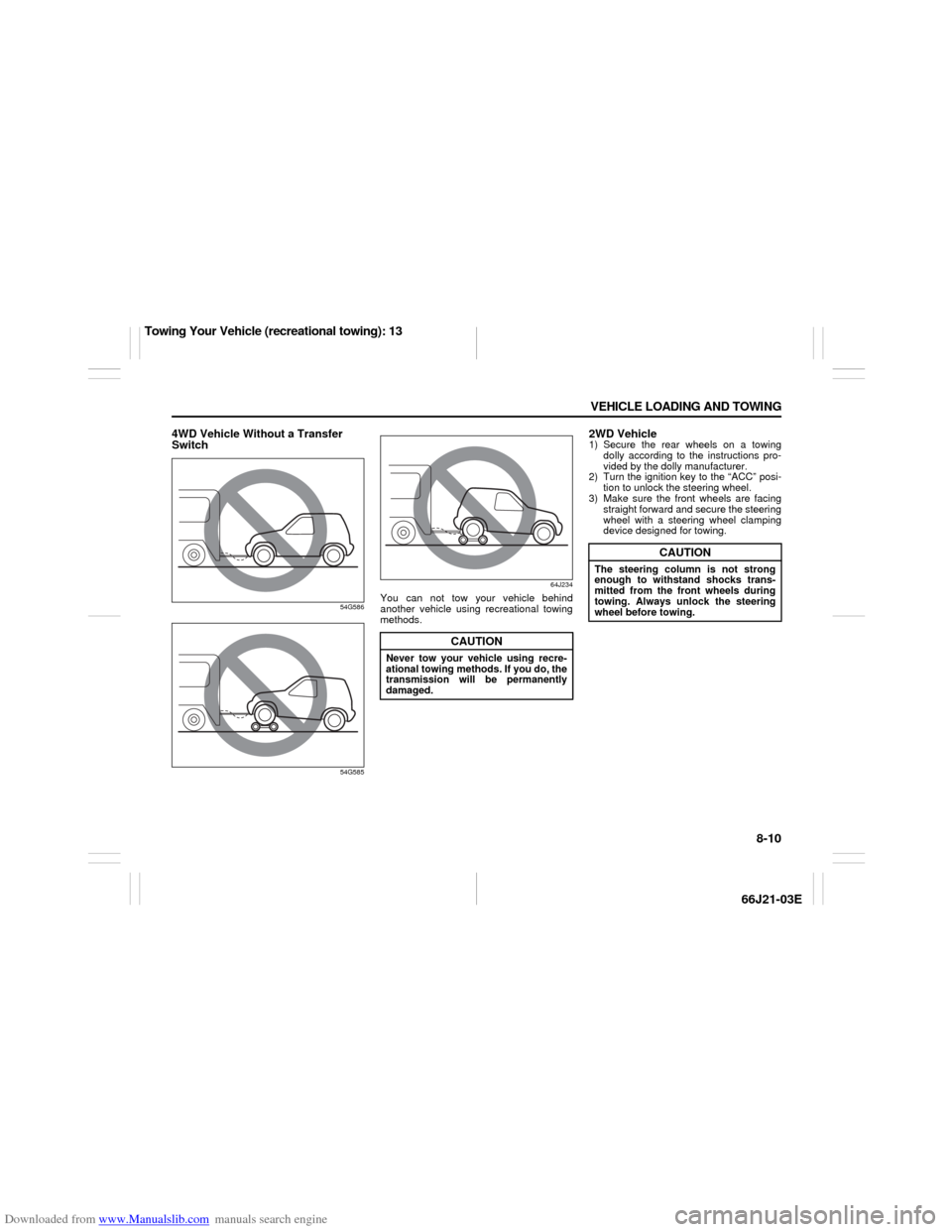
You can not tow your vehicle behind
another vehicle using recreational towing
methods.
2WD Vehicle1) Secure the rear wheels on a towing
dolly according to the instructions pro-
vided by the dolly manufacturer.
2) Turn the ignition key to the “ACC” posi-
tion to unlock the steering wheel.
3) Make sure the front wheels are facing
straight forward and secure the steering
wheel with a steering wheel clamping
device designed for towing.
CAUTION
Never tow your vehicle using recre-
ational towing methods. If you do, the
transmission will be permanently
damaged.
CAUTION
The steering column is not strong
enough to withstand shocks trans-
mitted from the front wheels during
towing. Always unlock the steering
wheel before towing.
Towing Your Vehicle (recreational towing): 13
Page 204 of 211

Downloaded from www.Manualslib.com manuals search engine 14-3 SPECIFICATIONS
66J21-03E
ITEM: Wheel
Tire size, front and rear P225/70R16, P225/65R17
Tire pressure For the specified tire pressure, see the Tire Information Label located
on the driver’s door lock pillar.
ITEM: Steering
Toe-in front 0 ± 2 mm (0 ± 0.08 in.)
rear 6 ± 2 mm (0.24 ± 0.08 in.)
Camber angle front 0° 00’
rear –1° 15’ ± 30’
Caster angle front 2° 30’
ITEM: Capacities (approx.)
Coolant 8.2 L (17.3 US pt)
Fuel tank 66 L (17.4 US gal)
Engine oil (replaced with filter) 4.8 L (10.1 US pt)
Transmission oil M/T 1.9 L (4.0 US pt)
A/T 2.5 L (5.2 US pt) (when drained)
Differential gear oil front 0.95 L (2.0 US pt)
rear2WD 0.9 L (1.9 US pt)
4WD 0.8 L (1.7 US pt)
Transfer gear box oil with a transfer switch 1.5 L (3.2 US pt)
without a transfer switch 1.6 L (3.4 US pt)
Extension case oil 0.47 L (1.0 US pt)
Specifications: 1, 2, 5, 6, 7, 10, 11
Page 210 of 211

Downloaded from www.Manualslib.com manuals search engine 15-5 INDEX
66J21-03E
Tire Inflation Pressure
.........................................................9-26
Tire Inspection
.....................................................................9-27
Tire Pressure Monitoring System (TPMS)
.........................6-21
Tire Rotation
........................................................................9-29
Tire Sidewall Labeling
.........................................................9-24
Tire Size
................................................................................9-25
Tires
......................................................................................9-24
Towing a Disabled Vehicle
.................................................10-4
Towing Your Vehicle (recreational towing)
.......................8-7
Traction Control System
.....................................................6-18
Trailer Towing
......................................................................8-2
Transfer Position Indicator Light
.......................................4-10
Transfer Switch
....................................................................4-17
Tripmeter
..............................................................................4-11
Troubleshooting
..................................................................4-54
Turn Signal Indicators
.........................................................4-10
Turn Signal Operation .........................................................3-7
UUnderfloor Bins
...................................................................5-23
Uniform Tire Quality Grading
.............................................9-28
Using the Transfer Switch
..................................................6-7
Using the Transmission
......................................................6-5
VVehicle Cleaning
..................................................................11-3
Vehicle Identification Number
............................................12-1
Vehicle Loading
........................................................... 8-1
, 9-33
Vehicle With Keyless Start System
............................ 3-2
, 6-3
Vehicle Without Keyless Start System
..............................3-1
WWarning and Indicator Lights
.............................................4-3
Warranties
............................................................................12-2Washing
............................................................................... 11-4
Waxing ................................................................................. 11-4
Windows .............................................................................. 2-14
Windshield Washer Fluid
................................................... 9-19
Windshield Wiper and Washer Lever
................................ 3-8
Wiper Blades
....................................................................... 9-44