warning light SUZUKI GRAND VITARA 2008 3.G Operating Manual
[x] Cancel search | Manufacturer: SUZUKI, Model Year: 2008, Model line: GRAND VITARA, Model: SUZUKI GRAND VITARA 2008 3.GPages: 40, PDF Size: 1.23 MB
Page 3 of 40
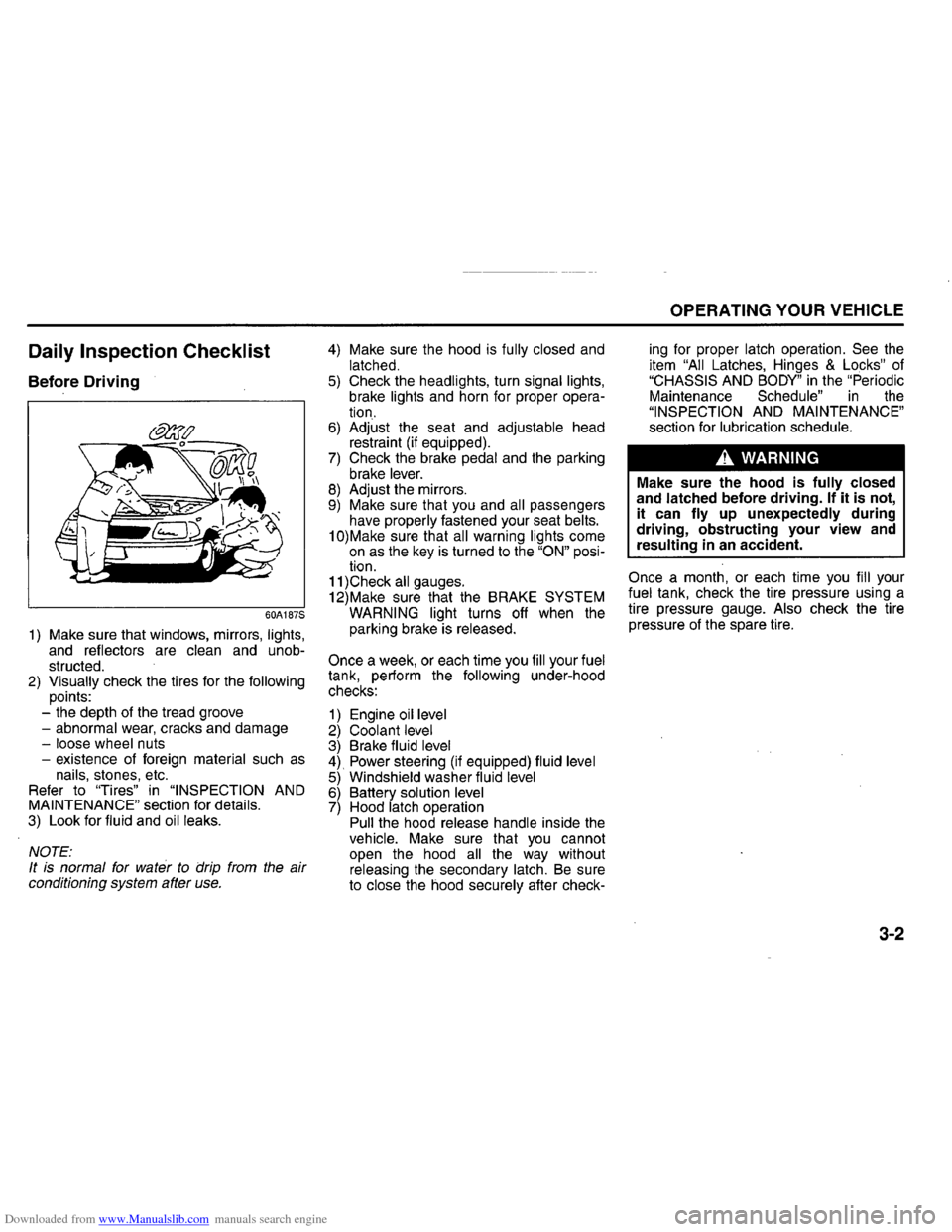
Downloaded from www.Manualslib.com manuals search engine Daily Inspection Checklist
Before Driving
60A187S
1) Make sure that windows, mirrors, lights, and reflectors are clean and unob
structed.
2) Visually check the tires for the following points:
- the depth of the tread groove
-
abnormal wear, cracks and damage
-loose wheel nuts
- existence of foreign material such as nails, stones, etc.
Refer to "Tires" in "INSPECTION AND MAINTENANCE" section for details. 3) Look for fluid and oil leaks.
NOTE:
It is normal for water to drip from the air conditioning system after use.
4) Make sure the hood is fully closed and latched. 5) Check the headlights, turn signal lights, brake lights and horn for proper opera
tion.
6) Adjust the seat and adjustable head
restraint (if equipped).
7) Check the brake pedal and the parking
brake lever. 8) Adjust the mirrors. 9) Make sure that you and all passengers
have properly fastened your seat belts.
10)Make sure that all warning lights come on as the key is turned to the "ON" posi
tion.
11 )Check all gauges.
12)Make sure that the BRAKE SYSTEM
WARNING light turns off when the
parking brake is released.
Once
a week, or each time you fill your fuel tank, perform the following under-hood
checks:
1) Engine oil level 2) Coolant level 3) Brake fluid level 4) Power steering (if equipped) fluid level 5) Windshield washer fluid level 6) Battery solution level 7) Hood latch operation Pull the hood release handle inside the vehicle. Make sure that you cannot
open the hood all the way without releasing the secondary latch. Be sure
to close the hood securely after check-
OPERATING YOUR VEHICLE
ing for proper latch operation. See the
item "All Latches, Hinges & Locks" of "CHASSIS AND BODY" in the "Periodic Maintenance Schedule" in the "INSPECTION AND MAINTENANCE" section for lubrication schedule.
A WARNING
Make sure the hood is fully closed
and latched before driving. If it is not,
it can fly up unexpectedly during
driving,
obstructing your view and
resulting in an accident.
Once a month, or each time you fill your fuel tank, check the tire pressure using a
tire pressure gauge. Also check the tire
pressure of the spare tire.
3-2
Page 7 of 40
Downloaded from www.Manualslib.com manuals search engine switch to "START'. If the engine does not
start, close all doors completely or turn the
ignition switch back to the "LOCK" position,
then start the engine.
The ignition switch has the
following four
positions:
LOCK (1) This is the normal parking position. It is the only position in which the key can be
removed. It locks the ignition, and prevents normal use of the steering wheel.
If
your vehicle is equipped with the auto
matic transmission key inter lock system,
the ignition switch can be turned to the
"LOCK" position only when the gearshift lever is in the "P" (Park) position.
To release the steering lock, turn the igni
tion switch clockwise to one of the other
positions. If you have trouble turning the
ignition switch to unlock the steering, try
turning the steering wheel slightly to the
right or left while turning the switch.
NOTE: You must push the ignition switch in to turn
it to the '~CC" position. Also you must
push the ignition switch in to return it to the "LOCK" position.
ACC (2) Accessories such as the radio can oper
ate, but the engine is off.
ON (3)
This is the normal operating position. All
electrical systems are on.
START (4)
This is the position for starting the engine
using the starter motor. The switch should be released from this position as soon as
the engine starts.
Ignition switch reminder (When using the keyless start system)
A buzzer sounds intermittently to remind
you to return the ignition switch to the
"LOCK" position if it is in the "ACC" position
when the driver's door is opened.
Ignition key reminder (When using the ignition key)
A buzzer sounds intermittently to remind
you to remove the ignition
key if it is in the
ignition switch when the driver's door is opened.
OPERATING YOUR VEHICLE
81A297S
A WARNING
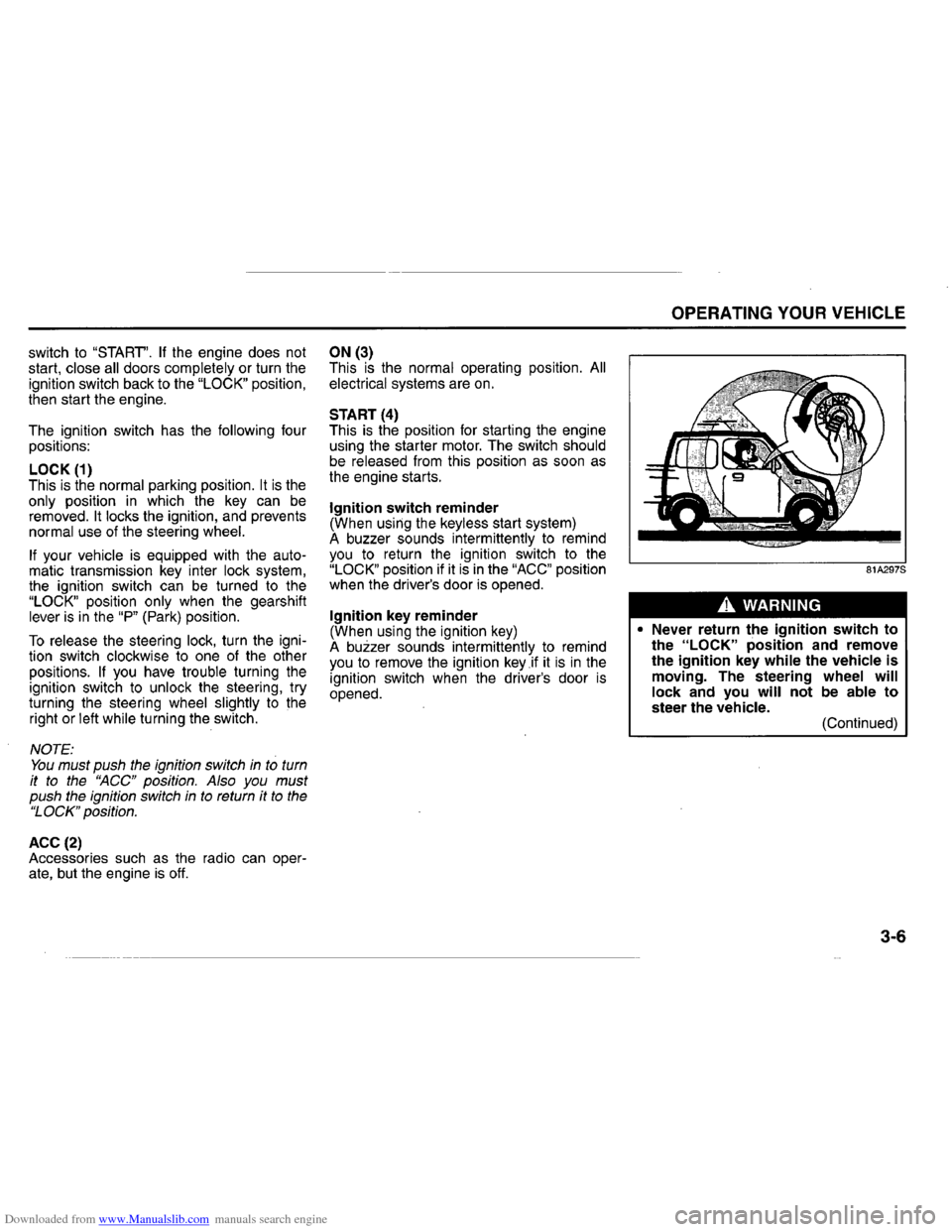
• Never return the ignition switch to the "LOCK" position and remove
the ignition key while the vehicle is moving. The steering wheel will lock and you will not be able to steer the vehicle. (Continued)
3-6
Page 8 of 40
Downloaded from www.Manualslib.com manuals search engine OPERATING YOUR VEHICLE
A. WARNING
(Continued) • Always return the ignition switch to the "LOCK" position and remove
the ignition key and the remote controller (if equipped) when leaving the vehicle even if a short time. Also do not leave children or pets alone in a parked vehicle. Unat
tended children could cause accidental movement of the vehicle or could tamper with power windows or power sunroof. They also could suffer from heat stroke in warm or hot weather. These could result in
severe injury or even death.
CAUTION
• Do not use the starter motor for more than 15 seconds at a time.
For diesel engine model, do not use the starter motor for more than 30 seconds at a time. If the engine
does not start, wait 15 seconds
before trying again. If the engine
does not start after several attempts, check the fuel and ignition systems or consult your SUZUKI dealer.
• Do not leave the ignition switch in
the "ON" position if the engine is not running as the battery will discharge.
3-7
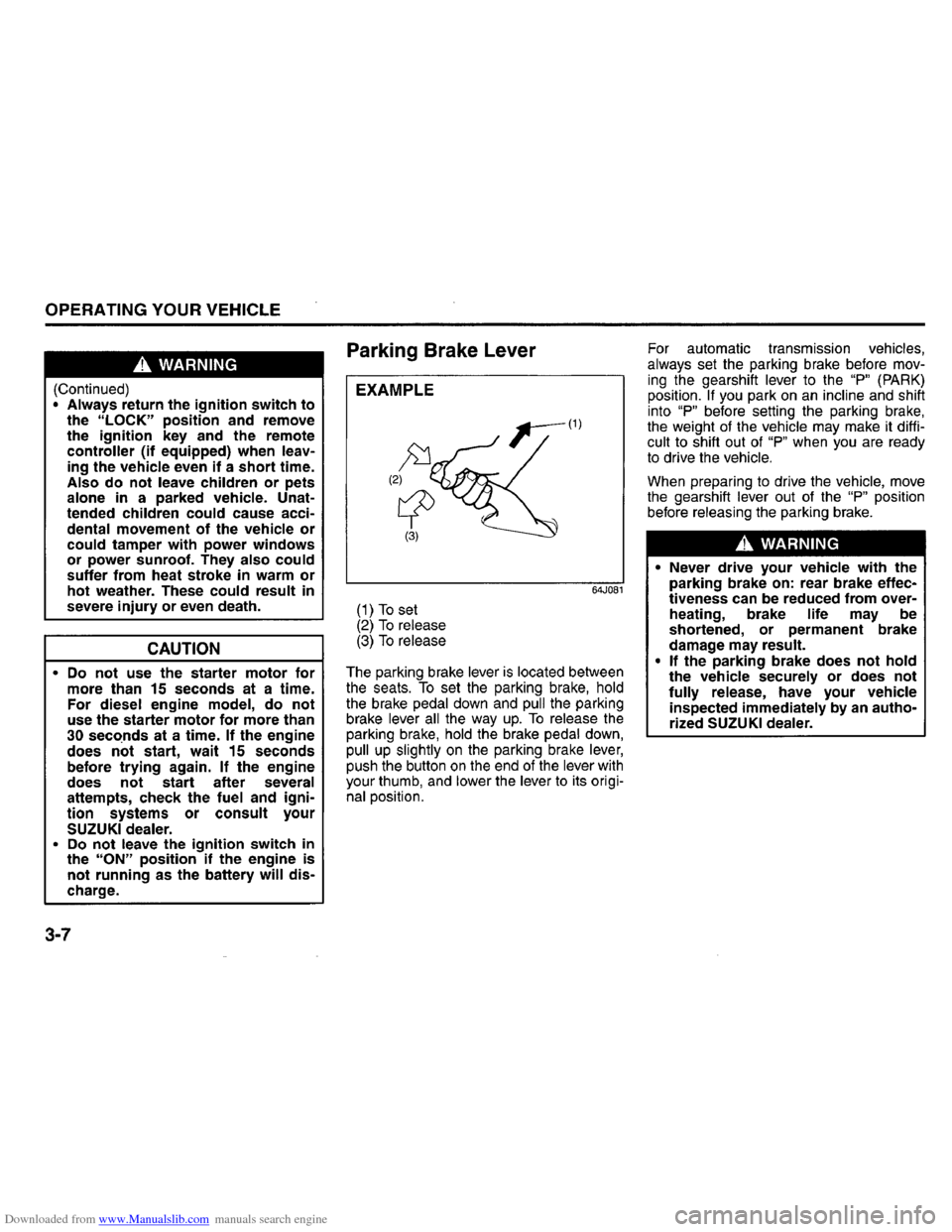
Parking Brake Lever
EXAMPLE
(1) To set (2) To release (3) To release
64J081
The parking brake lever is located between the seats. To set the parking brake, hold the brake pedal down and pull the parking
brake lever all the way up. To release the parking brake, hold the brake pedal down, pull up slightly on the parking brake lever, push the button on the end of the lever with
your thumb, and lower the lever to its original position. For
automatic transmission
vehicles,
always set the parking brake before moving the gearshift lever to the "P" (PARK) position. If you park on an incline and shift
into "P" before setting the parking brake, the weight of the vehicle may make it difficult to shift out of "P" when you are ready to drive the vehicle.
When preparing to drive the vehicle, move the gearshift lever out of the "P" position
before releasing the parking brake.
A. WARNING
• Never drive your vehicle with the
parking brake on: rear brake effec
tiveness can be reduced from over
heating, brake life may be
shortened,
or permanent brake
damage may result.
• If
the parking brake does not hold the vehicle securely or does not fully release, have your vehicle inspected immediately by an autho
rized SUZUKI dealer.
Page 12 of 40
Downloaded from www.Manualslib.com manuals search engine OPERATING YOUR VEHICLE
Diesel Particulate Filter (DP~ ;::D.:..p.:..j=®----=:w:..::a::..:rn..:.:i:..::ng~lig~h:..:..:t~ _____ _____, The DPj=® filters off the soot 'particles in the exhaust gas, so the DPp!9 could get clogged depending on the driving condition. The DPPW is cleaned by the regenerating function that combusts the soot
particles in the DPPW by raising the
exhaust gas temperature during driving.
A WARNING
Keep away from the exhaust pipe
when the engine is running. If the DPj=® is regenerating, the exhaust
gas temperature could be higher.
NOTE: When you drive your vehicle, white smoke
may be emitted depending on the grade of fuel used. This is due to the particle filter
regenerating automatically, and does not
affect the way the vehicle runs.
3-11
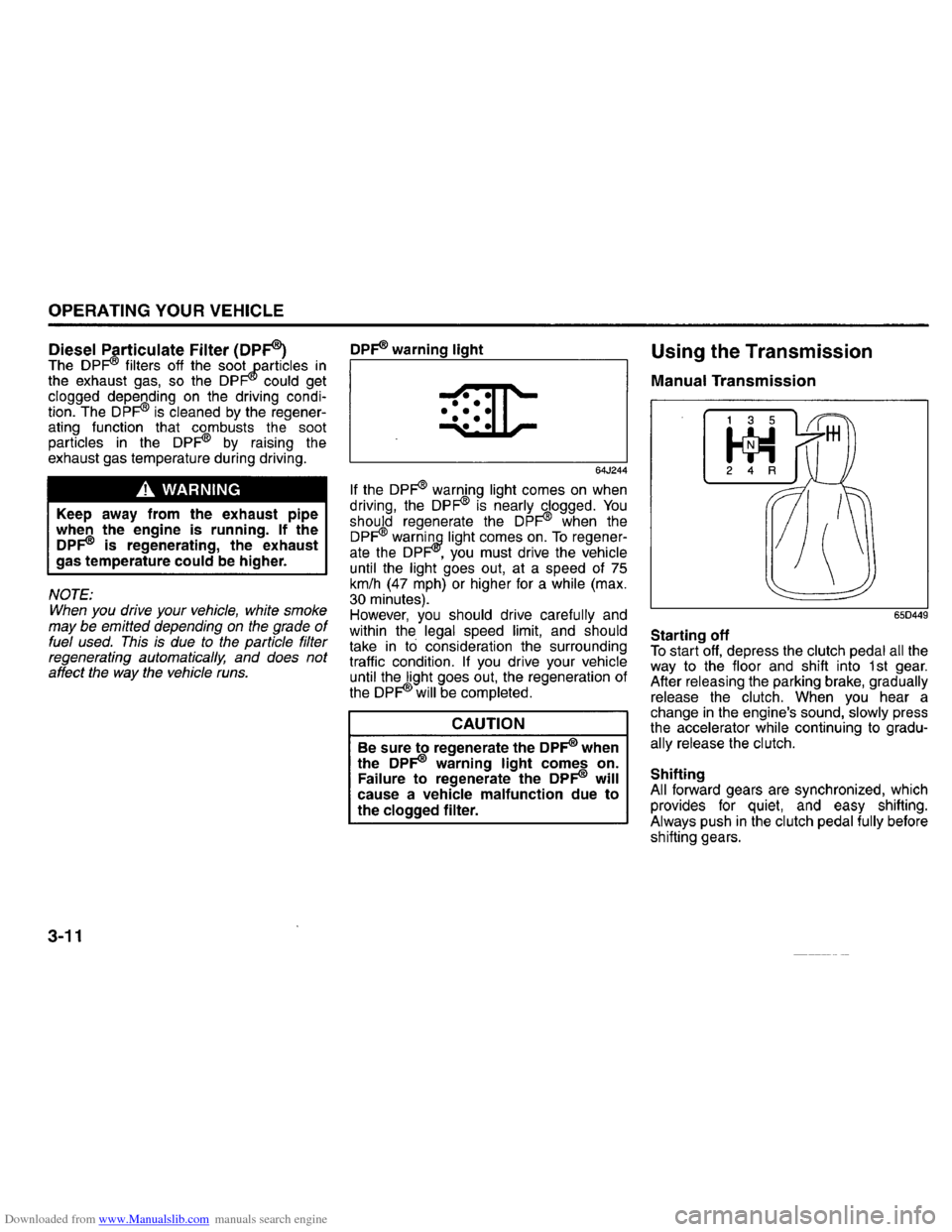
64J244
If the DPpID warning light comes on when
driving, the DPpID is nearly clogged. You should regenerate the DPpID when the DPPW warniqg light comes on. To regenerate the DPp!9, you must drive the vehicle
until the light goes out, at a speed of 75 km/h (47 mph) or higher for a while (max. 30 minutes).
However, you should drive carefully and
within the legal speed limit, and should
take in to consideration the surrounding
traffic condition. If you drive your vehicle
until the light goes out, the regeneration of
the DPPW will be completed.
CAUTION
Be sure to regenerate the DPj=® when
the DPj=® warning light comes on.
Failure to regenerate the DPj=® will cause a vehicle malfunction due to the clogged filter.
Using the Transmission
Manual Transmission
Starting off
650449
To start off, depress the clutch pedal all the
way to the floor and shift into 1 st gear. After releasing the parking brake, gradually release the clutch. When you hear a
change in the engine's sound, slowly press
the accelerator while continuing to gradu
ally release the clutch.
Shifting All forward gears are synchronized, which
provides for quiet, and easy shifting.
Always push
in the clutch pedal fully before
shifting gears.
Page 14 of 40
Downloaded from www.Manualslib.com manuals search engine OPERATING YOUR VEHICLE
A WARNING
• Reduce your speed and downshift to a lower gear before going down
a long or steep hill. A lower gear
will allow the engine to provide
braking. Avoid riding the brakes or they may overheat, resulting in
brake failure.
• When driving on slippery roads, be
sure to slow down before downshifting. Excessive and or sudden
changes in engine speed may
cause
loss of traction, which could cause you to lose control.
• Make sure that the vehicle is com
pletely stationary before you shift into reverse.
CAUTION
• To help avoid clutch damage, do not use the clutch pedal as a footrest while driving or use the clutch to keep the vehicle stationary on a
hill. Depress the clutch fully when
shifting.
• When shifting or starting off, do not race the engine. Racing the engine
can shorten engine life and affect
smooth shifting.
3-13
5-Speed Automatic Transmission
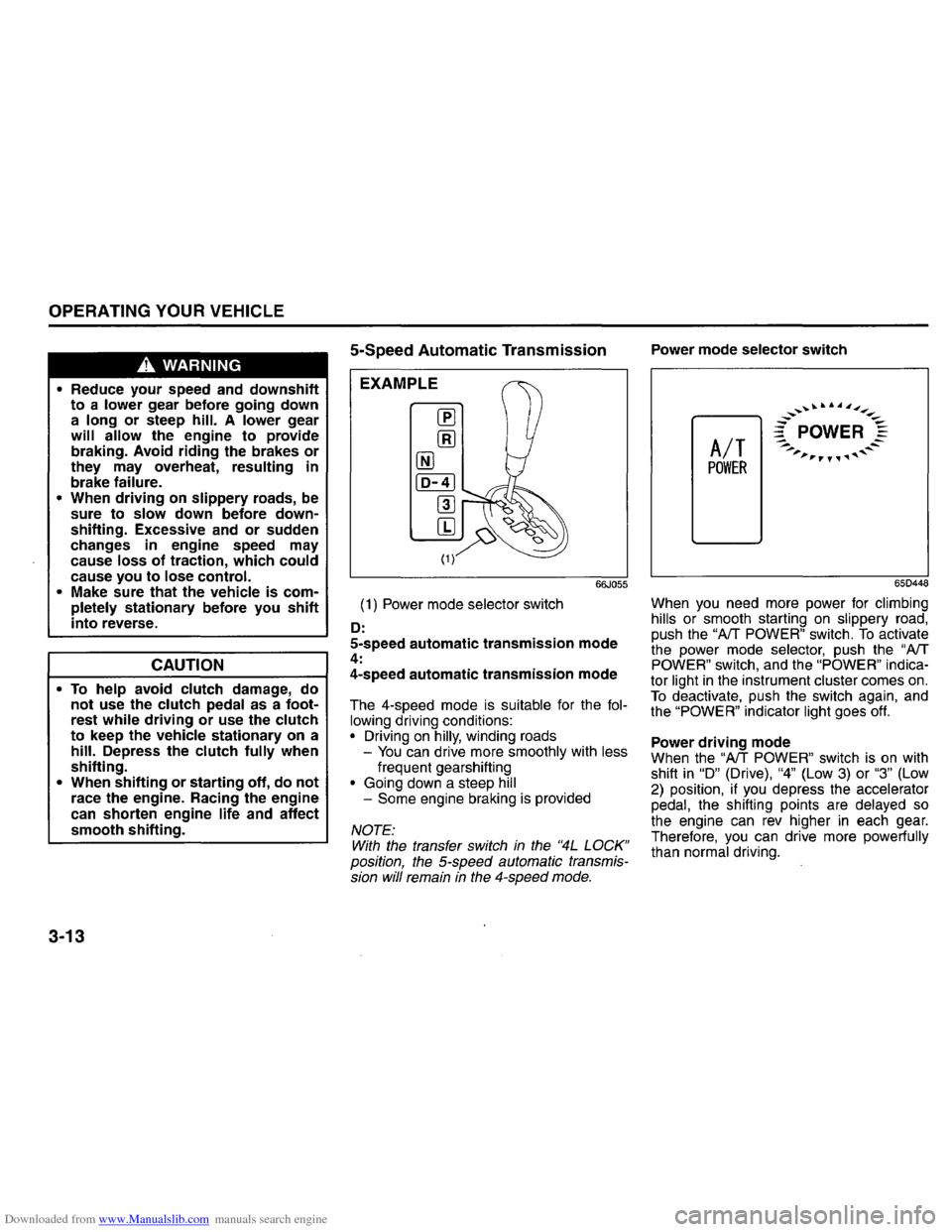
EXAMPLE
(1) Power mode selector switch
D:
66J055
5-speed automatic transmission mode 4: 4-speed automatic transmission mode
The 4-speed mode is suitable for the fol
lowing driving conditions: • Driving on hilly, winding roads
-You can drive more smoothly with less frequent gearshifting
• Going down a steep hill -Some engine braking is provided
NOTE:
With the transfer switch in the "4L LOCK" position, the 5-speed automatic transmission will remain in the 4-speed mode.
Power mode selector switch
A/T
POWER
650448
When you need more power for climbing
hills or smooth starting on slippery road,
push the "AfT POWER" switch. To activate
the power mode selector, push the "AfT POWER" switch, and the "POWER" indicator light in the instrument cluster comes on. To deactivate, push the switch again, and
the "POWER" indicator light goes off.
Power driving mode When the "AfT POWER" switch is on with
shift in "0" (Drive), "4" (Low 3) or "3" (Low 2) position, if you depress the accelerator
pedal, the shifting points are delayed so
the engine can rev higher in each gear.
Therefore, you can drive more powerfully than normal driving.
Page 15 of 40
Downloaded from www.Manualslib.com manuals search engine Gearshift lever
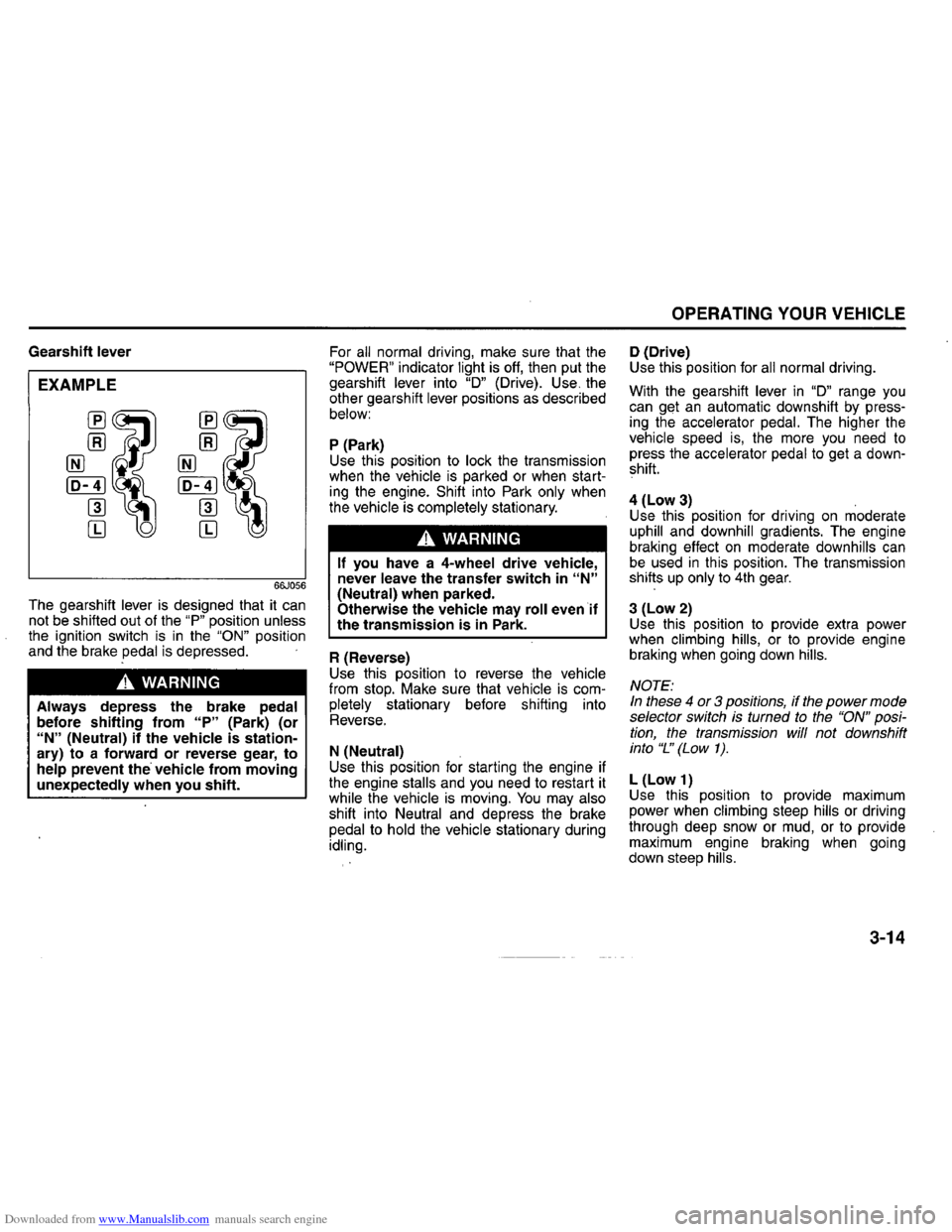
EXAMPLE
66J056
The gearshift lever is designed that it can not be shifted out of the "P" position unless the ignition switch is in the "ON" position
and the brake pedal is depressed.
A WARNING
Always depress the brake pedal before shifting from "P" (Park) (or "N" (Neutral) if the vehicle is stationary) to a forward or reverse gear, to help prevent the vehicle from moving unexpectedly when you shift.
For all normal driving, make sure that the "POWER" indicator light is off, then put the
gearshift lever into "0" (Drive). Use. the
other gearshift lever positions as described below:
P (Park) Use this position to lock the transmission
when the vehicle is parked or when starting the engine. Shift into Park only when
the vehicle is completely stationary.
A WARNING
If you have a 4-wheel drive vehicle, never leave the transfer switch in uN" (Neutral) when parked.
Otherwise the vehicle may roll even if the transmission is in Park.
R (Reverse)
Use this position to reverse the vehicle
from stop. Make sure that vehicle is com
pletely stationary before shifting into
Reverse.
N (Neutral) Use this position for starting the engine if
the engine stalls and you need to restart it while the vehicle is moving. You may also shift into Neutral and depress the brake pedal to hold the vehicle stationary during idling.
OPERATING YOUR VEHICLE
D (Drive) Use this position for all normal driving.
With the gearshift
lever in "0" range you can get an automatic downshift by pressing the accelerator pedal. The higher the vehicle speed is, the more you need to press the accelerator pedal to get a downshift.
4 (Low 3) . Use this position for driving on moderate uphill and downhill gradients. The engine
braking effect on moderate downhills can be used in this position. The transmission
shifts up only to 4th gear.
3 (Low 2) Use this position to provide extra power
when climbing hills, or to provide engine
braking when going down hills.
NOTE: In these 4 or 3 positions, if the power mode
selector switch is turned to the "ON" position, the transmission will not downshift
into "I.!' (Low 1).
L (Low 1) Use this position to provide maximum
power when climbing steep hills or driving
through deep snow or mud, or to provide
maximum engine braking when going
down steep
hills.
3-14
Page 17 of 40

Downloaded from www.Manualslib.com manuals search engine Slippery road mode
When the "AfT POWER" switch is on with
shift in "2" (Low 2) position, the gear will be
fixed in second while driving or when start
driving. Therefore, you can drive smoothly
on slippery road.
NOTE: • When you start driving with the gearshift lever in "2" (Low 2) position while the "AI T POWER" switch is on, the gear will be fixed in second. If you need to shift up, shift the' lever into "3" (Low 3) or "0" (Drive) position. • When the "AfT POWER" is on, if you
shift the gearshift lever from "3" (Low 3) or "0" (Drive) position to "2" (Low 2) position, the gear will be fixed in second. Gearshift
lever
64J142
The
gearshift lever is designed that it cannot be shifted out of the "P" position unless
the ignition switch is in the "ON" position and. the brake pedal is depressed.
A WARNING
Always depress the brake pedal before shifting from' "P" (Park) (or "N" (Neutral) if the vehicle is stationary) to a forward or reverse gear, to help prevent the vehicle from moving
unexpectedly when you shift.
OPERATING YOUR VEHICLE
For all normal driving, make sure that the "POWER" indicator light is off, then put the
gearshift lever into "0" (Drive). Use the
other gearshift lever positions as described
below: .
P (Park)
Use this position
to lock the transmission
when the vehicle is parked or when starting the engine. Shift into Park only when
the vehicle is completely stationary.
A WARNING
If you have a 4-wheel drive vehicle,
never leave the transfer switch in "N" (Neutral) when parked.
Otherwise the vehicle may roll even if the transmission is in Park ..
R (Reverse) Use this position to reverse the vehicle from stop. Make sure that vehicle is com
pletely stationary before shifting into
Reverse.
N (Neutral)
Use this position for starting the engine if
the engine
stalls and you need to restart it while the vehicle is moving. You may also
shift into Neutral and depress the brake
pedal to hold the I('ehicle stationary during
idling.
3-16
Page 30 of 40

Downloaded from www.Manualslib.com manuals search engine OPERATING YOUR VEHICLE
Cruise Control (if equipped)
79K032
The cruise control system allows you to maintain a steady speed without keeping
your foot on the accelerator pedal. The controls for operating the cruise control system are on the steering wheel. You can
use the cruise control system at speeds of
about 40 km/h (25 mph) or higher.
A WARNING
To help avoid loss of vehicle control, do not use the cruise control system
when driving in heavy traffic, on slippery or winding roads, or on steep
downgrades.
3-29
NOTE: If the transfer switch (if equipped) is in the "4L LOCK" position, you can not use the
cruise control system. Refer to "Using the
Transfer Switch (if equipped)" in this sec
tion.
CRUISE
52Dl13
When you push the "ON/OFF" switch, the
system is on and a "CRUISE" indicator light on the instrument cluster will be on.
SET
65D474
When the vehicle's speed is controlled by the cruise control system, a "SET' indica
tor light on the instrument cluster will be on.
(2) ----\-l~
(4) (1)
79K049
To Set Cruising Speed Turn on the cruise control system by push
ing the "ON/OFF" switch (1). Accelerate to the desired speed and push the "SET/
COAST' switch (3). Take your foot off the accelerator pedal and the set speed will be maintained.
With the cruise
control on, you can increase speed for passing by using the accelerator pedal. When you take your foot
off the pedal, your vehicle will return to the
set speed.
To Change Cruising Speed To reset the cruise control to a slower speed, hold in the "SET/COAST' switch (3) until the vehicle has slowed to the desired
speed, then release the switch. The new
speed will be maintained.
Page 32 of 40

Downloaded from www.Manualslib.com manuals search engine OPERATING YOUR VEHICLE
A WARNING
If
water gets into the brake drums,
brake performance may become poor
and unpredictable.
After driving through water or wash
ing the underside of the vehicle, test
the brakes while driving at a slow speed to see if they have maintained
their normal effectiveness. If the
brakes are less effective than normal, dry them by repeatedly applying the
brakes while driving slowly until the
brakes have regained their normal effectiveness.
Power Assisted Brakes Your vehicle has power assisted brakes. If power assistance is lost due to a stalled engine or other failures, the system is still
fully operational on reserve power and you can bring the vehicle to a complete stop by pressing the brake pedal once and holding it down. The reserve power is partly used
up when you depress the brake pedal and reduces each time the pedal is pressed. Apply smooth and even pressure to the pedal. Do not pump the pedal.
3-31
A WARNING
Even without reserve power in the
brake system, you can still stop the vehicle by pressing the brake pedal harder than normally required. However, the stopping distance may be longer.
Brake Assist System When you slam the brakes on, the brake
assist system judges as an emergency
stop and provides more powerful braking
for a driver who cannot hold down the
brake pedal firmly.
NOTE: If you quickly and forcefully depress the
brakes, you may hear a clicking sound in
the brake pedal. This is normal and indi
cates that the brake assist system is acti
vated properly.
Anti-Lock Brake System (ABS) ASS will help you avoid skidding by elec
tronically controlling braking pressure. It
will also help you maintain steering control when braking on slippery surfaces or when
braking hard.
The
ASS works automatically, so you do
not need any special braking technique.
Just push the brake pedal down without
pumping. The ASS will operate whenever it
senses that the wheels are locking up. You may feel the brake pedal pulsate while the ASS is operating.
NOTE: The ABS will not work if vehicle speed is under about 5 - 6 kmlh (3 - 4 mph).
A WARNING
•
On some types of loose surfaces
(such as gravel, snow-covered
roads, etc.) the stopping distance
required for
an ABS-equipped vehicle may be slightly greater than for
a comparable vehicle with a conventional brake system. With a conventional brake system, skid
ding tires are able to "plow" the gravel or snow layer, shortening
the stopping distance, ABS mini
mizes this resistance effect. Allow for extra stopping distance when driving on loose surfaces. • On regular paved roads, some driv
ers may be able to obtain slightly shorter stopping distances with
conventional brake systems than
with
ABS. • In both of the above conditions, ABS wi II still offer the advantage of helping you maintain directional control. However, remember that ABS will not compensate for bad road or weather conditions or poor
driver judgment. Use good judg
ment and do not drive faster than
conditions will
safely allow.
Page 33 of 40

Downloaded from www.Manualslib.com manuals search engine (8) or ABS
(1) (2)
(CD)
BRAKE (3)
(1) ABS warning light Type 1 (2) ABS warning light Type 2 (3) Brake system warning light
A WARNING
65D451
If the ABS warning light «1) or (2» on
the instrument panel comes on and
stays on while driving, there may be a
problem with the ABS system. If this happens:
1) Pull off the road and stop care
fully.
2) Turn the ignition switch to "LOCK" and then start the engine again.
(Continued)
A WARNING
(Continued) If the warning light comes on briefly then turns off, the system is normal.
If the. warning light still stays on,
have the system inspected by your
SUZUKI dealer immediately.
If the ABS system becomes inoperative, the brake system will function as
an ordinary brake system that has no
ABS.
A WARNING
If the ABS warning light «1) or (2» and the Brake system warning light (3) on the instrument panel simulta
neously stays on or comes on when
driving, both anti-lock function and
rear brake force control function (proportioning valve function) of the ABS system may have failed. If so, the rear wheels may easily skid or the vehicle can even spin in the worst case when
braking on a slippery road or when
hard braking even on a dry paved
road. Ask your SUZUKI dealer to inspect the ABS system immediately. Drive carefully, avoiding hard braking
as much as possible.
OPERATING YOUR VEHICLE
How the ABS Works A computer continuously monitors wheel speed. The' computer compares the
changes in wheel speed when braking. If the wheels slow suddenly, indicating a
skidding Situation, the computer will change braking pressure several times
each second to prevent the wheels from locking. When you start your vehicle or when you accelerate after a hard stop, you may hear a momentary motor or clicking sound as the system resets or checks itself.
A WARNING
The ABS may not work properly if
tires or wheels other than those
specified in the owner's manual are
used. This is because the ABS works
by comparing changes in wheel speed. When replacing tires or wheels, use only the size and type
specified in this owner's manual.
3-32