warning SUZUKI GRAND VITARA 2008 3.G Repair Manual
[x] Cancel search | Manufacturer: SUZUKI, Model Year: 2008, Model line: GRAND VITARA, Model: SUZUKI GRAND VITARA 2008 3.GPages: 290, PDF Size: 4.99 MB
Page 142 of 290
5-11OTHER CONTROLS AND EQUIPMENT
66J22-03E
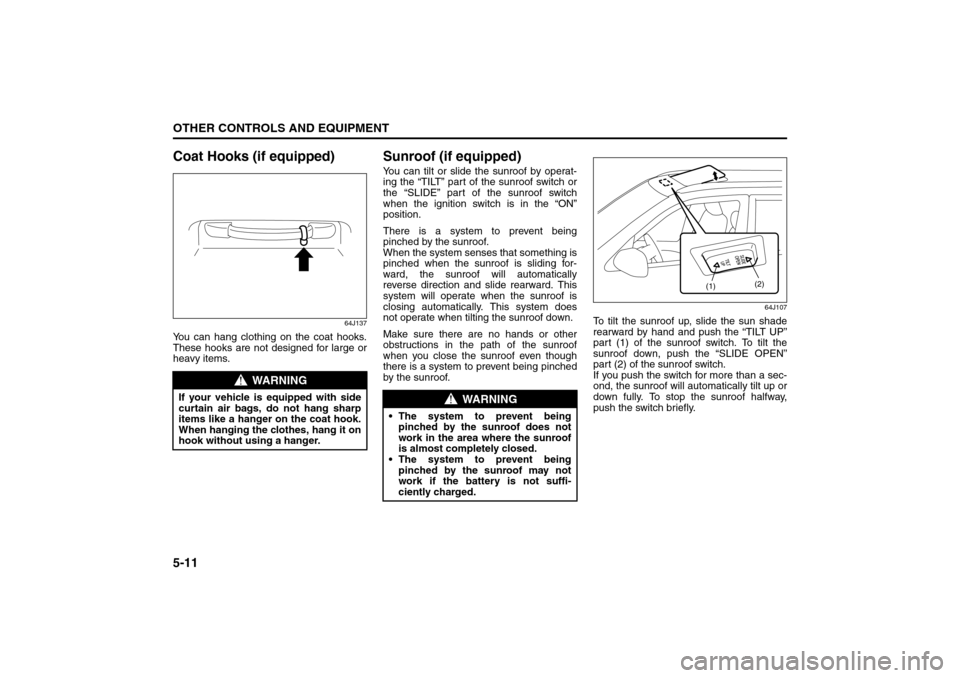
Coat Hooks (if equipped)
64J137
You can hang clothing on the coat hooks.
These hooks are not designed for large or
heavy items.
Sunroof (if equipped)You can tilt or slide the sunroof by operat-
ing the “TILT” part of the sunroof switch or
the “SLIDE” part of the sunroof switch
when the ignition switch is in the “ON”
position.
There is a system to prevent being
pinched by the sunroof.
When the system senses that something is
pinched when the sunroof is sliding for-
ward, the sunroof will automatically
reverse direction and slide rearward. This
system will operate when the sunroof is
closing automatically. This system does
not operate when tilting the sunroof down.
Make sure there are no hands or other
obstructions in the path of the sunroof
when you close the sunroof even though
there is a system to prevent being pinched
by the sunroof.
64J107
To tilt the sunroof up, slide the sun shade
rearward by hand and push the “TILT UP”
part (1) of the sunroof switch. To tilt the
sunroof down, push the “SLIDE OPEN”
part (2) of the sunroof switch.
If you push the switch for more than a sec-
ond, the sunroof will automatically tilt up or
down fully. To stop the sunroof halfway,
push the switch briefly.
WARNING
If your vehicle is equipped with side
curtain air bags, do not hang sharp
items like a hanger on the coat hook.
When hanging the clothes, hang it on
hook without using a hanger.
WARNING
The system to prevent being
pinched by the sunroof does not
work in the area where the sunroof
is almost completely closed.
The system to prevent being
pinched by the sunroof may not
work if the battery is not suffi-
ciently charged.
(1)(2)
Assist Grips: 3
Coat Hooks:
Sunroof: 5, 8
Page 144 of 290
5-13OTHER CONTROLS AND EQUIPMENT
66J22-03E
65D612
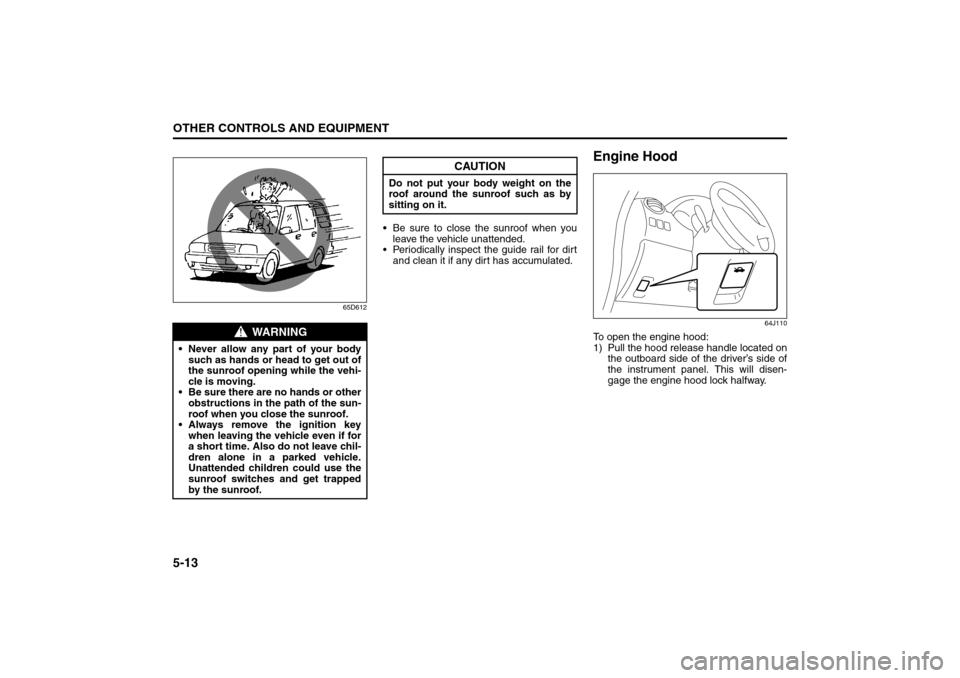
Be sure to close the sunroof when you
leave the vehicle unattended.
Periodically inspect the guide rail for dirt
and clean it if any dirt has accumulated.
Engine Hood
64J110
To open the engine hood:
1) Pull the hood release handle located on
the outboard side of the driver’s side of
the instrument panel. This will disen-
gage the engine hood lock halfway.
WARNING
Never allow any part of your body
such as hands or head to get out of
the sunroof opening while the vehi-
cle is moving.
Be sure there are no hands or other
obstructions in the path of the sun-
roof when you close the sunroof.
Always remove the ignition key
when leaving the vehicle even if for
a short time. Also do not leave chil-
dren alone in a parked vehicle.
Unattended children could use the
sunroof switches and get trapped
by the sunroof.
CAUTION
Do not put your body weight on the
roof around the sunroof such as by
sitting on it.
Sunroof: 5, 8
Page 145 of 290
5-14
OTHER CONTROLS AND EQUIPMENT
66J22-03E
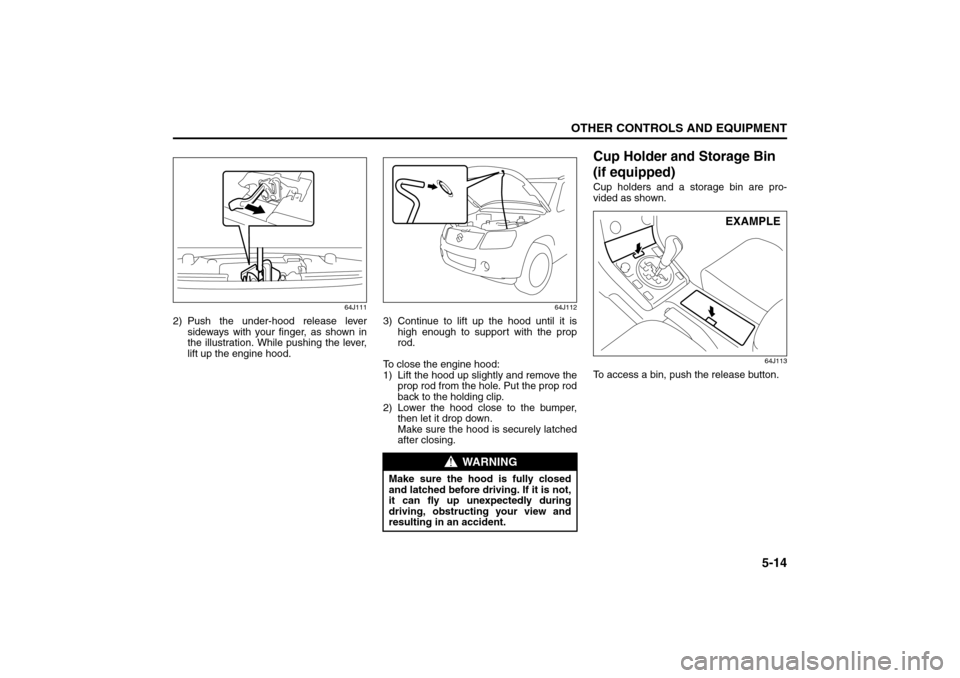
64J111
2) Push the under-hood release lever
sideways with your finger, as shown in
the illustration. While pushing the lever,
lift up the engine hood.
64J112
3) Continue to lift up the hood until it is
high enough to support with the prop
rod.
To close the engine hood:
1) Lift the hood up slightly and remove the
prop rod from the hole. Put the prop rod
back to the holding clip.
2) Lower the hood close to the bumper,
then let it drop down.
Make sure the hood is securely latched
after closing.
Cup Holder and Storage Bin
(if equipped)Cup holders and a storage bin are pro-
vided as shown.
64J113
To access a bin, push the release button.
WARNING
Make sure the hood is fully closed
and latched before driving. If it is not,
it can fly up unexpectedly during
driving, obstructing your view and
resulting in an accident.
EXAMPLE
Engine Hood: 5
Page 146 of 290
5-15OTHER CONTROLS AND EQUIPMENT
66J22-03E
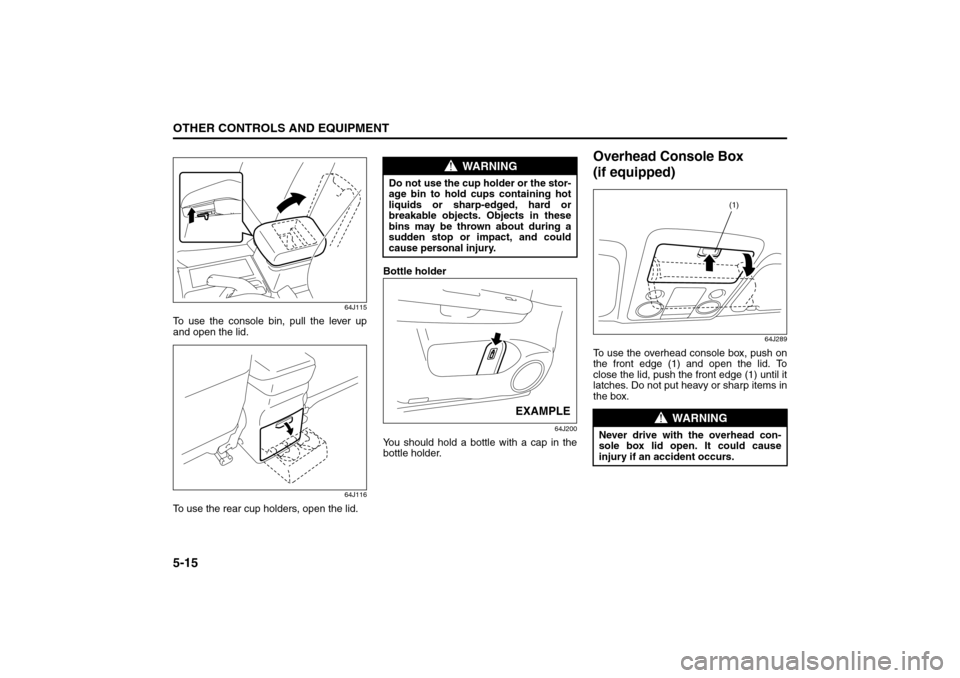
64J115
To use the console bin, pull the lever up
and open the lid.
64J116
To use the rear cup holders, open the lid.Bottle holder
64J200
You should hold a bottle with a cap in the
bottle holder.
Overhead Console Box
(if equipped)
64J289
To use the overhead console box, push on
the front edge (1) and open the lid. To
close the lid, push the front edge (1) until it
latches. Do not put heavy or sharp items in
the box.
WARNING
Do not use the cup holder or the stor-
age bin to hold cups containing hot
liquids or sharp-edged, hard or
breakable objects. Objects in these
bins may be thrown about during a
sudden stop or impact, and could
cause personal injury.
EXAMPLE
WARNING
Never drive with the overhead con-
sole box lid open. It could cause
injury if an accident occurs.
(1)
Cup Holder and Storage Bin: 3, 14
Page 148 of 290
5-17OTHER CONTROLS AND EQUIPMENT
66J22-03E
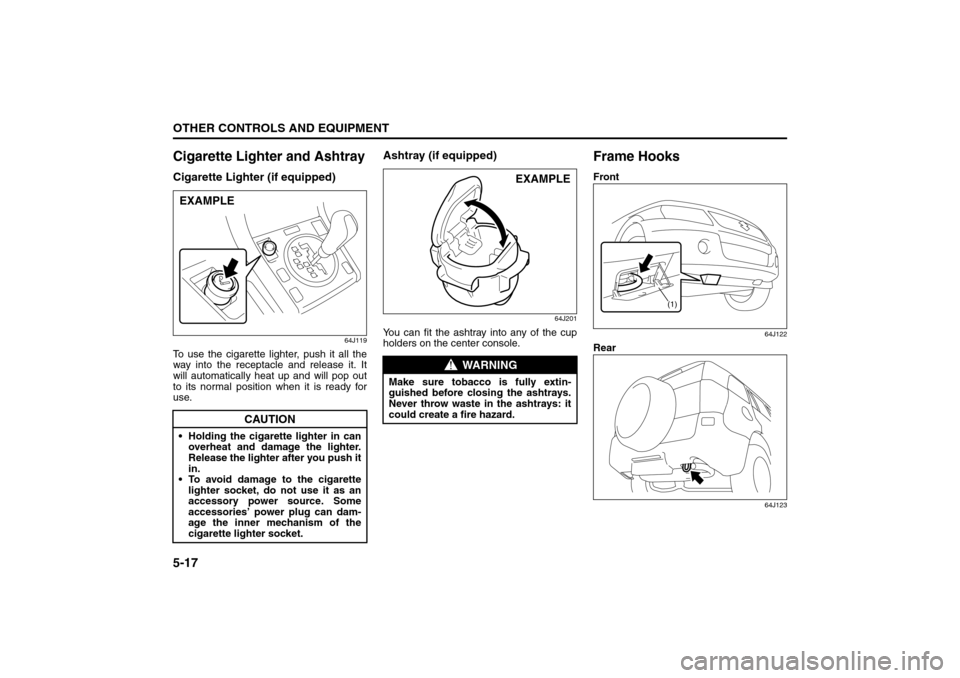
Cigarette Lighter and AshtrayCigarette Lighter (if equipped)
64J119
To use the cigarette lighter, push it all the
way into the receptacle and release it. It
will automatically heat up and will pop out
to its normal position when it is ready for
use.
Ashtray (if equipped)
64J201
You can fit the ashtray into any of the cup
holders on the center console.
Frame HooksFront
64J122
Rear
64J123
CAUTION
Holding the cigarette lighter in can
overheat and damage the lighter.
Release the lighter after you push it
in.
To avoid damage to the cigarette
lighter socket, do not use it as an
accessory power source. Some
accessories’ power plug can dam-
age the inner mechanism of the
cigarette lighter socket.EXAMPLE
WARNING
Make sure tobacco is fully extin-
guished before closing the ashtrays.
Never throw waste in the ashtrays: it
could create a fire hazard.
EXAMPLE
(1)
Accessory Socket: 8
Cigarette Lighter and Ashtray: 3, 8
Page 149 of 290
5-18
OTHER CONTROLS AND EQUIPMENT
66J22-03E
Frame hooks are provided at the front and
rear of the vehicle.
To access the front hook, unhook the
lower part of the cover (1) and then
remove the cover (1).
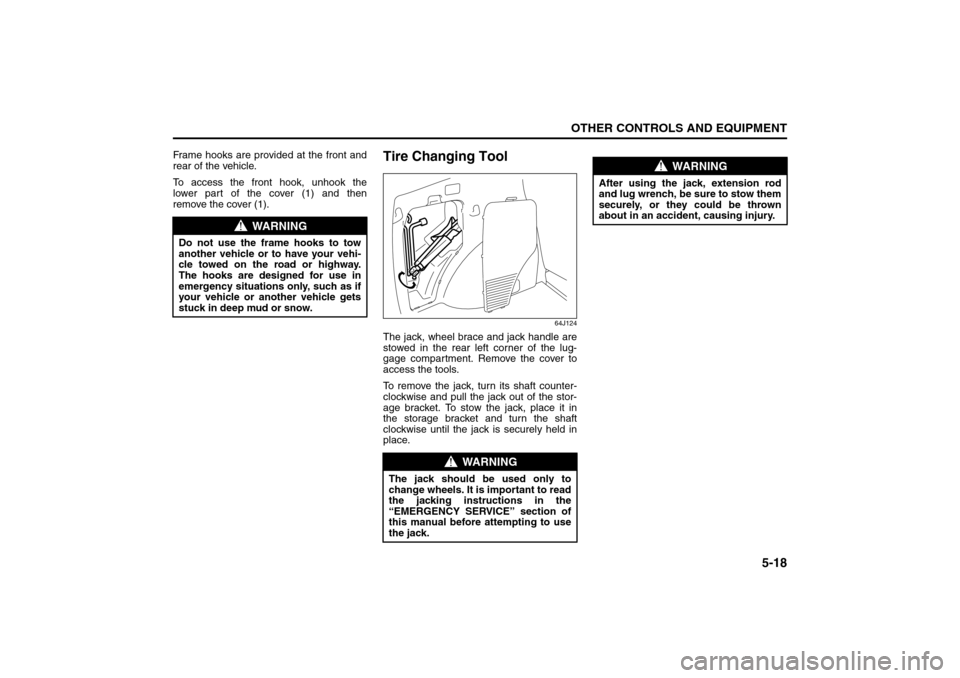
Tire Changing Tool
64J124
The jack, wheel brace and jack handle are
stowed in the rear left corner of the lug-
gage compartment. Remove the cover to
access the tools.
To remove the jack, turn its shaft counter-
clockwise and pull the jack out of the stor-
age bracket. To stow the jack, place it in
the storage bracket and turn the shaft
clockwise until the jack is securely held in
place.
WARNING
Do not use the frame hooks to tow
another vehicle or to have your vehi-
cle towed on the road or highway.
The hooks are designed for use in
emergency situations only, such as if
your vehicle or another vehicle gets
stuck in deep mud or snow.
WARNING
The jack should be used only to
change wheels. It is important to read
the jacking instructions in the
“EMERGENCY SERVICE” section of
this manual before attempting to use
the jack.
WARNING
After using the jack, extension rod
and lug wrench, be sure to stow them
securely, or they could be thrown
about in an accident, causing injury.
Frame Hooks: 5, 6
Tire Changing Tools: 3, 5
Page 150 of 290
5-19OTHER CONTROLS AND EQUIPMENT
66J22-03E
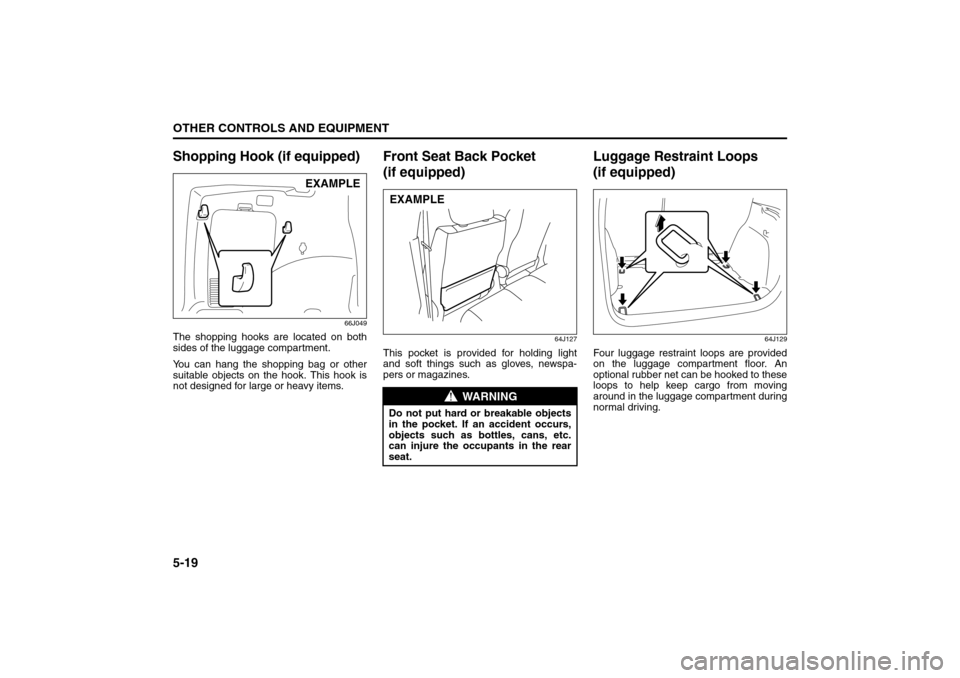
Shopping Hook (if equipped)
66J049
The shopping hooks are located on both
sides of the luggage compartment.
You can hang the shopping bag or other
suitable objects on the hook. This hook is
not designed for large or heavy items.
Front Seat Back Pocket
(if equipped)
64J127
This pocket is provided for holding light
and soft things such as gloves, newspa-
pers or magazines.
Luggage Restraint Loops
(if equipped)
64J129
Four luggage restraint loops are provided
on the luggage compartment floor. An
optional rubber net can be hooked to these
loops to help keep cargo from moving
around in the luggage compartment during
normal driving.
EXAMPLE
WARNING
Do not put hard or breakable objects
in the pocket. If an accident occurs,
objects such as bottles, cans, etc.
can injure the occupants in the rear
seat.EXAMPLE
Tire Changing Tools: 3, 5
Shopping Hook:
Front Seat Back Pocket: 3
Page 151 of 290
5-20
OTHER CONTROLS AND EQUIPMENT
66J22-03E
Luggage Compartment Cover Luggage or other cargo placed in the lug-
gage compartment can be hidden from
view by a luggage compartment cover.
However, the luggage compartment cov-
ers are not designed to support items
loaded on top of them, and may get dam-
aged if used as a shelf.
NOTE:
The seatback should always be securely
latched in a fairly upright position when
removing or installing the luggage com-
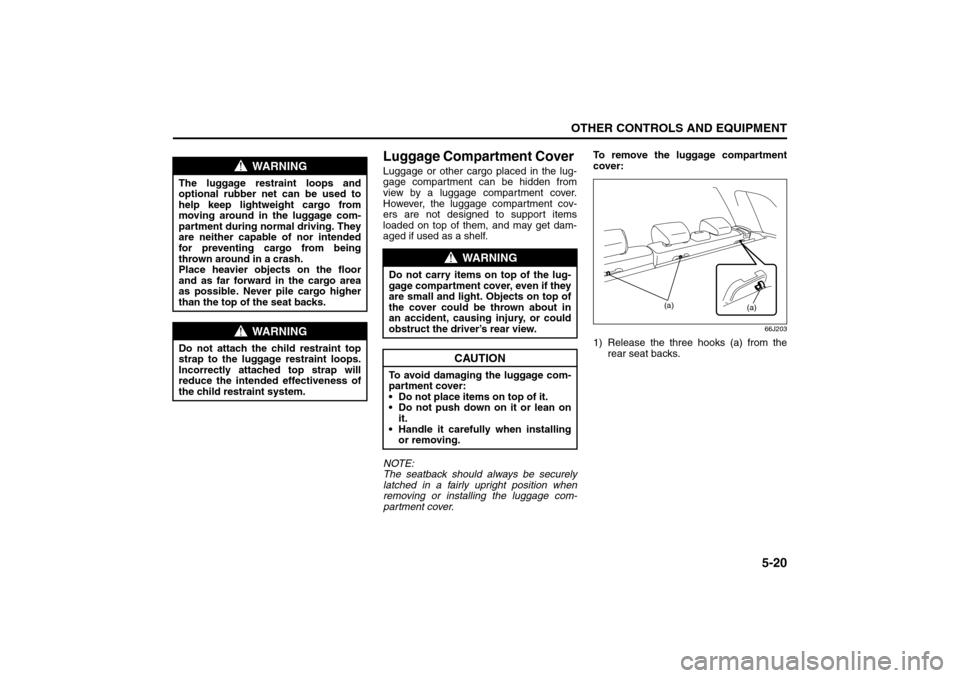
partment cover.To remove the luggage compartment
cover:
66J203
1) Release the three hooks (a) from the
rear seat backs.
WARNING
The luggage restraint loops and
optional rubber net can be used to
help keep lightweight cargo from
moving around in the luggage com-
partment during normal driving. They
are neither capable of nor intended
for preventing cargo from being
thrown around in a crash.
Place heavier objects on the floor
and as far forward in the cargo area
as possible. Never pile cargo higher
than the top of the seat backs.
WARNING
Do not attach the child restraint top
strap to the luggage restraint loops.
Incorrectly attached top strap will
reduce the intended effectiveness of
the child restraint system.
WARNING
Do not carry items on top of the lug-
gage compartment cover, even if they
are small and light. Objects on top of
the cover could be thrown about in
an accident, causing injury, or could
obstruct the driver’s rear view.
CAUTION
To avoid damaging the luggage com-
partment cover:
Do not place items on top of it.
Do not push down on it or lean on
it.
Handle it carefully when installing
or removing.
(a)
(a)
Underseat Tray: 3
Luggage Restraint Loops: 5
Page 155 of 290

5-24
OTHER CONTROLS AND EQUIPMENT
66J22-03E
You can use the roof rails or the roof rack
anchors to attach the optional roof rack
which is available at your SUZUKI dealer.
If you use a roof rack, observe the instruc-
tions and precautions in this section and
provided with the roof rack.
(For vehicles with roof rack anchors)
To remove the cap, slide the cap in the
direction of the arrow (1) and then lift the
edge of the cap up as shown in the illustra-
tion. To install the cap, put in the front part
of the cap, slide the cap in the opposite
direction of the arrow (1) and then push
down the rear part of the cap.
Make sure the roof rack is securely
installed.
To mount various types of cargo (such
as skis, bicycles, etc.) properly, use suit-
able attachments which are available
from your SUZUKI dealer. Be sure to
install the attachments properly and
securely according to the instructions
provided. Do not mount cargo directly on
the roof panel. The cargo can damage
the roof panel.
The gross weight of the roof rack plus
cargo must not exceed the loading
capacity (75 kg (165 lbs)). Also, do not
let the gross vehicle weight (fully loaded
vehicle including driver, passengers,
cargo, roof load and trailer tongue
weight) exceed the Gross Vehicle
Weight Rating (GVWR) listed on the
driver’s door lock pillar. Mount and secure the cargo onto the
roof rack properly according to the
instructions provided. Be sure to stow
the heaviest items at the bottom and dis-
tribute the cargo as evenly as possible.
Do not carry items so large that they
hang over the bumpers or the sides of
the vehicle, or block your view.
Secure the front and rear ends of long
items – such as wood panels, surfboards
and so forth – to both the front and rear
of the vehicle. You should protect the
painted surfaces of the vehicle from
scuffing caused by tie-down ropes.
Check periodically to make sure the roof
rack is securely installed and free from
damage.
For vehicles with roof rack anchors,
make sure the anchors are covered with
the caps when not in use.
WARNING
Abrupt maneuvers or failure to
properly secure cargo can allow
the cargo to fly off the vehicle and
hit others, causing personal injury
or property damage.
Mount cargo securely and avoid
abrupt maneuvers such as “jack-
rabbit” starts, sharp turns, fast cor-
nering and sudden braking. Check
periodically to make sure that
cargo is securely fastened.
Large, bulky, long, or flat items can
affect vehicle aerodynamics or be
caught by the wind, and can reduce
vehicle control resulting in an acci-
dent and personal injury. Drive
cautiously at reduced speed when
carrying this type of cargo.
HomeLink:
Page 159 of 290
OPERATING YOUR VEHICLE
6
66J22-03E
60G408
OPERATING YOUR VEHICLEExhaust Gas Warning ......................................................... 6-1
Daily Inspection Checklist .................................................. 6-2
Starting the Engine ............................................................. 6-2
Engine Block Heater (if equipped) ..................................... 6-4
Using the Transmission ..................................................... 6-5
Using the Transfer Switch (if equipped) ........................... 6-7
Braking ................................................................................. 6-15
Electronic Stability Program (ESP®) ................................. 6-18
Tire Pressure Monitoring System (TPMS)
(if equipped) ......................................................................... 6-21
Break-In ................................................................................ 6-25
Catalytic Converter ............................................................. 6-25
Improving Fuel Economy ................................................... 6-26