operation SUZUKI GRAND VITARA 2009 User Guide
[x] Cancel search | Manufacturer: SUZUKI, Model Year: 2009, Model line: GRAND VITARA, Model: SUZUKI GRAND VITARA 2009Pages: 337, PDF Size: 6.21 MB
Page 93 of 337
2-76
BEFORE DRIVING
79K21-03E
The three systems work together to operate your lights as shown in the following chart:
E/G: Engine
IG: Ignition switch
ON: Lights ON
LIGHT: When it is light around the light sensor (5).
DARK: When it is dark around the light sensor (5).
Lighting
switch
positionMain lights to
be operatedIG OFF IG ON
E/G OFF E/G OFF E/G RUNNING
LIGHT DARK LIGHT DARK LIGHT DARK
(1) OFFD.R.L. ––––ONON
Position lights,
Tail lights––––––
Head lights ––––––
(2) AUTOD.R.L. ––––ON–
Position lights,
Tail lights–––ON–ON
Head lights – – – ON – ON
(3) D.R.L. ––––ONON
Position lights,
Tail lightsON ON ON ON ON ON
Head lights ––––––
(4) D.R.L. ––––––
Position lights,
Tail lightsON ON ON ON ON ON
Head lights ONONONONONON
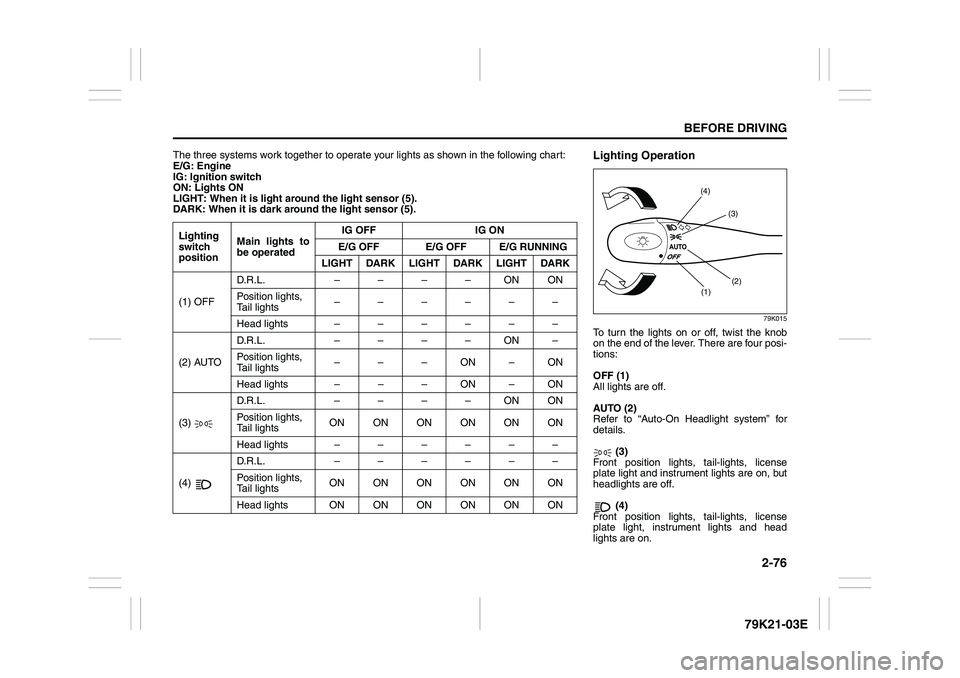
Lighting Operation
79K015
To turn the lights on or off, twist the knob
on the end of the lever. There are four posi-
tions:
OFF (1)
All lights are off.
AUTO (2)
Refer to “Auto-On Headlight system” for
details.
(3)
Front position lights, tail-lights, license
plate light and instrument lights are on, but
headlights are off.
(4)
Front position lights, tail-lights, license
plate light, instrument lights and head
lights are on.
(1)(2) (3) (4)
Page 94 of 337
2-77BEFORE DRIVING
79K21-03E
79K016
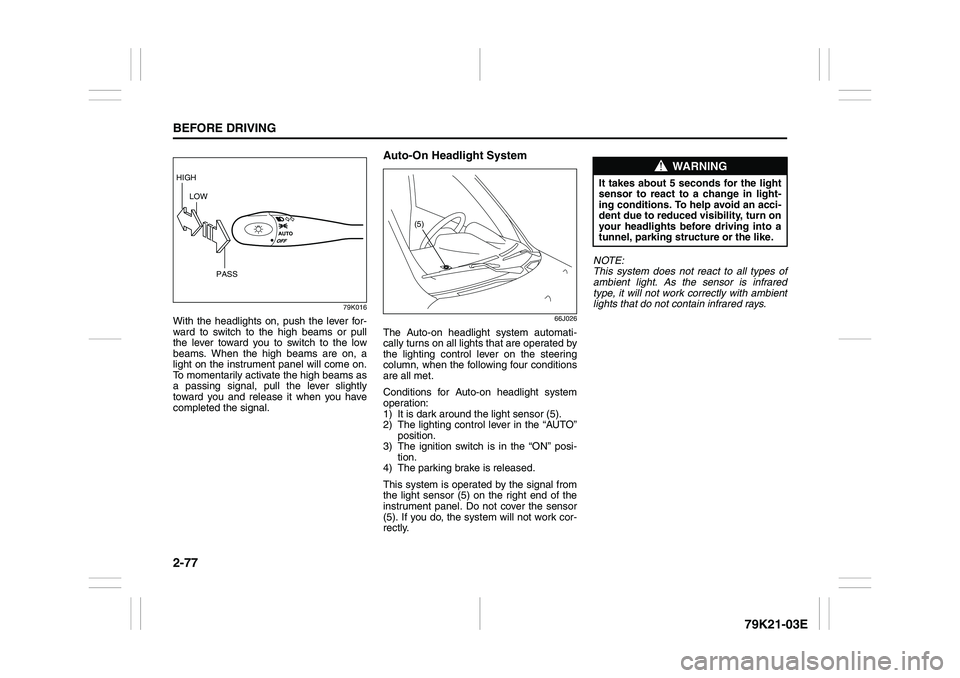
With the headlights on, push the lever for-
ward to switch to the high beams or pull
the lever toward you to switch to the low
beams. When the high beams are on, a
light on the instrument panel will come on.
To momentarily activate the high beams as
a passing signal, pull the lever slightly
toward you and release it when you have
completed the signal.
Auto-On Headlight System
66J026
The Auto-on headlight system automati-
cally turns on all lights that are operated by
the lighting control lever on the steering
column, when the following four conditions
are all met.
Conditions for Auto-on headlight system
operation:
1) It is dark around the light sensor (5).
2) The lighting control lever in the “AUTO”
position.
3) The ignition switch is in the “ON” posi-
tion.
4) The parking brake is released.
This system is operated by the signal from
the light sensor (5) on the right end of the
instrument panel. Do not cover the sensor
(5). If you do, the system will not work cor-
rectly.NOTE:
This system does not react to all types of
ambient light. As the sensor is infrared
type, it will not work correctly with ambient
lights that do not contain infrared rays.
HIGH
LOW
PASS
(5)
WARNING
It takes about 5 seconds for the light
sensor to react to a change in light-
ing conditions. To help avoid an acci-
dent due to reduced visibility, turn on
your headlights before driving into a
tunnel, parking structure or the like.
Page 95 of 337
2-78
BEFORE DRIVING
79K21-03E
Daytime Running Light (D.R.L.)
SystemThe headlights light, but are dimmer than
the low beam, when the following three
conditions are all met. Also, the D.R.L. indi-
cator light on the instrument panel comes
on.
Conditions for D.R.L. system operation:
1) The engine is running.
2) The parking brake is released.
3) The headlights are off, or the lighting
switch in the “AUTO” position and it is
light around the light sensor.
NOTE:
Be sure to turn the headlights on at night
or at any time of the day when driving or
weather conditions require the headlights
to operate at full brightness and the tail-
lights to be on.
Lights “On” reminder
A buzzer sounds to remind you to turn off
the lights if they are left on when the igni-
tion key is removed and the driver’s door is
opened.
NOTE:
The warning and indicator message and
the illumination indicator light will be shown
on the information display when this
reminder is activated.
Front Fog Light Switch
(if equipped)
64J058
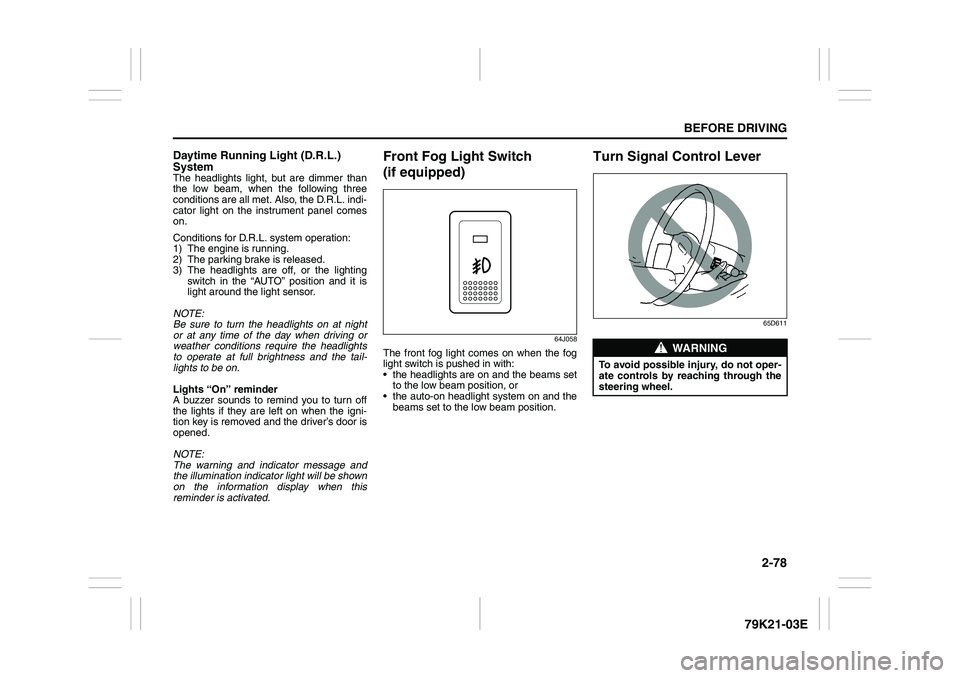
The front fog light comes on when the fog
light switch is pushed in with:
the headlights are on and the beams set
to the low beam position, or
the auto-on headlight system on and the
beams set to the low beam position.
Turn Signal Control Lever
65D611
WARNING
To avoid possible injury, do not oper-
ate controls by reaching through the
steering wheel.
Page 96 of 337
2-79BEFORE DRIVING
79K21-03E
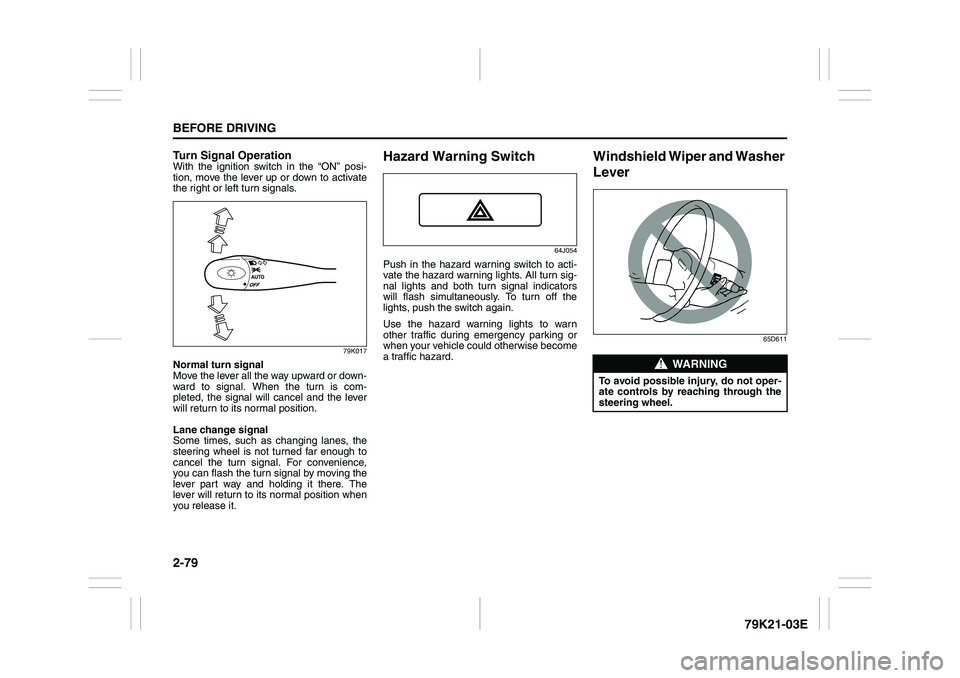
Turn Signal OperationWith the ignition switch in the “ON” posi-
tion, move the lever up or down to activate
the right or left turn signals.
79K017
Normal turn signal
Move the lever all the way upward or down-
ward to signal. When the turn is com-
pleted, the signal will cancel and the lever
will return to its normal position.
Lane change signal
Some times, such as changing lanes, the
steering wheel is not turned far enough to
cancel the turn signal. For convenience,
you can flash the turn signal by moving the
lever part way and holding it there. The
lever will return to its normal position when
you release it.
Hazard Warning Switch
64J054
Push in the hazard warning switch to acti-
vate the hazard warning lights. All turn sig-
nal lights and both turn signal indicators
will flash simultaneously. To turn off the
lights, push the switch again.
Use the hazard warning lights to warn
other traffic during emergency parking or
when your vehicle could otherwise become
a traffic hazard.
Windshield Wiper and Washer
Lever
65D611
WARNING
To avoid possible injury, do not oper-
ate controls by reaching through the
steering wheel.
Page 102 of 337
3-1OPERATING YOUR VEHICLE
79K21-03E
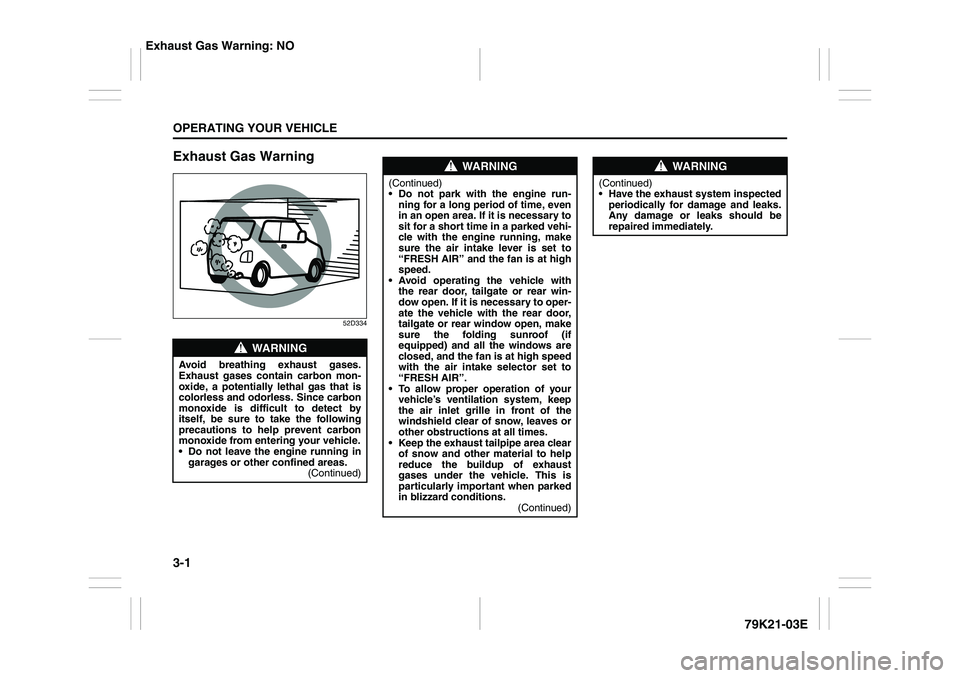
Exhaust Gas Warning
52D334
WARNING
Avoid breathing exhaust gases.
Exhaust gases contain carbon mon-
oxide, a potentially lethal gas that is
colorless and odorless. Since carbon
monoxide is difficult to detect by
itself, be sure to take the following
precautions to help prevent carbon
monoxide from entering your vehicle.
Do not leave the engine running in
garages or other confined areas.
(Continued)
WARNING
(Continued)
Do not park with the engine run-
ning for a long period of time, even
in an open area. If it is necessary to
sit for a short time in a parked vehi-
cle with the engine running, make
sure the air intake lever is set to
“FRESH AIR” and the fan is at high
speed.
Avoid operating the vehicle with
the rear door, tailgate or rear win-
dow open. If it is necessary to oper-
ate the vehicle with the rear door,
tailgate or rear window open, make
sure the folding sunroof (if
equipped) and all the windows are
closed, and the fan is at high speed
with the air intake selector set to
“FRESH AIR”.
To allow proper operation of your
vehicle’s ventilation system, keep
the air inlet grille in front of the
windshield clear of snow, leaves or
other obstructions at all times.
Keep the exhaust tailpipe area clear
of snow and other material to help
reduce the buildup of exhaust
gases under the vehicle. This is
particularly important when parked
in blizzard conditions.
(Continued)
WARNING
(Continued)
Have the exhaust system inspected
periodically for damage and leaks.
Any damage or leaks should be
repaired immediately.
Exhaust Gas Warning: NO
Page 103 of 337
3-2
OPERATING YOUR VEHICLE
79K21-03E
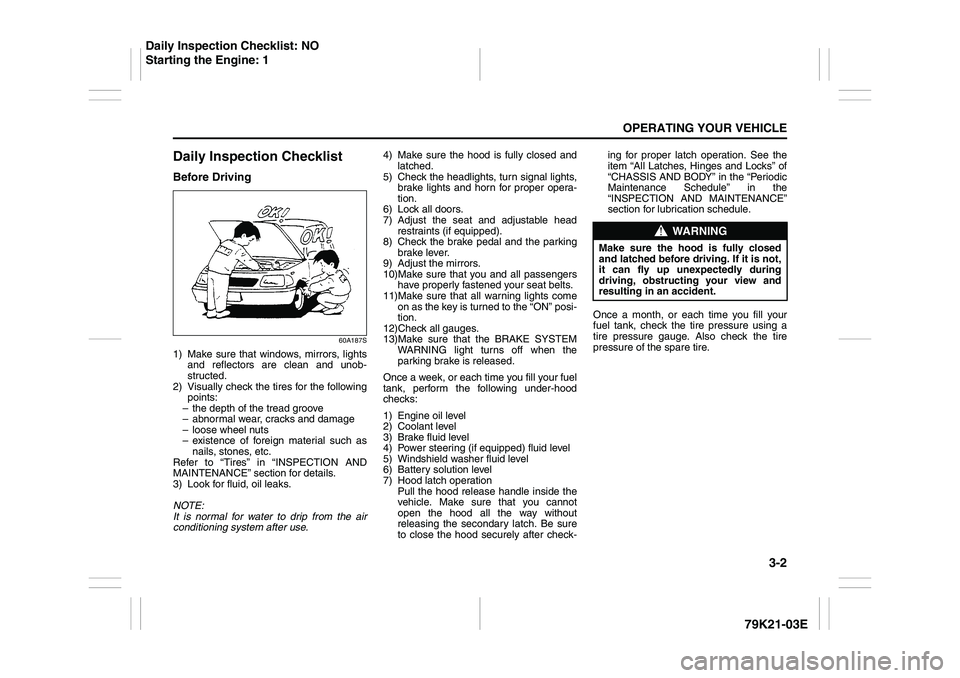
Daily Inspection ChecklistBefore Driving
60A187S
1) Make sure that windows, mirrors, lights
and reflectors are clean and unob-
structed.
2) Visually check the tires for the following
points:
– the depth of the tread groove
– abnormal wear, cracks and damage
– loose wheel nuts
– existence of foreign material such as
nails, stones, etc.
Refer to “Tires” in “INSPECTION AND
MAINTENANCE” section for details.
3) Look for fluid, oil leaks.
NOTE:
It is normal for water to drip from the air
conditioning system after use.4) Make sure the hood is fully closed and
latched.
5) Check the headlights, turn signal lights,
brake lights and horn for proper opera-
tion.
6) Lock all doors.
7) Adjust the seat and adjustable head
restraints (if equipped).
8) Check the brake pedal and the parking
brake lever.
9) Adjust the mirrors.
10)Make sure that you and all passengers
have properly fastened your seat belts.
11)Make sure that all warning lights come
on as the key is turned to the “ON” posi-
tion.
12)Check all gauges.
13)Make sure that the BRAKE SYSTEM
WARNING light turns off when the
parking brake is released.
Once a week, or each time you fill your fuel
tank, perform the following under-hood
checks:
1) Engine oil level
2) Coolant level
3) Brake fluid level
4) Power steering (if equipped) fluid level
5) Windshield washer fluid level
6) Battery solution level
7) Hood latch operation
Pull the hood release handle inside the
vehicle. Make sure that you cannot
open the hood all the way without
releasing the secondary latch. Be sure
to close the hood securely after check-ing for proper latch operation. See the
item “All Latches, Hinges and Locks” of
“CHASSIS AND BODY” in the “Periodic
Maintenance Schedule” in the
“INSPECTION AND MAINTENANCE”
section for lubrication schedule.
Once a month, or each time you fill your
fuel tank, check the tire pressure using a
tire pressure gauge. Also check the tire
pressure of the spare tire.
WARNING
Make sure the hood is fully closed
and latched before driving. If it is not,
it can fly up unexpectedly during
driving, obstructing your view and
resulting in an accident.
Daily Inspection Checklist: NO
Starting the Engine: 1
Page 122 of 337
3-21OPERATING YOUR VEHICLE
79K21-03E
Transfer Switch OperationOperate the transfer switch according to
the appropriate procedure described
below:
From N to 4H
Stop the vehicle completely, place the
transmission in “N” (Neutral) and depress
the brake pedal and the clutch pedal fully
(if equipped), then push in and turn the
switch to shift into “4H”.
From 4H to 4H LOCK
You can operate the transfer switch either
when the vehicle is stopped or while the
vehicle is moving.
Position the front wheels straight ahead
and turn the switch to shift into “4H LOCK”.
If the vehicle is moving, we recommend
that the speed be less than 100 km/h (60
mph) during this operation.
NOTE:
If it is difficult to shift between “4H” and “4H
LOCK” while the vehicle is moving, try
accelerating and decelerating your vehicle
several times after turning the transfer
switch. Be sure to wait until traffic condi-
tions allow you to accelerate and deceler-
ate safety before using this procedure.From 4H LOCK to 4L LOCK
Stop the vehicle completely, place the
transmission in “N” (Neutral) and depress
the brake pedal and the clutch pedal fully
(if equipped), then push in and turn the
switch to shift into “4L LOCK”.
From 4L LOCK to 4H LOCK
Stop the vehicle completely, place the
transmission in “N” (Neutral) and depress
the brake pedal and the clutch pedal fully
(if equipped), then push in and turn the
switch to shift into “4H LOCK”.
From 4H LOCK to 4H
You can operate the transfer switch either
when the vehicle is stopped or while the
vehicle is moving.
Position the front wheels straight ahead
and turn the switch to shift into “4H”. If the
vehicle is moving, we recommend that the
speed be less than 100 km/h (60 mph) dur-
ing this operation.
NOTE:
If it is difficult to shift between “4H” and “4H
LOCK” while the vehicle is moving, try
accelerating and decelerating your vehicle
several times after turning the transfer
switch. Be sure to wait until traffic condi-
tions allow you to accelerate and deceler-
ate safety before using this procedure.From 4H to N
64J209
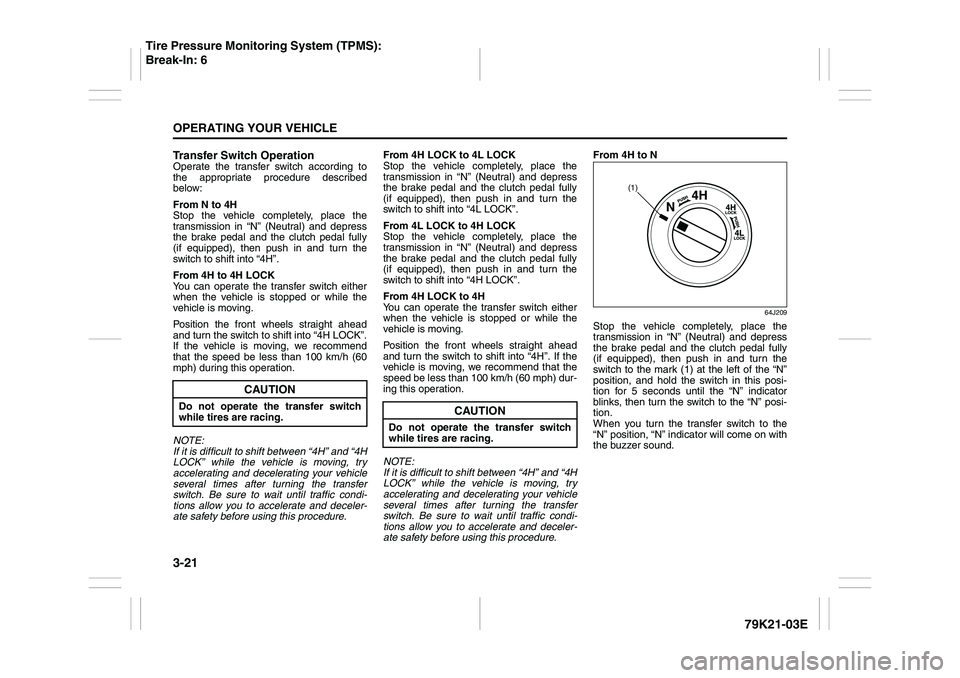
Stop the vehicle completely, place the
transmission in “N” (Neutral) and depress
the brake pedal and the clutch pedal fully
(if equipped), then push in and turn the
switch to the mark (1) at the left of the “N”
position, and hold the switch in this posi-
tion for 5 seconds until the “N” indicator
blinks, then turn the switch to the “N” posi-
tion.
When you turn the transfer switch to the
“N” position, “N” indicator will come on with
the buzzer sound.
CAUTION
Do not operate the transfer switch
while tires are racing.
CAUTION
Do not operate the transfer switch
while tires are racing.
(1)
Tire Pressure Monitoring System (TPMS):
Break-In: 6
Page 124 of 337
3-23OPERATING YOUR VEHICLE
79K21-03E
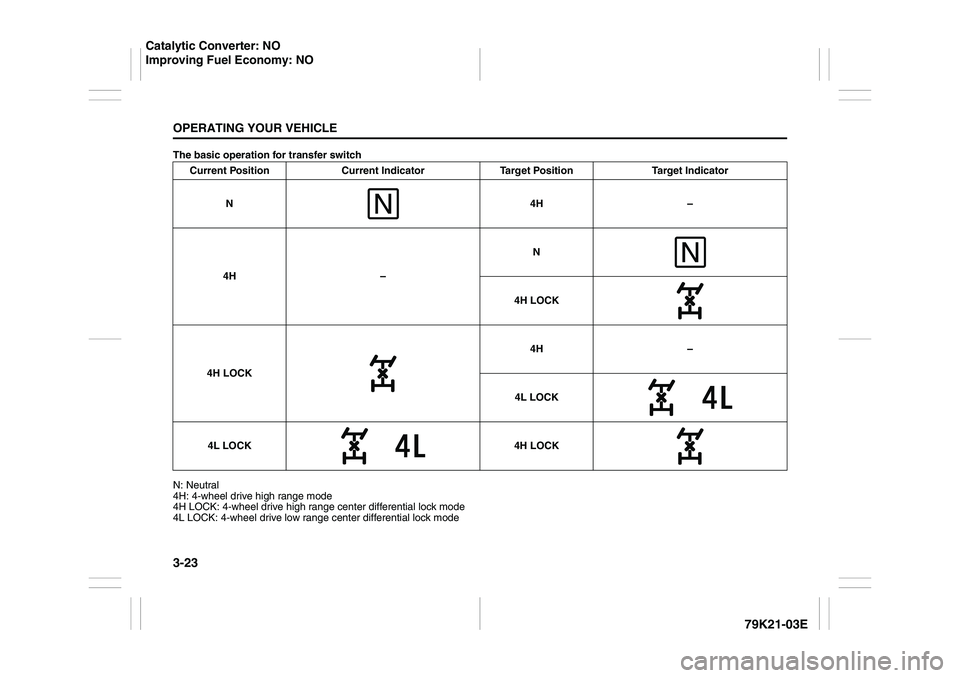
The basic operation for transfer switch
N: Neutral
4H: 4-wheel drive high range mode
4H LOCK: 4-wheel drive high range center differential lock mode
4L LOCK: 4-wheel drive low range center differential lock modeCurrent Position Current Indicator Target Position Target Indicator
N4H–
4H –N
4H LOCK
4H LOCK4H –
4L LOCK
4L LOCK 4H LOCK
Catalytic Converter: NO
Improving Fuel Economy: NO
Page 125 of 337
3-24
OPERATING YOUR VEHICLE
79K21-03E
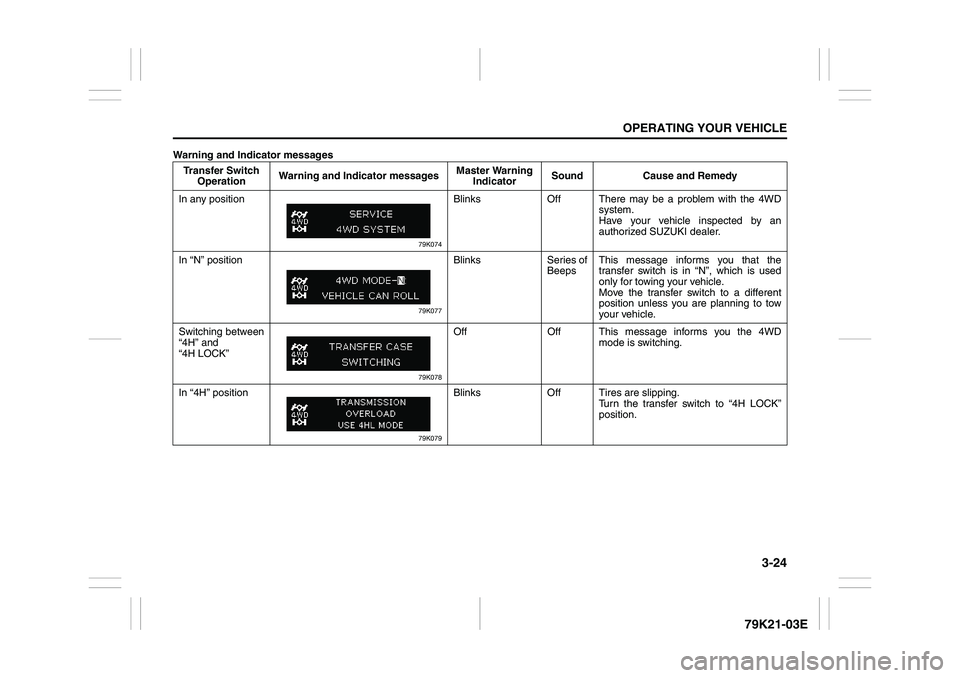
Warning and Indicator messages
Transfer Switch
OperationWarning and Indicator messagesMaster Warning
IndicatorSound Cause and Remedy
In any position
79K074
Blinks Off There may be a problem with the 4WD
system.
Have your vehicle inspected by an
authorized SUZUKI dealer.
In “N” position
79K077
Blinks Series of
BeepsThis message informs you that the
transfer switch is in “N”, which is used
only for towing your vehicle.
Move the transfer switch to a different
position unless you are planning to tow
your vehicle.
Switching between
“4H” and
“4H LOCK”
79K078
Off Off This message informs you the 4WD
mode is switching.
In “4H” position
79K079
Blinks Off Tires are slipping.
Turn the transfer switch to “4H LOCK”
position.
Page 126 of 337
3-25OPERATING YOUR VEHICLE
79K21-03E
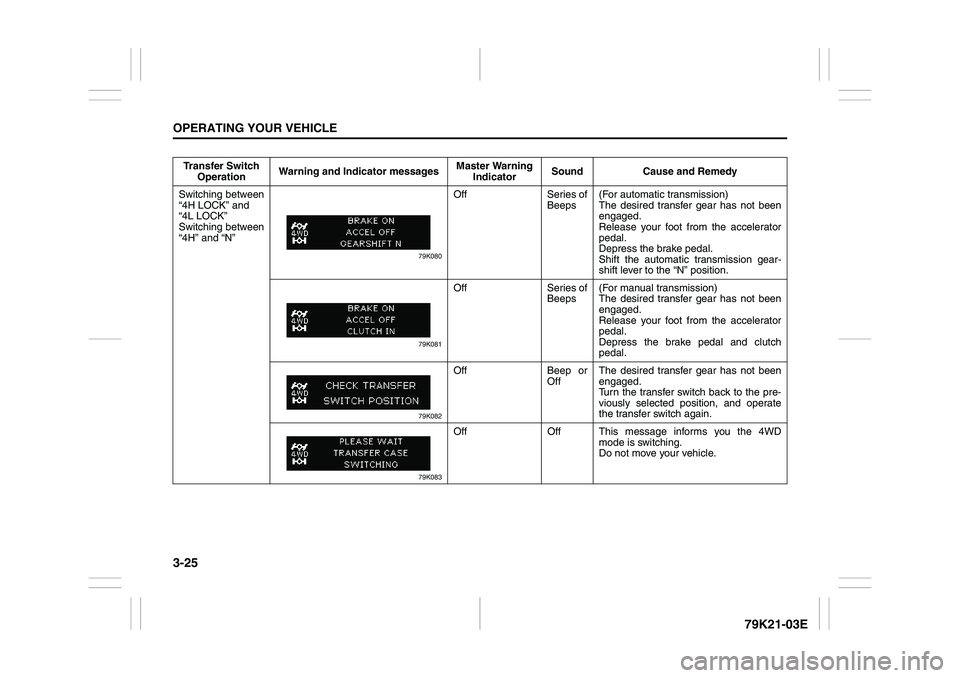
Transfer Switch
OperationWarning and Indicator messagesMaster Warning
IndicatorSound Cause and Remedy
Switching between
“4H LOCK” and
“4L LOCK”
Switching between
“4H” and “N”
79K080
Off Series of
Beeps(For automatic transmission)
The desired transfer gear has not been
engaged.
Release your foot from the accelerator
pedal.
Depress the brake pedal.
Shift the automatic transmission gear-
shift lever to the “N” position.
79K081
Off Series of
Beeps(For manual transmission)
The desired transfer gear has not been
engaged.
Release your foot from the accelerator
pedal.
Depress the brake pedal and clutch
pedal.
79K082
Off Beep or
OffThe desired transfer gear has not been
engaged.
Turn the transfer switch back to the pre-
viously selected position, and operate
the transfer switch again.
79K083
Off Off This message informs you the 4WD
mode is switching.
Do not move your vehicle.