Motor SUZUKI GRAND VITARA 2012 User Guide
[x] Cancel search | Manufacturer: SUZUKI, Model Year: 2012, Model line: GRAND VITARA, Model: SUZUKI GRAND VITARA 2012Pages: 337, PDF Size: 6.21 MB
Page 234 of 337
5-81OTHER CONTROLS AND EQUIPMENT
79K21-03E
NOTE:
Some gate operators and garage door
openers may require you to replace this
Programming step 3) with procedures
noted in the “Gate Operator / Canadian
Programming” section.
4) After the HomeLink
® indicator light
changes from a slow to a rapidly blink-
ing light, release both the HomeLink
®
and hand-held transmitter buttons.
NOTE:
If the HomeLink
® indicator light does not
change to a rapidly blinking light, contact
HomeLink
® at www.homelink.com
or call
1-800-355-3515 for assistance.
5) Press and hold the just-trained
HomeLink
® button and observe the
indicator light.
– If the indicator light stays on con-
stantly, programming is complete and
your device should activate when the
HomeLink® button is pressed and
released.
NOTE:
To program the remaining two HomeLink
®
buttons, begin with “Programming
HomeLink
®” – step 2). Do not repeat step
1).
– If the indicator light blinks rapidly for
two seconds and then turns to a con-
stant light continue with “ProgrammingHomeLink
®” steps 6–8 to complete the
programming of a rolling code
equipped device (most commonly a
garage door opener).
66J051
66J052
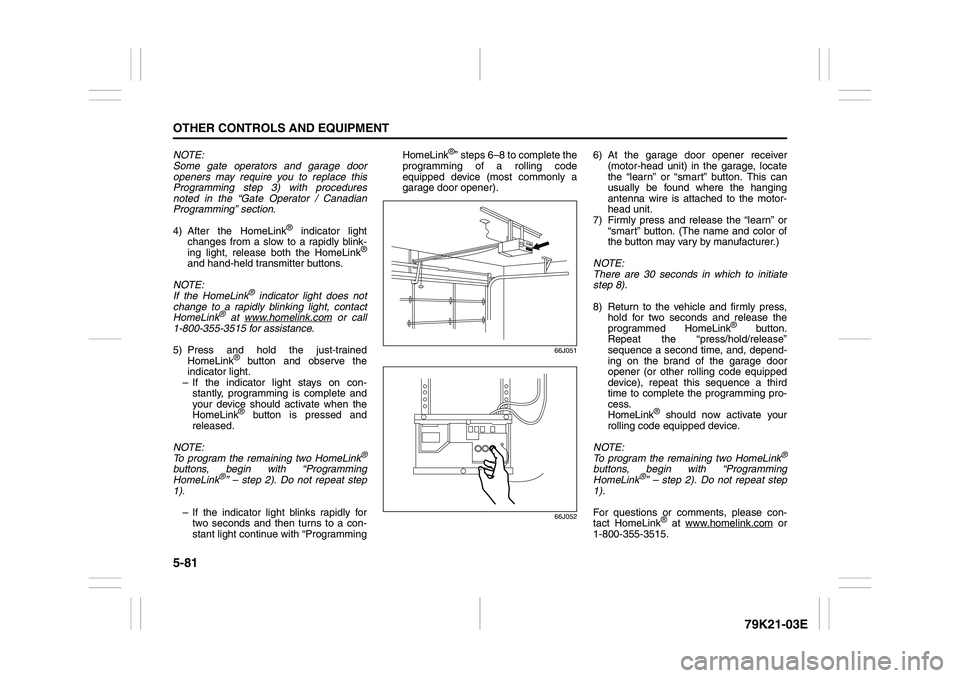
6) At the garage door opener receiver
(motor-head unit) in the garage, locate
the “learn” or “smart” button. This can
usually be found where the hanging
antenna wire is attached to the motor-
head unit.
7) Firmly press and release the “learn” or
“smart” button. (The name and color of
the button may vary by manufacturer.)
NOTE:
There are 30 seconds in which to initiate
step 8).
8) Return to the vehicle and firmly press,
hold for two seconds and release the
programmed HomeLink
® button.
Repeat the “press/hold/release”
sequence a second time, and, depend-
ing on the brand of the garage door
opener (or other rolling code equipped
device), repeat this sequence a third
time to complete the programming pro-
cess.
HomeLink
® should now activate your
rolling code equipped device.
NOTE:
To program the remaining two HomeLink
®
buttons, begin with “Programming
HomeLink
®” – step 2). Do not repeat step
1).
For questions or comments, please con-
tact HomeLink
® at www.homelink.com
or
1-800-355-3515.
Page 244 of 337
6-7VEHICLE LOADING AND TOWING
79K21-03E
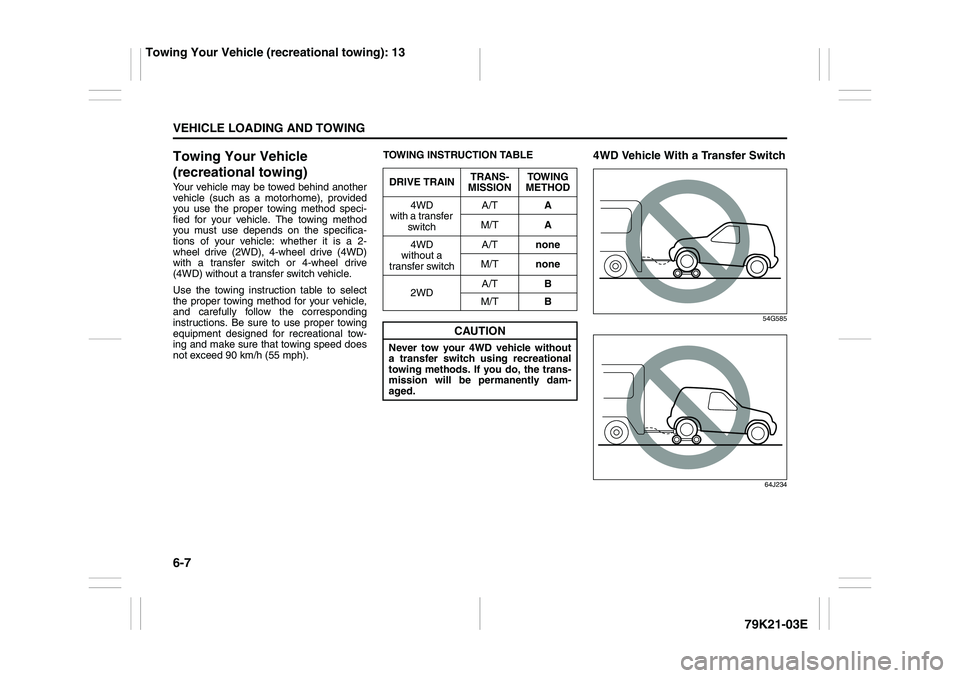
Towing Your Vehicle
(recreational towing)Your vehicle may be towed behind another
vehicle (such as a motorhome), provided
you use the proper towing method speci-
fied for your vehicle. The towing method
you must use depends on the specifica-
tions of your vehicle: whether it is a 2-
wheel drive (2WD), 4-wheel drive (4WD)
with a transfer switch or 4-wheel drive
(4WD) without a transfer switch vehicle.
Use the towing instruction table to select
the proper towing method for your vehicle,
and carefully follow the corresponding
instructions. Be sure to use proper towing
equipment designed for recreational tow-
ing and make sure that towing speed does
not exceed 90 km/h (55 mph).TOWING INSTRUCTION TABLE
4WD Vehicle With a Transfer Switch
54G585
64J234
DRIVE TRAINTRANS-
MISSIONTOWING
METHOD
4WD
with a transfer
switchA/TA
M/TA
4WD
without a
transfer switchA/Tnone
M/Tnone
2WDA/TB
M/TB
CAUTION
Never tow your 4WD vehicle without
a transfer switch using recreational
towing methods. If you do, the trans-
mission will be permanently dam-
aged.
Towing Your Vehicle (recreational towing): 13
Page 274 of 337
7-25INSPECTION AND MAINTENANCE
79K21-03E
TiresFor safe operation of your vehicle, it is
important that the tires be the correct
type and size, in good condition, and
properly inflated. Be sure to follow the
requirements and recommendations in
this section.Tire Sidewall LabelingUseful information about a tire is
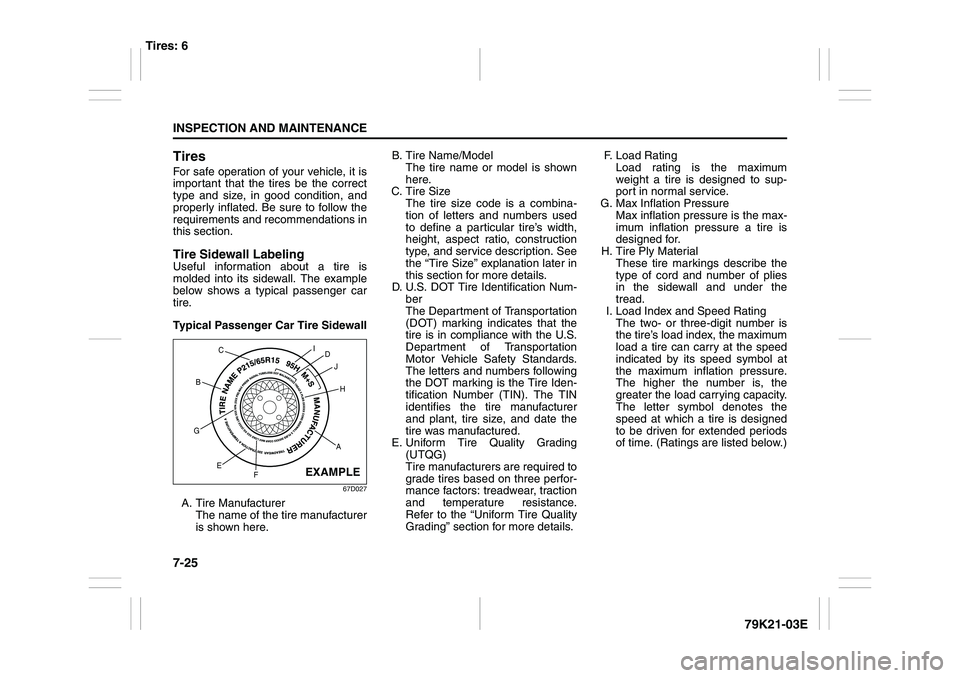
molded into its sidewall. The example
below shows a typical passenger car
tire.
Typical Passenger Car Tire Sidewall
67D027
A. Tire Manufacturer
The name of the tire manufacturer
is shown here.B. Tire Name/Model
The tire name or model is shown
here.
C. Tire Size
The tire size code is a combina-
tion of letters and numbers used
to define a particular tire’s width,
height, aspect ratio, construction
type, and service description. See
the “Tire Size” explanation later in
this section for more details.
D. U.S. DOT Tire Identification Num-
ber
The Department of Transportation
(DOT) marking indicates that the
tire is in compliance with the U.S.
Department of Transportation
Motor Vehicle Safety Standards.
The letters and numbers following
the DOT marking is the Tire Iden-
tification Number (TIN). The TIN
identifies the tire manufacturer
and plant, tire size, and date the
tire was manufactured.
E. Uniform Tire Quality Grading
(UTQG)
Tire manufacturers are required to
grade tires based on three perfor-
mance factors: treadwear, traction
and temperature resistance.
Refer to the “Uniform Tire Quality
Grading” section for more details.F. Load Rating
Load rating is the maximum
weight a tire is designed to sup-
port in normal service.
G. Max Inflation Pressure
Max inflation pressure is the max-
imum inflation pressure a tire is
designed for.
H. Tire Ply Material
These tire markings describe the
type of cord and number of plies
in the sidewall and under the
tread.
I. Load Index and Speed Rating
The two- or three-digit number is
the tire’s load index, the maximum
load a tire can carry at the speed
indicated by its speed symbol at
the maximum inflation pressure.
The higher the number is, the
greater the load carrying capacity.
The letter symbol denotes the
speed at which a tire is designed
to be driven for extended periods
of time. (Ratings are listed below.)
AH B
G
E
FD
J I
C
EXAMPLE
Tires: 6
Page 275 of 337
7-26
INSPECTION AND MAINTENANCE
79K21-03E
*The letters ZR may be used on tires
with a maximum speed capability over
149 mph and will always be used on
tires with a maximum speed capability
over 186 mph.
J. M+S Marking
This marking indicates the tire
has some mud and snow capabili-
ties and is designed for all-season
use.
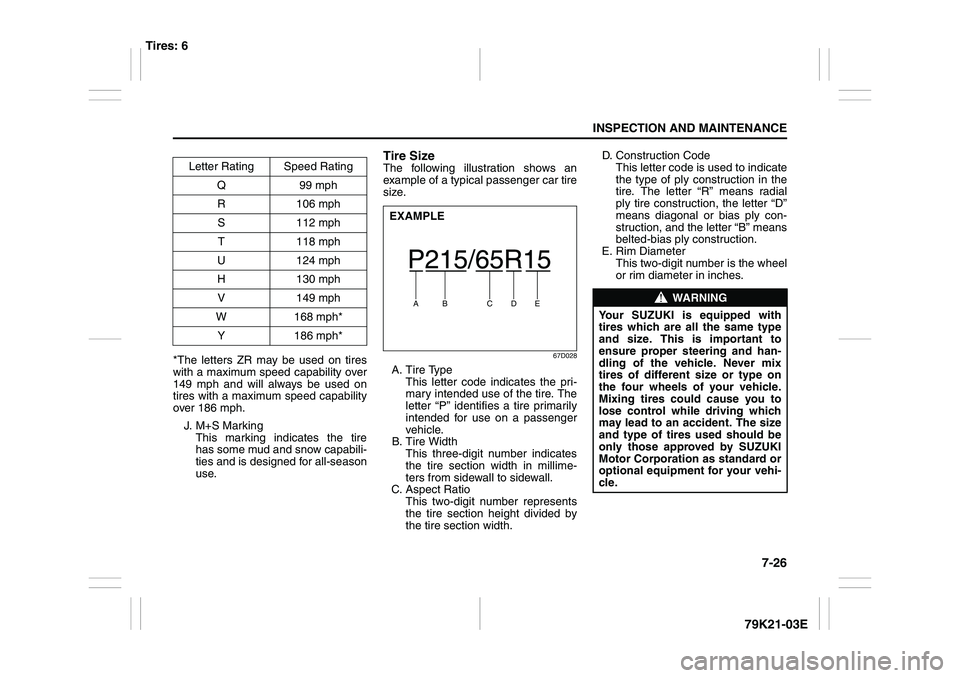
Tire SizeThe following illustration shows an
example of a typical passenger car tire
size.
67D028
A. Tire Type
This letter code indicates the pri-
mary intended use of the tire. The
letter “P” identifies a tire primarily
intended for use on a passenger
vehicle.
B. Tire Width
This three-digit number indicates
the tire section width in millime-
ters from sidewall to sidewall.
C. Aspect Ratio
This two-digit number represents
the tire section height divided by
the tire section width.D. Construction Code
This letter code is used to indicate
the type of ply construction in the
tire. The letter “R” means radial
ply tire construction, the letter “D”
means diagonal or bias ply con-
struction, and the letter “B” means
belted-bias ply construction.
E. Rim Diameter
This two-digit number is the wheel
or rim diameter in inches. Letter Rating Speed Rating
Q99 mph
R 106 mph
S 112 mph
T 118 mph
U 124 mph
H 130 mph
V 149 mph
W 168 mph*
Y 186 mph*
A
B
C
D
E
EXAMPLE
WARNING
Your SUZUKI is equipped with
tires which are all the same type
and size. This is important to
ensure proper steering and han-
dling of the vehicle. Never mix
tires of different size or type on
the four wheels of your vehicle.
Mixing tires could cause you to
lose control while driving which
may lead to an accident. The size
and type of tires used should be
only those approved by SUZUKI
Motor Corporation as standard or
optional equipment for your vehi-
cle.
Tires: 6
Page 278 of 337
7-29INSPECTION AND MAINTENANCE
79K21-03E
1.6 mm (0.06 in.) or less and the
tire should be replaced.
3) Check for abnormal wear, cracks
and damage. Any tires with cracks
or other damage should be
replaced. If any tires show abnor-
mal wear, have them inspected by
your SUZUKI dealer.
4) Check for loose wheel nuts.
5) Check that there are no nails,
stones or other objects sticking into
the tires.
WARNING
Hitting curbs and running over
rocks can damage tires and affect
wheel alignment. Be sure to have
tires and wheel alignment
checked periodically by your
SUZUKI dealer.
WARNING
Your SUZUKI is equipped with
tires which are all the same type
and size. This is important to
ensure proper steering and han-
dling of the vehicle. Never mix
tires of different size or type on
the four wheels of your vehicle.
The size and type of tires used
should be only those approved by
SUZUKI Motor Corporation as
standard or optional equipment
for your vehicle.
WARNING
Replacing the wheels and tires
equipped on your vehicle with
certain combinations of aftermar-
ket wheels and tires can signifi-
cantly change the steering and
handling characteristics of your
vehicle. Oversized tires may also
rub against the fender over
bumps, causing vehicle damage
or tire failure. Therefore, use only
those wheel and tire combina-
tions approved by SUZUKI Motor
Corporation as standard or
optional equipment for your vehi-
cle. For information regarding the
specified tires, refer to the Tire
Information Label located on the
driver’s side door pillar or the
“SPECIFICATIONS” section.
CAUTION
Replacing the original tires with
tires of a different size may result
in false speedometer or odometer
readings. Check with your
SUZUKI dealer before purchas-
ing replacement tires that differ in
size from the original tires.
Tires: 6
Page 279 of 337
7-30
INSPECTION AND MAINTENANCE
79K21-03E Uniform Tire Quality Grading
The U.S. National Highway Traffic
Safety Administration has developed a
grading system for evaluating the per-
formance of passenger car tires. The
following information will help you
understand the grading system, which
applies to vehicles sold in the U.S.
Consult your SUZUKI dealer or tire
retailer for help in choosing the correct
replacement tires for your vehicle.
Quality grades can be found where
applicable on the tire sidewall between
tread shoulder and maximum section
width. For example:
Treadwear 200 Traction AA Tempera-
ture ADOT Quality Grades
Treadwear
Traction AA A B C
Temperature A B CAll Passenger Car Tires Must Conform
To Federal Safety Requirements in
Addition To These Grades
Treadwear
The treadwear grade is a comparative
rating based on the wear rate of the
tire when tested under controlled con-
ditions on a specified government testcourse. For example, a tire graded 150
would wear one and one-half (1 1/2)
times as well on the government
course as a tire graded 100. The rela-
tive performance of tires depends
upon the actual conditions of their use,
however and may depart significantly
from the norm due to variations in driv-
ing habits, service practices and differ-
ences in road characteristics and
climate.
Traction – AA, A, B, C
The traction grades, from highest to
lowest, are AA, A, B and C. Those
grades represent the tire’s ability to
stop on wet pavement as measured
under controlled conditions on speci-
fied government test surfaces of
asphalt and concrete. A tire marked C
may have poor traction performance.Temperature – A, B, C
The temperature grades are A (the
highest), B and C, representing the
tire’s resistance to the generation of
heat and its ability to dissipate heat
when tested under controlled condi-
tions on a specified indoor laboratory
test wheel. Sustained high tempera-
ture can cause the material of the tire
to degenerate and reduce tire life, and
excessive temperature can lead to
sudden tire failure. The grade C corre-
sponds to a level of performance
which all passenger car tires must
meet under the Federal Motor Vehicle
Safety Standard No. 109. Grades B
and A represent higher levels of per-
formance on the laboratory test wheel
than the minimum required by law.
WARNING
The traction grade assigned to
this tire is based on straight-
ahead braking traction tests, and
does not include acceleration,
cornering, hydroplaning or peak
traction characteristics.
WARNING
The temperature grade for this
tire is established for a tire that is
properly inflated and not over-
loaded. Excessive speed, under-
inflation or excessive loading,
either separately or in combina-
tion, can cause heat buildup and
possible tire failure.
Tires: 6
Page 281 of 337
7-32
INSPECTION AND MAINTENANCE
79K21-03E Snow Tires
Your vehicle is equipped with all-sea-
son tires which are designed for use in
summer and most winter conditions.
For improved traction in severe winter
conditions, SUZUKI recommends
mounting radial snow tires on all four
wheels. Snow tires must be the same
size as the standard tires. Also be sure
to use the tires of the same type and
brand on all four wheels of your vehi-
cle.
GLOSSARY OF TIRE TERMI-
NOLOGYAccessory Weight – the combined
weight (in excess of those standard
items which may be replaced) of auto-
matic transmission, power steering,
power brakes, power windows, power
seats, radio, and heater, to the extent
that these items are available as fac-
tory-installed equipment (whether
installed or not).
Cold Tire Inflation Pressure – the pres-
sure in a tire that has been driven less
than 1 mile or has been standing for
three hours or more.
Curb Weight – the weight of a motor
vehicle with standard equipment
including the maximum capacity of
fuel, oil, and coolant, and, if so
equipped, air conditioning and addi-
tional weight optional engine.
Intended Outboard Sidewall – (1) the
sidewall that contains a whitewall,
bears white lettering or bears manu-
facturer, brand, and/or model name
molding that is higher or deeper than
the same molding on the other side-
wall of the tire, or (2) the outward fac-
ing sidewall of an asymmetrical tire
that has a particular side that mustalways face outward when mounted
on a vehicle.
Maximum Inflation Pressure – the
maximum cold inflation pressure a tire
is designed to support in normal ser-
vice.
Maximum Loaded Vehicle Weight –
the sum of curb weight, accessory
weight, vehicle capacity weight (total
load capacity), and production options
weight.
Normal Occupant Weight – 68 kilo-
grams times the number of occupants
specified in the second column of
Table 1 (shown below).
Occupant distribution – distribution of
occupants in a vehicle as specified in
the third column of Table 1 (shown
below).
Production Options Weight – the com-
bined weight of those installed regular
production options weighing over 2.3
kilograms in excess of those standard
items which they replace, not previ-
ously considered in curb weight or
accessory weight, including heavy
duty brakes, ride levelers, roof rack,
heavy duty battery, and special trim.
WARNING
(Continued) Do not use tire chains on the
spare tire. If you must use tire
chains, rearrange the wheels so
standard tires and wheels are
fitted to the rear axle.
Replace the spare tire with a
new one as soon as the tread
wear indicator appears.
When replacing the spare tire,
use a replacement tire with the
exact same size and construc-
tion.
Battery: 9
Fuses: 7
Page 286 of 337
7-37INSPECTION AND MAINTENANCE
79K21-03E
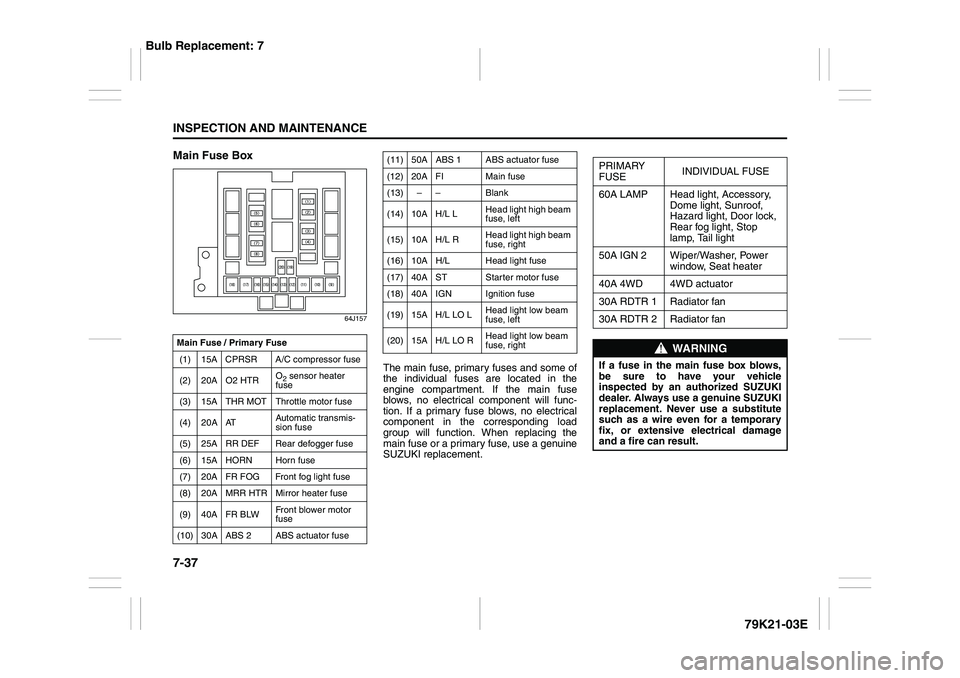
Main Fuse Box
64J157
The main fuse, primary fuses and some of
the individual fuses are located in the
engine compartment. If the main fuse
blows, no electrical component will func-
tion. If a primary fuse blows, no electrical
component in the corresponding load
group will function. When replacing the
main fuse or a primary fuse, use a genuine
SUZUKI replacement.
Main Fuse / Primary Fuse
(1) 15A CPRSR A/C compressor fuse
(2) 20A O2 HTRO
2 sensor heater
fuse
(3) 15A THR MOT Throttle motor fuse
(4) 20A ATAutomatic transmis-
sion fuse
(5) 25A RR DEF Rear defogger fuse
(6) 15A HORN Horn fuse
(7) 20A FR FOG Front fog light fuse
(8) 20A MRR HTR Mirror heater fuse
(9) 40A FR BLWFront blower motor
fuse
(10) 30A ABS 2 ABS actuator fuse
(11) 50A ABS 1 ABS actuator fuse
(12) 20A FI Main fuse
(13) – – Blank
(14) 10A H/L LHead light high beam
fuse, left
(15) 10A H/L RHead light high beam
fuse, right
(16) 10A H/L Head light fuse
(17) 40A ST Starter motor fuse
(18) 40A IGN Ignition fuse
(19) 15A H/L LO LHead light low beam
fuse, left
(20) 15A H/L LO RHead light low beam
fuse, right
PRIMARY
FUSEINDIVIDUAL FUSE
60A LAMP Head light, Accessory,
Dome light, Sunroof,
Hazard light, Door lock,
Rear fog light, Stop
lamp, Tail light
50A IGN 2 Wiper/Washer, Power
window, Seat heater
40A 4WD 4WD actuator
30A RDTR 1 Radiator fan
30A RDTR 2 Radiator fan
WARNING
If a fuse in the main fuse box blows,
be sure to have your vehicle
inspected by an authorized SUZUKI
dealer. Always use a genuine SUZUKI
replacement. Never use a substitute
such as a wire even for a temporary
fix, or extensive electrical damage
and a fire can result.
Bulb Replacement: 7
Page 287 of 337
7-38
INSPECTION AND MAINTENANCE
79K21-03E
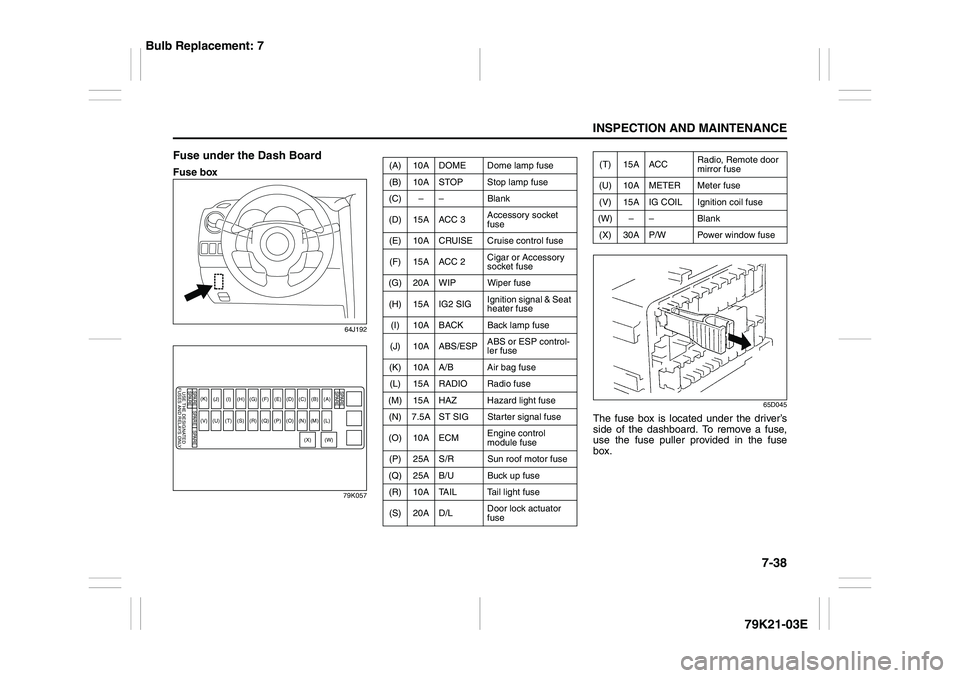
Fuse under the Dash BoardFuse box
64J192
79K05765D045
The fuse box is located under the driver’s
side of the dashboard. To remove a fuse,
use the fuse puller provided in the fuse
box.
SPARESPARE
SPARE
SPARE
USE THE DESIGNATED
FUSES AND RELAYS ONLYSPARE SPARE
(A)
(B)
(C)
(D)
(E)
(F)
(G)
(H)(I)
(J)
(L)
(M)
(N)
(O)
(P)
(Q)
(R)
(S)
(T)
(U)
(V)(K)
(W)
(X)
(A) 10A DOME Dome lamp fuse
(B) 10A STOP Stop lamp fuse
(C) – – Blank
(D) 15A ACC 3Accessory socket
fuse
(E) 10A CRUISE Cruise control fuse
(F) 15A ACC 2Cigar or Accessory
socket fuse
(G) 20A WIP Wiper fuse
(H) 15A IG2 SIGIgnition signal & Seat
heater fuse
(I) 10A BACK Back lamp fuse
(J) 10A ABS/ESPABS or ESP control-
ler fuse
(K) 10A A/B Air bag fuse
(L) 15A RADIO Radio fuse
(M) 15A HAZ Hazard light fuse
(N) 7.5A ST SIG Starter signal fuse
(O) 10A ECMEngine control
module fuse
(P) 25A S/R Sun roof motor fuse
(Q) 25A B/U Buck up fuse
(R) 10A TAIL Tail light fuse
(S) 20A D/LDoor lock actuator
fuse
(T) 15A ACCRadio, Remote door
mirror fuse
(U) 10A METER Meter fuse
(V) 15A IG COIL Ignition coil fuse
(W) – – Blank
(X) 30A P/W Power window fuse
Bulb Replacement: 7
Page 298 of 337
7-49INSPECTION AND MAINTENANCE
79K21-03E
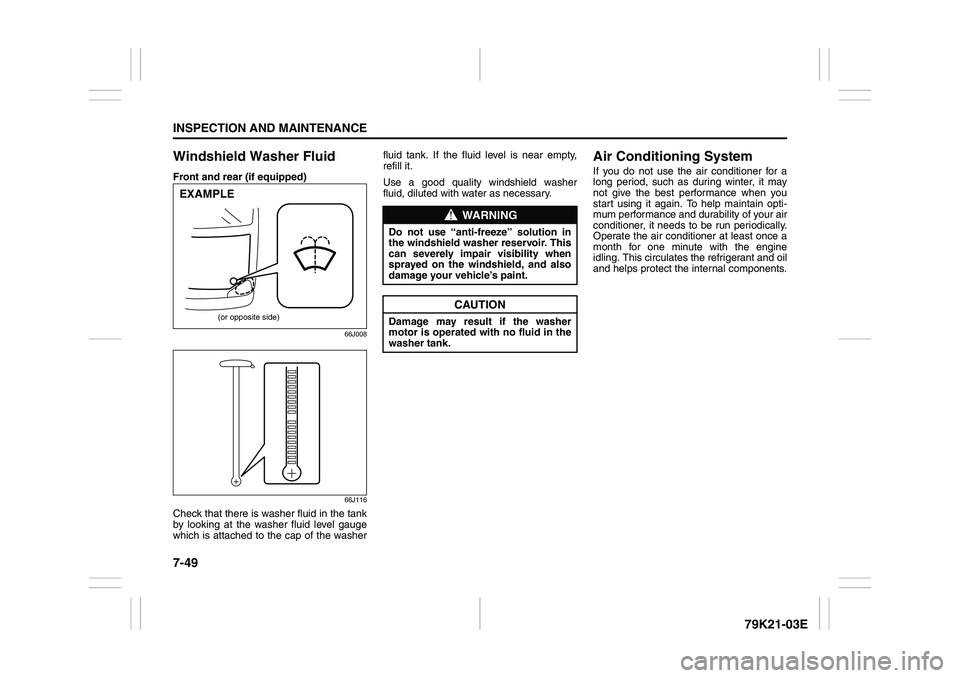
Windshield Washer FluidFront and rear (if equipped)
66J008
66J116
Check that there is washer fluid in the tank
by looking at the washer fluid level gauge
which is attached to the cap of the washerfluid tank. If the fluid level is near empty,
refill it.
Use a good quality windshield washer
fluid, diluted with water as necessary.
Air Conditioning SystemIf you do not use the air conditioner for a
long period, such as during winter, it may
not give the best performance when you
start using it again. To help maintain opti-
mum performance and durability of your air
conditioner, it needs to be run periodically.
Operate the air conditioner at least once a
month for one minute with the engine
idling. This circulates the refrigerant and oil
and helps protect the internal components.
(or opposite side)
EXAMPLE
WARNING
Do not use “anti-freeze” solution in
the windshield washer reservoir. This
can severely impair visibility when
sprayed on the windshield, and also
damage your vehicle’s paint.
CAUTION
Damage may result if the washer
motor is operated with no fluid in the
washer tank.